Moderate
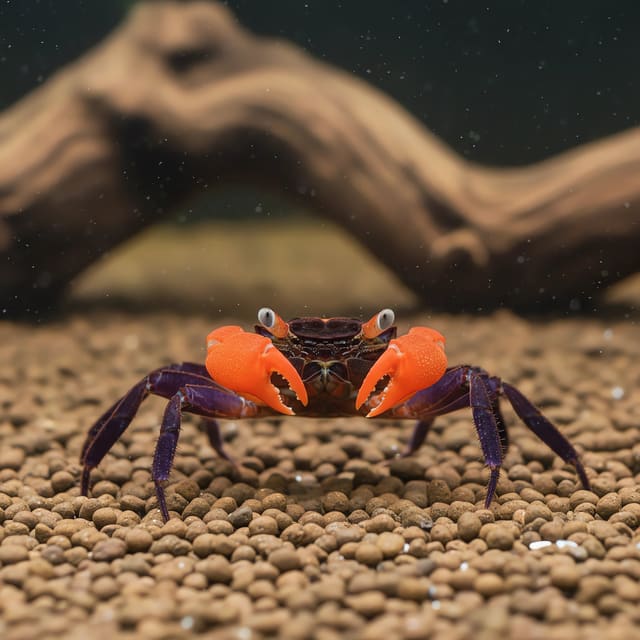
Land Hermit Crab (Coenobita sp.)
24–29°C
£8.99

Thai Micro Spider Crab (Limnopilos naiyanetri) is a tiny, fully aquatic freshwater crab from Thailand’s Tha Chin River. One purchase supplies one unsexed animal. It suits a mature, carefully monitored planted aquarium where its small size, feeding access and sensitivity to sudden water changes can be managed.
Limnopilos naiyanetri
Thai Micro Spider Crab (Limnopilos naiyanetri) is a tiny, fully aquatic freshwater crab from Thailand’s Tha Chin River. One purchase supplies one unsexed animal. It suits a mature, carefully monitored planted aquarium where its small size, feeding access and sensitivity to sudden water changes can be managed.
The Thai Micro Spider Crab, Limnopilos naiyanetri, is a genuinely small freshwater crab with a very particular appeal. It does not behave like a bold centrepiece crab. Its pleasure lies in close observation: a rounded, semi-translucent body moving among moss, roots and fine plants, with its hairy claws gathering minute material from nearby surfaces. It is fully aquatic, so it belongs in a freshwater aquarium rather than a land-and-water paludarium.
This listing is for one live crab per purchase. There is one sold form and no sex-guaranteed choice. Sex is guaranteed only when the selected option explicitly states male or female. This Thai Micro Spider Crab listing has no sex-guaranteed option. That matters because colour, body size and a gallery view are not reliable promises about the sex of the individual supplied.
| Suits | Think carefully if |
|---|---|
| You enjoy subtle invertebrate behaviour and can maintain a mature filtered aquarium | You want a conspicuous animal that stays in the open all day |
| You can provide fine structure, gentle flow and food that reaches a very small crab | Your aquarium contains fish likely to hunt or outcompete tiny invertebrates |
| You are willing to test water and respond to changes early | The tank is new, unstable or likely to be treated with copper-based products |
One useful way to judge suitability is to stop thinking of this animal as a miniature version of a larger pet crab. It occupies a small-scale world. Filter intakes, feeding portions, gaps in décor and even modest changes in water chemistry have a greater practical effect on an animal this slight. A successful aquarium therefore rewards patience and consistency more than constant intervention.
You can browse the aquarium shrimp and crustacean collection for the wider invertebrate range, but do not assume that two animals from the same shop category share a habitat or make suitable companions. This species needs its own evidence-led plan.
Limnopilos naiyanetri is an accepted species in the family Hymenosomatidae and order Decapoda. It was described in 1991 and is commonly called the Thai micro crab or Thai Micro Spider Crab. The species is endemic to Thailand, with confirmed records from the Tha Chin River basin. Individuals were found among the roots of water hyacinths, which gives useful context for its association with submerged plant structure.
Its measurements need careful labels. The mature carapace is reported at about 1 cm wide, while the leg span may reach about 2.5 cm. Carapace width and leg span are different measurements, so neither should be presented as a single unqualified whole-animal maximum. The practical message is simple: this is a very small crab, easily lost from view in dense planting and easily disadvantaged by coarse food or forceful equipment.
The circular, flattened carapace can be grey to light brown and partly translucent. Fine hairs occur on the carapace and claws. Published natural-history information suggests that these hairs collect detritus, which may contribute to feeding or camouflage. That does not mean every live animal will look identical under aquarium lighting. Natural colour, posture, age, condition and the surroundings all affect what the keeper sees.
Gallery images have been digitally enhanced to improve image quality. Natural colour, pattern, size and maturity can vary between live animals. The first image shows one translucent crab facing forward between plants and dark hardscape; the second shows two crabs on moss; the third is a single side profile against blue; and the fourth shows one crab beside broad green leaves. These observations describe the visible scenes only. They do not establish the provenance, sex or exact future appearance of the animal sent.
Detailed species husbandry remains scarce. That is a reason to keep claims modest, not a reason to leave the buyer without a plan. The species profile supplies useful size, habitat, activity and water information, while UK freshwater-crab guidance provides broader routines for filtration, feeding, acclimatisation, maintenance and warning signs. The care below keeps those two levels clear.
Choose a mature filtered aquarium with enough water volume to hold temperature and chemistry steady while supporting several foraging areas. A small body does not automatically make a tiny container suitable. The aquarium still has to dilute waste, support a biological filter and provide useful surfaces. Select a footprint that lets you create sheltered areas without packing every centimetre with décor.
Larger water volumes are generally easier to keep stable than very small ones. For this crab, that stability is useful because published care information describes sensitivity to water conditions. Decide the aquarium around the complete stocking plan, filtration capacity and mature water volume, not around the animal’s one-centimetre carapace alone. If a system cannot keep ammonia and nitrite at zero, it is not ready.
Use wood, mosses, roots and fine-leaved plants to create a network of surfaces. Wild records place the species on water-hyacinth roots, and it forages for detritus on aquatic plants and mosses. In the aquarium, complex structure gives a small crab places to cling, shelter and search for food. Arrange at least one area where you can check condition without dismantling the habitat.
Keep décor secure. A tiny crab can disappear behind loose hardscape, so arrange wood and stones before introduction and make sure routine maintenance will not cause them to shift. Smooth substrate is easier to keep clean around delicate legs than a bed full of sharp, tightly trapping fragments. Leaf litter may offer additional surfaces, but add any organic material conservatively and monitor its effect on water quality.
Filtration is essential because it supports the bacteria that convert toxic ammonia first to nitrite and then to safer nitrate. A sponge-covered intake reduces the chance of a small crab being drawn into a filter while retaining useful biological surface area. Aim for circulation that reaches the aquarium without pinning the animal against décor. Good oxygen exchange and dependable waste processing matter more than dramatic flow.
Before livestock is added, mature the system properly. The freshwater shrimp setup guide is useful for understanding the preparation of a small invertebrate aquarium, although a crab is not a shrimp and species-specific differences still apply. Test the finished system rather than assuming time alone has made it ready.
Imagine carrying out the weekly water change before choosing the final layout. The siphon must reach open substrate without pulling the crab from moss, and removable items should lift without collapsing the main shelter. Keep heater and filter guards visible enough to inspect. This practical rehearsal matters because a beautiful but inaccessible aquascape can turn every routine job into a disturbance.
Feed placement also belongs in the layout plan. Choose two or three small landing areas near cover where food can be seen and removed after the feeding window. That lets you confirm whether the crab has eaten without scattering excess throughout the aquarium. It also makes it easier to notice when another inhabitant monopolises every portion.
Allow the aquarium to settle after planting and hardscape work. Test after the filter has been running under its normal load, and recheck after any substantial change. A mature setup is an operating biological system, not simply a tank that has stood full of water. Stable readings, predictable temperature and an established maintenance routine together provide the useful preparation.
The species account gives an aquarium temperature of 21–27°C and pH 6.5–7.3. Treat these as the working range. Pick a sensible point within it that matches the intended aquarium, then keep it steady. Avoid treating the endpoints as goals to bounce between. A measured trend away from the normal value is more informative than a single isolated test.
Measure general hardness in both the source water and aquarium, keep a written baseline and prevent abrupt changes. The aquarium water-chemistry guide explains what the common tests measure, while the water-parameter matcher can help compare readings with the stated temperature and pH guidance. Neither tool replaces observation of the animal.
OATA’s broad guidance for crayfish and freshwater crabs calls for zero ammonia, zero nitrite and nitrate no more than 20 mg/l above the normal tap-water level. These are group-care values rather than a unique optimum for L. naiyanetri, but the zero-ammonia and zero-nitrite rule is an essential practical screen for any mature aquarium. The RSPCA likewise explains why biological filtration is vital to process fish waste; the same nitrogen-cycle principle applies to this stocked aquarium.
Test at least weekly and more often after a new animal is introduced, feeding is changed or anything disturbs the filter. A weekly record of temperature, pH, ammonia, nitrite and nitrate makes gradual movement visible. If the crab becomes unusually inactive, hides much more than normal or stops feeding, water testing is the first useful check rather than an afterthought.
OATA recommends a partial water change of 25% at least once every week for freshwater crabs as a group. Prepare replacement water with conditioner to remove chlorine or chloramine, and bring it close to the aquarium’s temperature before use. Siphon accumulated waste without stripping every feeding surface clean. The aim is clean, stable water with a functioning biological community.
Inspect the filter for blockage during maintenance. If filter material needs rinsing, do not run it under the tap; rinse it lightly in water removed from the aquarium. This helps protect the bacteria the filter depends on. Work gently around the crab’s hiding places and account for the animal before moving hardscape or starting a siphon.
A temperature inside range cannot compensate for detectable ammonia, and a suitable pH cannot compensate for a blocked filter. Read the set of results as one picture. When a value changes, look for a recent cause such as extra food, disturbed substrate, a missed water change or reduced flow. Correct the cause steadily and avoid making several large changes at once.
Keep notes in the same units each week. Record the reading, the time, any maintenance and the animal’s behaviour. This turns a vague impression into a useful comparison. If feeding falls at the same time as water quality changes, restore safe water first and seek appropriate advice if the crab does not recover its normal activity.
| Check | Keeper response |
|---|---|
| Temperature 21–27°C | Choose a stable point within the species account’s aquarium range |
| pH 6.5–7.3 | Track the normal reading and prevent abrupt movement |
| Ammonia and nitrite | Keep both at zero under broad UK freshwater-crab guidance |
| Nitrate | Use regular testing and water changes to control accumulation |
| Hardness | Measure both source and aquarium water and prevent sudden change |
Natural-history information describes nocturnal foraging for detritus on aquatic plants and mosses, with possible opportunistic carnivory. The setose, or hairy, parts of the body can collect detritus. This supports a feeding plan based on accessible, varied particles rather than one oversized meal placed far from the crab.
OATA’s broader freshwater-crab sheet describes crabs as omnivorous scavengers and names mysis, prawn or krill, courgette, cucumber, lettuce, sinking crustacean pellets, algae wafers and dried algae. Use that list as a broad menu, not proof that every item is equally important to this species. Prepare pieces small enough to be handled and place food close to known foraging areas.
The group guidance recommends feeding once a day and allowing about 30 minutes for food to be taken. Start with a tiny portion because the animal is tiny. Check whether it is actually reached, then remove leftovers that would decompose. Increasing the quantity because the crab is hidden can quickly turn a feeding problem into a water-quality problem.
Offer variety across the week instead of mixing a large number of foods at every meal. A small amount of sinking crustacean food may form the prepared-food base; finely divided vegetable matter or an appropriately small frozen item can add variety. Existing plant and moss surfaces continue to provide detritus for foraging, but visible biofilm should never be used as an excuse to stop monitoring condition.
In a mixed aquarium, faster animals may consume every obvious morsel before the crab reaches it. Watch the feeding event rather than assuming food that entered the tank fed every inhabitant. Delivering a small sinking portion near cover can improve access. If the crab repeatedly fails to feed, the stocking plan is not working even if the tank mates appear calm.
Overfeeding is equally risky. Uneaten food releases waste as it breaks down, and a small aquarium has little margin for repeated excess. Note the portion that disappears within the recommended feeding window and use that as the next starting point. Recheck after moulting, a temperature change or any alteration in the community.
Freshwater crabs moult as they grow. An empty exoskeleton can resemble a dead animal, so pause and inspect carefully before removing it. Do not handle a soft, newly moulted crab. Make sure it can retreat into structure while the new shell hardens, and keep the surrounding water steady.
OATA’s group sheet lists incomplete shedding, unusual moulting frequency, reduced feeding, abnormal swelling, weight change, altered colour, increased hiding, restlessness and changed breathing effort among signs worth investigating. One quiet period does not diagnose a problem, but a change from that individual’s normal pattern should trigger water tests and a review of recent maintenance, feeding and additions.
Copper is a critical invertebrate hazard. OATA states that crayfish and freshwater crabs can die after exposure even to low levels. Check every treatment before it enters the aquarium and confirm that it is explicitly safe for invertebrates. A fish medicine that is tolerated by the fish may still be unsuitable for this crab.
Have the aquarium mature, heated to the planned value and tested before delivery day. Someone must be present to receive live animals. Begin a continuous unboxing video while the parcel is still sealed, keep the outer box visible, show it being opened and show the animal still inside the sealed bag before anything is disturbed. The video is required evidence for any Live Arrival Guarantee claim. Contact the store the same day with the order number and evidence if there is a concern.
After the arrival condition has been recorded, follow the current store instructions and acclimatise slowly. The delivery policy says to float the bag for 20–30 minutes before release. OATA’s broader invertebrate guidance also warns that sudden chemistry changes can cause shock and advises gradual addition of aquarium water after temperature matching. Keep bag water out of the display aquarium as far as practical and observe the crab closely during the first week.
The full delivery and Live Arrival Guarantee policy is the governing place to check the current coverage, postcode and evidence conditions. The unboxing video is evidence for a claim; it is not a biological care requirement for the crab.
The broad OATA sheet describes freshwater crabs as scavengers that can also act opportunistically and hunt small or slow-swimming fish. It recommends a dedicated setup rather than mixing them with fish. The species account for L. naiyanetri likewise notes possible opportunistic carnivory. Together, those sources support a cautious plan: do not promise that this crab is universally shrimp-safe, fish-safe or suitable for a generic community.
A dedicated, planted freshwater invertebrate aquarium makes feeding and observation simpler. It removes the risk that fish will peck at the crab, and it lets the keeper see whether the animal receives its share of food. It also avoids treating this species as pest control. A crab that scavenges is not a guaranteed snail-eater, algae solution or cleaner that can live on leftovers.
OATA explains that social requirements vary widely among freshwater crabs: some species may be kept in groups while others are better alone. The species account for the Thai Micro Spider Crab does not provide a tested aquarium group minimum. Do not turn a broad group statement into a fixed number for this particular animal. Stock only as many as the aquarium can feed and monitor, and remember that one purchase supplies one animal.
If more than one is kept, spread shelter and food across the habitat so one location does not become the only useful place. Watch each animal’s access to food and note any repeated displacement. If a keeper cannot identify whether all individuals are feeding, adding more is not a solution.
| Situation | Decision |
|---|---|
| Dedicated planted crab aquarium | Safest starting point for observation and feeding |
| Small or slow-swimming fish | Avoid under broad freshwater-crab guidance |
| Shrimp or snails | No universal safety promise; assess predation and food competition |
| Larger crabs or crayfish | Do not improvise a mixed-crustacean display |
| Several Thai Micro Spider Crabs | Provide distributed cover and verify that every animal feeds |
The mature carapace is reported at about 1 cm wide, while the leg span may reach about 2.5 cm. These are separate measurements, so use them to understand scale rather than combining them into one whole-animal length.
Choose a mature, filtered aquarium with enough water volume to hold temperature and chemistry steady, maintain zero ammonia and nitrite, and provide several structured foraging areas. The crab’s tiny body should not be used to justify an unstable container.
Stock only a number the aquarium can feed and the keeper can observe. One purchase supplies one animal; if keeping several, provide separate feeding and shelter areas and check that every crab is eating.
It suits a patient keeper who already understands cycling, water testing and small-invertebrate feeding. Its minute size, sensitivity to water conditions and scarce husbandry detail make it a poor choice for an uncycled first aquarium.
It forages for detritus on plants and mosses and may feed opportunistically. OATA’s broader crab guidance also supports small portions of crustacean pellets, algae wafer, suitable vegetables and meaty frozen foods, offered once daily and cleared after about 30 minutes.
The species account gives 21–27°C and pH 6.5–7.3 for aquarium keeping. Keep a chosen point within those ranges stable, test hardness rather than guessing it, and maintain zero ammonia and nitrite.
Do not rely on a peaceful label. Published information allows for opportunistic carnivory, and broad UK freshwater-crab guidance warns that small or slow fish may be hunted, so a dedicated setup is the safest default.
No universal tank-mate list is justified. Any proposed companion must be assessed for predation, food competition, water overlap and the risk it poses to a very small moulting invertebrate.
Tropical Fish Co hand-packs live animals in oxygenated bags inside an insulated box, adding a heat pack when conditions call for it, and uses a licensed tracked live-animal courier. Film continuously from the sealed parcel through opening to the animal still in its sealed bag; this video is required for any Live Arrival Guarantee claim. Contact the store the same day.
The sold unit, sex boundary and gallery disclosure are stated in the overview, while this reference list concentrates on public sources a keeper can inspect.
No reviews for this item yet. Bought one? Honest reviews only, good or bad.
What customers say about ordering from us
I have a small group of long finned mountain minnows. So was delighted to be able to order ten of this variety to increase the genetics in my tank . The ones I recieved are healthy but it’s to early to give a verdict on wether they are of a long finned type since they are small currently.
Gordon Walker · 23 Sept 2026
100% success travel and "installation". Pleased with quality of purchase. The Siamese fighter a bit "shy" so have not yet seen him at his best yet but looking good. Happy customer. GG
George E Garratt · 21 Sept 2026
Reviews of our shop, collected by Judge.me, an independent third-party review collector. Newest first.