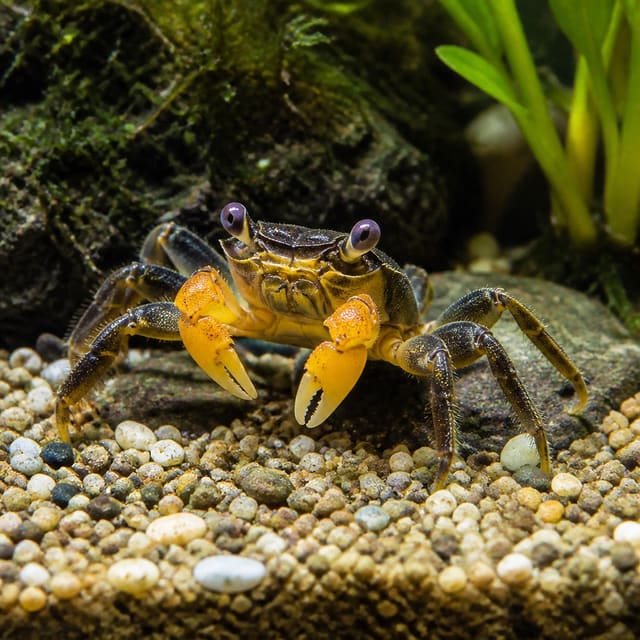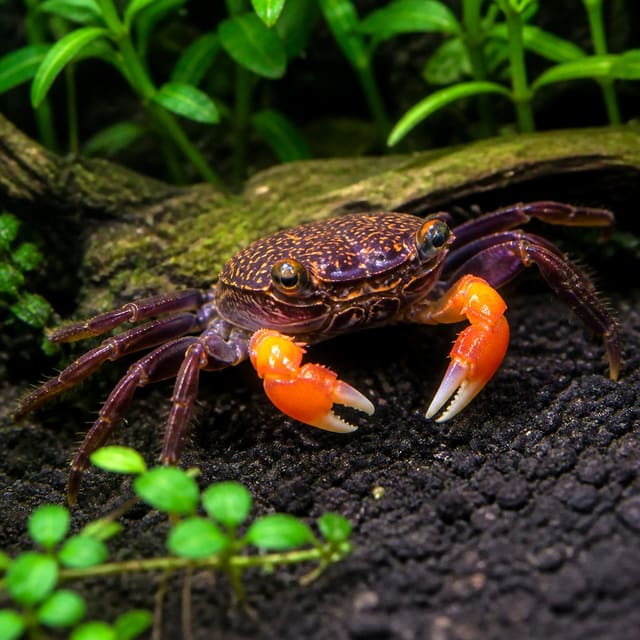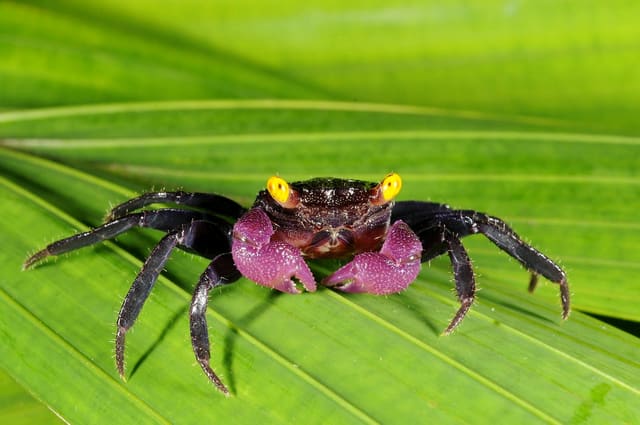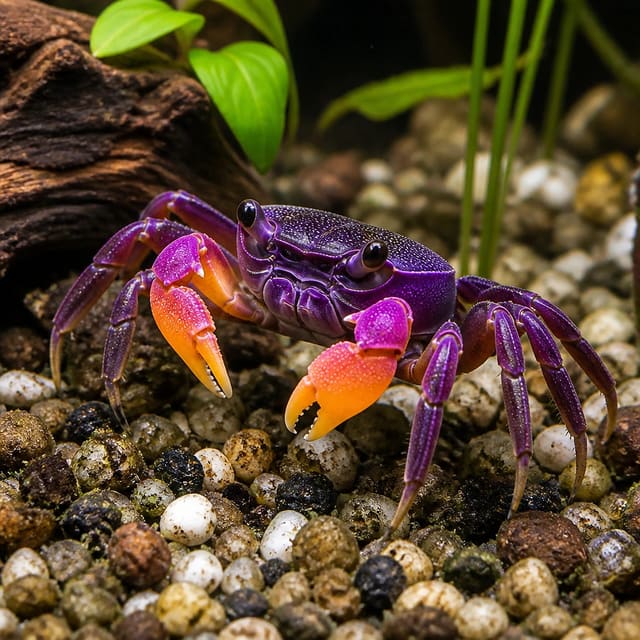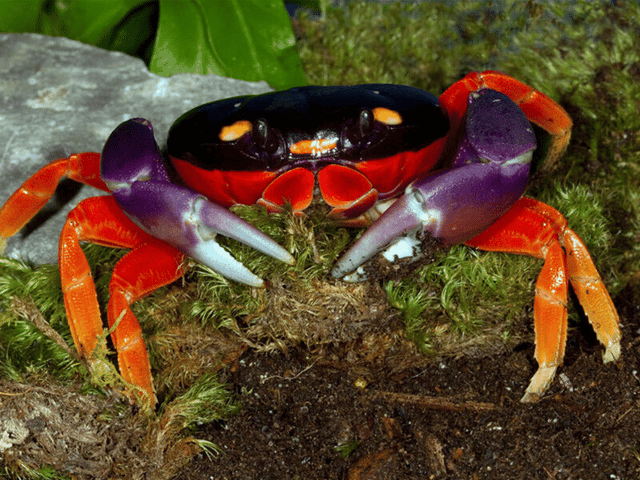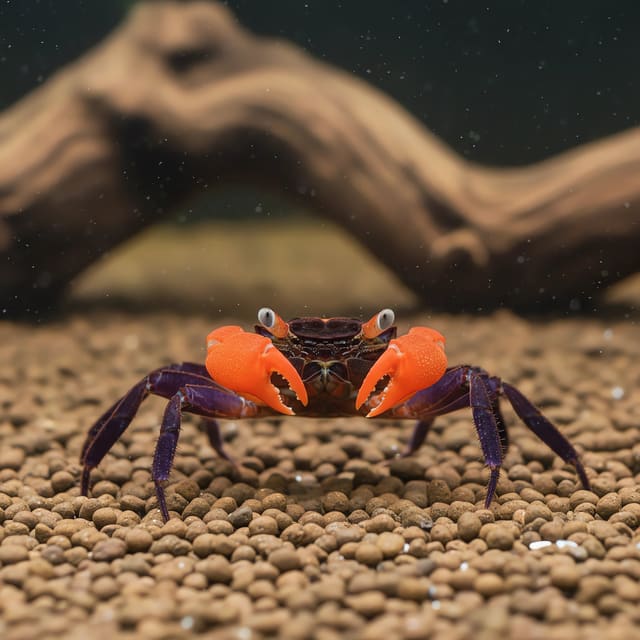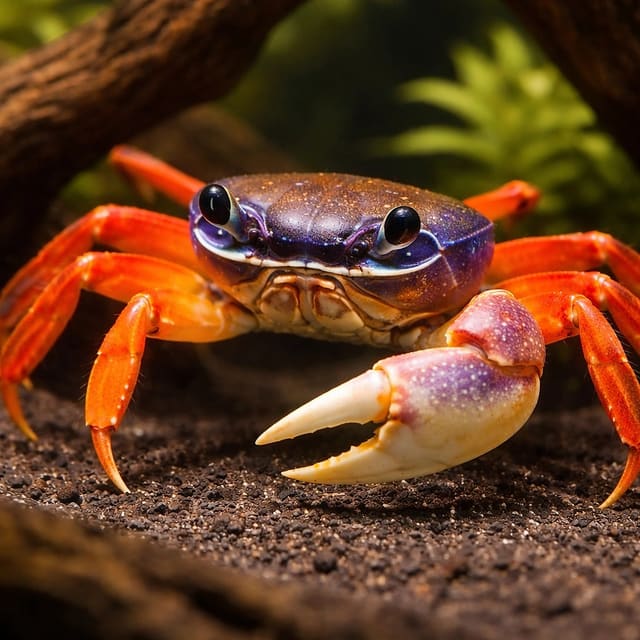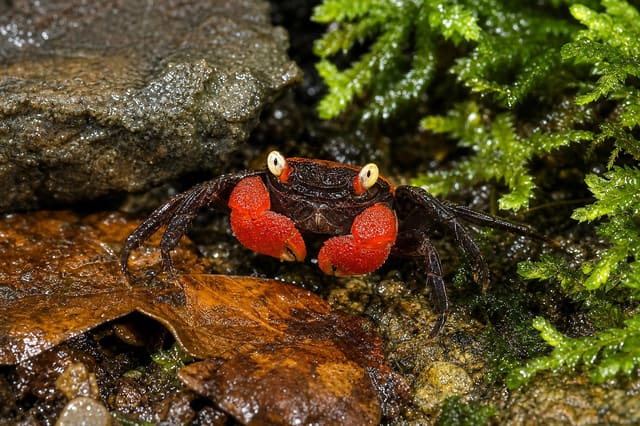
Red Devil Vampire Crab (Geosesarma hagen)
£9.99

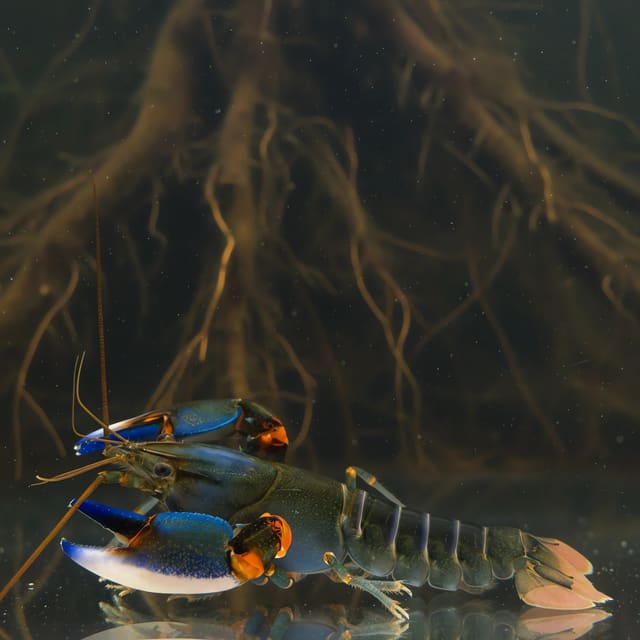
Red Claw Blue Lobster (Cherax quadricarinatus) is a large freshwater crayfish for a secure indoor aquarium with mature filtration, roomy shelters and a dedicated stocking plan.
Cherax quadricarinatus
Red Claw Blue Lobster (Cherax quadricarinatus) is a large freshwater crayfish for a secure indoor aquarium with mature filtration, roomy shelters and a dedicated stocking plan.
Maintain these water conditions for optimal health and vibrant colors
Red Claw Blue Lobster, Cherax quadricarinatus, is a large freshwater crayfish with substantial claws and a way of exploring that makes the aquarium floor as interesting as open water. It is sold here as one live crayfish per purchase, with 4–5 cm and 5–7 cm size choices. Both need an adult home with secure cover, a mature filter and enough room to move between shelters.
The appeal is in the everyday details: the antennae testing a new surface, food held between the claws, and the animal disappearing into a familiar retreat. Some individuals spend more time in view than others. A quiet hide remains part of a successful display even when you would prefer to see your crayfish at the front glass.
Despite its trade name, this animal belongs in freshwater. Plan the enclosure around its floor space, strength and moulting needs. It is particularly worth considering if you would enjoy keeping one substantial crustacean as the main inhabitant. A secure, uncluttered layout with generous caves is easier to maintain than a delicate planted scene that needs to remain undisturbed.
Choosing this crayfish
| Suits | A keeper able to maintain a dedicated indoor freshwater aquarium and secure every opening. |
|---|---|
| Adult space plan | Our practical recommendation is at least 120 litres and around 90 cm frontage for one, with 180 litres or more preferred. |
| Food | A measured variety of sinking crustacean foods, plant matter and frozen foods. |
| Companions | A dedicated aquarium gives the clearest starting point; fish and small invertebrates can be caught. |
| Daily attention | Check appetite, activity, equipment and enclosure security; keep the shelter quiet during a moult. |
The size you select is the size supplied, not the adult size. Use the size selector for your choice and the current purchase information. Sex is guaranteed only when the selected option explicitly states male or female. This Red Claw Blue Lobster listing has no sex-guaranteed option.
The gallery images are representative of this type of animal rather than photographs of the exact animal supplied, so colours can look slightly different from the live animal.
The accepted scientific name is Cherax quadricarinatus, a member of Parastacidae. Blue Lobster and Red Claw Crayfish are trade names for this freshwater animal. The blue wording describes the listed form and does not become an extra word in its scientific name. Keeping the binomial with your aquarium notes helps distinguish it from other animals sold under similar common names.
Aquarium Glaser describes light-blue youngsters becoming darker as they grow. Its species account reports males reaching up to 30 cm in length, with females smaller. The account does not specify whether that measurement includes extended claws, so use it as a warning of substantial adult size, rather than a promise about the exact dimensions of your animal.
Growth affects more than the length of the body. A cave that was generous on arrival can become awkward to enter; a clear route can become a squeeze when the claws are carried forward. Check the usable openings and turning space as the animal develops. Planning a large adult enclosure from the start gives you time to make these small adjustments without arranging an urgent move.
You can explore the wider shrimp and crustacean collection when choosing the kind of enclosure you want to build. Different crustaceans use space very differently, and the care needs of a small shrimp or a land-using crab should not be transferred to this crayfish.
For England and Wales, GOV.UK guidance on non-native crayfish permits Cherax quadricarinatus without a crayfish licence when kept in an indoor aquarium for ornamental use. This exception has a specific animal, location and purpose. It does not extend to every crayfish sold under a blue-lobster common name.
Keep the aquarium indoors and prevent escape. OATA states that crayfish cannot be traded in Scotland; keepers in Northern Ireland should check the relevant authority before purchase. Never release a crayfish into a pond, river, canal or other outdoor water. Arrange secure rehoming through an experienced retailer or keeper if you can no longer provide its home.
Include containment in routine maintenance: keep the animal secure while changing water, prevent escape during transfers, and dispose of aquarium waste responsibly. A lid that fits today also needs checking after a new hose, feeder or cable has been installed. These small changes can create an opening that was absent when the aquarium was first prepared.
For one Red Claw Crayfish, our cautious long-term recommendation is at least 120 litres with roughly 90 cm or more of frontage; 180 litres or more is preferred for an adult. This is a practical aquarium recommendation based on adult size, territory, waste production and usable floor area. It is not a legal threshold or a measurement taken from the wild.
A smaller mature aquarium can serve briefly as a carefully managed juvenile grow-on tank, but it is not a reason to postpone the adult plan. The animal will not stay 4-7 cm. Moving a territorial crayfish after it has outgrown its aquarium can be difficult, particularly if a larger replacement tank is not cycled. Set up the long-term home first whenever possible.
Footprint is more important than height. A long, wide aquarium provides room for separate feeding and shelter zones, while a tall display may offer little more than one contested patch of substrate. Write down the internal length and width as well as the volume, then sketch the shelter and feeding areas. This makes it easier to see whether furnishings will leave a usable route across the floor.
Space plan by life stage
| Stage | Practical use — Planning note |
|---|---|
| Retail juvenile | Temporary grow-on only if mature, covered and closely maintained — Have the adult aquarium ready before growth creates an emergency |
| One growing animal | Increase usable floor area, cave size and filter capacity ahead of growth — Do not wait for repeated escape attempts or poor water tests |
| One adult | 120 litres minimum; 180 litres or more preferred — Aim for at least about 90 cm frontage and several robust shelters |
| More than one | Not the default recommendation — Needs substantially more separated territory, redundant hides and an immediate separation plan |
A secure lid is essential. Crayfish can climb filter pipes, airline, heater cables, textured backgrounds and decor that reaches towards the surface. Cover cable notches and pipe cut-outs without blocking necessary ventilation, keep the waterline below the rim and inspect the lid every time equipment is moved. A gap that looks too small can become usable when the animal braces its legs and claws against nearby equipment.
Place heavy rocks directly and securely so digging cannot undermine them. Avoid unstable piles, narrow crevices that may trap a newly moulted animal and sharp ornaments that can damage soft shell. Wood and caves should be large enough for the crayfish to turn around as it grows. Several shelters are better than one perfect-looking central cave because the animal can choose a retreat during different stages of the moult cycle.
Protect the heater with a suitable guard or place it where direct contact is unlikely. Cover filter intakes that could trap a limb without starving the filter of flow. Keep electrical equipment in good condition and use a drip loop. Design every opening and furnishing for a strong climbing crustacean, including the small feeding flap and gaps behind the filter.
Crayfish-proof setup checklist
| Area | Required condition — Common failure |
|---|---|
| Lid | Close fitting, weighted or latched where appropriate — Loose feeding flap or uncovered corner |
| Cables and pipes | Small protected openings with no climbing route — Large cut-out around an external-filter hose |
| Rockwork | Stable before substrate is added — Heavy stone resting on diggable gravel |
| Caves | Several smooth, adult-sized retreats — One narrow hide that becomes too small |
| Heater | Guarded or positioned away from claws — Exposed glass heater beside the main cave |
| Intake | Protected while maintaining adequate flow — Open slots that can catch a limb or soft animal |
OATA's general guidance for crayfish and freshwater crabs gives 22–27°C, pH 7.0–8.0, general hardness 8–18 dGH and carbonate hardness 10–15 dKH. These are broad group-level aquarium ranges, not a measured optimum for this species. Use them with a stable freshwater setup and check the conditions in the aquarium before arrival.
Measure your source water and aquarium separately. General hardness describes the dissolved mineral content, while carbonate hardness relates to buffering. A pH reading alone does not tell you either of those things. Our aquarium water chemistry guide explains the tests so you can understand a result before reaching for an additive.
OATA group guidance for crayfish and freshwater crabs
| Temperature | 22–27°C, maintained steadily |
|---|---|
| pH | 7.0–8.0 |
| General hardness | 8–18 dGH |
| Carbonate hardness | 10–15 dKH |
| Ammonia and nitrite | Both zero mg/L |
| Nitrate | No more than 20 mg/L above normal tap-water levels under this group guidance |
The useful aim is consistency within an appropriate range. Avoid changing several products at once in response to an isolated result. Repeat an unexpected test, check the kit instructions and compare it with recent readings. This gives you a clearer basis for a measured correction.
The water matcher can help organise measured values. Treat any comparison alongside the animal's space, feeding and shelter needs: matching a few numbers cannot make an unsuitable enclosure suitable.
A large crayfish creates far more waste than a small ornamental shrimp. Use a mature biological filter sized for the adult animal, not only the juvenile arriving today. Equipment choice needs to account for hose security, intake protection and the ability to service media without destabilising the tank.
Provide steady surface movement and good gas exchange. An air pump can add aeration where the aquarium and filter arrangement require it, but bubbles do not replace biological filtration or water changes. Warm water holds less oxygen, and decomposing food consumes more, so feeding control and surface movement work together.
Do not add the crayfish to a tank that has only been filled for a few days. A cycled aquarium has established bacteria that process ammonia to nitrite and then nitrate. Confirm zero ammonia and nitrite under a realistic bioload before delivery. An appropriate ammonia test kit supports routine checks, alongside nitrite, nitrate, pH, GH and KH tests appropriate to the aquarium.
Filtration and oxygen decisions
| Need | Good approach — Do not rely on |
|---|---|
| Biological capacity | Mature filter media sized for an adult, messy animal — A new filter installed on delivery day |
| Mechanical capture | Accessible media that can remove food and shell fragments — Leaving debris to decay behind decor |
| Gas exchange | Surface movement, sensible temperature and optional air stone — Bubbles alone in a poorly filtered tank |
| Intake safety | Guard or sponge that still permits adequate flow — An open intake beside the main shelter |
| Monitoring | Regular tests plus observation of breathing and activity — Clear-looking water as proof that water is safe |
If you have kept smaller invertebrates, the shrimp-keeping guide can refresh the principles of maturation and measured feeding. A crayfish needs its own larger, secure enclosure; shrimp stocking and companion advice do not describe its requirements.
The RSPCA's aquarium environment advice explains the role of a working biological filter in processing waste.
A crayfish grows by shedding its old exoskeleton. Before a moult it may eat less, hide more and become less active. During and immediately after the shed, the new shell is soft and the animal is vulnerable. Do not pull it from a cave, handle it, rearrange the aquarium or introduce companions during this period.
Leave the shed shell in the aquarium unless it is fouling the water or there is another clear reason to remove it. The crayfish may consume much of it and recover minerals. The empty shell can look alarmingly like a dead animal, so confirm the crayfish is hiding before assuming the worst. A complete shed usually includes delicate antenna and leg shapes.
Support moulting through the complete care routine. Stable pH and hardness, varied nutrition, good oxygen, low waste and a secure retreat all contribute. Repeated incomplete moults, a shell that remains soft, unusual limb loss or persistent weakness should trigger a review of water chemistry, diet, temperature, recent treatments and possible harassment.
Moult-stage guide
| Stage | Possible signs — Keeper response |
|---|---|
| Pre-moult | Reduced appetite, more hiding, quieter behaviour — Keep conditions stable and make the retreat inaccessible to companions |
| Shedding | Animal lies unusually or works free of the old shell — Do not touch, net or disturb it |
| Soft shell | Pale, flexible-looking body and prolonged hiding — Maintain oxygen and security; avoid major maintenance |
| Recovery | Shell firms, appetite returns and activity increases — Resume measured feeding and observe limb function |
| Concern | Repeated failed shed, persistent weakness or foul water — Test immediately and seek experienced aquatic-veterinary advice where needed |
Cherax quadricarinatus is an opportunistic omnivore. Use a quality sinking crustacean food as the foundation, then rotate algae-based foods, safe vegetable matter, leaf litter and measured protein foods. Variety is more useful than repeatedly offering one rich food. Feed amounts the animal can finish and remove leftovers before they soften into the substrate or filter.
Under OATA's general feeding guidance, offer food once a day and allow about 30 minutes for feeding before removing leftovers. A crayfish takes time to manipulate food; the amount matters more than filling the floor with different items. Suitable vegetable choices include courgette, cucumber and lettuce. Rotate foods in small portions so that you can see which are actually eaten.
Offer food near the shelter after lights dim if a new arrival is shy. Use feeding tongs only to place food, never to tease or grab the animal. Appetite may reduce before a moult, but prolonged refusal accompanied by poor posture, rapid movement at the surface or abnormal water results needs investigation. A hungry crayfish may become more destructive, yet overfeeding is not a safe way to prevent predation.
Balanced feeding rotation
| Food type | Role — Use |
|---|---|
| Sinking crustacean pellet | Consistent staple with trace nutrients — Choose an appropriate size and remove uneaten pieces |
| Algae wafer or plant-rich food | Plant material and grazing variety — Rotate rather than offering unlimited wafers |
| Blanched vegetable | Texture and plant variety — Use a small portion and remove it the same day |
| Leaf litter | Natural grazing surface and shelter enrichment — Use aquarium-safe leaves without pesticides |
| Frozen crustacean or other protein food | Measured protein variety — Offer sparingly; thaw and portion before feeding |
| Old moult | Mineral recovery — Leave temporarily if water quality remains sound |
Expect a bottom-oriented animal that explores by touch and smell. Some individuals are visible throughout the day; others wait until the room quietens or the aquarium lights dim. Carrying food, moving loose substrate, defending a cave, standing at the entrance with raised claws and testing climbing routes can all be normal.
Normal territorial display should not be confused with proof that cohabitation is safe. A crayfish that ignores a fish for weeks may still catch it while it rests near the substrate. Likewise, an animal that shares a cave area as a juvenile may become intolerant after growth or a moult. Behaviour is individual and can change.
Provide enrichment through a complex but stable layout: more than one tunnel, safe wood, shaded cover, open feeding space and varied surfaces. Avoid constant redecorating. The animal establishes familiar routes and retreats, and repeated disruption can leave it exposed during a vulnerable stage.
Keep one Red Claw Blue Lobster in a dedicated aquarium as the starting plan. OATA advises keeping crayfish apart from fish because even scavengers can hunt small or slow-swimming companions. Feeding generously does not remove that behaviour, and a fish resting near the substrate may be within reach even if it usually swims higher in the aquarium.
Small shrimp, snails and delicate plants also make poor companions for a large omnivorous crayfish. A mixed display can place the animals you want to protect in the same area as the claws, shelter entrances and food. Choose the inhabitants around this practical conflict before buying, rather than relying on a peaceful first introduction.
Keeping more than one crayfish needs much more usable floor space, multiple separated shelters and a ready separation plan. Aquarium Glaser describes peaceful examples of this particular species in its own experience, but that is not a guarantee for two unfamiliar animals in a home aquarium. OATA's more cautious solitary recommendation is the one followed here.
Compatibility decisions
| Fish community | Avoid mixing: small or slow fish can be hunted, and faster fish are not guaranteed safe. |
|---|---|
| Small invertebrates | Avoid relying on shrimp or snails remaining untouched. |
| Second crayfish | Requires a much larger enclosure, many retreats and immediate separation capacity. |
| Delicate plants | Expect feeding and disturbance; choose another display if plant preservation is the priority. |
Watch interactions around shelter entrances and meals if a carefully planned multiple-crayfish enclosure is used. Repeated exclusion from food, damaged limbs or one animal constantly retreating call for separation and a layout review. A soft animal after moulting needs particular protection from disturbance.
Red Claw Crayfish can dig, clip shoots and uproot plants. Hardy epiphytes attached securely to wood or rock may survive better than delicate stems or carpeting plants, but no plant is guaranteed safe. Accept plant damage as a possibility from the start and keep essential shelter available independently of living stems.
Sand or smooth gravel is easier on the underside than sharp substrate and allows natural digging. Keep the bed shallow beneath heavy structures so the crayfish cannot excavate a collapse. Dark wood, pale sand and shaded caves can make blue and bronze tones easier to see, but visual contrast should never take priority over stable furnishings.
Use aquarium-safe materials only. Avoid copper ornaments, exposed metal, painted items not intended for aquariums and shells collected from unknown environments. Rinse new decor without detergent and check that every opening remains usable after the crayfish gains body width.
Prepare the aquarium before delivery: mature filter, tested water, secure lid, protected heater, stable caves and low lighting. Read the current live-animal delivery and guarantee information before selecting a date. Be present to receive the parcel and confirm an acclimatisation plan with us before delivery, taking the transport and receiving water into account.
Do not open the transport bag and leave it standing for a long period. Match temperature as directed, introduce the animal carefully without adding transport water to the aquarium, and release it beside a prepared shelter. Never lift a crayfish by a claw or leg. If it must be guided, use a suitable container and keep hands away from the claws.
Keep lighting low and disturbance minimal for the rest of the day. A new arrival may hide, refuse the first meal or appear duller than the gallery. Offer a small sinking food once it has settled, then remove leftovers. For a Live Arrival Guarantee claim, a continuous unboxing video must show the still-sealed parcel being opened and the animal still inside its sealed bag. Record that sequence before releasing the animal. Someone must receive the parcel, inspect it on the day it arrives and contact us that day with the order number if there is a concern.
First-week observation plan
| Time | Look for — Response |
|---|---|
| Arrival | Normal movement, intact limbs and access to a shelter — Keep light low and use the agreed acclimatisation plan |
| First night | Quiet exploration or continued hiding — Secure the lid and avoid forcing the animal into view |
| Days 1-2 | Interest in a small sinking food — Remove leftovers and do not overfeed to provoke a response |
| Days 2-4 | Zero ammonia and nitrite, stable temperature and normal posture — Test promptly if activity or breathing changes |
| Days 4-7 | Regular use of shelters and normal shell condition — Review flow, security and water chemistry before changing decor |
Observe the crayfish daily and remove obvious uneaten food. Check that filter flow and surface movement remain strong, the lid is seated correctly and no cable opening has widened. Count limbs without chasing the animal; a missing limb may regenerate over later moults, but the cause should still be investigated.
Use regular partial water changes with dechlorinated replacement water reasonably matched for temperature and chemistry. Vacuum accessible debris without dismantling every shelter. If filter media needs cleaning, rinse it lightly in removed aquarium water; never rinse it under the tap, where chlorine or chloramine can damage the beneficial bacteria. Keep mature biological media in service.
Record temperature, pH, GH, KH, ammonia, nitrite and nitrate often enough to see trends. A stable log is more informative than one isolated test after a problem appears. Check the aquarium more frequently during hot weather, after a moult, after equipment changes and after any period of reduced appetite.
Simple maintenance rhythm
| Frequency | Task — Purpose |
|---|---|
| Daily | Observe posture, shell, appetite, lid and equipment — Find changes before they become emergencies |
| After feeding | Remove soft leftovers — Limit ammonia and oxygen demand |
| Several times weekly | Check temperature, flow and surface movement — Catch heater, blockage or aeration faults |
| Weekly or as tests indicate | Partial water change and targeted substrate cleaning — Control dissolved and solid waste without sudden disruption |
| Periodically | Inspect caves, pipe gaps, heater guard and intake cover — Keep the enclosure secure as the animal grows |
OATA's group guidance recommends a 25% partial water change at least once every week and testing at least weekly. Adjust your maintenance response to actual waste and water results rather than waiting for the next scheduled change when a problem appears. Treat replacement tap water with conditioner for chlorine and chloramine and match temperature carefully.
A healthy settled crayfish should react to its surroundings, use shelters, maintain a firm shell between moults and show interest in food according to its normal rhythm. Hiding before and after a moult can be normal. Diagnose the environment before assuming every quiet period is disease.
Warning signs include repeated escape attempts, prolonged surface climbing, persistent weakness, loss of balance, foul-smelling water, a shell that stays soft, repeated failed moults, unusual lesions or continued refusal to eat outside a likely moult window. Test ammonia, nitrite, temperature, pH and oxygen conditions immediately and inspect equipment.
Crustaceans can be sensitive to treatments used routinely for fish, including copper-containing medicines. Never dose the main aquarium without confirming that the exact product and concentration are appropriate for crayfish. When a diagnosis or treatment is uncertain, seek advice from an aquatic veterinarian or a keeper experienced with large Cherax.
Normal event or reason to investigate?
| Observation | Possible normal explanation — Investigate when |
|---|---|
| Hiding | New arrival, daytime rest or pre/post-moult behaviour — Water tests are abnormal or weakness persists after recovery time |
| Reduced appetite | Short pre-moult period — It continues with poor posture, lesions or deteriorating water |
| Empty crayfish-shaped shell | A complete moult — The animal cannot be found and the enclosure was not secure |
| Colour change | Age, background, lighting, stress or a recent moult — It accompanies soft shell, tissue damage or abnormal behaviour |
| Climbing | Occasional exploration — It is persistent, especially near the surface or with low oxygen signs |
Choose Red Claw Crayfish if you enjoy observing natural crustacean behaviour and can provide a secure, warm, mineral-supportive aquarium with substantial floor area. It rewards careful planning with bold movement, feeding interaction and fascinating moulting behaviour.
Choose a different animal if your priority is a delicate planted aquascape, dwarf shrimp colony, peaceful bottom-fish community or open-top display. It is also a poor choice when the adult tank is only an intention, the source water is very soft and acidic with no stable adjustment plan, or nobody can receive live delivery promptly.
Buyer-fit check
| Good fit | Poor fit |
|---|---|
| Secure heated indoor aquarium | Open-top tank or outdoor pond |
| Our 120-litre starting recommendation for one adult, with useful floor area | Small tall aquarium chosen only by litre figure |
| Mature filtration and regular testing | New, uncycled or lightly filtered setup |
| Robust caves and stable decor | Loose rocks or delicate aquascape |
| Species-first expectations | Need for guaranteed shrimp, snail or fish compatibility |
| Acceptance of natural colour variation | Expectation of an exact photographed shade or sex |
| Long-term rehoming responsibility | Any possibility of outdoor release |
Aquarium Glaser reports males reaching up to 30 cm in length and females remaining smaller. Its measurement basis is unspecified, so plan for a substantial adult with generous turning and shelter space.
Our practical recommendation is at least 120 litres with around 90 cm frontage, with 180 litres or more preferred. This is a store planning recommendation for one animal; usable floor space and adult-sized shelters matter alongside the volume.
Start with one in a dedicated aquarium. OATA advises solitary crayfish unless a very large aquarium provides many hiding places. Keeping several requires separated retreats and a ready way to separate animals.
It can suit a careful keeper who prepares a secure indoor aquarium, matures the filter and learns water testing before purchase. It requires more enclosure planning than adding another small fish to a community tank.
Offer varied sinking crustacean foods, plant-rich foods, suitable vegetables and measured frozen foods. OATA's general guidance is to feed once a day, allow about 30 minutes for eating and remove leftovers.
OATA's broad crayfish and freshwater crab guidance is 22–27°C and pH 7.0–8.0, with GH 8–18 dGH and KH 10–15 dKH. These group ranges are not a species-specific optimum; keep conditions stable.
A dedicated aquarium is recommended. Crayfish can hunt small or slow-swimming fish, and a fish that is ignored during the day may be caught while resting. Feeding more does not make a fish community safe.
Expect a large omnivore to eat or disturb plants and to threaten small invertebrates. It is a poor choice for a delicate planted display or a shrimp colony that you want to preserve.
Tropical Fish Co uses insulated packing and a licensed live-animal courier, with the confirmed delivery date sent by email. Be present to receive and inspect the parcel that day. For a Live Arrival Guarantee claim, a continuous unboxing video must show the sealed parcel being opened and the animal still in its sealed bag; contact us the same day with your order number.
WoRMS accepted species record identifies the animal. The OATA crayfish and freshwater crab care sheet explains the group aquarium care. Aquarium Glaser's species account discusses adult males, blue juveniles and changing appearance.
No reviews for this item yet. Bought one? Honest reviews only, good or bad.
What customers say about ordering from us
I have a small group of long finned mountain minnows. So was delighted to be able to order ten of this variety to increase the genetics in my tank . The ones I recieved are healthy but it’s to early to give a verdict on wether they are of a long finned type since they are small currently.
Gordon Walker · 23 Sept 2026
100% success travel and "installation". Pleased with quality of purchase. The Siamese fighter a bit "shy" so have not yet seen him at his best yet but looking good. Happy customer. GG
George E Garratt · 21 Sept 2026
Reviews of our shop, collected by Judge.me, an independent third-party review collector. Newest first.