Moderate
Purple Vampire Crab (Geosesarma dennerle) – Semi-Terrestrial Paludarium Crab
£8.09
Golden Eye Vampire Crab (Geosesarma sp.) is a trade form of an unidentified Geosesarma species: a small semi-terrestrial crab sold as one live animal per purchase. It needs a secure, humid paludarium with far more land than water, a deep moist substrate to burrow into, leaf litter and bark for cover, easy access to clean fresh water and a varied diet of animal and plant foods.
Geosesarma sp.
Golden Eye Vampire Crab (Geosesarma sp.) is a trade form of an unidentified Geosesarma species: a small semi-terrestrial crab sold as one live animal per purchase. It needs a secure, humid paludarium with far more land than water, a deep moist substrate to burrow into, leaf litter and bark for cover, easy access to clean fresh water and a varied diet of animal and plant foods.
The Golden Eye Vampire Crab is a small, semi-terrestrial crab from the genus Geosesarma. Each purchase is one live crab. It lives mostly on land, so it needs a secure, humid paludarium with plenty of floor space and easy access to clean fresh water, rather than a standard fish tank.
The enclosure is the decision that matters most. Geosesarma crabs live and reproduce on land, and successful set-ups for them are mostly ground: a deep, moist substrate to dig into, leaf litter and bark to hide under, living plants for cover and humidity, and a pool of clean fresh water the crab can walk into and out of. Add a secure, escape-resistant lid from the first day. Any gap around a cable, a sliding front or a loose corner is a way out for a small crab.
What makes this crab rewarding is watching it behave as it would among roots and fallen leaves: digging, foraging across the ground, climbing over bark and stepping in and out of the water. Those behaviours only show when the crab has space and cover, which is why the set-up comes before the purchase.
| Suits | Keepers ready to build and look after a humid paludarium with far more land than water |
|---|---|
| Not suited to | A community fish aquarium or any fully aquatic tank |
| Enclosure | Secure and escape-resistant, humid, with deep moist substrate, leaf litter, bark and plants |
| Water | Clean, tested fresh water in a pool or dish the crab can enter and leave easily |
| Diet | Varied: prepared crab food, small animal foods, fruit and greens |
| Companions | Best in its own set-up; OATA advises caution with fish |
| Behaviour | Digs, burrows and uses hides, so expect it to spend time out of sight |
| Handling | Best watched rather than handled |
| Identity | Genus Geosesarma, family Sesarmidae; species not identified |
Many keepers meet vampire crabs while browsing shrimp and snails, but day-to-day care is closer to looking after a small land animal. Where a shrimp tank is judged mainly by its water, a Geosesarma enclosure is judged by its ground: how damp the substrate is, how much cover there is, how steady the humidity stays and how secure the lid is. The water area still matters and still needs clean, tested water, but it is one feature of the enclosure rather than the whole of it.
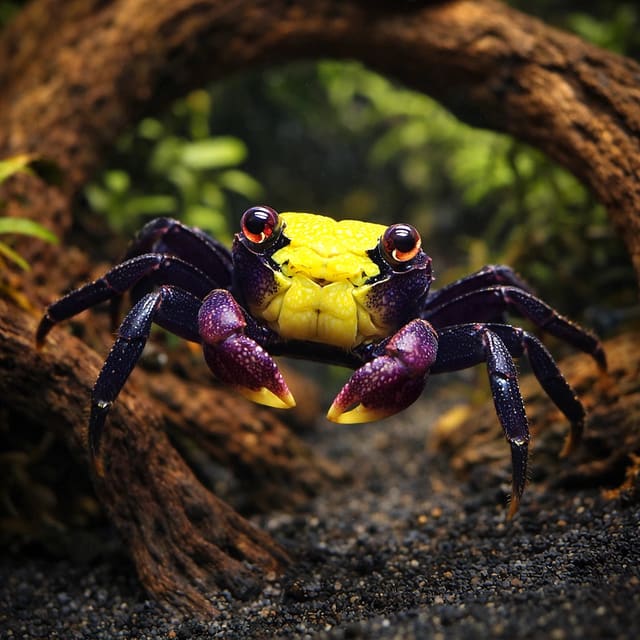
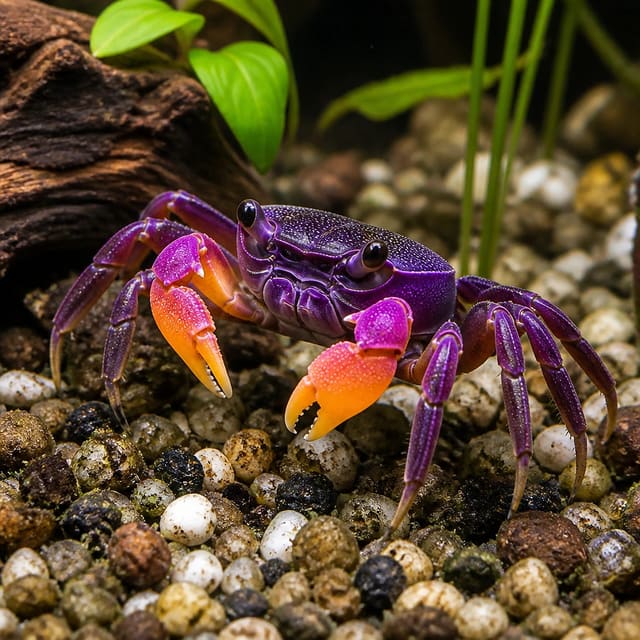
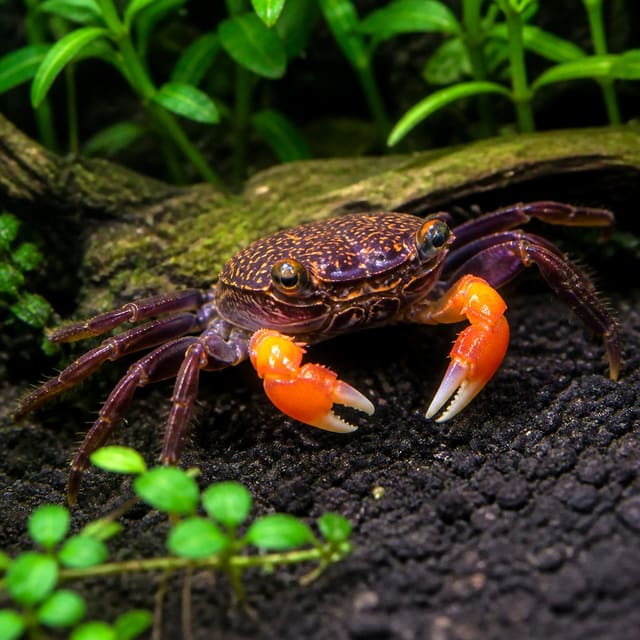
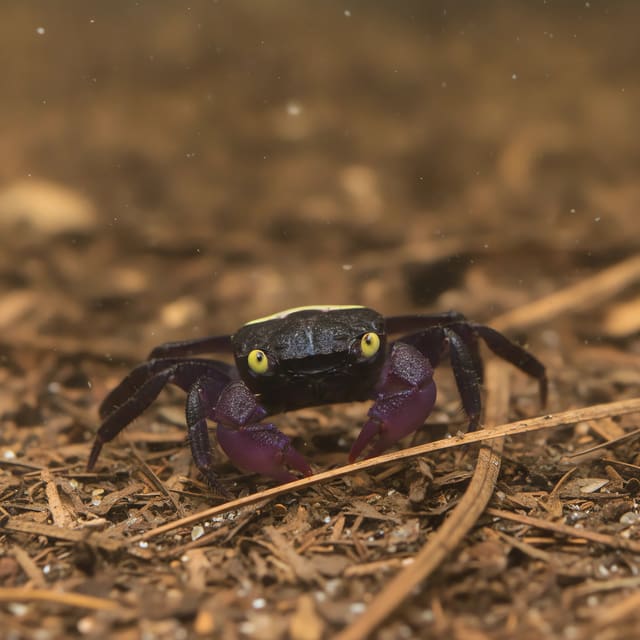
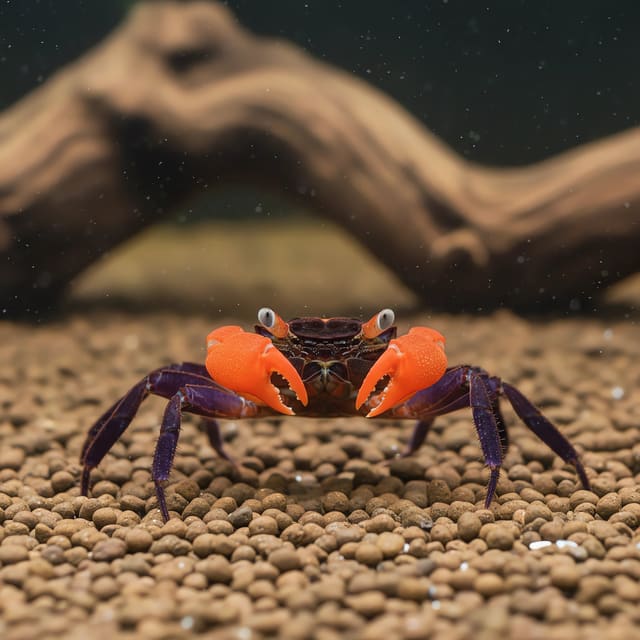
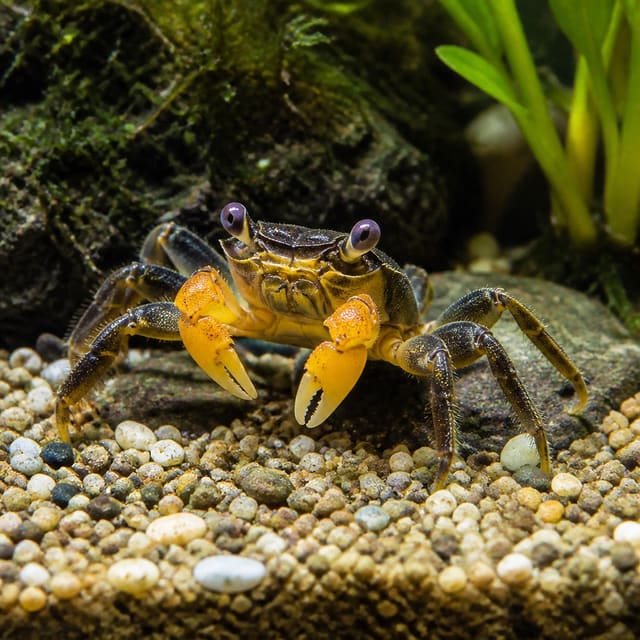
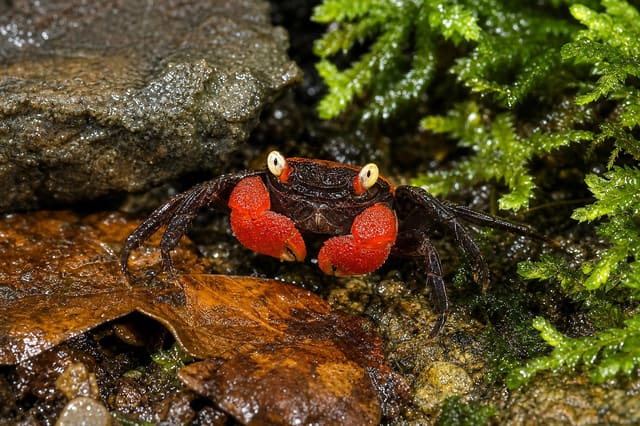
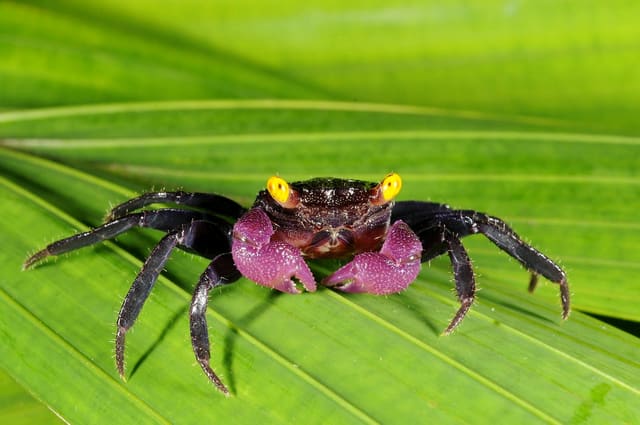
The photograph on this page shows the colouring behind the trade name: a dark, purple-black body and legs, golden-orange eyes and orange claws. Gallery images have been digitally enhanced to improve image quality. Natural colour, pattern, size and maturity can vary between live animals.
Sex is guaranteed only when the selected option explicitly states male or female. This Golden Eye Vampire Crab listing has no sex-guaranteed option. The care on this page applies to either sex.
If you are comparing crabs, shrimp and other invertebrates before deciding, our aquarium shrimp and crustacean collection brings the range together in one place.
Golden Eye is a hobby trade name. The crab is supplied as a Geosesarma "Golden eye" form, and Geosesarma is an accepted genus in the family Sesarmidae, within the decapod crustaceans, according to the World Register of Marine Species genus record. No species name is attached to this form.
The exact species has not been identified, so the care advice here follows the genus Geosesarma and its care group. In practice that means the guidance centres on what these crabs share: a life spent mostly on land, a need for humidity and clean fresh water, a habit of digging and hiding, and a broad scavenging diet. Where this page gives a number, it says whose number it is and how widely it applies.
Trade names for Geosesarma crabs describe appearance rather than species, so read "Golden Eye" as a colour description, not a scientific label. If you keep more than one Geosesarma form, label each enclosure with the name the crab was bought under.
The crab in our photograph has a dark, purple-black carapace and legs, bright golden-orange eyes with dark pupils, and orange claws with paler tips. Against dark wood and substrate the claws and eyes are the features you notice first.
The Wikipedia summary of the genus describes Geosesarma as small freshwater or terrestrial crabs, typically less than 10 mm across the carapace. They live and reproduce on land, with the larval stages passed inside the egg, and the genus is found in India, Indonesia, Malaysia, Thailand, the Philippines, the Solomon Islands and Hawaii. That range describes the genus as a whole; it does not tell you where this particular form was collected or bred.
Two points from that natural history shape everyday care. The crab's world is the ground surface: damp soil, leaf litter and crevices close to fresh water. And because the young develop inside the egg, the whole life cycle belongs on land beside fresh water, with no open-water larval stage to cater for.
This crab is sent at a 4 cm size grade. Treat that as a description of the crab supplied, not a forecast of adult size. It may not line up with the carapace widths quoted for the genus either, because width across the shell and overall spread with the legs extended are very different measurements for a crab.
We do not give an adult size for the Golden Eye form. Without a species identification there is no species record to take one from, and a figure borrowed from another Geosesarma would only look precise.
Think of the set-up as a humid land enclosure with fresh water in it, rather than an aquarium with a small beach. The Tye-Dyed Iguana vampire crab care sheet describes Geosesarma crabs spending most of their time on land while still using water, and the Los Angeles Zoo account of its vampire crabs, which it identifies as Geosesarma dennerle, describes wet soil beside fresh water, heavy use of land and burrowing. That account covers a named species rather than this form, but it paints the same picture as the genus-level advice: plenty of ground, dense cover and water close at hand.
Give the crab far more usable land than water. Usable means ground it can walk, dig and hide on; a steep slope against the glass or a single rock island counts for little. A long, low enclosure offers more floor than a tall, narrow one of the same volume, and floor is what this crab uses.
A glass terrarium, or an aquarium fitted with a secure glass-and-mesh lid, both work well. Front-opening doors make feeding and cleaning easier without lifting the whole top, but check that they close tightly along the bottom rail, which is exactly where a ground-dwelling crab spends its time. Glass holds humidity better than open mesh, so a mostly glazed top with a strip of fine mesh for air exchange is a practical balance. Whatever you choose, floor area matters more than height.
An escape-resistant enclosure is part of the basic kit, not an upgrade. Check every opening before the crab arrives:
Plants and decor near the top can act as ladders, so keep climbable wood and stems a little below the lid line, or make sure the lid seals completely where they reach it.
A deep, moisture-retentive substrate lets the crab burrow and helps hold humidity. The Tye-Dyed Iguana sheet describes soil or sand topped with moss; a soil-based mix with some sand, laid deep enough for burrows to hold their shape, follows that lead. Keep it damp rather than sodden. If the lower layer stays waterlogged and starts to smell sour, it is too wet: mist less, improve drainage towards the water area or replace the affected part.
Slope the land gently down towards the water so the edge stays moist and the crab has a natural shoreline to explore.
Fresh water should be easy to reach and easy to leave. Build gentle slopes of substrate, stone or wood into it, so the crab can walk in and climb out at several points, and keep it small compared with the land.
How you keep that water clean depends on its size. A larger pool can run with gentle filtration: RSPCA aquarium guidance explains that waste releases toxic ammonia, which filter bacteria convert to nitrite and then to safer nitrate. A small dish has no filter to do that work, so empty, rinse and refill it whenever it clouds or collects food and waste. If you are new to letting a filter mature before livestock arrives, our freshwater shrimp tank set-up guide walks through the same patient start for small invertebrates.
Both care accounts describe humid conditions, and the zoo describes a warm, humid habitat. Aim for an enclosure that stays warm, humid and steady rather than one that swings between dry and saturated. Measure at crab level: a thermometer and hygrometer placed near the ground tell you far more than one at the top of the glass.
For the wider group of crayfish and freshwater crabs, which the OATA crayfish and freshwater crab care sheet says includes vampire crabs, OATA gives 22–27 °C. Use that as a broad starting point for a warm room and enclosure rather than a measured optimum for this form, and keep whatever temperature you settle on stable. If you need to add warmth, use thermostat-controlled equipment and check the reading where the crab lives.
Humidity comes from damp substrate, living plants, the water area and a lid that holds moist air in. Mist lightly when the surface starts to dry, and allow some air exchange so the air does not turn stale. Condensation that never clears, or mould spreading across the substrate, is a sign to open the ventilation slightly and mist less.
OATA's advice for the crab group starts with clean, tested fresh water, and it applies here even though this crab spends most of its time on land. Use tap water treated with an aquarium conditioner, or another water you have tested, and keep the pool or dish free of rotting food.
For a filtered pool, test ammonia, nitrite and nitrate as you would for a small aquarium; our guide to which aquarium water values to test and why explains each one. OATA's figures for the whole crayfish and freshwater crab group are pH 7.0–8.0 and 8–18 °dH. They describe a wide range of animals, so treat them as context: stable, clean water matters more than chasing a particular number. To see how your own tap water sits against those figures, the water parameter matcher lets you compare your readings with stated guidance.
OATA's care sheet asks for invertebrate-safe, copper-free treatments. Read the label of anything that goes into the water area or onto the plants, including conditioners, plant feeds and medicines, and choose products labelled safe for invertebrates. Never move water, decor or equipment into the paludarium from a tank that has been treated with copper.
Household sprays, polishes and cleaning products are best kept well away from the enclosure and its lid. Clean the glass and any equipment with water only.
Geosesarma crabs scavenge on both animal and plant material. The Tye-Dyed Iguana sheet's menu combines prepared crab food, small animal foods, fruit and greens; OATA recommends a varied diet of animal and plant foods for the crab group; and the zoo describes its Geosesarma dennerle scavenging on animal and plant matter. Build the menu from all three strands:
Offer small portions on the land area, in a shallow dish or on a flat stone near cover, so food is easy to find and easy to remove. A small crab eats a modest amount, and warmth and humidity make leftovers spoil quickly, so take away anything uneaten before it turns mouldy or sours the water.
Vary what you offer rather than relying on one food. Watching what disappears and what is left untouched is the best guide to adjusting portions for your crab.
Burrowing and using hides are part of how Geosesarma crabs live, in both the keeper and zoo accounts. A healthy crab may spend long spells out of sight, under bark or in a burrow. Leave burrows intact rather than digging the crab up to check on it; a crab that feels secure shows far more of its natural behaviour.
The best way to see it is to make the enclosure feel safe: dense cover near the front, food placed where you can watch, and a quiet position away from constant movement.
Like every crab, a Geosesarma grows by moulting its exoskeleton. Around a moult it may stay hidden and eat little, and its new shell stays soft until it hardens. A shed exoskeleton lying on the substrate can look like a dead crab at first glance, so look closely before removing anything. Keep humidity and temperature steady and leave a moulting crab undisturbed.
Handle the crab as little as possible. When you need to move it, guide it into a small container rather than picking it up, and never lift it by a leg or claw.
If a problem appears, correct the conditions first. Any treatment used in the enclosure must be invertebrate-safe and copper-free.
Geosesarma crabs reproduce on land, and the larval stages are passed inside the egg, so there is no free-swimming larval stage to raise. Because this crab is sold without a guaranteed sex, buy it to keep and enjoy rather than as a breeding project. If a female ever carries eggs, keep conditions stable and the enclosure quiet.
Have the paludarium running before you order: substrate damp, hides and leaf litter in place, water area clean, and temperature and humidity steady. Our delivery and Live Arrival Guarantee page explains that you are emailed a tracking number and a confirmed delivery date, so you know when to be in. Someone needs to be at the delivery address to receive the parcel, because live animals cannot be left unattended.
The delivery page's routine of floating a bag in aquarium water is written for fish. This crab is going onto land, so skip that step and move it straight onto the damp substrate.
If the crab has not arrived alive, contact us the same day, by WhatsApp for the fastest reply, with your order number and the unboxing video, and we will arrange a replacement or refund under the Live Arrival Guarantee.
OATA's care sheet for crayfish and freshwater crabs advises caution with fish, and for a semi-terrestrial crab the practical case for a crab-only enclosure is strong. Fish need open swimming water; this crab needs land. A paludarium built well for the crab leaves any fish only a small pool, and a tank built for fish leaves the crab too little ground.
| Situation | Guidance |
|---|---|
| Fully aquatic aquarium | Unsuitable: there is no land for the crab to live on |
| Community fish tank | Unsuitable for the same reason, and OATA advises caution with fish |
| Fish in a paludarium pool | Approach with caution; a crab-only enclosure is the simpler, safer choice |
| More than one Golden Eye crab | Plan around space and cover: several hides and feeding spots, and a watchful eye |
| Other small animals | No companions are recommended; keep the enclosure for the crab |
Let the enclosure decide the number, not a fixed head count. If you keep more than one crab, give each its own choice of hides on land and near the water, scatter food in more than one place and watch how they share the ground. A crab that is repeatedly pushed away from food or cover needs more space or an enclosure of its own.
If you also keep other vampire crabs, such as the named species Geosesarma dennerle, house each form in its own enclosure. That keeps each crab's care, records and any young clearly matched to the name it was bought under.
A crab-only paludarium lets you set humidity, water depth, feeding and decor entirely around one animal. It also means that everything you see in the enclosure, from fresh digging to a shed shell, belongs to the crab, which makes changes easier to notice early.
Geosesarma crabs live and reproduce on land, and keeper accounts describe them spending most of their time out of the water while still using it. A paludarium provides both: a large, humid land area to walk, dig and hide in, and clean fresh water the crab can reach and leave easily. A fully aquatic tank gives it no ground to live on.
Give the crab far more usable land than water. Most of the floor should be deep, moist substrate with leaf litter, bark and plants, beside a smaller pool or dish of clean fresh water with gentle slopes, stones or wood so the crab can walk in and climb out at several points.
Use a deep, moisture-retentive substrate it can burrow into, such as soil or a soil-and-sand mix topped with moss. Cover it with leaf litter, add curved cork bark as ready-made hides and plant densely, so the crab always has shelter on land and near the water.
It is a scavenging omnivore. Offer a varied menu of prepared crab food, small animal foods such as thawed frozen aquarium foods, and small pieces of washed fruit and greens. Feed small portions on the land area and remove anything uneaten before it spoils.
No. Use only invertebrate-safe, copper-free products in the water area and on the plants, as OATA advises for crayfish and freshwater crabs. Check the labels of conditioners, plant feeds and medicines, and never move water or decor from a tank that has been treated with copper.
A crab-only paludarium is the safer plan. OATA advises caution with fish for this group of crabs, and the two need different homes: fish need open swimming water, while this crab needs mostly land with only a small pool.
Golden Eye is a trade name for an unidentified member of the genus Geosesarma, in the family Sesarmidae. No species has been confirmed, so its care follows what Geosesarma crabs share: humid land, clean fresh water, burrowing cover and a varied diet.
Have the humid paludarium ready before it arrives. Open the parcel the same day, filming one continuous unboxing video from the sealed parcel to the crab still in its bag, as the Live Arrival Guarantee requires. Then ease the crab onto damp land near cover, leave the transport water behind and watch it quietly while it settles.
No reviews for this item yet. Bought one? Honest reviews only, good or bad.
What customers say about ordering from us
Easy website plenty of info on fish your buying great to pick a time slot
TRACEY DURRANT · 7 Oct 2026
Got some lovely fish thank you
Kevin Mackie · 7 Oct 2026
Reviews of our shop, collected by Judge.me, an independent third-party review collector. Newest first.