

Advanced
Leopard Crab (Parathelphusa pantherina crab phanter)
22–27°C · pH 7–8
£16.99

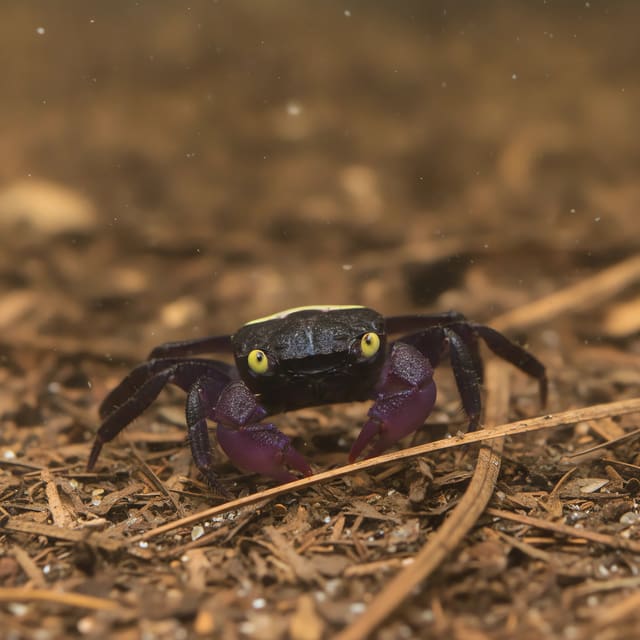
Red Tomato Vampire Crab (Geosesarma sp.) is an unresolved trade form for a secure, humid paludarium with plenty of usable land, accessible clean freshwater, deep moisture-retentive substrate, leaf litter, cover and a varied animal-and-plant diet.
Geosesarma sp.
Red Tomato Vampire Crab (Geosesarma sp.) is an unresolved trade form for a secure, humid paludarium with plenty of usable land, accessible clean freshwater, deep moisture-retentive substrate, leaf litter, cover and a varied animal-and-plant diet.
The Red Tomato Vampire Crab is sold here as Geosesarma sp., a genus-level identity rather than a named species. The red trade name helps distinguish the offer, but it does not prove a species, locality or lineage. That distinction matters because precise adult size, water targets and group rules can differ among animals traded under the wider vampire-crab label. This Red Tomato Vampire Crab is identified only as Geosesarma sp.; its exact species remains unknown.
This is a semi-terrestrial crab for a purpose-built paludarium, not a crab to add to an ordinary fish aquarium. Its useful space should be mostly humid land, with clean freshwater that it can reach and leave easily. Soil or fine sandy substrate, moss, leaf litter and cork-bark cover give the animal places to move, shelter and burrow. A close-fitting, escape-resistant top is an essential part of the enclosure because the hardscape and planting create climbing routes.
One purchase supplies one live crab. The crab is supplied at a 4 cm dispatch grade; that is the size supplied, not an adult-size promise. Sex is guaranteed only when the selected option explicitly states male or female. This Red Tomato Vampire Crab listing has no sex-guaranteed option. Colour, pattern, size and maturity can differ naturally between live animals, so plan the home around the animal's husbandry rather than an exact visual match.
Think of this crab as a paludarium animal first and a shopping colour name second. The best buying decision starts with the enclosure already planned: humid land that remains usable, a clean freshwater area, a secure boundary and a maintenance route that does not require taking the habitat apart. If those basics are ready, the trade form can be enjoyed for what it is without attaching a species story or a precise biological promise that the name cannot carry.
Geosesarma crabs are land-oriented, and a humid paludarium with extensive usable land beside accessible freshwater is the safest genus-level starting point. Species-specific measurements should not be applied to this unresolved trade form. It also gives a clear test for suitability: a keeper who wants a conventional all-water display should choose another animal, while someone interested in planted banks, leaf litter, moss and sheltered land can build around the crab from the start.
| Suits | Keepers ready to build and maintain a secure, humid, primarily land-based paludarium with accessible freshwater. |
|---|---|
| Not suited to | A standard fully aquatic community aquarium or a set-up where escape gaps, dry substrate or copper exposure cannot be controlled. |
| Identity | Red Tomato Vampire Crab; identified only as Geosesarma sp. |
| Sold unit | One live crab per purchase. |
| Core habitat | Moist land, deep diggable substrate, leaf litter, moss, cork or similar hides, and clean freshwater access. |
| Feeding approach | A varied menu spanning prepared crab foods, small animal foods and plant matter. |
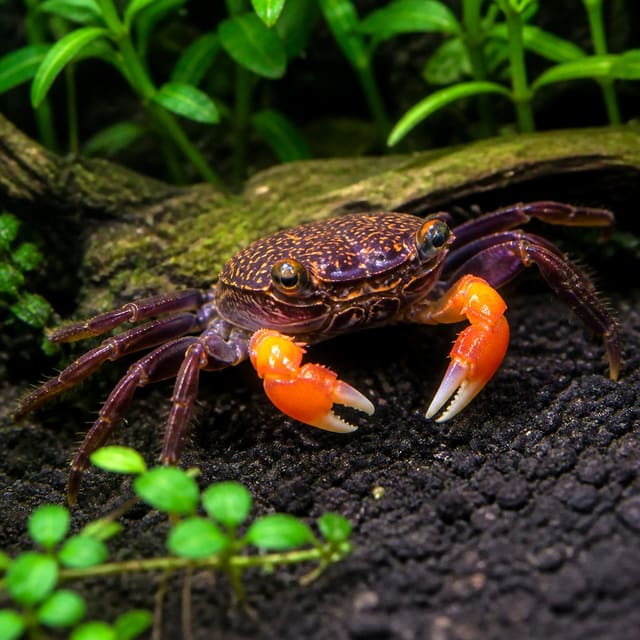
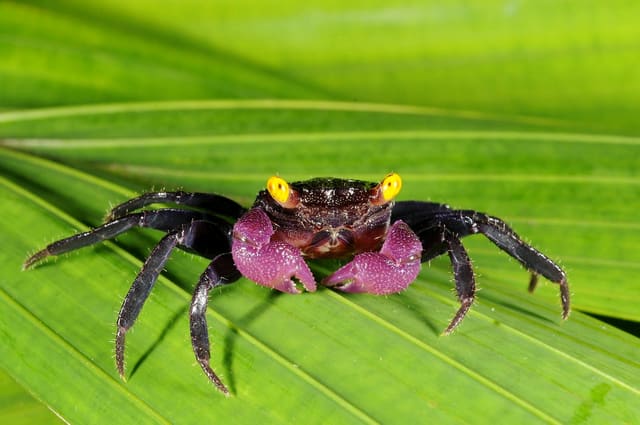
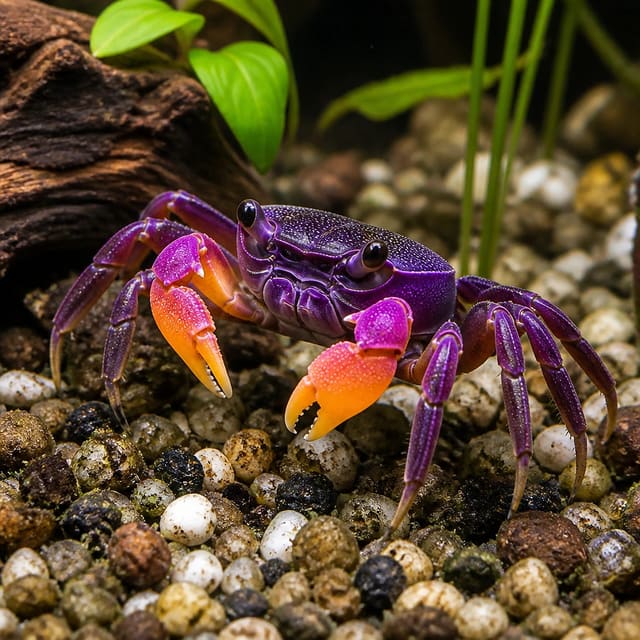
Gallery images have been digitally enhanced to improve image quality. Natural colour, pattern, size and maturity can vary between live animals.
Start by deciding whether you genuinely want a land-and-water enclosure. If the answer is yes, the shrimps and crustaceans collection provides wider context for specialist invertebrate keeping. The Red Tomato Vampire Crab is the better choice when the paludarium itself is part of the appeal: a planted, humid landscape with a clean freshwater area, rather than an aquarium whose main purpose is keeping fish.
No exact minimum enclosure volume is established for this unresolved trade form. That makes floor plan and structure more useful planning tools than a fixed litre figure. Set aside generous usable land, then add a freshwater area with easy, stable access. The land should not be a token island surrounded by deep water. It should be the animal's main living surface, furnished so the crab can move between exposed and covered places without being forced into the open.
A secure top must close the whole enclosure while still allowing sensible ventilation. Check cable ports, pipe cut-outs, lid corners and the spaces around backgrounds or branches. An enclosure can look closed from above while still offering a route where wood, silicone or plants meet the rim. Finish these details before the crab arrives so the animal can move into a settled home.
Create a humid, textured land area with soil or fine sand, moss, leaf litter and cork-bark cover. Together these materials provide a moisture-retentive surface rather than a bare shelf; the Geosesarma care sheet gives further husbandry detail. Use enough substrate for burrowing and for roots to establish, while keeping it stable around the water's edge. Leaf litter offers cover and a natural foraging surface. Cork, wood or comparable hides create sheltered pockets and make the usable land three-dimensional.
Moisture-retentive does not mean turning the whole land area into stagnant mud. Aim for damp substrate and high humidity while preserving surface variation. A keeper should be able to inspect the enclosure, remove spoiled food and reach the water without dismantling every refuge. Stable planting and several covered routes are more useful than one decorative cave placed in an otherwise open enclosure.
Wet planted soil beside freshwater, extensive land use and room to burrow are useful features in a vampire-crab paludarium; the Los Angeles Zoo profile of G. dennerle illustrates those habitat features. Keep this Red Tomato crab at genus level and avoid species-specific measurements or reproduction assumptions.
The water area must be freshwater, easy to enter and easy to leave. Avoid steep smooth walls that turn the water into a trap. Place stone, cork or textured wood so there is a clear route at the margin, and make sure any structure is stable. Cleanliness matters even when the water section is smaller than the land area. Remove waste, test the water and keep the biological system working rather than assuming a small pool looks clean because it is clear.
The OATA freshwater-crab sheet gives 22–27 °C, pH 7.0–8.0 and 8–18 °dH as broad guidance for the wider group. Those figures are not an exact optimum for this unresolved Red Tomato form, so they are not presented as standalone product specifications. Use them as context when discussing the water area with an experienced retailer, keep conditions stable and avoid sudden changes. The water chemistry guide explains what common aquarium tests measure, while the water matcher can help organise measured values before asking for species-specific advice.
If filtration is used, choose a layout that keeps water moving and biologically managed without creating an inaccessible intake or a difficult exit. A working biological filter helps convert toxic ammonia through nitrite towards nitrate. Test regularly and maintain the freshwater area responsibly, while remembering that filtration does not replace the humid land habitat; the RSPCA aquarium guidance explains the nitrogen cycle in more detail.
Build, plant and test the enclosure before ordering. Confirm that the lid closes, the water margin is stable, the substrate holds moisture, and the water can be maintained without flooding the land. Watch how the enclosure behaves over normal room-temperature changes. A mature, predictable layout is far easier to correct without an animal present.
The store's invertebrate set-up guide is useful for the general discipline of preparing water and biological filtration before livestock arrives. Apply that discipline to the freshwater portion while remembering that this crab's main requirement is a humid terrestrial area. A filter and tested water do not compensate for missing land, and a beautiful planted bank does not compensate for polluted water.
A varied diet spanning animal and plant foods is the sensible starting point. Suitable categories include prepared crab food, small animal foods and plant matter such as greens or modest pieces of fruit. The Red Tomato Vampire Crab can therefore be fed as an omnivorous scavenger, without imposing a rigid timetable or treating one ingredient as nutritionally complete. Rotate sensible foods, use pieces the crab can handle, and judge the amount by what is actually eaten rather than by a universal portion rule.
Place food where it can be found without contaminating the whole water area. Leaf litter and covered land are part of the animal's usable environment, but perishable leftovers still need attention. Remove spoiled food carefully, especially where it can become hidden under damp furnishings. Clean-up should preserve the stable habitat rather than repeatedly stripping the enclosure bare.
Do not narrow the menu to insects, fruit or one pellet alone. Rotate suitable animal-and-plant foods so the crab receives genuine variety without relying on a single category. Variety is the central rule; exact frequencies and quantities must be adjusted to the individual and the enclosure.
Make routine access part of the design. You should be able to remove debris, refresh water appropriately and inspect hidden corners without collapsing the bank. A removable dish or serviceable pool can work when it still provides safe access; a filtered area can work when intakes and exits are suitable. No single engineering solution is required, so choose the arrangement you can keep clean and stable.
Test water rather than relying on appearance. Clear water can still contain harmful nitrogen compounds, and shallow volumes can change quickly when food or substrate enters them. Treat replacement tap water appropriately and avoid exposing the crab to abrupt differences. Clean, tested freshwater is the goal; a particular exact-form pH, hardness or temperature target has not been established for this trade form.
Copper is toxic to invertebrates, so choose invertebrate-safe, copper-free treatments. Read labels on water conditioners, medications, plant treatments and decorative products before use. A product marketed for fish is not automatically appropriate for a crab enclosure. When there is uncertainty, pause and obtain advice rather than adding a treatment speculatively.
Good day-to-day observation is more valuable than building a disease-treatment section from guesses. Notice changes in feeding, movement and use of shelter, check the water, and look for environmental causes such as drying substrate, fouled water or an escape gap. A Red Tomato-specific treatment protocol, lifespan and moulting schedule cannot be given reliably at genus level.
A paludarium is easiest to manage when land, water, plants and access have been planned together. Water can wick into substrate, loose soil can move into the pool, food can be carried under cover, and a branch can become an escape route. These interactions are not reasons to avoid the format; they are reasons to look at the whole enclosure during routine care instead of treating the land and water as unrelated compartments.
Begin each inspection at the boundary between land and water. Check that the entry route remains firm, that the crab can leave the water without climbing a smooth vertical face, and that substrate has not slumped into the pool. Look at the lid and cable openings from the animal's level as well as from above. A small shift in wood or planting can create a new route to the rim.
The land area should stay humid and moisture-retentive, but food and furnishings still need sensible hygiene. Remove spoiled pieces, inspect the underside of accessible hides and keep the freshwater area free of decomposing material. Leaf litter and moss are useful habitat features, so routine care should preserve them while dealing with localised waste. The aim is a stable living surface, not a bare enclosure that is rebuilt at every clean.
Watch how quickly different parts of the land dry. Exposed edges may lose moisture faster than shaded areas under cork or planting. Adjust the layout and watering practice gradually, then observe the result. There is no reliable exact humidity percentage for this trade form, so practical consistency and the condition of the substrate are more useful than chasing a number detached from the enclosure.
A short husbandry note can make patterns easier to see. Record when water was tested, when a food was offered, what remained, and whether the crab used land, water and shelter as usual. This is not about turning the animal into a spreadsheet; it helps separate a one-off observation from a repeating change and gives useful details if advice is needed.
Change one major feature at a time where possible. If water quality, food, cover and substrate are all altered together, it becomes difficult to understand what helped. Gradual, observable adjustments fit the wider guidance to keep conditions stable. They also reduce the temptation to reach first for medication when the enclosure itself may need attention.
Before lifting a hide or moving wood, locate the crab. Work slowly and keep the lid controlled while your hands are in the enclosure. Prepare tools and replacement water in advance so the paludarium is not left open. After maintenance, check every edge, cable route and contact point again rather than assuming the lid has returned to exactly the same position.
Use dedicated tools that have not been contaminated with household chemicals or copper-bearing aquarium treatments. Rinse and store them so they are ready for the next service. If any product has been used elsewhere, check its suitability for invertebrates before it enters the crab enclosure.
The Red Tomato label does not resolve species, adult size, lifespan, group structure or exact water preferences. Plan cautiously around that uncertainty rather than filling the gaps with confident guesses. The positive requirements are still clear: a secure humid land-first enclosure, accessible clean freshwater, deep moisture-retentive substrate, leaf litter and cover, varied animal-and-plant food, careful waste removal and copper-safe product choices.
Different Geosesarma species are not biologically identical. If this trade form is identified reliably in future, species-level husbandry can refine the plan. Until then, the land-first genus-level guidance above is the safest practical foundation.
A specialist set-up succeeds when normal tasks are straightforward. Leave a clear route for testing the freshwater area, removing old food and checking the lid. Position cork and planting so they give cover without blocking every view into the substrate. Keep the water margin visible enough to notice a collapsed bank or trapped debris. These choices make regular care calmer for both keeper and animal.
Consider how water will be added or removed before finalising the hardscape. A service point that can be reached without lifting the main shelter helps preserve the established structure. Likewise, a removable feeding surface can make leftover food easier to find while still allowing the crab to carry food under cover. The goal is not a sterile display; it is a furnished habitat whose hygiene can be managed.
Before each maintenance task, close doors and windows nearby, prepare a temporary secure container in case it is needed, and make sure the lid can be controlled throughout. After finishing, count tools, locate the crab and check the enclosure perimeter. These simple habits complement the escape-resistant design and reduce hurried handling.
Have the paludarium running and checked before the parcel is due. Confirm that the lid is secure, the land is damp, freshwater is accessible and there is a covered place ready for the crab. Keep the room calm and organise the transfer route so the animal is not left exposed while equipment is adjusted.
The store policy requires someone to be present for live-animal delivery and asks customers to inspect the parcel on the day it arrives. If there is a problem, continuous unboxing video beginning with the sealed parcel and showing the animal before it is disturbed helps the store handle a Live Arrival Guarantee claim. Read the current delivery and Live Arrival Guarantee policy before delivery day.
A fish-style floating routine is not prescribed for this semi-terrestrial animal. The useful priorities are a ready enclosure, a calm direct transfer, secure humid cover, clean freshwater access and the correct record if a claim is needed.
The clearest compatibility advice is caution with fish and a dedicated-set-up bias. This is practical because a semi-terrestrial crab and an aquatic community use the enclosure differently. Building around the crab makes it easier to provide useful land, shallow freshwater access, cover and secure boundaries without compromising those needs for fish swimming space.
No fish can be treated as a universally safe tank mate for this unresolved trade form. A fast fish, small fish or bottom-dweller label is not enough to prove safety, and a product listed as an alternative is not automatically a compatible companion. If mixed housing is being considered, treat it as an individual enclosure-design decision and seek advice on the exact animals, water area and escape routes.
No dependable Red Tomato-specific group number, male-to-female ratio or aggression rule has been established. That means a fixed claim such as a pair, trio or small colony would be guesswork. The responsible plan is to provide abundant usable structure and avoid purchasing a group on the assumption that a simple number guarantees harmony.
When more than one crab is considered, the enclosure needs multiple covered areas and enough separated resources that one shelter or feeding place is not the only useful location. This is sound layout planning, but it still does not prove that unfamiliar individuals will be compatible. Watch behaviour and have a safe separation plan rather than treating the trade colour as evidence of social behaviour.
| Dedicated paludarium | Preferred starting point because the whole enclosure can be designed around semi-terrestrial crab care. |
|---|---|
| Fish | Caution. OATA advises caution with fish for freshwater crabs, and there is no universally safe fish companion for this trade form. |
| Other crabs | No dependable exact group formula has been established for this trade form; space and individual behaviour require careful planning. |
| Related products | Use as shopping comparisons only, never as automatic tank-mate recommendations. |
The core rule is simple: protect the crab's land-first care needs and do not make mixed housing the reason to compromise the paludarium. A well-planned dedicated home is easier to understand, maintain and observe.
No. This Geosesarma trade form needs a primarily land-based humid paludarium with accessible clean freshwater. Give it substantial usable land, moisture-retentive substrate, leaf litter, moss and secure hides rather than placing it in a standard fish aquarium.
Use deep damp soil or fine sandy substrate with moss, leaf litter and cork bark or comparable cover. The land should offer sheltered routes and diggable areas while remaining practical to inspect and clean. A tight, escape-resistant lid is essential.
Provide clean tested freshwater with easy entry and exit. OATA's 22–27 °C, pH 7.0–8.0 and 8–18 °dH figures are broad freshwater-crab guidance, not an exact optimum for this unresolved trade form, so keep conditions stable and seek advice for the individual animal.
Offer a varied menu spanning prepared crab food, small animal foods and plant matter. The useful principle is variety, with spoiled leftovers removed before they foul the humid land or freshwater area; do not impose one rigid feeding schedule.
Copper is toxic to invertebrates. Check conditioners, medications and other water products for invertebrate safety before use, and avoid adding a fish treatment to the paludarium simply because it is sold for aquariums.
A dedicated paludarium is the safer starting point. OATA advises caution with fish for freshwater crabs, and no universal fish companion is named for this unresolved form. Do not treat a related product or similar water requirement as proof of compatibility.
No exact group number or sex ratio has been established for this Red Tomato trade form. Do not buy to a fixed colony formula. If considering more than one crab, plan abundant separated cover and resources, watch behaviour closely and keep a safe separation option.
Have the secure humid paludarium ready. For a possible Live Arrival Guarantee claim, begin continuous video with the parcel still sealed, then open and inspect it on the day of arrival. Move the crab calmly into the enclosure without adding transport water, and contact Tropical Fish Co the same day if something is wrong.
No reviews for this item yet. Bought one? Honest reviews only, good or bad.
What customers say about ordering from us
I have a small group of long finned mountain minnows. So was delighted to be able to order ten of this variety to increase the genetics in my tank . The ones I recieved are healthy but it’s to early to give a verdict on wether they are of a long finned type since they are small currently.
Gordon Walker · 23 Sept 2026
100% success travel and "installation". Pleased with quality of purchase. The Siamese fighter a bit "shy" so have not yet seen him at his best yet but looking good. Happy customer. GG
George E Garratt · 21 Sept 2026
Reviews of our shop, collected by Judge.me, an independent third-party review collector. Newest first.
22–27°C · pH 7–8


22–28°C · pH 7.5–8 · 40L



22–28°C
22–28°C · pH 7.5–8 · 40L

22–27°C · pH 7–8
24–28°C · pH 7–8.5 · at least 75 litres, preferably larger (around 100+ for a single adult)

22–28°C · pH 7–8 · 41L

21–25°C · pH 5–7
24–29°C

24–27°C · pH 6.5–6.5

22–27°C · pH 6–8 · 72L
24–27°C · pH 6.5–8 · 200L

23–27°C · pH 5.5–7 · 60L

22–27°C · pH 6–8