Moderate
Purple Vampire Crab (Geosesarma dennerle) – Semi-Terrestrial Paludarium Crab
£8.09
Vampire Crab Colour Mix (Geosesarma sp.) is an unidentified trade form of a small, semi-terrestrial vampire crab that lives mostly on land. Each purchase is one crab from a mixed-colour batch. Give it a secure, humid paludarium with plenty of land, deep burrowing substrate, moss, leaf litter and hides, easy access to clean fresh water and a varied diet, and plan a crab-only set-up rather than a fish tank.
Geosesarma sp.
Vampire Crab Colour Mix (Geosesarma sp.) is an unidentified trade form of a small, semi-terrestrial vampire crab that lives mostly on land. Each purchase is one crab from a mixed-colour batch. Give it a secure, humid paludarium with plenty of land, deep burrowing substrate, moss, leaf litter and hides, easy access to clean fresh water and a varied diet, and plan a crab-only set-up rather than a fish tank.
The Vampire Crab Colour Mix is a small, semi-terrestrial crab from the genus Geosesarma, the group sold in the hobby as vampire crabs. Each purchase supplies one crab from a mixed-colour batch, graded by the supplier at around 4 cm, so the colour of the individual you receive is not something you can pick. The most important thing to know before ordering is that this is a land-living crab: it needs a humid, secure paludarium with plenty of ground and easy access to fresh water, not a conventional fish tank.
The exact species has not been identified, so the care advice here follows the genus Geosesarma and its care group. That means the guidance on this page is built around what is well documented for vampire crabs as a group, rather than numbers that belong to one particular species.
Kept well, vampire crabs turn a planted paludarium into a small, busy landscape. They pick through leaf litter for food, dig retreats in damp soil, clamber over bark and wade in at the water's edge, which makes them rewarding to watch once they have settled and feel secure.
| Suits | Keepers building a dedicated, humid paludarium with a secure lid |
|---|---|
| Supplied as | One crab from a mixed-colour batch, at the supplier's 4 cm grade |
| Lifestyle | Mostly on land, visiting fresh water to drink and bathe |
| Set-up | Moist burrowing substrate, moss, leaf litter, cork bark and plants, plus an easy-access freshwater area |
| Diet | Varied: prepared crab food, small animal-based foods, fruit and greens |
| Fish | Keep separately; a crab-only set-up is the safer plan |
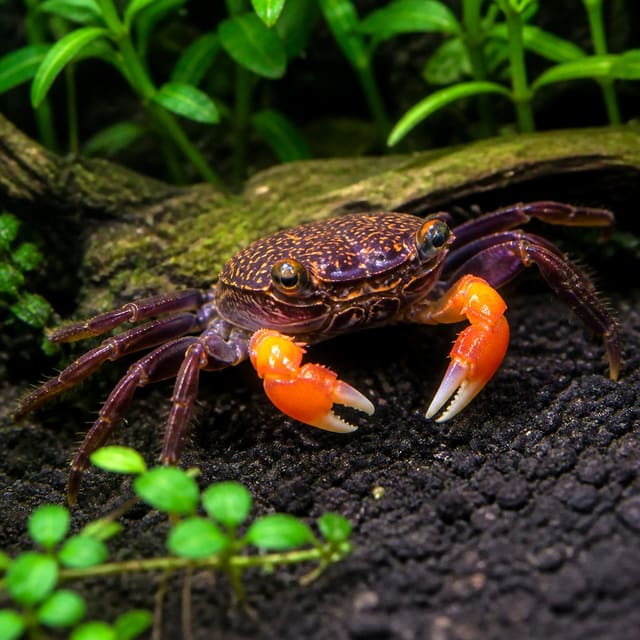
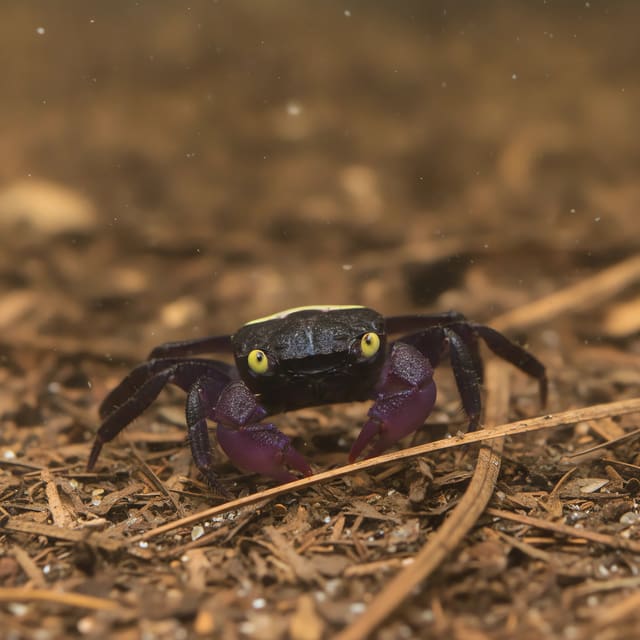
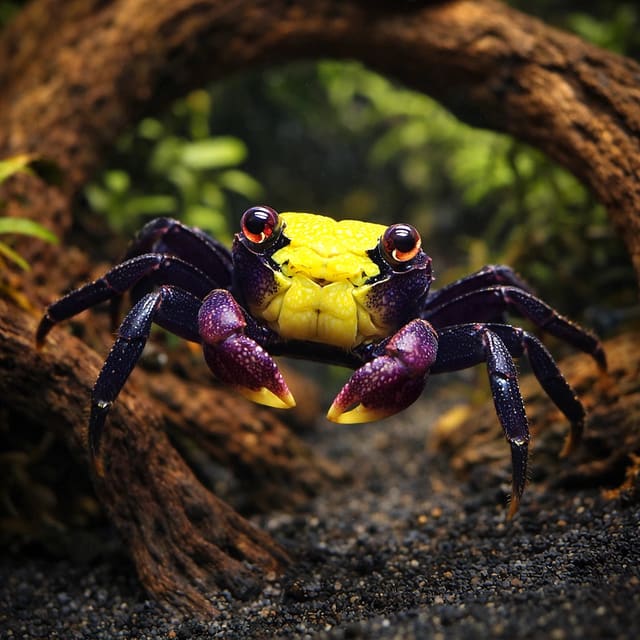
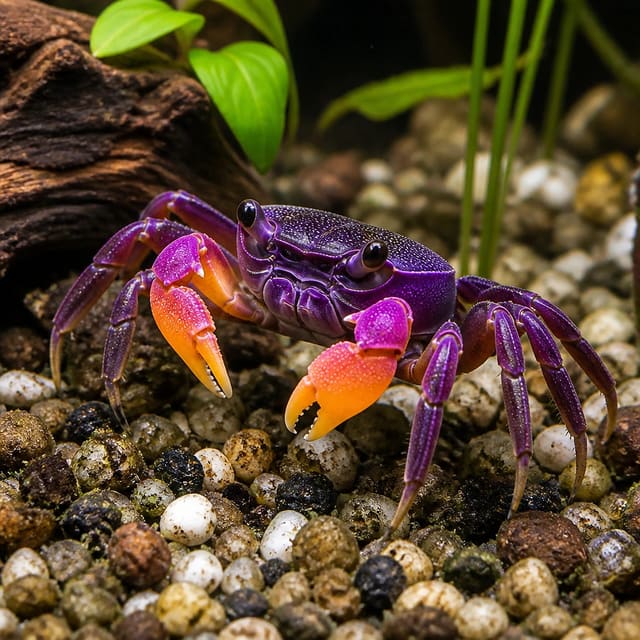
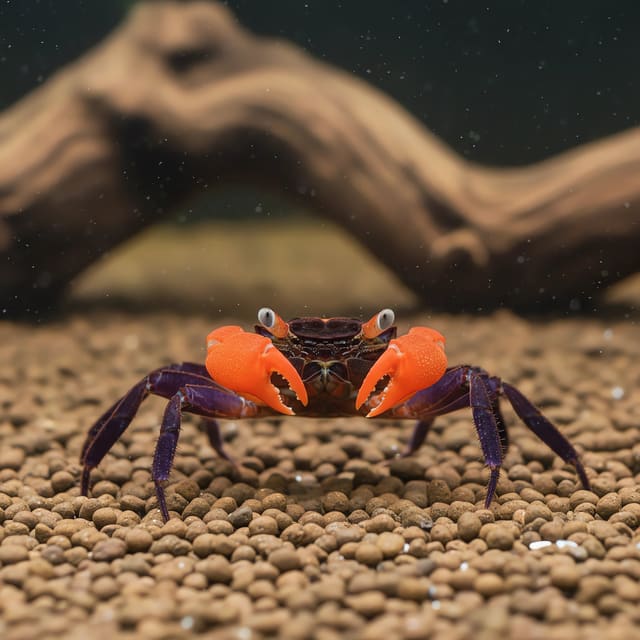
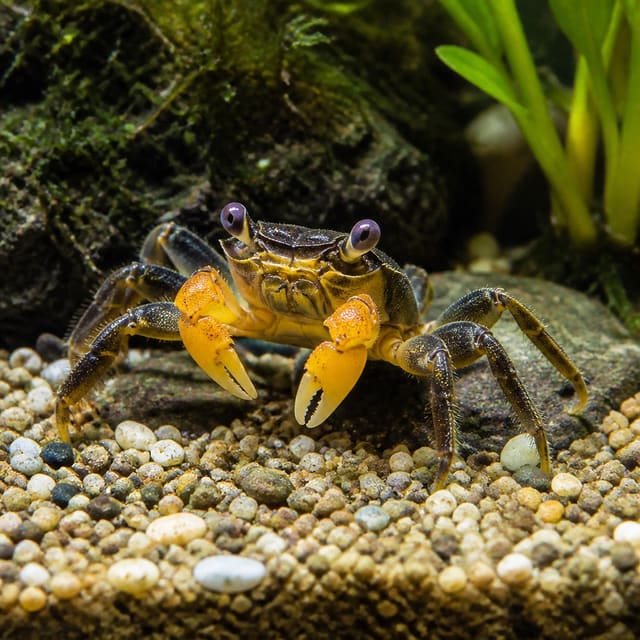
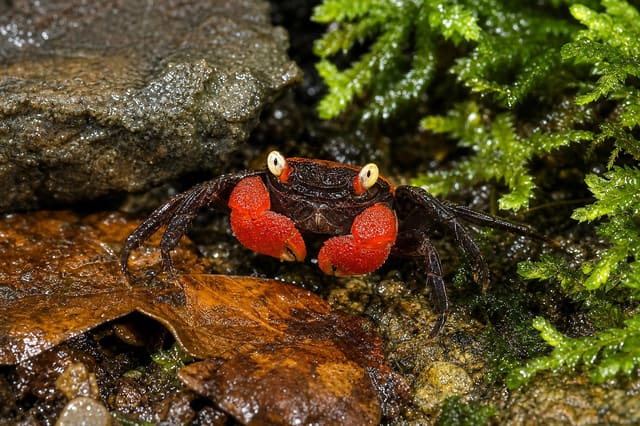
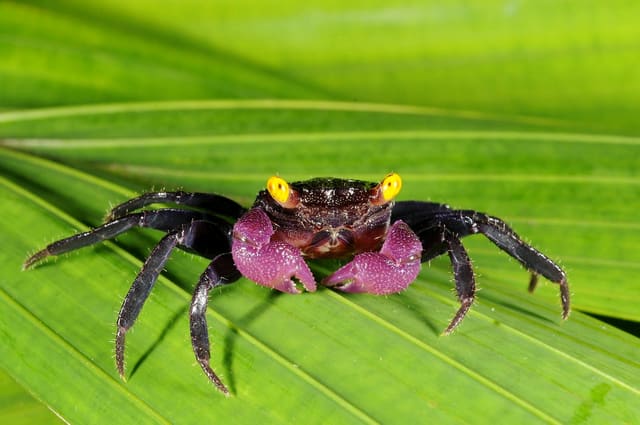
Vampire crabs are sold under a range of trade names that describe colour rather than species. A colour mix is a batch of crabs in different shades, and the one you receive is taken from that batch. The photograph shows three crabs in purple, orange and dark red tones on pebbles beside mossy wood, which gives a fair idea of the variety. Gallery images have been digitally enhanced to improve image quality. Natural colour, pattern, size and maturity can vary between live animals. If you want one particular colour, a single named colour form is a better choice than a mix.
Sex is guaranteed only when the selected option explicitly states male or female. This Vampire Crab Colour Mix listing has no sex-guaranteed option. Each purchase is simply one vampire crab from the mixed-colour batch, whatever its shade.
| A good match | Think again |
|---|---|
| You enjoy building and tending a planted, humid enclosure | You want an animal for an existing fish tank |
| You are happy to watch a shy animal that often stays hidden | You want an animal that is always on show |
| You can check humidity, water and leftovers every day | The enclosure would be left for long spells without checks |
| You are content with an animal of mixed, unselected colour | You need one particular colour or a named species |
Because each purchase is a single crab, you can build up to more than one over time. Plan the enclosure, hides and feeding spots for the final number before the first crab arrives, rather than squeezing extra crabs into a space designed for one. If you would like to compare other crustaceans before deciding, you can browse our shrimp and crustacean range.
Geosesarma is an accepted genus in the family Sesarmidae, according to the World Register of Marine Species. The genus contains a number of named species, and vampire crabs in the trade are frequently sold under colour names without a confirmed species. That is the situation here: the label tells you the genus and the colour mix, not the species.
The 4 cm figure is the supplier's grade for the crabs sent out, not a measurement of the adult. Crab sizes are also quoted in different ways, sometimes as the width of the shell and sometimes including the legs, and the two can differ a great deal. As the species behind this colour mix is unknown, we do not quote an adult size for it; plan the enclosure around the crab's behaviour and needs, which are shared across the genus, rather than around a single number.
The Los Angeles Zoo keeps one named species, Geosesarma dennerle, and its account of that crab describes a warm, humid, thickly planted habitat with wet soil beside fresh water, adults that spend most of their time on land and burrow, and scavenging on both animal and plant material. That is useful context for how vampire crabs live, but it describes a different, identified species, so its figures for size, breeding and range are not applied to this mix.
A paludarium is an enclosure that combines land and water in one set-up. For a vampire crab the land is the main living space and the water is a place to drink, bathe and moisten itself. Specialist keepers of Geosesarma describe crabs that spend most of their time on land but will venture into water, and that balance should shape every decision.
Vampire crabs can climb and slip through small gaps, so an escape-resistant enclosure matters more than its exact size. Fit a close-fitting lid, seal cable and tubing gaps, and check that no plant, piece of wood or silicone seam gives an easy route to the top. A crab that escapes into a dry room is in real danger, so it is worth testing every opening before the crab arrives.
Wild vampire crabs live in humid places where the ground stays damp, and the zoological account of G. dennerle describes a warm, humid, thickly planted setting. In the home, that means:
Stable conditions matter more than hitting a precise figure. Place the enclosure away from direct sun, radiators and draughts, all of which can swing temperature and dry the air quickly. In a UK home, central heating in winter tends to dry room air and a hot spell in summer can push an enclosure too warm, so check your readings more often at those times of year.
Vampire crabs dig. A deep, moisture-retentive substrate of soil and sand lets them make burrows and retreats, and holds moisture so the enclosure stays humid. Build the land up so part of it is deep enough to burrow into and slopes down gently towards the water. Cover the surface with moss and leaf litter, which keep the ground damp, give the crabs natural cover and provide something to pick through while they forage.
Arrange everything so it is stable. Heavy pieces should rest on the base or on firm substrate rather than on loose soil a crab could dig away.
Running the set-up before the crab arrives shows you how quickly it dries out, whether the lid holds humidity and whether any part of the land becomes waterlogged. Those are much easier to fix in an empty enclosure.
Even though a vampire crab spends most of its life on land, the water it uses must be clean. It drinks from it, bathes in it and carries moisture back onto the land, so dirty water affects the whole enclosure.
Waste and leftover food break down into ammonia, which is toxic. As the RSPCA explains for aquariums, a working biological filter lets beneficial bacteria turn ammonia into nitrite and then into the less harmful nitrate. A small paludarium pool may be filtered or kept clean by regular partial changes; either way, test it rather than judging by appearance. Our freshwater shrimp care guide explains how to mature water and check it before invertebrates arrive, and those basics apply to the crab's pool even though the rest of this set-up is land.
OATA's care sheet for crayfish and freshwater crabs, which expressly includes vampire crabs, gives 22–27 °C, pH 7.0–8.0 and 8–18 °dH. OATA describes these as a general guide for the whole group, which ranges from large crayfish to tiny land crabs, not as an optimum for any one species. Use them as a sensible frame for the water area, aim for stability within them and avoid sudden changes.
If pH and hardness are unfamiliar terms, our guide to aquarium water parameters explains what each value means, and the water parameter matcher lets you compare your tap water with the group guidance above before the crab arrives.
A vampire crab enclosure stays healthy through small, regular jobs rather than occasional big clean-outs, which disturb burrows and hides.
| How often | What to do |
|---|---|
| Every day | Check warmth and humidity, remove leftover food, look at the water for debris, and mist the land if the surface is drying. |
| Every few days | Change part of the water with conditioned fresh water at a similar temperature, and wipe away any mould on food spots or decor. |
| Weekly | Test the water area for ammonia and nitrite, replace fouled moss or leaf litter near the water's edge, and check every lid seal and cable gap. |
| As needed | Top up leaf litter, trim plants, and refresh any patch of substrate that smells sour or stays waterlogged. |
Work gently around hides and burrows. A crab that has dug in, or is hiding to moult, is best left undisturbed, so clean the areas around it and come back to its corner another day.
Vampire crabs are animals to watch rather than handle. Picking one up is stressful for it, and a fall onto glass or stone can injure such a small crab. When you do need to move one, guide it into a small container with a soft brush or your hand rather than grabbing it, and keep it low over the enclosure.
Vampire crabs are scavengers that eat both animal and plant material. The zoological account of G. dennerle describes scavenging on both, OATA recommends a varied diet of animal and plant foods for freshwater crabs, and specialist keepers of Geosesarma list a menu that mixes prepared crab food, small animal foods, fruit and greens.
| Food type | How to use it |
|---|---|
| Prepared crab food | A reliable base that is easy to portion |
| Small animal-based foods | Variety and protein, offered in crab-sized pieces |
| Fruit | Small pieces as part of a mixed diet |
| Greens | Small portions of leafy plant matter alongside the other foods |
Rotate between these food types rather than relying on one. Offer small amounts on a flat stone or shallow dish on the land area, where you can see what has been eaten, and remove leftovers before they spoil. In a warm, humid enclosure uneaten food moulds quickly and can foul both the substrate and the water.
A shy crab may not eat while you are watching. If you rarely see yours feed, offer food in the same spot each time and check later to see what has gone. A crab that ignores food for a while is not necessarily unwell, especially if it has recently dug in or is hiding more than usual, but a long loss of appetite together with lethargy is a reason to check conditions.
Every Tropical Fish Co order is hand-packed by our team and sent in an insulated poly box, with a heat pack when the weather calls for it, by a tracked, licensed live-animal courier. You receive the tracking number and your confirmed delivery date by email, and the full conditions are set out in our delivery and Live Arrival Guarantee policy.
Plan the paludarium well ahead of ordering. It should have run for several days with steady warmth and humidity, the water area should be clean and tested, and hides should already be in place, so the crab moves straight into a settled home rather than a newly built one.
The delivery page describes floating bags for fish. A vampire crab lives mostly on land, so its arrival is simpler and should not involve adding transport water to the enclosure.
Expect a new crab to hide. It may dig in straight away or tuck itself under bark and stay out of sight for some time while it settles. Resist the urge to lift hides to check on it; instead keep the enclosure humid, offer a small amount of food near its hiding place and remove anything uneaten the next day.
Watch quietly for signs that it is exploring, drinking and feeding. If you add more crabs later, introduce them into an enclosure with plenty of spare hides so newcomers are not forced to compete for cover.
Like all crabs, vampire crabs grow by shedding their shell. A crab preparing to moult, or recovering from one, often hides more than usual and may stop eating for a while. That is a normal part of growth. Keep the enclosure stable and humid, leave hides undisturbed and avoid handling. A newly moulted crab is soft and vulnerable, which is one more reason to provide enough cover for every crab.
Crustaceans are sensitive to copper, and OATA advises copper-safe treatment choices for freshwater crabs. Check the label of anything that could reach the enclosure: water conditioners, plant fertilisers, plant treatments and medicines intended for fish tanks. Choose invertebrate-safe, copper-free products, and rinse new plants and decor well before adding them.
Many problems with vampire crabs trace back to the enclosure drying out, dirty water or an escape route, so a daily look at those three things prevents most trouble.
Because the genus reproduces on land, with development taking place inside the egg, vampire crabs do not need a separate larval-rearing set-up of the kind some other crabs and shrimp require. Breeding behaviour, clutch size and timing differ between species, though, and the species of this mix is unknown, so no breeding plan is offered here beyond keeping healthy crabs in good conditions.
Vampire crabs are best kept in a set-up designed around them. OATA advises caution when keeping freshwater crabs with fish, and the practical reasons are clear once you picture the enclosure: a crab that spends most of its time on land needs a big humid land area, while fish need open water. Combining the two usually compromises both.
| Situation | Our advice |
|---|---|
| Fish in a shared tank | Keep separately. A crab-only paludarium is the safer and simpler plan. |
| More than one vampire crab | Possible in a suitably spacious enclosure; add hides and feeding spots in proportion and watch how the crabs share space. |
| Other crab species or invertebrates | Better kept in their own set-ups; each has different needs, and mixing them makes conditions harder to judge. |
| A community aquarium | Unsuitable, because it offers no proper land area. |
If you decide to keep several vampire crabs, space and structure matter more than any particular number. Give every crab several hides, spread food across more than one spot and make sure the land area has room for crabs to keep apart. Watch the first weeks closely. A crab that is persistently chased away from food or cover needs more space or a separate enclosure.
Because individual crabs and species differ, no pairing or group is guaranteed to work. Planning a dedicated enclosure with room to adjust is the most reliable way to keep vampire crabs well.
It is a small semi-terrestrial crab of the genus Geosesarma, sold as a mix of colour forms. The exact species has not been identified, so it is labelled Geosesarma sp. and cared for as a vampire crab rather than as any one named species.
Vampire crabs spend most of their time on land and visit water rather than living in it, and the genus even reproduces on land. A paludarium gives them humid ground to walk, dig and hide on, with clean fresh water they can reach whenever they choose.
Give most of the floor space to land and add a clean freshwater area the crab can walk into and out of easily, using gentle slopes, stones or roots. Keep the land moist and the enclosure humid, and fit a secure lid because these crabs climb.
Use a deep, moisture-retentive mix of soil and sand that the crab can burrow into, topped with moss and leaf litter. Add pieces of cork bark and plants so every crab has several places to hide.
Offer a varied diet that combines a prepared crab food, small animal-based foods and plant matter such as fruit and greens. Feed small amounts and remove anything left over so it does not spoil in the humid enclosure.
No. Choose copper-free, invertebrate-safe products for anything that goes into the enclosure or its water, and check labels on plant and water treatments before use.
OATA advises caution when keeping freshwater crabs with fish, and a crab that lives mostly on land gains little from a fish community. A dedicated paludarium planned around the crabs is the safer choice.
Tropical Fish Co hand-packs each order into an insulated poly box, with a heat pack when the weather calls for it, and sends it by tracked, licensed live-animal courier. Someone needs to be in to receive it. Open and inspect the parcel the same day while filming one continuous unboxing video from the sealed box, move the crab into its prepared paludarium without the transport water, and report any problem the same day to keep the Live Arrival Guarantee.
These references support the identity, habitat and care information on this page.
No reviews for this item yet. Bought one? Honest reviews only, good or bad.
What customers say about ordering from us
Easy website plenty of info on fish your buying great to pick a time slot
TRACEY DURRANT · 7 Oct 2026
Got some lovely fish thank you
Kevin Mackie · 7 Oct 2026
Reviews of our shop, collected by Judge.me, an independent third-party review collector. Newest first.