

Moderate
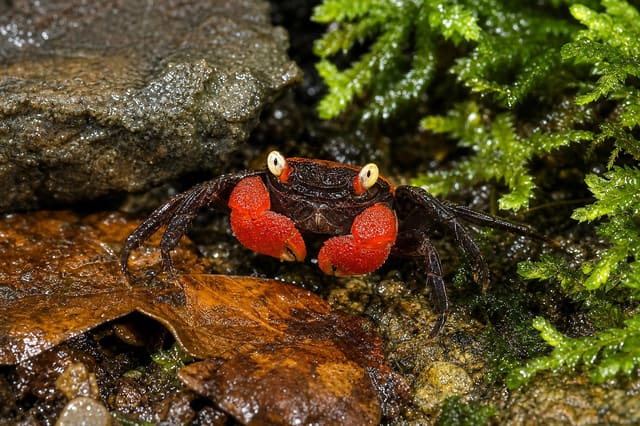
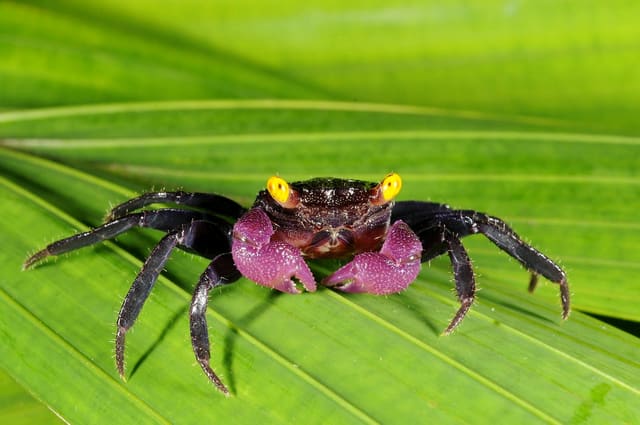
Red Tomato Vampire Crab (Geosesarma sp.)
£13.99

A semi-terrestrial Geosesarma trade-form crab supplied at approximately 3-4 cm, for a secure humid paludarium with substantial damp land, shallow freshwater and dense cover.
Geosesarma sp. (Midnight Red Claw trade form)
A semi-terrestrial Geosesarma trade-form crab supplied at approximately 3-4 cm, for a secure humid paludarium with substantial damp land, shallow freshwater and dense cover.
Maintain these water conditions for optimal health and vibrant colors
Midnight Red Claw Vampire Crab is the trade name used for this small Geosesarma crab, supplied at approximately 3-4 cm. It is a semi-terrestrial invertebrate for a humid, planted paludarium: the enclosure needs substantial damp land, safe access to shallow freshwater, dense cover and a secure lid. It is not suitable for a conventional fish tank filled with deep water.
The supplier identifies this animal only as Geosesarma sp. "midnight red claw". That is a genus-level trade identity, not a formally verified species name. We therefore describe the care features that can be supported for the genus and this trade listing, while avoiding invented claims about exact locality, adult size, lifespan or narrow water chemistry. This distinction matters because several colourful Geosesarma forms entered the aquarium trade before scientists could assign them securely to described species.
This listing is best for a keeper who enjoys observing natural behaviour and preparing the habitat before ordering. A well-covered crab may spend long periods out of sight, especially after travel or around a moult, then emerge when the enclosure is quiet and the light is subdued.
The most important correction is taxonomic. This product is a Geosesarma vampire crab trade form. It is not the much larger land crab Gecarcinus quadratus, which is commonly called a Halloween crab or moon crab and belongs to a different family. Those names and care profiles must not be mixed.
| Name encountered online | Identity | What it means for this listing |
|---|---|---|
| Midnight Red Claw Vampire Crab | Geosesarma sp. trade form | This is the animal offered here. The exact species and wild locality are not confirmed by the supplier. |
| Halloween crab or Halloween moon crab | Gecarcinus quadratus | A separate, larger terrestrial crab. It is not a synonym for this product and its care must not be copied here. |
| Red claw crab | Used for several unrelated crabs in trade | Colour alone is not enough for identification. Use the genus and complete listing name when comparing products. |
Formal crab identification can depend on adult morphology, sex and collection locality. A shop photograph or colour label is not enough to manufacture a species name. For that reason, we retain the honest Geosesarma sp. designation until reliable source information supports something more precise.
Build this animal's home as a humid land habitat beside freshwater, rather than as an aquarium with a token platform. The land section should offer several damp retreats at different heights and depths. The water section should be shallow enough to leave easily from more than one point. The crab must never have to scale a smooth vertical wall to reach air or land.
There is no defensible universal minimum-litre claim for an unidentified trade form. A tall enclosure can hold many litres while providing very little usable floor area, so footprint, structure and animal count are more informative than volume alone. Choose an enclosure that can hold distinct hides, feeding points, a safe water margin and escape-proof clearance without forcing the crab into an open central space.
Geosesarma are associated with humid terrestrial and freshwater-edge habitats, and genus-level observations describe animals using wet forest floors, leaf litter, wood and water margins. Recreate that choice of microhabitats. Moisture-holding soil, leaf litter, moss and cork can provide humid cover, while plants and roots break up sightlines.
The land should be damp rather than flooded. Permanently sour substrate, moulding food and still air are warning signs that moisture and ventilation are out of balance. Ventilation is necessary even when humidity is high. Monitor the enclosure instead of relying on a permanently misted appearance.
Use dechlorinated freshwater. Keep the water section free of uneaten food and check that the crab can climb out at every water level. We do not publish a made-up species-specific pH or dGH range for this unidentified trade form. Stable, clean water with no detectable ammonia or nitrite is more useful than chasing a narrow number copied from a different named species. Avoid abrupt changes in temperature, mineral content or water source.
A broad 22-28°C working band is commonly used for tropical Geosesarma husbandry. It should be treated as cautious genus-level guidance, not proof that this exact trade form has been tested across every point in that range. Aim for a stable position within the band and measure the enclosure itself; room temperature alone does not tell you what is happening inside a closed paludarium.
Protect the enclosure from direct sun, radiators, cold windows and rapid night-time drops. Heat equipment should be thermostatically controlled and inaccessible to the crab. If the land surface, retreat and water area differ sharply in temperature, correct the setup before ordering.
Cover is functional, not decorative. Use several hides so the crab can retreat without depending on one cave. Leaf litter and pieces of cork create foraging surfaces as well as shade. Any heavy stone or wood should rest securely so digging cannot undermine it.
Assume the crab can climb silicone, textured backgrounds, cables, plants and hardscape. A lid that looks closed to a fish keeper may still have gaps around cable ports or hinges. Check the entire upper perimeter, and repeat the check after maintenance. An escaped crab can dehydrate quickly in a warm home.
Published field observations at genus level describe mixed feeding that includes plant material, detrital resources and occasional animal matter. In captivity, offer variety rather than presenting one ingredient as a cure or guaranteed route to colour, shell quality or successful moulting.
| Food role | Practical examples | How to use it |
|---|---|---|
| Prepared staple | Quality crab or invertebrate pellet matched to the crab's size | Offer a small observable portion near cover. |
| Plant and detrital material | Safe leaf litter, algae-based foods and small suitable vegetable pieces | Use as part of a varied plan, not as proof of a strictly herbivorous diet. |
| Animal-derived food | Small portions of suitable frozen or dried invertebrate food | Offer occasionally and remove remains before they spoil. |
Feed where you can inspect the area later. Warm, humid enclosures can conceal leftovers under leaves, and decomposition affects both land and water quality. Begin with a smaller portion than you think is needed, observe whether it is taken, and adjust. Do not use uneaten food as evidence that the crab is ill immediately after arrival; a newly delivered or pre-moult crab may remain hidden.
Vampire crabs are often most active when light levels fall and the room becomes quieter. Individuals vary, and a secure animal may still choose cover for much of the day. More hiding places can make observation better over time because the crab is not forced to cross exposed ground to feed or reach water.
Keep handling to the minimum needed for a safe transfer or welfare check. A crab can drop a limb when stressed or restrained, and a fall can cause injury. Never lift it by a leg or claw. If it must be moved, guide it into a secure container instead of chasing it around the enclosure.
A crustacean is soft and vulnerable after shedding its old exoskeleton. Increased hiding, reduced feeding or a period out of view can occur around a moult, but those signs are not specific enough to diagnose the cause. Do not dismantle the enclosure simply to make the crab visible.
Maintain stable moisture, clean water and undisturbed retreats. If an exuvia is left in place and remains clean, the crab may consume part of it; remove it only if it is fouling the enclosure. Claims that one supplement guarantees a successful moult are not responsible. A varied diet and stable husbandry are the useful foundations.
This listing supplies one crab and does not offer sex selection. The exact species is also unconfirmed, so we cannot promise a male-to-female ratio, group harmony or compatibility based only on the trade colour. A species-focused enclosure is the conservative recommendation.
Do not assume that two crabs with the word Geosesarma in their names are the same species or a safe breeding group. Mixed trade forms can differ in identity and behaviour. Fish, shrimp and snails also require an aquatic layout that conflicts with this land-led paludarium, and small animals may be disturbed or taken as food. Keepers attempting social housing need surplus floor area, many separated hides, multiple feeding points and a plan to separate animals immediately if conflict appears.
Hiding after transport is expected and is not, by itself, evidence of a problem. Confirm that the enclosure remains secure and stable, then observe quietly. Avoid rebuilding the layout during the settling period.
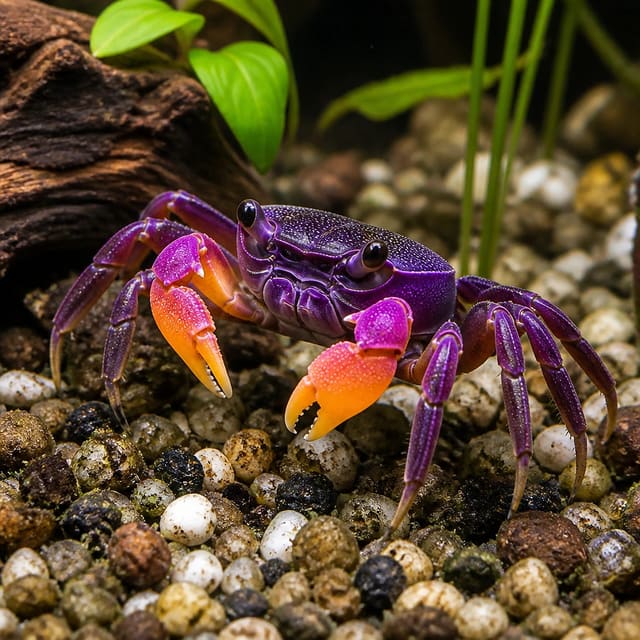
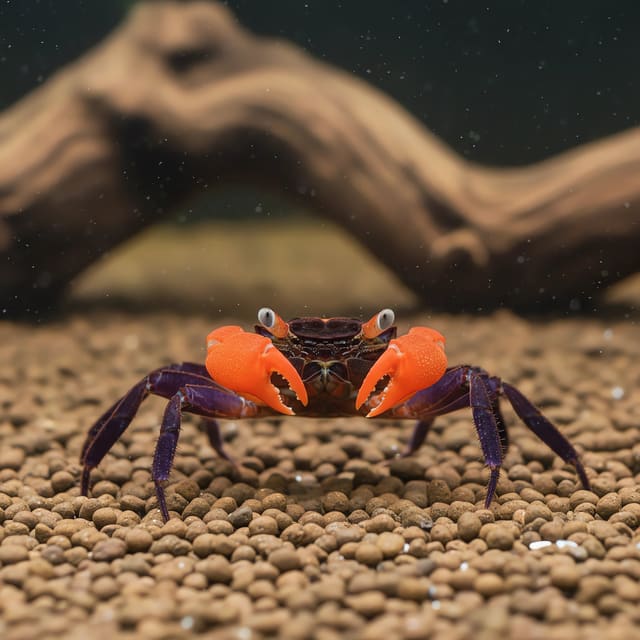
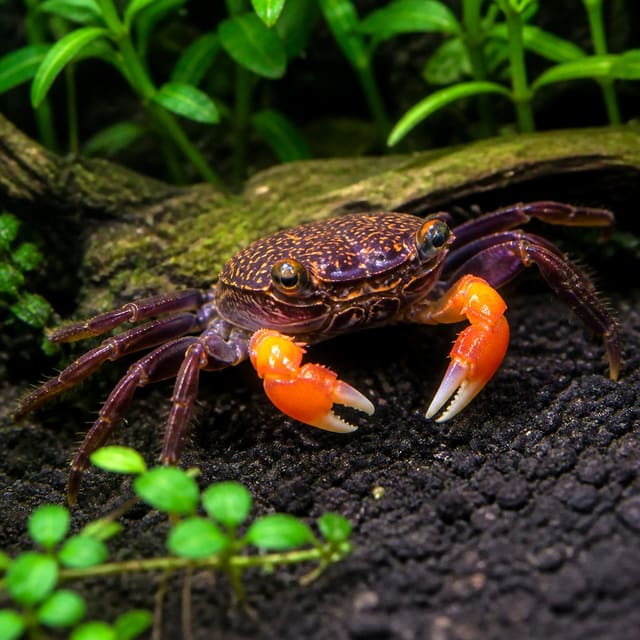
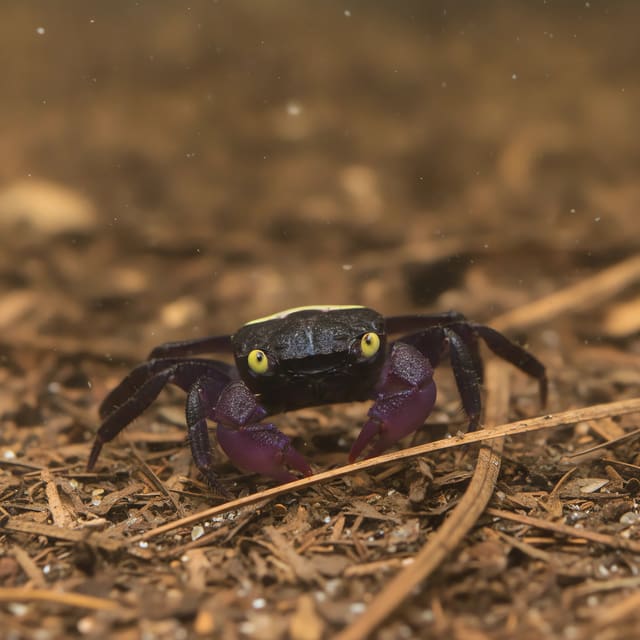
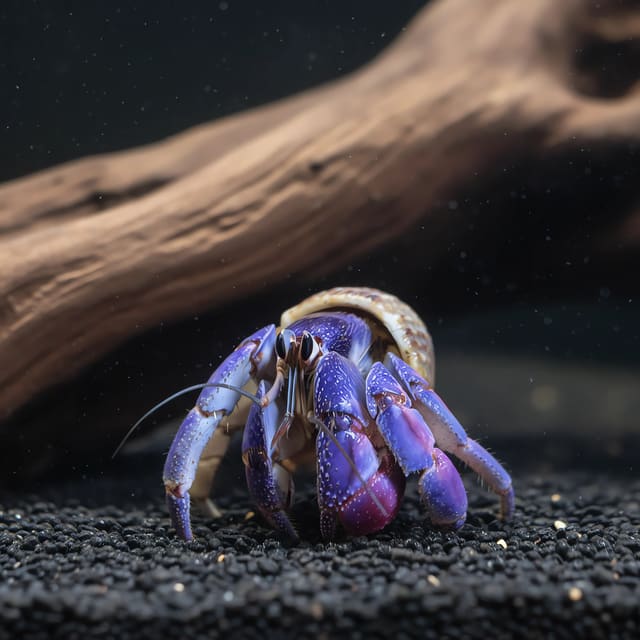
The main gallery image is representative artwork based on the trade name. It is not a photograph of the current individual, the supplier batch or a scientifically identified voucher specimen. It should help communicate the dark-bodied, red-claw trade concept, but it cannot guarantee exact colour, markings, sex, claw size or pose.
Live animals vary with age, sex, moult stage, stress and lighting. The supplier size label is approximately 3-4 cm and does not specify whether that means carapace width, body length or total span. Order on the basis of the animal's identity boundary and habitat needs, not a promise that every individual will match the artwork pixel for pixel.
Our vampire crabs for sale in the UK category is the best place to compare current availability. Keep each trade form's identity separate and avoid mixing animals merely because their care pages look similar.
| Related listing | Listed identity | Use the link for |
|---|---|---|
| Red Tomato Vampire Crab | Geosesarma sp. red tomato | Comparing another genus-level colour trade form |
| Red Devil Crab | Geosesarma hagen | Reviewing a separately listed named species |
| Golden Eye Crab | Geosesarma sp. golden eye | Comparing another trade identity without merging it into this one |
| Geosesarma Colour Mix | Mixed Geosesarma trade forms | Understanding why mixed identity needs extra caution |
| Vampire White Leg Crab | Geosesarma sp. vampire white leg | Comparing a different supplier trade form |
This is live livestock. Current dispatch days, destination limits and courier arrangements are shown on our delivery page. Eligible livestock orders are supported by our Live Arrival Guarantee; the policy explains the evidence and contact window required if something is wrong on arrival. Read those live terms before ordering because they can change with weather, bank holidays and courier conditions.
New customers can use WELCOME10 for 10% off an eligible first order, subject to the current special-offer terms and checkout validation. General ordering answers are available in the shop FAQ.
We reviewed our stock records alongside taxonomic and habitat evidence rather than treating search-volume phrases as animal names. Useful references include the GBIF Geosesarma genus record, the peer-reviewed description of pet-trade vampire crabs in the Raffles Bulletin of Zoology, and a genus-level habitat and food study. The separate Gecarcinus quadratus record is included to make the historical Halloween-crab naming error explicit.
These sources support the genus, family distinction and broad ecological context. They do not prove that the trade label "midnight red claw" is a described species, reveal its collection locality or validate a universal adult size, lifespan, enclosure volume, pH or hardness range. Where the evidence stops, this listing says so.
No reviews for this item yet. Bought one? Honest reviews only, good or bad.
What customers say about ordering from us
I have a small group of long finned mountain minnows. So was delighted to be able to order ten of this variety to increase the genetics in my tank . The ones I recieved are healthy but it’s to early to give a verdict on wether they are of a long finned type since they are small currently.
Gordon Walker · 23 Sept 2026
100% success travel and "installation". Pleased with quality of purchase. The Siamese fighter a bit "shy" so have not yet seen him at his best yet but looking good. Happy customer. GG
George E Garratt · 21 Sept 2026
Reviews of our shop, collected by Judge.me, an independent third-party review collector. Newest first.



22–28°C · pH 7.5–8 · 40L
22–28°C · pH 7.5–8 · 40L

22–27°C · pH 7–8

22–27°C · pH 7–8

22–28°C · pH 7–8 · 41L

21–25°C · pH 5–7
24–29°C

24–27°C · pH 6.5–6.5

22–27°C · pH 6–8 · 72L
24–27°C · pH 6.5–8 · 200L

23–27°C · pH 5.5–7 · 60L

22–27°C · pH 6–8