Moderate
Red Carnival Vampire Crab (Geosesarma sp.)
£14.99

Vampire Banana Crab is an undescribed Geosesarma trade form for a warm, secure, land-led paludarium. One unsexed crab is supplied per quantity at the trade-listed approximate 4 cm dispatch grade; sex, shade, markings and exact measurement vary.
Adult size is the maximum length this species reaches at full maturity (scientific sources). The livestock you receive will be younger and smaller. Product-photo provenance and any image-specific limitations are stated on the listing.
Geosesarma sp.
Vampire Banana Crab is an undescribed Geosesarma trade form for a warm, secure, land-led paludarium. One unsexed crab is supplied per quantity at the trade-listed approximate 4 cm dispatch grade; sex, shade, markings and exact measurement vary.
Adult size is the maximum length this species reaches at full maturity (scientific sources). The livestock you receive will be younger and smaller. Product-photo provenance and any image-specific limitations are stated on the listing.
Maintain these water conditions for optimal health and vibrant colors
Vampire Banana Crab (Geosesarma sp. "Banana") is a small, mostly land-dwelling freshwater crab for a warm, humid paludarium. Its trade name refers to a yellow-toned form in the aquarium hobby; it is not a fully aquatic crab for an ordinary fish tank. A successful home provides a broad moist land area, a clean freshwater section deep enough for the crab to immerse, several easy exits, dense cover and a tightly secured lid.
One quantity buys one unsexed crab. The supplier lists an approximate dispatch size of 4 cm but does not state whether that measurement is body width or leg span, so treat it as a handling grade rather than an exact adult-size promise. Sex, shade, markings, limb proportions and apparent size vary between animals and after moulting.
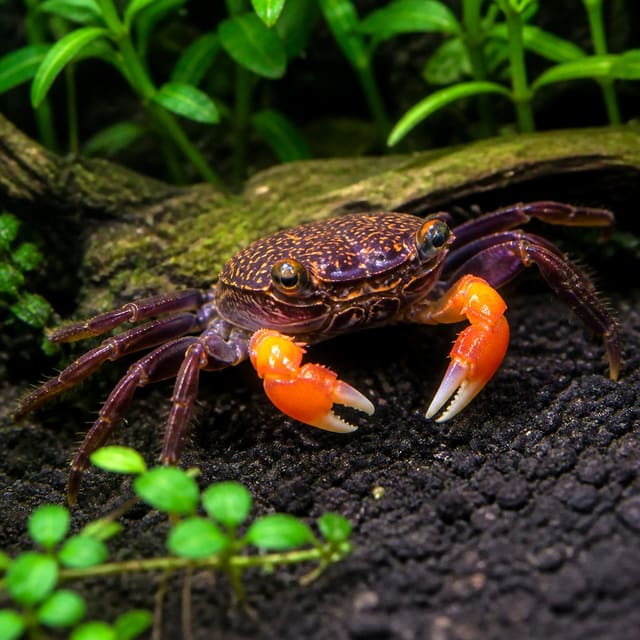
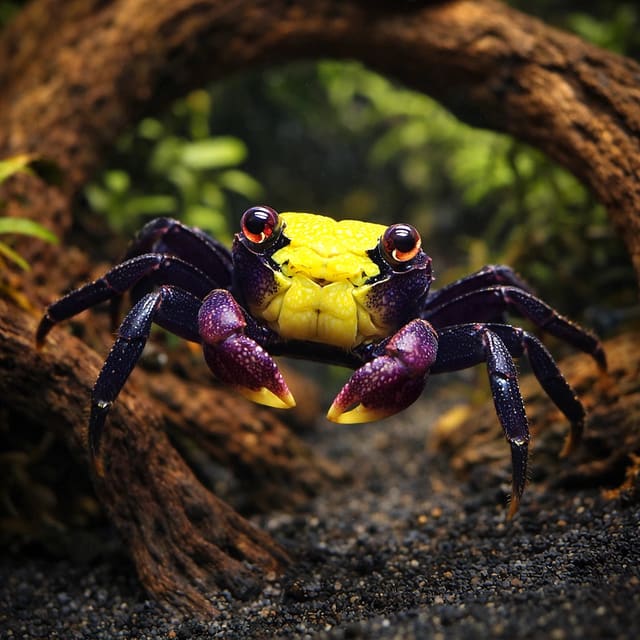
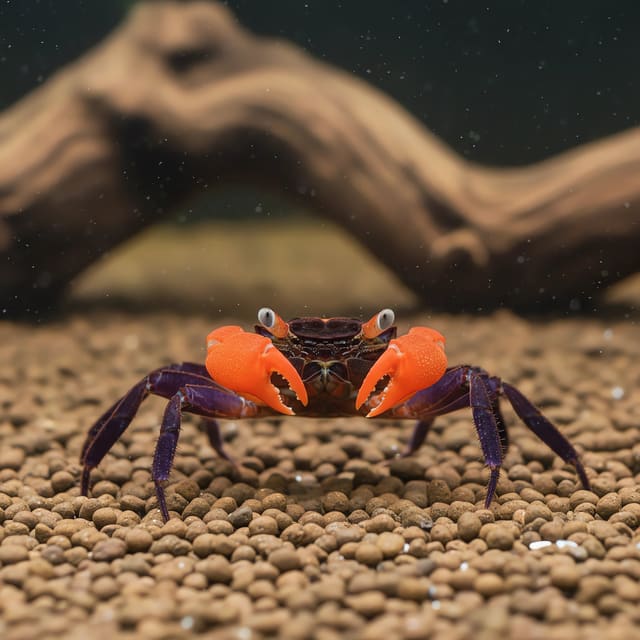
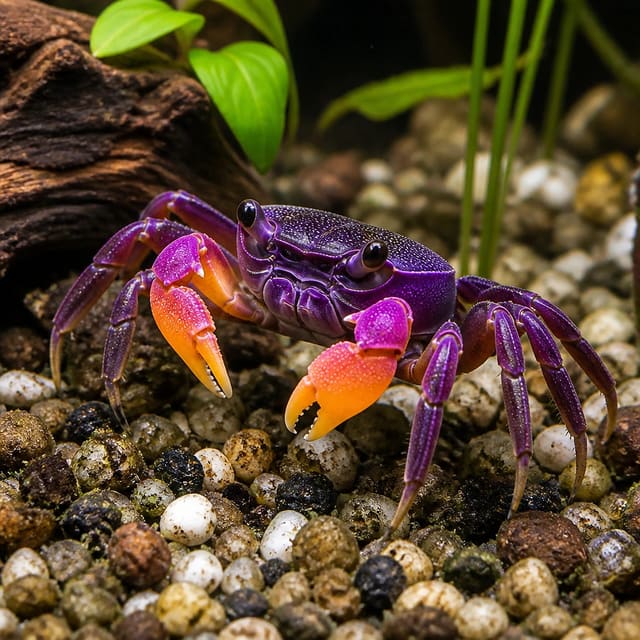
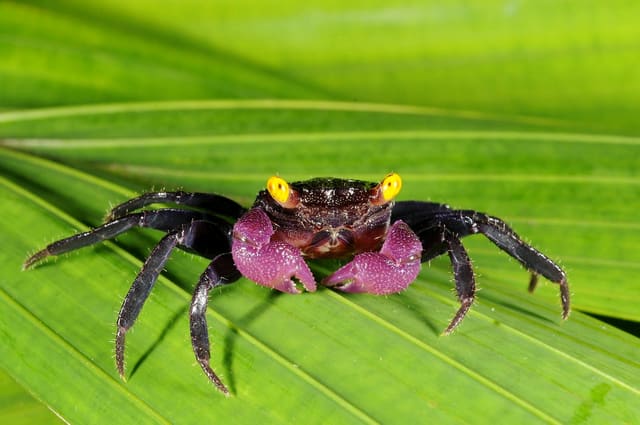
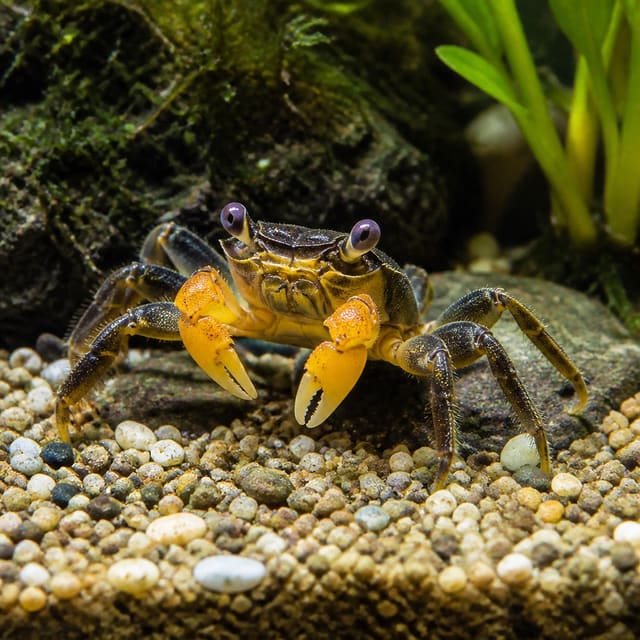
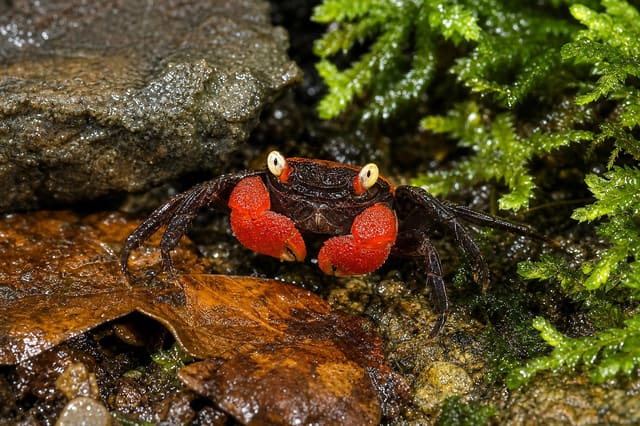
The gallery image is a representative illustration, not a photograph of the exact crab that will be supplied. It helps show the named trade form but cannot confirm species-level identity, exact colour or scale. Read the identification note below before ordering: "Banana" is a trade label attached to Geosesarma sp., not a formally verified scientific species name for this shipment.
The abbreviation sp. means the animal has been assigned to the genus Geosesarma but not to a confirmed named species. "Vampire Banana", "Banana Vampire Crab" and sometimes "Lemon Vampire Crab" are hobby trade labels. They are useful for ordering a colour form, but they are not substitutes for a preserved specimen, collection locality and taxonomic diagnosis.
This distinction matters because vampire-crab identification in the trade is genuinely difficult. A 2024 taxonomic paper from the Raffles Bulletin of Zoology explains that colourful Geosesarma often enter commerce with exotic names and claimed origins that cannot be substantiated, while dozens of Indonesian forms remain undescribed. A recent peer-reviewed survey of online land-crab listings also found mismatches between advertised names, photographs and known species phenotypes. For that reason, this page does not relabel the animal as G. dennerle, G. hagen, G. bicolor or any other named species.
The supplier identifies this stock only as Geosesarma sp. Vampire Banana. It does not provide a collection locality, breeder, wild-caught or captive-bred statement, or genetic confirmation. The genus is primarily Southeast Asian, and specialist hobby sources associate the Banana form with Java, but that does not prove the origin of the individual supplied. This is why the care advice uses conservative Geosesarma husbandry and clearly labels form-specific details as trade guidance.
Buy this crab because you can provide the correct land-led environment, not because a photograph appears to guarantee one exact shade. Trade names, sex, moult stage, lighting and individual variation all affect how a crab looks.
Specialist profiles describe the Banana form as having a yellow or cream-yellow carapace area, dark legs, violet-toned claws and dark eyes. Real animals may be paler, darker or differently divided in colour, especially before and after a moult. Transport stress can also mute colour temporarily. The supplied crab should therefore be assessed by condition and identity as a small Geosesarma trade form, not by demanding an exact digital colour match.
Size claims need a measuring point. Taxonomic papers normally record carapace width, while shops and hobbyists often quote the wider leg span. A crab described as 4-5 cm across the legs can have a carapace only around 2 cm wide. The supplier's 4 cm listing does not identify the method, so the figure should not be compared directly with a scientific carapace measurement. Adults are small, but their territorial footprint is much larger than their body size suggests.
Sex is not guaranteed. Mature males and females can often be distinguished by the abdominal flap on the underside: males generally have a narrower, more triangular flap, while females have a broader rounded flap for carrying eggs. Do not repeatedly turn or restrain a newly arrived crab merely to sex it. Let it settle, then observe safely when it is already visible against glass or during routine enclosure work.
| Listing detail | What it means | What is not promised |
|---|---|---|
| Quantity 1 | One live, unsexed crab | Not a pair, trio or breeding group |
| Approx. 4 cm supplier size | A practical dispatch listing | No exact measuring method or final adult size |
| Geosesarma sp. "Vampire Banana" | Genus plus trade-form identity | No formally named species, locality or genetic certificate |
| Representative gallery | A visual guide to the named form | Not the exact animal, colour, sex, scale or anatomy guarantee |
| Live-animal delivery | Eligible delivery under current terms | No unconditional date, postcode or weather promise |
If a planned colony requires a particular sex ratio, do not assume that ordering several unsexed crabs will create it. Availability, maturity and safe sexing all affect what can be confirmed. A single crab can be maintained in a well-designed enclosure; a group can provide more interaction but needs more footprint, hides and monitoring.
A paludarium combines terrestrial and freshwater zones in one secure enclosure. For this crab, the land section is the main living area. It should be broad enough for foraging, retreat and moulting, with moisture gradients rather than one uniformly wet surface. The water section is still essential: it must let the crab submerge fully, turn around and climb out from more than one point.
There is no single magic land-to-water percentage that makes every layout safe. A land-led design around three-quarters land is a useful visual starting point, but usable area matters more than an exact ratio. A tall decorative rock face does not replace horizontal territory. Likewise, a deep open pool with one steep exit is less useful than a smaller mature water section with shallow shelves, textured ramps and several escape routes.
Use a secure glass or acrylic enclosure with fine ventilation and a close-fitting lid. Vampire crabs can climb silicone seams, roots, cables and background structures. Seal cable gaps without blocking airflow. Check that decor cannot shift and trap the crab, and keep electrical heating equipment protected from digging, climbing and direct contact.
Forty litres is a practical minimum starting point for one crab or a very carefully managed small setup, provided the enclosure has useful floor area. It is not a universal stocking formula. Wider enclosures are preferable to narrow tall ones because each crab needs routes, visual barriers and separate retreat options. Add space as numbers increase; never use a simple litres-per-crab calculation without looking at layout and behaviour.
For a group, use a larger footprint and duplicate every important resource: several dry-to-moist hides, more than one route to water, multiple feeding points and cover that breaks line of sight. Be ready to separate an injured, newly moulted or persistently harassed animal. A spare ventilated recovery enclosure is part of responsible group keeping, not an optional extra.
Build the land with a stable, moisture-retentive substrate deep enough for shallow digging. Suitable components can include pesticide-free soil, coco fibre, leaf mould, sand and leaf litter, provided the final mix does not collapse into a waterlogged paste. Create a gradient: damp lower areas near water, moist shaded refuges, and slightly drier raised places. Constant saturation without ventilation encourages mould and poor air quality.
Add cork bark, small caves, roots, stones and dense planting. Each hide should have an opening the crab can use without becoming wedged. Leaf litter is more than decoration: it offers cover, supports microbial grazing and lets the crab forage naturally. Replace decomposed material gradually so the enclosure never loses all of its established microhabitat at once.
The freshwater area must be dechlorinated, mature and accessible. It should be deep enough for full-body immersion, but depth alone is not quality. Use textured slopes, stones, wood or ramps that remain grippable when wet. Check every side from a crab's perspective; a smooth vertical glass edge can turn a shallow pool into a trap.
Cycle the water section before the crab arrives. Test until ammonia and nitrite remain at zero and keep nitrate low through restrained feeding and appropriate water changes. Because paludarium water volumes are often small, waste can concentrate quickly. Match replacement water for temperature and chemistry, and avoid sudden large changes unless an emergency requires them.
| Parameter | Working guide | Why it matters |
|---|---|---|
| Water temperature | About 22-26°C, stable | Avoids a cold pool beneath warmer air and reduces thermal shock |
| pH | About 7.5-8.0 | Broad specialist trade guidance; stability matters more than chasing a decimal |
| General hardness | About 4-16 dGH | Provides a mineral-bearing range; test the actual source water |
| Ammonia | 0 mg/L | Toxic nitrogen waste must not be tolerated |
| Nitrite | 0 mg/L | Another sign the water section is not biologically safe |
| Nitrate | Keep low | Use feeding control, plants and measured water changes |
A filter is not an automatic yes-or-no requirement; it depends on the water volume, stocking, feeding and maintenance design. A small sponge filter or guarded low-flow filter can improve biological stability and circulation. Strong suction, exposed intakes and fast current are unsuitable. In a very small removable pool, frequent measured maintenance may be safer than forcing in oversized equipment, but the water must still be cycled and tested.
Never assume clear water is safe water. Ammonia and nitrite are invisible. Use liquid tests, record results and investigate changes in feeding, smell, cloudiness or animal behaviour. Remove spoiled food promptly. If a filter is used, rinse biological media in removed enclosure water rather than untreated tap water, and do not replace all mature media at once.
Use 22-28°C as a broad working range, with 24-26°C as a sensible steady target for most homes. The upper end is not a reason to run the enclosure hot. Heat raises evaporation and can reduce oxygen in the water section, while cold nights can chill a small pool quickly. Measure air and water separately because they do not always match.
Heat with thermostat-controlled equipment positioned so the crab cannot touch, climb onto or dig against a hot surface. Heating one side rather than the whole enclosure can create a mild thermal choice, but verify the gradient with reliable thermometers. Keep the paludarium away from radiators, direct sun and cold draughts. A sunlit glass enclosure can overheat far faster than room temperature suggests.
Humidity should stay high enough to keep retreat areas moist and support normal gill function, but the enclosure must still exchange air. Condensation on every surface does not prove good humidity and may signal poor ventilation. Combine a moisture-holding substrate, planted cover and a fitted lid with fine vents. If misting is needed, use dechlorinated water and avoid leaving food or hides permanently sodden.
Mosses, creeping plants, small ferns and other humidity-tolerant species make excellent cover. Confirm that plants have not been treated with pesticides or systemic insecticides. Rinse and quarantine them where practical; residues dangerous to arthropods can arrive on apparently healthy nursery plants. Avoid sharp wire, exposed mesh edges and resin decor with flaking paint.
Build hardscape from the base of the enclosure rather than balancing heavy stones on loose substrate. Crabs dig. A rock that appears stable on day one can shift after tunnelling. Leave access for inspection without dismantling the entire habitat, and provide at least one snug hide in every major zone. During a moult, privacy is more valuable than a decorative open view.
A bioactive cleanup crew can be useful, but it is not a substitute for hygiene or water testing. Springtails may help consume mould and small waste. Any additional invertebrate should be pesticide-free and introduced deliberately. Do not add wild-collected soil, leaves or insects from places that may carry chemicals, parasites or protected wildlife.
Geosesarma are opportunistic omnivores and scavengers. In captivity, provide a varied rotation rather than one daily block of the same food. A quality complete invertebrate or crustacean pellet can form the base, supported by leaf-litter grazing, small protein foods and modest plant-based items. The goal is nutritional variety without leaving rich food to decay in a warm humid enclosure.
Offer tiny portions near cover in the evening, when many individuals feel secure enough to forage. Suitable additions may include small pieces of earthworm, defrosted bloodworm, daphnia, insect-based food, algae wafer, blanched courgette or other aquarium-safe vegetables. Foods from the kitchen must be plain, free from salt, seasoning, oil and pesticide residues. Do not use wild insects from treated areas.
Provide calcium and other minerals through a complete diet and mineral-bearing water rather than indiscriminate supplementation. Cuttlebone or an appropriate invertebrate mineral source can be offered, but it does not correct poor water chemistry or an unbalanced diet. Leave a clean shed exoskeleton in the enclosure initially; the crab may consume it and recover minerals.
| Food role | Examples | Practical use |
|---|---|---|
| Complete staple | Quality crab or invertebrate pellet | Small portions several times per week |
| Animal protein | Earthworm, insect-based feed, defrosted aquatic foods | Rotate in tiny amounts; remove leftovers |
| Plant and grazing material | Leaf litter, algae-based food, small vegetable pieces | Supports variety; not all leaf matter is edible immediately |
| Mineral support | Balanced food, suitable mineral source, stable hard water | Supports normal exoskeleton maintenance without over-dosing |
Start with a small portion every one to two days and adjust from observation. A settled crab that has access to leaf litter and natural grazing may need less prepared food than a sterile new enclosure. Juveniles and breeding females can have different needs. Remove moist protein or vegetables before they spoil, and reduce the next portion if food remains.
Do not interpret hiding after a meal as proof that more food is needed. Overfeeding is a common cause of mould, mites and poor water quality. Keep a simple feeding record for the first weeks so you can distinguish appetite changes from random behaviour. Sudden refusal combined with weakness, odour or poor posture deserves investigation; reduced feeding around a moult can be normal.
These small crabs often become most active in dim light, at dusk or after the room quietens. A newly arrived animal may remain hidden for several days. Dense cover usually increases visible natural activity over time because the crab can move between safe points instead of crossing open ground.
Expect climbing, digging, leaf-litter foraging, shallow soaking and territorial displays. Activity varies with sex, maturity, enclosure design and individual temperament. "Bold" and "social" should not be treated as guarantees. One crab may become visible at feeding time, while another spends most daylight hours beneath bark.
Handle only when necessary. A crab can drop a limb under severe stress, pinch defensively or fall from a hand. Move it in a ventilated container with damp cover rather than carrying it across a room. Never hold it by a leg or claw. Wash hands before and after enclosure work and keep soaps, sprays, nicotine, flea treatments and cleaning chemicals away.
A single crab can be kept alone and is often the simplest choice for a first paludarium. Groups are possible, but these animals are not obligate shoalers. More crabs mean more competition for hides, feeding points and secure moulting sites. Behaviour must decide whether a group is working; the number ordered does not guarantee compatibility.
If keeping several, use a larger floor area, dense visual barriers and multiple copies of every resource. Avoid crowding adult males, but remember this listing is unsexed and a requested ratio cannot be assumed. Monitor after introduction and after moults. Persistent chasing, blocked access to food, repeated limb loss or one animal remaining exposed and weak are reasons to separate them.
Do not mix trade forms simply because their care ranges look similar. Different names may represent distinct species, uncertain identities or populations that should not be combined. Mixing also makes breeding records unreliable. Related products on this page are comparisons for separate setups, not automatic companions.
A species-focused paludarium is safest. Fish need a larger open water volume than this crab requires, and the crab may catch resting or slow animals. Shrimp and small snails may be eaten, especially when vulnerable. Larger aquatic animals can injure the crab during immersion or moulting. A shared display creates risk in both directions and should not be presented as a dependable community.
| Companion | Recommendation | Reason |
|---|---|---|
| One Vampire Banana Crab | Suitable | A well-structured solo enclosure avoids sex-ratio and territorial uncertainty |
| Same trade form | Caution | Possible with extra space, hides, feeding points and a separation plan |
| Different Geosesarma forms | Avoid | Identity, aggression and breeding-line risks |
| Fish or dwarf shrimp | Avoid | Predation and incompatible habitat priorities |
| Snails | Caution to avoid | Small individuals and exposed soft tissue may be eaten |
| Amphibians or reptiles | Avoid | Predation, injury and different welfare requirements |
Growth requires the crab to shed its old exoskeleton. Before a moult it may eat less, hide more and become inactive. The new shell is soft, leaving the animal vulnerable to dehydration, falls and attacks. Do not pull a crab from a hide because it has not appeared at feeding time, and do not rearrange the enclosure around a freshly moulted animal.
Stable temperature, mineral-bearing water, varied nutrition and access to both moist land and freshwater support the process. Avoid sudden humidity or chemistry changes. Keep the shed exoskeleton unless it is clearly fouling the enclosure; the crab may eat it. A missing limb can sometimes regenerate over later moults, but repeated limb loss indicates injury, aggression or husbandry failure.
Never use copper-based medication or a treatment not explicitly safe for the invertebrates present. Many fish medicines, plant dips and household pest products can harm crustaceans. If treatment is needed, identify the problem before dosing and use a separate controlled container when professional advice supports it.
Scientific work describes Geosesarma as freshwater crabs that do not return to the sea to breed. Their relatively large eggs develop directly and hatch as juvenile crabs rather than free-swimming marine larvae. That genus-level fact makes captive breeding possible in a terrestrial-freshwater enclosure, but it does not make breeding automatic.
This shipment is unsexed, and the Banana trade form is not formally identified to species. The listing therefore does not promise a breeding pair, fixed egg count, one-month incubation or a guaranteed number of young. Those details vary with species, female size, temperature and condition. A female carrying eggs should be disturbed as little as possible and given deep cover.
Juveniles need humid micro-hides, safe freshwater access and food small enough to graze. They can be outcompeted or eaten by adults. Dense moss, leaf litter and bark fragments create refuge, but a separate nursery may improve control. Keep records of parent appearance and trade identity, and never release unwanted crabs, eggs or enclosure material into the wild.
A settled healthy crab should support itself normally, use its legs and claws, respond to disturbance, move between suitable zones and feed over time. One missing limb is not automatically fatal, but the cause matters. Before dispatch and on arrival, visible condition should be judged alongside behaviour rather than colour alone.
Warning signs include persistent inability to stand, repeated falling, foul odour, rapidly worsening discolouration, fuzzy growth on damaged tissue, multiple recent limb losses, failure to leave deep water, or frantic attempts to escape unsuitable conditions. Hiding by itself is not a diagnosis. Check air and water temperature, ammonia, nitrite, humidity, ventilation, access routes and recent chemical exposure before guessing at disease.
For isolation, use a secure ventilated container with damp pesticide-free substrate, a hide and safe shallow freshwater access. Match the established temperature and avoid unnecessary handling. Veterinary expertise for small crustaceans can be difficult to find, so prevention through stable husbandry is especially important.
Never release this crab, juveniles, plants, substrate or water into a garden pond, stream or drain. Rehome responsibly or ask a specialist retailer or exotics rescue for advice.
The complete paludarium must be running before dispatch. Confirm that the water section is cycled, ammonia and nitrite are zero, temperature is stable, the lid is secure and every pool has an easy exit. Do not order first and plan the enclosure while the animal is in transit.
Read the current delivery information and Live Arrival Guarantee and returns before dispatch. Delivery timing depends on postcode, service availability, weather and the live-animal schedule; this listing does not promise unconditional next-day arrival. Be available for the parcel and prepare a dim, quiet place for unpacking.
Follow the instructions supplied with the order. Avoid pouring transport material into the established water section. Introduce the crab near a sheltered transition between moist land and water, then let it choose where to settle. Keep lighting low and handling minimal. Offer a small meal after it has had time to recover rather than immediately crowding it with food.
Browse the vampire crab collection when choosing a form, and use the detailed vampire crab care guide for broader setup planning. Compare separate listings by confirmed scientific name, adult size, current image limits and sale unit rather than colour words alone.
| Listing | Identity shown | How to use the comparison |
|---|---|---|
| Vampire Banana Crab | Geosesarma sp. trade form | This page; yellow-toned trade identity with explicit taxonomic limits |
| Purple Vampire Crab | Geosesarma dennerle listing | Compare named-species evidence and current stock; keep separately |
| Red Tomato Vampire Crab | Geosesarma sp. trade form | Compare another unconfirmed form; not an automatic tank mate |
| Geosesarma sp. Violet | Geosesarma sp. trade form | Compare a separate colour-trade identity and its own listing evidence |
Do not build a mixed-form display from this table. Similar temperature and humidity ranges do not prove compatibility, and ambiguous trade names make hybridisation and provenance problems harder to avoid. Separate, clearly labelled enclosures are the responsible default.
One quantity buys one unsexed crab. A pair, breeding group or requested sex is not included unless a future variant explicitly says so.
No formal species name is supplied. The stock is listed as Geosesarma sp. "Vampire Banana", which is a genus-level identification plus a hobby trade name.
No. It is mostly terrestrial and needs a secure, humid paludarium with substantial usable land plus a clean freshwater section for full immersion.
A cautious expectation is about 4-5 cm across the legs, with a much smaller carapace. The supplier lists approximately 4 cm at dispatch but does not state the measuring method.
Forty litres is a practical starting minimum for one crab when the floor area and layout are good. Groups need more usable footprint, cover and a separation plan.
No exact percentage guarantees a good enclosure. Make it clearly land-led, then ensure the freshwater area permits full immersion, turning and easy exit from several points.
Use 22-28°C as a broad range and aim for stable air around 24-26°C. Maintain high humidity with moist refuges while preserving ventilation rather than sealing in stagnant air.
Gentle guarded filtration can improve stability, especially in a larger pool, but equipment must suit the water volume. Filtered or not, water must be cycled, dechlorinated and tested.
Rotate a complete invertebrate food with small animal-protein items, leaf-litter grazing and modest plant-based foods. Feed tiny portions and remove leftovers before they spoil.
Start with a small portion every one to two days and adjust to appetite and natural grazing. More food is not better if it creates mould or nitrogen waste.
Yes. A well-designed solo paludarium avoids uncertain sex ratios and much territorial risk. A group is optional, not a welfare requirement implied by this listing.
They may be kept together with more floor space, multiple hides and feeding points, but conflict is possible. Monitor closely and keep a separate recovery enclosure ready.
A species-focused setup is safest. Fish, shrimp and small snails may be caught, while aquatic companions can also injure a crab during immersion or moulting.
Leave the crab undisturbed, maintain stable conditions and provide secure cover. Keep the clean shed exoskeleton initially because the crab may consume it.
Geosesarma have direct development: eggs hatch into small juvenile crabs rather than marine larvae. This listing does not guarantee a sexed pair, egg count or breeding result.
No exact match is promised. The gallery is representative, and real colour, proportions, sex, moult stage and markings vary. The image is not a photograph of the exact animal dispatched.
This listing separates formal taxonomy from specialist husbandry. The following sources were reviewed; species-specific findings are not automatically transferred to an unidentified trade form.
Last reviewed: 14 July 2026. Husbandry knowledge and trade identifications can change. Where your own tested water or an individual animal falls outside this guide, prioritise stability, welfare observation and qualified veterinary or specialist advice.
No reviews for this item yet. Bought one? Honest reviews only, good or bad.
What customers say about ordering from us
I have a small group of long finned mountain minnows. So was delighted to be able to order ten of this variety to increase the genetics in my tank . The ones I recieved are healthy but it’s to early to give a verdict on wether they are of a long finned type since they are small currently.
Gordon Walker · 23 Sept 2026
100% success travel and "installation". Pleased with quality of purchase. The Siamese fighter a bit "shy" so have not yet seen him at his best yet but looking good. Happy customer. GG
George E Garratt · 21 Sept 2026
Reviews of our shop, collected by Judge.me, an independent third-party review collector. Newest first.