Moderate
Purple Vampire Crab (Geosesarma dennerle) – Semi-Terrestrial Paludarium Crab
£8.09
One violet vampire crab (Geosesarma sp.), a small land-living crab from South-east Asia with violet-purple legs and orange-tipped claws. It spends most of its life out of the water, so it needs a lidded paludarium with damp land, a shallow shoreline and plenty of cover, not an ordinary fish tank.
Adult size is the maximum length this species reaches at full maturity (scientific sources). The livestock you receive will be younger and smaller. Product-photo provenance and any image-specific limitations are stated on the listing.
Geosesarma sp.
One violet vampire crab (Geosesarma sp.), a small land-living crab from South-east Asia with violet-purple legs and orange-tipped claws. It spends most of its life out of the water, so it needs a lidded paludarium with damp land, a shallow shoreline and plenty of cover, not an ordinary fish tank.
Adult size is the maximum length this species reaches at full maturity (scientific sources). The livestock you receive will be younger and smaller. Product-photo provenance and any image-specific limitations are stated on the listing.
Maintain these water conditions for optimal health and vibrant colors
This listing is for one live violet vampire crab. There is a single option, so each unit you add to the basket is one crab, and no sex is specified or offered. It is listed as Geosesarma sp. The genus is not in doubt, but the exact species has not been identified, and we would rather say so plainly than borrow a species name that may not belong to it.
Vampire crabs are not aquarium crabs in the usual sense. They are small, land-living crabs from South-east Asia that need water close by but spend most of their adult lives on damp ground among rocks and dense plants. If you were hoping for something to potter about on the gravel of a community tank, this is the wrong animal. If you want a lidded paludarium with a proper shoreline, moss and rocks, and a small, brightly coloured crab picking its way across it, it is one of the most rewarding animals you can build an enclosure around.
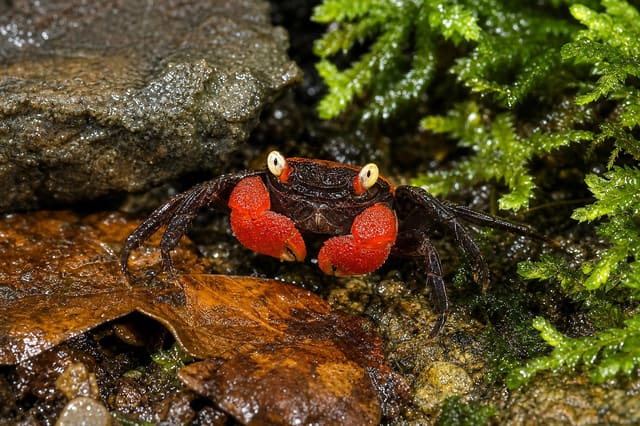
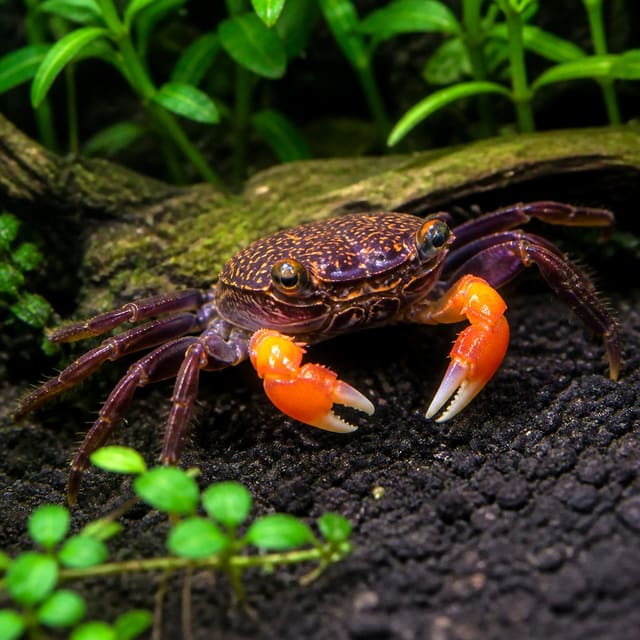
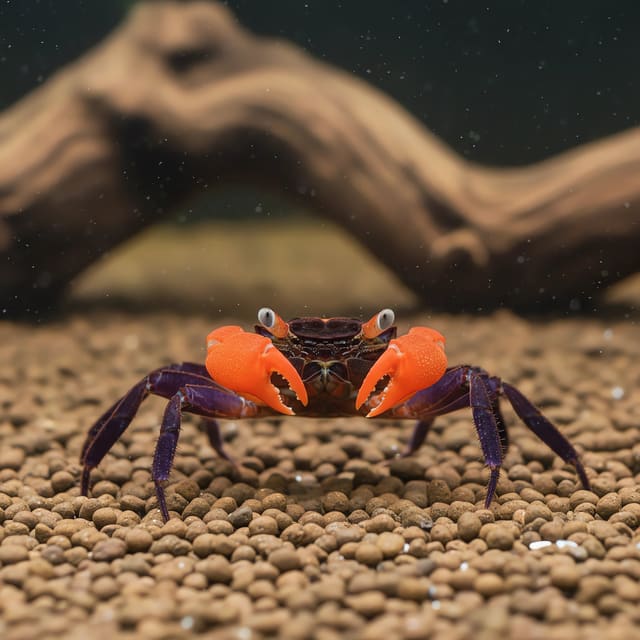
"Violet" describes the colour. In the photograph at the top of this page the crab has a deep violet-purple shell and legs, dark eyes, and claws that run from pinkish purple on top to vivid orange at the tips. That is the look the name refers to. Bear in mind that vampire crab colour can change with age. In Geosesarma dennerle, the best-documented purple species, the scientists who described it found that juveniles tend to be purplish-brown and that the brightest claws belong mainly to larger adults. Nobody has published the same detail for our violet crab, so a young one may not yet show every shade you see in the picture.
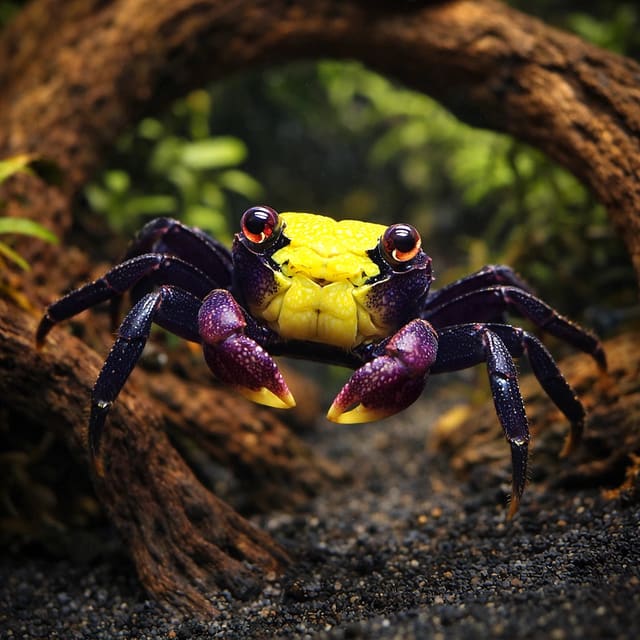
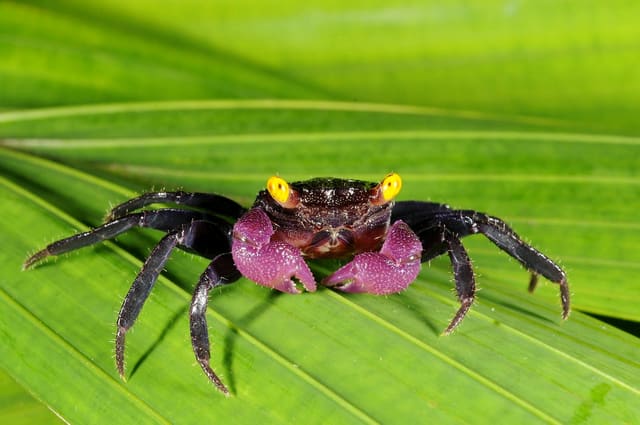
Please don't confuse it with our purple vampire crab, Geosesarma dennerle. That species was formally described in 2015 and has a two-tone shell: violet-purple to purplish-brown on the front half, cream to yellowish-white on the back half, with bright yellow eyes and, in larger adults, bright purple claws. The violet crab on this page is sold under its own trade name, and we make no claim that the two are the same species.
What follows is the guide we would give you across the counter: where these crabs come from, how big they get, how to build them a home that suits a land animal, what to feed, what to watch for, and how to get your crab settled once it arrives. Where the science is thin, as it often is with vampire crabs, we tell you so rather than filling the gap.
Geosesarma is a genus of small freshwater and terrestrial crabs in the family Sesarmidae. More than 60 species have been described from India, Indonesia, Malaysia, Thailand, the Philippines, the Solomon Islands and Hawaii, and Professor Peter Ng of the National University of Singapore has named 20 of them himself. The list is still growing. In 2024 Ng and Daisy Wowor described two more vampire crabs from Java, G. riani and G. nigripes, which gives you an idea of how much of this genus is still being sorted out.
The trade name comes from the eyes, not the eating habits. Several popular species have bright, contrasting yellow eyes, and that glowing stare earned them the name "vampire crab". Not every vampire crab has yellow eyes, though. Some species have white or black eyes, which is worth remembering when you look at the dark-eyed crab in our photograph.
The feature that matters most to a keeper is how these crabs breed. Geosesarma crabs live and reproduce on land, and their larval stages take place inside the egg. The young hatch as tiny, fully formed crabs rather than as free-swimming larvae. That is a large part of the reason they can live their whole lives in a well-built paludarium, and why they can be bred at home.
In their 2015 paper in the Raffles Bulletin of Zoology, Peter Ng, Christoph Schubart and Christian Lukhaup wrote that over the previous decade a growing number of colourful land-dwelling crabs had been sold in the ornamental trade in Europe and Asia as vampire crabs, and exported to Europe, East Asia and America. The two most common colour forms were a cream-and-violet crab and a dark brown and bright orange one. Dealers variously claimed they came from Sulawesi, Java, Krakatau or the Riau Islands.
The authors showed that both forms are native to central Java and named them Geosesarma dennerle and G. hagen. The second is the species behind our red devil vampire crab. They also pointed out that the Krakatau story was doubtful, because the island is an active volcano with no permanent source of fresh water.
Telling the Javan species apart is specialist work. The paper separates G. dennerle from G. hagen by colour in life, but also by the granules on the front of the shell, the shape of the tooth at the outer corner of the eye socket and the fine structure of the male's first gonopod, a reproductive appendage tucked under the body. None of that can be judged from a photograph. It is why trade names such as "violet" so often travel without a confirmed species attached, and why this crab is listed as Geosesarma sp.
Crab biologists measure the carapace, the hard shell over the body, and for vampire crabs the numbers are small. Wikipedia describes Geosesarma as typically less than 10 mm across the carapace. The Javan trade species run larger than that. The holotype of G. dennerle, the specimen the species is named from, is a male 14.4 mm wide and 14.0 mm long, and the G. hagen holotype is 13.9 mm wide. An egg-carrying G. dennerle female in the same study measured 12.0 by 10.6 mm.
With the legs spread the animal looks much bigger. Wikipedia gives a general size of 38–51 mm (1.5–2 inches) for G. dennerle, which must be an overall measurement including the legs, since the shell alone is about a third of that. Our care sheet lists 5 cm as the adult size, which matches the top of that overall figure rather than the shell.
| Measurement | Figure | Source and scope |
|---|---|---|
| Carapace width, genus in general | Usually under 10 mm | Wikipedia, Geosesarma |
| Carapace width, largest G. dennerle examined | 14.4 mm | Ng, Schubart and Lukhaup (2015) |
| Overall size, G. dennerle | 38–51 mm | Wikipedia, Geosesarma dennerle |
| Adult size on our care sheet | 5 cm across the legs | Planning figure, not species-specific |
For a crab sold as Geosesarma sp., none of these numbers is a species-specific guarantee. What they give you is the scale of animal to plan for: a body roughly the size of a thumbnail, carried on legs that reach several times wider. That scale matters when you choose decor. Gaps under stones and between roots only need to be a centimetre or two high to make a perfect hide, and any gap of that size in a lid is a way out.
The best field notes on vampire crabs come from the 2015 description of the two Javan species, and they read almost like a set-up guide. G. dennerle was found on the slopes of a small valley north of Cilacap town in central Java, living under and between rocks among dense vegetation. It sometimes digs burrows in the loose ground at the edge of the creek that runs through the valley, and juveniles are often seen on land close to the waterline. Wikipedia's summary describes the same picture: crabs hiding in burrows in muddy creek valleys with rocks and dense plants.
G. hagen was collected about 10.5 km away, on a banana and rubber plantation on the side of a small hill, an area threaded with trickles of water and one slightly larger rivulet. Adults hide under dense ground vegetation, usually under and between rocks, and also burrow at the edge of the water. One of the paper's photographs shows an adult male on a moss-covered stream bank. The authors noted that adults are seldom found in the water and live mostly on the moist banks, while juveniles are often in the water or right beside it and are far less often seen on the drier forest floor. They describe both habitats as essentially hill streams.
Read those notes with a paludarium in mind and the requirements are clear. Damp ground matters more than open water. Rocks and wood provide the daytime hiding places, and soft soil at the shoreline gives a crab somewhere to dig. Dense planting and moss hold moisture and give cover, and a shallow water margin that is easy to reach keeps the young within reach of water. We don't know the exact home of the violet crab, but those are the conditions documented for the vampire crabs that have been studied in the wild, and they are what we would build around.
Ng and his co-authors added a warning. G. dennerle and G. hagen are collected in large numbers for the global aquarium trade, and local collectors in Java told them the populations of both had been decreasing over the years. The authors concluded that continued collection was not sustainable and that a conservation management plan, probably including captive breeding, would be needed if the crabs stayed popular. Wikipedia now describes both species as threatened by illegal overcollection for the aquarium trade.
Those findings concern two named species, not necessarily the violet crab. They are still a good reason to keep vampire crabs well and to let them breed if you can. Every young crab raised in a home paludarium is one that never had to be collected from the wild.
A paludarium is an enclosure with both land and water, and Wikipedia's definition makes the central point well: each area has to be large enough to meet the needs of the animals living in it. For a vampire crab, land comes first. OATA, the UK trade association for ornamental fish and aquatic animals, names Geosesarma among the crabs that need an area above the waterline to forage and hide. The field notes above show adults living on moist banks and rarely entering the water.
Our care sheet sets 40 litres as the minimum enclosure for this crab. With a land animal, floor area counts for far more than water depth. Choose a tank that is wide and deep from front to back rather than tall and narrow, and give most of the floor to land. A front-opening glass terrarium with a pond section, or an ordinary aquarium with a built-up bank, both work if the lid fits properly.
Wild crabs dig into loose ground at the creek edge, so build the bank from a substrate that stays damp and soft enough to dig, like the loose ground at a creek edge, and make it deep enough at the shoreline for a burrow. Lay flat stones and pieces of wood so that they leave gaps underneath; both Javan species spend their days under and between rocks. Then plant heavily. Wikipedia names Anubias as a common, hardy paludarium plant. Moss on stones and wood recreates the stream banks where wild crabs were photographed, and leaf litter adds cover and something to pick through.
The water area does not need to be deep. Adults seldom swim, while wild juveniles stay in or right beside the water, so make the shoreline a gentle slope or a ramp of stones and wood that a crab of any size can walk straight out on. A steep glass wall with deep water beneath it is the one layout to avoid. Keep the water clean enough to meet the figures in the next section. Whatever filtration you choose, check that a small crab cannot climb into the intake or get trapped behind equipment.
OATA includes a secure lid in its basic kit list for crabs and crayfish. With a vampire crab you should treat it as essential. This is a walking land animal with a body about the size of a thumbnail, and a gap at the back for cables or a filter pipe is easily wide enough to let it out. A close-fitting lid has a second job too: it keeps the air inside humid, which is what keeps the land damp and the moss green between waterings. Seal cable gaps with foam or a cut-to-fit cover rather than leaving them open.
The most specific UK guidance for the water side of the set-up is OATA's care sheet for crayfish and freshwater crabs, which names vampire crabs. It asks for clean, stable, medium-hard water. The figures below are the ones we work to for this crab.
| Parameter | Target | Note |
|---|---|---|
| Temperature | 22–27 °C | OATA range for crayfish and freshwater crabs |
| pH | 7.5–8.0 | Inside OATA's 7.0–8.0 |
| General hardness | 8–16 °dH | OATA advises medium-hard, 8–18 °dH |
| Carbonate hardness | 10–15 °dKH | OATA figure |
| Ammonia and nitrite | Zero | OATA figure |
| Nitrate | No more than 20 mg/l above your tap water | OATA figure |
| Partial water change | About 25% weekly | OATA recommendation |
OATA also recommends testing the water at least once a week. In a paludarium the water area is often small, so it can swing faster than a big aquarium; a weekly test is the only way to know where you stand. Match the temperature and chemistry of new water to the old before topping up or changing it.
Keep the whole enclosure between 22 and 27 °C. A heater in the water section warms the air above it as well, especially under a closed lid, but check the temperature on the land too with a second thermometer. Sitting a heat source directly under land the crabs dig into is a mistake; leave them a cooler, damp corner to retreat to.
Neither OATA nor the scientific descriptions give a humidity figure for vampire crabs, so we won't invent one. What the field notes describe is moist ground under dense cover beside running water. Aim for land that is always damp to the touch but never waterlogged, a lid that holds that moisture in, and moss and plants that stay healthy. If the moss dries and browns, the enclosure is too dry. Mist the land lightly when it needs it rather than flooding it.
Twenty minutes a week covers it, and a regular routine catches slow changes early, such as land that dries a little more each week or nitrate creeping up in a small water area.
OATA's warning on copper is blunt: crayfish and freshwater crabs are very sensitive to it and will die if exposed even to low levels. Make sure any treatment you add to the enclosure is safe for invertebrates. If you also keep fish, use separate nets and buckets for the crab set-up so a fish treatment cannot travel across on wet equipment.
Wild vampire crabs are mainly hunters of small animals. According to Ng and his co-authors, G. dennerle feeds mostly on small terrestrial insects such as grasshoppers, and probably also on chironomid (non-biting midge) larvae and plant detritus. G. hagen appears to be carnivorous, feeding at least partly on insects that live on the ground. Wikipedia sums up the diet of G. dennerle as insects and plant matter.
OATA describes freshwater crabs in general as omnivorous scavengers that will also eat plants. It suggests offering courgette, cucumber and lettuce, feeding once a day and removing anything still uneaten after about 30 minutes.
Put those together and a sensible routine for a violet vampire crab looks like this:
Watching your crab feed is also your daily health check. A vampire crab that comes out to take food and carries it back under cover is a crab that is settled. One that stops eating for more than a few days, or that stops hiding and wanders listlessly, deserves a closer look at water quality and temperature.
Don't rely on the enclosure to feed the crab by itself. However lush the planting, a 40 litre paludarium cannot produce enough insects to sustain a crab, so the daily feed is what keeps it going.
Expect to see your crab less than you might hope at first. Both Javan species spend their days under and between rocks among dense vegetation, and both dig burrows at the water's edge. So expect a new crab to spend much of its time out of sight. Plan the layout so that some hides sit near the front glass and close to the feeding stone; that way a crab can stay under cover and still be seen.
Like all crabs, vampire crabs grow by shedding their hard outer shell. OATA notes that crabs and crayfish moult frequently, and warns keepers not to be surprised by a cast shell that looks exactly like a dead animal. Leave it where it is; check under the rocks before you assume the worst. A crab that has just moulted is soft and vulnerable until the new shell hardens, so don't disturb the enclosure if you find a fresh moult. OATA lists difficulties during moulting, incomplete shedding and a change in normal moulting frequency among the signs that something is wrong, and water quality is the first thing to check if you see them.
This listing sells crabs one at a time, so you decide how many to keep. OATA's general advice is that some crab species are social and do best in groups of at least five, becoming stressed when kept alone or in too small a group, while others are aggressive towards each other and should be kept alone. We have not found a published study of social behaviour in Geosesarma, and our care sheet rates this crab as semi-aggressive. If you keep several, give each crab its own hiding places with more hides than crabs, feed so that nobody goes short, and watch closely around moults, when a soft crab is at its most vulnerable.
This is one of the most common questions we get, and OATA's answer is clear: crabs will hunt small and slow-swimming fish, so it recommends not mixing them with fish. Add to that the wild diet of small animals, and shrimp, small snails and other small invertebrates are best treated as possible prey too. A vampire crab paludarium works best as a species set-up, with the planting and the crab itself as the display.
We list several vampire crabs, from the red tomato vampire crab to a vampire crab colour mix. Because many trade forms have never been identified to species, nobody can tell you with confidence how different forms behave together or whether they should share a home. Our advice is one kind per enclosure. If you love more than one colour, give each its own paludarium.
OATA's list of things to watch in crabs is a good daily routine: changes in movement, colour, temperament, breathing, appearance, condition and feeding. In practice that means noticing whether your crab comes out to eat, whether it moves normally on all its legs, whether its colour and shell look as they did last week, and whether moults are completing cleanly. A crab that keeps losing limbs or struggles to moult is telling you something about its water or its company.
When something looks wrong, check four things first: ammonia and nitrite, temperature, any treatment that might contain copper, and whether the enclosure has dried out. Keep the water side within the figures above, do the weekly 25% change OATA recommends, and never add a medicine to the enclosure unless the label says it is safe for invertebrates.
Breeding is where vampire crabs differ most from other crabs, and it is one of the joys of keeping them. Because the larval stages of Geosesarma take place inside the egg, the young hatch as complete miniature crabs and need no separate larval rearing. The best figures come from G. dennerle. Wikipedia reports that this species becomes sexually mature at around six months, that the male mounts the female to mate, and that the female carries around 20–80 fertilised eggs for about a month before they hatch. Ng and his co-authors examined an egg-carrying female 12.0 mm across with eyed eggs 1.5 mm in diameter.
Those numbers belong to a named species, and the violet crab may differ in the detail. What is safe to say is that it will breed in the same direct way as the rest of the genus. The young will need what wild juveniles have: damp ground right at the waterline, shallow water they can climb out of, and plenty of tiny hiding places in moss and leaf litter, away from larger crabs.
This listing sells single crabs with no sex specified, so one crab on its own will not breed. If breeding is your aim, keep a small group, and give them the space and cover described above. Given what the 2015 paper says about collection pressure on wild vampire crabs, a paludarium that produces its own youngsters is about the best outcome a keeper can hope for.
Get the paludarium ready before you order. The enclosure should be running, with the filter working, the water tested and the temperature matched to the figures above, and the land damp and planted. Someone must be at the delivery address to receive live animals; a parcel left on a doorstep is no place for a small crab. Please read our delivery and live-arrival information before ordering, so you know exactly how it works.
Our livestock travels in oxygen-filled bags inside insulated packaging, with heat packs when conditions call for them, via a tracked courier licensed to carry live animals. We email you the confirmed delivery date and tracking details, so you can plan to be in.
Start a continuous unboxing video while the parcel is still sealed, then open it in the same take and show the crab in its still-sealed bag. If it has arrived dead, dying or clearly compromised, email hello@tropicalfishco.co.uk on the day of delivery with your order number and that video. Photos alone do not meet the policy. The resolution is a replacement with your next order or a refund for the affected animal, subject to the guarantee terms.
Over the first week, watch its breathing, appetite and behaviour. Offer a small piece of food on the land each day and remove it after half an hour if it is untouched. Don't go hunting under rocks to check on it; a crab that disappears for a day or two after arrival is behaving much as wild vampire crabs do, spending the day under rocks. If it stays hidden for much longer, or shows any of the warning signs above, test the water and get in touch.
These are the sources we used for this guide. They are worth reading if you want to understand vampire crabs in more depth.
No reviews for this item yet. Bought one? Honest reviews only, good or bad.
What customers say about ordering from us
Easy website plenty of info on fish your buying great to pick a time slot
TRACEY DURRANT · 7 Oct 2026
Got some lovely fish thank you
Kevin Mackie · 7 Oct 2026
Reviews of our shop, collected by Judge.me, an independent third-party review collector. Newest first.