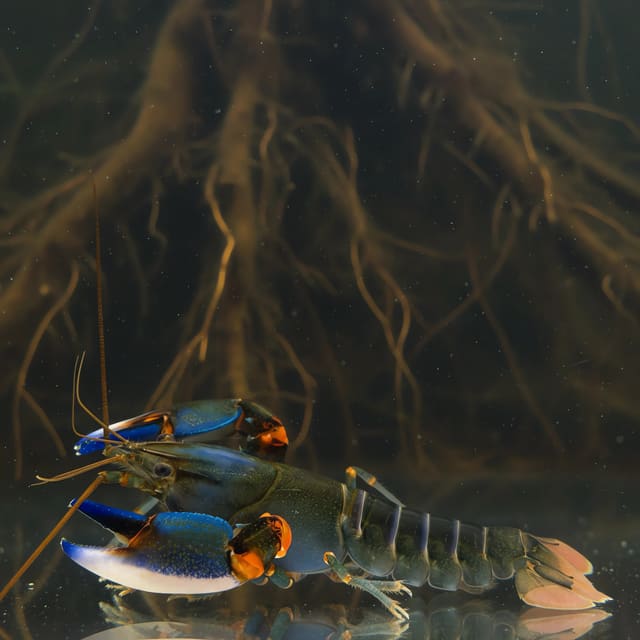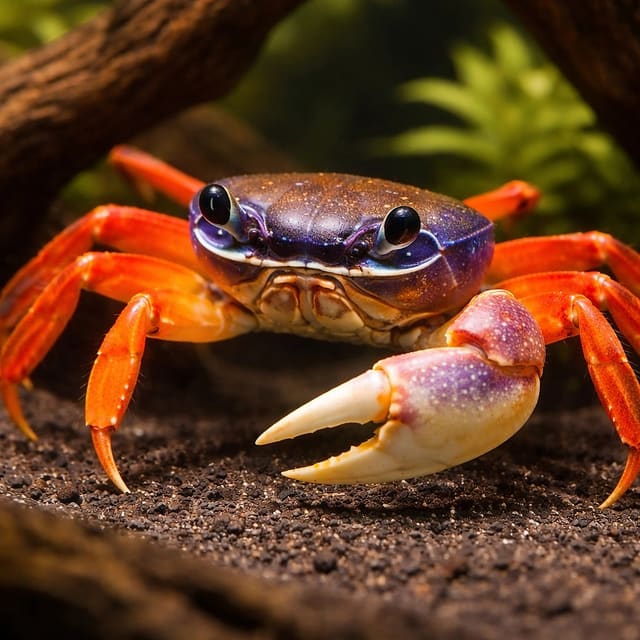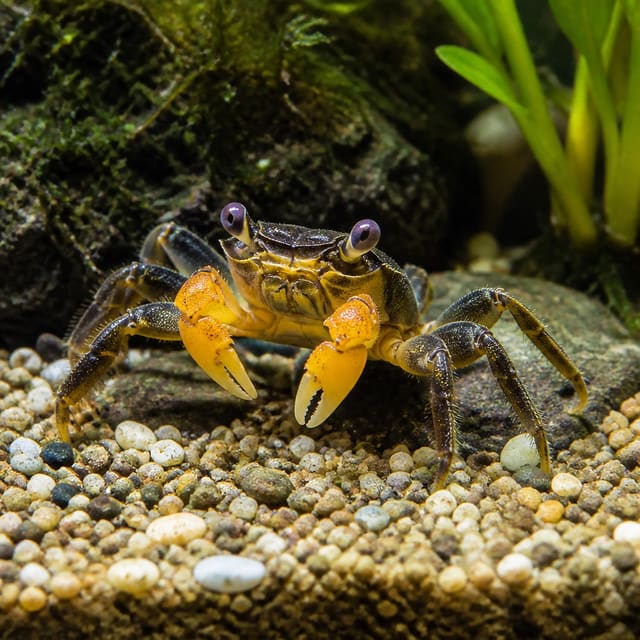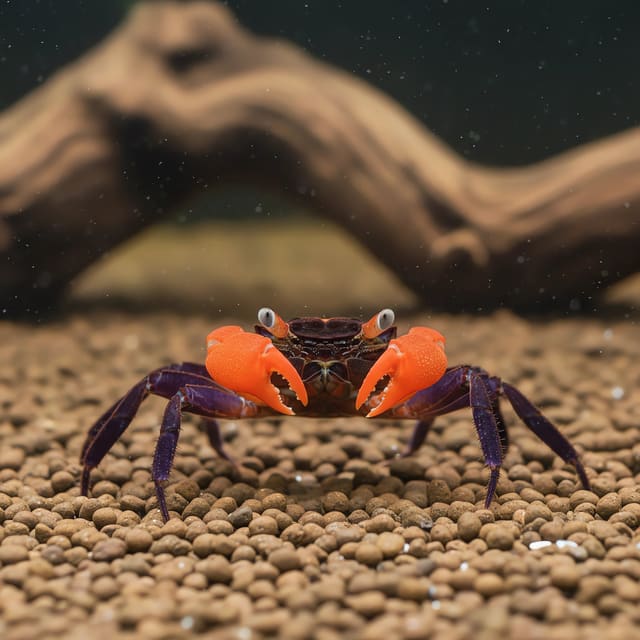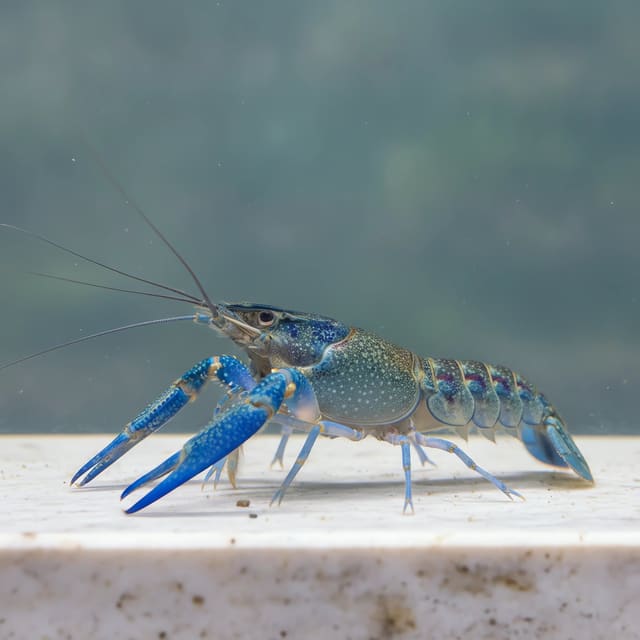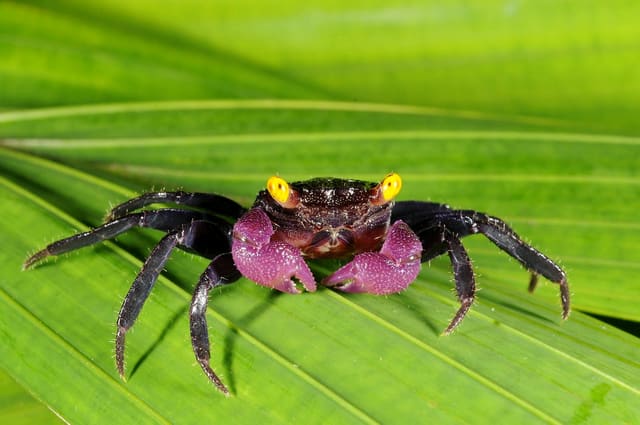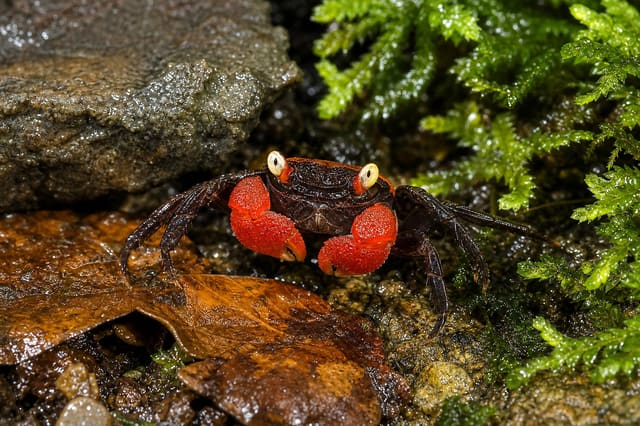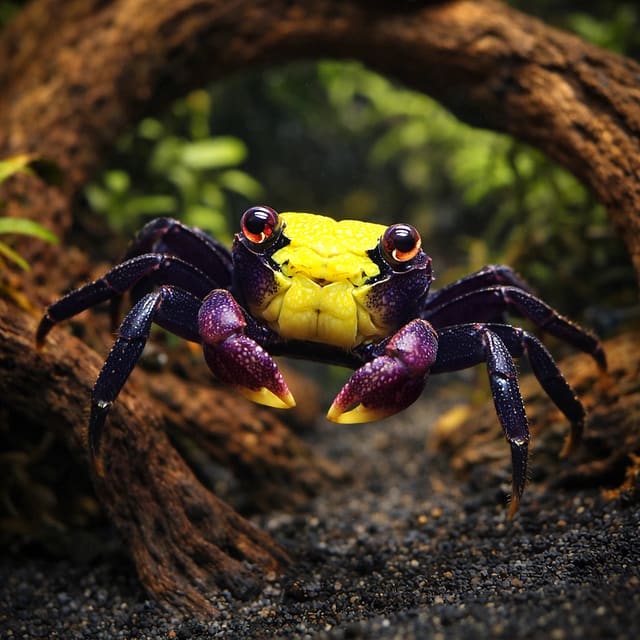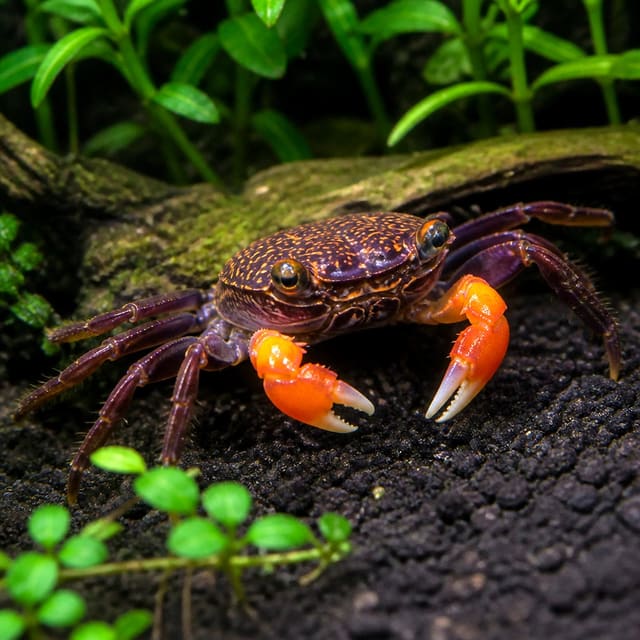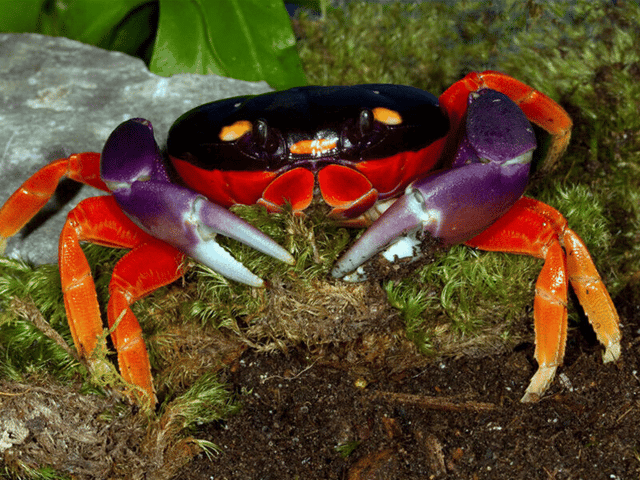
Halloween crab (Gecarcinus quadratus)
£83.99
Photo coming soon
The size, price and care details on this page are for this listing.
A true freshwater river crab of the genus Mekhongthelphusa from the Mekong basin, sold as one crab with the exact species not confirmed. It needs clean, heated water, rocks or a bank it can climb out onto, plenty of hiding places and a lid it cannot get through.
Mekhongthelphusa sp.
A true freshwater river crab of the genus Mekhongthelphusa from the Mekong basin, sold as one crab with the exact species not confirmed. It needs clean, heated water, rocks or a bank it can climb out onto, plenty of hiding places and a lid it cannot get through.
This listing is for a river crab of the genus Mekhongthelphusa, a small group of true freshwater crabs from the Mekong basin in mainland South-east Asia. It used to appear on our site as "Mekhong thelphussa", which is the genus name split in two and misspelt. We have corrected it to Mekhongthelphusa sp., where "sp." means the genus is known but the exact species has not been confirmed.
The name is a description in itself. "Mekhong" is the spelling Thai zoologists use for the Mekong River, and "thelphusa" is a word ending shared by many Asian freshwater crab genera. The genus was first proposed by the Thai carcinologist Phaibul Naiyanetr in a short conference abstract in 1985, and the World Register of Marine Species (WoRMS), which also covers freshwater crustaceans, now lists it as Mekhongthelphusa Naiyanetr, 1994. According to the 1995 revision of the genus by Naiyanetr and Peter Ng, these crabs share the Thai name pu mae nam with other river crabs.
Mekhongthelphusa sits in the family Gecarcinucidae. Wikipedia describes this as a family of true freshwater crabs found across South Asia, South-east Asia and New Guinea, with a single genus reaching Australia. Older papers, including the 1995 revision, place the genus in a separate family, Parathelphusidae; that group is now treated as a subfamily within Gecarcinucidae, so the two names you will see in the literature refer to the same crabs. "True freshwater crab" matters here: these animals complete their whole life cycle in fresh water, with no trip to the sea for breeding.
WoRMS lists five accepted species in the genus:
Telling these species apart is specialist work. In both scientific papers we used, the species are separated by details such as the shape of the crests across the front of the shell, the shape of the side teeth, the proportions of the last walking leg and, above all, the shape of the male's first pair of reproductive appendages (gonopods), which can only be examined on a male specimen under magnification. That is not something that can be checked on a living crab in a shipping bag, and our stock records name the genus only. Rather than guess an epithet, we sell it as Mekhongthelphusa sp. and describe the genus honestly.
Each unit on this listing is one crab. The listing has a single option, with no pack size, sex or size grade, so we cannot promise a male or a female, and we do not quote a dispatch size. If size matters for your set-up, email us before ordering and ask about the current animals.
The genus was set up for a crab with a very square-looking shell, and that is still the first thing to look for. Naiyanetr and Ng's 1995 diagnosis describes the carapace as squarish, with flat, smooth upper surfaces. Pan, Yeo and Sun, describing the newest species in 2021, add that the carapace is slightly broader than long. Seen from above, the back edges of the shell run almost parallel, which gives the boxy outline.
Colour has only been described in life for one species. Pan and colleagues describe M. menglongensis as having a light brownish carapace with dark brown patches towards the front, bordered by the grooves on the shell, and dark brown walking legs. We cannot say the crab you receive is that species, so treat that description as a guide to the kind of colouring the genus can show rather than a promise.
Crab sizes are given as carapace width by carapace length, measured across and along the shell, not including the legs. None of our sources gives a published maximum size for the genus, so here are the specimens that were actually measured:
| Species | Measured specimens (carapace width x length) | Source |
|---|---|---|
| M. tetragona | Male 24.5 x 21.0 mm; females 31.9 x 25.7 mm and 33.5 x 28.1 mm; lectotype female 25.0 x 22.0 mm | Naiyanetr and Ng, 1995 |
| M. kengsaphu | Holotype male 33.7 x 26.5 mm; paratypes up to 35.0 x 28.0 mm | Naiyanetr and Ng, 1995 |
| M. menglongensis | Holotype male 35.1 x 30.4 mm; paratypes 33.5 to 35.9 mm wide | Pan, Yeo and Sun, 2021 |
In plain terms, the crabs measured in the scientific descriptions have shells roughly 2.5 to 3.6 cm across. With the legs spread, a crab takes up a good deal more room than that, which is worth remembering when you plan hiding places and the size of the tank.
The genus is mainly Indochinese. Pan and colleagues describe it as distributed along the Mekong (the Lancang Jiang in China), and the records in the two papers we used come from Thailand, Laos, Vietnam and, since 2021, the far south of Yunnan in China. The collecting notes in those papers are the best guide we have to how these crabs live, so here they are in some detail.
Most of the M. tetragona specimens studied by Naiyanetr and Ng were collected along the bank of the Mekong at Mukdahan in north-east Thailand, under stones, on muddy sand. They were collected there on several visits in 1982 and 1984. That one line tells you a lot: this is a crab of the river margin, sheltering beneath stones where the bank meets the water.
The type series of M. kengsaphu was collected under water plants in the Mun River at Kaeng Saphue, in Ubon Ratchathani province. The Mun is a tributary of the Mekong (Seriously Fish describes it as such). Here the crabs were using submerged plants as cover rather than stones.
The 2021 description of M. menglongensis records the crabs in a small gravel-bed river about 5 metres wide, slightly turbid and slow-flowing, and notes that they were collected from the middle of the river rather than the edges.
The records for M. brandti include Tad San Falls in Loei province, northern Thailand, and M. neisi comes from the old Cochinchina region of southern Vietnam. The papers do not give habitat notes for these two.
Wikipedia's overview of freshwater crabs fills in the wider picture. Around 1,300 species live in the tropics and subtropics, in habitats from fast-flowing rivers to swamps, and even in tree holes and caves. Most forage mainly at night. Many have a "pseudolung" in the gill chamber that lets them breathe air, which allows some species to live a partly land-based life, although they still have to return to water to get rid of ammonia, their main waste product.
A river crab needs a different set-up from a fish. It walks rather than swims, spends its time on the bottom and among cover, and can climb out of the water whenever it likes. Get the layout right before the crab arrives and most of the common problems never happen.
We have not found a published tank size for this genus, so this is our own advice, based on the size of the crab: a single crab with a shell of around 3 cm across, plus legs, needs floor space for a land area, several hiding places and open bottom to forage over. We would not use a tank shorter than 60 cm for one crab. Length and floor area matter far more than height, and a lower water level is actually useful, as explained below.
Because freshwater crabs can breathe air, give this one the choice. Build part of the tank so that rocks, a sloping pile of stones or a piece of wood rise above the waterline and give the crab a dry or damp place to sit out. It must be able to walk straight back into the water from that area, without a drop it cannot climb, because it has to return to water to get rid of its waste. Keep the water level a few centimetres below the top of the tank so the emergent area sits well clear of the lid.
A tank that is half water and half land is one option. Our sources show the genus living in rivers, under stones on banks and among submerged plants, and one species collected from the middle of a river, so a tank that is mostly water with a generous emergent rock area is the closer match. What matters is that both options exist and that the crab can move freely between them.
An animal that walks, climbs and breathes air will explore beyond the water. A crab that gets out of the tank overnight is likely to dry out on the floor, so a closely fitting lid is not optional. Before the crab arrives, go over the top of the tank:
Cables and airline are the classic escape ladders. Route them so they do not run from the water straight up to a gap.
A sponge filter or an internal filter with a sponge over the intake is a good choice. It keeps the crab's legs and small pieces of food out of the impeller and gives gentle, even flow. Use a heater with a guard so a crab resting against it cannot be burnt.
No scientific source we found gives an aquarium temperature, pH or hardness for any Mekhongthelphusa species. What we do know is where they live. One species was described from the Mun River in Ubon Ratchathani, and Seriously Fish gives aquarium conditions for a loach, Lepidocephalichthys kranos, whose type locality is a marsh beside that same river: 23 to 26°C, pH 5.5 to 7.5, and hardness 2 to 10 dGH.
A loach is not a crab, so take those figures as a guide to the water these animals come from rather than as a crab specification. Our practical advice is a heated tank held steady somewhere between 23 and 26°C, with water that is roughly neutral and not extremely soft. If your tap water tests far outside that, talk to us before ordering. Stability matters more than chasing an exact number: a steady reading is far better for an invertebrate than one that swings with every water change.
OATA, the UK ornamental fish trade association, sets out the basics in its freshwater water quality care sheet, and they apply just as much to a crab:
OATA also explains that in a newly set-up aquarium ammonia and nitrite rise first and only fall to zero once the filter bacteria have built up. Put the crab only into a tank that has finished this cycle.
A crab sitting out of the water is not excreting into it, but it has to come back to the water to do so, and it brings food and debris into the water from the land area. Keep the water around the climb-out rocks especially clean, siphon the bottom where food collects, and check that the emergent area stays damp rather than baking under a light.
A lid keeps the air above the water warm and humid, which is also more comfortable for an animal that spends time out of the water. If you use an open-top light, the gap you leave for it is exactly the gap a crab will find.
Wikipedia's overview of freshwater crabs describes most of them as omnivores, with some specialists; it gives the example of one predatory species that eats almost nothing but snails. Wikipedia's general crab article describes crabs as feeding on a mixture of algae, small animals such as molluscs, worms and other crustaceans, and detritus. Freshwater crabs forage mainly at night. Nothing in our sources records the natural diet of Mekhongthelphusa specifically, so we feed it as the omnivore its family tends to be.
Variety is the point. A crab fed on one food only is more likely to go short of something.
Feed in the evening, around lights-out, because that is when freshwater crabs are most active. Put the food in the water near its shelter rather than on the land area, so the leftovers stay where the filter and your siphon can deal with them. With a shy new crab, drop food near its hiding place after the lights go off, then check in the morning whether it has gone.
Our sources give no feeding schedule for this genus, so judge it by what disappears. Offer an amount the crab finishes overnight, remove anything left the next morning, and adjust. A crab that ignores food for a day or two is not necessarily ill; it may be hiding before or after a moult, which is covered in the health section below. Check the water first, then wait and offer again.
If your crab carries pieces of food up onto the rocks, pick them up when you see them, because food rotting out of the water is easy to miss and unpleasant in a closed tank.
A crab with claws, an omnivorous diet and a night-time foraging habit is not a natural community fish. Keep that in mind when you plan the tank.
Crabs eat small animals, including molluscs, worms and other crustaceans, according to Wikipedia. That puts snails and small shrimp firmly in the food category. Small fish that sleep on or near the bottom are also within reach of a crab hunting at night. Bottom-dwelling fish such as small loaches and catfish share the crab's space and its food, and can get pinched.
The crab's own weak point is the moult. After moulting, an arthropod is pale and soft-bodied until the new outer layer hardens (Wikipedia, ecdysis), and in that state it cannot defend itself. Large or boisterous fish, crayfish and other crabs could injure or eat a freshly moulted crab. Fish that peck at anything on the bottom are a nuisance at the best of times and a danger during a moult.
Our sources do not describe how these crabs behave towards each other. Because a freshly moulted crab is defenceless, we suggest starting with one. If you want more, give each crab its own hiding place plus extra spares, use a larger tank, and watch closely around moults. If one crab starts harassing another, separate them.
Both described species from the 1995 paper have a sharp spine on the inner side of the claw arm, and any crab can pinch. Move the crab by guiding it into a small container or a soft net rather than picking it up with your fingers, and never lift it by a leg or a claw.
Crustaceans have a hard outer skeleton which, as Wikipedia puts it, must be moulted for the animal to grow. The old covering is shed and a new, larger one forms. Moulting is the most important event in a crab's life in the aquarium, and most health worries come back to it.
When a crab moults it leaves its old outer skeleton behind; Wikipedia's term for these remains is exuviae. Because the cast-off skeleton is the crab's own old outer covering, it can easily be mistaken for a dead crab. Before you remove anything that looks like one, look closely: a cast skeleton is light and empty, and the living crab is likely to be hiding nearby. After moulting, the crab is soft and pale until the new shell hardens, and it will usually stay hidden during that time. Leave it alone, keep tank mates away from it, and do not move its shelter.
The other common loss is an escape. If your crab disappears, search the tank thoroughly first, under every stone and inside caves, because a hiding crab can stay out of sight for days. Then check the floor around and behind the tank, the cabinet, and behind the filter.
A crab that sits out on the land area all the time, stops eating or seems weak is a reason to test the water straight away. Freshwater crabs must return to the water to excrete waste, so they cannot simply avoid bad water. Test ammonia, nitrite and pH whenever behaviour changes.
If your crab loses a leg or a claw, look for the cause: rough handling, a tank mate, a sharp edge, or a fall from the climb-out area.
Some products sold to treat fish carry warnings about invertebrates. Read the label before dosing a tank that contains a crab, and if you are unsure, ask us before you add anything. Treating fish in a separate tank keeps the crab out of it entirely.
As true freshwater crabs, Mekhongthelphusa species do not need the sea to breed. Wikipedia describes freshwater crabs as having direct development: the larval stages pass inside the egg and the eggs hatch as small juvenile crabs. Females carry only a few hundred eggs, each about 1 mm across, far fewer and much larger than the eggs of most sea crabs.
In this genus the male's abdomen, folded flat under the body, is T-shaped, and Wikipedia's general crab article notes that males often have larger claws than females. With a calm look at the underside, those two features are the way to tell a male. The listing does not sell a sex, so you may receive either.
Naiyanetr and Ng noted something unusual about M. tetragona: in random collecting, most specimens taken were females, and males were relatively rare. They suggested the ratio of males to females in that species is very unbalanced. We cannot say whether the same applies to every species in the genus, but it is one more reason we do not promise a sex.
None of our sources describes Mekhongthelphusa breeding in an aquarium. Buy this crab to keep and watch rather than as a breeding project. If you ever find a female carrying eggs under her abdomen, give her peace and plenty of cover, keep the water clean, and be aware that tiny juvenile crabs would be at risk from any tank mates, including adult crabs.
Before you order, please read our delivery and live-arrival information. These are the points that matter on the day, with the crab-specific details added.
Live animals travel in oxygen-filled bags in insulated packaging, with heat packs added when the conditions call for them, by a tracked courier licensed to carry live animals. Your confirmed delivery date and tracking details come by email.
Start filming before you open the outer box and keep the video running without a break. Open the box in the same take and show the animal in its bag before the bag is opened. If it has arrived dead, dying or clearly compromised, email hello@tropicalfishco.co.uk on the day of delivery, quoting the order number and attaching that video. Photographs on their own are not enough under the policy. Where a claim is accepted, we replace the affected animal with your next order or refund it, subject to the guarantee terms.
Keep the light low for the first day and watch breathing, appetite and behaviour over the first week. Expect a new crab to hide at first, and do not worry if you see little of it for a few days. Offer a small amount of food near its shelter after dark from the second evening, take out anything left the next morning, and test the water a couple of times. If the crab spends time on the land area, that is normal for an air-breathing freshwater crab, as long as it also goes back into the water.
These are the sources behind the facts on this page. The two scientific papers are free to read online.
No reviews for this item yet. Bought one? Honest reviews only, good or bad.
What customers say about ordering from us
Easy website plenty of info on fish your buying great to pick a time slot
TRACEY DURRANT · 7 Oct 2026
Got some lovely fish thank you
Kevin Mackie · 7 Oct 2026
Reviews of our shop, collected by Judge.me, an independent third-party review collector. Newest first.