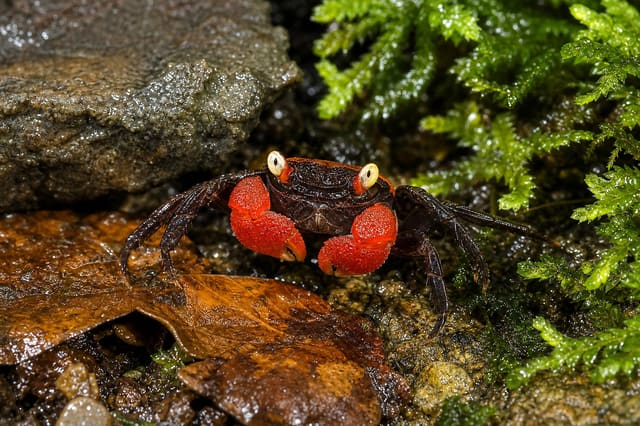
Red Devil Vampire Crab (Geosesarma hagen)
£9.99
Photo coming soon
The size, price and care details on this page are for this listing.
One live blue vampire crab (Geosesarma sp.), sex not selected. A small semi-terrestrial crab that lives mostly on land, it needs a warm, humid paludarium with a shallow freshwater pool, plenty of hiding places and a lid that fits, not an ordinary fish tank.
Geosesarma sp.
One live blue vampire crab (Geosesarma sp.), sex not selected. A small semi-terrestrial crab that lives mostly on land, it needs a warm, humid paludarium with a shallow freshwater pool, plenty of hiding places and a lid that fits, not an ordinary fish tank.
Maintain these water conditions for optimal health and vibrant colors
This listing is for one live blue vampire crab. Each unit you order is a single crab. The sex is not selected: there is no male or female option, so the crab you receive could be either, and nothing on this page should be read as a promise of one or the other. There is no size option to choose from either.
"Blue vampire" is a hobby name, not a scientific one. It tells you the colour the crab is known by. It does not tell you the species, and nobody has yet tied this form to a formally described species. That is why the title reads Geosesarma sp.: the genus is certain, the species is not, and we will not make one up to look tidy.
That caution is well founded. Peter Ng and Daisy Wowor, the taxonomists who described two more traded Javan species in 2024, wrote that year that a lot of colourful Geosesarma have been found by local collectors in recent years and gone into the aquarium trade under exotic names and localities, few of which can be substantiated and many of which turn out to be false. In the same paper they note that dozens of other species from Indonesia remain undescribed. Two widely traded crabs, Geosesarma dennerle and Geosesarma hagen, had been in the trade for many years before they were formally named in 2015, once their collection sites had been confirmed. A colour name in a shop can easily belong to a crab that science has not described yet.
For a keeper the practical difference is small. The vampire crabs studied so far share the things that matter for care. They are small. They live and breed on land rather than in open water. They need humidity and shelter, they eat a mix of small animal and plant foods, and their young hatch as tiny crabs rather than as drifting larvae. This guide uses what is recorded for the genus as a whole and for its named Javan species. Where a figure comes from one of those relatives rather than from the blue form, the text names the species it belongs to, so you can see exactly what is known and what is borrowed.
If you take one thing from this page, make it this: a vampire crab is not a fish-tank animal. It needs a paludarium, an enclosure that is mostly land with a shallow area of fresh water, kept warm and humid, with plenty of places to hide and a lid that closes properly. If you were hoping to add a small crab to a planted community aquarium, please choose something else. If you are happy to build a small slice of damp forest floor and watch it come alive in the evenings, this is a fascinating little animal to keep.
Vampire crabs are tiny. When Ng and Wowor described two Javan species in 2024 they measured dozens of specimens, and the adults mostly fell between about 10 and 15 mm across the carapace, the hard shell over the body. The biggest male they recorded was 15.3 mm wide. The legs reach well beyond the shell, so a crab walking over moss looks larger than that: Wikipedia describes the related G. hagen as reaching about 7 cm when the full leg span is counted. Published size figures do not agree well. Wikipedia's genus page calls the crabs typically under 10 mm across the carapace, while its G. dennerle page quotes a far larger carapace figure that does not fit the specimens taxonomists have measured. We have relied on the measurements in the scientific description, and because the blue form has not been identified to species, this listing does not state an adult size for it.
In outline the shell is squarish and a little wider than long in the species measured in 2024. Like other crabs it has five pairs of limbs: a pair of claws, which zoologists call chelae, and four pairs of walking legs. According to local collectors and dealers quoted in the 2024 paper, it is mostly adult males that are collected for the trade, because the males are more colourful and carry bigger claws. So a bright crab with heavy claws is quite likely a male, but treat that as a rule of thumb rather than a test.
To sex a crab with confidence, look underneath. Wikipedia notes for G. hagen that males have a narrow, slim plate on the belly while females have a broad one. It is the simplest check if you want to know what you have, and it matters if you hope to breed them.
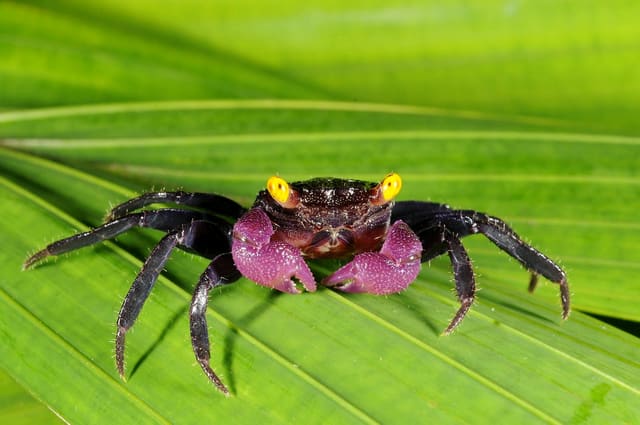
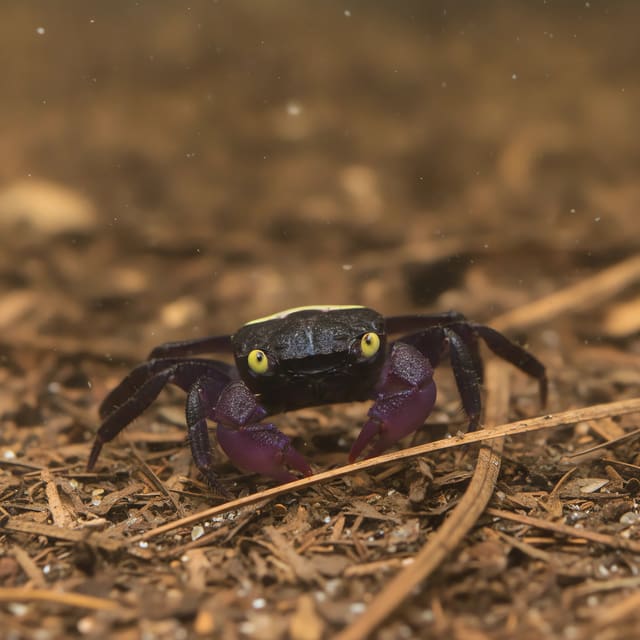
The name "vampire crab" has nothing to do with blood or feeding. Wikipedia explains that it comes from the bright, contrasting yellow eyes of some species, and then adds the caveat every buyer should hear: not every vampire crab has yellow eyes, and some have white or black eyes. We make no promise about eye colour on this crab.
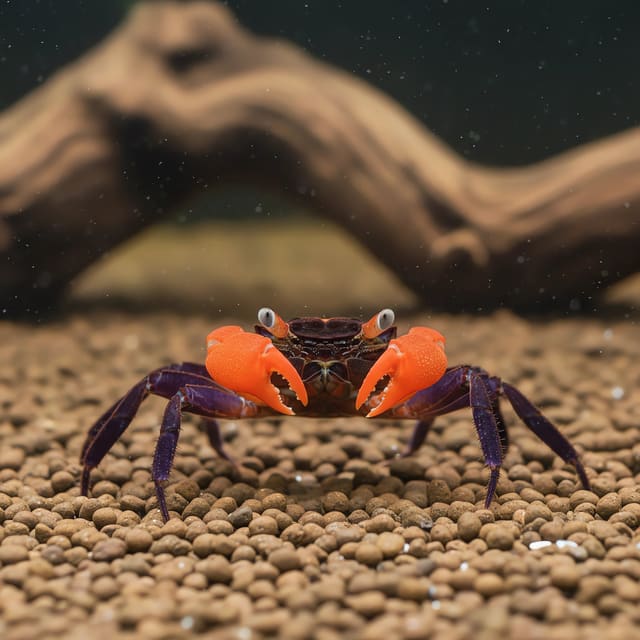
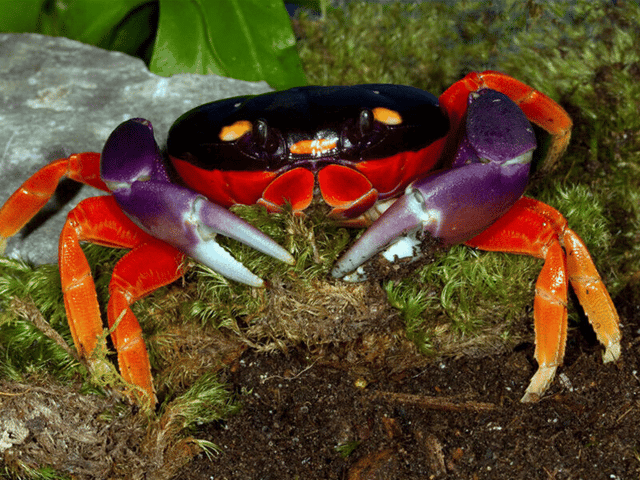
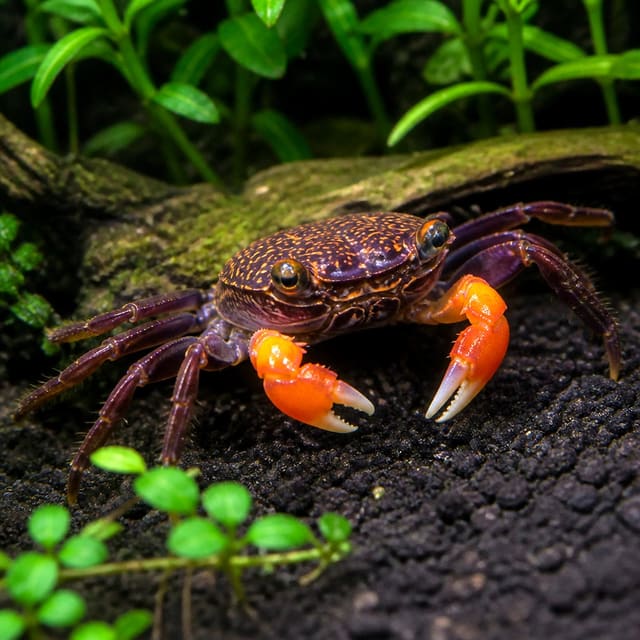
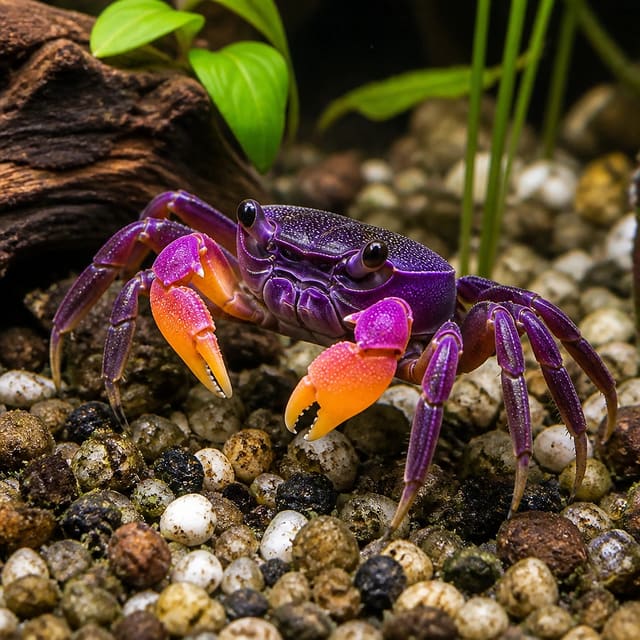
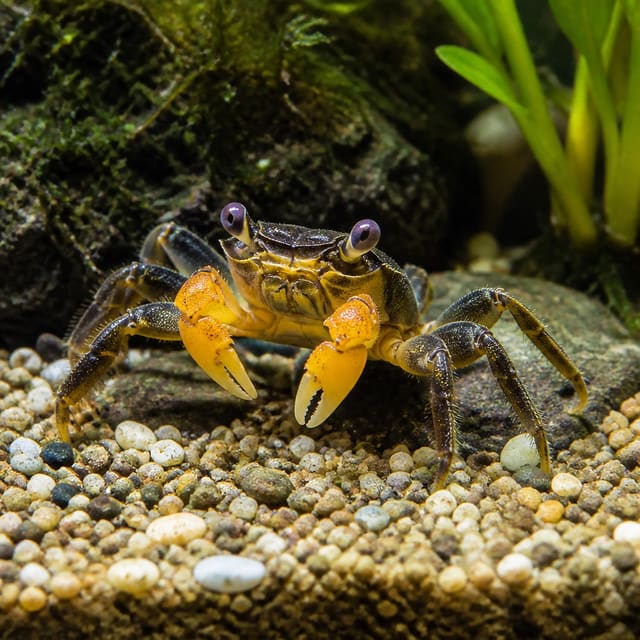
Colour in life is one of the main ways taxonomists tell vampire crab species apart, and the range is wide. The 2024 paper describes Geosesarma riani as having a grey to greyish-blue carapace with dark brown rear corners, orange claws and pale orange to orange-red legs. G. dennerle is mainly purple with a cream patch and violet claws, and G. hagen is dark brown with orange to red on the claws and parts of the shell. The same paper found four species, each with its own colour pattern, within roughly 1,000 square kilometres of western and central Java. A crab sold as blue is named for blue colouring, but without a formal identification nobody can tell you which described pattern, if any, it matches. Other forms sold under colour names, such as the Orange Vampire Crab (Geosesarma sp.), sit in the same position: a confirmed genus without a confirmed species.
Age changes colour as well. Wikipedia records that young G. hagen have little colour at first, turn dark brown and only later develop their bright adult colours. If your blue vampire crabs breed, do not be surprised when the youngsters look nothing like their parents for a while.
The genus Geosesarma was named by De Man in 1892 and is accepted in the World Register of Marine Species, which places it in the family Sesarmidae within the superfamily Grapsoidea. Despite the register's name, its entry for the genus covers freshwater and land habitats as well as the sea. Wikipedia lists vampire crabs from India, Indonesia, Malaysia, Thailand, the Philippines, the Solomon Islands and Hawaii, counts around sixty named species, and sums the group up as small freshwater or terrestrial crabs that live and reproduce on land.
Many of the colourful crabs in the hobby come from Indonesia, and Java has some of the best-documented examples. With the two species added in 2024, fourteen Geosesarma are known from Java, and every one of them is endemic, found there and nowhere else. The habitat notes in the scientific descriptions read almost like a set-up guide:
Read those notes together and the picture is clear. These crabs live on wet ground beside streams, under stones, in burrows and among dense plants, in air that stays humid, with water close by rather than all around them. That is exactly what a paludarium copies, and it is why a standard aquarium full of water is no use to them.
Their wild situation is worth knowing about. Wikipedia reports that G. dennerle and G. hagen are threatened by illegal overcollection for the aquarium trade. Ng and Wowor write that large numbers of the newer Javan species are collected for the global trade, that nobody knows the effect on their populations, and that, given their small ranges and small broods, they expect harm in the near term. No Geosesarma has yet been assessed under IUCN guidelines. None of that is a reason not to keep them. It is a good reason to keep the crabs you have well, to let them breed if they will, and to pass the youngsters on to other keepers rather than buying more.
Think of the enclosure as a strip of stream bank in a box. Most of the floor should be land, with a shallow pool of fresh water along one side or at one end that a crab can walk into and out of without effort. The wild crabs live near water but are not aquatic, so the pool is part of the landscape rather than the main living space. Keep it shallow, with a gently sloping edge or a few stones as steps, so a small crab can always get back onto land.
These are ground dwellers that shelter under stones and in burrows, so the area of usable land matters more than the volume of water. OATA, the UK's ornamental aquatic trade association, asks keepers to make sure an enclosure suits the animals once they are fully grown. For vampire crabs that means enough land for every crab to have its own hiding place, with a few spare, so no crab ever has to share a refuge. A long, low tank or a purpose-built paludarium gives more useful floor than a tall, narrow one.
Wild vampire crabs burrow and dig small shelters, so give them land made of something that stays damp without turning to waterlogged mud and that holds its shape when a crab digs into it. Layer leaf litter on top. Leaves give cover, break up sight lines and add the decaying plant matter that wild G. hagen are recorded as eating. Keep the deeper layers damp rather than wet, and build in some drainage so stagnant water does not collect at the bottom.
The habitat notes keep returning to stones, rocks and thick vegetation, so give the crabs plenty of all three. Flat stones resting on the base make instant caves. Cork bark, wood and clay pieces add more. Dense planting on the land, and plants that trail down to the water's edge, give a crab somewhere to sit unseen. Bed every stone firmly on the base of the tank rather than on top of loose substrate; a digging crab can undermine a rock that is only resting on soil.
OATA's equipment list for freshwater crabs includes a secure lid, and with a land-living animal we would treat it as essential. A crab that walks on land can walk out of any gap it finds, including the cut-outs for cables and pipes. Close those with mesh or foam, and check the lid every time you have had it open. A good lid also holds in the humidity the crabs need, so it does two jobs at once.
Wikipedia describes G. hagen as spending most of its life hidden from the light and becoming an active hunter and scavenger at night. Lighting for the plants is fine, but leave shaded corners, keep the enclosure out of direct sun, and expect most of the activity in the evening. The hour after the main light goes off, with a dim room light on, is the best time to watch them.
Unless the room stays reliably warm all year, plan on heating the enclosure. Use a heater suited to the layout, a reliable thermostat and a thermometer read at ground level on the land, not only in the pool. The temperature range to aim for is in the next section. Whatever you use, make sure a crab cannot climb onto or wedge itself against a heating element.
OATA's care sheet for crayfish and freshwater crabs names vampire crabs among the animals it covers and sets these targets:
| Measure | OATA target |
|---|---|
| Temperature | 22 to 27 °C |
| pH | 7.0 to 8.0 |
| General hardness | medium-hard, 8 to 18 °dH |
| Carbonate hardness | medium-hard, 10 to 15 °dKH |
| Ammonia | zero |
| Nitrite | zero |
| Nitrate | no more than 20 mg per litre above your tap water |
Wikipedia gives the natural environment of G. hagen as 24 to 28 °C. The two ranges overlap between 24 and 27 °C, so aiming for around 24 to 26 °C keeps you inside both. OATA also warns that invertebrates are prone to shock from sudden changes, so steady conditions matter more than hitting an exact figure.
Every habitat description for these crabs stresses wet ground and humid air. Keep the substrate damp, mist the land and plants with dechlorinated water when they start to dry, and let the lid hold the moisture in. A small hygrometer at crab level shows you whether the air is staying moist; if the moss and leaf litter dry out on top between mistings, mist more often or close the gaps in the lid. Do not swing to the opposite extreme and flood the land, because the crabs need ground they can walk and dig on.
OATA notes that some crabs come from estuaries and need a little salt in their water. The Javan vampire crabs in the hobby are not in that group: the 2024 paper describes them as semiterrestrial freshwater crabs, and their habitats are forest streams and wet ground. Use plain dechlorinated fresh water for the pool and for misting.
A shallow pool holds very little water, so a few forgotten scraps of food can foul it fast. Small, frequent partial changes with dechlorinated water at the same temperature keep ammonia and nitrite at zero far more easily than occasional large ones. Test it with the same kits you would use for an aquarium. If you run a small pump or filter to move the water, guard the intake so a small crab cannot become trapped against it.
OATA is blunt on this point: crayfish and freshwater crabs are very sensitive to copper and will die if exposed to even low levels. Check that every treatment and additive that goes near the enclosure is safe for invertebrates, and never use a fish medicine in the crab set-up without confirming it contains no copper.
Vampire crabs are omnivores with a taste for small animal food. Wikipedia describes G. hagen as an omnivore that prefers animal prey, eating anything from detritus and dead plants to fruit flies, woodlice and other small bugs, and gives the wild diet of G. dennerle as insects and plant matter. OATA's general advice for freshwater crabs fits that well. It suggests meaty frozen foods such as mysis, prawns and krill; vegetables such as courgette, cucumber and lettuce; and sinking crustacean pellets, algae wafers and dried algae.
OATA advises feeding crabs once a day, leaving the food for about 30 minutes and then removing what is left, and it warns against overfeeding. A vampire crab is a very small animal, so a portion is tiny: a single thawed mysis, a crumb of pellet, a thin sliver of courgette. With several crabs, scatter several small portions so that one bold crab cannot sit on all of them. Lift out anything uneaten, because food spoils quickly in a warm, humid enclosure and a shallow pool shows the effect almost at once.
These crabs come out mainly after dark, so feed in the evening, around the time the main light goes off. Put the food on the land near the water's edge or on a small flat stone, where the crabs will find it and you can see what has gone and clear the rest.
Cultured fruit flies or woodlice, the kinds of prey recorded for wild G. hagen, make a good occasional offering and let you watch the crabs hunt. Buy them from a clean culture rather than collecting them outdoors, where you cannot know what they have been exposed to. Keep quantities small so that live insects do not escape into the room or go uneaten in the leaf litter.
A mix through the week that is mostly animal foods, with a little vegetable matter and leaf litter always available on the land, follows what the wild crabs are recorded eating. Rotate rather than feeding the same thing every night. If the crabs stop coming out to feed, check the temperature and the water first, then work through the health checks further down this page.
Expect a shy animal by day and a busy one at night. Wikipedia calls G. hagen cathemeral, meaning it can be active at irregular times of day or night, but notes that it spends most of its life hidden from the light and hunts and scavenges after dark. In a well-planted paludarium you may see little of your crabs at midday and a good deal of them in the evening, picking over the leaf litter and moving between hides.
People often ask what fish can live with vampire crabs. OATA's answer is that freshwater crabs are best kept in a dedicated set-up and not mixed with fish at all. Crabs are scavengers, it explains, but they are opportunistic and will hunt small, slow-swimming fish. The layout is wrong for fish anyway: the pool in a vampire crab paludarium is shallow and small, and a layout built around damp land leaves very little open water for anything that needs to swim.
Wikipedia notes that G. hagen shows a higher level of social and behavioural complexity, but that it is often aggressive towards crabs of other species. Because different colour forms in the trade can be different species, as the 2024 paper makes clear, the safe course is to keep blue vampire crabs only with other blue vampire crabs. If you also like the Red Devil Vampire Crab (Geosesarma hagen) or the Purple Vampire Crab (Geosesarma dennerle), both of them named species, give each one an enclosure of its own.
OATA notes that some crab species are social and do best in groups of at least five, while others are better kept alone. Its sheet does not say which applies to vampire crabs, so we will not put a number on it. What we can say is that a group needs room: a hiding place for each crab with spares, enough floor for crabs to stay out of each other's way, and food scattered rather than piled in one spot. Bear in mind too that the 2024 paper reports adult males making up most of the crabs collected from the wild, so do not assume any group of vampire crabs has an even mix of the sexes. Check the belly plates if you want both.
Small shrimp and snails can look like a natural addition, but an omnivore that prefers animal prey and hunts at night is a poor companion for anything small enough to catch. Keep dwarf shrimp in an aquarium of their own rather than in the crab enclosure.
Crabs grow by moulting, shedding the old outer skeleton and hardening a new, larger one. OATA warns new keepers not to panic at a shed skin that looks just like a dead crab: check the hides before you assume the worst, and count your crabs in the evening when they are out and about. The moulting problems OATA asks keepers to watch for are a crab struggling to moult, an outer skeleton shed only partly, and a clear change in how often moults happen. Wikipedia notes that G. hagen moults both to grow and to regrow lost legs, replacing them within a few months, so a crab missing a leg or a claw is not necessarily in trouble. In good conditions the lost limb comes back over the following moults.
OATA lists the changes that tell you a crab or crayfish is not right. Adapted for a vampire crab, they are:
When you see any of these, check the basics first: temperature at ground level, humidity, and ammonia and nitrite in the pool. OATA's warning about copper is worth repeating here, because even low levels are lethal to crabs.
Vampire crabs are not long-lived animals. Wikipedia gives G. hagen a lifespan of up to two years, with about a year and a half typical, and OATA notes that some of the smaller freshwater crabs live only a couple of years. Go in knowing that. A colony that breeds can carry on long after its first crabs have gone, which is one more reason to set the enclosure up so the crabs can breed.
OATA reminds keepers that releasing aquarium animals or plants into the wild is illegal, and it is never kind to the animal. If you can no longer keep your crabs, find them a new home through a local aquatic shop or another keeper.
Breeding is realistic in a home paludarium, and the reason is in the biology of the genus. Wikipedia describes Geosesarma as living and reproducing on land, with the larval stages passed inside the egg. There is no free-swimming larval stage to raise: the eggs hatch as fully formed miniature crabs. The detail we have comes from the named Javan species, so treat these figures as a guide for the blue form rather than its own measured values:
The 2024 paper describes vampire crabs as having a small brood size, and the egg counts above bear that out. With so few eggs per clutch, every youngster that survives counts.
You need both sexes, and crabs on this listing are not sexed. If breeding matters to you, check the belly plates when your crabs arrive and settle: going by what is recorded for G. hagen, the broad plate marks a female and the narrow one a male. Bear in mind that a mix is never guaranteed in any single order.
Baby vampire crabs are very small, and they need the same things as the adults on a smaller scale: damp cover, moss and leaf litter to hide in, and food small enough to handle, such as crushed pellets and finely chopped frozen food. If you want to raise as many as possible, a second small enclosure set up the same way lets you feed the youngsters and watch them closely. Expect them to look dull at first. Young G. hagen start with little colour and only gradually develop the adult pattern, and the blue form may well do something similar.
Captive-bred youngsters are the best answer to the collecting pressure described earlier. If your colony does well, other keepers will be glad of them, and every crab bred at home is one fewer that needs to be collected from the wild.
Please read our delivery and live-arrival information before you order, so you know how the parcel travels and what to do on the day. Live animals travel in oxygen-filled bags inside insulated packaging, with heat packs when conditions call for them, and go by a tracked courier licensed to carry live animals. You will receive the confirmed delivery date and tracking by email. Someone must be at the delivery address to receive the parcel.
The enclosure must be set up and running before the parcel arrives: pool filled and conditioned, water tested, land damp, hides in place and the temperature steady in the range above. Do not order and then start building. A crab that arrives to a half-finished set-up has nowhere safe to go.
Start a continuous video while the parcel is still sealed, and open it in the same take, showing the crab in its still-sealed bag. If a crab arrives dead, dying or clearly compromised, email hello@tropicalfishco.co.uk on the day of delivery with your order number and that video. Photos alone do not meet the policy. Subject to the guarantee terms, the resolution is a replacement with your next order or a refund for the affected animal.
Expect your crab to disappear into cover for a while; for an animal that naturally spends daylight hours hidden, that is normal. Over the first week, watch its breathing, appetite and behaviour. Offer a small portion of food in the evening and remove what is left. Keep checking temperature and humidity, and the pool's ammonia and nitrite, as the new arrival settles. A crab that is out exploring and picking at food after dark within a few days is settling well.
These are the sources behind the facts on this page:
No reviews for this item yet. Bought one? Honest reviews only, good or bad.
What customers say about ordering from us
Easy website plenty of info on fish your buying great to pick a time slot
TRACEY DURRANT · 7 Oct 2026
Got some lovely fish thank you
Kevin Mackie · 7 Oct 2026
Reviews of our shop, collected by Judge.me, an independent third-party review collector. Newest first.