Moderate
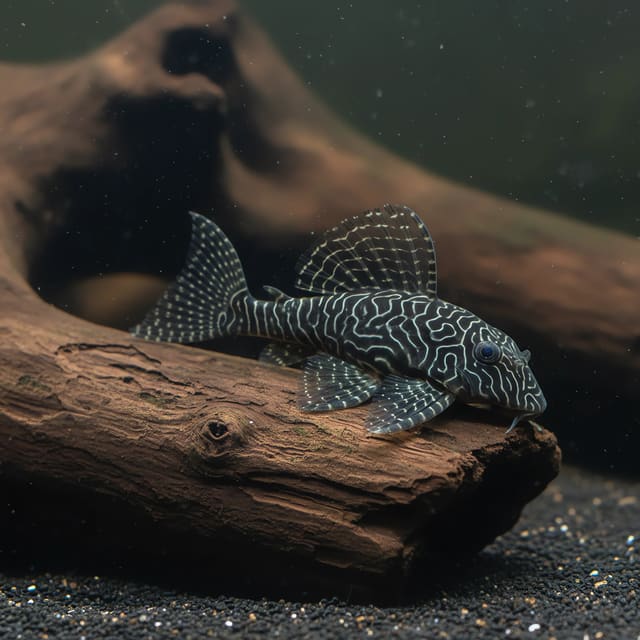
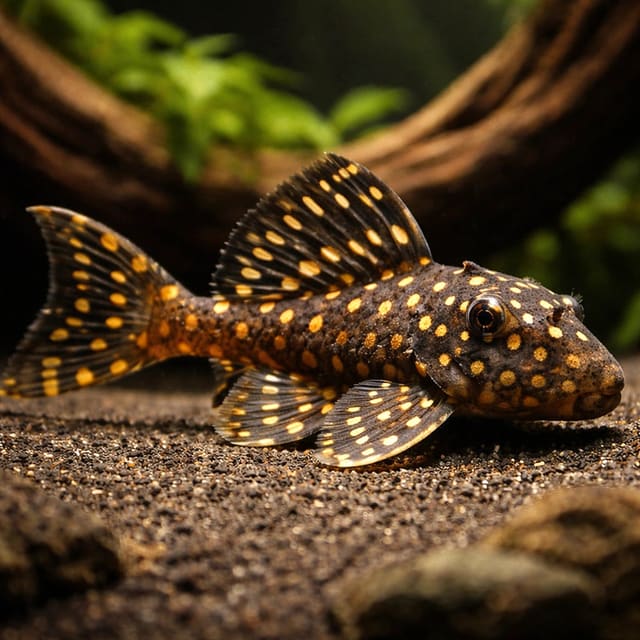
L029 Pleco (Hypancistrus sp. L029)
24–28°C · pH 5.5–7.5 · 200L
£47.99
The L091 Three Beacon Pleco (Leporacanthicus triactis) is a large vampire pleco from the upper Orinoco basin with a dark body and an orange blotch on each of its three unpaired fins. It grows to about 25 cm and needs a 120 × 45 cm aquarium with strong flow, high oxygen, caves and a meat-leaning diet. Sold individually as one live fish.
Leporacanthicus triactis
The L091 Three Beacon Pleco (Leporacanthicus triactis) is a large vampire pleco from the upper Orinoco basin with a dark body and an orange blotch on each of its three unpaired fins. It grows to about 25 cm and needs a 120 × 45 cm aquarium with strong flow, high oxygen, caves and a meat-leaning diet. Sold individually as one live fish.
‘Pleco’ is a loose aquarium-trade label, not one species or one care sheet. Before buying, confirm the scientific name or defensible L-number, adult size and measurement method, required footprint, temperature and water, diet, social plan and source. No universal pleco tank size, menu or algae result is honest.
Read the full care guidance when planning conditions for your aquarium.
The L091 Three Beacon Pleco (Leporacanthicus triactis) is a large armoured suckermouth catfish from the upper Orinoco River basin in Colombia and Venezuela. Its body shades from brown or grey to charcoal black depending on age, sex, mood and surroundings, and each of its three unpaired fins carries a vivid orange to yellow blotch: one on the dorsal fin, one on the small adipose fin behind it and one on the tail. Those three flashes of colour are the "beacons" in its common name.
It belongs to the family Loricariidae and to Leporacanthicus, the genus aquarists call vampire plecos. Every member has two long, fang-like teeth in the upper jaw and a small, blunt, backward-facing thorn on top of the head. Unlike many patterned plecos, the Three Beacon Pleco keeps its markings as it grows. Seriously Fish notes that the colour does not fade with age, and Planet Catfish adds that adults are a little paler in the body than youngsters, so the orange stands out even more on a grown fish.
| Name | What it means |
|---|---|
| L091 (also written L91 or L-091) | The trade code this fish was given in April 1992, before it had a scientific name |
| Three Beacon Pleco, Three Beacon Plec | English trade names, from the three orange fin flashes |
| Triactis pleco | A short trade name taken from the species name |
| Leporacanthicus triactis Isbrücker, Nijssen & Nico, 1992 | The scientific name; some references give the description year as 1993 |
| Vampire pleco | A nickname for the whole genus, so always check the L-number as well |
Planet Catfish records that L091 has no other L-number "synonyms", which is unusual among plecos, so the code and the scientific name point to one fish. Colour forms with more or less orange in the fins are traded under names such as "dragon fin" and "tiger fin", but they are all L. triactis. Browse the other vampire plecos in our Leporacanthicus category, every coded catfish in our L-number plecos range, the wider South American catfish category or our full catfish and plecos collection.
One purchase supplies one live Three Beacon Pleco at the standard size offered on this listing. Whatever its length on arrival, it is the same species that grows to about 25 cm, so make every decision about the aquarium for the adult fish rather than for the one in the bag.
Sex is not specified. Planet Catfish describes adult males as having a much longer and broader head, small bristle-like odontodes on the sides of the head, more odontodes on the pectoral-fin spine and body, a bigger dorsal fin and usually brighter colour. These differences only show reliably in mature fish, so do not plan around receiving a particular sex.
The photographs show the species, not the individual you will receive. The body shade and the size of the orange blotches vary from fish to fish and change with mood and lighting, so expect some difference from the pictures.
Before ordering, read our delivery and Live Arrival Guarantee information and have the aquarium running and mature, so the fish goes straight into stable water.
Seriously Fish recommends an aquarium with a base of at least 120 × 45 cm for L. triactis; at 45 cm tall that is about 243 litres. Treat this as the minimum for a single fish. A large pleco uses floor space rather than height, so do not swap the stated footprint for a taller, narrower tank that happens to hold a similar number of litres.
Extra fish need extra floor. This pleco claims a cave and the ground around it, and Seriously Fish says a group can only be kept where there is plenty of space and several possible territories. If you add other bottom dwellers, each needs its own share of the base as well.
Our tank volume calculator turns your tank's dimensions into litres, which you need for the filter, heater and water-change sums on this page. Our pleco care guide covers the basics that apply to every suckermouth catfish.
In the wild this is a fish of rapids and fast-flowing water, where it lives among rocks and snags of driftwood. FishBase records that it is known to live in burrows, and Seriously Fish describes wild fish spawning in deep holes in river banks during the wet season. Recreate that with strong water movement, a soft floor and plenty of dark hiding places.
| Area | Purpose |
|---|---|
| Sandy floor | Seriously Fish prefers a sandy substrate; it is kind to the fish's underside and easy to keep clean |
| Caves and pipes | Clay pipes or rock caves a little longer than the fish give it a home base it can defend |
| Driftwood and darker rocks | Planet Catfish notes it prefers bogwood and darker rocks; both also cast useful shade |
| Open flow lane | A clear run where powerheads push water across the tank, as in its rapids habitat |
| Dim lighting | Seriously Fish says dim light is beneficial; shaded areas encourage it to come out |
Set heavy rocks and caves directly on the glass before you add sand, so digging cannot undermine them, and check that nothing can topple when a large fish pushes against it. Leave gaps between pieces of décor so a siphon can reach the floor.
Plants are optional. If you want greenery, choose tough plants attached to wood or rock rather than delicate rooted stems, because a strong pleco moving through the layout can dislodge them. Seriously Fish's advice centres on sand, rocks, driftwood and shade rather than plants, so a plant-free river layout suits it perfectly.
Seriously Fish and Planet Catfish both give 24–27°C and pH 6.0–7.6, and Seriously Fish gives a general hardness of 2–15 dGH. ScotCat's older factsheet suggests a cooler 22–25°C and a narrower pH of 6.5–7.2, so the sources do not fully agree. We suggest working within the 24–27°C range that both current profiles give, and above all keeping it steady: Seriously Fish lists a stable temperature as one of this fish's needs.
| Reading | Target |
|---|---|
| Temperature | 24–27°C, held steady |
| pH | 6.0–7.6 |
| General hardness | 2–15 dGH |
| Ammonia | Zero mg/l |
| Nitrite | Zero mg/l |
| Nitrate | No more than 20 mg/l above your tap water |
The waste limits come from OATA's catfish care sheet. They answer a different question from pH and hardness: water can sit inside the right pH range and still be unsafe because ammonia or nitrite has built up.
UK tap water varies a great deal from region to region. Soft and moderately hard supplies fall inside 2–15 dGH, while parts of southern and eastern England have very hard water that can reach the top of that range or beyond; blending with reverse-osmosis water brings it down. Your water company publishes the hardness for your postcode. Always treat tap water with a conditioner that removes chlorine and chloramine. Our water matcher compares your readings with this fish's range, and our water chemistry guide explains what each reading means.
Seriously Fish stresses two things for this species: highly oxygenated water with good movement, and an efficient filter to cope with the large amount of waste a big pleco produces. For a 243-litre tank it suggests a filter rated at roughly 970–1,215 litres per hour, which is four to five turnovers of the tank volume an hour, and about 100–175 W of heating split across two heaters, assuming a room near 20°C. Powerheads or large airstones add the extra current and oxygen of its rapids home.
Protect the heaters, as OATA advises for tanks with large fish, so the pleco cannot rest against or dislodge them. Keep the tank out of direct sunlight and away from draughts so the temperature stays stable.
If ammonia or nitrite reads above zero, test again, check the flow and review how much you are feeding before changing anything else. Clear water is not proof of safe water.
Do not buy this pleco to clean up algae. Planet Catfish describes it as "not a true vegetarian", and Seriously Fish says it prefers meaty foods while also taking algae and other vegetable matter. Seriously Fish suggests its fang-like teeth probably help it grip prey such as snails and other invertebrates, and Planet Catfish notes that shelled crustaceans and molluscs are dispatched with alarming ease.
Build the diet on good sinking foods such as carnivore pellets, catfish tablets and algae wafers. Add frozen or live bloodworm, chopped mussel and prawn or shrimp several times a week, and offer greens such as cucumber or courgette regularly, as both profiles recommend. Planet Catfish suggests using shelled crustaceans and molluscs sparingly, as a conditioning food rather than the everyday staple.
Check the belly when it rests on the glass: a well-fed pleco looks rounded, while a hollow belly means it is not getting enough. In a busy community, place food near its cave so faster fish cannot take it all first.
Add the fish only to a tank that has been running long enough for the filter to mature, with ammonia and nitrite at zero and the temperature already inside 24–27°C. OATA recommends the floating-bag method: switch the aquarium lights off, float the sealed bag for about 10 minutes so the temperatures match, then add small amounts of tank water to the bag over up to 20 minutes before releasing the fish with as little bag water as possible. Our guide on how to acclimatise new fish walks through each step.
Handle it gently. Like most catfish it has sharp fin spines, and OATA advises double-bagging catfish so the spines cannot puncture the bag. Its bristly odontodes also catch easily in netting, so guide it into a container or bag rather than lifting it out in a net.
| Checkpoint | What to do |
|---|---|
| Before release | Test ammonia, nitrite, temperature and pH, and make sure its cave is already in place |
| First evening | Leave the lights off and offer a small sinking meal near the cave |
| Days 2–3 | Look for it at dusk; expect it to hide during the day at first |
| Day 4 | Retest ammonia and nitrite, because a large new fish adds to the filter's load |
| End of week | Do the normal water change and compare its belly shape with day one |
Expect it to spend the first days hidden. A settled pleco usually starts exploring after dark; continued refusal to eat, heavy breathing or a hollow belly after the first week are reasons to test the water and contact us.
Seriously Fish describes the Three Beacon Pleco as territorial, especially towards its own kind, and says males are more territorial than females. Planet Catfish adds that it gets on with small, lively catfish but that you should avoid too many other larger bottom dwellers unless space allows, because of disputes over territory.
Seriously Fish suggests characins, peaceful South American cichlids, Corydoras and other loricariids as companions. In a high-flow river tank it names headstanders (Anostomus), Hemiodus and current-loving cichlids such as Retroculus and the African Steatocranus. From our range, the Striped Headstander and the Lionhead Cichlid fit that river-tank style; check each fish's own water range with our tank mates tool before mixing.
| Suits | Avoid |
|---|---|
| Medium-sized characins that cope with current | Snails and shrimps, which its teeth turn into food |
| Peaceful South American cichlids | Several large plecos in a tank without separate territories |
| Robust Corydoras and small, lively catfish | A second Three Beacon Pleco unless there is room for two territories |
| Current-loving fish such as headstanders and Steatocranus | Slow, delicate fish that need still water |
If you love vampire plecos, compare it with the L074 Galaxy Pleco, the L007 Galaxy Pleco and the L264 Sultan Pleco, which share the genus's fang-like teeth and head thorn. Treat them as alternatives rather than tank mates unless you can give each its own territory.
Seriously Fish advises checking any pleco for a rounded belly and eyes that are not sunken, because emaciation is common in newly imported fish. Keep watching those two signs after arrival, along with the general warning signs OATA lists for all catfish: changes in swimming, colour, breathing, appetite, hiding and body condition.
| If you see | Do this |
|---|---|
| Hollow belly or sunken eyes | Feed near its cave after dark and check it is not being outcompeted |
| Fast breathing or resting high in the water | Test ammonia and nitrite and check oxygen and flow at once |
| Clamped fins, flicking or rubbing on décor | Test the water and look closely for parasites |
| White spots or fluffy growths | Test the water and follow our white spot guidance |
| Constant hiding or loss of colour after week one | Check the water readings, tank mates and number of caves |
| Torn fins or scuffed skin | Look for a territorial dispute and add caves or visual barriers |
Do not diagnose from one sign alone. Similar behaviour can follow poor water, low oxygen, bullying or hunger, so test first and change one thing at a time. If white spots appear, our white spot treatment guide explains the next steps; read any medicine's label for warnings about catfish before using it.
The sources disagree on whether this species has been bred in aquariums. Seriously Fish says it is not known to have been bred in the hobby, but Planet Catfish has published a keeper's account of a spawning. In that report four adults of about 20 cm (8 inches) shared a large show aquarium; after a water change, a male guarded roughly 150 eggs inside a large clay drainage pipe blocked at one end with slate. The water was about 27°C (80°F) at pH 6.8. Many eggs were lost to fungus, but around twelve fry were raised and reached about 4–5 cm (1.5–2 inches) within three to four months.
In the wild, Seriously Fish describes spawning in deep holes in river banks during the wet season. Planet Catfish's catfish-of-the-month article suggests that the orange "beacons" may help females find occupied burrows in murky water, though the author presents this as his own idea rather than a tested fact.
It is Leporacanthicus triactis, coded L091, a vampire pleco from the upper Orinoco River basin in Colombia and Venezuela. It has a brown, grey or charcoal body and a vivid orange to yellow blotch on each of its three unpaired fins: the dorsal fin, the adipose fin and the tail.
About 24.5–24.7 cm standard length: Seriously Fish gives 245 mm, Planet Catfish 247 mm and FishBase 24.7 cm. Plan for a fish of roughly 25 cm plus its tail.
Seriously Fish recommends a base of at least 120 × 45 cm, about 243 litres at 45 cm tall, for one fish. A group or other large bottom dwellers need more floor space and more caves.
Only a little. Planet Catfish describes it as not a true vegetarian, and Seriously Fish says it prefers meaty foods. Feed sinking pellets, frozen foods such as bloodworm, mussel and prawn, and some vegetables.
Not safely. Its fang-like teeth make easy work of shelled crustaceans and molluscs, which it treats as food.
Only in a large aquarium with several caves and separate territories. Seriously Fish says it is territorial, especially towards its own kind, and that males are more territorial than females.
Yes. Seriously Fish and Planet Catfish both note that the orange flashes stay into adulthood, and adults are slightly paler in the body than youngsters, so the orange stands out well.
Seriously Fish and Planet Catfish give 24–27°C and pH 6.0–7.6, and Seriously Fish gives 2–15 dGH. Add strong flow and high oxygen, keep ammonia and nitrite at zero, and keep nitrate no more than 20 mg/l above your tap water.
No reviews for this item yet. Bought one? Honest reviews only, good or bad.
What customers say about ordering from us
Easy website plenty of info on fish your buying great to pick a time slot
TRACEY DURRANT · 7 Oct 2026
Got some lovely fish thank you
Kevin Mackie · 7 Oct 2026
Reviews of our shop, collected by Judge.me, an independent third-party review collector. Newest first.
Moved by UK carriers licensed to handle live animals
Hand-packed with oxygen bags, poly box, heat pack
Email photos the same day; an optional unboxing video helps us review problems faster — claim terms apply
Klarna & PayPal Pay in 3 at checkout