Advanced
L027D Tapajos Royal Pleco (Panaque armbrusteri)
£76.59
The L027B Xingu Royal Pleco (Panaque cf. armbrusteri "Xingu") is a large wood-eating royal panaque from Brazil's Rio Xingu, rusty-finned when young and nearly black with dark green stripes as an adult. It grows to about 35–40 cm and needs a very large tank full of driftwood at 26–29°C, with powerful filtration. Sold individually as one live fish.
Panaque cf. armbrusteri 'Xingu'
The L027B Xingu Royal Pleco (Panaque cf. armbrusteri "Xingu") is a large wood-eating royal panaque from Brazil's Rio Xingu, rusty-finned when young and nearly black with dark green stripes as an adult. It grows to about 35–40 cm and needs a very large tank full of driftwood at 26–29°C, with powerful filtration. Sold individually as one live fish.
‘Pleco’ is a loose aquarium-trade label, not one species or one care sheet. Before buying, confirm the scientific name or defensible L-number, adult size and measurement method, required footprint, temperature and water, diet, social plan and source. No universal pleco tank size, menu or algae result is honest.
The L027B Xingu Royal Pleco is a large, wood-eating royal panaque from the Rio Xingu in Brazil. Planet Catfish lists it as Panaque cf. armbrusteri "Xingu": "cf." means "compare with", because it is very close to Panaque armbrusteri, described in 2010 from the neighbouring Rio Tapajós, but has not been confirmed as the same species. The scientists who described P. armbrusteri noted possibly conspecific populations in the Xingu, Tocantins and Araguaia and left them out of their study until more work is done.
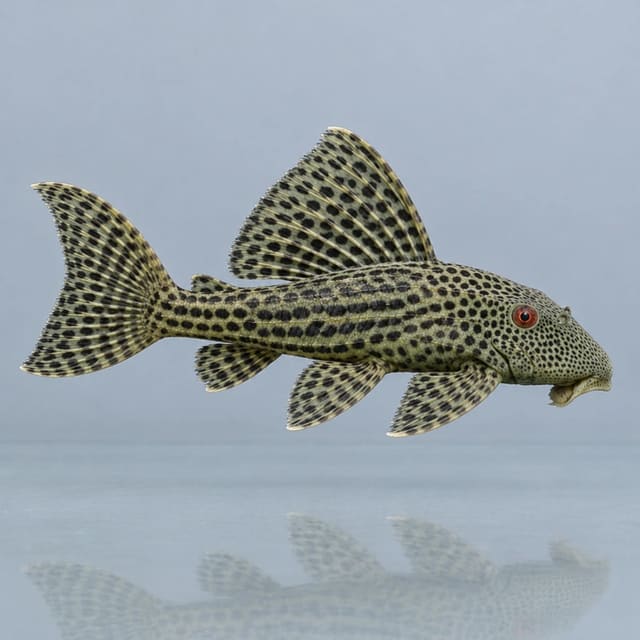
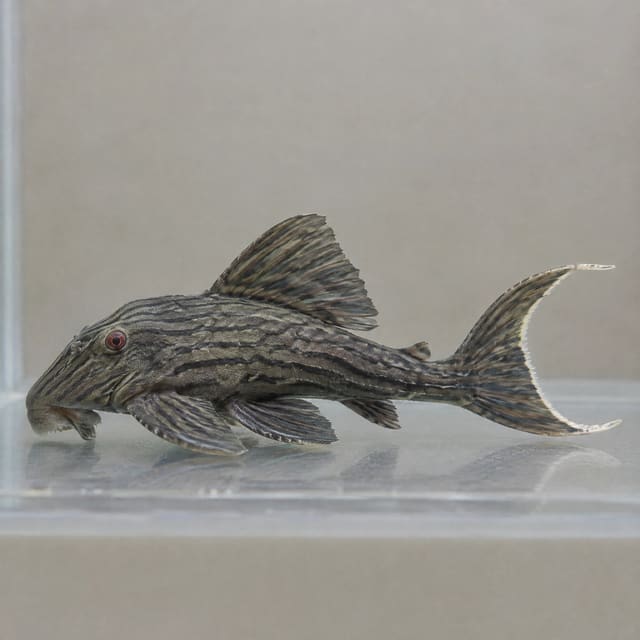
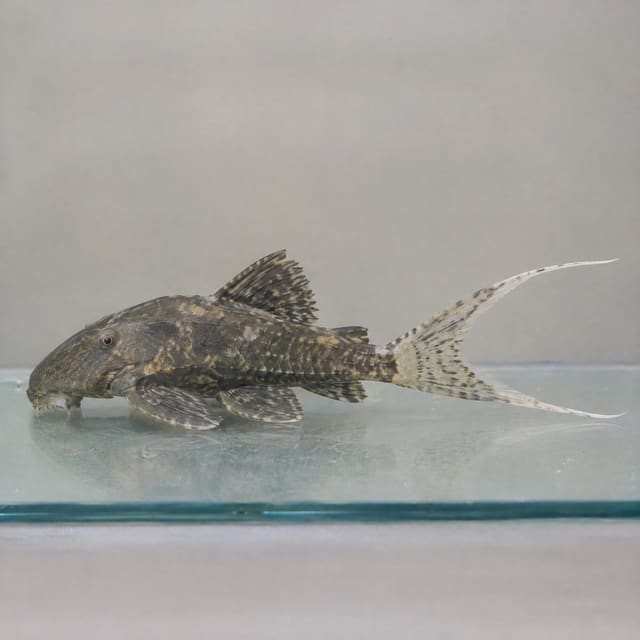
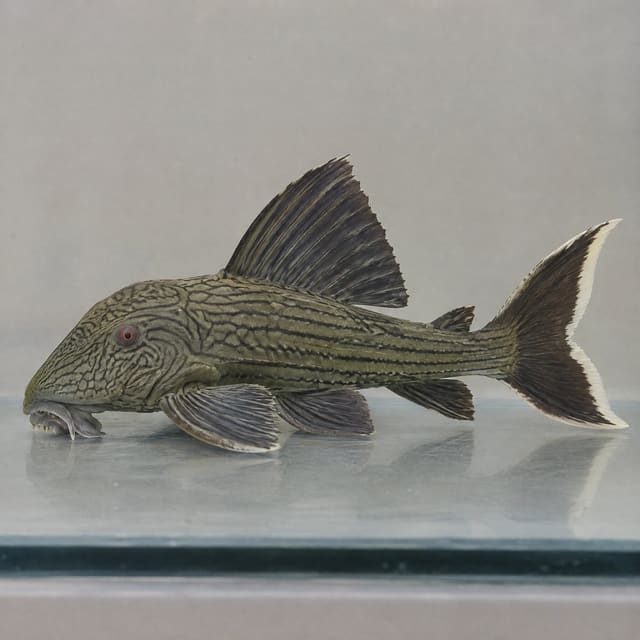
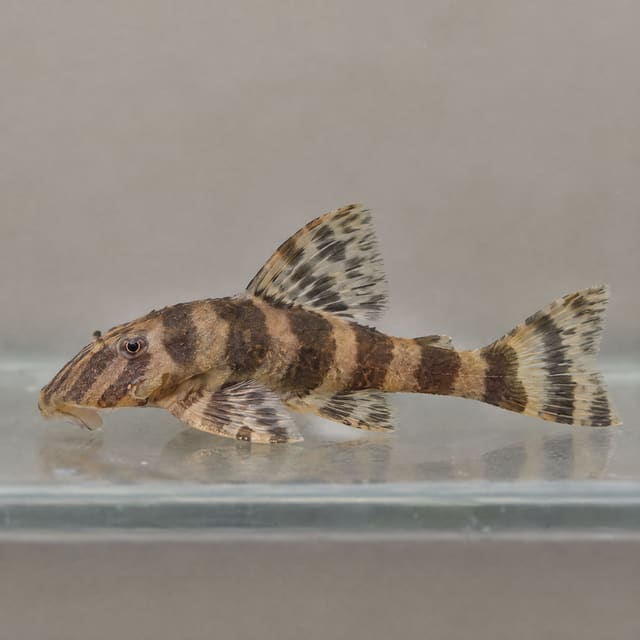
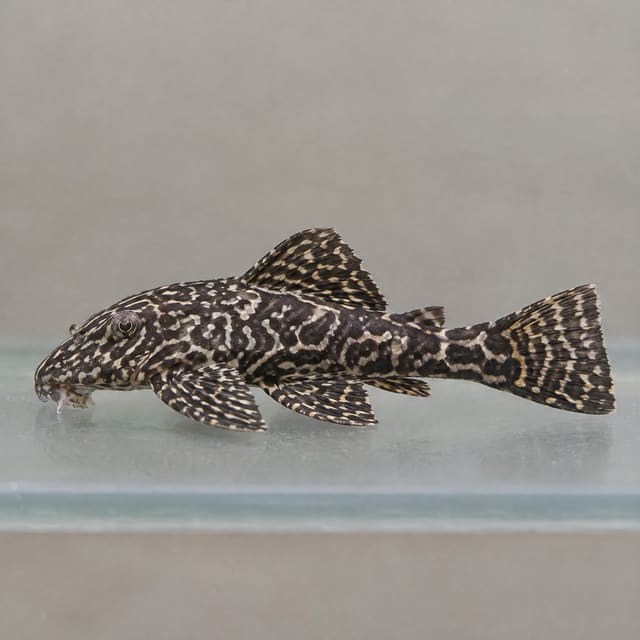
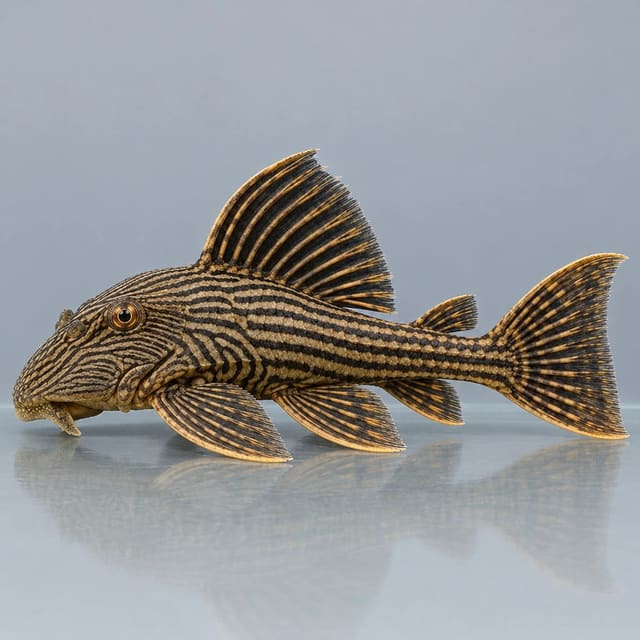
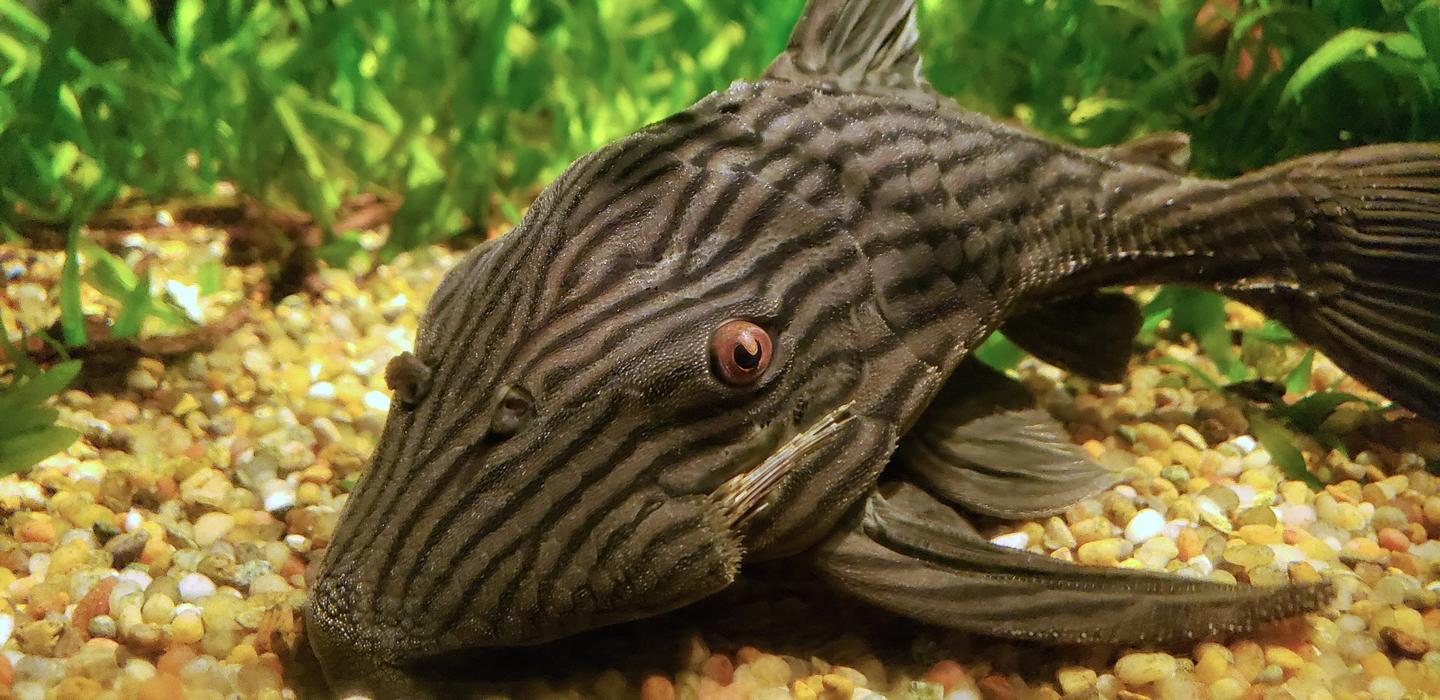
It changes a great deal as it grows. Planet Catfish describes youngsters with distinctive rusty patches in every fin except the tail, an almost transparent tail with some dark marbling at the back, and rusty-red eyes. Adults turn very dark, almost black, with dark green stripes; the unpaired fins become black with the dorsal-fin rays picked out in dark green. Planet Catfish adds that this form appears to have the largest fins in relation to body size of all the royal plecos, and gives a size of 400 mm standard length.
| Royal pleco | Codes | River | How Planet Catfish describes it |
|---|---|---|---|
| P. cf. armbrusteri "Xingu" (this fish) | L027 "Xingu", L027A, LDA063; sold in the UK as L27B | Rio Xingu | Young with rusty fin patches, clear tail, rusty-red eye; adults near-black with dark green stripes |
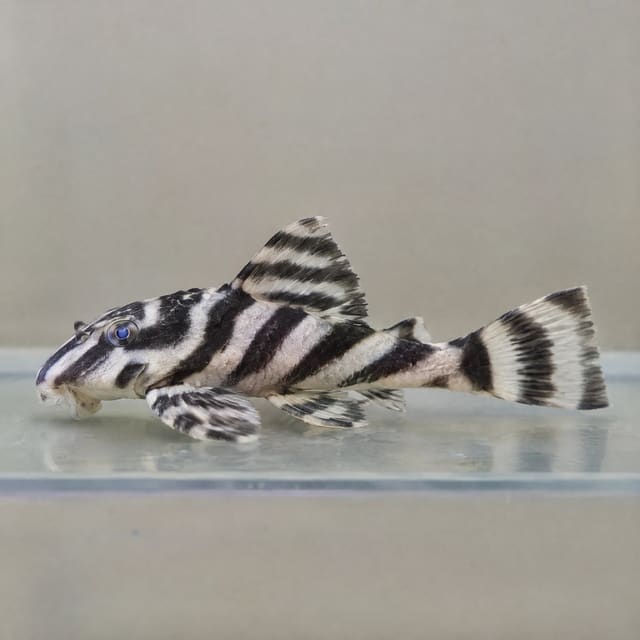
| P. armbrusteri | L027, LDA077 | Rio Tapajós basin | Brownish black with beige stripes; young with a clear window in the dark tail |
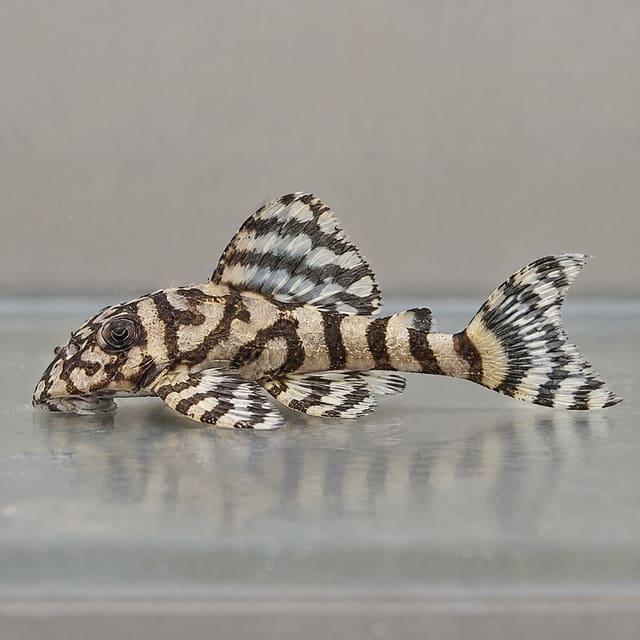
| P. cf. armbrusteri "Tocantins" | L027 | Rio Tocantins | Young very pale with black lines and an all-black tail; adults mid to dark green with black lines |
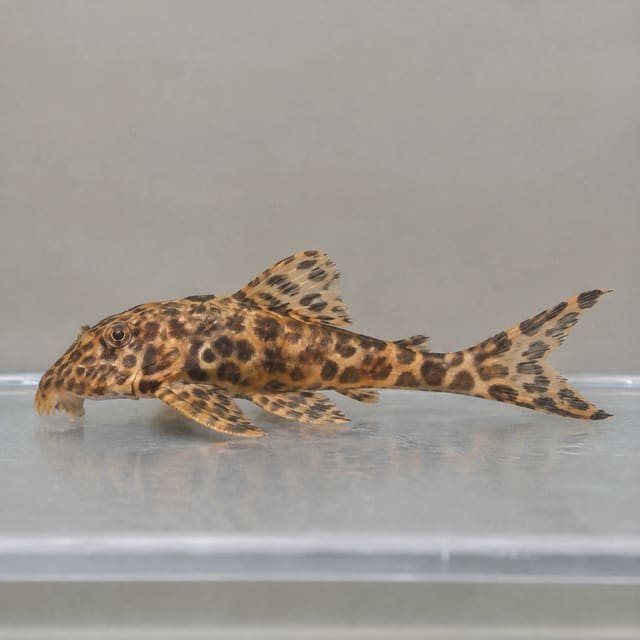
| P. cf. armbrusteri "Teles Pires" | LDA107 | Rio Nhandu, Teles Pires (Tapajós) | Always has spots in the tail fin |
The letter after L027 is a trade label, not part of an official scheme, and different lists use it differently. Shops in the UK sell this Xingu fish as L27B, but the Wikipedia L-number list gives L027b to the Teles Pires royal pleco (LDA107). The river of origin and the look of the fish are more reliable than the letter. Other names used for this form are Xingu Royal Pleco, Longnosed Royal Pleco and Red Fin Royal Pleco. Browse our Panaque royal plecos, every coded catfish in our L-number plecos range, the wider South American catfish category, our rare and collector fish or our full catfish and plecos collection.
One purchase supplies one live L027B Xingu Royal Pleco at the standard size offered on this listing. Expect a youngster in juvenile colours, with rusty fin patches and a pale tail, rather than the near-black adult; plan the aquarium for a fish that can reach around 35–40 cm.
Sex is not specified. For P. armbrusteri, Planet Catfish describes mature males with heavy odontode growth on the pectoral fins and long cheek spines (interopercular odontodes), which the 2010 revision describes as hooked and able to flare out to about 90 degrees. These differences only show in large, mature fish.
The photographs show the form, not the individual you will receive. Colour, stripe pattern and fin markings change with age and vary from fish to fish.
Before ordering, read our delivery and Live Arrival Guarantee information and have the aquarium running and mature, so the fish goes straight into stable water.
A royal pleco is small in the shop and very large at home. ScotCat's royal panaque factsheet says a fully grown fish needs a 5 or 6 ft aquarium to function properly, about 150–180 cm long. OATA's guidance on very large fish lists the larger plecos among "tank busters" and says they need an exceptionally large aquarium, often well over 500 litres, adding that an off-the-shelf tank is unlikely to be big enough in the long term.
Length and depth matter more than height. A royal pleco spends its life on the floor and among wood, so choose the longest, deepest base you can, and remember that each extra large bottom dweller needs its own territory.
Our tank volume calculator turns your tank's dimensions into litres for the filter, heater and water-change sums, and our pleco care guide covers the basics for every suckermouth catfish.
Planet Catfish says royal plecos live among fallen trees and wood tangles, and that all Panaque appear to feed on wood, so wood should always be present. The 2010 revision of the genus explains why: Panaque have spoon-shaped teeth, wider at the tip than at the base, which the authors compare to the head of an adze, a tool made for gouging wood, and powerful jaw muscles to drive them. ScotCat goes further, saying the fish's long-term survival depends on having driftwood to chew.
| Area | Purpose |
|---|---|
| Large driftwood pieces | Food and cover; replace pieces as they are rasped away over time |
| Root tangles and overhangs | Daytime hiding places, as in its fallen-tree habitat |
| Sand floor | Kind to its underside and easy to siphon clear of rasped wood and droppings |
| Open front strip | A feeding area where you can watch it eat vegetables and check its belly |
| Midwater space | Swimming room for the large, calm fish that share the tank |
Choose solid, well-soaked hardwoods so they sink and stay put, and wedge large pieces so a heavy fish cannot topple them. OATA warns that large fish can disturb décor, so secure every piece and fit a cover, as very large fish can be jumpy when first introduced.
Planet Catfish gives 26–29°C for the Xingu form, warmer than the 23–27°C it gives for P. armbrusteri from the Tapajós and the "Tocantins" form. No pH or hardness range is published for this form itself; ScotCat gives pH 6.0–7.5 and 23–29°C for the related royal panaque, P. nigrolineatus. We suggest keeping it within 26–29°C, at pH 6.0–7.5, and above all holding conditions steady.
| Reading | Target |
|---|---|
| Temperature | 26–29°C (Planet Catfish, Xingu form) |
| pH | 6.0–7.5 (ScotCat, for the related royal panaque) |
| General hardness | Not published; soft to moderately hard water is the safe choice |
| Ammonia | Zero mg/l |
| Nitrite | Zero mg/l |
| Nitrate | No more than 20 mg/l above your tap water |
The waste limits come from OATA's catfish care sheet. With a large, constantly grazing fish they matter more than small differences in pH.
UK tap water varies a great deal from region to region, from soft supplies in the north and west to very hard water in much of southern and eastern England. Your water company publishes the hardness for your postcode, and blending with reverse-osmosis water softens hard tap water. Always treat new water with a conditioner that removes chlorine and chloramine. Our water matcher compares your readings with this fish's range, and our water chemistry guide explains each reading.
ScotCat warns that a royal panaque produces a lot of waste because of its diet, and recommends a large external filter that turns the tank's water over about six times an hour, with a good current. OATA adds that very large fish may need several large aquarium filters, or even a pond filter, to cope with solid waste. FishBase notes that Panaque can breathe air when they need to, but that is a back-up, not a reason to skimp on aeration and flow.
Protect heaters from damage, as OATA advises for tanks with large fish, and keep the tank away from draughts and direct sun so the temperature stays steady.
If ammonia or nitrite reads above zero, test again, check the flow and cut back the feeding before changing anything else.
Planet Catfish lists the foods royal plecos take besides wood: prepared algae wafers, fresh vegetables such as courgette, cucumber, peas and green beans, and tubers such as potato and yam. ScotCat calls vegetable foods "a must", adding lettuce, spinach and vegetable tablets, and warns against feeding meaty frozen foods too often because the royal panaque's long gut is geared to greens.
Feed close to lights-out, when ScotCat says royal plecos come out to search for food, and remove leftover vegetables the next morning. A rounded belly shows it is eating well.
Add the fish only to an aquarium with a mature filter, ammonia and nitrite at zero, the temperature already inside 26–29°C and the driftwood in place. OATA recommends the floating-bag method: switch the aquarium lights off, float the sealed bag for about 10 minutes so the temperatures match, then add small amounts of tank water to the bag over up to 20 minutes before releasing the fish with as little bag water as possible. Our guide on how to acclimatise new fish walks through each step.
Royal plecos have hooked odontodes on the cheeks and fin spines that catch in netting and can pierce bags, so OATA's advice to double-bag catfish applies; guide the fish into a container rather than lifting it in a net.
| Checkpoint | What to do |
|---|---|
| Before release | Test ammonia, nitrite, temperature and pH, and soak and place the driftwood |
| First evening | Keep the lights off and leave a slice of courgette near the wood |
| Days 2–3 | Expect it to hide by day; check at night for rasping marks on the wood |
| Day 4 | Retest ammonia and nitrite, because a new large fish adds load |
| End of week | Do the normal water change and compare its belly with day one |
Planet Catfish describes royal plecos as generally peaceful but able to defend their territory against their own kind. ScotCat suggests a large community with like-sized tank mates such as cichlids or large barbs that swim in the upper layers, notes that even smaller congeners come to no harm from a royal panaque, and warns against aggressive species, which tend to upset this peaceful catfish.
From our range, the Severum is a large, calm South American cichlid and the Redhook Silver Dollar a big, peaceful characin that lives above the floor. This form likes it warm, so check each candidate's temperature range with our tank mates tool before mixing.
| Suits | Avoid |
|---|---|
| Like-sized, calm cichlids | Aggressive cichlids and other bullies |
| Large barbs and robust characins in midwater | A second royal pleco without separate wood and caves |
| Fish that share 26–29°C | Fish that need cool water |
| Smaller peaceful catfish in a big enough tank | Fast feeders that strip every vegetable before it emerges |
If you are comparing royal plecos, see the L190 Golden Royal Pleco, the L191 Royal Pleco, our L027 Royal Pleco and the very large Titan Panaque. They are alternatives rather than tank mates unless the aquarium can give each its own territory.
OATA's warning signs for catfish apply: clamped fins, flicking against décor, shimmying, changes in breathing, colour or appetite and long spells of hiding. In a royal pleco, a hollow belly is the most important early sign, because a fish that is not finding food will decline slowly.
| If you see | Do this |
|---|---|
| Hollow belly or no rasping marks on the wood | Offer vegetables after dark near its hiding place and check tank mates are not taking them |
| Fast breathing or resting near the surface | Test ammonia and nitrite at once and increase aeration and flow |
| Clamped fins, flicking or shimmying | Test the water, do a water change and look closely for parasites |
| White spots or fluffy growths | Test the water and follow our white spot guidance |
| Cloudy water or clogged sponges | Clean pre-filters, remove leftovers and siphon the sand |
| Scuffed skin or split fins | Look for a bully or a territory dispute and add more wood cover |
Do not diagnose from one sign alone; poor water, low oxygen, bullying and hunger can all look alike. If white spots appear, our white spot treatment guide explains the next steps; read any medicine's label for warnings about catfish before using it.
Planet Catfish records no aquarium breeding of the Xingu form or of P. armbrusteri. It does link a 2013 report in Amazonas magazine of a first captive breeding of royal plecos, listed under the closely related Araguaia royal pleco, so breeding these giants is possible but very rare. Buy this fish as a long-term display animal: with a big tank and constant wood, royal plecos are among the most impressive plecos you can keep.
It is a royal pleco from Brazil's Rio Xingu, listed by Planet Catfish as Panaque cf. armbrusteri "Xingu" under the codes L027 "Xingu", L027A and LDA063. "cf." means it is close to P. armbrusteri from the Tapajós but not yet confirmed as the same species.
Large. Planet Catfish gives 400 mm standard length for this form. The scientific revision of the group recorded a largest Tapajós specimen of 345 mm, and FishBase gives up to 43 cm total length for P. armbrusteri.
Planet Catfish describes youngsters with rusty patches in every fin except the tail, an almost clear tail with dark marbling at the back and rusty-red eyes. Adults become very dark, nearly black, with dark green stripes, and have the largest fins for their size of all the royal forms.
Yes. Planet Catfish says all Panaque appear to feed on wood, and the revision of the genus describes spoon-shaped teeth shaped like the head of an adze, a tool for gouging wood. Keep driftwood in the tank at all times and add vegetables and tubers.
ScotCat says a fully grown royal panaque needs a 5–6 ft aquarium, about 150–180 cm long, and OATA notes that very large fish often need well over 500 litres. Plan the tank for the adult before you buy.
Planet Catfish gives 26–29°C for the Xingu form, a little warmer than the 23–27°C it gives for the Tapajós species.
Generally, yes. Planet Catfish says royal plecos are generally peaceful but may defend their territory against their own kind, and ScotCat recommends large, like-sized tank mates that swim in the upper layers.
Not necessarily. L027 is used for several royal plecos from different rivers, and the letter suffixes are trade labels rather than an official system; one widely used L-number list even gives L027b to the Teles Pires royal pleco. Always check the river of origin as well as the code.
No reviews for this item yet. Bought one? Honest reviews only, good or bad.
What customers say about ordering from us
Easy website plenty of info on fish your buying great to pick a time slot
TRACEY DURRANT · 7 Oct 2026
Got some lovely fish thank you
Kevin Mackie · 7 Oct 2026
Reviews of our shop, collected by Judge.me, an independent third-party review collector. Newest first.
Moved by UK carriers licensed to handle live animals
Hand-packed with oxygen bags, poly box, heat pack
Email photos the same day; an optional unboxing video helps us review problems faster — claim terms apply
Klarna & PayPal Pay in 3 at checkout