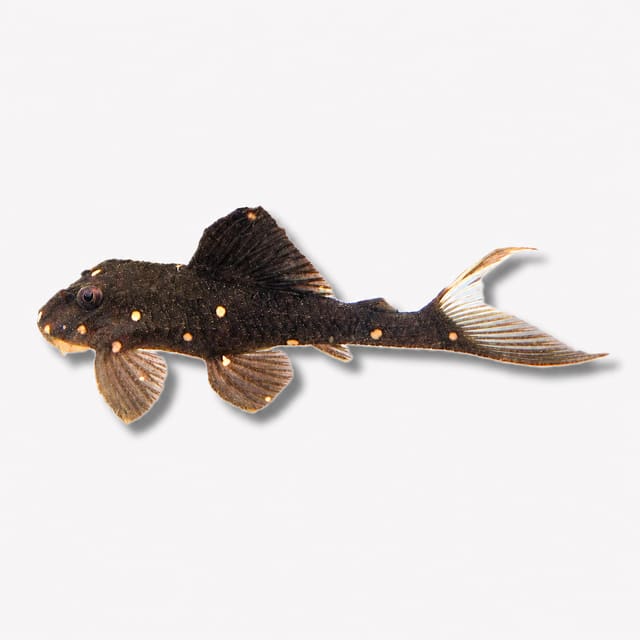
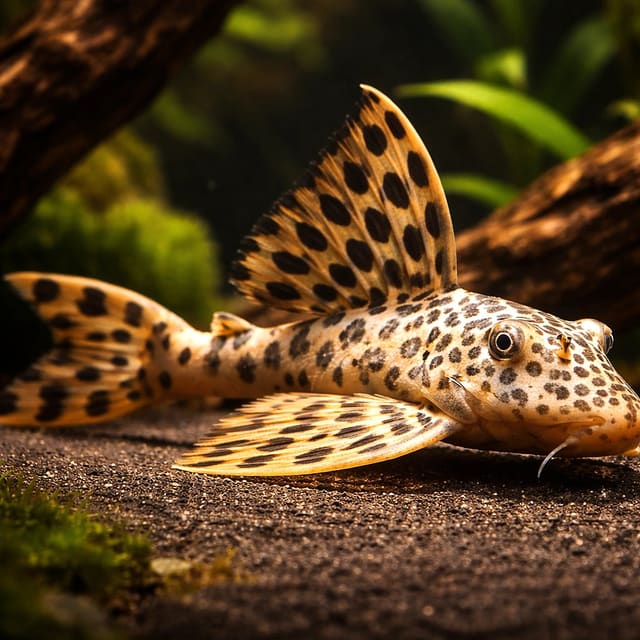
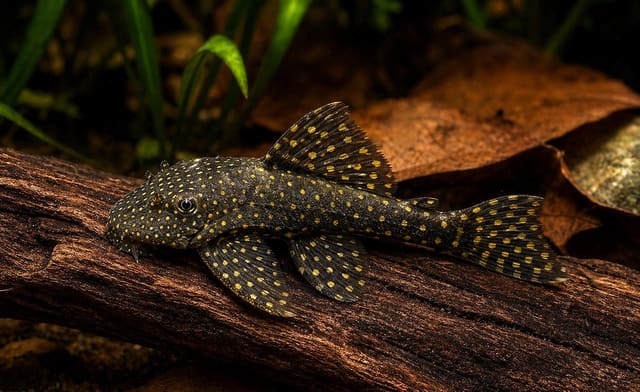
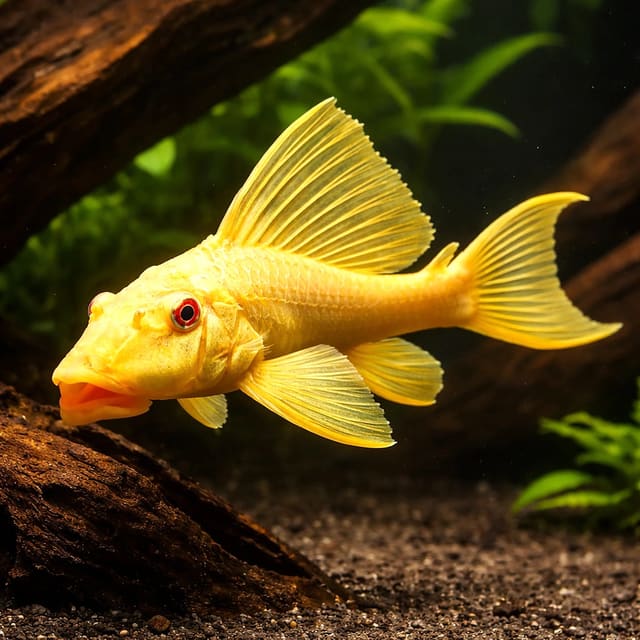
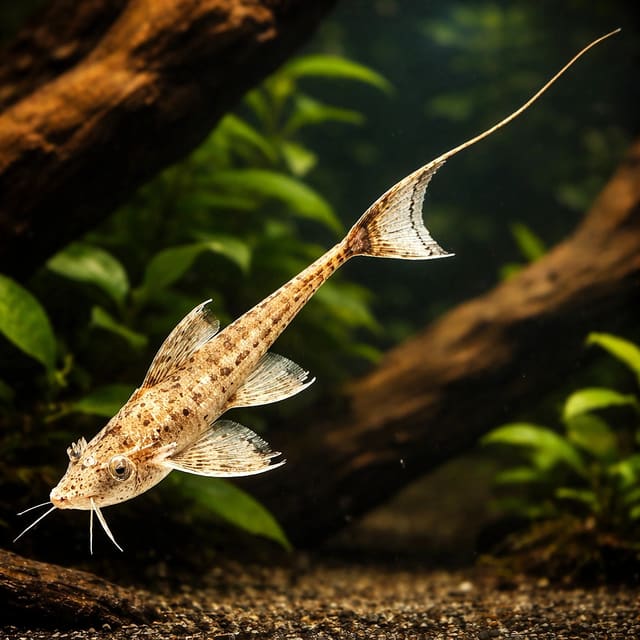
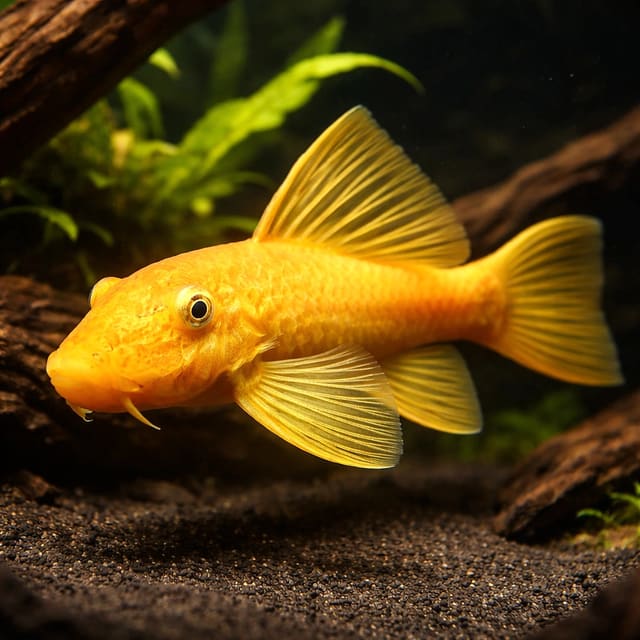
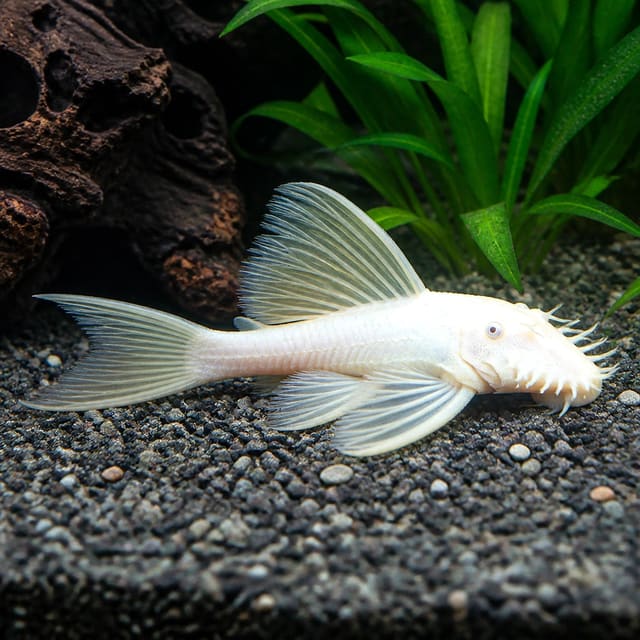
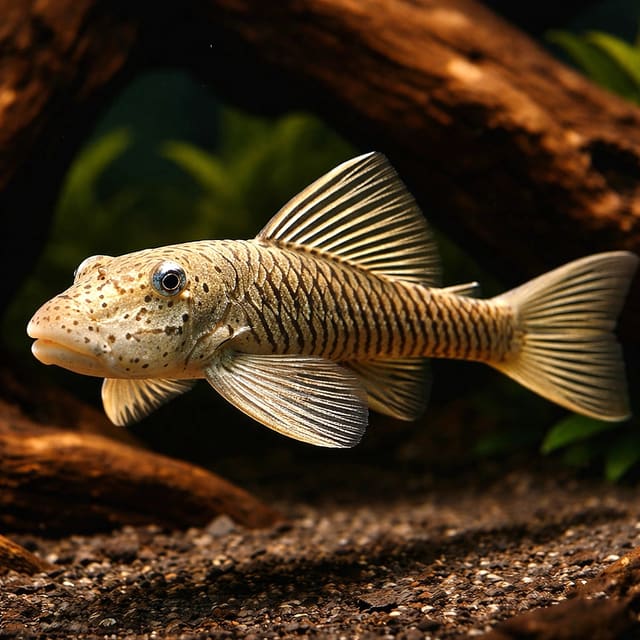
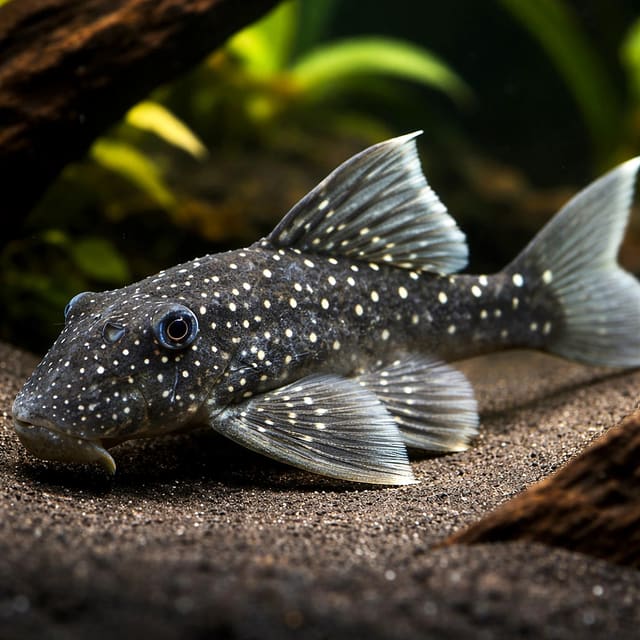
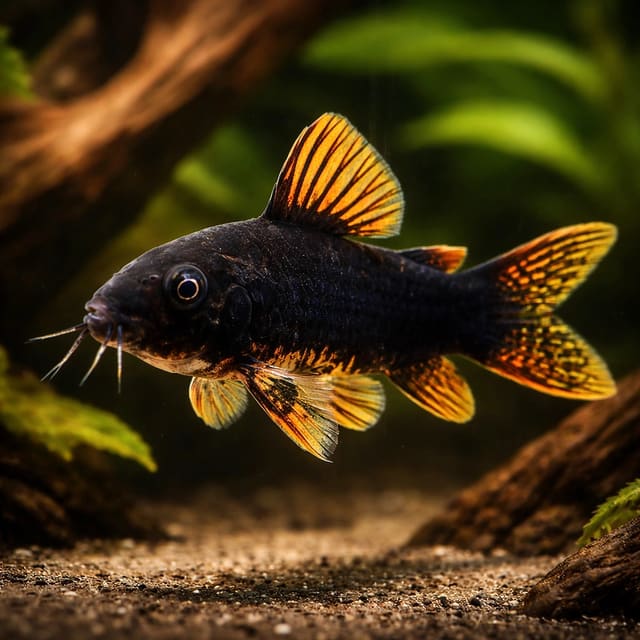
L226 Iquitos Tiger Pleco (Panaqolus changae) – Multiple Size Grades
22–27°C · pH 6–8
£50.99
The candy striped pleco (L015, Peckoltia vittata) is a banded suckermouth catfish from the Amazon basin that grows to about 15 cm total length. It wants warm, soft to medium water at 23–26 °C, caves, rocks and current, and a mixed diet leaning towards meaty foods. Sold as one fish per unit at 4–5 cm or 8–12 cm; sex is not selected.
Adult size is the maximum length this species reaches at full maturity (scientific sources). The livestock you receive will be younger and smaller — pick a size above for the actual shipping size. Product-photo provenance and any image-specific limitations are stated on the listing.
Peckoltia vittata
5 for £84.99· £17.00 eachYou save £69.96
Free delivery on this pack and anything else in the same order
Weekly deal pack · Ends Fri 23 Oct, 5pm · vs £154.95 for 5 fish bought singly
See the deal packThe candy striped pleco (L015, Peckoltia vittata) is a banded suckermouth catfish from the Amazon basin that grows to about 15 cm total length. It wants warm, soft to medium water at 23–26 °C, caves, rocks and current, and a mixed diet leaning towards meaty foods. Sold as one fish per unit at 4–5 cm or 8–12 cm; sex is not selected.
Adult size is the maximum length this species reaches at full maturity (scientific sources). The livestock you receive will be younger and smaller — pick a size above for the actual shipping size. Product-photo provenance and any image-specific limitations are stated on the listing.
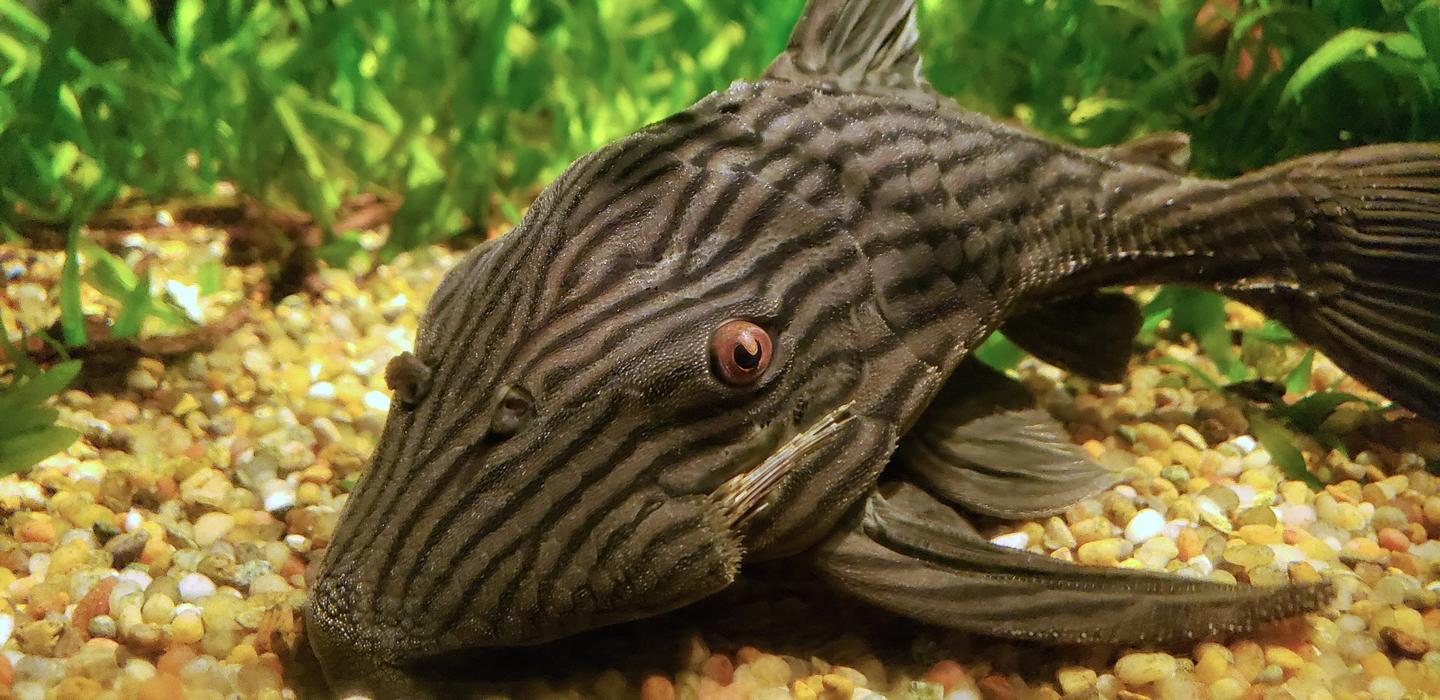
‘Pleco’ is a loose aquarium-trade label, not one species or one care sheet. Before buying, confirm the scientific name or defensible L-number, adult size and measurement method, required footprint, temperature and water, diet, social plan and source. No universal pleco tank size, menu or algae result is honest.
Maintain these water conditions for optimal health and vibrant colors
The candy striped pleco is a compact, banded suckermouth catfish from the Amazon basin, known in the hobby by its trade code L015 (often shortened to L15). Its scientific name is Peckoltia vittata. Steindachner described it in 1881 as Chaetostomus vittatus, and Planet Catfish explains that vittata means "decorated with a ribbon", a reference to the bands of colour across the body. Wikipedia records a second trade name earned by the same stripes: tiger pleco.
This is a pleco for people who like the group but do not have room for a giant. FishBase gives a maximum of 15 cm total length and a top recorded weight of 43 g. Planet Catfish lists 14 cm standard length, and in Jonathan Armbruster's 2008 scientific revision of the genus the largest specimen measured was 11.3 cm standard length. Plan the aquarium for a fish that can reach about 15 cm including the tail, and you will not be caught out.
What we send is simple. Each unit is one fish, and there are two dispatch sizes: 4–5 cm and 8–12 cm. Those figures are the length of the fish when it leaves us, not the size it will grow to. Neither size is sold as a particular sex. If breeding interests you later on, the section on males and females below explains how keepers tell them apart once the fish mature.
| Quick fact | Figure | Where it comes from |
|---|---|---|
| Maximum size | 15 cm total length (14 cm standard length) | FishBase; Planet Catfish |
| Temperature | 23–26 °C | FishBase (Planet Catfish: 22–26 °C) |
| pH | 5.0–7.5 | FishBase (Planet Catfish: 5.6–7.0) |
| General hardness | 2–20 dGH | FishBase and Planet Catfish agree |
| Minimum tank | 80 cm long | FishBase aquarium note |
| Active | Mainly at night | FishBase |
| Diet | Omnivore leaning towards meaty foods | Planet Catfish |
| Temperament | Peaceful, a little territorial | Planet Catfish |
| Conservation status | Least Concern (IUCN, assessed 2018) | FishBase |
The name "vittata" has been stuck on more than one fish over the years. Erwin Schraml, writing on ScotCat, points out that Peckoltia vittata has been used in the trade as a label for several other species, some of which are not even in the genus Peckoltia. Planet Catfish adds that hobby books have long confused it with the clown pleco, now Panaqolus maccus, and gives the example of volume 1 of the Baensch Aquarium Atlas, which printed a clown pleco photograph under this fish's name. So it pays to know what the real thing looks like.
Armbruster's revision gives the clearest description. The base colour is light tan with brown markings, and however strong or faint those markings are, there are always four dark saddles across the back. The first sits under the middle of the dorsal fin, the second under the rear of the dorsal fin, the third just in front of the small adipose fin, and the fourth at the end of the caudal peduncle, where the body narrows into the tail. Fainter secondary bars can appear between the main saddles, and some fish carry a broad, faint stripe along the lower flank.
What separates this species from every other Peckoltia is the top of the head. Adults have two dark saddles there: a wedge that runs from the tip of the snout back to the front of the eyes, and a second bar further back that ends just behind the raised crest on the nape. Sometimes these look more like mottling than clean bands. According to Armbruster, all the other species in the genus have spots or worm-like vermiculations on the head, or have the head plates outlined in black. A candy striped pleco has no head spots at all.
The fins are banded as well, with dark and light stripes of roughly equal width, and the number of bands goes up as the fish grows. Look for a dark spot right at the front of the dorsal fin, between the tiny spinelet and the first spine. The belly is plain or shows a few large, faint spots.
This matters if you pick the 4–5 cm size. Armbruster notes that the smallest fish usually show a dark "E" shape on the snout where an adult has the solid wedge. Apart from that, young fish are coloured like their parents. Planet Catfish also reminds keepers that, as with most loricariids, colour depends on mood, so a fish that has just been moved can look paler than it will once settled.
Seen side-on, a candy striped pleco often shows a patch of stiff bristles on each cheek. These are enlarged odontodes, tooth-like structures that sit on bony cheek plates, and the plates can be swung out from the head to roughly 90 degrees. Armbruster counted between 13 and 57 of these enlarged cheek odontodes in the fish he examined. The two halves of the lower jaw meet at an angle of 90 degrees or less, one of the features used to define the genus.
Schraml counts L015 as identical with P. vittata and suggests that L209 and L211 may be local forms of the same fish. He also illustrates a relatively rare form that carries extra spots on top of the stripes, while noting that most specimens are very regularly striped. Armbruster says the species varies slightly in colour across its huge range and may prove to be more than one species once more material is studied. For a buyer, that simply means some variation in contrast between individuals is normal.
The trade name "tiger pleco" is shared with quite different fish. Our L226 Iquitos Tiger Pleco (Panaqolus changae) belongs to another genus, as does the boldly marked L066 King Tiger Pleco (Hypancistrus sp.). When you compare striped plecos, go by the scientific name rather than the common one.
The original specimens came from several places at once. Armbruster lists the type localities as the Amazon itself, Tajapuru, the Xingu at Porto de Moz and the Rio Madeira, all in Brazil, and one of the type specimens he lists was collected at Tajapuru by the Thayer Expedition in January 1874.
Since then the fish has turned out to be wide-ranging. FishBase describes its distribution as the Brazilian Amazon and the lower reaches of the Rio Tapajós, Rio Madeira and Xingu, the Río Ventuari in Venezuela, the southern tributaries of the Amazon from the Madeira to the river mouth, and the Uatumã, Trombetas, Capim and Maranhão. The museum material Armbruster examined fills in that map with fish from the Tocantins near Tucuruí and Itupiranga, the Tapajós near Itaituba and Santarém, the Xingu at Altamira, the Rio Machado in Rondônia, the Madeira drainage in Bolivia, Amapá state near the mouth of the Amazon, and the Ventuari and Manapiare rivers in the Orinoco drainage of southern Venezuela.
Two further records come with question marks. One collection from the upper Río Guaviare in Colombia appears to be this species, and Wikipedia lists that Colombian occurrence as unconfirmed. A fish photographed in the Maroni River of French Guiana looks closest to P. vittata, but Armbruster thought its pattern different enough that it may be an undescribed species.
The L015 that reached the aquarium hobby has a more specific story. Planet Catfish records that L15 was collected in the Rio Xingu at Altamira, and in Germany the fish is known as Xingu-Peckoltia.
Field notes are thin, but they all point the same way. Armbruster records that the Venezuelan specimens were taken from rocks in runs, the steady, flowing stretches of a river between pools and rapids. Wikipedia describes the species as living in rocky areas. FishBase calls it a nocturnal, bottom-living freshwater fish that feeds on algae in the wild.
Put together, that is a fish that spends the day tucked into gaps between stones and comes out after dark to forage over hard surfaces in moving water. Everything in the set-up advice below, from caves to current to evening feeding, follows from that picture.
The species is not under threat as far as anyone knows. The IUCN assessed it as Least Concern in November 2018, and FishBase notes that it supports both a commercial fishery and a commercial aquarium trade. ScotCat describes it as imported regularly.
Fish sizes are quoted in two ways, and it helps to know which is which. Standard length (SL) runs from the snout to the base of the tail. Total length (TL) includes the tail fin. FishBase's 15 cm figure for this species is total length; Planet Catfish's 14 cm is standard length. Those two numbers do not sit perfectly together, because 14 cm SL plus a tail would come out above 15 cm TL, so we treat 15 cm TL as the working maximum and note the difference. Armbruster's largest museum specimen, at 11.3 cm SL, suggests that many wild adults stop short of the top figure.
For tank planning, the honest answer is to allow for 15 cm. That is still a modest pleco, and FishBase puts its top weight at just 43 g.
These are young fish. To give a sense of scale, in a breeding report published on Planet Catfish, Swedish keeper Janne Ekström's captive-bred youngsters reached 3.5–4 cm at ten weeks old, by which point they "look like midget versions of the parents", in his words. A 4–5 cm candy striped pleco is therefore a juvenile with most of its growing ahead of it. You may see the juvenile "E" mark on the snout described above. Small fish need food small enough to manage, so crumble or soak sinking pellets and use the smaller frozen foods covered in the feeding section.
The appeal of the smaller size is watching the pattern develop and the fish settle into your tank from an early age. The trade-off is that you cannot yet tell males from females, and it will be a while before the fish fills out.
Fish in this grade are well grown. For context, the pair that spawned in Ekström's report were only 8–8.5 cm long, so fish at the upper end of this range are already at a size where spawning has been recorded in an aquarium. Because the differences between males and females develop as the fish mature, they are easier to see on larger fish, though we do not select sexes for this listing.
Bigger fish also make an immediate impression in a display tank. Whichever size you choose, the tank should be ready for the adult, because the fish will get there.
FishBase's aquarium note gives two useful starting points: a minimum aquarium length of 80 cm, and a suggestion to keep this species in groups of five or more. Planet Catfish describes it as peaceful but a little territorial, and offers a rough guide of a 12-inch (about 30 cm) square of floor per fish, well broken up with decorations. Those two pieces of advice fit together if you think in floor area rather than litres.
A 30 × 30 cm patch is 900 square centimetres. Five fish at that rate need about 4,500 square centimetres of bottom. A tank measuring 120 × 45 cm has 5,400 square centimetres, so a group of five fits with a little room to spare, provided the floor is divided up with rocks and wood so that each fish has its own corner. An 80 cm tank meets FishBase's minimum length and suits a single fish or a small number, again with plenty of cover. For comparison, the breeding pair in Ekström's report lived in a 130-litre tank measuring 95 × 40 × 35 cm.
Planet Catfish lists "rock piles and wood tangles" as the furniture this fish wants, and says plants are not vital. Build stacks of smooth stone with gaps underneath, add a few branches of aquarium wood, and include caves. Ekström used a large piece of driftwood with small clay-pipe caves, and before spawning his male lay in the entrance of the cave he had claimed. Give every fish a cave of its own and add one or two spare, so that a newcomer or a lower-ranking fish is never left without shelter.
Wood in this tank is about cover and structure. None of our sources describe P. vittata as a wood-eating specialist, so there is no need to stack the tank with bogwood for feeding purposes.
The OATA catfish care sheet recommends aquarium sand or fine gravel, because catfish have sensitive barbels around the mouth. Ekström kept his breeding fish on gravel and raised the youngsters on 2–3 mm gravel with slate pieces for hiding places. Either works if it is smooth and kept clean.
On plants the sources disagree slightly. Planet Catfish says well-fed individuals will not damage most plants, while FishBase's aquarium note says the species feeds on plants and roots. The practical answer is to keep the fish properly fed, choose sturdy plants, and tie them to wood or rock where a pleco cannot easily uproot them.
The OATA sheet is firm that a filter is always essential, and that filter media should be rinsed in water taken out of the tank rather than in tap water, so the beneficial bacteria survive. For this species a decent current is worthwhile as well. Ekström fitted a powerhead moving 1,000 litres per hour with the outlet aimed at the male's cave, and found the fish more active with current than without it, though he added that the flow does not need to be excessive. That fits the wild record of fish living on rocks in flowing runs.
Because this is a night forager, it will spend much of the day out of sight. Arrange the rockwork so that at least one cave entrance faces the front glass, and you will see a striped face looking out during the day. The best time to watch is in the first hour after the tank lights go off, when the fish come out to search for food.
Published ranges for P. vittata agree closely on the essentials. This is a warm-water fish of soft to moderately hard water, comfortable on the acidic side of neutral.
| Parameter | FishBase | Planet Catfish | Wikipedia |
|---|---|---|---|
| Temperature | 23–26 °C | 22–26 °C | 22–26 °C |
| pH | 5.0–7.5 | 5.6–7.0 | around 6 |
| Hardness | 2–20 dH | 2–20 dH | soft water |
Our care figures follow FishBase: 23–26 °C, pH 5.0–7.5 and 2–20 dGH. If you want a single target, aim for the middle of those ranges, around 24–25 °C and a pH a little below 7. More important than any exact figure is keeping conditions steady, so make changes slowly rather than chasing a number.
The parameters above describe chemistry. Day-to-day health depends on cleanliness. The OATA catfish care sheet sets out the standards: ammonia and nitrite at zero, and nitrate no more than 20 mg per litre above the level in your tap water. It recommends testing ammonia, nitrite, nitrate and pH weekly and changing about 25% of the water at least once a week. Bottom-dwellers live closest to any waste that settles, so gravel cleaning under rocks and around caves earns its keep in a pleco tank.
Check the hardness of your own tap water with a test kit before the fish arrive. The published hardness range is wide, but it is better to know your own numbers than to guess.
A fish that lives on rocks in flowing runs appreciates moving water. Point a filter outlet or small powerhead across the rockwork rather than leaving the bottom of the tank still. Keep the surface rippling too, because surface movement is what lets oxygen into the water.
Ekström's pair spawned at 28 °C, pH 6.0 and a conductivity of about 90 µS/cm, after he had brought the conductivity down from 300 to roughly 150 and then 90–100 µS over several weeks with reverse-osmosis water. That is one keeper's successful breeding trigger, and 28 °C sits above FishBase's range. It is a record of what worked for him, not a target for keeping the fish day to day.
A lot of people buy plecos to clean algae. If that is your plan, this is the wrong fish. Planet Catfish describes P. vittata as "not an effective algae eater", and Ekström says much the same: not a good algae eater, with a clear preference for meaty foods. In the wild, FishBase records it feeding on algae, so it will graze, but in the aquarium it needs proper feeding.
Planet Catfish sums up the diet as omnivorous with a tendency towards meaty foods. Ekström's menu is a good model. He fed frozen brine shrimp and Cyclops, small shrimps such as Mysis, the sinking shrimp pellets many people use for Corydoras, and his own home-made shrimp mix. He also stressed that the fish need some vegetables, giving peas as the example, even though they seem to prefer the meaty foods.
A sensible weekly pattern looks like this:
FishBase calls the species nocturnal, and Ekström fed his fish every evening just before the lights went off. Do the same. If you feed in the morning with the lights on, livelier fish higher in the tank will have cleared most of it before a candy striped pleco has even left its cave.
The OATA care sheet's rule of thumb is to give only what can be eaten within a few minutes, once a day, while allowing grazing species up to about 30 minutes. For a pleco feeding after dark, that means checking the next morning. Food still lying about means you gave too much; remove it and cut back.
Ekström noticed that his plecos came straight out when food dropped into a covered tank, even though they could not see him approach, and concluded that loricariids must have a very sensitive sense of smell. That is one more reason to drop food close to the caves.
As mentioned above, Planet Catfish says well-fed fish leave most plants alone, while FishBase notes aquarium fish feeding on plants and roots. Hunger tends to settle that argument. A pleco that is getting enough vegetable matter and protein after dark has little reason to work on your plants.
Planet Catfish describes the candy striped pleco as "peaceful if a little territorial" and calls it a medium-sized pleco that can be combined with a very wide range of tank mates thanks to its unfussy nature. It says the species is perfectly safe with small fishes and shrimp, and robust enough to cope with the attention of all but the largest cichlids.
The territorial streak shows itself around caves and favourite resting spots, not in open aggression towards fish swimming in the middle of the tank. That is what Planet Catfish's 30 cm-square guide is for: give each fish its own cave and its own patch of floor, with rocks and wood breaking up the lines of sight, so that no two fish need the same spot.
Choose fish that share the same water: warm, soft to moderately hard, and slightly acidic. Check each candidate's own published ranges against 23–26 °C and pH 5.0–7.5 before buying. Freshwater shrimp are an option too, as Planet Catfish rates them safe with this species. A group of FishBase's suggested five plecos makes an interesting display in itself if you have the floor space.
If you are building a community around several L-number fish, check each species' own requirements before mixing them, rather than assuming one pleco's needs fit another. Read the care notes on each listing, for example our L204 Flash Pleco (Panaqolus albivermis), alongside this one.
This listing does not sell a chosen sex, but it helps to know how the sexes differ, especially if you buy several fish with breeding in mind.
Planet Catfish explains that males develop small, tooth-like odontodes along the leading rays of the pectoral fins and across the back half of the body, while females stay smooth. Females also have a wider girth, which is easiest to see from above just behind the pectoral fins. Armbruster, describing nuptial males, adds enlarged odontodes on the sides and the rear of the head, becoming larger towards the back, plus enlarged odontodes on the upper tail-fin spine and the adipose spine, with that upper tail spine thickened. Ekström found the difference easy to see in his fish, and noticed the male's odontodes grew visibly larger when he was conditioned for spawning.
These differences belong to mature fish. Do not expect to sex a 4–5 cm juvenile.
Planet Catfish confirms that the species has been bred in captivity and holds seven breeding reports for it. The most detailed, by Janne Ekström, is worth summarising because it shows exactly how this cave spawner behaves.
Ekström started the fry on newly hatched brine shrimp and his shrimp mix, then moved them after a week to a 60-litre tank filled with water from the breeding tank, with small gravel and slate for cover. He warned that fry in a bare tank cling to the glass, never come down to feed and starve. He changed 10% of the water daily to bring them gradually back to his tap water. The young reached 22–23 mm total length at three weeks and 35–40 mm at ten weeks, fighting keenly over every piece of food, which he took as a sign they are easy to raise.
One warning from the same report applies to anyone checking a guarding male: he was nervous of the torch, and Ekström was careful not to disturb him for fear of the male abandoning the eggs, something he had seen happen with other species.
A healthy candy striped pleco spends the day in or near its cave, appears at dusk, and feeds keenly once the lights are off. Daytime hiding on its own is normal for a nocturnal fish and is not a sign of trouble. The OATA care sheet lists the changes worth noticing: unusual swimming such as hanging at the surface or erratic movement, and changes in colour, temperament or appearance. For this species, the most useful daily check is simple. Is it out at night, is it eating, and are its fins held normally?
If something looks wrong, test the water before reaching for a treatment. The OATA limits in the water section, zero ammonia and nitrite and low nitrate, are the benchmark to check against, along with temperature and pH. Remember too that colour shifts with mood in loricariids, so a pale fish the morning after a rearrangement is not necessarily unwell.
Have the aquarium fully ready before you order: filter running, water tested, and temperature matched to the 23–26 °C range. Someone must be at the delivery address to receive live animals. Please read our delivery and live-arrival information before ordering.
Fish travel in oxygen-filled bags inside insulated packaging, with heat packs when conditions call for them, and go by a tracked courier licensed to carry live animals. We send the confirmed delivery date and tracking details by email.
Start a continuous video while the parcel is still sealed, and open it in the same take so the fish can be seen in its sealed bag. If a fish arrives dead, dying or clearly compromised, email hello@tropicalfishco.co.uk on the day of delivery with your order number and that video. Photos alone do not meet the policy. The resolution is a replacement with your next order or a refund for the affected fish, subject to the guarantee terms.
Over the next few days, watch breathing, appetite and behaviour. Expect the new arrival to vanish into the rockwork, which is exactly what a candy striped pleco should do. Offer a small amount of sinking food near its chosen cave after lights out, and check the next morning whether it has gone. Resist moving the rocks to look for it; let it keep the shelter it has chosen. A fish that is out after dark and finding its food is a fish that is settling in.
These are the sources behind the facts in this guide. Planet Catfish's species page and Janne Ekström's breeding article on the same site were also used, and are easy to find by searching for Peckoltia vittata there.
No reviews for this item yet. Bought one? Honest reviews only, good or bad.
What customers say about ordering from us
Easy website plenty of info on fish your buying great to pick a time slot
TRACEY DURRANT · 7 Oct 2026
Got some lovely fish thank you
Kevin Mackie · 7 Oct 2026
Reviews of our shop, collected by Judge.me, an independent third-party review collector. Newest first.