Expert
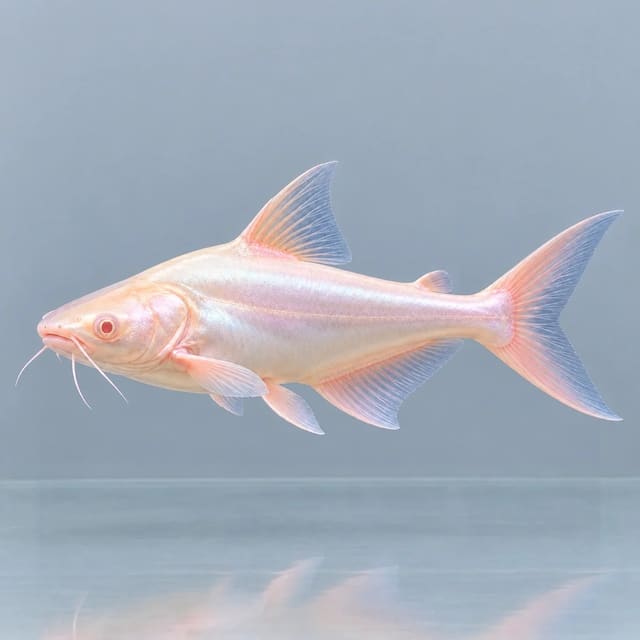
Albino Iridescent Shark Catfish (Pangasianodon hypophthalmus)
22–26°C · pH 6.5–7.5 · 14580L
£12.99
The Iridescent Shark Catfish (Pangasianodon hypophthalmus) is a shoaling Mekong catfish, not a shark, that is sold at 4–5 cm but easily grows past 90 cm and can live 20 years or more. One adult needs an indoor system of around 450 × 180 × 180 cm at 22–26°C. Buy it only if you can house the adult for life. Sold individually.
Pangasianodon hypophthalmus
The Iridescent Shark Catfish (Pangasianodon hypophthalmus) is a shoaling Mekong catfish, not a shark, that is sold at 4–5 cm but easily grows past 90 cm and can live 20 years or more. One adult needs an indoor system of around 450 × 180 × 180 cm at 22–26°C. Buy it only if you can house the adult for life. Sold individually.
Read the full care guidance when planning conditions for your aquarium.
The Iridescent Shark Catfish, Pangasianodon hypophthalmus, is sold at 4–5 cm, but it is one of the largest fish in the aquarium trade. Seriously Fish says it easily tops 90 cm in captivity and can live for 20 years or more, and FishBase records wild fish up to 130 cm and 44 kg. Seriously Fish gives at least 450 × 180 × 180 cm for one adult kept long term, and openly questions whether it should be kept as an aquarium fish at all. ScotCat goes further and describes it as not fit for aquarium use.
We are listing the iridescent shark for the few keepers who already run, or are building, an indoor system on that scale, such as a very large heated indoor pool or public-aquarium-style tank. If that is not you, please do not buy one: it will outgrow any ordinary aquarium, large catfish are very hard to rehome, and it must never be released.
| Suits | Not suited to |
|---|---|
| An indoor system of around 450 × 180 × 180 cm (about 14,580 litres) for one adult | Any home aquarium, including large "monster fish" tanks of a few hundred litres |
| A keeper ready for a 20-year commitment | Buying a small fish now and "upgrading later" |
| Large, peaceful tank mates too big to swallow | Community fish of any ordinary size |
| Open water, dim light, heavy cover and a sump | A decorated display with glass heaters and loose ornaments |
| 22–26°C and very clean, well-oxygenated water | Outdoor ponds of any kind |
If you want a catfish that stays a manageable size, browse our catfish and plecos or our other catfish category, where most species stay a fraction of this size.
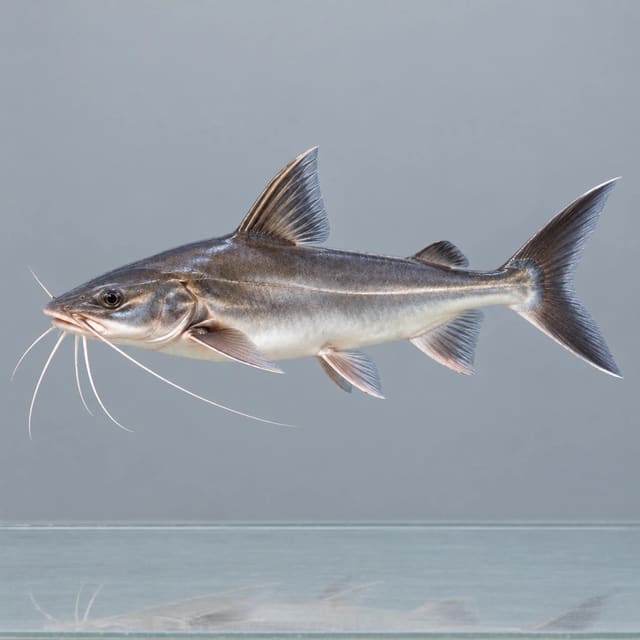
Despite the name, it is not a shark but a catfish in the family Pangasiidae, the shark catfishes. Its shark-like look comes from the tall, pointed dorsal fin, deeply forked tail and constant open-water swimming.
It is native to the lower Mekong in Thailand, Laos, Cambodia and Vietnam and to the Chao Phraya and Maeklong basins of Thailand. Seriously Fish describes it as a fish of the main river channels and larger tributaries that migrates upstream to spawn; FishBase adds that it moves upstream in the Mekong between May and July and returns to the main river between September and December. In the wild it eats fish, crustaceans and plant debris.
Most fish in the trade are mass-bred on farms in its native region, where the species is also farmed for food. Wild populations are in trouble: FishBase lists it as Endangered on the IUCN Red List (assessed 2011), and ScotCat notes it is nearly gone from the Chao Phraya and the Thai Mekong.
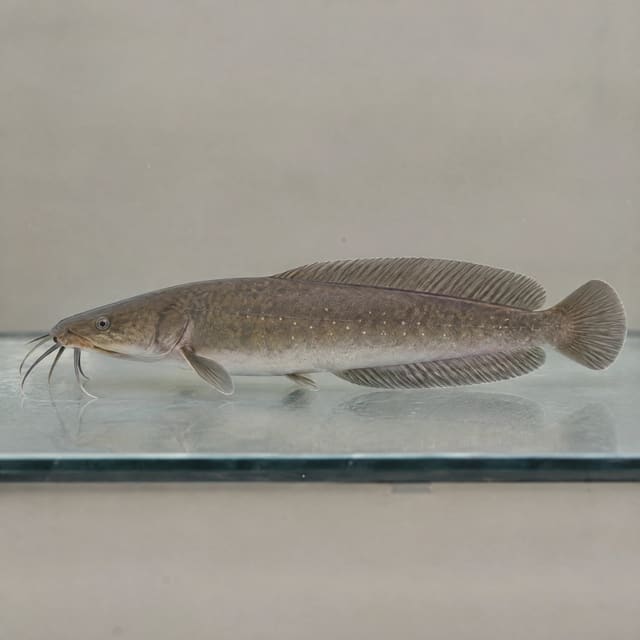
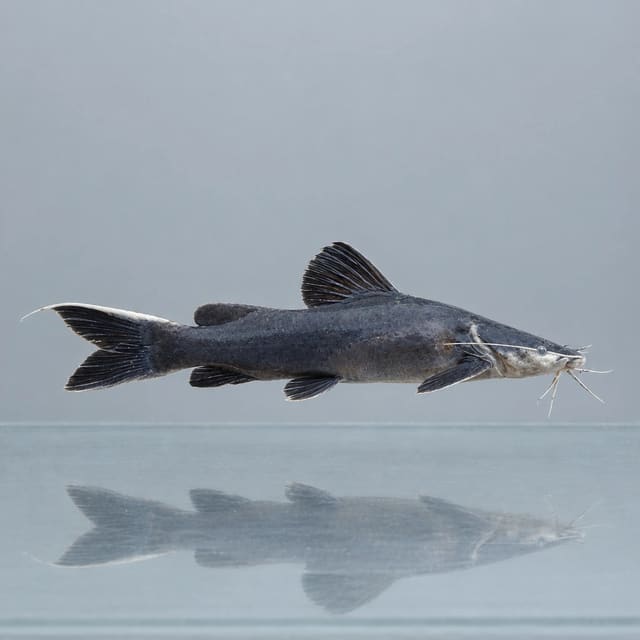
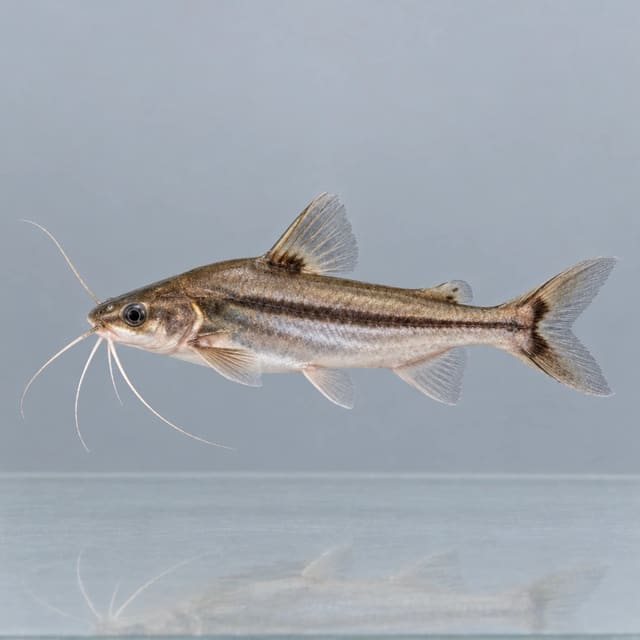
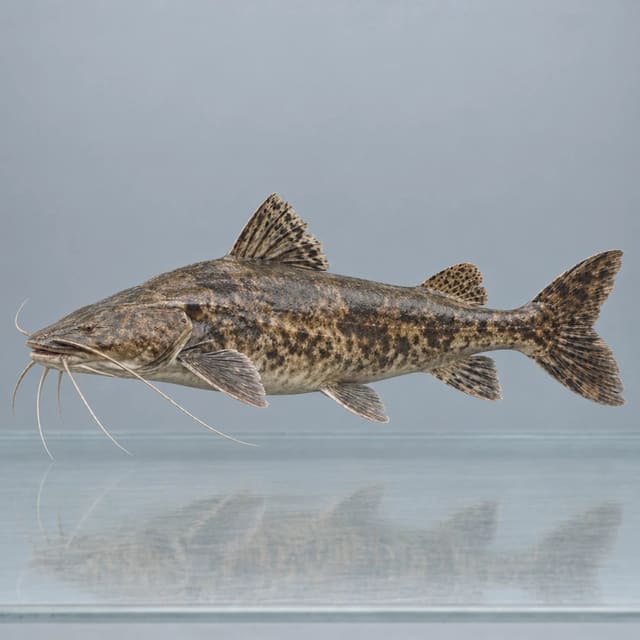
One purchase quantity supplies one live Iridescent Shark Catfish, dispatched at 4–5 cm. Our photographs show an older fish to illustrate the species, not the size or the individual you will receive. Seriously Fish says females are supposedly stockier with lighter patterning, but these differences cannot be seen at sale size, so the sex is not specified.
Seriously Fish also notes selectively bred albino and "shortbody" or "balloon" forms. The shortbody form stays much smaller than the natural fish. This listing is the natural form, which grows to full size.
| Stage | Size | What it needs |
|---|---|---|
| As sold | 4–5 cm | A mature, well-filtered aquarium as a short-term grow-on home |
| Adult in captivity | Easily over 90 cm (Seriously Fish) | At least 450 × 180 × 180 cm for one fish long term |
| Wild maximum | 130 cm standard length, 44 kg (FishBase) | Large rivers |
| Lifespan | 20 years or more (Seriously Fish) | A plan that lasts as long as the fish |
Seriously Fish gives a minimum of 450 × 180 × 180 cm, about 14,580 litres, for a single adult kept long term, and says the species is unsuitable for all but the very largest tanks. A juvenile can be grown on in a smaller tank for a while, but the final home has to exist before the fish needs it. Seriously Fish is clear that the belief that fish only grow to fit their tank is a myth.
In England and Wales the genus Pangasianodon is on the government list of fish kept under a general licence that allows keeping in indoor aquaria only. It must never go into an outdoor pond or be released. If you are planning an indoor pool system rather than a glass aquarium, check with the Fish Health Inspectorate, through the GOV.UK non-native fish page, that your set-up is covered.
Our tank volume calculator shows how far short a typical aquarium falls: a generous 180 × 60 × 60 cm home aquarium holds about 648 litres, under 5% of the Seriously Fish figure.
Seriously Fish says an adult needs no décor if the lighting is fairly dim, and that bogwood, beech branches or smooth rocks are optional extras. Anything you add must be too heavy to move or firmly fixed, and there must be plenty of open swimming space. The fish sometimes breaks the surface when agitated, so a heavy cover is essential, and it can smash glass heaters and thermometers.
| Area | Purpose |
|---|---|
| Large clear swimming area | Room to turn and cruise without hitting the glass |
| A few heavy, fixed pieces of wood or smooth rock | Optional shelter that cannot be knocked over |
| Dim, even lighting | Keeps a nervous fish calmer |
| Heating and sensors in the sump or behind guards | Nothing breakable inside the fish's space |
| Heavy, close-fitting cover | Stops a startled fish from leaping out |
Avoid sudden changes of light and movement close to the glass. A startled iridescent shark bolts, and in a cramped or cluttered system that is when injuries happen.
Seriously Fish gives 22–26°C and pH 6.5–7.5, and says a hardness of about 2–30 degrees should be acceptable because its rivers vary with seasonal flooding. FishBase gives the same temperature and pH ranges and 2–29 dH. As a river fish, it needs well-oxygenated, moving water.
Compare your tap water with these values using our water matcher, and read the aquarium water chemistry guide if you are unsure what pH and hardness mean.
| Reading | Action point |
|---|---|
| Temperature | Keep 22–26°C |
| pH | Keep 6.5–7.5 |
| Hardness | About 2–30 dGH is acceptable |
| Ammonia | Maintain at zero mg/l |
| Nitrite | Maintain at zero mg/l |
| Nitrate | No more than 20 mg/l above your normal tap-water level |
The waste limits follow OATA's freshwater care sheets. A fish of this size produces a great deal of waste, so test at least weekly and more often while the fish is growing.
Seriously Fish recommends a large, efficient biological filter and says a sump is preferred. Plan filtration for the adult fish from the start, with strong water movement and plenty of surface agitation for oxygen.
Our guide to aquarium filtration explains biological, mechanical and chemical filtration.
Seriously Fish describes the iridescent shark as omnivorous. Juveniles need a good amount of protein: chopped earthworm, bloodworm and dry pellets. Adults need more vegetable matter, such as spinach, frozen peas, Spirulina-based dry foods and occasional fruit.
Confirm a mature filter, zero ammonia and nitrite and 22–26°C before the fish arrives. Acclimatise with the lights off: float the sealed bag for about 10 minutes, add small amounts of aquarium water over up to 20 minutes, then net the fish into the tank and discard the bag water. Keep the room quiet and the lights dim for the first days.
| Checkpoint | What to do |
|---|---|
| Before arrival | Test the water; check the cover and heater guards |
| Arrival day | Acclimatise in dim light; avoid movement near the tank |
| First feeds | Small protein-rich portions; check the fish eats |
| Every day | Look for scrapes, damaged fins and panicked swimming |
| End of week | Retest ammonia and nitrite and carry out normal maintenance |
Our guide to acclimatising new fish has more detail, and our delivery information explains dispatch days and live arrival terms.
Seriously Fish and ScotCat both describe the iridescent shark as nervous and skittish. In cramped conditions it can injure itself by striking the glass and décor. Most problems with this fish trace back to space, sudden disturbance or water quality.
| If you see | Do this |
|---|---|
| Scraped snout or torn fins | Remove obstacles, dim the lights and review the space; the fish may already need a larger system |
| Dashing into the glass when people approach | Reduce movement near the tank and add a background |
| Gasping or fast gill movement | Test ammonia, nitrite and temperature; increase aeration |
| White spots or fluffy growths | Test the water and seek fish-health advice |
| Refusing food | Check water readings and whether tank mates are frightening it |
Seriously Fish describes the iridescent shark as a shoaling species that is less flighty in a group, but points out that keeping several would need an enormous tank. That leaves a real dilemma: a lone fish is more nervous, and a group multiplies a space requirement that is already beyond a home aquarium.
Breeding in aquariums is considered unlikely because of its migratory spawning and the size of mature fish; it is bred commercially in large ponds on fish farms.
The iridescent shark is not aggressive, but it will eat much smaller fish, its constant activity can bother sedentary or shy fish, and boisterous species easily intimidate it. Seriously Fish suggests large, peaceful bottom-dwellers and mid- to upper-water shoaling fish, such as big doradid catfish (Oxydoras niger, Megalodoras uranoscopus and Pterodoras granulosus), pacu and larger cyprinids.
| Suits (in a system big enough for all) | Avoid |
|---|---|
| Pacu such as the Red-Bellied Pacu or Colossoma Pacu | Any fish small enough to swallow |
| Large cyprinids such as the Tinfoil Barb and Bala Shark | Boisterous or aggressive fish that panic it |
| Large, peaceful doradid catfish | Shy, slow or sedentary fish it will disturb |
| Fish that share 22–26°C and pH 6.5–7.5 | Fish needing very different water |
These companions are large fish too, and their adult space needs add to the iridescent shark's. Check any combination with our tank mates tool, and look at our centrepiece fish for big, striking species that suit more realistic aquarium sizes.
Seriously Fish says it easily tops 90 cm in captivity, though it rarely reaches 130 cm there. FishBase records wild fish up to 130 cm standard length and 44 kg. It is sold at 4–5 cm, so plan for the adult, not the juvenile.
Seriously Fish gives at least 450 × 180 × 180 cm, about 14,580 litres, for one adult kept long term. That is far beyond any normal home aquarium.
Seriously Fish gives a lifespan of around 20 years or more, so buying one is a commitment of two decades to a fish that will need a very large system.
No. It is a catfish, Pangasianodon hypophthalmus, from the Mekong and Chao Phraya region. It only looks shark-like because of its tall dorsal fin, forked tail and constant swimming.
No. Seriously Fish calls the idea that fish only grow to fit their tank a myth. In a cramped tank it becomes stressed, crashes into the glass and décor and can be badly injured.
Only large, peaceful fish too big to swallow, such as pacu, big doradid catfish and larger cyprinids, in a system big enough for all of them. It will eat much smaller fish and is frightened by boisterous ones.
It is an omnivore. Young fish need plenty of protein, such as pellets, bloodworm and chopped earthworm; adults need more vegetable matter, such as spinach, peas and Spirulina-based foods.
Rarely. Seriously Fish says public aquaria are already overwhelmed with large unwanted fish and few hobbyists can take one. Please only buy it if you can house it for life, and never release it.
No reviews for this item yet. Bought one? Honest reviews only, good or bad.
What customers say about ordering from us
Easy website plenty of info on fish your buying great to pick a time slot
TRACEY DURRANT · 7 Oct 2026
Got some lovely fish thank you
Kevin Mackie · 7 Oct 2026
Reviews of our shop, collected by Judge.me, an independent third-party review collector. Newest first.
Moved by UK carriers licensed to handle live animals
Hand-packed with oxygen bags, poly box, heat pack
Email photos the same day; an optional unboxing video helps us review problems faster — claim terms apply
Klarna & PayPal Pay in 3 at checkout