−10%
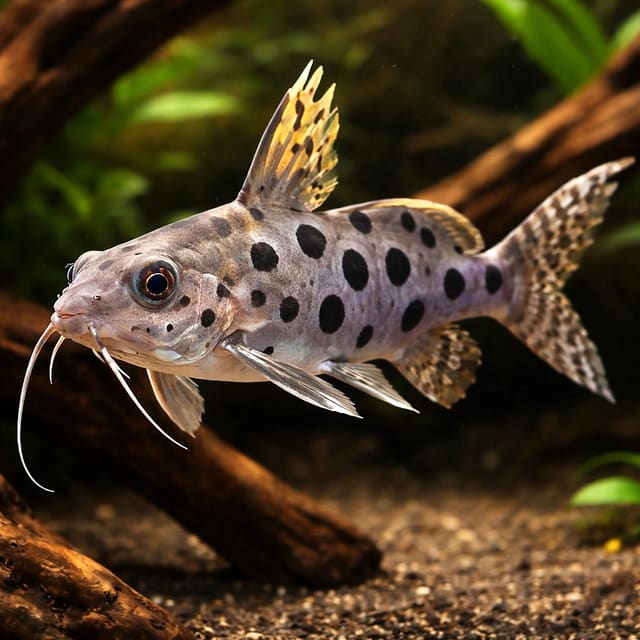
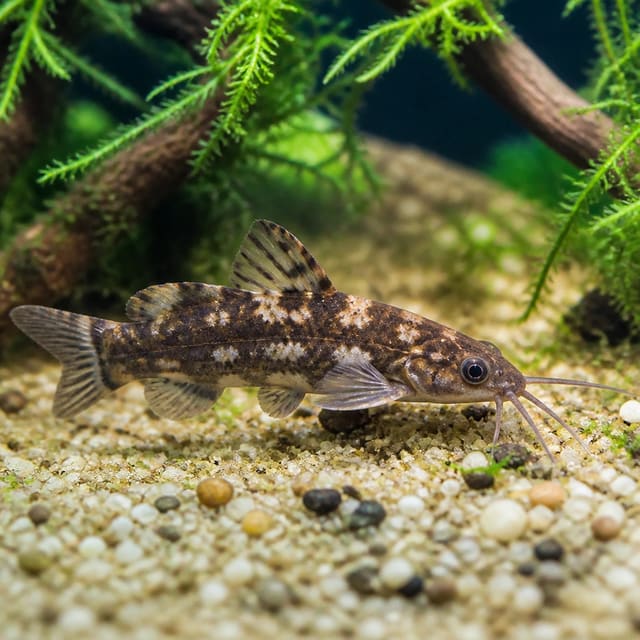
Dwarf Marbled Catfish (Microglanis poecilus)
22–27°C · pH 6–8
£8.09£8.99
Walking Catfish (Clarias batrachus) is an advanced, very large air-breathing catfish for a purpose-built, tightly covered aquarium. One purchase supplies one fish in the selected 4–12 cm dispatch size; plan conservatively around the 100 cm specialist-profile record, a 210 × 120 cm adult base, powerful filtration and strict predation-aware compatibility.
Adult size is the maximum length this species reaches at full maturity (scientific sources). The livestock you receive will be younger and smaller — pick a size above for the actual shipping size. Product-photo provenance and any image-specific limitations are stated on the listing.
Clarias batrachus
Walking Catfish (Clarias batrachus) is an advanced, very large air-breathing catfish for a purpose-built, tightly covered aquarium. One purchase supplies one fish in the selected 4–12 cm dispatch size; plan conservatively around the 100 cm specialist-profile record, a 210 × 120 cm adult base, powerful filtration and strict predation-aware compatibility.
Adult size is the maximum length this species reaches at full maturity (scientific sources). The livestock you receive will be younger and smaller — pick a size above for the actual shipping size. Product-photo provenance and any image-specific limitations are stated on the listing.
Maintain these water conditions for optimal health and vibrant colors
Walking Catfish (Clarias batrachus) is a large air-breathing catfish for a purpose-built specialist aquarium. FishBase identifies the exact species from Java, Indonesia, and notes that fish from Indochina and Sundaland have often been misidentified under the same name. That warning matters: this page follows the Java species identity rather than assigning the broader historical use of “walking catfish” to its native range.
The common name reflects an unusual ability to breathe air and move over damp ground for short distances, but it is not an invitation to leave the fish exposed. In nature the species occupies lowland streams, swamps, ponds, ditches, rice paddies, flooded fields and stagnant water bodies. In an aquarium, those observations point to resilience and escape ability, not permission for poor water quality. It still needs mature filtration, zero ammonia and nitrite, stable temperature, strong oxygenation and a tight, secure cover.
One purchase supplies one live fish in the size selected. The dispatch sizes are 4–5 cm, 5.5–7 cm and 8–12 cm. The size you select is the size supplied, not the adult size. Sex is guaranteed only when the selected option explicitly states male or female. This Clarias batrachus listing has no sex-guaranteed option.
| Common and scientific name | Walking Catfish; Clarias batrachus |
|---|---|
| Family and exact native range | Clariidae; Java, Indonesia |
| Published adult records | 47 cm total length in FishBase; 100 cm standard length in the specialist profile |
| Adult aquarium profile | 210 × 120 cm base; about 2,268 litres |
| Routine water | 20–26 °C; pH 5.5–8.0; 2–25 dGH |
| Sold unit | One live fish per purchase |
| Dispatch sizes | 4–5 cm, 5.5–7 cm and 8–12 cm |
| Care level | Advanced retailer assessment |
| Suits | A keeper with space, secure cover and a long-term large-fish plan |
This fish is small at dispatch only because it is young. The specialist profile gives a 210 × 120 cm base and approximately 2,268 litres for a fully grown adult, while allowing juveniles to be grown on in smaller tanks. A temporary juvenile aquarium therefore needs an upgrade date, a realistic destination and equipment capable of supporting growth. “I will decide later” is not a safe housing plan for a fish with a large adult footprint and rapid juvenile growth.
The two published length records use different conventions and disagree substantially. FishBase records 47 cm total length; the aquarium profile gives 1,000 mm standard length. Standard length and total length are not interchangeable, and this page does not disguise the conflict with a home-made conversion. For conservative space and equipment planning, use the larger specialist profile while keeping the FishBase identity record visible.
A juvenile Walking Catfish can look manageable beside ordinary community fish, but that snapshot is a poor guide to the years ahead. Growth increases turning space, food intake, waste production, mouth size and the force the fish can apply to a lid. Each stage therefore needs more than a longer tank: filtration, service access, handling equipment and companion decisions must advance with it. The safest purchase is one backed by a complete adult plan rather than optimism about a future upgrade.
Before selecting a dispatch size, measure the intended aquarium base, doorways and access route for the adult system. Check the floor or stand capacity with a competent professional where necessary, and calculate how water changes will be moved without unsafe lifting or uncontrolled discharge. Large-fish welfare includes the practical ability to maintain the aquarium every week, not merely fitting the glass into a room.
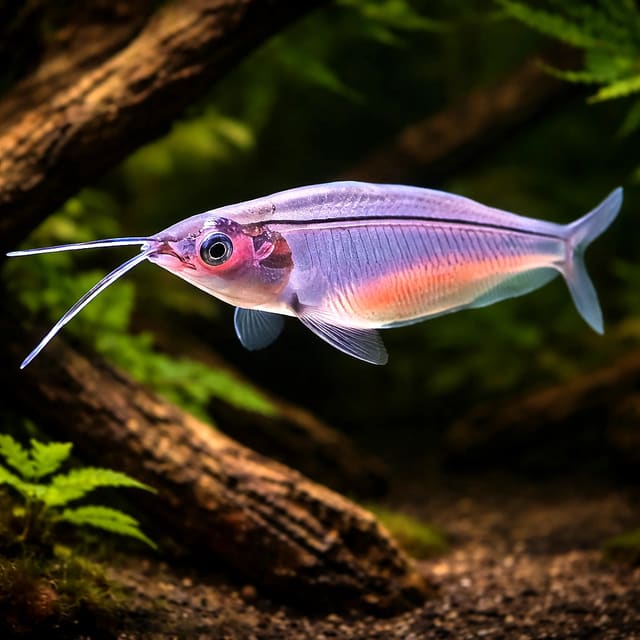
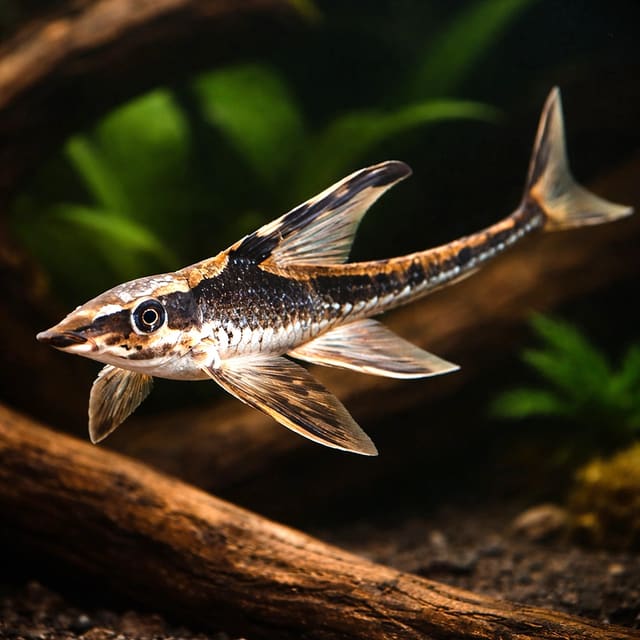
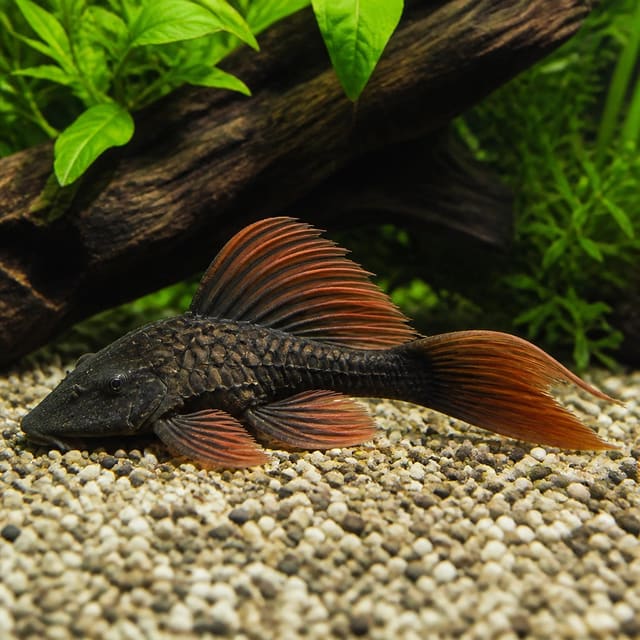
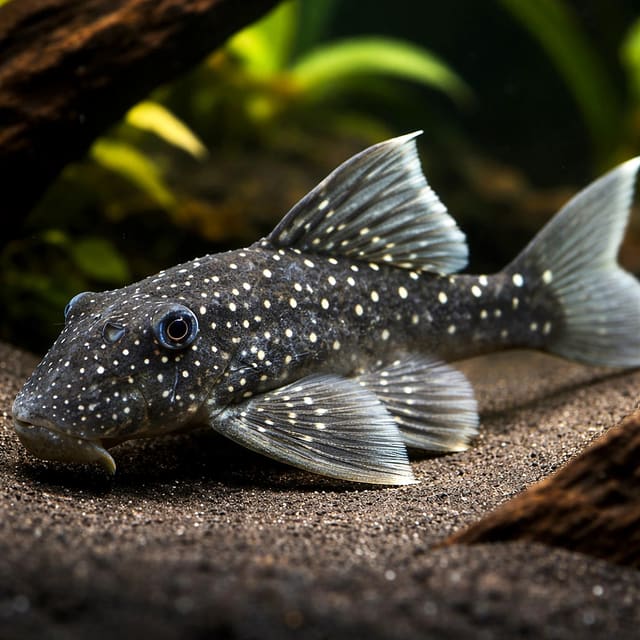
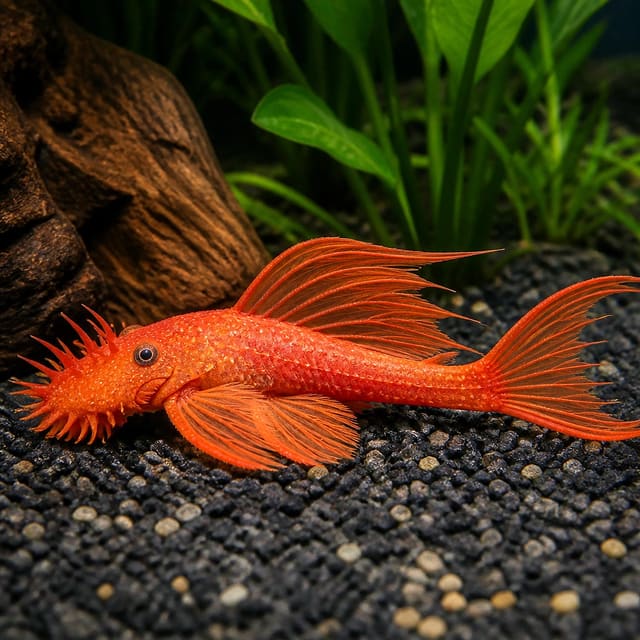
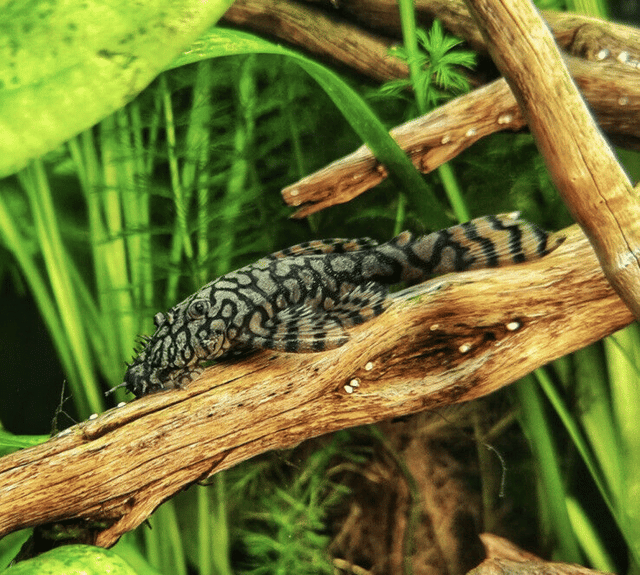
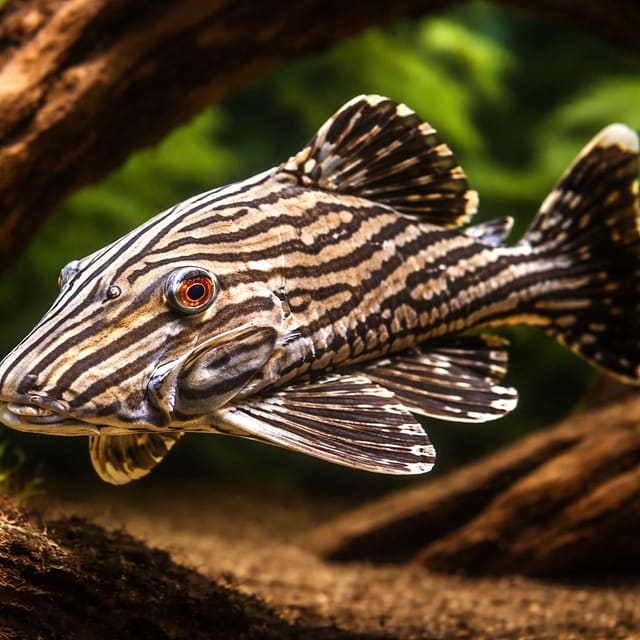
The catfish and pleco collection contains very different animals. Use it to compare alternatives, not as a compatibility list. A dwarf catfish, armoured loricariid and metre-profile Clarias do not share one universal setup simply because shoppers browse them together.
Gallery images have been digitally enhanced to improve image quality. Natural colour, pattern, size and maturity can vary between live animals.
The species aquarium profile gives a base of 210 × 120 cm and a volume of approximately 2,268 litres for a fully grown adult. Treat the footprint as essential: a tall aquarium with the same headline volume does not provide the same room to turn, rest and move along the bottom. The structure supporting a system of this size, safe electrical supply, water-change route and access for maintenance all need planning before the fish is bought.
Juveniles can be grown on in smaller aquariums, but a grow-on tank is a stage rather than a permanent answer. Set measurable upgrade triggers based on the fish's ability to turn comfortably, the space left after hides are added, water-quality trends and access for maintenance. Growth can be rapid, so do not wait until the fish looks cramped. Moving a large catfish, cycling new filtration and commissioning a bigger aquarium take time.
Use a soft substrate that will not damage the underside or barbels. Add large, smooth driftwood, rounded rocks, sturdy pipes or caves that the fish can enter without becoming wedged. Every object must be stable and accessible for cleaning. Leave broad open floor space rather than filling the footprint with décor. Check each hide again as the fish grows; an entrance safe for a juvenile can become a trap later.
C. batrachus is a facultative air-breather and can move short distances over damp ground. The aquarium must have a tight-fitting, robust cover. Secure feeding flaps, cable notches, hose cut-outs and gaps around filter returns. A heavy lid is not enough if one corner lifts or a service opening remains exposed. Inspect the cover after every maintenance session and whenever equipment is changed.
Allow access to the surface without creating an exit. Keep the water level and lid arrangement consistent with safe air access, and make sure condensation channels do not lead to open gaps. Do not depend on the fish appearing sedentary in daylight; an animal can test the cover when the room is quiet. Keep the surrounding floor clear so a displaced lid or leak is noticed quickly.
Plan capture and transfer before an emergency. Large clariid catfish have strong bodies and fin spines; OATA's group sheet warns that catfish spines can puncture bags, which is why double bagging is used for transport. For aquarium work, use equipment sized to control the fish without squeezing it or entangling spines. Never lift a large fish casually by a small net.
A large omnivorous fish produces a substantial waste load. Build filtration for the adult, with mechanical stages that can be serviced and biological media that remain oxygenated. Fish excrete ammonia, which is toxic; mature bacteria convert it to nitrite and then nitrate. Complete a fishless cycle and verify that ammonia and nitrite are zero before stocking. The first tropical tank guide explains the maturation sequence, while the RSPCA fish environment guidance covers the general welfare role of filtration, testing and stable temperature.
Distribute the filter return so waste is carried towards an intake without creating a punishing current across the whole floor. Large hides and wood can create still pockets, so test circulation around them. Use vigorous aeration even though the fish can breathe atmospheric air. Air breathing is an adaptation, not a substitute for clean, oxygenated aquarium water or a functioning biological filter.
When cleaning, rinse dirty filter media gently in water removed from the aquarium and do not run it under the tap. Do not allow mechanical waste to accumulate until flow collapses. Service stages in a repeatable sequence, confirm that every valve is reopened, and watch the outlet after restart. A flow reduction, unusual noise or water bypass should be corrected before water quality deteriorates.
A 2,268-litre adult system requires equipment that can be maintained without leaving the fish exposed or the cover open for long periods. Position pre-filters, valves and mechanical stages where they can be reached safely. Label flow directions and shut-off points. Provide isolation valves where appropriate so a routine clean does not drain hoses unexpectedly. Protect electrical connections from splashes and use drip loops.
Use more than one route for water movement so a single blocked intake does not leave the entire aquarium stagnant. This does not remove the need to inspect every pump, but it adds resilience while a fault is corrected. Keep spare air equipment and understand how long the biological media can remain without flow. After a stoppage, restart cautiously, verify temperature and oxygenation, and test ammonia and nitrite more often.
Mechanical stages should capture solid waste before it reaches deep biological media, yet they must be easy enough to clean at the necessary frequency. If servicing requires lifting a huge dirty component across the room, it will be delayed. Design the routine around realistic access, drainage and lifting. The best large-system plan is one the keeper can repeat reliably even on a busy week.
Heaters also need redundancy and protection appropriate to the aquarium. A powerful catfish can move décor and contact equipment, so use guards and secure mounting. Verify temperature with an independent thermometer rather than relying only on a heater dial. In a large volume, a failing heater may cause a slow drift that goes unnoticed without a log.
The specialist species profile gives 20–26 °C, pH 5.5–8.0 and 2–25 dGH for aquarium care. This is a wide range, not an instruction to let conditions swing between its endpoints. Choose a stable point that suits the fish and any carefully selected companion, then keep replacement water close to it.
| Temperature | 20–26 °C |
|---|---|
| pH | 5.5–8.0 |
| General hardness | 2–25 dGH |
| Ammonia | 0 mg/l |
| Nitrite | 0 mg/l |
| Nitrate | Track against the source-water baseline and control with maintenance |
The OATA freshwater-catfish sheet gives 22–27 °C, pH 6.0–8.0 and 4–18 dGH for catfish as a group, along with zero ammonia and nitrite and nitrate no more than 20 mg/l above the normal tap-water level. Those values are useful background, but they do not replace the species profile. Use the species range for routine planning and the group sheet for general water-quality discipline.
The water chemistry guide explains pH and hardness, and the water matcher helps compare tested water with the range above. Test the tap supply as well as the aquarium. Avoid repeated quick chemical adjustments; stable conditions prepared consistently are safer than chasing a number after each test.
Test ammonia, nitrite, nitrate, pH, hardness and temperature on a regular schedule and keep a written log. Increase testing after a move, heavy feed, filter service, power interruption, medication or unexpected behaviour change. A trend matters more than a single acceptable result. Rising nitrate or falling flow should be addressed before the fish shows distress.
Use partial water changes sized to the measured waste load and source-water nitrate. Dechlorinate new water and match temperature closely. Siphon uneaten food and waste from accessible floor areas, including behind hides. A large aquarium still needs maintenance; volume adds stability but does not make waste disappear. Make sure hoses and pumps used for changes cannot injure the fish or leave an escape gap unattended.
Observe before maintenance. Note breathing, body condition, barbel condition, skin, fin carriage and response to food. A fish that suddenly remains at the surface, refuses food, rubs, develops lesions or loses balance needs immediate water tests and equipment checks. Compare the change with recent feeding, cleaning and temperature records before reaching for treatment.
Run the aquarium fully assembled before the fish enters it. Confirm that flow reaches behind every large hide, the surface is vigorously disturbed, the cover stays secure under normal service and the heater maintains the chosen temperature throughout the volume. Add marks for the normal water level and examine how quickly evaporation exposes filter returns or creates new lid gaps.
Practise a full water-change routine with the aquarium empty of livestock. Time how long draining and refilling take, confirm that replacement water can be conditioned and temperature-matched, and test every valve after restart. Check that no hose route creates a siphon risk when a pump stops. A rehearsal reveals problems while correction is straightforward.
Cycle the filtration against the expected initial load and keep results, dates and feeding-equivalent inputs in a log. When the juvenile is introduced, continue measuring rather than assuming the cycle is permanent. Biological capacity follows the waste it receives; a rapidly growing fish and increasing meals can outpace the previous bacterial population.
Review capacity at every growth checkpoint. If nitrate rises faster, mechanical media blocks sooner or oxygenation falls after feeding, the system is signalling a higher load. Increase maintenance or filtration before water quality fails. The upgrade sequence should lead the fish's growth, never trail it.
Write down the dimensions and capacity of each planned housing stage, the trigger for moving on, and the equipment that must be mature before the transfer. A trigger might be reduced turning room, a hide becoming too tight, a faster nitrate rise or the next aquarium reaching its safe commissioned state. Dates alone are less useful because individual growth and feeding vary.
Budget for the adult system rather than only the juvenile purchase. Filtration media, pumps, heaters, aeration, water conditioning and the energy needed to run a large heated aquarium are recurring welfare costs. Keep critical consumables in date and hold spares for the parts most likely to stop flow or aeration. Test replacement equipment before relying on it.
Prepare for a power or equipment interruption. Keep the cover secure while arranging emergency aeration, and prioritise surface movement and temperature stability. When circulation returns, inspect the fish, verify heater and pump operation, and test ammonia and nitrite. Feed cautiously until the biological system is demonstrably processing waste normally again.
If the household can no longer provide the necessary adult aquarium, arrange an appropriate experienced keeper or facility before the fish outgrows the present stage. Never release it into outdoor water. FishBase records adverse ecological effects from introductions, and the fish's air-breathing, overland movement and predatory diet make casual release especially irresponsible. Rehoming must preserve secure transport and suitable mature housing.
The species is omnivorous. FishBase records insect larvae, earthworms, shells, shrimps, small fish, aquatic plants and debris among wild food items. The aquarium profile recommends a varied mixture of suitable dried pellets, meaty frozen foods and vegetable matter. That variety is more useful than feeding only mammal meat, only feeder fish or one oversized meal.
Adults do not need to be fed every day. Portion food to the individual and watch it being consumed; the specialist profile warns that the fish does not know when to stop eating. Remove leftovers and adjust the next portion rather than letting food decay. Rapid feeding enthusiasm is not proof that another meal is needed.
Use sinking or deliberately placed foods that the fish can find without scattering excessive waste. If companions are present, confirm that they eat too; a large catfish can monopolise food. Track body condition over time. Persistent swelling after feeds, uneaten food, rising nitrate or greasy surface film are reasons to reduce portions and review the menu.
Make each feed an observation session. Note how quickly the fish locates food, whether it chews or rejects items, and whether any piece remains hidden under wood or pipework. Remove accessible leftovers promptly. If appetite changes, test water and temperature before offering a succession of richer foods that can worsen pollution.
Juveniles and adults do not need identical portions or frequency. The explicit species guidance is that adults do not require food every day; adjust the juvenile routine to growth and body condition without allowing the fish to become obese. Weigh consistency across the week more heavily than one large meal. Record what is offered so several household members do not feed the same fish twice.
Have the aquarium cycled, covered, heated and tested before dispatch. Make sure someone will receive the parcel, and read the current delivery and Live Arrival Guarantee policy. Keep a suitable transfer container and handling equipment ready without leaving the lid unsecured.
The specialist profile is direct: Clarias batrachus is highly predatory and will eat fish it can fit into its large mouth. The risk changes as the catfish grows, so a companion that looks safe beside an 8 cm juvenile can become prey later. Compatibility must be judged against the larger adult plan, not the dispatch-day photograph.
Ordinary labels such as “peaceful”, “bottom dweller” or “community fish” are not enough. A companion has to pass four tests at once: it must share the routine water range, remain too large and robust to be swallowed, tolerate the aquarium's feeding pattern, and fit within the remaining adult floor space. The tank also needs enough filtration for the combined waste load.
The profile names similarly sized robust species such as large barbs, Loricariids and cichlids. It also says proposed companions should be introduced at a larger size than the Clarias because young Walking Catfish grow quickly. These are conditional categories, not guaranteed partners. The exact species still needs its own adult-size, water, temperament and space assessment.
Do not place small schooling fish, dwarf catfish, shrimp, snails or other mouth-sized animals in the aquarium and hope the catfish ignores them. Do not depend on heavy feeding to suppress predation; overfeeding creates obesity and water-quality problems without removing instinctive feeding behaviour. A fish that can be swallowed should be treated as prey.
The 210 × 120 cm base and 2,268-litre adult profile describe housing for the catfish itself. Companions add their own footprint, waste, hides and feeding needs. An aquarium that meets the catfish's stated adult figure is not automatically spacious enough for a mixed display. Draw the usable floor after wood, pipes and equipment are installed, then assess whether another adult can move and rest without blocking the Clarias.
Plan around one adult first. Multiple large Clarias require exceptional space, careful observation and a way to separate fish immediately. Never buy several juveniles simply because they fit in the present tank; the real question is whether the adult system can house every fish safely.
Measure the fish and review companions regularly. As the mouth, body depth and feeding speed increase, reconsider any fish that is approaching prey size. Watch after feeding and during quieter periods. Missing scales, torn fins, hiding, refusal to feed or one animal being displaced from a resting area show that the arrangement needs intervention.
A backup aquarium must be large enough for the fish being moved and already capable of supporting its waste. An empty glass box found after conflict begins is not an immediate solution if it has no mature filtration. Decide in advance which animal would move, how it would be caught safely and how lids would remain secure during the transfer.
Predation can be sudden, but incompatibility also appears as chronic pressure. One fish may stop approaching food, abandon a preferred area or stay behind equipment long before visible wounds develop. Observe at several times of day and compare normal positions. A companion that survives is not necessarily thriving.
Feeding can briefly increase competition and reveal the real hierarchy of access. Distribute food in a controlled way and make sure every permitted companion consumes its own diet. If the Clarias rushes every feeding point or another fish must enter striking range to eat, the arrangement needs revision. Adding more food is not a safe solution because it raises waste and overeating risk.
Recheck adult dimensions at regular intervals. A robust fish introduced larger than the Clarias may cease to be larger after rapid growth. The named compatibility categories remain conditional throughout life. Move a newly vulnerable companion before it becomes mouth-sized rather than waiting for a failed encounter.
Avoid every mouth-sized fish and any fragile, slow or easily displaced animal. Use caution even with large barbs, Loricariids and cichlids because the category alone does not prove a match. A suitable companion is a specific robust adult whose care overlaps and whose space is genuinely additional to the catfish's own requirement.
These answers address the size, housing, feeding, water, compatibility and delivery decisions that matter before purchase.
Published species records conflict. FishBase gives 47 cm total length, while the specialist aquarium profile gives 100 cm standard length. Those measurement conventions do not reconcile into one neat figure, so plan conservatively for the larger profile and never treat the 4–12 cm dispatch sizes as adult size.
The species aquarium profile gives a 210 × 120 cm base and about 2,268 litres for a fully grown adult; juveniles can be grown on in smaller aquariums. Floor area, a tight cover, strong filtration and the adult waste load matter more than a nominal volume alone.
Plan the aquarium around one adult first. Additional Clarias or companions need enough separate space, close observation and a ready separation option. Never buy a group of juveniles without secured adult housing for every fish.
No. Treat it as an advanced fish because it becomes very large, is highly predatory, needs a tightly covered specialist aquarium and creates a substantial feeding, filtration and compatibility commitment. It is not a fish for a new or general community setup.
Offer a varied omnivore diet using suitable dried pellets, meaty frozen foods and vegetable matter. Adults do not need feeding every day. Portion carefully because the species readily overeats, watch the fish feed and remove leftovers before they affect water quality.
Use the species aquarium profile's 20–26 °C, pH 5.5–8.0 and 2–25 dGH. Keep values stable, ammonia and nitrite at zero, and oxygenation strong. The broader OATA catfish figures are group guidance, not a better species target.
The main risk is predation rather than ordinary fin nipping: it will eat fish that fit into its large mouth. Its rapid growth changes what is vulnerable. Do not rely on peaceful behaviour at dispatch size, and separate fish if there is persistent pursuit, injury or feeding exclusion.
The specialist profile allows only similarly sized, robust fish such as large barbs, Loricariids and cichlids, introduced at a larger size than the Clarias. This is not a general community fish. Every candidate still needs matching water, enough space and protection from becoming mouth-sized prey.
Tropical Fish Co uses oxygen-filled bags, insulation and a tracked licensed live-animal courier. Have someone receive the parcel and record one continuous video from the sealed box to the fish still in the sealed bag. Inspect it that day and send the order number and video the same day if a Live Arrival Guarantee claim is needed.
The husbandry above keeps the exact Java species identity separate from historically misidentified Asian walking catfish, and it preserves the large conflict between the two published length records rather than averaging them.
Retail size, sex selection and delivery wording follow Tropical Fish Co's current product and policy terms. The adult setup, secure cover and long-term destination should be settled before choosing a dispatch size.
No reviews for this item yet. Bought one? Honest reviews only, good or bad.
What customers say about ordering from us
Easy website plenty of info on fish your buying great to pick a time slot
TRACEY DURRANT · 7 Oct 2026
Got some lovely fish thank you
Kevin Mackie · 7 Oct 2026
Reviews of our shop, collected by Judge.me, an independent third-party review collector. Newest first.