−10%
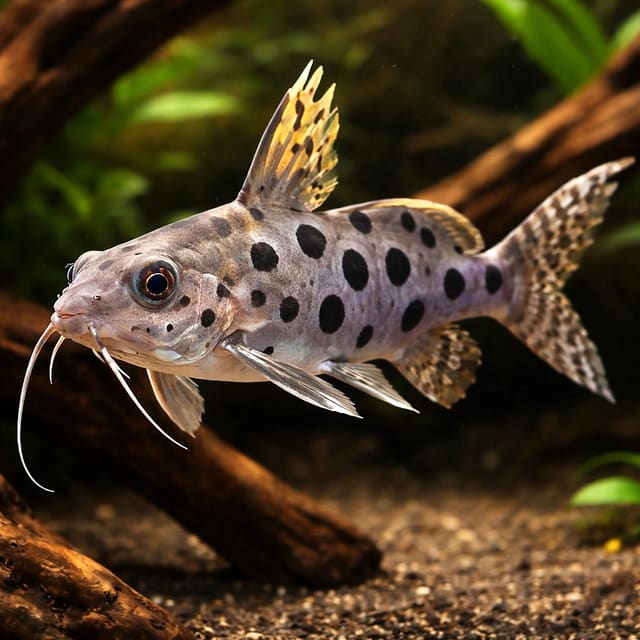
Dwarf Marbled Catfish (Microglanis poecilus)
22–27°C · pH 6–8
£8.09£8.99

A see-through schooling catfish from South-East Asia, traded for decades as Kryptopterus bicirrhis and now usually identified as K. vitreolus. One fish per unit in four dispatch sizes, 4–5 cm to 7–9 cm. Keep six or more in a mature, dimly lit tank at 22–26 °C with soft, slightly acidic water.
Adult size is the maximum length this species reaches at full maturity (scientific sources). The livestock you receive will be younger and smaller — pick a size above for the actual shipping size. Product-photo provenance and any image-specific limitations are stated on the listing.
Kryptopterus bicirrhis
Shoaling fish: kept in a group they feel safer, stay calmer and show their best colour.
A see-through schooling catfish from South-East Asia, traded for decades as Kryptopterus bicirrhis and now usually identified as K. vitreolus. One fish per unit in four dispatch sizes, 4–5 cm to 7–9 cm. Keep six or more in a mature, dimly lit tank at 22–26 °C with soft, slightly acidic water.
Adult size is the maximum length this species reaches at full maturity (scientific sources). The livestock you receive will be younger and smaller — pick a size above for the actual shipping size. Product-photo provenance and any image-specific limitations are stated on the listing.
Maintain these water conditions for optimal health and vibrant colors
The glass catfish is the fish people stop and point at in a shop tank. It is a small catfish you can see straight through: the backbone, the fine bones either side of it and the organs packed in close behind the head are all on show, and two long barbels reach forward from the upper jaw like feelers. It is a schooling fish and a timid one, and it looks its best in a quiet, softly lit aquarium among a group of its own kind. Set up that way, a school of glass catfish moving together in front of the planting is one of the more memorable sights in freshwater fishkeeping.
Each unit you add to your basket is one live glass catfish. You choose the dispatch size from four grades: 4–5 cm, 5–6 cm, 6–7 cm and 7–9 cm. Those figures are a guide to the size of the fish when it leaves us, not a promise of how big it will grow, and the fish are not sexed or selected by sex. Because this is a schooling species, plan to order enough to make a proper group in one go rather than buying one or two to see how they get on. The reasons are set out in the behaviour section further down.
A straight word about the name. We list this fish as Kryptopterus bicirrhis because that is the name it carries in our stock records, and it is the name the glass catfish has been traded under for a very long time. Anyone keeping it should know that the science has moved on. In 2013 the ichthyologists Heok Hee Ng and Maurice Kottelat described the transparent glass catfish as a separate species, Kryptopterus vitreolus. Seriously Fish records that this fish had been available for decades and was widely misidentified as K. bicirrhis or K. minor until that description, and the Wikipedia account of K. bicirrhis says the true species was only ever exported in insignificant numbers, with the smaller K. vitreolus commonly sold under its name. FishBase still treats K. bicirrhis as a valid species in its own right. It simply is not, in most cases, the see-through fish that arrives in the bag.
Nobody can settle which species an individual fish belongs to from a photograph or a quick look. The published differences rest on body proportions, barbel length and fin-ray counts, plus whether the body is clear in life. What we can do is be open about it, give you the care that suits the transparent glass catfish the hobby actually keeps, and point out where the larger, true K. bicirrhis would need something different. That is how the rest of this page is written.
| Need | What to provide |
|---|---|
| Group size | Six at the very least; FishBase suggests ten or more |
| Aquarium | 100 litres or more, with a footprint of at least 90 × 30 cm |
| Temperature | 22–26 °C |
| pH | 6.0–7.0 |
| General hardness | 2–10 °dGH |
| Food | Small live and frozen foods every day, plus suitably sized dried food |
| Temperament | Peaceful and timid; may eat eggs and fry |
| Adult size | About 6.5 cm standard length for K. vitreolus; up to 15 cm for true K. bicirrhis |
| Care level | Moderate |
The see-through body has a plain explanation. Catfish have no scales, and fish of the genus Kryptopterus carry no body pigment, so light passes through skin and muscle with very little to stop it. The Wikipedia account of K. vitreolus, drawing on a 2023 study, describes the skin as having a layered, plywood-like arrangement of collagen fibres, and notes from the original description that most of the organs sit close to the head, where the heart can be seen beating if you look with a magnifying glass. Behind that small cluster the body is little more than clear muscle around a visible spine.
The body is not completely colourless. When light strikes it at certain angles, a rainbow shimmer runs along the flanks. That same 2023 study, published in the Proceedings of the National Academy of Sciences by Fan and colleagues, traced the effect to light being diffracted by the sarcomeres, the tiny repeating contractile units inside the muscle fibres. In other words, the colour you see is a trick of the light passing through living muscle rather than a pigment in the skin.
| Feature | K. vitreolus (the usual glass catfish) | True K. bicirrhis |
|---|---|---|
| Body in life | Transparent | Mostly opaque and light greyish; clearly see-through only around the head |
| Maximum size | 6.5 cm standard length (FishBase); Wikipedia gives up to 8 cm | 15 cm standard length |
| Wild range | Thailand only | Mekong and Chao Phraya basins, the Malay Peninsula, Sumatra and Borneo |
| Habitat | Slow or still water, turbid brown or acidic black water | Large turbid rivers, often in fast water near the banks |
| Temperament | Peaceful and timid | Described as larger and more aggressive; may take small fish |
| Availability | The glass catfish normally seen in shops | Uncommon; exported only in small numbers |
Seriously Fish states that true K. bicirrhis does not have a transparent body in life, and that within the genus only K. vitreolus, K. minor and K. piperatus are truly transparent. K. minor is a Bornean fish. So if the fish swimming in your tank is clear enough to read through, it is one of the transparent species and, in the trade, that almost always means K. vitreolus.
A note on the measurements. Standard length, the figure FishBase uses, runs from the tip of the snout to the base of the tail and leaves out the tail fin. A dispatch grade is simply a guide to the size of the fish when it leaves us, so the two figures are not directly comparable.
Several unrelated fish share the "glass" label, which causes its own confusion. The African glass catfish (Pareutropius debauwi) is a different catfish from Africa with its own care needs, and the glass bloodfin tetra is a tetra, not a catfish at all. If you have come here looking for either, follow those links instead.
The transparent glass catfish, K. vitreolus, comes from a small part of one country. Seriously Fish describes its range as the coastal river basins of Peninsular Thailand that drain into the Gulf of Thailand south of the Isthmus of Kra, plus a handful of rivers draining the Cardamom Mountains in the south-east of Thailand. FishBase gives the same picture, peninsular and south-eastern Thailand and absent from central Thailand, and mentions a report from Penang in Malaysia that still needs to be verified.
Within that range it prefers slow-moving or standing water. It has been collected from turbid, brownish water and from acidic blackwater, the tea-coloured, soft water that drains through forest leaf litter. Neither is the bright, clear, fast-moving water many people picture for a tropical fish, and that matters when you set up an aquarium for it. Low light, gentle movement and soft, slightly acidic water are what the fish is built for.
The glass catfish has its place in Thai folklore, too. Its Thai name, pla kang phra ruang, means roughly "Phra Ruang's skeletal fish", after a legend in which the king Phra Ruang brought the bare bones of a fish back to life, producing a fish you can see the skeleton through.
True K. bicirrhis covers a far wider area. FishBase lists the Mekong and Chao Phraya basins, the Malay Peninsula, Sumatra and Borneo, and Seriously Fish adds Java. It lives in large rivers with turbid water and favours fast-flowing water along the banks, moving into flooded fields and lowland streams, where FishBase records schools of up to a hundred fish. Seriously Fish notes it is abundant at the end of the wet season in the Danau Sentarum lakes of West Kalimantan. It is a bigger fish of big rivers, quite unlike the quiet backwaters of its see-through cousin.
Wikipedia notes that the aquarium trade in K. vitreolus generally relies on wild-caught fish, that unlike many aquarium species it is not known to be bred at commercial facilities, and that there are concerns about whether this is sustainable given the numbers involved and the species' limited range. Both species were assessed as Least Concern on the IUCN Red List in 2019, according to FishBase.
For a buyer, the practical point is that a wild-caught fish has made a long journey before it reaches you, and it is adjusting to captive foods and a new set of water conditions. It rewards patience. A calm, mature aquarium, a proper school and good small foods give it the best chance of settling, and buying a group that stays together for life makes every fish count.
Seriously Fish recommends an aquarium with a base of at least 90 × 30 cm, roughly 81 litres, for K. vitreolus. We list 100 litres as the minimum for a group because a little extra water gives a shy schooling fish more room to move as a unit and makes the water chemistry steadier. FishBase's advice is more generous still: at least ten fish, kept in an aquarium at least 100 cm long. If you have the space for a metre-long tank, a school of ten in it follows that advice to the letter.
If you ever find yourself keeping true K. bicirrhis, which grows to 15 cm standard length, the numbers change: Seriously Fish suggests a base of 120 × 45 cm, around 243 litres, for that species. A glass catfish that keeps growing well past the size of K. vitreolus and stays mostly opaque is the signal to plan for that larger tank.
Seriously Fish is clear that this fish should not be added to a biologically immature aquarium. In practice that means a tank whose filter has been running and fully cycled for some time, with ammonia and nitrite reading zero and nitrate stable from week to week, and ideally one that has already settled with a few hardy fish. A brand-new set-up, however carefully cycled, swings too much in its early weeks for a sensitive wild-caught fish.
The same source recommends a well-decorated set-up with some surface or floating vegetation, because the species appears to prefer relatively dim conditions. A layout that works well looks like this:
Lighting should be modest. If your light has a dimmer or a programmable ramp, use it so the tank brightens gradually in the morning rather than snapping on. Room position matters too: a tank by a busy door or in direct sunlight will keep a timid fish on edge.
The transparent glass catfish comes from slow-moving and standing water, so a strong current is not what it is used to. Choose a filter that keeps the water clean without turning the tank into a river: a spray bar aimed at the glass, an outlet turned towards the surface, or a filter rated a little lower than you might use for an active community tank. The aim is good oxygenation from gentle surface movement, with calm areas where the school can rest without effort.
If you like the look, a handful of dried leaves can tint the water slightly brown, echoing the stained water the species is found in, but keep an eye on pH if you do, as leaves and wood can lower it over time in soft water.
The sources agree more than they disagree on water, and the overlap gives a comfortable range that suits both the transparent fish of the hobby and true K. bicirrhis.
| Parameter | Range we recommend | What the sources say |
|---|---|---|
| Temperature | 22–26 °C | Seriously Fish gives 20–26 °C for K. vitreolus; FishBase and Wikipedia give 21–26 °C for K. bicirrhis, which Wikipedia describes as a low temperature for its tropical range |
| pH | 6.0–7.0 | 4.0–7.0 for K. vitreolus; 6.0–7.5 for K. bicirrhis (Seriously Fish) |
| General hardness | 2–10 °dGH | 1–10 °dGH for K. vitreolus; 2–15 °dGH for K. bicirrhis (Seriously Fish) |
Community tanks are often run warm. For glass catfish, keep to the lower and middle part of the tropical range. Every source we used puts the upper limit at 26 °C apart from one wider range given for K. bicirrhis, so there is no good reason to push higher. A reliable heater with a thermostat, and a separate thermometer you actually read, are worth more than any additive. In a British summer, watch for heatwaves pushing the tank above 26 °C; extra surface movement and a fan blowing across the water help, and so does keeping the room curtains drawn on the hottest days.
The wild habitat includes acidic blackwater, and the recommended ranges sit on the soft, slightly acidic side. Tap water across the UK varies a great deal, and hard, alkaline water is common in many areas. If your tap water is hard, blending it with reverse-osmosis water is the steadiest way to bring hardness and pH down; chemical pH adjusters tend to give swings rather than stability. Whatever you do, change things slowly and aim for steady readings rather than chasing an exact number.
A sensitive, wild-caught fish copes far better with a slightly imperfect but steady tank than with perfect numbers that bounce around. A sound routine looks like this:
You will sometimes see the glass catfish called an omnivore. The sources say otherwise. Seriously Fish describes K. vitreolus as a predator feeding on small invertebrates and zooplankton in nature, and FishBase describes true K. bicirrhis as a daytime feeder taking water bugs, small fishes, worms, crustaceans and insects. Both are meat-eaters of small prey, and the aquarium diet should reflect that.
Seriously Fish advises that K. vitreolus will accept dried foods of a suitable size but should also have daily meals of small live and frozen foods. The examples given are:
For the larger true K. bicirrhis, the same site lists sinking dried foods and live or frozen bloodworm and Tubifex. Between those two lists you have a good menu: small frozen foods such as baby brine shrimp, daphnia, Moina and small bloodworm form the core, backed up by a fine-grade dried food that the fish learn to take as they settle.
Seriously Fish describes the glass catfish as somewhat timid and poor at competing with much larger, robust or boisterous fishes. That shapes the way you feed:
Start new arrivals on frozen or live foods, which the sources say should be offered daily anyway, then mix in a little dried food alongside them over the following weeks. Once the whole school is eating well, you can settle into a normal feeding routine.
Feeding is also your daily health check. A glass catfish that comes forward for food with the rest of the school is usually a settled fish; one that hangs back, hides or ignores food it took the day before deserves a closer look and a water test.
If there is one thing to take from this page, it is that the glass catfish is a group animal. Seriously Fish describes K. vitreolus as highly gregarious, forming quite tight schools, and gives six as the minimum group. FishBase advises at least ten in the aquarium, and in the wild true K. bicirrhis has been recorded in schools of up to a hundred. Six is the floor, not the target; ten or more, in a tank that can hold them, follows the FishBase advice.
Seeing glass catfish move together as a school is much of the appeal, and the group sizes above come straight from the sources. Buy the whole group at once from the same dispatch grade, or from neighbouring grades, so the fish settle in together as one school.
Seriously Fish rates K. vitreolus as generally peaceful, with two cautions. It may eat eggs or fry, so it is not the fish for a tank where you want other species to raise young. And it is somewhat timid, so it does not compete well with much larger, robust or boisterous fishes. True K. bicirrhis is a different matter: Wikipedia describes it as larger and more aggressive, and Seriously Fish notes it may take smaller fish.
Seriously Fish suggests small, peaceful species from Thailand as companions, naming these groups:
The common thread is size and manner: small, calm fish from the same part of the world that enjoy the same soft water, the same moderate temperatures and the same subdued light.
If you are unsure about a particular combination, ask before you order. It is far easier to plan a community around a timid fish from the start than to rescue a school that has been bullied into hiding.
A see-through fish gives you an early warning that most fish do not. Wikipedia notes that the tissues of K. vitreolus turn milky-white during illness or after death, and records the same milky-white change in K. bicirrhis as it dies. A healthy glass catfish is clear, with the bones crisp and the rainbow shimmer visible under the right light. A fish that is turning cloudy or milky is telling you something is wrong, and it should never be put down to normal colour change.
Test the water before anything else. Most problems with a fish this sensitive trace back to the tank itself: an immature or overloaded filter, a temperature swing, a change in hardness or pH, or tank mates that are too pushy. Seriously Fish's warning against adding the species to a biologically immature aquarium tells you how much the water matters. Correct the cause with steady, gradual changes rather than one large correction, and remove any fish that has died straight away so it does not affect the water.
Because the fish in the trade are generally wild-caught, a separate quarantine tank is worth having if you keep other fish already. A few weeks on their own, in mature water at matching temperature and chemistry, lets you watch the new school feed and settle without risking your existing community, and without the pressure of competing for food from day one.
The sources point to three things above all: water that is mature and stable, a group that is large enough, and companions that are small and calm. Get those right before worrying about anything else.
If something does go wrong, write down your readings and what you have seen before asking for help. Temperature, pH, ammonia, nitrite, nitrate, the age of the tank and the other fish in it are the details anyone will need to give you useful advice.
We do not sex glass catfish, and that is not us being cautious. Seriously Fish lists both the visible differences between males and females and the breeding behaviour of K. vitreolus as unknown. You may read confident descriptions elsewhere of fuller-bodied females or of spawning triggers, but the sources we rely on for this page do not support them, so we will not repeat them as fact.
The wider picture is consistent with that. Wikipedia notes that, unlike many aquarium fish, K. vitreolus is not known to be bred at commercial facilities, which is why the fish in the hobby are generally wild-caught. If you do see spawning in your aquarium, it would be worth recording carefully, because good observations of how this species breeds in captivity are scarce.
For most keepers the practical advice is simple. Buy the glass catfish for what it is, a striking, peaceful schooling fish for a quiet planted tank, and treat any breeding behaviour as a bonus rather than a goal. Since the fish may eat eggs and fry, it is also not a species to house with other fish you hope to breed.
A wild-caught, timid fish that has just travelled needs a calm landing. Have everything ready before the parcel arrives: the filter running in a mature tank, the water tested, and the temperature set and steady within the 22–26 °C range. Someone needs to be at the delivery address to receive the parcel, because live animals cannot be left on a doorstep. Please read our delivery and live-arrival information before you order.
Your fish travel in oxygen-filled bags inside insulated packaging, with heat packs when the weather calls for them, carried by a tracked courier licensed to carry live animals. We email the confirmed delivery date and tracking details so you know when to expect them.
Start a continuous unboxing video while the parcel is still sealed, then open it in the same take and show the fish in the still-sealed bag. If a fish has arrived dead, dying or clearly compromised, email hello@tropicalfishco.co.uk on the day of delivery with your order number and that video. Photos alone do not meet our live-arrival policy. Where a claim is accepted, we replace the affected fish with your next order or refund them, subject to the guarantee terms.
Give the school a few days to find its feet among the plants. Offer a small amount of frozen or live food once the fish have had some time to settle, and keep the portions small until you see the whole group feeding. Watch breathing, appetite and behaviour every day, and keep a particular eye on the clarity of each fish. A school that comes out to feed and moves together by the end of the first week is settling well.
Hold back on adding other new fish for a few weeks, keep the routine quiet, and let the group find its place in the tank. Glass catfish reward that patience.
These are the sources used for this page. They are worth reading in full if you want the detail behind the care advice and the naming question.
No reviews for this item yet. Bought one? Honest reviews only, good or bad.
What customers say about ordering from us
I have a small group of long finned mountain minnows. So was delighted to be able to order ten of this variety to increase the genetics in my tank . The ones I recieved are healthy but it’s to early to give a verdict on wether they are of a long finned type since they are small currently.
Gordon Walker · 23 Sept 2026
100% success travel and "installation". Pleased with quality of purchase. The Siamese fighter a bit "shy" so have not yet seen him at his best yet but looking good. Happy customer. GG
George E Garratt · 21 Sept 2026
Reviews of our shop, collected by Judge.me, an independent third-party review collector. Newest first.