Moderate
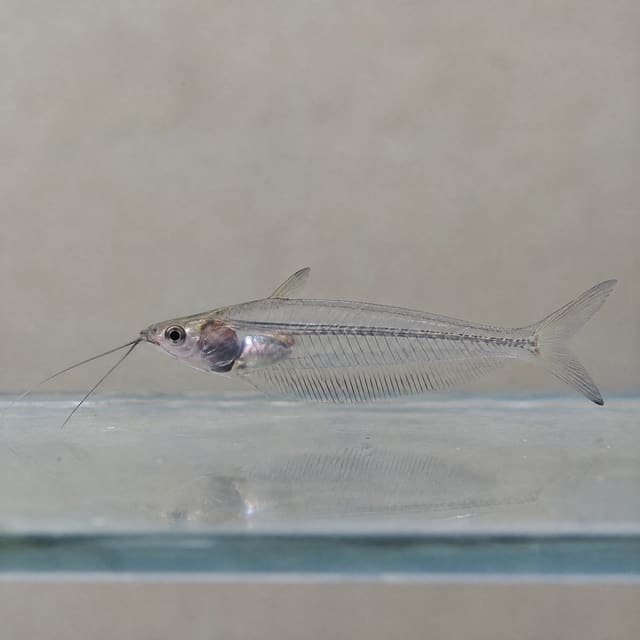
Glass Catfish (Kryptopterus bicirrhis)
22–26°C · pH 6–7 · 100L
£9.29
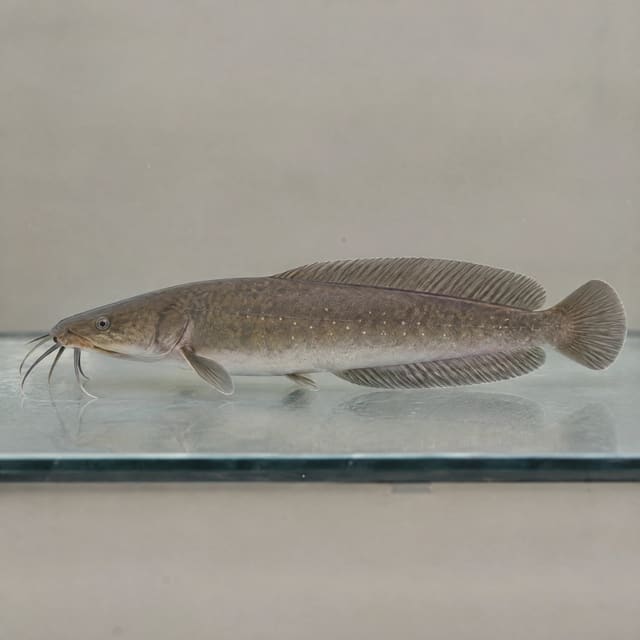
Mystus wyckii, now Hemibagrus wyckii and known as the crystal-eyed catfish, is a large Southeast Asian river catfish that reaches about 71 cm standard length and can live for decades. It is an aggressive lone predator that must be kept on its own in a very large, heavily filtered system. Sold individually as one young fish.
Hemibagrus wyckii
Mystus wyckii, now Hemibagrus wyckii and known as the crystal-eyed catfish, is a large Southeast Asian river catfish that reaches about 71 cm standard length and can live for decades. It is an aggressive lone predator that must be kept on its own in a very large, heavily filtered system. Sold individually as one young fish.
Read the full care guidance when planning conditions for your aquarium.
The Mystus wyckii is a large river catfish from Southeast Asia whose accepted scientific name is now Hemibagrus wyckii (Bleeker, 1858). It was first described as Bagrus wyckii and has also been listed as Macrones wyckii and Mystus wyckii, which is why the old name still appears on stock lists. In English it is usually called the crystal-eyed catfish, and Planet Catfish also records the names freshwater shark and, in Indonesia, baung jaksa. It belongs to the bagrid catfish family, Bagridae, the same family as the much smaller Mystus species kept in community aquariums.
Please read this page in full before you buy. Seriously Fish gives a maximum standard length of 710 mm, describes the species as aggressively territorial and notes that it can live for several decades. Its own advice is that juveniles are sometimes offered for sale but should not be bought, and that this is not a home aquarium fish except in exceptional circumstances. We list it only for experienced keepers who already run a very large, heavily filtered system and want one specimen kept on its own for life.
| Suits | Not suited to |
|---|---|
| An experienced keeper with a very large, mature aquarium or heated indoor pond | A first large-fish tank, or a system you plan to upgrade "later" |
| One fish kept alone as a single display animal | Any community aquarium, including one stocked with big fish |
| Oversized filtration and a fixed weekly water-change routine | A tank that is already close to its filtration limit |
| Secured rocks and wood, guarded heaters and a heavy cover | Loose décor, bare heaters or a lightweight lid |
| A commitment that may last for decades | A short-term or trial purchase |
If you are still deciding, browse our wider catfish and plecos range or the other catfish category, where you will find Asian and African catfish that stay far smaller.
Members of the genus Hemibagrus have a flattened head, a rough bony head shield that is not covered by skin, a slender bony point at the back of the skull and a moderately long adipose fin. Planet Catfish identifies H. wyckii in life by its crystal-blue eye and its long, low, sloping forehead. Seriously Fish adds that the tail is grey with cream-coloured main rays in both lobes, that the area just behind the gill cover is cream, and that the dorsal spine is strongly ossified, at least as thick as the soft dorsal rays, with 10–12 serrations along its rear edge.
The sources do not fully agree about the eye. Seriously Fish points out that the blue eye is not used as a distinguishing feature in any formal description it has seen, so treat it as a helpful field mark rather than proof of identity. Planet Catfish also warns that, because the scientific names are so similar, this species is sometimes confused with Hemibagrus wyckioides.
| Feature | Hemibagrus wyckii (this fish) | Hemibagrus wyckioides |
|---|---|---|
| Overall colour | Darker, with a cream patch behind the gill cover | A more grey colour (Planet Catfish) |
| Tail fin | Grey with cream main rays in both lobes | Red |
| Quickest check | Crystal-blue eye and long, low forehead (Planet Catfish) | The red tail fin |
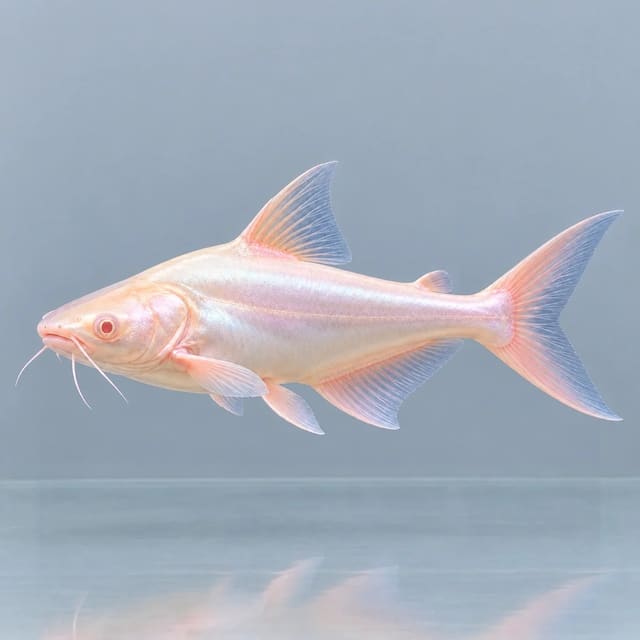
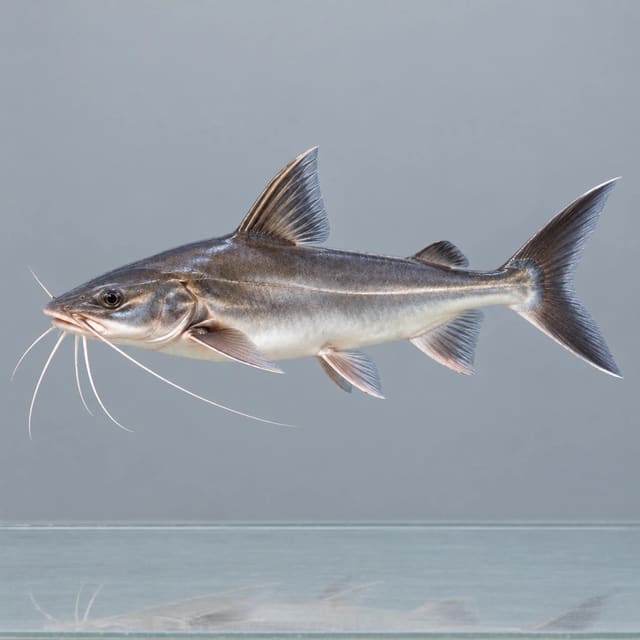
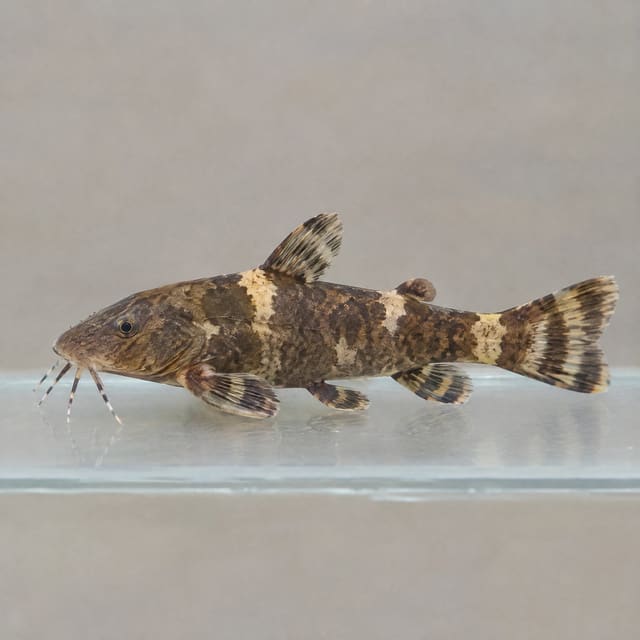
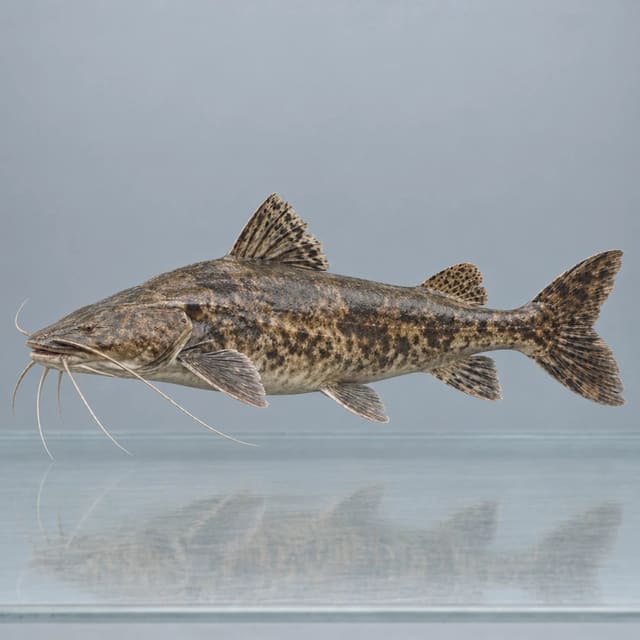
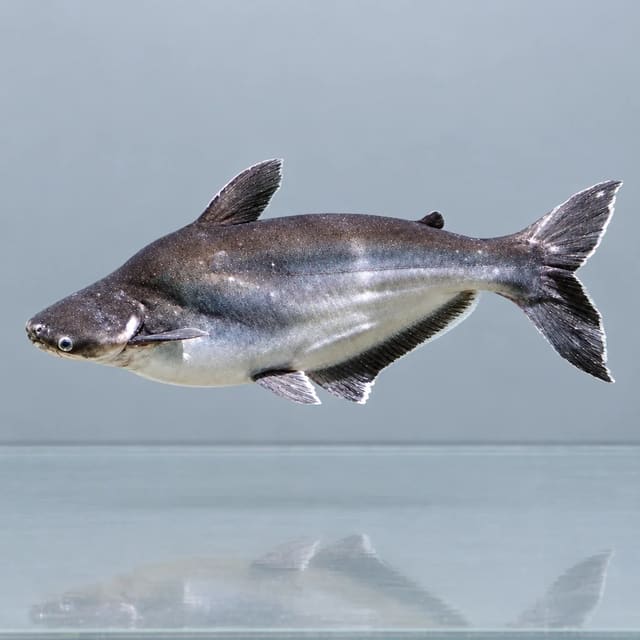
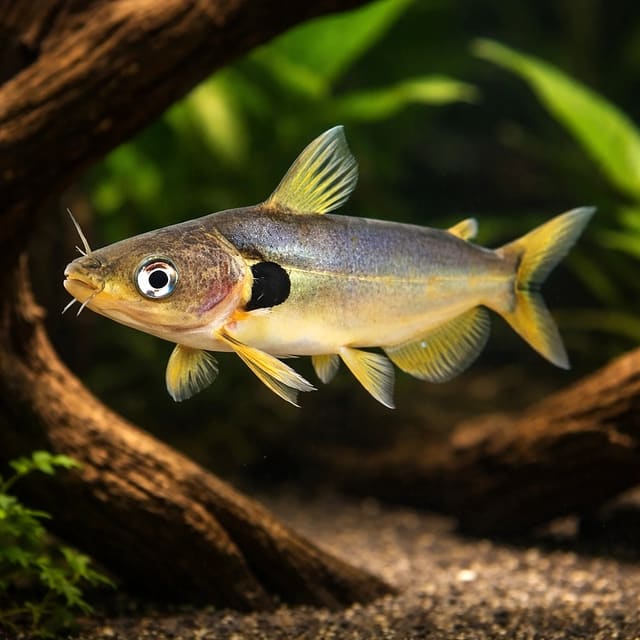
Our photographs show the species rather than the individual you will receive. The fish supplied will differ from the pictures in size, shade and markings.
One purchase supplies one live crystal-eyed catfish. It is sold as a growing young fish, far below adult size, and this listing has a single standard option without a size grade. Sex is not specified: Planet Catfish lists sexing as unknown and suggests only that females may be smaller and fuller-bodied.
The size you receive changes nothing about the commitment. Plan every part of the system, from tank length to filtration and the food budget, for an animal that Seriously Fish records at up to 710 mm standard length and FishBase at up to 90 cm total length.
Never release an aquarium fish into the wild. OATA points out that it is illegal, usually fatal for the fish, and that survivors can harm native wildlife. Large predatory catfish are also very hard to rehome, so the time to decide is before you order, not after the fish has outgrown its tank. Dispatch days and our Live Arrival Guarantee are explained on our delivery and Live Arrival Guarantee page.
Standard length is measured from the snout to the base of the tail, so the fish is longer again once the tail is included. Seriously Fish and Planet Catfish both give 710 mm standard length, and FishBase records 90 cm total length. Wild crystal-eyed catfish live in the middle reaches of moderate to large rivers, sometimes in rapids and turbulent water, and move into flooded forest during the wet season from July to October. This is a powerful river fish, not a sedentary bottom-sitter.
Seriously Fish's difficulty rating calls for a tank at least 2 m long and describes the species as suitable only for public displays or the largest home aquaria. OATA's care sheet for very large "tankbuster" fish says that such species often need an aquarium of more than 500 litres, that a heated indoor pond can be an alternative, and that the tank should be chosen for the adult size, not the juvenile size. Treat these as floors rather than targets: 2 m is the shortest length the source accepts, and an adult needs room to turn and patrol without striking the glass.
| Check | What the sources say |
|---|---|
| Adult length | 710 mm standard length (Seriously Fish, Planet Catfish); 90 cm total length (FishBase) |
| Aquarium length | At least 2 m (Seriously Fish), and better suited to public-display sized systems |
| Aquarium volume | Tankbuster species often need more than 500 litres (OATA) |
| Tank mates | None (Planet Catfish) |
| Lifespan | Several decades (Seriously Fish) |
Use our aquarium volume calculator to turn your tank's measurements into litres, then allow for the space taken by rock, wood and substrate. OATA notes that big fish bought small can live in a smaller tank at first, but that many grow very quickly, so the adult system should be planned and paid for from the day the young fish arrives.
Seriously Fish suggests that the species probably prefers dim lighting and refuges such as driftwood, large rocks or lengths of plastic piping. Planet Catfish recommends large rocks and driftwood "if anything at all", firmly secured in place, and says heater guards are necessary. It suggests external heating and filtration, and notes that large, sturdy plants will not be eaten but must also be fixed in place. A powerful fish of this size can move anything that is not anchored.
| Area | Purpose |
|---|---|
| One large refuge | A cave, wide pipe or overhang that the adult can enter completely |
| Open central lane | Room to swim the length of the tank and turn without hitting décor |
| Fixed rock and wood | Structure that cannot topple, roll or crack the glass |
| Guarded equipment | Heaters inside guards, or heating placed in an external filter or sump |
| Soft substrate | Sand or smooth fine gravel that will not damage the barbels |
OATA recommends sand or fine gravel for catfish because their barbels are sensitive, and a substrate without sharp edges for large bottom-dwelling fish. Keep the lighting subdued, or shade part of the tank with sturdy cover, and fit a heavy, fish-proof lid: OATA notes that large fish can be jumpy, especially in new surroundings.
The published ranges overlap well, and Planet Catfish describes the species as hardy, adding that water parameters are not vitally important to it. Stable temperature and very clean water matter far more than chasing an exact pH.
| Value | Seriously Fish | Planet Catfish | FishBase | Aim for |
|---|---|---|---|---|
| Temperature | 20–27°C | 22–25°C | 22–25°C | 22–25°C |
| pH | 6.0–8.0 | 6.4–7.6 | Not given | 6.4–7.6 |
| Hardness | 2–20 dGH | Not given | Not given | 2–20 dGH |
Temperature, pH and hardness describe the habitat. Ammonia, nitrite and nitrate describe waste. OATA's targets are zero mg/l of ammonia and nitrite, with nitrate no more than 20 mg/l above your tap water. A large carnivore produces a lot of waste, so test at least weekly and again after any change in feeding.
UK tap water ranges from soft to very hard depending on where you live, and supplies are treated with chlorine or chloramine. Treat every water change with a tap water conditioner, as OATA advises, and check your supply's hardness against the range above. Our water matcher tool compares your readings with a species' needs, and our aquarium water chemistry guide explains each test.
Seriously Fish describes a very large filter and a regular water-change routine as mandatory for this species. OATA's tankbuster guidance points to large aquarium filters, several filters working together or a pond filter to cope with the volume of solid waste, together with a partial water change of about 25% at least once a week and siphoning of waste from the substrate.
Work carefully. Seriously Fish notes that the crystal-eyed catfish appears unafraid of people, so keep your hands away from its mouth during maintenance, and remember the strong, serrated dorsal spine. OATA advises handling catfish with care because of their fin spines and double-bagging them for transport so the spines cannot puncture the bag.
In the wild this is a predator. Seriously Fish says it eats mainly crustaceans and smaller fishes, and FishBase lists insects, prawns and fishes. In the aquarium, Seriously Fish says smaller specimens accept live or frozen bloodworm, Tubifex and most dried foods, while adults take earthworms, prawns or shrimp, mussels, strips of white fish and larger sinking pellets. Young fish need a relatively high-protein diet, but adults need only one or two meals a week.
Planet Catfish advises against feeding live fish to young specimens, because the fish will eat far more as it grows and may become picky about other foods. Seriously Fish warns against mammal meat such as beef heart or chicken, which fish cannot metabolise properly and which can cause fat deposits and organ damage over time.
| Stage | Foods | Portion and frequency |
|---|---|---|
| Young fish | Frozen bloodworm, small frozen seafood and quality sinking pellets or granules | Small, protein-rich meals that are finished within a few minutes |
| Growing fish | Larger pellets, prawns, mussel and strips of white fish | Fewer, larger meals as it grows |
| Adult | Earthworms, prawns, mussels, white fish strips and large sinking pellets | One or two meals a week (Seriously Fish) |
A large sinking food such as Tropical Krill Gran XXL sinking granules makes a convenient staple alongside frozen seafood. Remove anything left over after the meal. OATA warns that uneaten food breaks down and releases toxic waste, and with a large carnivore that happens quickly.
Only add the fish to a fully established system with zero ammonia and nitrite. OATA advises taking fish home quickly because they are easily stressed, acclimatising them with the floating-bag method, or by slowly adding tank water if they arrive in a box or bucket, and monitoring water quality closely during the first week.
| When | Check | Action |
|---|---|---|
| Arrival | Temperature in the bag and the tank | Float and acclimatise with the tank lights off |
| Day 1 | The fish has found its refuge | Keep the room quiet and leave it to settle |
| Days 2–3 | Ammonia and nitrite | Offer a small meal and remove anything not eaten |
| Days 4–7 | Water tests and behaviour | Make a partial water change if ammonia or nitrite rises |
Expect a newly arrived fish to hide at first. Keep the cover in place at all times, avoid moving décor while it settles and keep a written log of food, test results and behaviour from day one.
Both main sources are blunt about tank mates. Seriously Fish describes the species as aggressively territorial and incompatible with other fishes except in the largest public installations, where it may still attack them, and says it is fine kept alone. Planet Catfish calls it a lone predator that will try to dismantle any living thing too large to swallow whole, and lists its suggested tank mates simply as "none".
| Suits | Avoid |
|---|---|
| One fish kept on its own for life | Any fish small enough to be swallowed |
| A dedicated tank, pond or sump-filtered system | Larger fish, which it may still attack (Seriously Fish) |
| Keepers who enjoy a single, bold display fish | Other catfish or bottom-dwellers competing for its refuge |
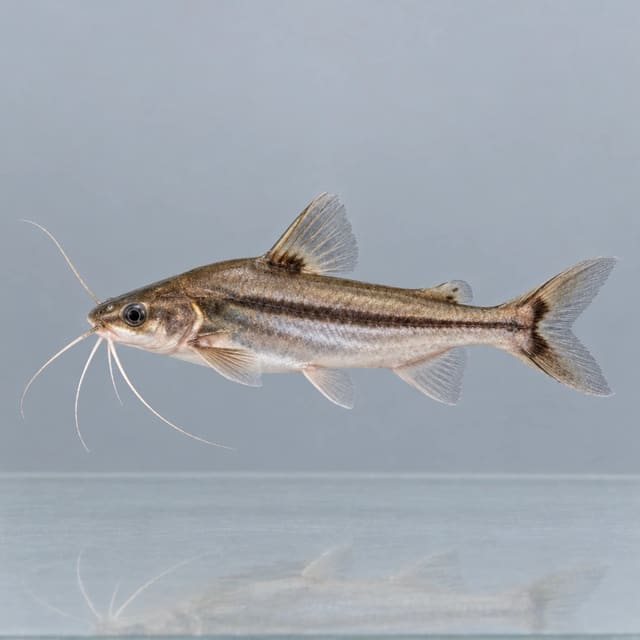
If you would like a bagrid catfish for a community aquarium instead, look at the smaller species in our Mystus catfish category, such as the Pyjama Catfish (Mystus vittatus), or at the Asian Bumblebee Catfish, and check each listing's adult size and temperament before you buy. If a true monster fish is what you want, the Red-Tailed Catfish needs the same scale of planning, and more unusual species are in our rare and collector fish section.
Most problems in large predatory fish begin with water quality, injury from décor or an unsuitable diet. Because changes are easy to miss in a fish that spends much of its time in a refuge, compare each week's notes with the last.
| You notice | Check first | Action |
|---|---|---|
| Refusing food for several days | Ammonia, nitrite and temperature | Correct the water, then offer a different food such as prawn or mussel |
| Rapid breathing or hanging near the surface | Ammonia and surface movement | Change water and increase surface agitation |
| Grazes, split fins or damaged barbels | Décor edges and substrate | Remove sharp items and keep the water very clean while it heals |
| Swollen body or sluggishness after meals | Portion size and food type | Return to adult rations of one or two meals a week; never feed mammal meat |
| Lunging at hands during maintenance | Your routine | Feed with long tongs and keep hands clear of the mouth |
If a problem does not improve once the water is right, ask an aquatic vet or an experienced large-fish keeper for advice before you add any medication, and dose any treatment for the true water volume of the system.
Breeding has not been recorded in aquariums. Seriously Fish lists reproduction and sexual differences as unknown, and Planet Catfish says breeding is unreported in the home aquarium and that the species probably lays huge numbers of eggs. Do not buy this fish with breeding in mind.
The species ranges across the Mekong and Chao Phraya drainages of Laos, Vietnam, Cambodia and Thailand, the Pahang river of Peninsular Malaysia, and rivers on Sumatra, Java and Borneo; the type specimens came from the Citarum river in Java. FishBase records it in large rivers with fast-flowing water over muddy beds, notes that it is sold fresh in local markets, and lists it as Least Concern on the IUCN Red List (assessed 2019). Seriously Fish says it can live for several decades, which, after its adult length, is the most important number on this page.
Yes. Mystus wyckii is an older name. The accepted scientific name is Hemibagrus wyckii (Bleeker, 1858), and the usual English name is the crystal-eyed catfish.
Seriously Fish and Planet Catfish give a maximum of 710 mm standard length, measured without the tail, and FishBase records up to 90 cm total length. Plan for a fish of roughly that size, whatever size arrives.
Seriously Fish calls for a tank at least 2 m long and describes the species as suitable only for public displays or the largest home aquaria. OATA notes that tankbuster species often need more than 500 litres. Treat both as minimums.
No. Seriously Fish describes it as aggressively territorial, even towards fish in very large public tanks, and Planet Catfish lists no suitable tank mates. Keep it on its own.
Young fish take frozen bloodworm and most dried and sinking foods. Adults take earthworms, prawns, mussels, strips of white fish and large sinking pellets, and need only one or two meals a week. Avoid live feeder fish and mammal meat such as beef heart.
Aim for 22 to 25°C, pH 6.4 to 7.6 and 2 to 20 dGH, where the published ranges overlap. Keep ammonia and nitrite at zero and nitrate no more than 20 mg/l above your tap water.
Seriously Fish says it can live for several decades, so buying one is a very long commitment.
No aquarium breeding has been recorded, and the sexes cannot be reliably told apart, so do not plan on breeding it.
No reviews for this item yet. Bought one? Honest reviews only, good or bad.
What customers say about ordering from us
Easy website plenty of info on fish your buying great to pick a time slot
TRACEY DURRANT · 7 Oct 2026
Got some lovely fish thank you
Kevin Mackie · 7 Oct 2026
Reviews of our shop, collected by Judge.me, an independent third-party review collector. Newest first.
Moved by UK carriers licensed to handle live animals
Hand-packed with oxygen bags, poly box, heat pack
Email photos the same day; an optional unboxing video helps us review problems faster — claim terms apply
Klarna & PayPal Pay in 3 at checkout