Advanced
Fire Eel (Mastacembelus erythrotaenia)
24–28°C · pH 6.5–7.5 · 500L
£33.99
The Unicolor Spiny Eel (Mastacembelus unicolor) is a rare, plain brown to olive spiny eel from Indonesia, closely related to the Fire Eel but without the red markings. It grows to about 55–60 cm and needs a covered aquarium with a base of 120 × 60 cm, soft sand, caves and meaty foods. Sold singly: one live eel per purchase.
Adult size is the maximum length this species reaches at full maturity (scientific sources). The livestock you receive will be younger and smaller. Product-photo provenance and any image-specific limitations are stated on the listing.
Mastacembelus unicolor
The Unicolor Spiny Eel (Mastacembelus unicolor) is a rare, plain brown to olive spiny eel from Indonesia, closely related to the Fire Eel but without the red markings. It grows to about 55–60 cm and needs a covered aquarium with a base of 120 × 60 cm, soft sand, caves and meaty foods. Sold singly: one live eel per purchase.
Adult size is the maximum length this species reaches at full maturity (scientific sources). The livestock you receive will be younger and smaller. Product-photo provenance and any image-specific limitations are stated on the listing.
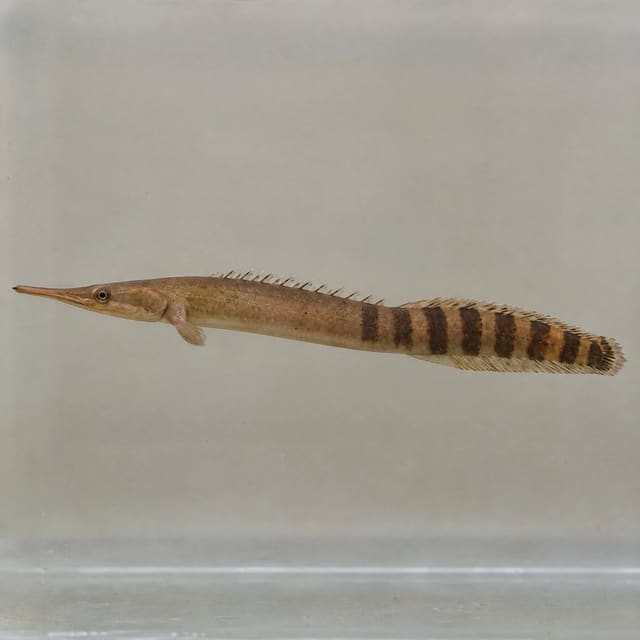
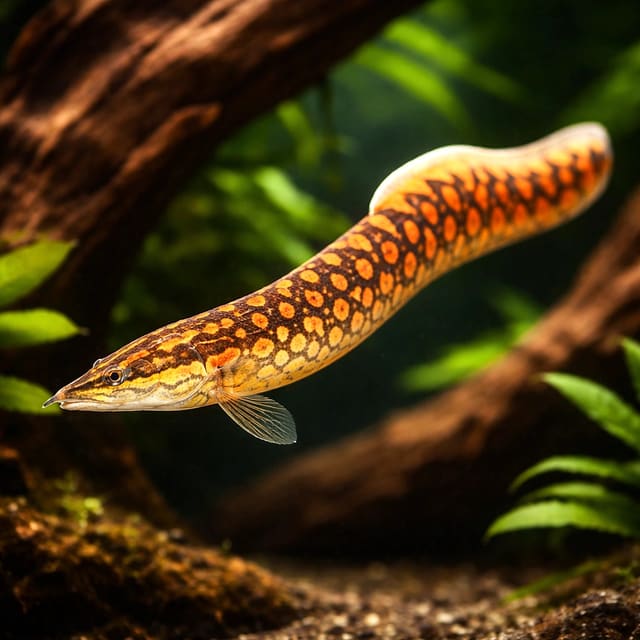
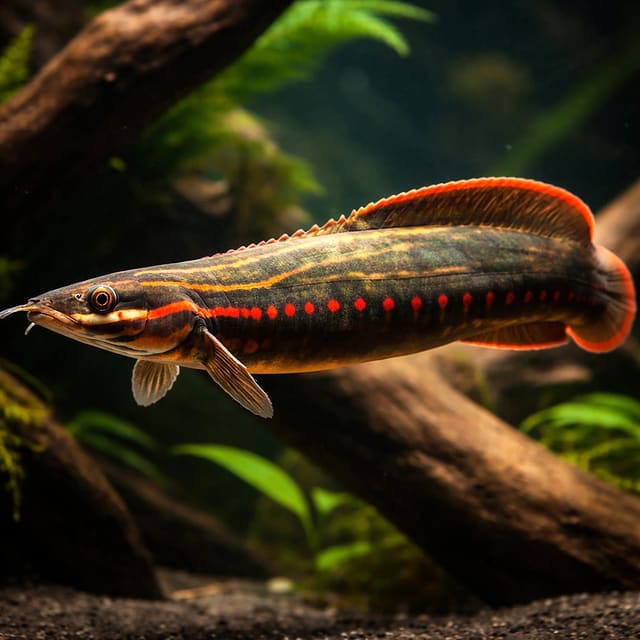
The Unicolor Spiny Eel (Mastacembelus unicolor) is a large, long-bodied spiny eel from Indonesia and neighbouring parts of South-East Asia. It belongs to the family Mastacembelidae, the same family as the Fire Eel and the Tyre-Track Eel, and shares their pointed, fleshy snout, the row of small separate spines along the back and the long soft dorsal and anal fins that run into the tail. Where the Fire Eel is striped with red, this fish is an even brown to dark olive, which is where the name unicolor, "one colour", comes from.
It is a true oddball for a large, quiet aquarium: nocturnal, partly buried in sand by day and increasingly confident at feeding time once it settles. Despite the name, spiny eels are not true eels but a separate group of freshwater fish. FishBase lists the species as harmless to people, and Seriously Fish describes the dorsal spines of its close relatives as harmless to humans too.
| Feature | What to look for |
|---|---|
| Colour | Plain brown to olive with faint darker mottling; no red stripes or spots |
| Fin edge | A pale to white seam along the dorsal, tail and anal fins, which develops from about 20 cm |
| Pectoral fin | An unusual stripe running over the small, rounded pectoral fin |
| Juveniles | Two colour phases are recorded in young fish: reddish and blackish-brown |
| Snout and back | Long, pointed snout and a row of short, separate spines in front of the soft dorsal fin |
Aquarium Glaser, which has imported the species several times, describes it as looking very much like a Fire Eel without the red, and notes that its first unicolor were sent by mistake as M. erythrotaenia. Ralf Britz of the Natural History Museum in London identified those fish as most probably M. unicolor, "or what is currently thought to be that species", so the scientific picture may still change. The species was first collected in western Java by the naturalists Kuhl and van Hasselt in the early 1820s and later described by Cuvier from their material.
Browse our Mastacembelus spiny eels to compare it with the Fire Eel, the Zig-zag Spiny Eel and the Zebra Spiny Eel, or see all our spiny eels and other loaches and oddball fish.
One purchase supplies one live Unicolor Spiny Eel. The listing has a single option rather than graded sizes, and this species reaches the trade at very different sizes: Aquarium Glaser reports juveniles of 10–20 cm, a younger fish of 20–25 cm and adults of 50–60 cm. If the size at dispatch matters for your setup, ask us before ordering and we will tell you what is currently available.
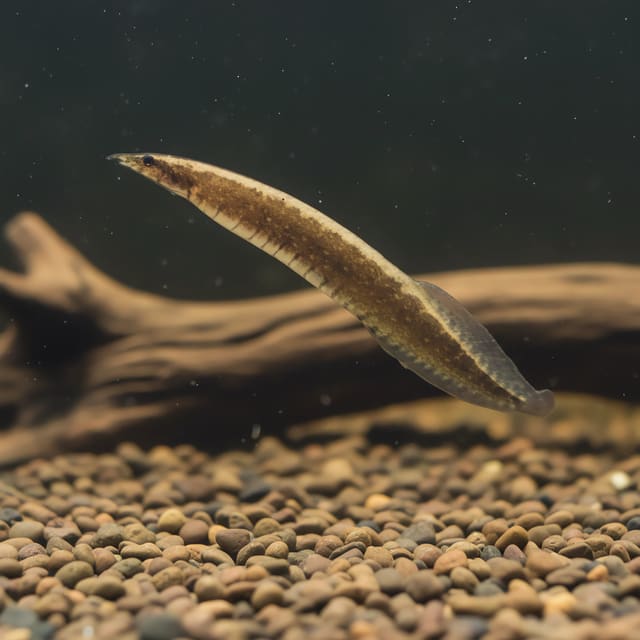
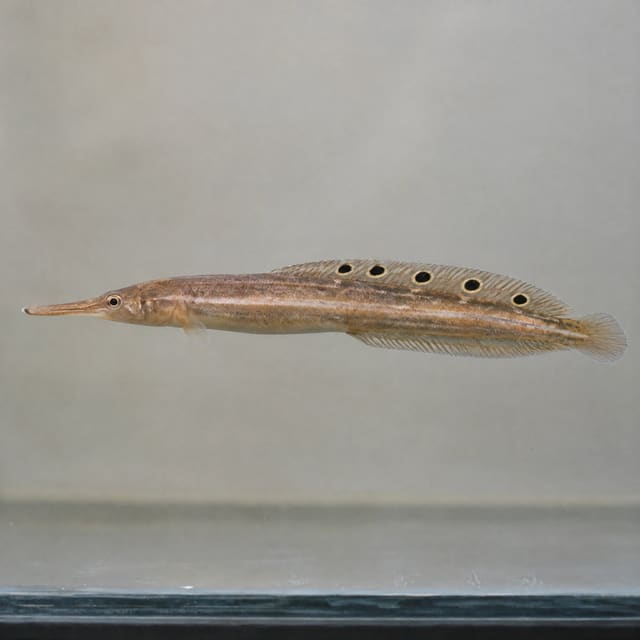
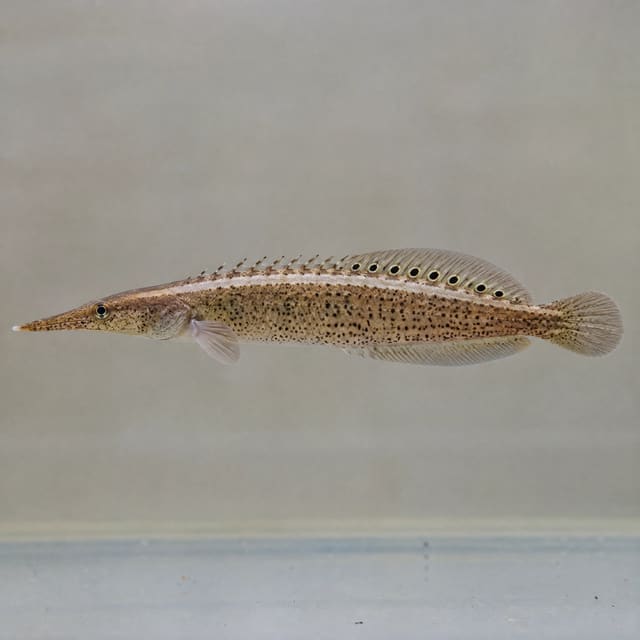
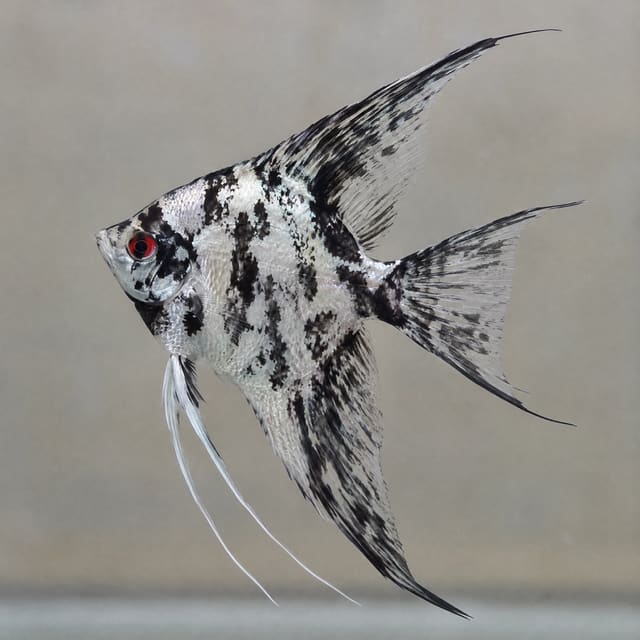
The photographs are illustrations prepared from a reference image of the species. They show the body form and plain colouring, not the individual you will receive. Young fish can be noticeably redder or darker than adults, and the pale fin edge may be missing in fish below about 20 cm.
Read our delivery and Live Arrival Guarantee information before you buy, and make sure the aquarium is fully matured before the eel arrives.
The sources agree that this is a big fish. FishBase records a maximum of 55 cm total length, and Aquarium Glaser describes the species as reaching around 60 cm. Plan the aquarium for a fish of 55–60 cm, not for the size it arrives at.
No species-specific aquarium profile exists for M. unicolor, so the tank size here comes from its closest well-documented relatives. Seriously Fish gives the same minimum for the Fire Eel and the Tyre-Track Eel: a base of 120 × 60 cm, about 432 litres, and notes that juveniles can start in a smaller tank. Both of those species can grow larger than the unicolor, so that footprint gives a 55–60 cm eel room to stretch, turn and patrol.
| Measurement | Minimum | Why it matters |
|---|---|---|
| Length | 120 cm | Lets an adult turn without folding against the glass |
| Front to back | 60 cm | The eel lives on the floor, so floor area counts more than height |
| Volume | About 432 litres | Dilutes the waste of a large meat-eater |
| Cover | Tight lid with no gaps | Spiny eels are escape artists |
Use our tank volume calculator to check the real capacity of your aquarium, remembering that sand, rock and wood displace water. A juvenile can be grown on in a smaller, well-filtered tank, but only if the larger aquarium is a firm plan rather than a hope.
OATA's guidance on very large fish applies here: plan for the adult size from the start, because many big fish grow quickly, and only take one on if you can look after it for its whole life. Never release an aquarium fish into the wild; OATA points out that this is illegal and usually ends badly for the animal.
Spiny eels spend the day buried or hidden. Seriously Fish recommends sand for large Mastacembelus because they often bury themselves, and the Maidenhead Aquatics fish database describes the Fire Eel spending the day partly buried with only its snout showing. Practical Fishkeeping accepts smooth gravel as an alternative for the Tyre-Track Eel, but fine, rounded sand is what lets a spiny eel burrow properly.
| Area | Purpose |
|---|---|
| Open sand along the front | Burrowing and feeding ground you can see at night |
| Smooth rock caves or wide PVC pipe | Daytime refuges the eel can fit its whole body into |
| Bogwood roots | Shade, broken sight lines and extra hiding places |
| Floating plants | Dim the light so the eel comes out more often |
Seriously Fish lists bogwood, rock caves and PVC piping as hiding places and recommends dimmer lighting to encourage the fish to emerge. Maidenhead Aquatics adds two practical points: set heavy decor on the glass base before you add the sand, because large spiny eels can undermine it, and fit a timed blue moonlight that comes on just before the main lights go off, so you can watch the eel's night-time activity.
Because large spiny eels dig, plants tied to wood and floating plants tend to last better than plants rooted in the sand. Leave the front of the tank open so you can see the eel feed.
Seriously Fish says a close-fitting hood is essential because spiny eels can find their way through the smallest of gaps. Maidenhead advises tight cover slides with no openings where equipment enters the tank, and suggests plugging holes with oversized pieces of filter sponge. Practical Fishkeeping makes the same point: spiny eels often try to escape. Check the lid again after every maintenance session.
FishBase records the species as a tropical freshwater fish, mainly from upland streams and also found in lakes during the dry season, but it gives no water values. The ranges below come from the Seriously Fish profiles of the Fire Eel and Tyre-Track Eel and from Maidenhead Aquatics. They overlap well, so a stable mid-range setting suits this fish.
| Reading | Target | Source note |
|---|---|---|
| Temperature | 24–28°C | Seriously Fish and Maidenhead Aquatics agree |
| pH | 6.0–7.0 | Seriously Fish; Maidenhead accepts up to 7.5 |
| General hardness | 5–12 dGH | Seriously Fish; Maidenhead accepts up to 18 dH |
| Ammonia and nitrite | 0 mg/l | OATA |
| Nitrate | No more than 20 mg/l above your tap water | OATA |
UK tap water ranges from soft to very hard depending on where you live, so check your water company's report for your postcode, then test the aquarium itself. If your water is on the hard side, Maidenhead's upper limit of 18 dH and Practical Fishkeeping's note that the Tyre-Track Eel adapts to harder water show that the genus is adaptable; a steady reading matters more than a perfect one. Our water matcher compares your readings with the range, and the water chemistry guide explains each value.
A 55–60 cm eel eating prawn, mussel and krill produces a lot of waste. For the Fire Eel, Seriously Fish suggests filtration that turns the tank volume over four to five times an hour, with fairly gentle flow because the species lives mainly in still water. For a 432-litre aquarium that is roughly 1,730–2,160 litres per hour, which Seriously Fish meets with two external filters rather than one.
Protect the heater with a guard, or run it in a sump or external unit, so a resting eel cannot lie against it; OATA advises protecting heaters in large-fish tanks. Our guide to aquarium filtration covers sizing filters for big fish, and the nitrogen cycle guide explains why the tank must be mature before the eel arrives.
Seriously Fish describes wild Fire Eels as omnivores that eat smaller fish, aquatic invertebrates, some plant matter and detritus. In the aquarium, large Mastacembelus do best on meaty foods: Seriously Fish lists prawn, krill and lancefish, and warns that small live and frozen foods alone are unlikely to sustain larger fish. Practical Fishkeeping adds that bigger spiny eels appreciate earthworms and that some take sinking tablet foods. Maidenhead notes that dried foods are rarely accepted, so do not rely on flake or pellets.
| Food | When to use it |
|---|---|
| Frozen bloodworm and mysis | Settling in, and for smaller juveniles |
| Krill, chopped prawn and mussel | Regular staple for a growing fish |
| Lancefish or smelt | Larger fish, as part of the weekly rotation |
| Earthworms | A treat, and a trigger for shy or newly arrived feeders |
Feed once a day, as OATA recommends for large fish, in the evening just after the main lights go off. At first, place the food close to where the eel hides. Offer what it finishes within a few minutes and siphon out anything left the next morning, because uneaten meaty food quickly fouls the water.
Our frozen mussel meat, large frozen krill and live earthworms cover the main foods. Thaw frozen food in a little tank water first.
This species reaches the trade as imports from Indonesia. OATA notes that wild-caught fish can be less tolerant of water outside their normal range, may need live or fresh food before they reliably take prepared diets, and should be acclimatised with care and patience.
Our step-by-step acclimatisation guide covers the method in more detail, including the slower drip method for sensitive fish.
| Checkpoint | What to do |
|---|---|
| Day 1 | Lights off, no food, lid closed |
| Day 2 | A small evening portion of bloodworm or mysis near its refuge |
| Days 3–7 | Note whether food disappears overnight and where the eel rests |
| End of week | Test ammonia, nitrite and nitrate and do the usual water change |
Do not worry if you barely see it at first; a new spiny eel can hide for days. What matters is that food disappears overnight and the body stays full. If it ignores frozen food after several days, try a live earthworm or live bloodworm, as OATA suggests for wild-caught fish.
OATA lists warning signs that apply to every fish: hanging at the surface or lying abnormally, colour changes, faster or slower gill movement, white spots or fluffy growths, damaged fins, weight loss and reduced feeding. In a spiny eel, pay particular attention to the skin, which is in constant contact with the sand, and to the belly, which shows whether it is eating.
| If you see | Do this |
|---|---|
| Thin body or sunken belly | Feed at night near its refuge and check tank mates are not taking the food |
| Scratches or red marks on the skin | Check the substrate and decor for rough edges, then test the water |
| White spots or fluffy patches | Test the water first, then ask for advice before you medicate |
| Repeated climbing at the surface or the glass | Test the water at once and check the lid |
| Food untouched for several nights | Test the water, then offer live food such as earthworms |
Before using any treatment, read the label for warnings about eels or sensitive species and correct the water first. When you contact us, share the tank size, temperature, pH, ammonia, nitrite and nitrate readings and what you have seen.
Seriously Fish calls its large relatives generally peaceful but warns that tank mates must be too large to be prey, and recommends one per tank because they may be aggressive to their own kind; groups of five or more sometimes spread the aggression, but only in a very large aquarium with many refuges. Maidenhead adds that adult Fire Eels will eat small fish overnight. The same rules apply to a 55–60 cm unicolor.
| Suits | Avoid |
|---|---|
| Severums and other calm, medium to large cichlids | Tetras, rasboras and small livebearers |
| Geophagus eartheaters | Shrimps and small catfish |
| Larger peaceful loaches in a big enough tank | A second spiny eel in a standard-size tank |
| Knifefish where space allows | Fast, greedy feeders that leave nothing for a night feeder |
Maidenhead's suggested companions for the Fire Eel are large gouramis, larger peaceful botiid loaches, knifefish, Geophagus and severums. From our range, the Severum, the Surinam Geophagus and a group of Clown Loaches fit that list, provided the tank is large enough for every adult. Check a plan with our tank mates tool and stocking calculator before you buy, and see more oddball spiny eels if you want to compare species.
Spiny eels are hard to sex. Maidenhead says mature female Fire Eels in breeding condition may look plumper, and that breeding in home aquariums is rare; Seriously Fish describes the few Fire Eel spawnings as accidental. There are no published aquarium breeding reports for M. unicolor, so buy it as a single display fish rather than as a breeding project.
It is Mastacembelus unicolor, a large freshwater spiny eel (family Mastacembelidae) from Indonesia and neighbouring parts of South-East Asia. It looks much like a Fire Eel without the red: an even brown to olive body, a long pointed snout and a pale edge to the fins in larger fish.
Plan for 55–60 cm. FishBase records a maximum of 55 cm total length and Aquarium Glaser describes the species as reaching around 60 cm.
A base of at least 120 × 60 cm, about 432 litres, which is what Seriously Fish gives for its close relatives the Fire Eel and Tyre-Track Eel. A juvenile can be grown on in a smaller, mature tank while the large aquarium is prepared.
Spiny eels are not true eels; they are a separate family of freshwater fish. FishBase lists the species as harmless, and Seriously Fish describes the dorsal spines of its relatives as harmless to humans. Move it with a soft net or a container, as for any large fish.
Meaty foods: frozen krill, prawn, mussel, mysis and bloodworm, with lancefish or smelt and earthworms for larger fish. Dried foods are rarely accepted. Feed once a day, in the evening, and remove leftovers.
Usually not. Seriously Fish advises one per tank because large Mastacembelus may be aggressive to their own kind; groups of five or more sometimes work, but only in a very large aquarium with many refuges.
Peaceful fish too big to swallow, such as severums, Geophagus eartheaters and larger loaches in a tank big enough for all of them. Avoid small fish, shrimps and anything that can fit in its mouth, because large spiny eels hunt at night.
One purchase supplies one live eel. The listing has one option rather than graded sizes, and imports of this species range from juveniles to adults, so ask us before ordering if you need to know the current size.
No reviews for this item yet. Bought one? Honest reviews only, good or bad.
What customers say about ordering from us
Easy website plenty of info on fish your buying great to pick a time slot
TRACEY DURRANT · 7 Oct 2026
Got some lovely fish thank you
Kevin Mackie · 7 Oct 2026
Reviews of our shop, collected by Judge.me, an independent third-party review collector. Newest first.
Moved by UK carriers licensed to handle live animals
Hand-packed with oxygen bags, poly box, heat pack
Email photos the same day; an optional unboxing video helps us review problems faster — claim terms apply
Klarna & PayPal Pay in 3 at checkout