Moderate
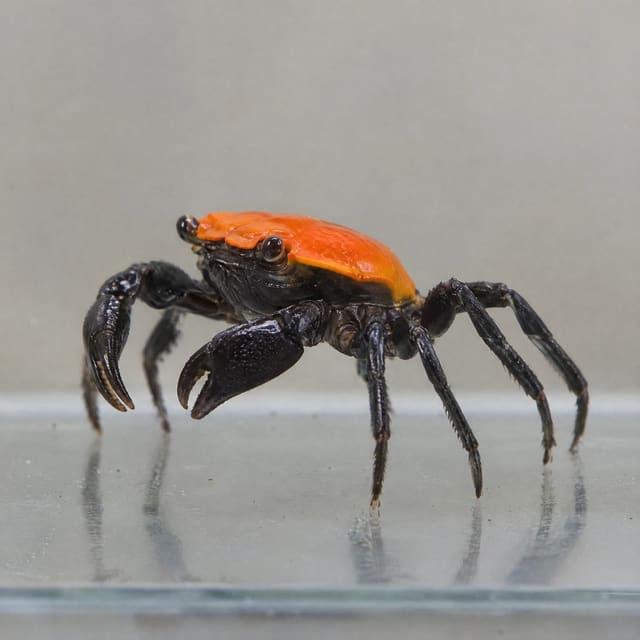
Red Batik Vampire Crab (Geosesarma sp.)
22–28°C · pH 7.5–8 · 40L
£16.99
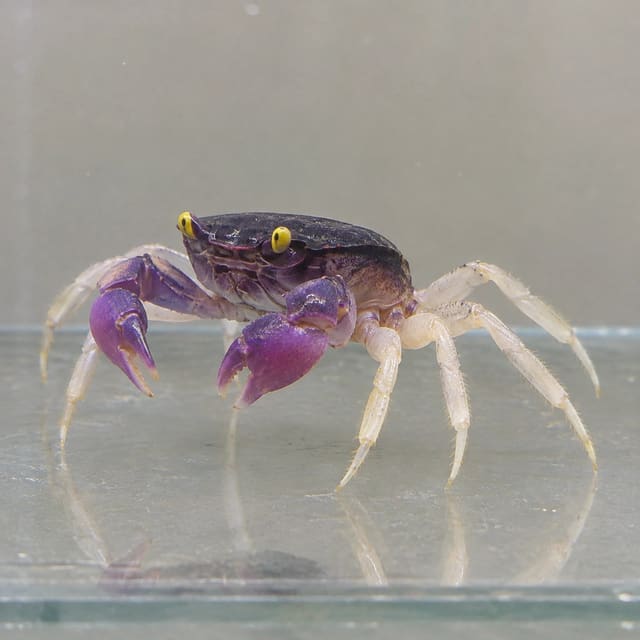
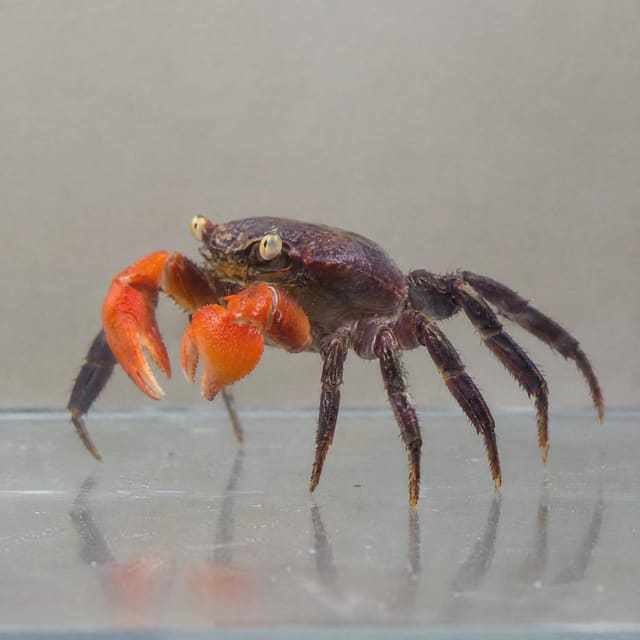
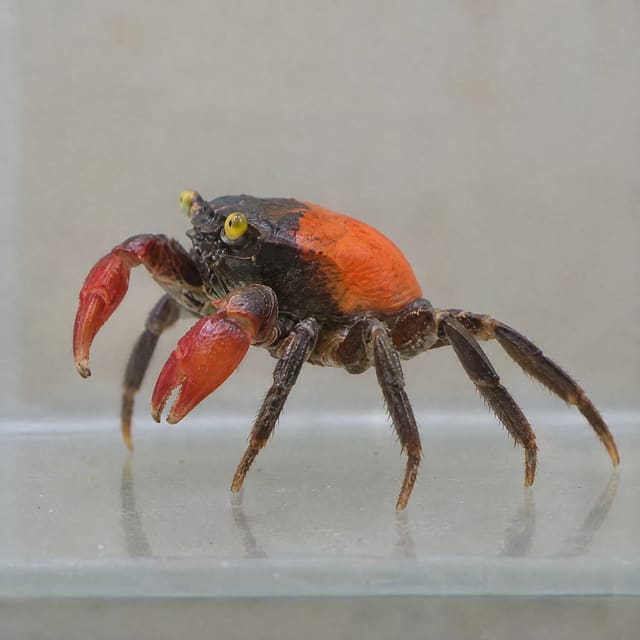
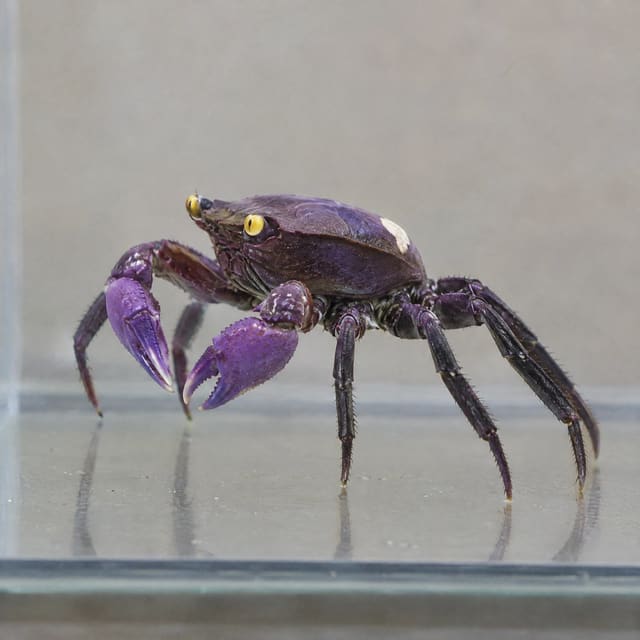
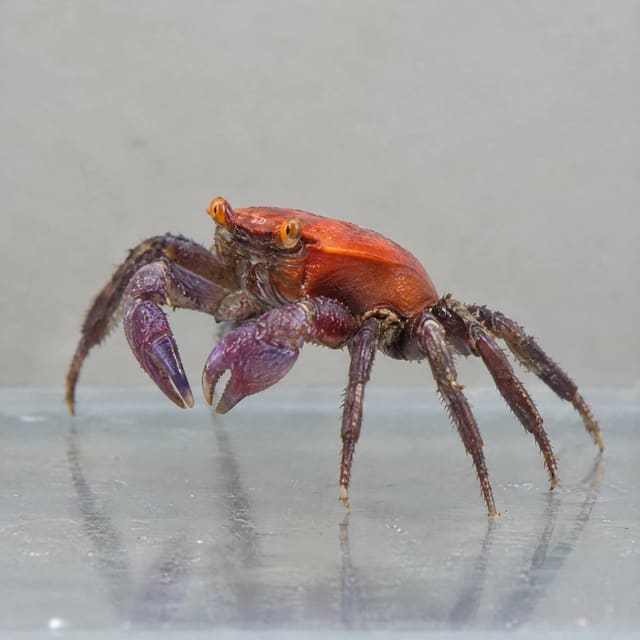
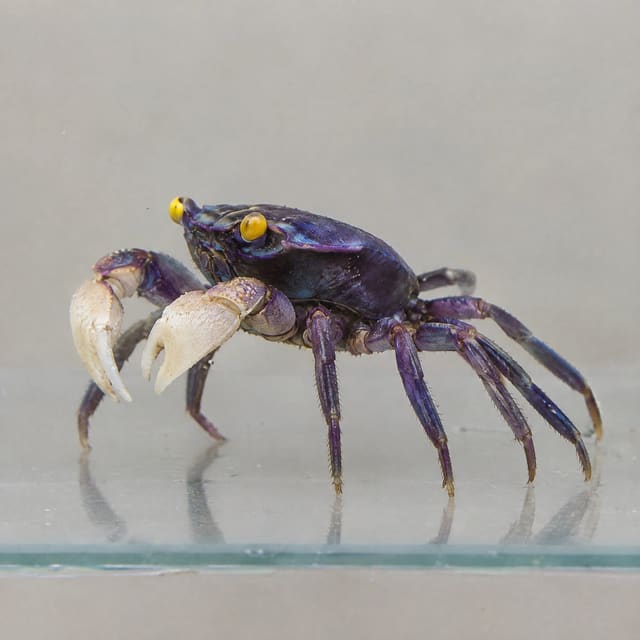
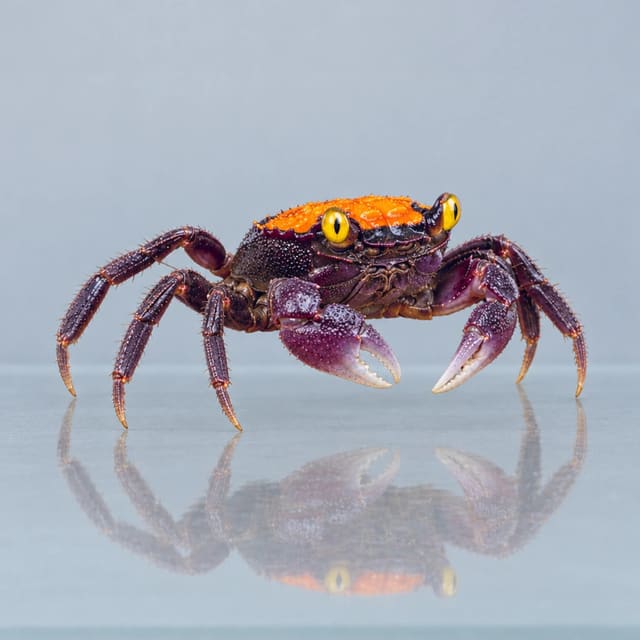
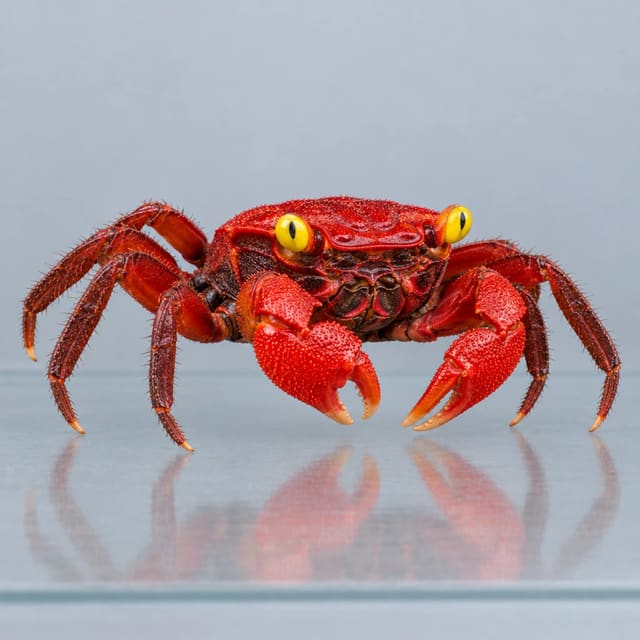
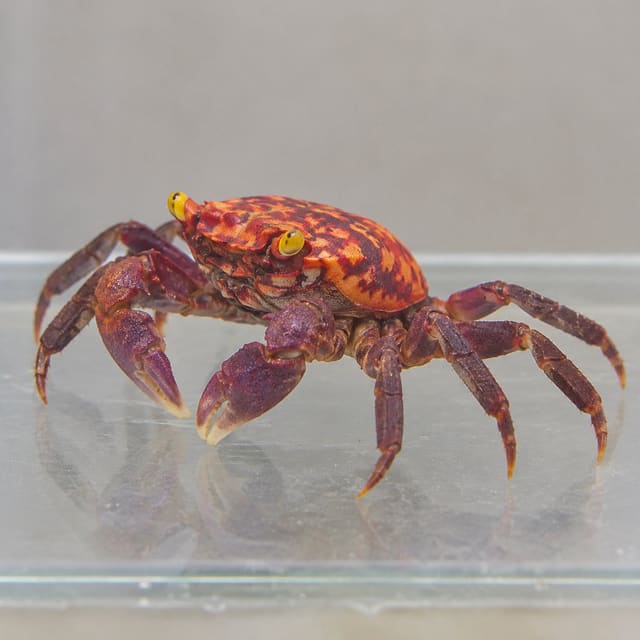
The Rainbow Vampire Crab is a tiny land-living Geosesarma crab with a purple shell, orange-red sides, purple claws and glowing yellow eyes. It lives mostly on moist land, so keep it in a humid paludarium of at least 60 litres with about two-thirds land, a shallow freshwater pool at 22–27°C and a lid that seals. Sold individually as one live crab.
Geosesarma sp. (trade form "Rainbow"; species not identified)
The Rainbow Vampire Crab is a tiny land-living Geosesarma crab with a purple shell, orange-red sides, purple claws and glowing yellow eyes. It lives mostly on moist land, so keep it in a humid paludarium of at least 60 litres with about two-thirds land, a shallow freshwater pool at 22–27°C and a lid that seals. Sold individually as one live crab.
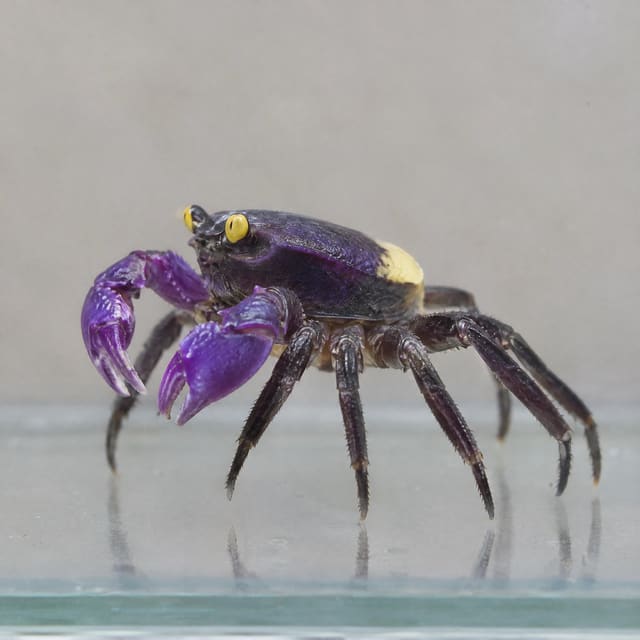
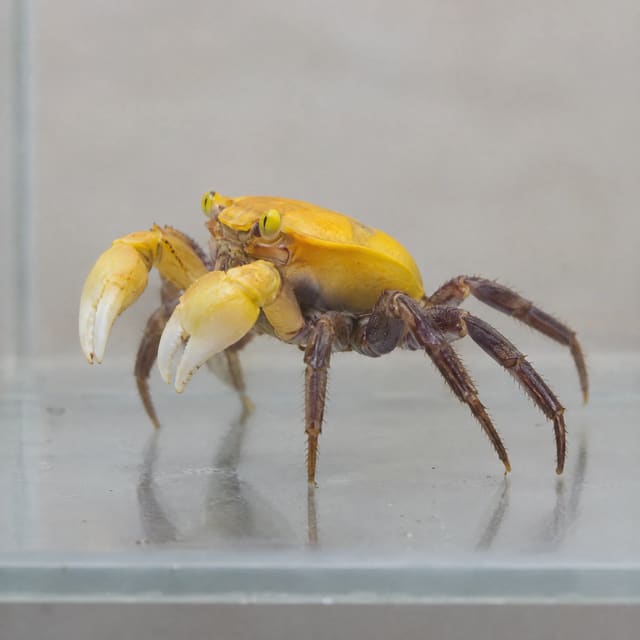
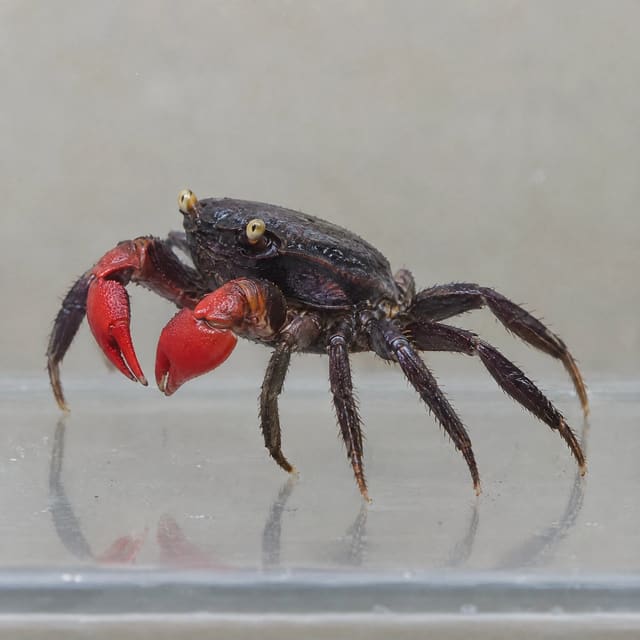
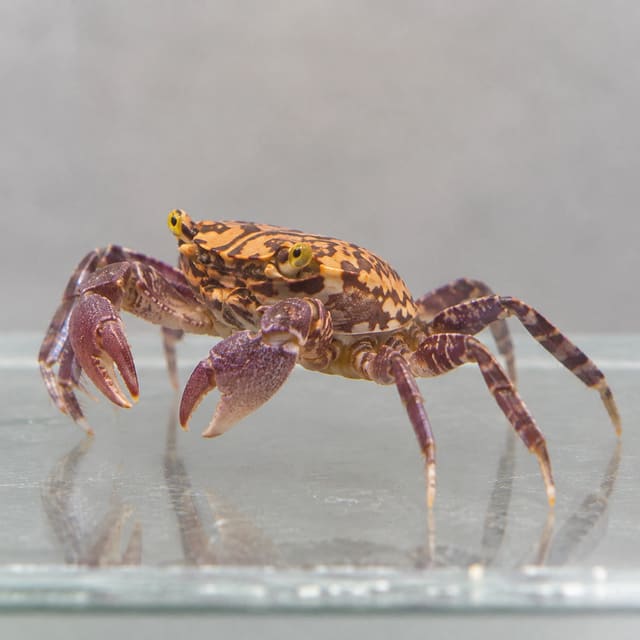
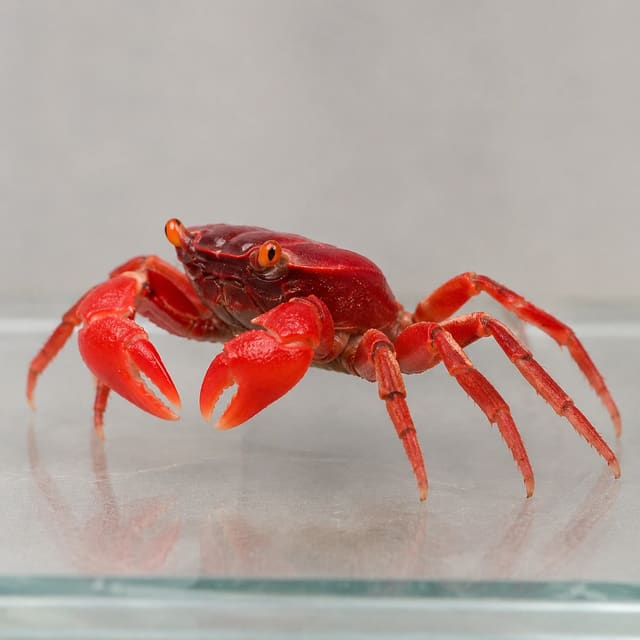
The Rainbow Vampire Crab is a tiny, brightly coloured crab of the genus Geosesarma, one of the land-living "vampire crabs" that have become favourites for planted paludariums. Our photographs show why it earns the name: a deep purple shell that turns orange-red along the front and sides, purple claws, dark purple legs and large, glowing yellow eyes. It spends most of its life on damp ground among moss, roots and leaf litter, and comes down to the water to drink, moult and forage.
Vampire crabs are not aquatic animals. In the peer-reviewed description of the two best-known trade species, Peter Ng, Christoph Schubart and Christian Lukhaup found the adults living on moist banks and valley slopes near small streams in central Java, hiding under rocks and in dense vegetation and sometimes digging burrows at the water's edge, while the juveniles stayed close to the waterline. A Rainbow Vampire Crab therefore needs a paludarium with plenty of land, a shallow pool of fresh water, high humidity and a lid that seals.
| Name | What it means |
|---|---|
| Rainbow Vampire Crab | The trade name for this colour form: purple, orange and yellow-eyed |
| Geosesarma sp. | The genus is clear, but the species behind this trade name has not been identified; "sp." says exactly that |
| Geosesarma De Man, 1892 | A large genus of terrestrial crabs from Southeast Asia, family Sesarmidae (WoRMS); the 2015 paper brought it to 53 species |
| Vampire crab | A popular name for the colourful Geosesarma sold in the trade, after their "spooky" colours and glowing yellow eyes |
Vampire crabs were kept by hobbyists for years before anyone knew what they were. Dealers variously claimed they came from Sulawesi, Java, Krakatau or the Riau Islands, until the 2015 paper described the two most common trade forms, the cream-and-violet Geosesarma dennerle and the dark-brown-and-orange Geosesarma hagen, and showed that both are native to central Java. Practical Fishkeeping reported that the two species were named after the aquatic companies that supported the expedition. Many other colour forms, including this one, are still sold without a species name.
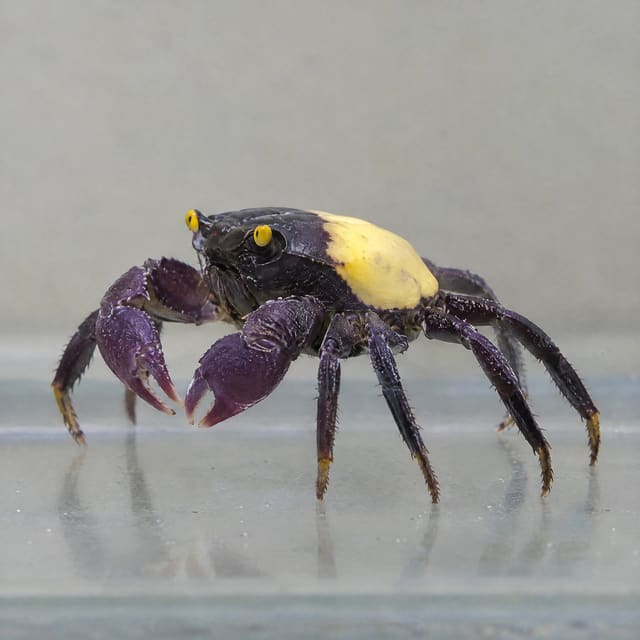
The Rainbow Vampire Crab is easy to confuse with the Purple Vampire Crab, Geosesarma dennerle. The scientific description of G. dennerle records a violet-purple to purplish-brown front half, a cream to yellowish-white rear half, bright purple claws and bright yellow eyes. The Rainbow form is sold separately, with orange on the shell rather than cream. A colour name alone cannot prove a species, so keep the two in separate enclosures rather than assuming they will mix or interbreed.
OATA explains that crabs are easy to sex by the flap folded under the body: narrow and pointed in males, much wider in females. The Fishkeeper profile adds that males typically have larger claws and can be territorial, and recommends one male with several females unless the enclosure is very spacious. To build a group, buy several crabs, sex them on arrival and be ready to move extra males to a second enclosure.
Vampire crabs are small. In the 2015 description, adult shells of the two Javan species measured roughly 1.1–1.5 cm across. Hobby sources quote larger figures: Practical Fishkeeping gives a body length of 2–3 cm and the Fishkeeper profile a maximum of 3 cm. Because our Rainbow form is not identified to species, expect a crab within that range. Small does not mean a small enclosure, though: these crabs use the whole floor, climb roots and need separate hiding places. OATA recommends at least 60 litres for a small group of crabs and a tank as long and wide as possible.
The Fishkeeper profile describes the natural habitat as rocky caves and small burrows on valley slopes beside a stream, with shallow, warm water and roots and plants to climb. Recreate that: a sloping bank of sand or soil with roots, terrestrial or marginal plants and rocky caves; a shallow pool deep enough for the crab to submerge fully when it moults; and Java moss growing both in and out of the water to give cover and easy routes between land and pool. OATA adds that the land should be built from sloped rocks, pebbles and gravel capped with sand, with live plants, roots and caves.
| Zone | What to build | Why it matters |
|---|---|---|
| Land | About two-thirds of the floor: damp, well-drained soil or sand with leaf litter | Adults live mainly on moist ground |
| Cover | Rocky caves, cork, roots and dense plants | Wild crabs hide under rocks and in vegetation |
| Moss bridge | Java moss growing from the water up onto the land | Shelter and an easy path in and out of the water |
| Pool | Shallow, filtered, heated fresh water, deep enough to submerge in | Drinking, moulting and a nursery area for young crabs |
| Air | Humid, but not stagnant | Practical Fishkeeping stresses high humidity |
Practical Fishkeeping describes vampire crabs as kept in high humidity, and the Fishkeeper profile notes that they bask in humid air. A close-fitting lid, damp moss and a moist land surface keep humidity up; a small ventilated gap covered with fine mesh stops the air going stale. Our vampire crab buying guide explains how to balance humidity and ventilation, and why condensation on the glass is not a reliable measurement. A simple hygrometer on the land area tells you much more.
Vampire crabs climb everything. OATA warns that crabs are very good at escaping and that a secure lid must be fitted with every hole blocked, and the Fishkeeper profile calls vampire crabs great escape artists and says a tight-fitting lid is essential. Because a Rainbow Vampire Crab is so small, gaps that look harmless are wide enough for it, and once out it soon dries out.
Vampire crabs live by fresh water, and the sources agree closely on temperature. Practical Fishkeeping and the Fishkeeper profile both give 22–28°C, and OATA gives 22–27°C for crabs in the trade. The Fishkeeper profile describes their water as hard and alkaline, while OATA's general crab values are slightly softer.
| Value | Fishkeeper (vampire crab) | Practical Fishkeeping | OATA (crabs) | Our working range |
|---|---|---|---|---|
| Temperature | 22–28°C | 22–28°C | 22–27°C | 22–27°C |
| pH | 7.5–8.5 | Not given | 7.0–8.0 | 7.5–8.0 |
| General hardness | 10–25 dH | Not given | 8–18 dGH | 10–18 dGH |
| Humidity | Humid air | High | Not given | High, with some ventilation |
| Ammonia and nitrite | Not given | Not given | Zero | Zero |
| Nitrate | Kept low | Not given | No more than 20 mg/l above tap water | No more than 20 mg/l above tap water |
Much of the UK has hard, alkaline tap water that suits vampire crabs well, but supplies range from soft to very hard by region, so test pH, GH and KH first. Treat all water, including water for misting, with a tap water conditioner. Our water parameter matcher compares your readings with the crab's needs, and the water chemistry guide explains the terms. Remember that a heater in the pool warms the water, not necessarily the land, so check the temperature on the land as well.
A small pool turns toxic fast if the filter is not mature, so cycle it before the crabs arrive; our guide to the nitrogen cycle explains how. Put a sponge over any filter intake so a small crab cannot be trapped.
Vampire crabs are omnivores with a strong appetite for animal food. In the wild, the 2015 description found that their diet consists mainly of small insects on the ground, such as grasshoppers, and probably also midge larvae and plant detritus. Practical Fishkeeping notes that meaty prey makes up much of the diet: the crabs accept dry food, freeze-dried foods, earthworms and springtails, hunt live house crickets, and at night graze on mosses and algae. The Fishkeeper profile adds bloodworm, mysis shrimp, finely chopped krill or prawn, vegetable matter, fish pellets, algae wafers and specialist crab foods.
OATA advises feeding crabs once a day and leaving food for about 30 minutes before removing what is left. Vampire crabs are crepuscular and nocturnal (Practical Fishkeeping), so feed at dusk, when they come out. Place tiny portions on the land near each hide so that a subordinate crab does not have to cross a male's territory. A live springtail colony on the land, such as our springtail culture, gives the crabs something to hunt between meals and helps clear mould and leftovers.
Check that ammonia and nitrite read zero and that temperature and humidity are stable before the crabs arrive. Use OATA's floating-bag method: switch off the lights, float the closed bag in the pool for 10 minutes, then add small amounts of tank water to the bag over at least 30 minutes. Release the crab at the edge of the pool, next to moss or cover, with as little bag water as possible, so it can walk straight onto land. Our acclimatisation guide explains the method in detail.
| When | What to check | What to do |
|---|---|---|
| Day 1 | The crab has found cover | Lights low, lid closed, leave it alone |
| Days 2–3 | Feeding at dusk | Tiny portions near its hide; remove leftovers after 30 minutes |
| Days 1–7 | Pool water and humidity | Test more often than usual; OATA advises close monitoring in the first week |
| Day 7 | Sex and territories | Sex the crabs; separate males that fight constantly |
The Fishkeeper profile rates vampire crabs as non-community and says they are best kept in a species-only tank. They will hunt small fish, and slow bottom-dwelling fish should be avoided; some keepers have kept them with small, fast, peaceful fish. OATA's general advice for crabs is to keep them in a dedicated set-up because they are opportunistic hunters. Our own buying guide adds that different vampire crab forms are best kept apart, because a shared colour is not proof of the same species.
| Suits | Avoid |
|---|---|
| A group of Rainbow Vampire Crabs: one male with several females | Several males in a small enclosure |
| Springtails living in the land area | Shrimp and small or slow fish |
| Dense moss, plants and roots | Other vampire crab colour forms or species |
| A humid enclosure with a sealed lid | A fully aquatic tank without land |
Our tank mate checker is useful if you are still thinking of adding anything else. If you would like a different colour, keep it in its own enclosure: compare the Red Devil Vampire Crab, G. hagen, the Violet Vampire Crab and our Vampire Crab Colour Mix, or see all our Geosesarma vampire crabs, the wider crayfish and crabs category and our shrimps and crustaceans.
Crabs grow by moulting, and the Fishkeeper profile notes that vampire crabs need water deep enough to submerge completely while they moult, and rocky caves to hide in afterwards. OATA warns that the shed skin can look like a dead crab, so look closely before removing anything. A newly moulted crab is soft and defenceless for some days; leave it alone and make sure other crabs cannot corner it. All crabs are very sensitive to copper, so use only treatments labelled safe for invertebrates (OATA).
| What you see | What to do |
|---|---|
| A crab sitting in the water all the time | Check the land temperature and humidity; it may be too dry or too cold on land |
| Less activity, restlessness or unusual behaviour | Test the pool water first |
| Colour fading or darkening | Check water quality, humidity and stress from other crabs |
| Trouble moulting or a partly shed shell | Review hardness, humidity and diet; keep the crab undisturbed |
| Refusing food, losing weight or swelling | Test the water and ask us for advice |
Unlike many crabs, vampire crabs have been bred in home enclosures. The Fishkeeper profile explains that the female carries her eggs under her abdomen for several weeks and that there is no larval stage: miniature crabs hatch directly, stay in or near the water at first and become more terrestrial as they grow. The 2015 description recorded a female carrying eyed eggs about 1.5 mm across. Practical Fishkeeping reports that females carry eggs about every six months and that about 50–60 young hatch from each clutch.
The wild juveniles in the 2015 study stayed close to the waterline, so give young crabs a shallow edge, dense moss and plenty of tiny food such as springtails and crushed pellets. Young crabs are small and vulnerable to adults, so a separate rearing tank improves survival. Keep only one colour form in a breeding enclosure so you know what you are raising. OATA notes that smaller crabs often live only a couple of years, so breeding is the best way to keep a colony going.
It is a small land-living crab of the genus Geosesarma (family Sesarmidae) sold under the trade name Rainbow Vampire Crab. Our photographs show a purple shell with orange-red sides and front, purple claws, dark purple legs and bright yellow eyes. The species behind this trade name has not been identified, so we list it as Geosesarma sp.
Not as far as anyone can show. The scientific description of G. dennerle records a violet front half, a cream to yellowish-white rear half and bright purple claws. The Rainbow Vampire Crab is sold as a separate colour form with orange on the shell, and a colour name alone does not establish a species. Keep the two in separate set-ups.
Mainly land. The scientists who described the Javan vampire crabs found adults living on moist banks and slopes, under rocks and in dense vegetation, with juveniles near the waterline. The Fishkeeper profile recommends about two-thirds land and one-third water, with the water deep enough for the crab to submerge fully when it moults.
Practical Fishkeeping and the Fishkeeper profile give 22–28°C, and OATA gives 22–27°C for crabs in the trade, so 22–27°C suits all of them. Use clean, dechlorinated fresh water; Fishkeeper gives pH 7.5–8.5 and 10–25 dH, OATA pH 7.0–8.0 and 8–18 dGH, so aim for pH 7.5–8.0 and 10–18 dGH. Keep the air humid.
Small. Adult shells of the two described Javan vampire crabs measured about 1.1–1.5 cm across in the scientific description. Hobby sources give larger figures, 2–3 cm body length in Practical Fishkeeping and up to 3 cm in the Fishkeeper profile. Our crab is an unidentified trade form, so expect a crab in that range.
Males can be territorial, so the Fishkeeper profile suggests one male with several females unless the enclosure is very spacious. Sex your crabs on arrival by the flap under the body (narrow in males, wide in females) and give each crab its own hiding place.
They are best kept on their own. The Fishkeeper profile rates them as non-community and says they will hunt small fish, and the scientific description found wild crabs feeding on insects on the ground. Shrimp and small or slow fish are at risk.
Yes, they have been bred in home enclosures. The Fishkeeper profile explains that the female carries her eggs for several weeks and miniature crabs hatch directly, with no larval stage. Practical Fishkeeping reports clutches of about 50–60 young, roughly every six months. Give the young shallow water, moss and cover.
No reviews for this item yet. Bought one? Honest reviews only, good or bad.
What customers say about ordering from us
Easy website plenty of info on fish your buying great to pick a time slot
TRACEY DURRANT · 7 Oct 2026
Got some lovely fish thank you
Kevin Mackie · 7 Oct 2026
Reviews of our shop, collected by Judge.me, an independent third-party review collector. Newest first.
Moved by UK carriers licensed to handle live animals
Hand-packed with oxygen bags, poly box, heat pack
Email photos the same day; an optional unboxing video helps us review problems faster — claim terms apply
Klarna & PayPal Pay in 3 at checkout