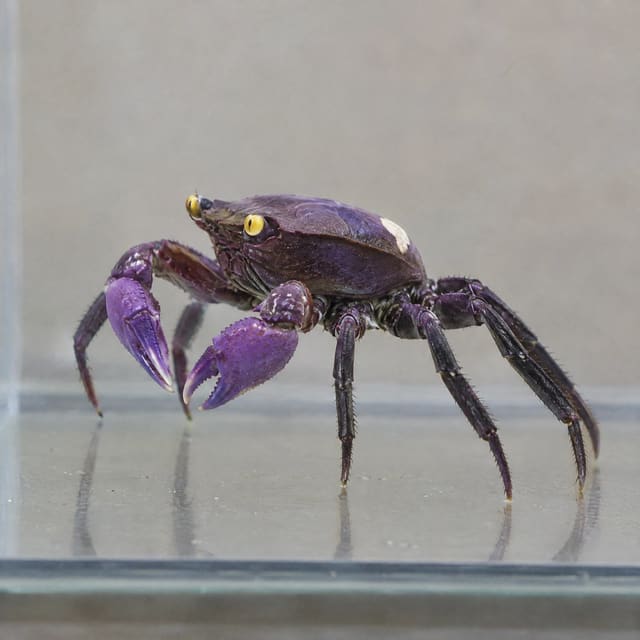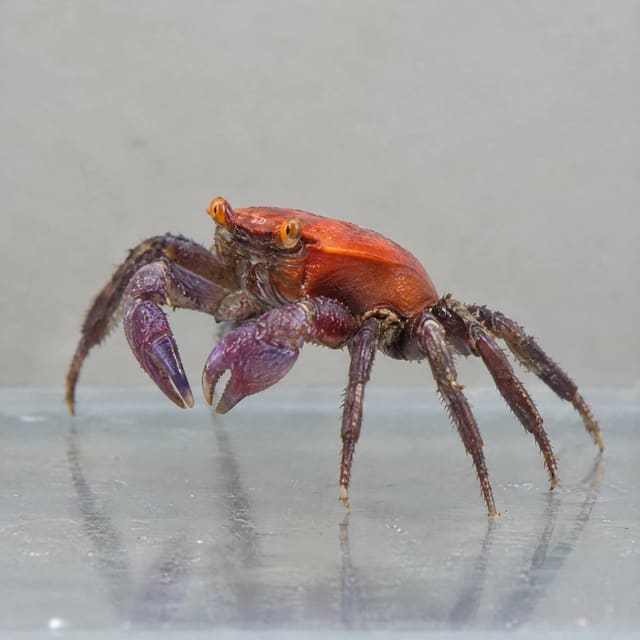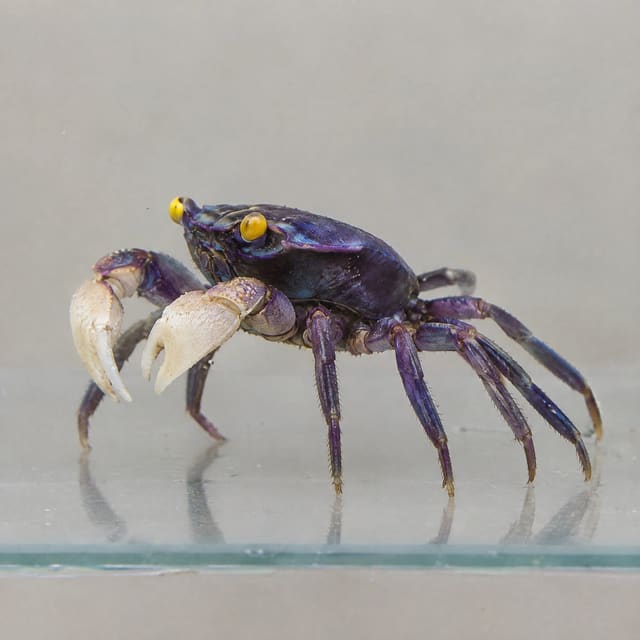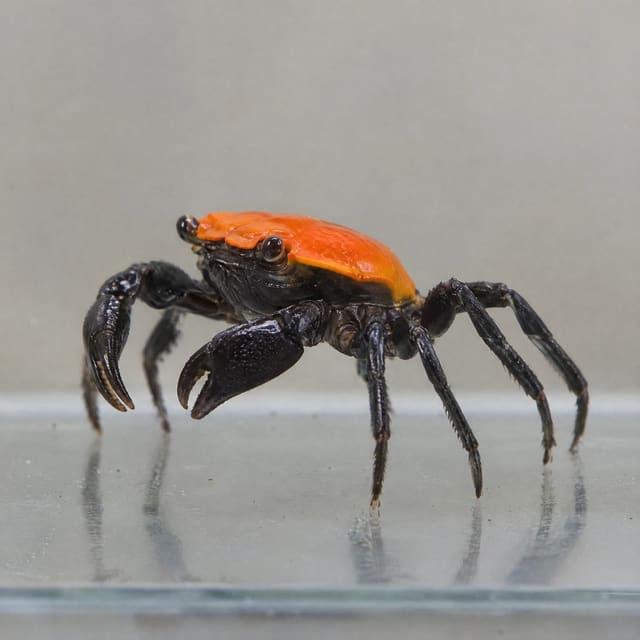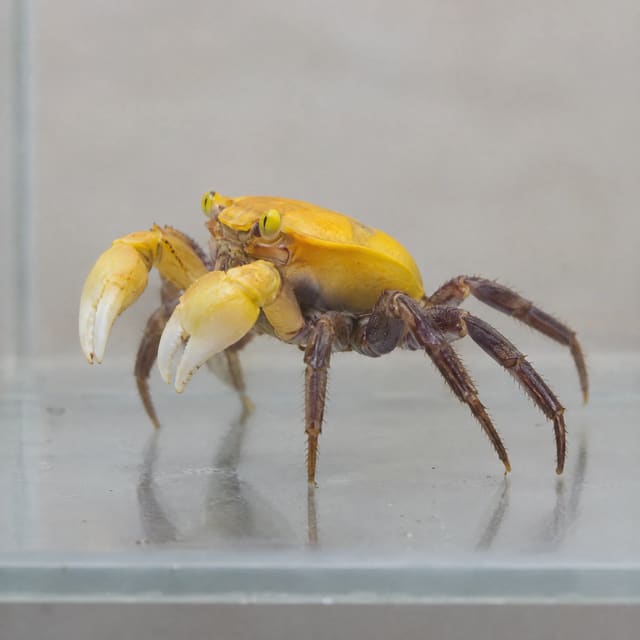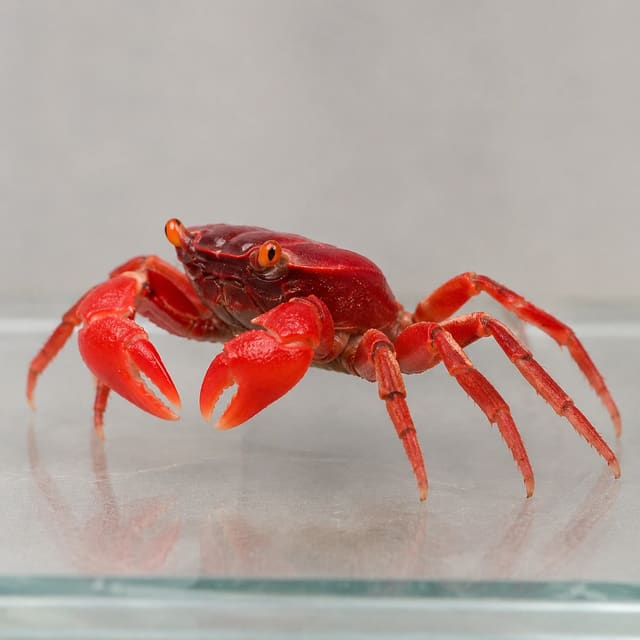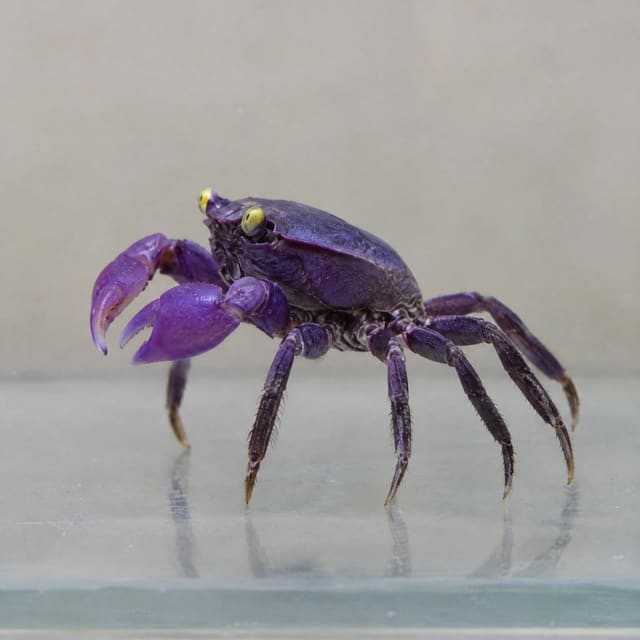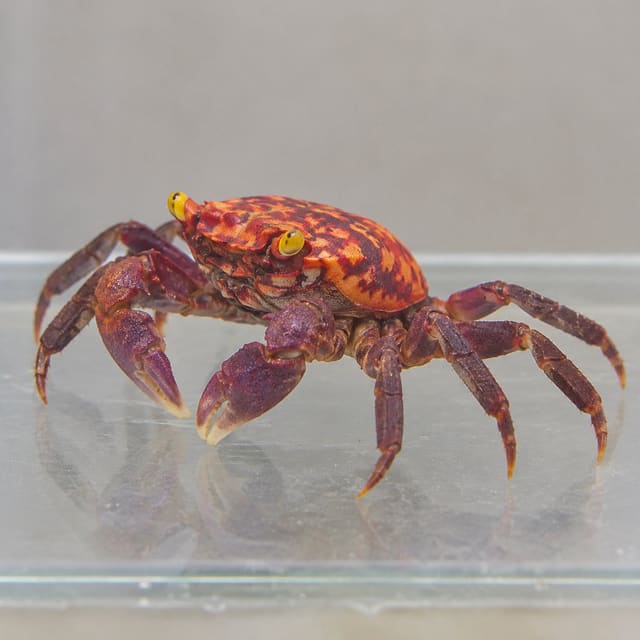
Red Devil Vampire Crab (Geosesarma hagen)
£9.99
The Scarlet Vampire Crab is a tiny Geosesarma land crab coloured scarlet from shell to legs, with bright yellow eyes. It lives mostly on moist ground, so give it a humid paludarium of at least 60 litres with about two-thirds land, a shallow freshwater pool at 22–27°C, plenty of hides and a lid that seals. Sold individually as one live crab.
Geosesarma sp. (trade form "Scarlet"; species not identified)
The Scarlet Vampire Crab is a tiny Geosesarma land crab coloured scarlet from shell to legs, with bright yellow eyes. It lives mostly on moist ground, so give it a humid paludarium of at least 60 litres with about two-thirds land, a shallow freshwater pool at 22–27°C, plenty of hides and a lid that seals. Sold individually as one live crab.
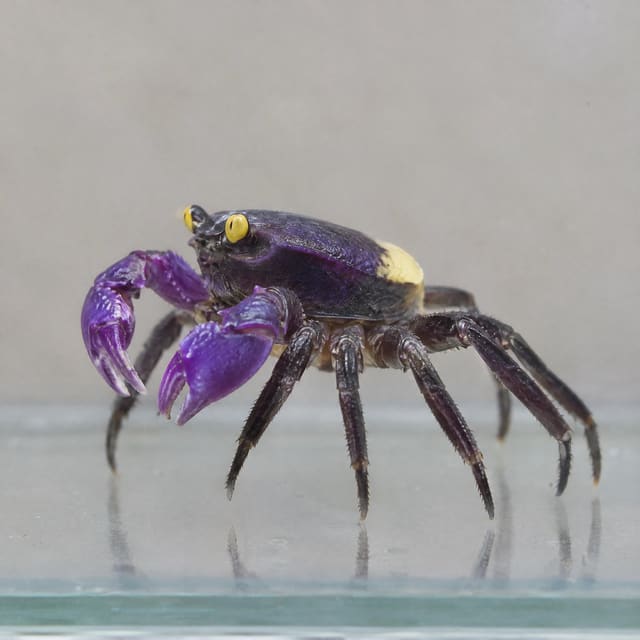
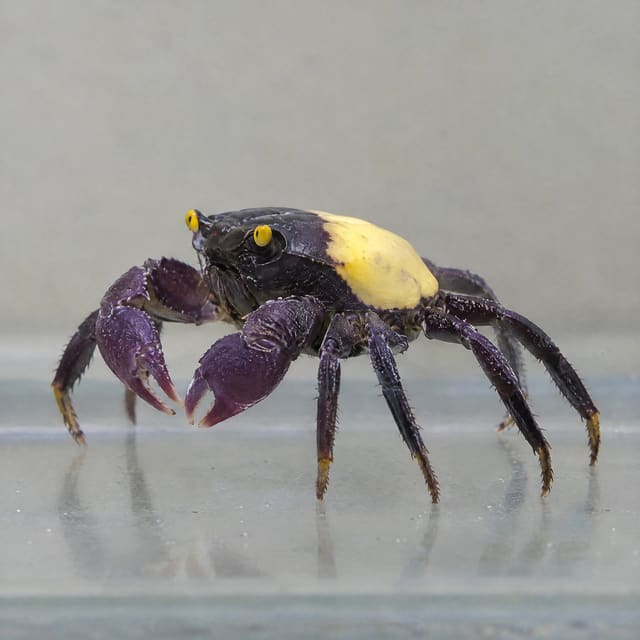
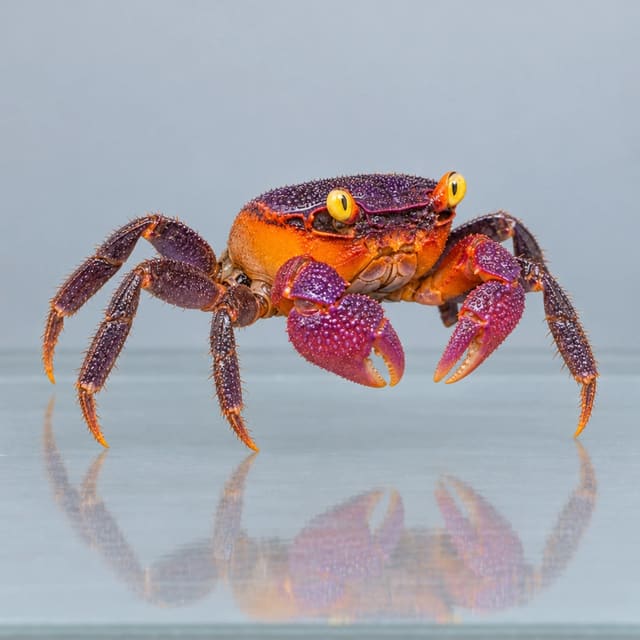
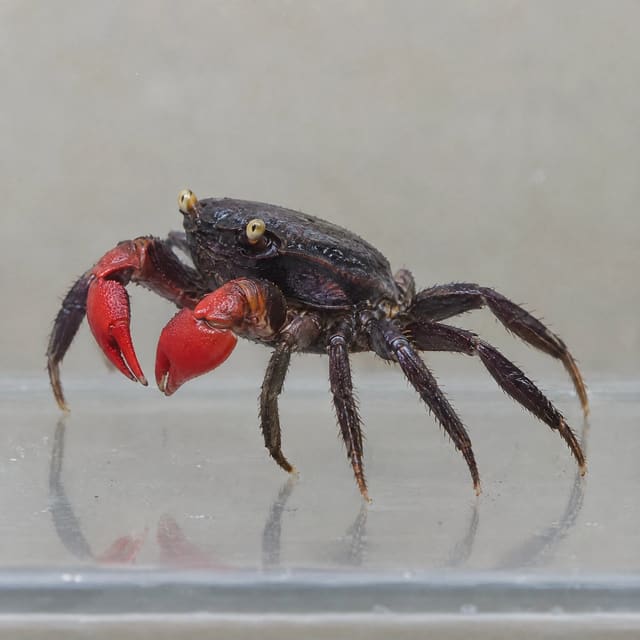
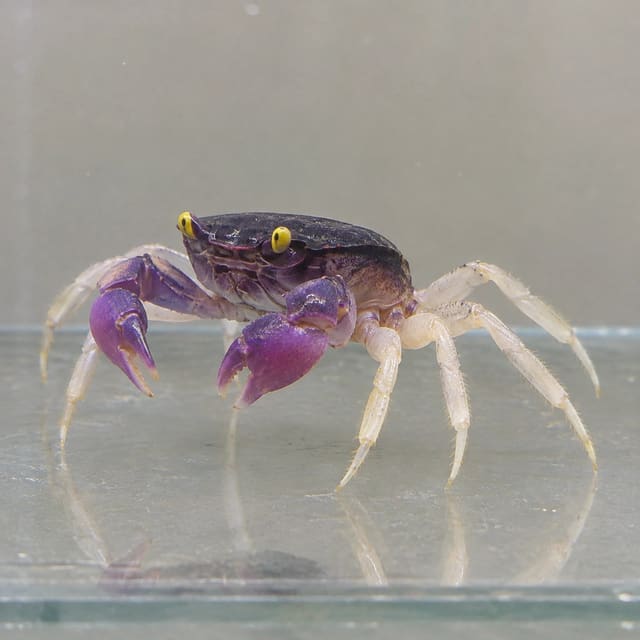
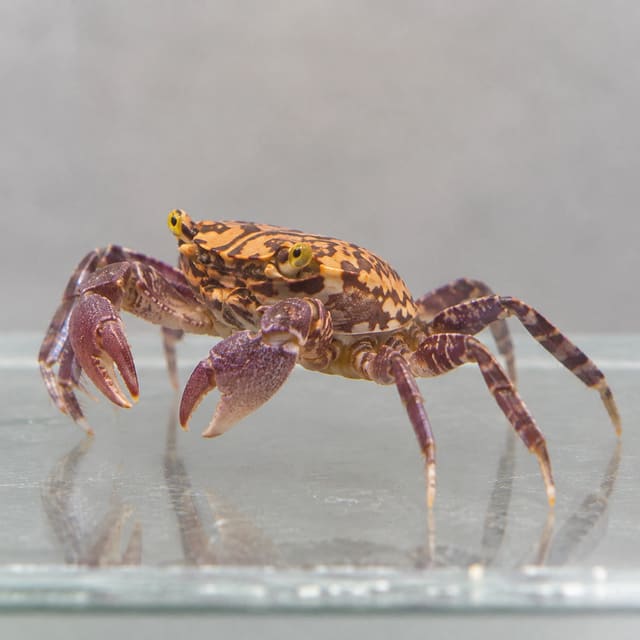
The Scarlet Vampire Crab is a small land crab of the genus Geosesarma coloured red from end to end: our photographs show a scarlet shell, scarlet claws and red legs, set off by large, bright yellow eyes. It is one of the colour forms sold as "vampire crabs", a group of tiny, mostly terrestrial crabs from Southeast Asia that suit a humid, planted paludarium. At dusk it comes out of its cave to patrol the moss, pick over leaf litter and visit the water's edge, and a small group of red crabs moving through green moss is one of the most striking sights in fishkeeping.
This listing is for one live Scarlet Vampire Crab sold as Geosesarma sp. The genus is certain; the species behind the trade name "Scarlet" has not been identified, and we do not invent one. Like every vampire crab, it lives mainly on land and needs a paludarium with moist ground, cover, a shallow freshwater pool and a lid that closes every gap.
Vampire crabs were in the trade for years before they had names. In 2015, Peter Ng, Christoph Schubart and Christian Lukhaup published a peer-reviewed description of the two commonest trade forms as new species, Geosesarma dennerle and Geosesarma hagen, and established that both are native to central Java, settling years of conflicting dealer claims about Sulawesi, Krakatau and the Riau Islands. Practical Fishkeeping reported that the names honour the two aquatic companies that supported the fieldwork. The paper also confirmed that Geosesarma is a large genus of terrestrial crabs from Southeast Asia, then numbering 53 species, which is why so many trade colours remain unidentified. The genus belongs to the family Sesarmidae (WoRMS).
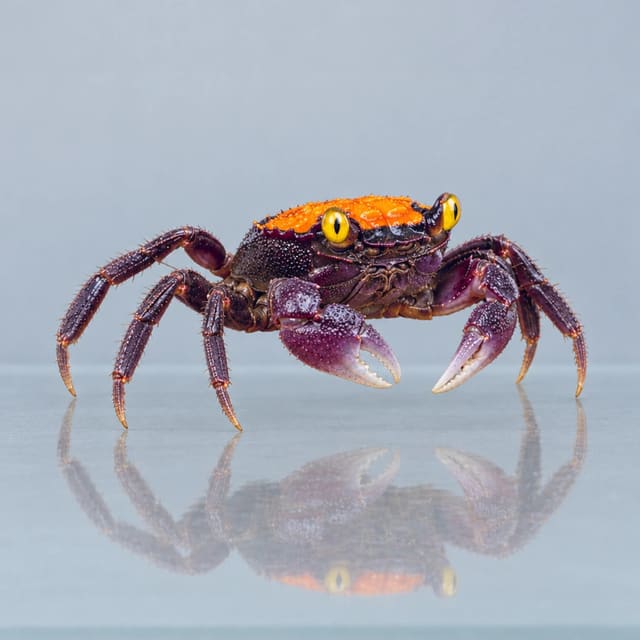
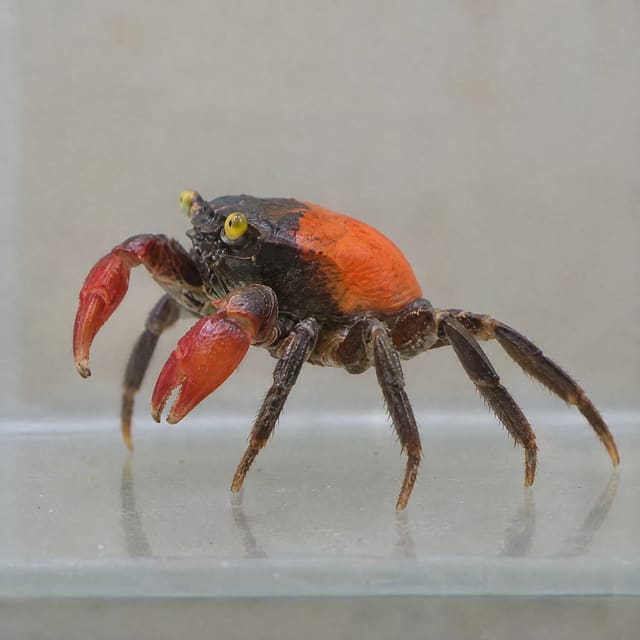
We sell several red vampire crabs, and they are not interchangeable. The only one with a confirmed species is the Red Devil Vampire Crab, Geosesarma hagen. Its scientific description records a dark brown front to the shell and legs, an orange or yellow rear, bright orange to reddish-orange claws and bright yellow eyes, with the amount of orange varying so much that some crabs are almost completely orange. The Scarlet form is sold as a distinct crab, red all over.
| Crab | Name status | How to treat it |
|---|---|---|
| Scarlet Vampire Crab | Geosesarma sp., species not identified | Keep as its own group |
| Red Tomato Vampire Crab | Geosesarma sp., sold as a separate trade form | Separate enclosure |
| Red Devil Vampire Crab | Geosesarma hagen, described in 2015 | Separate enclosure |
| Red Carnival Vampire Crab | Geosesarma sp., trade form 'Red Carnival' | Separate enclosure |
| Midnight Red Claw Vampire Crab | Geosesarma sp., trade form | Separate enclosure |
A shared colour is not evidence of a shared species, and mixing forms makes behaviour and any breeding unpredictable. Our guide to choosing a vampire crab explains why we keep identified groups apart, and you can compare every form in our Geosesarma vampire crab category.
Look at the underside. OATA describes how crabs are sexed by the shape of the flap tucked under the body: narrow and pointed in males, wide and rounded in females. The Fishkeeper profile adds that males usually carry larger claws and can be territorial, so it suggests one male with several females unless the enclosure is very roomy. If you buy several crabs, sex them in the first week and move extra males to another set-up.
Vampire crabs are tiny. Adult shells of the two Javan species in the 2015 description measured roughly 1.1–1.5 cm across, while hobby sources give 2–3 cm body length (Practical Fishkeeping) and a maximum of 3 cm (Fishkeeper). As the Scarlet form is unidentified, plan for a crab in that range. What they need is floor and cover rather than depth of water: OATA recommends at least 60 litres for a small group of crabs, as long and wide as possible, with only a half to a third of the tank holding water.
Wild vampire crabs in central Java live on the slopes of small valleys and on the banks of streams and rivulets, hiding under and between rocks in dense vegetation, and sometimes digging burrows in loose ground at the water's edge. The 2015 paper found adults seldom in the water and mostly on moist banks, with juveniles often in or right beside the water. The Fishkeeper profile describes the same picture: rocky caves and burrows near a stream, shallow warm water, and roots and plants for climbing.
OATA recommends overhead lighting to keep a proper day-night cycle, and advises placing the tank away from draughts, heat sources, direct sunlight, loud noises and vibration. That matters for a humid paludarium: sunlight can overheat a closed enclosure, and a draughty spot makes it hard to hold temperature and humidity on the land.
A Scarlet Vampire Crab will climb out of any gap it can reach. OATA says crabs are very good at escaping and need a secure lid with every hole blocked, and the Fishkeeper profile calls vampire crabs great escape artists. The lid that keeps them in also keeps the humidity up, so it does two jobs.
Practical Fishkeeping describes vampire crabs as kept in high humidity, and the Fishkeeper profile says they bask in humid air. Neither gives a percentage, so judge by the land: the surface and the moss should stay moist, with fresh rather than stagnant air. A hygrometer and a thermometer on the land tell you far more than condensation on the glass. Remember that the pool heater warms the water first; check that the land is warm enough too.
| Value | Practical Fishkeeping | Fishkeeper (vampire crab) | OATA (crabs) | Aim for |
|---|---|---|---|---|
| Temperature | 22–28°C | 22–28°C | 22–27°C | 22–27°C |
| pH | Not given | 7.5–8.5 | 7.0–8.0 | 7.5–8.0 |
| General hardness | Not given | 10–25 dH | 8–18 dGH | 10–18 dGH |
| Carbonate hardness | Not given | Not given | 10–15 dKH | 10–15 dKH |
| Humidity | High | Humid air | Not given | Moist land, fresh air |
| Ammonia, nitrite | Not given | Not given | Zero | Zero |
| Nitrate | Not given | Kept low | Within 20 mg/l of tap water | Within 20 mg/l of tap water |
The Fishkeeper profile calls vampire crab water hard and alkaline, which matches the tap water in much of the UK, but supplies vary from soft to very hard, so test before you build. Dechlorinate all water, including misting water. Our water matcher checks your readings against the crab's needs, and the page on pH and hardness explained covers the basics.
Test the pool once a week for ammonia, nitrite, nitrate, pH and hardness, and change at least 25% of its water, as OATA recommends for crabs. Rinse the filter sponge in old tank water, never under the tap. On the land, lift out uneaten food and mouldy leaves, top up leaf litter and check the humidity and lid seals before closing up.
Wild vampire crabs are mainly hunters of small ground insects. The 2015 description found G. hagen apparently carnivorous, feeding at least partly on insects living on the ground, and G. dennerle eating mainly small insects such as grasshoppers, probably with midge larvae and plant detritus. Practical Fishkeeping adds that captive vampire crabs take dry food, freeze-dried food, earthworms and springtails, hunt live house crickets and graze moss and algae at night. The Fishkeeper profile lists bloodworm, mysis shrimp, finely chopped krill or prawn, vegetable matter, pellets, algae wafers and crab foods.
| Food | How to use it |
|---|---|
| Crab pellets or crumbled sinking pellets | The everyday staple, in tiny portions on the land |
| Frozen bloodworm, mysis or chopped krill | A few times a week for protein |
| Live springtails | A permanent colony in the soil to hunt |
| Vegetables, moss and algae wafers | Occasional plant food to graze |
| Leaf litter | Always present for picking over |
Feed once a day at dusk, when the crabs become active (Practical Fishkeeping describes them as crepuscular and nocturnal). OATA's rule is to leave food for about 30 minutes and then remove what is left. A tropical springtail culture seeded into the land gives the crabs live prey and eats leftover food and mould.
Make sure ammonia and nitrite read zero and that the land is warm and humid before the crabs arrive. Follow OATA's floating-bag method: lights off, float the closed bag in the pool for 10 minutes, then add small amounts of tank water over at least 30 minutes. Let the crab walk out at the pool edge beside moss or a cave, with as little bag water as possible. Our page on how to acclimatise new arrivals covers the method.
| When | Check | Action |
|---|---|---|
| Day 1 | Crab has found cover | Keep the lights low and leave it alone |
| Days 2–3 | Feeding at dusk | Tiny portions near its hide; remove leftovers after 30 minutes |
| Days 1–7 | Pool water, land humidity, temperature | Test more often; OATA advises close monitoring in the first week |
| Day 7 | Sexes and squabbles | Sex the crabs and separate persistent fighters |
The Fishkeeper profile rates vampire crabs as non-community and recommends a species-only tank. They will hunt small fish, so slow bottom-dwellers should be avoided, although some keepers have kept them with small, fast, peaceful fish. OATA advises a dedicated set-up for crabs in general. In practice, the best companions for a group of Scarlet Vampire Crabs are the springtails in their soil.
| Suits | Avoid |
|---|---|
| A group of the same form: one male with several females | Several males in a small space |
| Springtails in the land area | Shrimp and small or slow fish |
| Dense moss, roots and leaf litter | Red Devil, Red Tomato or other forms in the same enclosure |
| A humid, sealed paludarium | Any tank without land |
Run any other idea through our compatibility checker first. Browse the full range of freshwater crabs and crayfish and our shrimp and crustacean range for other invertebrates, each in its own set-up.
Crabs grow by moulting. The Fishkeeper profile notes that vampire crabs need water deep enough to submerge fully while they moult and rocky caves to shelter in afterwards. OATA warns that a shed shell can be mistaken for a dead crab, so check before you remove anything, and that crabs are very sensitive to copper: use only treatments labelled safe for invertebrates.
| Sign | Response |
|---|---|
| Crab staying in the pool all day | Check land humidity and temperature; adults normally live on land |
| Inactivity or restlessness | Test the pool water first |
| Colour turning darker or paler | Review water quality, humidity and crowding |
| Failed or incomplete moult | Check hardness, humidity and diet; leave the crab undisturbed |
| No interest in food, weight loss, swelling | Test the water and ask us for advice |
Vampire crabs are among the crabs that have been bred in home enclosures. The Fishkeeper profile explains why: the female carries the eggs under her abdomen for several weeks, then miniature crabs hatch directly, with no swimming larval stage. Practical Fishkeeping reports that females carry eggs about every six months and that 50–60 young hatch from each clutch. In the wild, young vampire crabs stay in or very close to the water and become more terrestrial as they grow, so give them a shallow, mossy edge and plenty of tiny food. Young crabs are small and vulnerable to adults, so moving a carrying female or the young to a separate tank improves survival. Keep breeding groups to a single form, so you know what you are raising. OATA notes that smaller crabs often live only a couple of years, which makes a breeding group the best way to enjoy Scarlet Vampire Crabs for longer.
It is an all-red colour form of vampire crab, genus Geosesarma (family Sesarmidae), sold under the trade name Scarlet Vampire Crab. Our photographs show a scarlet shell, claws and legs with bright yellow eyes. The species behind this trade name is not identified, so we list it as Geosesarma sp.
It is sold as a different form. The Red Devil is Geosesarma hagen, which its scientific description records as dark brown on the front of the shell and legs, orange or yellow behind, with bright orange claws, although some are almost completely orange. The Scarlet form is red all over. Keep the two in separate enclosures.
They are sold as separate trade forms. Neither has been identified to species, so a similar red colour cannot prove they are the same animal. If you keep both, give each its own enclosure.
Mostly on land. Wild vampire crabs in central Java live on moist banks under rocks and in dense vegetation, and adults are seldom found in the water. Give it about two-thirds land and one-third water, as the Fishkeeper profile recommends, with water deep enough to submerge in when it moults.
OATA recommends at least 60 litres for a small group of crabs, in a tank that is as long and wide as possible. The crabs are small, but they need floor space, climbing cover and a hiding place each.
Aim for 22–27°C, which fits OATA (22–27°C) and the vampire crab profiles in Practical Fishkeeping and Fishkeeper (22–28°C). Use dechlorinated fresh water at pH 7.5–8.0 and 10–18 dGH, inside both the Fishkeeper and OATA ranges, and keep the air humid.
They are omnivores that love animal food. Wild vampire crabs eat mainly small ground insects; in captivity offer crab pellets, frozen bloodworm and mysis, springtails and other small live foods, with some vegetables, moss and algae. Feed once a day at dusk and remove leftovers after about 30 minutes.
It is best kept without fish. The Fishkeeper profile rates vampire crabs as non-community and says they will hunt small fish; slow bottom-dwellers are most at risk. Shrimp are also likely prey.
They can. Vampire crabs have no larval stage: the female carries her eggs for several weeks and miniature crabs hatch directly (Fishkeeper). Practical Fishkeeping reports about 50–60 young per clutch, roughly every six months.
No reviews for this item yet. Bought one? Honest reviews only, good or bad.
What customers say about ordering from us
Easy website plenty of info on fish your buying great to pick a time slot
TRACEY DURRANT · 7 Oct 2026
Got some lovely fish thank you
Kevin Mackie · 7 Oct 2026
Reviews of our shop, collected by Judge.me, an independent third-party review collector. Newest first.
Moved by UK carriers licensed to handle live animals
Hand-packed with oxygen bags, poly box, heat pack
Email photos the same day; an optional unboxing video helps us review problems faster — claim terms apply
Klarna & PayPal Pay in 3 at checkout