Moderate
Rainbow Vampire Crab (Geosesarma sp.)
£16.19
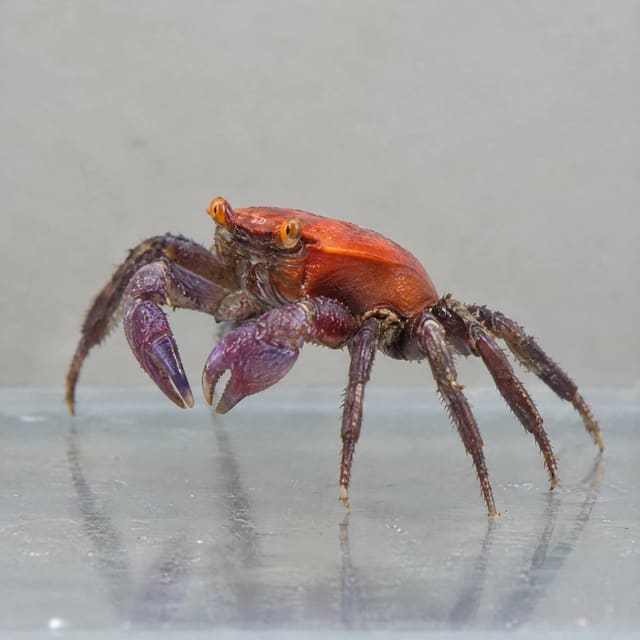
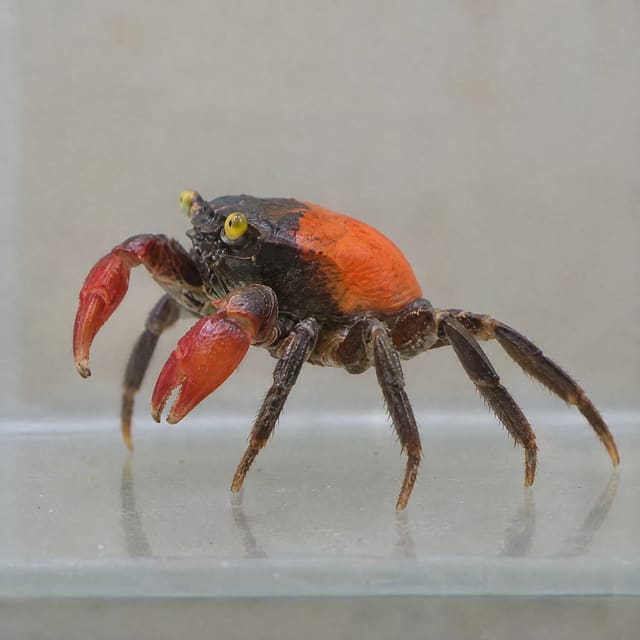
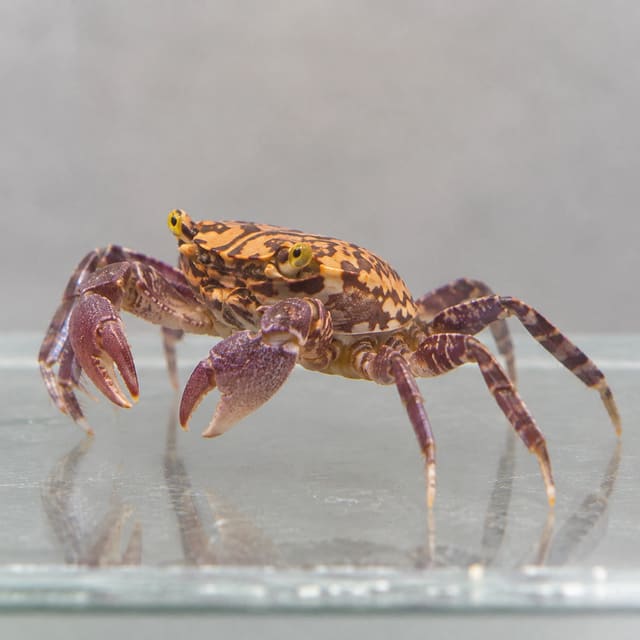
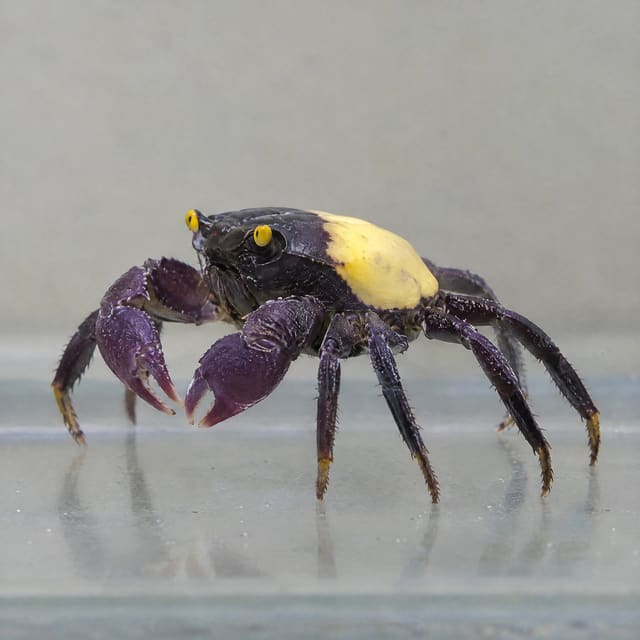
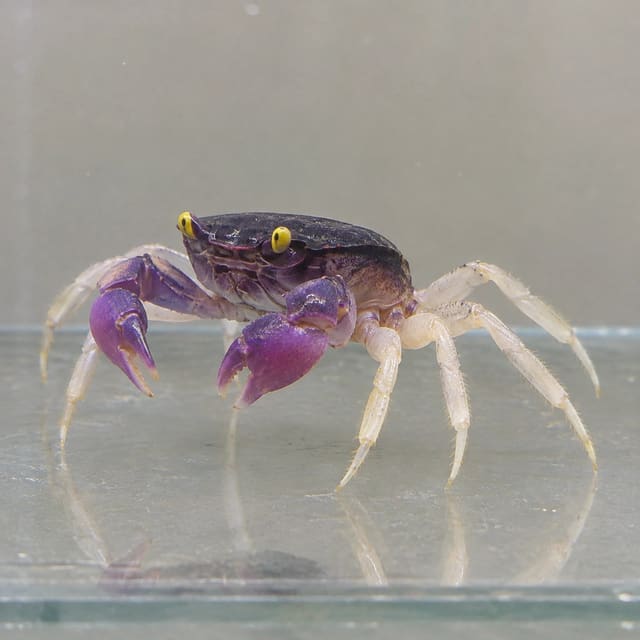
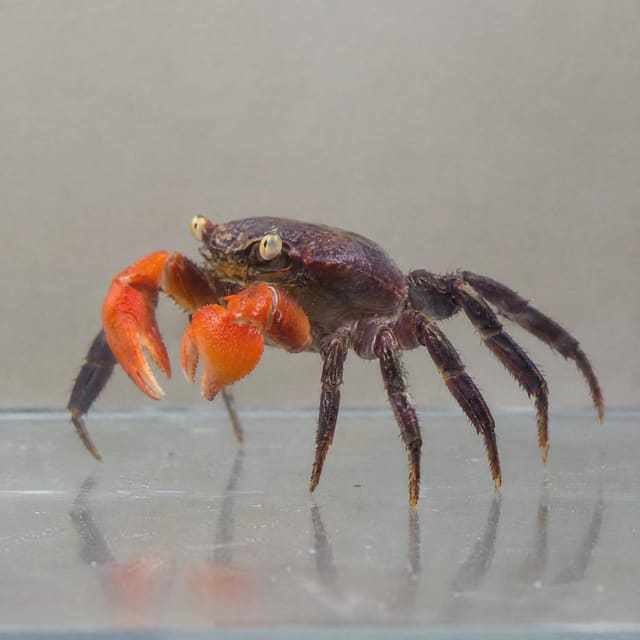
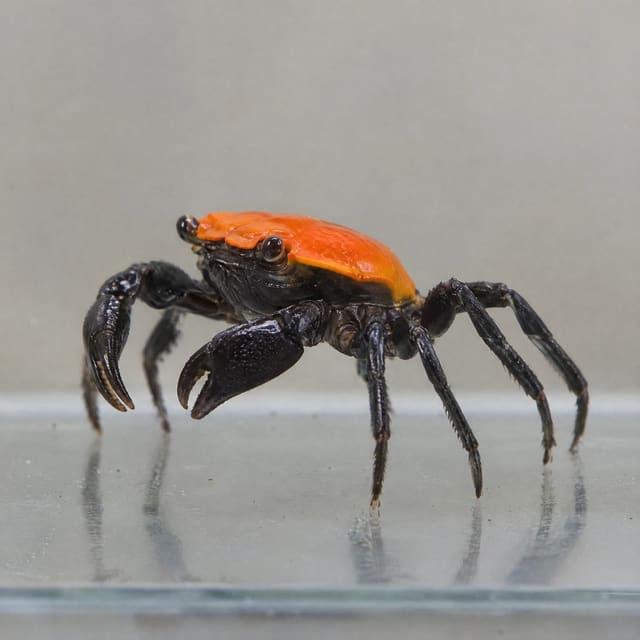
The Orange Back Vampire Crab is a small, mainly land-living Geosesarma crab with a bright orange back, purple-black legs and claws and yellow eyes. Keep it in a lidded, humid paludarium with about two-thirds land and a shallow freshwater pool at 22–27°C. Sold individually as one live crab.
Geosesarma sp.
The Orange Back Vampire Crab is a small, mainly land-living Geosesarma crab with a bright orange back, purple-black legs and claws and yellow eyes. Keep it in a lidded, humid paludarium with about two-thirds land and a shallow freshwater pool at 22–27°C. Sold individually as one live crab.
Read the full care guidance when planning conditions for your aquarium.
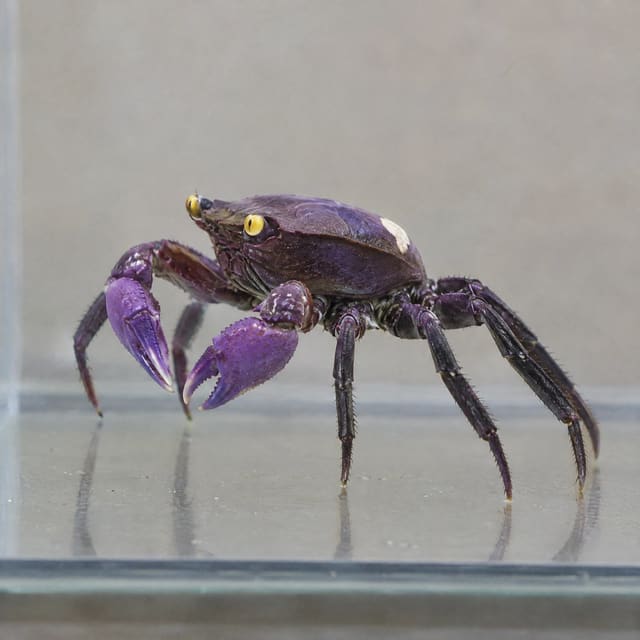
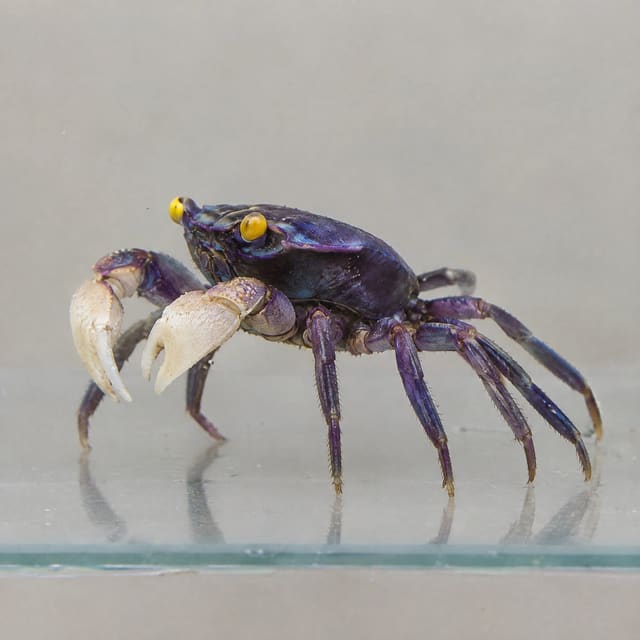
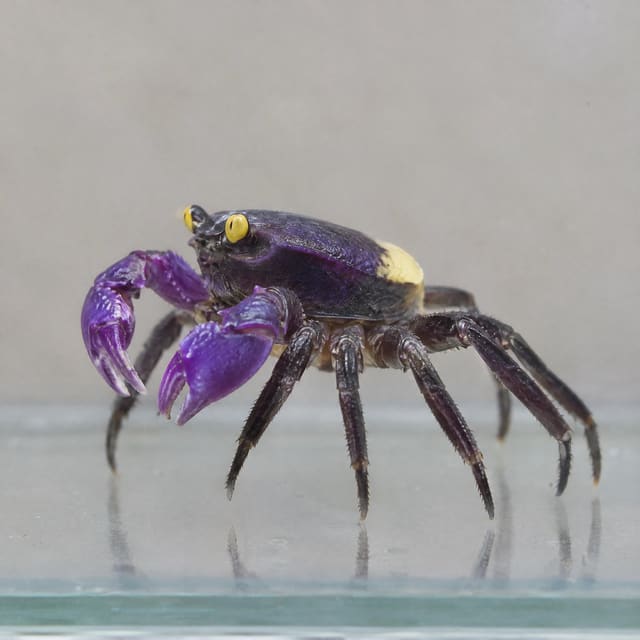
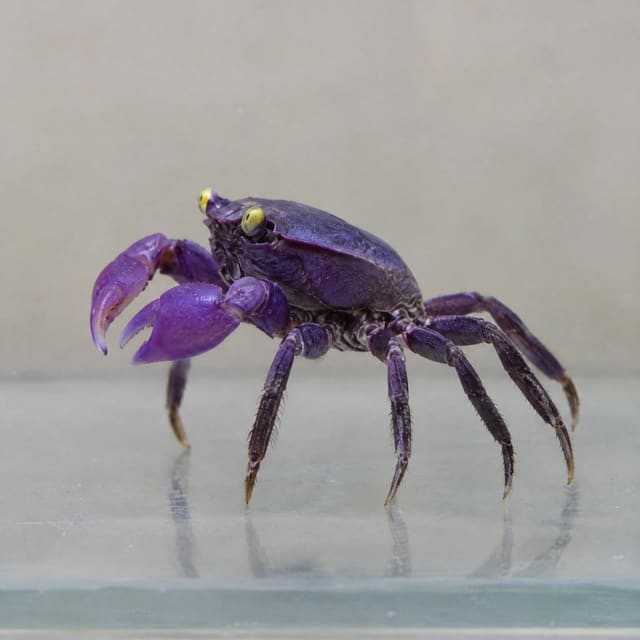
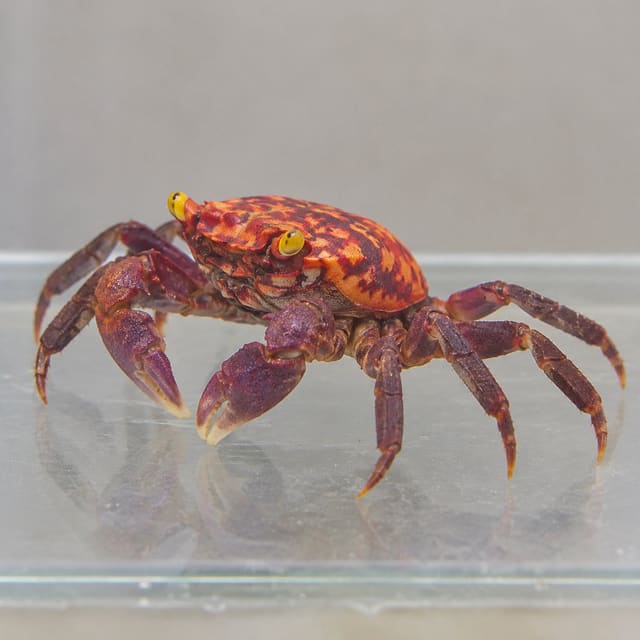
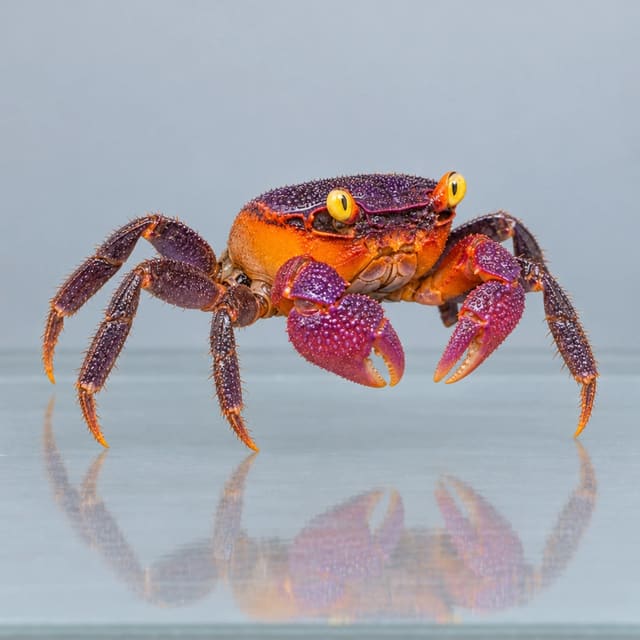
The Orange Back Vampire Crab is a small, mainly land-living crab of the genus Geosesarma, sold as Geosesarma sp. because this colour form has not been matched to a named species. Its carapace carries a vivid orange saddle across the back, while the front edge of the shell, the legs and the claws are a deep purple-black. The claw tips fade to ivory, and the bright yellow eyes have a dark central bar. Those eyes explain the trade name: Wikipedia notes that “vampire crab” refers to the yellow eyes of some species, not to anything the crab eats.
Vampire crabs are land crabs that need fresh water close by. Fishkeeper describes them spending most of their time out of the water, and Practical Fishkeeping notes that they are independent of the sea, so they never need salt or brackish water. That combination makes the Orange Back Vampire Crab a classic animal for a planted paludarium: a lidded enclosure that is mostly land, with a small, clean pool.
They are crepuscular, meaning most active at dusk and dawn, so you will see the most of them in the evening as the lights dim. In a well-planted set-up they climb roots and moss, pick over leaf litter and sit at the water’s edge with their claws raised, and the orange back shows up strongly against dark wood and green moss.
| Suits | Not suited to |
|---|---|
| A lidded paludarium with far more land than water | An ordinary, fully aquatic fish tank |
| A room or enclosure held steady at 22–27°C | A cold room with no heating |
| A crab-only set-up, or one with carefully chosen small, fast fish | A busy community tank with slow bottom-dwelling fish or dwarf shrimp |
| A keeper who enjoys watching in the evening | Someone who wants an animal on show all day |
| An escape-proof lid with every cable gap sealed | Open tops or lids with gaps around pipes and wires |
The Orange Back Vampire Crab sits with our other shrimps and crustaceans. You can also browse the full freshwater crabs and crayfish category or go straight to the Geosesarma vampire crab range to compare colours.
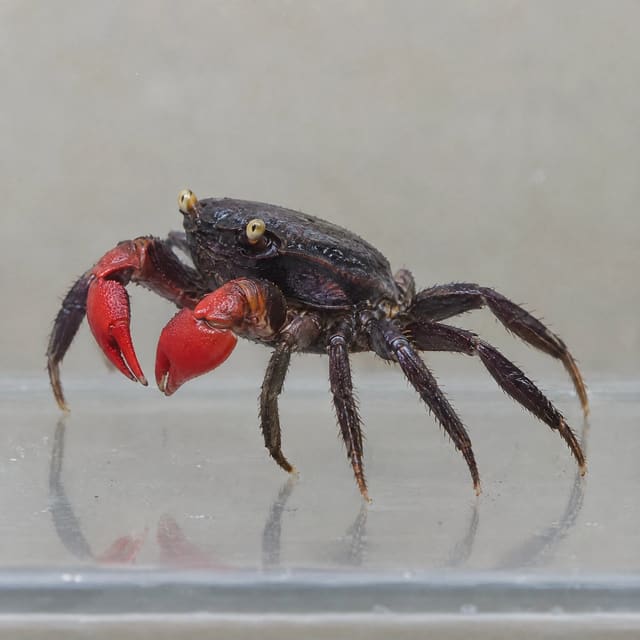
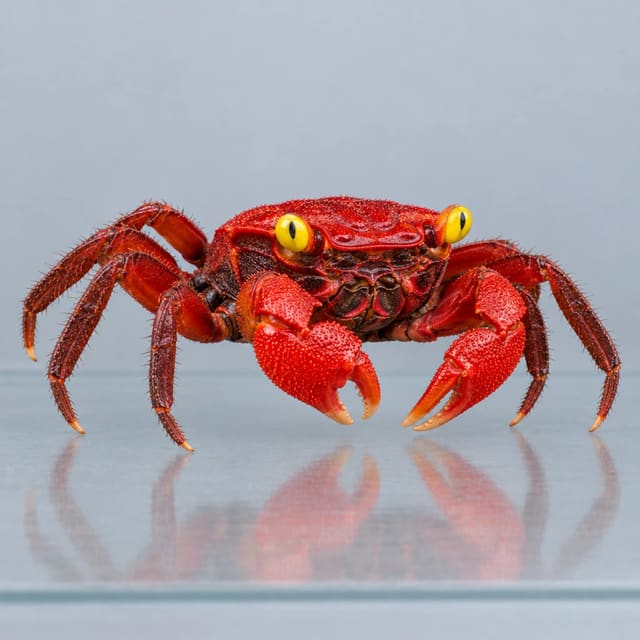
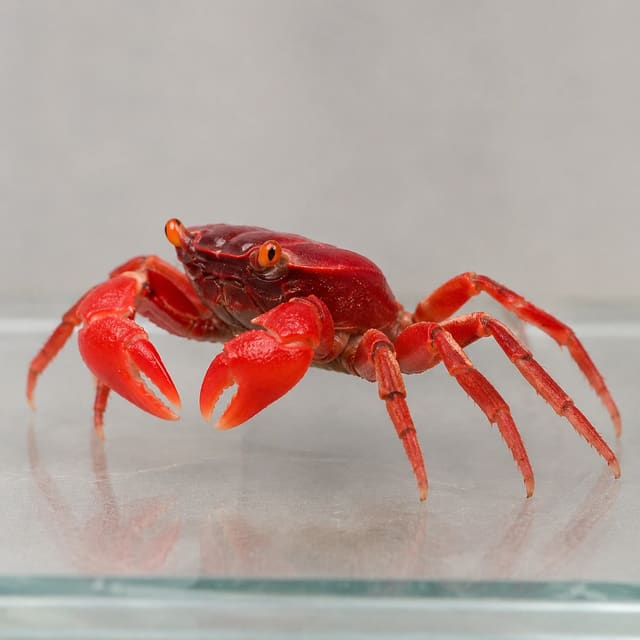
One purchase quantity supplies one live Orange Back Vampire Crab. The only option is “Standard”: this form is not graded into sizes, so crabs are sent at the size available on the day, usually young adults or adults. The photographs show the colour form, not the individual crab you will receive. The amount of orange on the back varies from crab to crab, and the purple of the legs can look almost black in some lights.
Sex is not specified. If you are building a breeding group, ask us before you order and we will tell you what is available at the time. Read our delivery and live arrival terms before ordering, and have the enclosure running, warm and tested before the crabs arrive.
Geosesarma belongs to the family Sesarmidae. It is a large genus: Wikipedia lists 59 species, and a 2019 paper by Shy and Ng in ZooKeys counted 64 recorded species, most of them from Indonesia. The genus ranges from India through Thailand, Malaysia, Indonesia and the Philippines to the Solomon Islands and Hawaii.
Aquarium vampire crabs were long sold without scientific names. In 2015 Ng, Schubart and Lukhaup formally described two of them from central Java, Geosesarma dennerle and Geosesarma hagen, noting that both had been in the aquarium trade for many years under the popular name “vampire crabs”. Other trade forms remain unidentified; Practical Fishkeeping’s profile of a traded vampire crab describes one believed to be an undescribed species. Colour names such as “Orange Back” describe what the crab looks like, not which species it is, and different sellers use different names for similar-looking crabs.
Wikipedia also records that both Javan species are threatened by illegal over-collection for the aquarium trade. Looking after your crabs well, breeding them where you can and never releasing them all help reduce pressure on wild populations.
Watch the crab from below when it climbs the glass. Fishkeeper explains that females have a wider, oval abdomen flap, while males have a narrow, tapering one, and that males usually have larger claws. Avoid catching crabs just to check: handling stresses them, and a crab that has just moulted is soft and easily injured.
Size figures differ because sources measure different things. Wikipedia describes Geosesarma as typically less than 10 mm across the carapace, and the 2015 description measured a male Geosesarma hagen at 13.1 × 11.7 mm. Practical Fishkeeping gives 2–3 cm and Fishkeeper gives up to 3 cm, figures that take in more than the shell alone. In practice the Orange Back Vampire Crab is a small animal whose legs make it look larger than its shell, which is why a modest enclosure can suit a small group if it offers enough land, cover and climbing surfaces.
Because these crabs live on surfaces rather than in open water, usable land area matters more than total volume. Use our tank volume calculator for the pool section, so you know how much water you are conditioning and changing each week, and plan the land around hides, climbing routes and feeding spots.
Fishkeeper recommends a paludarium or vivarium-style tank with about two-thirds land and one-third water, and a tight-fitting lid. Vampire crabs are skilled climbers and escape artists, so block every hole where cables, pipes or tubing enter the enclosure. Our vampire crab guide adds that the land is the main habitat, and that the water should have several easy exits.
Fishkeeper suggests a sandy land area with roots, marginal or terrestrial plants and rocky caves for hiding, particularly after moulting. Java moss on the land and in the water gives shelter and helps the crabs climb out. The water area should be heated and filtered like a normal aquarium and deep enough for a crab to submerge fully when it moults, with shallow, stable footholds at the edges.
| Zone | What it gives the crab |
|---|---|
| Raised land of moist sand or soil with leaf litter | Space to forage, dig and spend most of the day |
| Caves, cork bark and roots | Hiding places, which matter most just after a moult |
| Moss on the land and along the water’s edge | Climbing routes, grazing and damp cover |
| A small, filtered pool with sloping stones | Drinking, wetting the gills and a safe place to moult |
| A flat feeding stone on land | A spot where you can see who eats and lift out leftovers |
| A tight lid with sealed cable gaps | No escapes |
Live plants rooted in the land area help hold humidity and give the crabs more to climb. Keep the enclosure away from direct sunlight and radiators, which can overheat a small, closed set-up quickly.
Practical Fishkeeping gives 22–28°C and high humidity for vampire crabs. Fishkeeper also gives 22–28°C, with hard, alkaline water at pH 7.5–8.5 and 10–25 dH. OATA’s UK care sheet for freshwater crabs as a group gives 22–27°C, pH 7.0–8.0, 8–18 dGH and 10–15 dKH. The sources differ at the edges, so we suggest the range they share: 22–27°C, pH 7.5–8.0 and 10–18 dGH.
None of these sources gives a humidity figure. Keep the air damp with a lid, moist substrate and moss, and measure at the level where the crabs live: our vampire crab guide warns that condensation on the glass is not a full measure of humidity or temperature. Tap water in the UK ranges from soft to very hard depending on where you live, so test your own water before you set up, and use our water matcher to compare it with these values. Always treat tap water with a conditioner to remove chlorine or chloramine, and do not add salt: these are freshwater crabs.
| Reading | Aim for | Where it comes from |
|---|---|---|
| Temperature | 22–27°C | OATA 22–27°C; Practical Fishkeeping and Fishkeeper 22–28°C |
| pH | 7.5–8.0 | OATA 7.0–8.0; Fishkeeper 7.5–8.5 |
| General hardness | 10–18 dGH | OATA 8–18; Fishkeeper 10–25 |
| Carbonate hardness | 10–15 dKH | OATA |
| Ammonia and nitrite | Zero mg/l | OATA |
| Nitrate | No more than 20 mg/l above your tap water | OATA |
| Copper | None at all | OATA: crabs are very sensitive to copper |
| Humidity | High, with moist land and a lid | Practical Fishkeeping; no figure published |
Our water chemistry guide explains what pH, general hardness and carbonate hardness mean and how to test them.
Practical Fishkeeping describes vampire crabs as omnivores whose diet is largely meaty. Its profile lists dry food, freeze-dried animals, earthworms, springtails and live house crickets, and notes that they also eat moss and graze algae. Fishkeeper suggests bloodworm, Mysis and finely chopped krill or prawn, plus vegetable matter, and says they accept pellets, algae wafers and specialist crab foods. OATA advises feeding freshwater crabs once a day, leaving the food for about 30 minutes and then removing what is left, with sinking crustacean pellets, algae wafers and vegetables such as courgette and cucumber among the options.
Live foods suit the crab’s hunting habits. A springtail culture added to the land area also helps clean up leftovers, and the smallest small house crickets make an occasional chase-and-catch meal. For the staple, algae wafers and freeze-dried bloodworm are easy to portion.
OATA recommends the floating-bag method for crabs and crayfish. It suits the Orange Back Vampire Crab well, with one change: release the crab onto the land at the water’s edge rather than dropping it into the pool.
| When | What to do |
|---|---|
| Before arrival | Test ammonia, nitrite, nitrate, pH and hardness; confirm the temperature and humidity are steady |
| Day one | Keep the light low and leave the crab to find a hide; do not feed |
| Days two to seven | Offer a small evening meal on land and check that it is found and eaten |
| Every evening | Count the crabs you can see and note any that stay in the water for long periods |
| End of the week | Retest the pool water and do the first routine partial change |
New crabs often hide for several days. That is normal behaviour for a shy, crepuscular animal, not a sign of illness.
OATA recommends changing 25% of the water at least once a week, testing ammonia, nitrite, nitrate, pH and hardness weekly, and treating replacement water with a tap water conditioner. Rinse filter media in water removed from the enclosure, never under the tap, so the useful bacteria survive. Fishkeeper also stresses regular partial water changes in the water section to keep nitrate low.
Crabs grow by shedding their shell. OATA notes that moulting is frequent and that a discarded skin can look just like a dead animal, which is normal. Fishkeeper explains why caves matter after a moult and why the pool must be deep enough for a crab to submerge: a freshly moulted crab is soft and vulnerable until its new shell hardens.
Learn what normal looks like in the first month: crabs hidden by day, out at dusk, feeding on land and dipping into the pool. OATA lists the changes that point to a problem.
| If you see | Do this |
|---|---|
| A crab inactive for days, or restless and climbing constantly | Test the water and check temperature and humidity |
| Colour much darker or paler than usual | Compare with last week’s readings and any recent change |
| A crab sitting in the water far more than normal | Check the land is not too dry or too hot, then test the pool |
| A moult that has not come away cleanly | Keep the crab undisturbed, check hardness and ask us for advice |
| Reduced feeding or weight loss | Check where food is placed and whether another crab is guarding it |
| Chasing or claw damage | Add hides and visual barriers; separate a persistent bully |
If you are worried, test the water first and contact us with your readings, the enclosure size and what you have seen.
Many crabs hatch as tiny swimming larvae, but most Geosesarma do not. Shy and Ng found that over 90% of Geosesarma species with known egg sizes have large eggs and direct development, and they observed females of the Taiwanese species they described brooding young crabs under the abdomen flap. Wikipedia likewise notes that the larvae develop inside the egg. Fishkeeper reports vampire crabs breeding in home aquariums: the female carries eggs under her abdomen for several weeks and miniature crabs hatch directly. Practical Fishkeeping says females of the form it describes carry eggs about every six months, with about 50 to 60 young hatching.
OATA warns that freshwater crabs can hunt small, slow fish and recommends a dedicated set-up. Fishkeeper calls vampire crabs non-community animals best kept in a species-only enclosure, although some keepers succeed with small, fast, peaceful fish. Our vampire crab guide adds that small fish and shrimp may become prey and that other crab species have different needs. Use the tank mates checker to screen any fish you are considering for the pool.
| Possible with care | Avoid |
|---|---|
| More Orange Back Vampire Crabs, with one male to several females | Other crab species or other vampire crab forms in the same enclosure |
| Small, fast, peaceful fish that stay in open water | Slow bottom-dwelling fish the crabs can catch |
| A crab-only planted paludarium | Dwarf shrimp, which the crabs may hunt |
| Springtails and other clean-up animals on land | Any medicine or treatment containing copper |
Several vampire crab forms look alike at first glance. The Orange Vampire Crab carries its orange on the claws, while the Orange Back keeps its claws purple and wears the orange on the shell. The Red Devil Vampire Crab is the named species Geosesarma hagen, the Purple Vampire Crab is Geosesarma dennerle, and the Golden Eye Vampire Crab is another unidentified trade form. Keep each form in its own enclosure.
OATA reminds keepers never to release aquarium animals or plants into the wild. Dispose of old substrate, leaf litter and water through household waste or the drain, never into ponds, streams or gardens.
Not as far as anyone has published. It is a trade name for an orange-backed colour form of Geosesarma whose exact species has not been identified, so we list it as Geosesarma sp. Two vampire crabs known from the aquarium trade, G. dennerle and G. hagen, were formally described in 2015; many other trade forms are still unidentified.
Small. Wikipedia gives Geosesarma shells as usually under 10 mm across, while Practical Fishkeeping gives 2–3 cm and Fishkeeper up to 3 cm, figures that take in more of the body and legs.
Mostly on land. It needs a humid enclosure with far more land than water, plus a shallow, clean freshwater pool deep enough to submerge in when it moults. Fishkeeper suggests about two-thirds land and one-third water.
Keep it within 22–27°C. Practical Fishkeeping and Fishkeeper both give 22–28°C and OATA gives 22–27°C for freshwater crabs, so 22–27°C satisfies all three.
It is an omnivore that takes a lot of animal food: crab or crustacean pellets, algae wafers, frozen bloodworm or Mysis, springtails and small crickets, plus some vegetable matter. Feed in the evening on the land area and remove what is left.
A crab-only enclosure is safest. OATA warns that freshwater crabs hunt small, slow fish, and small shrimp can be eaten. Some keepers manage small, fast, peaceful fish in the pool, but slow bottom-dwellers should be avoided.
Fishkeeper advises one male with several females unless the enclosure is very large, because males may fight. Sex is not specified on this listing, so ask us before ordering if you are building a group.
They can. Geosesarma females carry large eggs under the abdomen and the young hatch as tiny crabs with no larval stage, so no salt water is needed. Plenty of cover and fine food help the young survive.
Yes, they climb well and squeeze through gaps. Use a tight-fitting lid and seal every hole where cables or pipes enter the enclosure.
No reviews for this item yet. Bought one? Honest reviews only, good or bad.
What customers say about ordering from us
Easy website plenty of info on fish your buying great to pick a time slot
TRACEY DURRANT · 7 Oct 2026
Got some lovely fish thank you
Kevin Mackie · 7 Oct 2026
Reviews of our shop, collected by Judge.me, an independent third-party review collector. Newest first.
Moved by UK carriers licensed to handle live animals
Hand-packed with oxygen bags, poly box, heat pack
Email photos the same day; an optional unboxing video helps us review problems faster — claim terms apply
Klarna & PayPal Pay in 3 at checkout