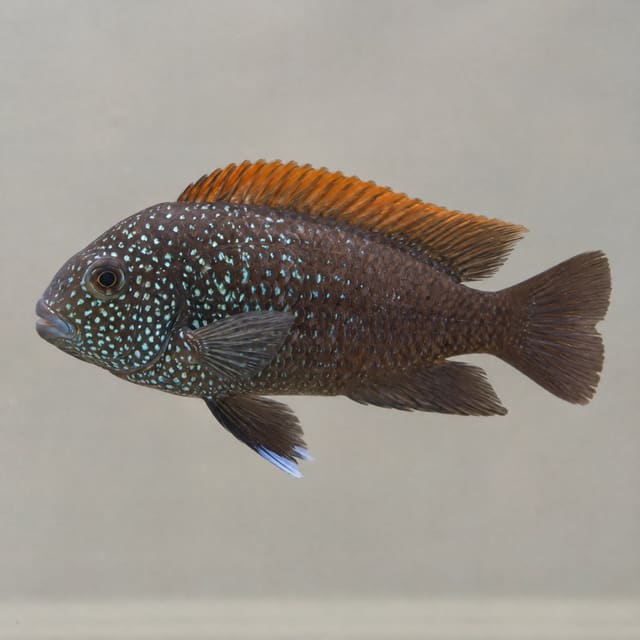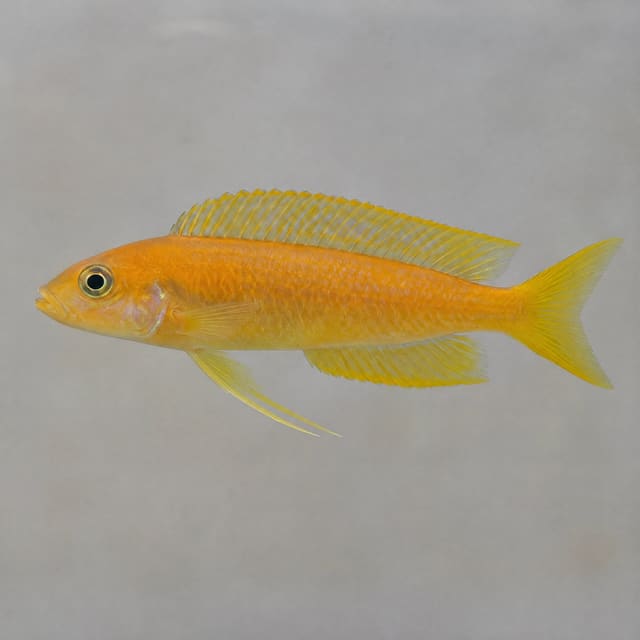
Moderate
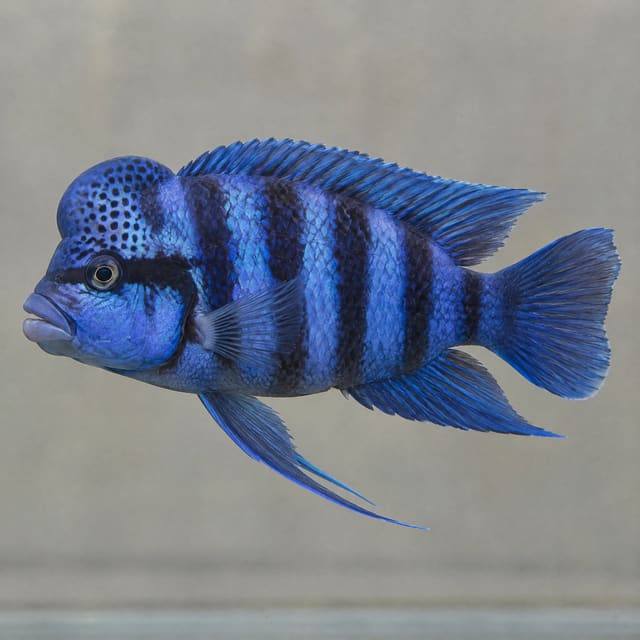
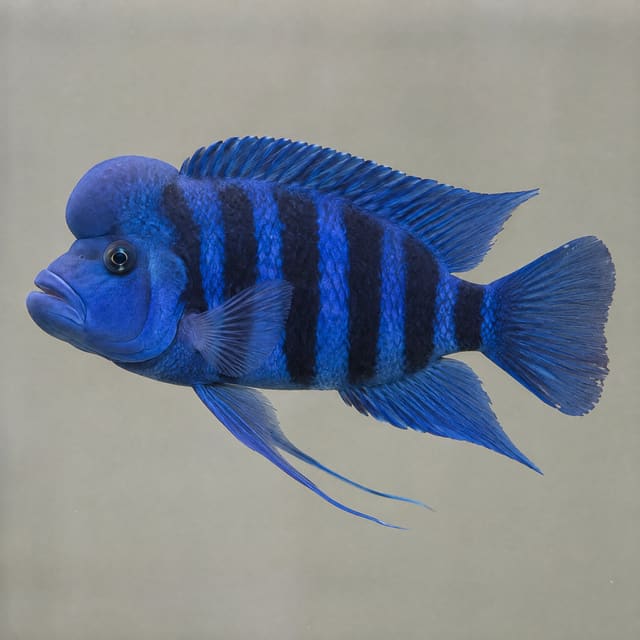
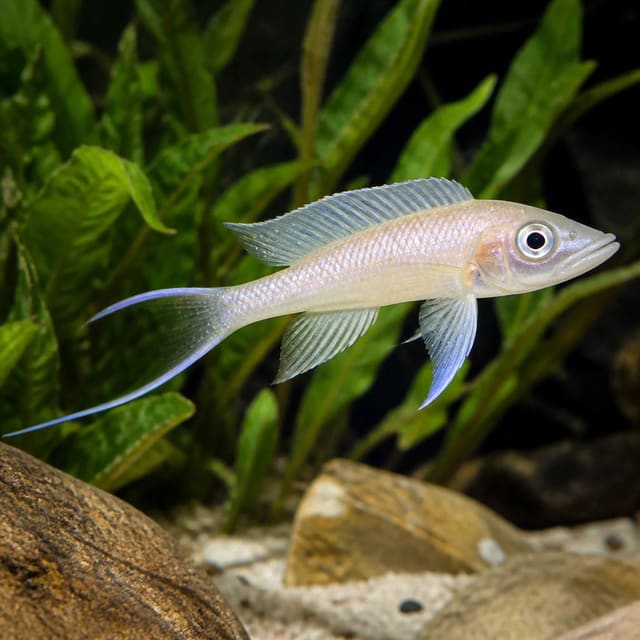
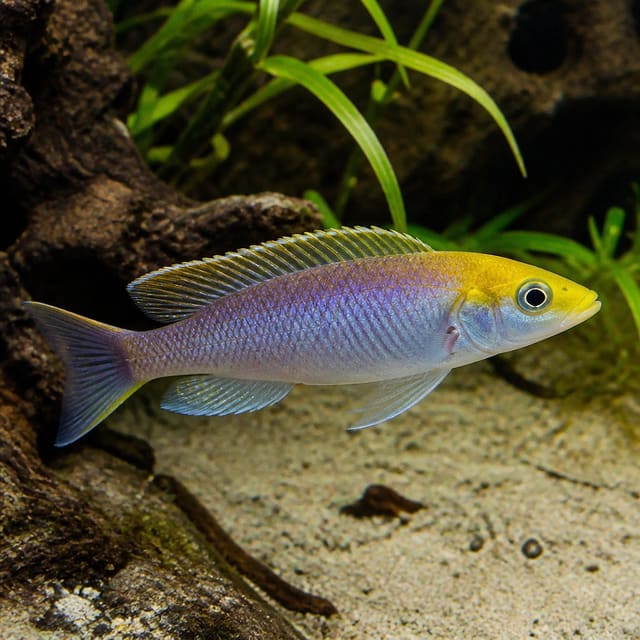
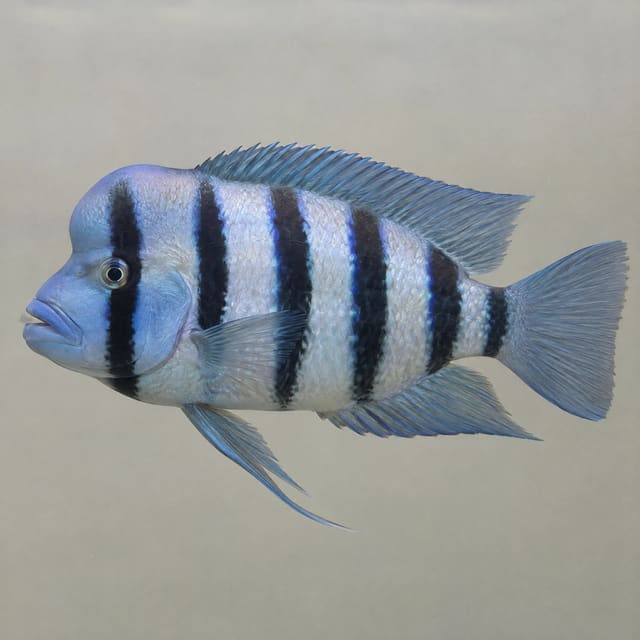
Zambia Blue Frontosa (Cyphotilapia gibberosa)
23–27°C · pH 8–9 · 500L
£46.99
The Red Frontosa is an aquarium-bred colour strain of the Lake Tanganyika humphead cichlid (Cyphotilapia frontosa), with broad reddish-brown to copper bars on a pale body; Seriously Fish also calls it copperband. It grows to around 30 cm and needs a group of five to ten or more in a very large aquarium (240 × 60 × 60 cm recommended) with hard, alkaline, spotless water. Sold individually as one live fish, Small or 5–6 cm.
Adult size is the maximum length this species reaches at full maturity (scientific sources). The livestock you receive will be younger and smaller — pick a size above for the actual shipping size. Product-photo provenance and any image-specific limitations are stated on the listing.
Cyphotilapia frontosa
Save when buying multiple fish. Each quantity is one fish; sex and pair formation are not guaranteed unless the selected variant explicitly states them.
The Red Frontosa is an aquarium-bred colour strain of the Lake Tanganyika humphead cichlid (Cyphotilapia frontosa), with broad reddish-brown to copper bars on a pale body; Seriously Fish also calls it copperband. It grows to around 30 cm and needs a group of five to ten or more in a very large aquarium (240 × 60 × 60 cm recommended) with hard, alkaline, spotless water. Sold individually as one live fish, Small or 5–6 cm.
Adult size is the maximum length this species reaches at full maturity (scientific sources). The livestock you receive will be younger and smaller — pick a size above for the actual shipping size. Product-photo provenance and any image-specific limitations are stated on the listing.
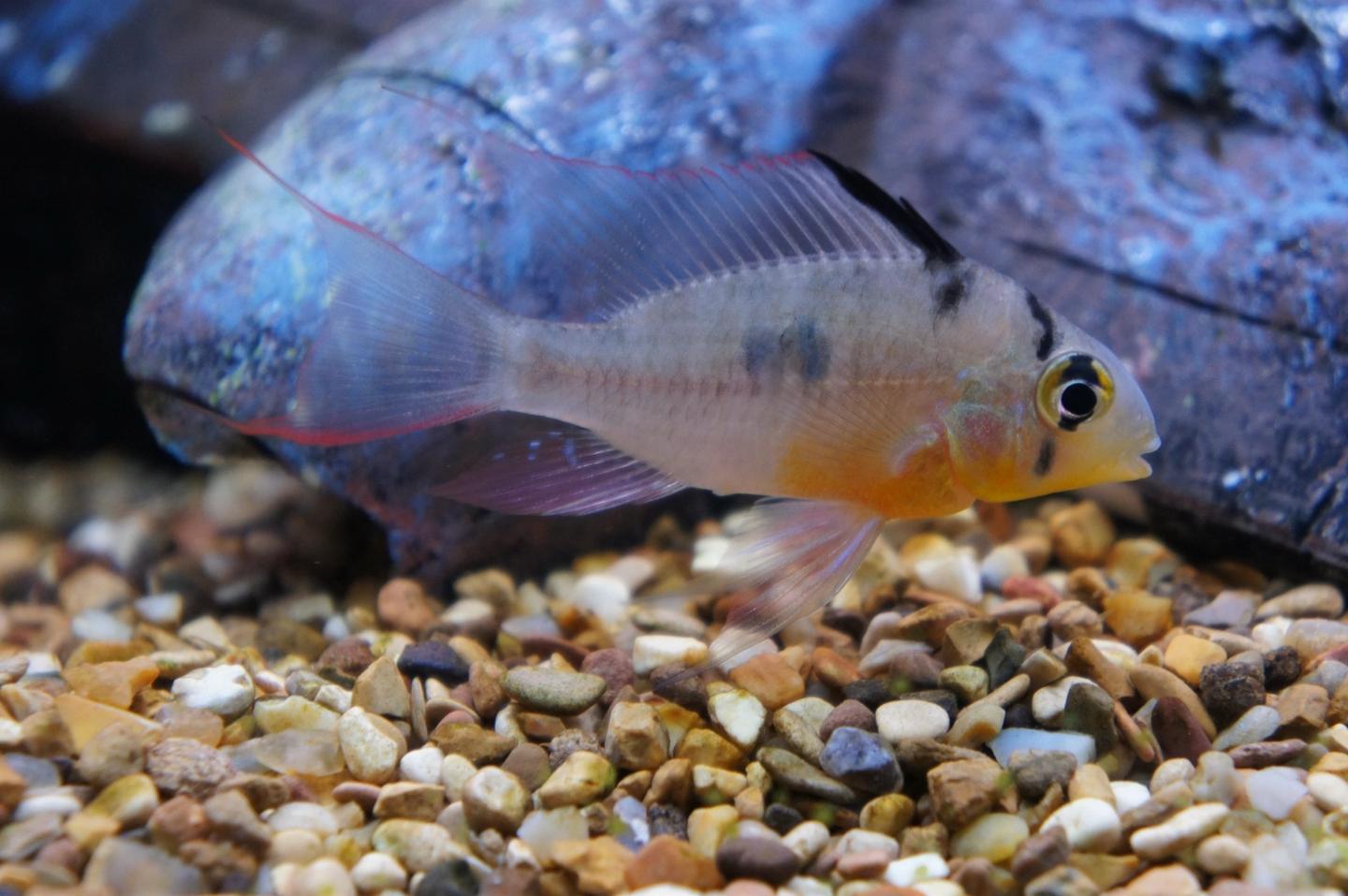
Cichlids are a family of roughly 1,800 accepted species, not one care type. Before buying, identify the exact species and source, then compare adult measurement, usable tank dimensions, social system, territory, tested water, diet and an exit plan. No family-wide minimum tank, water range or tank-mate list is safe.
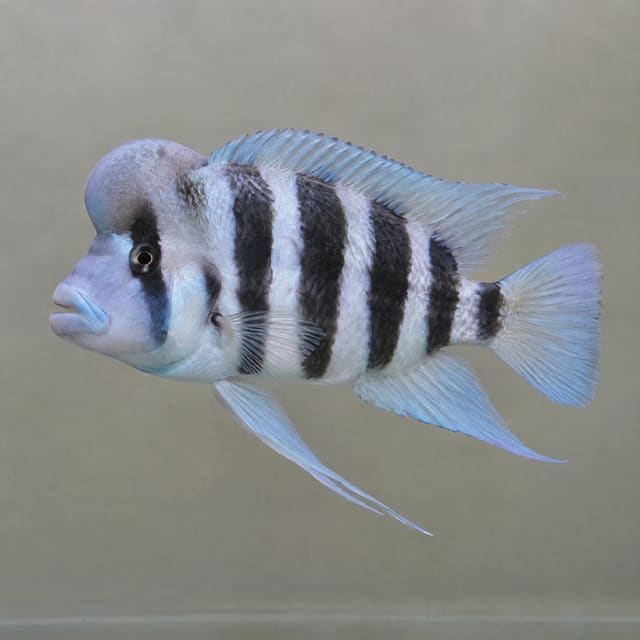
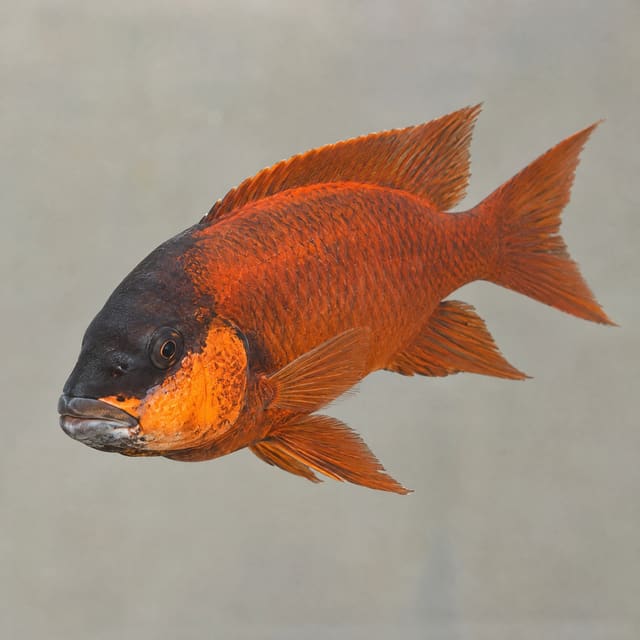
The Red Frontosa Cichlid is a colour strain of Cyphotilapia frontosa, the large, slow-moving humphead cichlid of Lake Tanganyika in East Africa. In place of the usual black bars on a white body, the Red Frontosa has broad reddish-brown to copper bars on a pale, pearly body. Seriously Fish lists it among the few selectively bred ornamental strains of the species and notes that it is also called 'copperband' after the colour of its bars, so every Red Frontosa is an aquarium-bred fish.
Frontosa are among the most impressive cichlids a fishkeeper can keep, and among the most demanding in space. They grow to around 30 cm, live in groups with a clear pecking order, need hard, alkaline, spotless water and take several years to mature. The Red Frontosa suits a keeper who is ready to build a very large Lake Tanganyika aquarium for a group of them. FishBase lists the wild species as Near Threatened on the IUCN Red List (assessed in March 2025), which is a good reason to choose aquarium-bred stock such as this strain.
| Name | What it means |
|---|---|
| Red Frontosa, Red Frontosa Cichlid | The trade name for the red-barred strain |
| Copperband frontosa | Another name for the same strain, according to Seriously Fish |
| Frontosa, 'front' | The hobby names for Cyphotilapia; Seriously Fish also records 'Tanganyika humphead' |
| Humphead cichlid | The English name used by FishBase and Seriously Fish |
| Cyphotilapia frontosa (Boulenger, 1906) | The scientific name; the genus name comes from the Greek for 'a hump' and Tilapia |
| Cyphotilapia gibberosa | The only other species in the genus, described in 2003; 'Blue Zaire' frontosas belong to it |
Seriously Fish explains that wild frontosa are usually sold by the place they were collected, to keep each bloodline pure. Most populations have six dark vertical bands on the body; the population from Kigoma, on the eastern side of the lake, has seven. Among the few bred strains it names are the red, or copperband, and the 'black widow', in which the bars are broken into large blotches.
| Fish | How it differs |
|---|---|
| Red Frontosa (this fish) | Bred strain with reddish-brown bars |
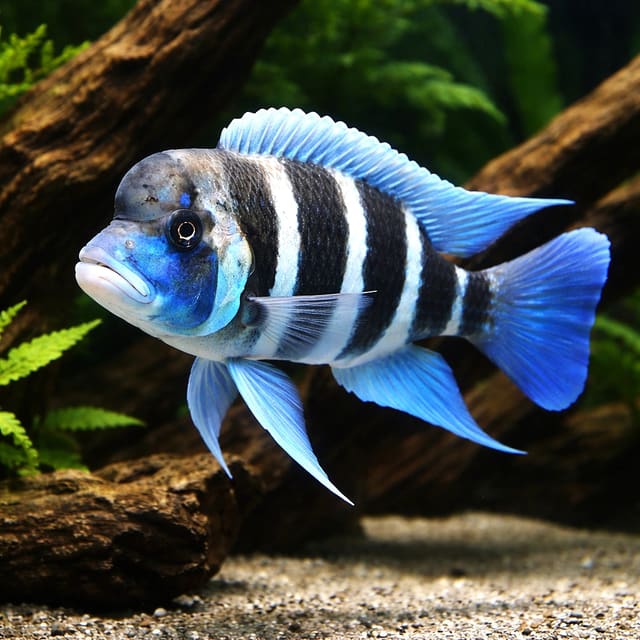
| Frontosa Cichlid | The classic black-barred form of the same species |
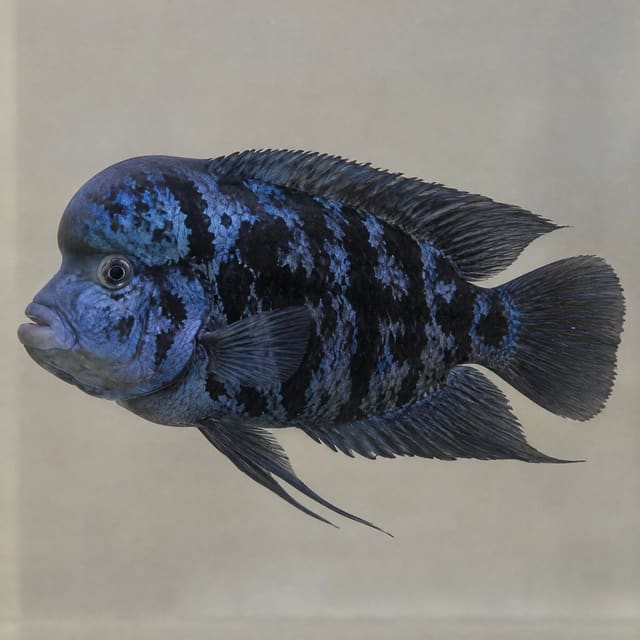
| Black Widow Frontosa | Bred strain with the bars reduced to large blotches |
| Kigoma Frontosa | A locality form; Seriously Fish says Kigoma fish have seven bars |
| Zambia Blue Frontosa | A blue form of the second species, C. gibberosa |
You can compare every form on our Cyphotilapia frontosa page, see the blue species on the Cyphotilapia gibberosa page, and browse the whole Lake Tanganyika cichlids category.
Frontosa are not fish to keep alone. Seriously Fish says they are gregarious and should be kept in a group of at least five, ideally ten or more. OATA says very few African lake cichlids do well singly and that frontosa do best in groups of over six, with more females than males to prevent fighting. FishBase likewise records several females to one male in aquariums.
Because young fish cannot be sexed, the usual approach is to buy a group of youngsters at the same time and grow them on together, so the hierarchy forms while they are small. Order the whole group in one go and choose the same size for all of them, so no single fish is much smaller than the rest.
The fish you receive is a few centimetres long, but the aquarium has to be planned for adults of around 30 cm, living as a group. The sources agree that frontosa are big; they differ on the exact figures.
| Source | Adult size | Aquarium |
|---|---|---|
| Seriously Fish | 255 mm standard length | 240 × 60 × 60 cm, about 864 litres, as the minimum for long-term keeping; more width and depth highly recommended |
| FishBase | 33 cm total length | More than 200 cm long |
| OATA | Over 30 cm | About 180 cm long, possibly more as they grow |
Standard length leaves out the tail, so the 255 mm and 33 cm figures describe similar fish. We recommend building towards the Seriously Fish size, because it is written for a group of adults kept for the long term.
In Lake Tanganyika, Seriously Fish says frontosa live along rocky, sediment-rich slopes between 6 and 120 metres deep, usually among boulders with patches of open sand between 15 and 70 metres, and form large aggregations that sometimes number a thousand fish or more, with the oldest and largest in deeper water. Shelter is scarce in that habitat, so the aquarium should give the fish a mix of open water and a few well-made refuges.
Seriously Fish suggests a sandy floor with piles of smooth, water-worn rocks of different sizes, some built into caves, and perhaps a few large boulders; earthenware flowerpots also work as refuges. Avoid sharp edges, which injure the fish. The dominant male usually claims a particular cave, so build enough caves big enough for the largest males, and add some smaller ones for females holding eggs. OATA recommends fine coral sand or a similar substrate to help buffer the water, rockwork that breaks up lines of sight to reduce aggression, and notes that African lake cichlids uproot all but the hardiest plants. Stack rocks on the glass floor before adding sand so digging cannot topple them.
| Zone | What to put there | Why |
|---|---|---|
| Centre and front | Open sand and clear water | A group of large fish needs swimming room |
| Back | Low piles of smooth rocks with large caves | Dominant males claim caves |
| Ends | Smaller caves or flowerpots | Refuges for females holding eggs and for lower-ranking fish |
| Lighting | Soft, not bright | Seriously Fish says frontosa prefer somewhat murky conditions; OATA says deeper-water fish may appreciate dimmer light |
Lake Tanganyika water is hard and alkaline, and frontosa need it that way. The three sources give these ranges:
| Source | Temperature | pH | Hardness |
|---|---|---|---|
| Seriously Fish | 23–27°C | 8.0–9.0 | 10–25 dGH |
| FishBase | 24–26°C | 8.0 and above | 8–12 dH |
| OATA (African lake cichlids) | 23–27°C | 8.0–8.6 | GH 12–18, KH 10–15 |
Where the sources overlap, aim for 24–26°C, pH 8.0–8.6 and 12–18 dGH, with carbonate hardness of 10–15 dKH as OATA suggests. FishBase's hardness figure is lower than the others, so treat the low teens as the bottom of the range rather than the target. Above all, keep the values steady.
Seriously Fish warns that frontosa need hard, alkaline conditions and in most cases will not thrive in untreated tap water. UK tap water ranges from very soft to very hard depending on where you live, so test pH, GH and KH before you buy. If your water falls short, raise and buffer it with a coral sand substrate, as OATA suggests, or with products made for African lake aquariums, and adjust slowly. Treat every refill with tap water conditioner to remove chlorine and chloramine. Our water parameter matcher checks your readings against the fish, and the water chemistry guide explains pH, GH and KH.
Waste readings matter even more than habitat values. Seriously Fish describes frontosa as extremely sensitive to deteriorating water quality and says they should never go into a biologically immature aquarium. OATA's limits are zero ammonia, zero nitrite, and nitrate no more than 20 mg per litre above your tap water.
For an aquarium of 864 litres, Seriously Fish suggests turning the water over four to five times an hour with three filters of 1,150–1,440 litres per hour each, using external canisters, a sump or both, and heating with roughly 200–300 W across three heaters in a room at about 20°C. It also says high flow rates should be avoided, so point the outlets to keep the current gentle. OATA recommends an oversized filter and vigorous aeration so there is plenty of dissolved oxygen.
Our cichlid care guide sets out the same routine for other cichlids.
In the wild, Seriously Fish describes the frontosa as a generalised predator of smaller fish, large invertebrates and molluscs, with some algae and detritus swallowed while browsing; FishBase records snails, mussels and fish. In the aquarium Seriously Fish recommends high-quality prepared foods with live or frozen brine shrimp, mosquito larvae and shrimp, and says some of the dried food should contain a good share of vegetable matter such as spirulina, with chopped peas as a useful extra.
Two things to avoid, according to Seriously Fish: mammal or bird meat such as beef heart or chicken, whose fats the fish cannot properly digest and which can cause fat deposits and organ damage, and 'feeder' fish such as small livebearers or goldfish, which can carry parasites and disease and are of little food value. OATA suggests pellets with a higher animal content plus frozen brine shrimp, prawns or cockles for the larger, predatory lake cichlids, fed twice a day in amounts the fish clear within a few minutes.
| Part of the meal | What to use | How to use it |
|---|---|---|
| Staple | A high-quality cichlid pellet with a high animal content, sized for the mouth | The base of most meals; small pellets for young fish |
| Frozen food | Brine shrimp, mosquito larvae, shrimp, prawn, cockle | Rotated through the week |
| Plant part | A spirulina-rich dried food or chopped peas | A regular share of the diet |
| Amount | What the group clears in a few minutes | Twice a day (OATA); remove leftovers |
Only add frontosa to an aquarium whose filter is fully matured. OATA advises checking that ammonia and nitrite are zero before any fish goes in and building up the population gradually, because stocking too quickly causes new tank syndrome. For African lake cichlids it adds that some species are best added as a group, so no single newcomer takes all the aggression, that peaceful species should go in first and more aggressive ones later, and that rearranging the décor helps when new fish join.
Acclimatise with OATA's floating bag method: lights off, float the bag for about 10 minutes, add small amounts of aquarium water over up to 20 minutes, then net the fish into the aquarium with as little bag water as possible. Because hardness and pH may differ between the bag and your aquarium, take the mixing slowly.
| When | What to do | What to look for |
|---|---|---|
| Arrival day | Acclimatise the whole group together, keep the lights off and the room quiet | Steady breathing; fish settling among the rocks |
| The next day | Offer a small meal; test ammonia and nitrite | Interest in food; zero readings |
| Rest of the first week | Keep meals small, test the water every few days, watch the pecking order form | Clear eyes, intact fins, no fish pinned in a corner |
Seriously Fish says frontosa may eat much smaller fish but can form part of a well-chosen Tanganyikan community in a big enough aquarium. Males do not hold fixed territories like many cichlids; instead the group forms a dominance hierarchy with one or more alpha fish, depending on the group's size and the space available. OATA's general rule is to stock African lake cichlids only with species from the same lake, and it does not recommend mixing Malawi and Tanganyika cichlids because of their different temperaments and behaviour.
| Suits a Red Frontosa group | Avoid |
|---|---|
| Its own kind, in a group of five to ten or more | Keeping a single frontosa |
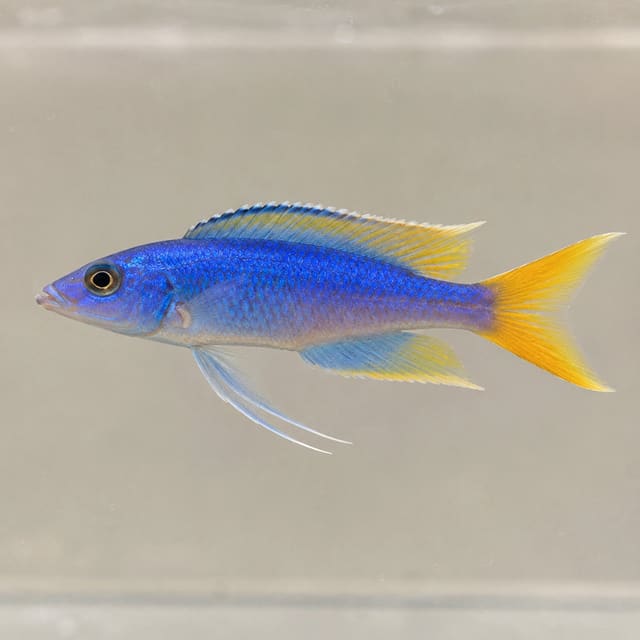
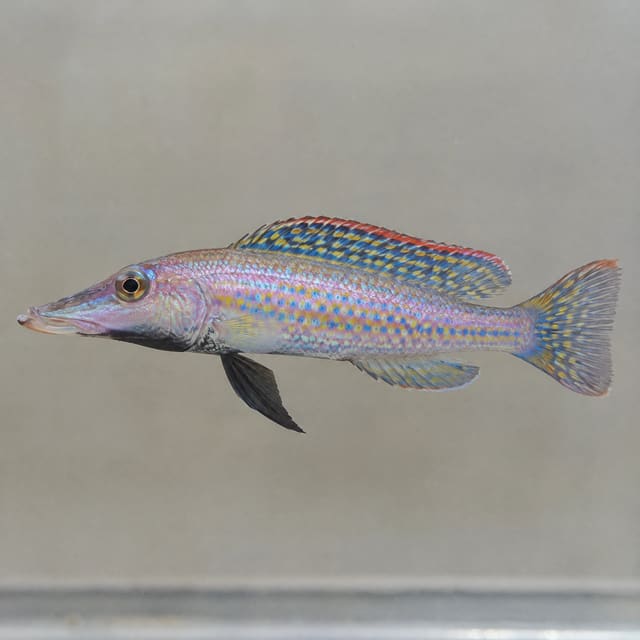
| Larger Tanganyikan cichlids such as the featherfin Cyathopharynx furcifer, which FishBase gives as 21 cm long and living in groups off rocky slopes | Small fish and shrimp that fit in a frontosa's mouth |
| Other robust Lake Tanganyika fish that share the same hard, alkaline water | Malawi cichlids (OATA) and soft-water fish from South America or Asia |
| Fish that accept a calm, dimly lit aquarium | Other frontosa forms, if you want pure-bred young |
On our site, the Furcifer Featherfin Cichlid and the other Cyathopharynx featherfins are the classic large companions; check every candidate's adult size first. Keep frontosa away from our Malawi cichlids, and run your final list through our tank mate checker.
Frontosa show stress quickly when the water slips. OATA's list of changes to watch for applies to every fish in the group: swimming (hanging at the surface, sitting on the bottom or swimming erratically), colour (darker or paler than normal), temperament (more aggression or more hiding), breathing (gill covers moving faster or slower), appearance (white spots, fluffy growths, damaged fins or scales), condition (weight loss or gain) and feeding (less interest in food). Clamped fins, flicking against décor and shimmying are further warning signs.
| What you see | What to do first |
|---|---|
| Fast breathing, fish at the surface | Test ammonia and nitrite at once, do a partial water change and check filters and aeration |
| One fish hiding constantly or with torn fins | Watch for bullying; add refuges or rearrange rocks to break sight lines |
| Clamped fins, flicking, shimmying | Test the water, including pH and hardness, and look closely for spots or growths |
| White spots, fluffy patches, swellings | Seek advice from an aquatic specialist or vet before treating |
| A female with a full throat refusing food | Likely holding eggs; leave her in peace (see breeding) |
Seriously Fish describes the frontosa as a maternal mouthbrooder that is commonly bred in aquariums. Adult males grow larger than females, with longer fins and a bigger forehead hump, and each male should ideally have at least three or four females. Sexual maturity takes several years, so a group bought young needs patience.
The eggs are very large and few, usually 10–50 depending on the female's size. She picks them up as soon as they are fertilised and carries them, and then the fry, in her mouth for a long time: 35–50 days or more. FishBase and Seriously Fish both describe how a brooding female takes in food that the young in her mouth can eat, even while they still have large yolk sacs; Seriously Fish suggests offering brooding females regular meals of newly hatched brine shrimp, and says the fry are not released until they can survive on their own. Some breeders strip the eggs or fry from the female and raise them in an egg tumbler, but Seriously Fish says this is not for beginners.
Browse our African cichlids for more fish from Lake Tanganyika and the other African lakes.
It is a selectively bred colour strain of the frontosa or humphead cichlid, Cyphotilapia frontosa, from Lake Tanganyika. Seriously Fish lists it as the 'red' strain, also called 'copperband' because the dark body bars are reddish-brown instead of black. Its care is the same as for any frontosa.
No. It is the same species bred for colour. The blue 'Zaire' frontosas are different: Seriously Fish places them in a second species, Cyphotilapia gibberosa, described in 2003.
Very large. Seriously Fish gives 255 mm standard length, FishBase 33 cm total length, and OATA says frontosa can grow to over 30 cm. Plan for a fish of around 30 cm.
Seriously Fish gives 240 × 60 × 60 cm (about 864 litres) as the minimum for long-term keeping and recommends more width and depth. FishBase gives more than 200 cm and OATA about 180 cm or more. We recommend planning for the 240 cm figure.
A group. Seriously Fish says at least five, ideally ten or more; OATA says frontosa do best in groups of over six and that more females than males helps prevent fighting. One purchase is one fish, so add the quantity you need.
No. Seriously Fish says juveniles are impossible to sex accurately. Adult males grow larger, with longer fins and a bigger hump on the forehead.
Hard, alkaline, very clean water. Where the sources overlap, aim for 24–26°C, pH 8.0–8.6 and 12–18 dGH, with zero ammonia and nitrite. Seriously Fish warns that most untreated tap water is not suitable, so test yours first.
OATA does not recommend mixing Malawi and Tanganyika cichlids because of their different temperaments and behaviour. Keep frontosa with other Lake Tanganyika fish that are too big to be eaten.
Two: Small, the smaller and cheaper grade, and 5–6 cm. Each purchase supplies one unsexed fish of the size you select; the photographs show the strain, not the individual.
No reviews for this item yet. Bought one? Honest reviews only, good or bad.
What customers say about ordering from us
Easy website plenty of info on fish your buying great to pick a time slot
TRACEY DURRANT · 7 Oct 2026
Got some lovely fish thank you
Kevin Mackie · 7 Oct 2026
Reviews of our shop, collected by Judge.me, an independent third-party review collector. Newest first.
Moved by UK carriers licensed to handle live animals
Hand-packed with oxygen bags, poly box, heat pack
Email photos the same day; an optional unboxing video helps us review problems faster — claim terms apply
Klarna & PayPal Pay in 3 at checkout