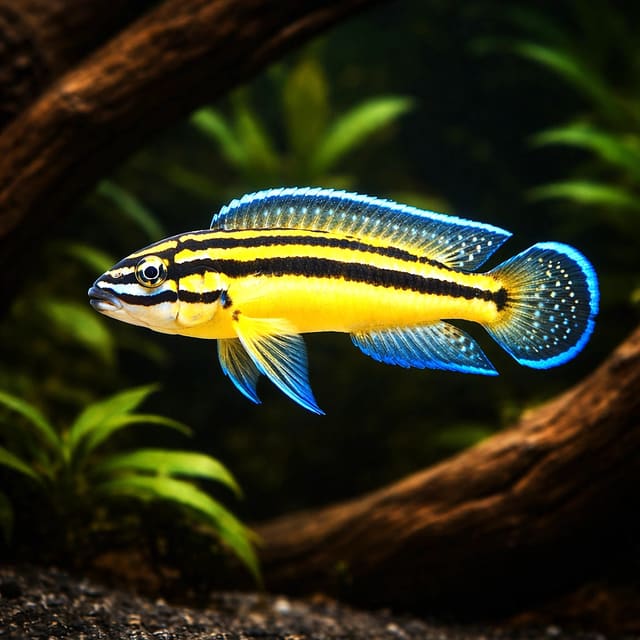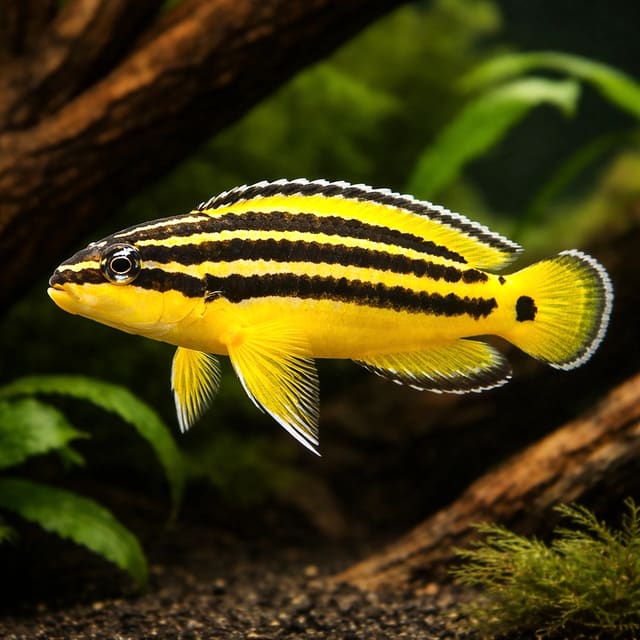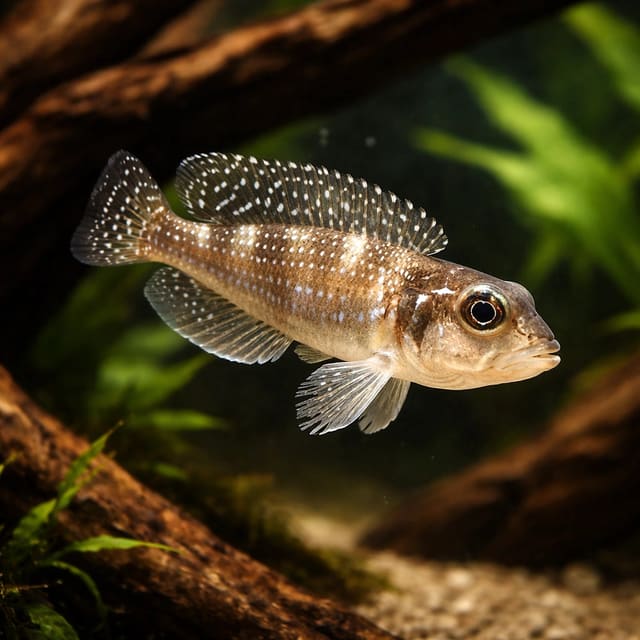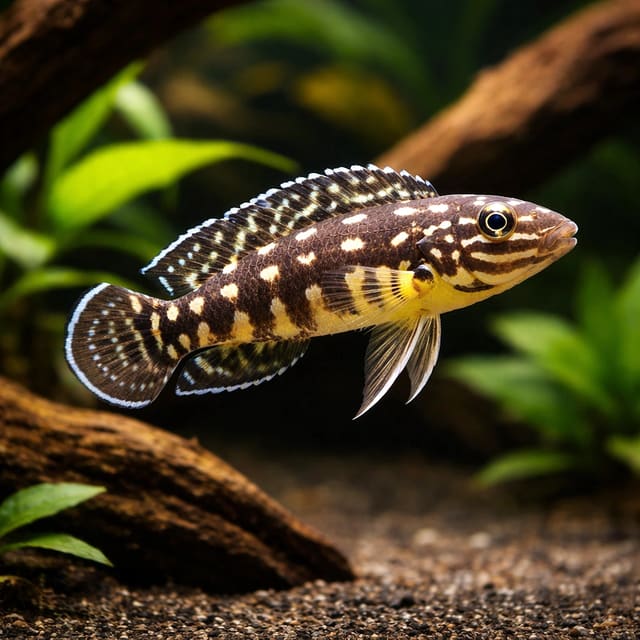
Marlier's Julie (Julidochromis marlieri)
23–25°C · pH 8–8.6 · 110L
£8.99

Choose one unsexed Neolamprologus longicaudatus in an approximate 3-4 cm or 4-5 cm living size grade. This territorial Lake Tanganyika rock cichlid needs a mature aquarium, hard alkaline water, separate retreats and an adult territory plan; ordering two does not guarantee a pair.
Neolamprologus longicaudatus
Save when buying multiple fish. Each quantity is one fish; sex and pair formation are not guaranteed unless the selected variant explicitly states them.
Confirm your email, then we’ll send an availability message for this exact item if it returns within 180 days.
This request is only for this product—no newsletter or other promotions. A mail-provider retry may very rarely duplicate the same availability message. Unconfirmed addresses are removed after 48 hours. See our privacy policy.
Choose one unsexed Neolamprologus longicaudatus in an approximate 3-4 cm or 4-5 cm living size grade. This territorial Lake Tanganyika rock cichlid needs a mature aquarium, hard alkaline water, separate retreats and an adult territory plan; ordering two does not guarantee a pair.
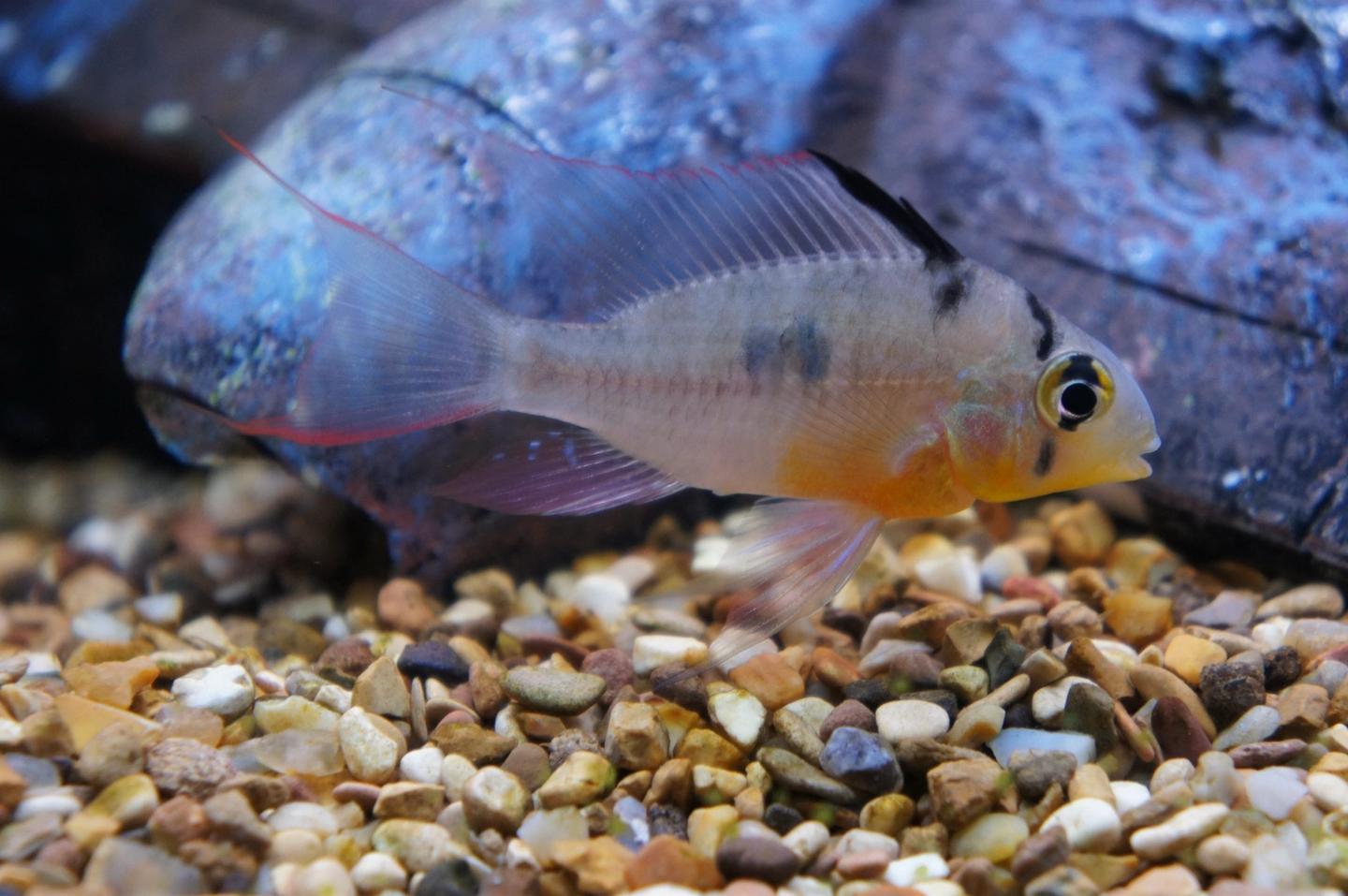
Cichlids are a family of roughly 1,800 accepted species, not one care type. Before buying, identify the exact species and source, then compare adult measurement, usable tank dimensions, social system, territory, tested water, diet and an exit plan. No family-wide minimum tank, water range or tank-mate list is safe.
Maintain these water conditions for optimal health and vibrant colors
Neolamprologus longicaudatus is an elongated Lake Tanganyika cichlid with a deeply curved tail and trailing fin extensions. It is a specialist rock-dweller for a mature, hard-water aquarium: the right home has secure stonework, several independent retreats, clean oxygen-rich water and enough footprint to manage territory as the fish matures.
This product has two selectable living size grades, approximately 3-4 cm and 4-5 cm. Each selected quantity is one unsexed fish in the chosen grade. Two fish are not guaranteed to be male and female, compatible or bonded, and a multi-buy option is not a biological pair certificate.
The care guidance below separates published species facts from aquarium practice. The species description and FishBase support its accepted identity, western Lake Tanganyika distribution, elongated form, rocky habitat, invertebrate diet and mainly solitary wild observations. Pairing, harem structure, cave spawning and tank-size figures come from specialist aquarium sources, which do not agree on every detail; those differences are shown rather than hidden.
| Accepted scientific name | Neolamprologus longicaudatus Nakaya & Gashagaza, 1995 |
|---|---|
| Family / tribe | Cichlidae / Lamprologini |
| Natural range | Western Lake Tanganyika, between the Ubwari Peninsula and Kavalla Islands region of DR Congo |
| Supplied sizes | Choose approximately 3-4 cm or 4-5 cm |
| Sale unit | One unsexed fish per selected quantity; no pair, sex or pictured-individual guarantee |
| Recorded adult measurement | FishBase: 8.6 cm standard length; specialist aquarium sources report up to about 15 cm total length including the unusually long tail |
| Care level | Moderate to advanced specialist cichlid care |
| Temperament | Territorial around rockwork; most often solitary in published wild observations |
| Aquarium plan | At least a 100 cm frontage / around 150 litres is a cited specialist floor for a carefully managed established fish or compatible pair; around 300 litres is the more conservative reference for mixed or multi-fish plans |
| Aquarium temperature | About 24-27°C; keep the chosen value stable |
| Aquarium water | Hard, mineral-rich and alkaline; a practical planning target is about pH 8.0-9.0 |
| Diet | Carnivore; quality correctly sized cichlid food with varied aquatic invertebrate foods |
| Natural habitat | Rocky areas, commonly recorded around 12-15 m depth |
| Page choice | What is supplied | What is not promised |
|---|---|---|
| 3-4 cm | One unsexed young fish in the approximate smaller living grade | An exact ruler measurement, sex, adult colour or the pictured individual |
| 4-5 cm | One unsexed young fish in the approximate larger living grade | Maturity, sex, pair status or breeding readiness |
| Quantity of two or more | The selected number of individual fish | A male-female pair, compatibility, hierarchy or future bond |
Fish grow continuously and are not manufactured to a fixed length, so the chosen band is an approximate dispatch grade. Fin extensions, posture and normal measurement variation can also affect how long an individual appears. Select the grade you prefer, but prepare for the same adult territory and water needs in either case.
This species was formally described in 1995 by Kazuhiro Nakaya and Masta Mukwaya Gashagaza from three specimens collected along the northern Zairean coast, now the Democratic Republic of the Congo side of Lake Tanganyika. The original description compares it with N. furcifer, N. christyi and N. buescheri, then distinguishes it through a combination of characters rather than a single colour mark.
Useful features include an elongated body, small eye, long pointed snout and a strongly emarginate or crescent-like caudal fin. The body was described as light greyish brown and the vertical fins are partly scaled. Aquarium colour can shift with age, background, hierarchy, lighting and transport stress, so a pale or dark newly arrived juvenile should not be judged against one fixed promotional colour.
The name longicaudatus draws attention to the long tail. Mature fish can develop conspicuous filament-like extensions that make the outline look longer and more dramatic than the central body alone. This detail matters when comparing published size numbers and when leaving clearance around sharp stone.
FishBase records the species as endemic to Lake Tanganyika between the Ubwari Peninsula and Kavalla Islands region on the DR Congo coast. It is associated with rocky habitat and is commonly recorded at about 12-15 metres. This is a geographically specific Tanganyika fish, but our stock records for the current batch does not state a collection point, breeder, wild-caught status or captive-bred status. The listing therefore does not invent one.
Published ecology describes it as most often solitary, feeding on invertebrates and spending more time visible outside rocky caves than the related N. buescheri. That does not mean it ignores shelter. In an aquarium it still needs cracks, shaded boundaries and routes through rockwork, but the goal is a connected territory rather than one decorative cave at the centre of an otherwise bare tank.
Natural depth is context, not an instruction to make the display dark. Moderate lighting, shaded recesses and a background that reduces reflections are usually enough. Stable water, secure territory and low conflict matter more than trying to reproduce the exact brightness at 12 metres.
FishBase records a maximum of 8.6 cm standard length. Standard length is measured from the snout to the base of the tail and therefore excludes the caudal fin. Specialist Lake Tanganyika references often quote up to about 15 cm total length, which includes the very long tail and its extensions. These figures use different measurement conventions and should not be treated as a simple contradiction.
| Measurement | What it includes | How to use it |
|---|---|---|
| 8.6 cm standard length | Body from snout to the tail base | Published species record in FishBase |
| Up to about 15 cm total length | Body plus the unusually extended tail | Conservative aquarium-space planning from specialist sources |
| 3-4 cm or 4-5 cm supplied grade | Approximate live juvenile size at dispatch | Choose the current grade, while planning for the adult outline |
Use the larger tail-inclusive figure when checking passages and sight lines. A narrow-bodied fish can enter tight gaps, yet long rays can be damaged by jagged edges or frantic chasing. Smooth stone faces and multiple exits are safer than blind holes.
There is no honest one-number answer for every setup. The Nordic Cichlid Society lists a 100 cm aquarium frontage and about 150 litres. Another specialist Tanganyika reference recommends 300 litres and discusses pairs, harems and mixed communities. Those recommendations describe different stocking risks, and litres alone do not show the footprint left after rock displacement.
| Long-term plan | Practical interpretation | Main condition |
|---|---|---|
| One established fish | Use at least a 100 cm frontage / around 150 litres as a specialist floor | Several retreats, stable water and no cramped cave rivals |
| Known compatible pair | Start from the same footprint only with careful observation and separation capacity | Two independent refuge zones; compatibility cannot be forced |
| Two unsexed juveniles | Do not assume they will become a pair; use more territory and keep a removal plan | Future sex and hierarchy are unknown |
| Mixed Tanganyika aquarium | Around 300 litres or more is the more conservative planning reference | Separate rock territories plus open water for species using other zones |
| Harem or group experiment | Advanced only, substantially larger than a pair setup | Many sight breaks, close monitoring and spare accommodation |
Footprint, rock volume, sex, adult size, individual aggression and the ability to divide territory all matter. Use the tank volume calculator to estimate real water volume, then judge the usable floor area after stonework. A tall narrow aquarium with 300 litres can offer less useful territory than a lower, longer tank.
Place heavy rocks directly on a protected tank base before adding sand, or use a stable support method designed for aquarium loads. The structure must not shift if a fish excavates around it. Build several passages and recesses with more than one exit, then use separate rock groups and broken sight lines so one fish cannot watch every shelter from a single position.
Fine sand suits the visual character of a Tanganyika setup and lets waste remain easier to see around open areas. Keep a clear feeding lane and enough service space to siphon debris. Do not pack every centimetre with stone: the fish needs room to turn its long tail, and the keeper needs access for maintenance.
| Layout feature | Purpose | Common mistake |
|---|---|---|
| Several separate rock zones | Creates more than one defensible area | One central pile that becomes the only territory |
| Narrow passages with two exits | Provides security without trapping a chased fish | Blind ornaments or sharp holes |
| Open sand lane | Supports feeding, observation and cleaning | Rockwork that traps all food and waste |
| Tight-fitting lid | Reduces escape risk during chasing or arrival stress | Open gaps around cables and filters |
| Moderate light and shaded recesses | Allows choice between display and cover | Harsh light with no visual shelter |
Our stock records do not provide a batch-specific care range. Specialist aquarium guidance places this fish in warm, hard, alkaline Tanganyika conditions. A sensible routine target is about 24-27°C and pH 8.0-9.0, with adequate carbonate buffering and mineral content for a Tanganyika aquarium. Choose a stable point your source water and intended companions can share rather than adjusting the tank every day to chase an exact number.
| Parameter | Aquarium planning guidance | Why it matters |
|---|---|---|
| Temperature | About 24-27°C | Avoid rapid swings during water changes and acclimation |
| pH | About 8.0-9.0, stable | Tanganyika fish are poorly suited to soft acidic community conditions |
| GH and KH | Hard, mineral-rich water with reliable buffering; test both | pH alone does not describe mineral stability |
| Ammonia / nitrite | 0 mg/L | Add only to a fully cycled aquarium |
| Nitrate | Keep low and steady through feeding control and water changes | Long-term quality matters more than a one-off clean test |
| Oxygen | Strong gas exchange without blasting every shelter | Warm, protein-fed cichlid systems need dependable aeration |
If your tap water is naturally soft, make the mineral plan before ordering. Test a prepared water-change batch and confirm that the aquarium remains stable between changes. Our water parameter matcher is a useful first comparison, but measured GH, KH and pH in your own tank are the deciding evidence.
Use mature biological filtration sized for the real stock and feeding load. Surface movement or additional aeration should keep oxygen high, while the flow around caves should still allow the fish to rest. Intake guards and secure pipework help prevent a young fish entering an unsafe gap.
Feed measured portions, remove trapped food and siphon exposed waste. Regular moderate water changes are usually safer than neglect followed by a dramatic correction. Match replacement water for temperature and chemistry, and never use a water change to force a sudden pH shift.
Test whenever behaviour changes. Rapid breathing, surface hanging, clamped fins or unusual hiding can begin with water quality, oxygen or conflict even when they resemble disease. Check the system before reaching for medication.
Published natural-history information describes invertebrate feeding. In the aquarium, use a reputable carnivorous or Tanganyika cichlid food in a size the juvenile can swallow, supported by varied frozen aquatic invertebrates. A balanced prepared staple is more dependable than trying to imitate the wild diet with one rich food.
| Food | Role | Use |
|---|---|---|
| Quality correctly sized carnivorous cichlid pellet or granule | Regular staple | Offer a small amount the fish can finish promptly |
| Frozen mysis, brine shrimp or similar aquatic invertebrates | Variety and settling support | Rotate rather than feeding one item exclusively |
| Small krill or prawn-based foods | Occasional variety | Size carefully and avoid heavy portions |
| Feeder fish | Not needed | Avoid the disease and nutritional risks |
| Mammal or poultry meat | Unsuitable routine food | Do not use as a staple |
Watch each fish eat. A deliberate rock-dweller can lose food to fast open-water fish even when plenty enters the tank. Target food near its route without pushing leftovers into caves. A persistently pinched belly, swollen abdomen, stringy waste or refusal to eat needs investigation.
FishBase says the species is most often found solitary in its rocky habitat. That is the strongest concise wild social observation available here. Specialist aquarium sources, however, describe pair formation or one male with several females, strong aggression between members of the same species and cave-oriented breeding.
Those accounts are not identical, so the safest buying advice is practical: do not assume that two unsexed juveniles will form a stable pair, and do not buy several fish without enough territory and spare accommodation. Compatibility can change at maturity or when breeding begins. A calm juvenile phase does not prove an adult arrangement will remain calm.
A settled fish may spend visible time patrolling outside its chosen recess, which fits the species account, but it should always be able to leave another fish's line of sight. Repeated cornering, blocked access to food, torn fins or one individual remaining at the surface are intervention signs, not normal hierarchy to ignore.
No named species is automatically safe. Start with full water overlap, then compare adult size, feeding speed, swimming zone and demand for the same caves. The main question is not whether two species have both been called Tanganyika cichlids; it is whether the individual aquarium gives each fish a workable territory and feeding route.
| Candidate | Risk level | Decision test |
|---|---|---|
| Open-water Tanganyika fish of suitable adult size | Possible in a larger setup | They must share chemistry and leave the rock zone available |
| Other rock-dwelling Lamprologini | Case by case | Provide separate territories and watch for cave competition |
| Another unsexed N. longicaudatus | Potentially high as adults | Do not assume pair formation; keep a separation plan |
| Very small fish, fry or ornamental shrimp | High prey risk | Avoid animals that may be swallowed or hunted |
| Soft-water community species | Unsuitable | The chemistry requirement does not overlap |
| Boisterous cave competitors | High conflict risk | Avoid fish that occupy every refuge or exclude this species from food |
To compare other Lake Tanganyika listings without treating them as automatic tank mates, see the Jumbo Yellow Sardine Cichlid, Marlier's Julie, Striped Julie Kipili and Golden Julie. Use those pages for size and water comparison, then make the final decision from the actual aquarium.
Specialist aquarium sources describe this species as a cave spawner, but the reported social arrangement differs: one account describes harem breeding, while another describes a pair with the female tending the cave and the male guarding the entrance. The Nordic Cichlid Society reports pair formation and strong intraspecific aggression.
This background helps explain why multiple caves and territory are important, but it does not turn a juvenile order into a breeding group. The fish offered here is unsexed and is not sold as bonded, mature or breeding-ready. If breeding is the goal, plan a specialist setup, allow fish to choose rather than forcing two adults together, and keep a safe way to remove an incompatible individual.
During spawning, a previously manageable fish may defend a larger area. Other residents need routes that do not cross the breeding cave, and the keeper must be prepared to separate fish before injuries develop.
| Gallery position | What it is | What it is not |
|---|---|---|
| First image | A representative illustration created from the product identity before the supplier source photo was added | Not based on the later reference image and not the exact fish supplied |
| Second image | The retained supplier source photo for this product | Not a promise of the exact dispatch individual, sex, size or colour |
Both images remain in the existing gallery and in the existing order. Living fish vary with age, condition, sex, hierarchy, lighting and stress. Use the gallery to understand the species' elongated form and long tail, while using the selected size grade and written sale-unit statement for what the order contains.
Prepare the aquarium before dispatch: confirm zero ammonia and nitrite, stable temperature and pH, strong gas exchange, secure rockwork and an available retreat. Keep lights low during introduction. Follow the current fish acclimation guide and use the acclimation timer so the process is deliberate rather than guessed.
| Settling sign | Warning sign | First response |
|---|---|---|
| Steady breathing and controlled movement near cover | Gasping, loss of balance or persistent surface hanging | Check temperature, oxygen, ammonia, nitrite and acclimation mismatch |
| Gradual interest in small food | Continued refusal with a pinched belly | Reduce stress, verify food access and assess health |
| Open fins and use of several routes | Clamped fins, torn edges or being trapped in one corner | Investigate aggression and separate if needed |
| Normal colour variation while settling | White spots, excess mucus, sores or rapidly worsening marks | Test water, isolate where practical and seek a diagnosis |
Eligible livestock orders are protected by the current Live Arrival Guarantee when its delivery and evidence conditions are followed. Read that page before choosing a dispatch date. Eligible first-time customers can use WELCOME10 for 10% off a first order, but aquarium readiness should decide the purchase.
Choose this fish if you already run, or are deliberately building, a mature Lake Tanganyika aquarium and enjoy subtle territorial behaviour around stone. It suits a keeper who can test hard alkaline water, judge usable footprint after rockwork and intervene if an unsexed social plan fails.
Skip it for a new or uncycled tank, a soft-water community, a small aquarium built around one cave, or a display containing tiny fish and ornamental shrimp. It is also the wrong purchase if you need a guaranteed sexed pair. The species is rewarding because of its unusual form and behaviour, not because it is a generic cichlid that can be added to any hard-water tank.
Each selected quantity is one unsexed live fish in the chosen approximate 3-4 cm or 4-5 cm living size grade. The order does not promise an exact ruler measurement, sex, colour pattern or the individual shown in an image.
No. Two young fish may mature as any sex combination and may not be compatible. A quantity discount does not certify a bonded pair, and you need enough territory plus a separation plan before ordering more than one.
FishBase records 8.6 cm standard length, which excludes the tail. Specialist aquarium references report up to about 15 cm total length, including the unusually long tail and extensions. Plan passages and adult space around the larger outline.
A specialist society cites 100 cm frontage and around 150 litres, while another Tanganyika source recommends 300 litres. Treat the lower figure as a floor for a carefully managed established fish or known compatible pair; use around 300 litres or more for mixed or multi-fish plans.
Plan for stable hard, mineral-rich and alkaline water at about 24-27°C and pH 8.0-9.0. Test GH, KH and pH, maintain zero ammonia and nitrite, and avoid repeated chemical adjustment to chase one exact number.
It is associated with rocky habitat and needs caves and passages, although FishBase says it is seen outside caves more often than N. buescheri. Build several connected retreats rather than one isolated ornament.
Published wild information says it is most often solitary. Specialist aquarium sources report pairs or harems and disagree on breeding roles. Do not assume a purchased group will organise safely; judge the actual fish and keep a separation option.
Natural records describe invertebrate feeding. Use a quality correctly sized carnivorous cichlid staple and rotate suitable frozen aquatic invertebrates such as mysis or brine shrimp in measured portions.
Possibly in a large, carefully structured aquarium, but no named species is automatically safe. Compare exact water needs, adult size, feeding speed and cave use, then give each fish a separate territory and monitor behaviour.
That is not recommended. Small fish, fry and ornamental shrimp may be treated as prey, and a territorial chase can be dangerous even when an animal is not swallowed.
Support heavy stone securely, create several independent zones, include passages with more than one exit and leave open sand for feeding and maintenance. Avoid unstable piles, sharp gaps and one cave that every fish must contest.
No sex is promised. The available size grades are young fish, and external sex differences may not be dependable enough for a guaranteed selection.
Specialist aquarium sources report cave spawning, but they differ on whether pair or harem behaviour is typical. That is species-care context only; the fish sold here is not promised as mature, sexed, paired or breeding-ready.
No. The first image is a representative made before the supplier source was added, and the second is the supplier source photo. Neither is the exact selected dispatch fish; living colour, markings, tail development and size vary.
Stock is shown by the live variant selector and can change independently of this evergreen care guide. Static stock wording becomes inaccurate, so use the current page controls for availability.
Eligible livestock orders are covered when the current delivery, timing and evidence terms are followed. Review the delivery page before dispatch and contact Tropical Fish Co promptly if an arrival problem occurs.
Identity and diagnostic morphology were checked against the open-access 1995 species description by Nakaya and Gashagaza in the Japanese Journal of Ichthyology. Distribution, rocky habitat, recorded depth, maximum standard length, solitary observation and invertebrate diet were checked against FishBase.
Aquarium temperature, pH, tank dimensions, aggression and spawning context were compared across the Nordic Cichlid Society species register and a specialist Lake Tanganyika species reference. Their different tank-size and social recommendations are retained as planning context instead of being flattened into false certainty.
No reviews for this item yet. Bought one? Honest reviews only, good or bad.
What customers say about ordering from us
I have a small group of long finned mountain minnows. So was delighted to be able to order ten of this variety to increase the genetics in my tank . The ones I recieved are healthy but it’s to early to give a verdict on wether they are of a long finned type since they are small currently.
Gordon Walker · 23 Sept 2026
100% success travel and "installation". Pleased with quality of purchase. The Siamese fighter a bit "shy" so have not yet seen him at his best yet but looking good. Happy customer. GG
George E Garratt · 21 Sept 2026
Reviews of our shop, collected by Judge.me, an independent third-party review collector. Newest first.