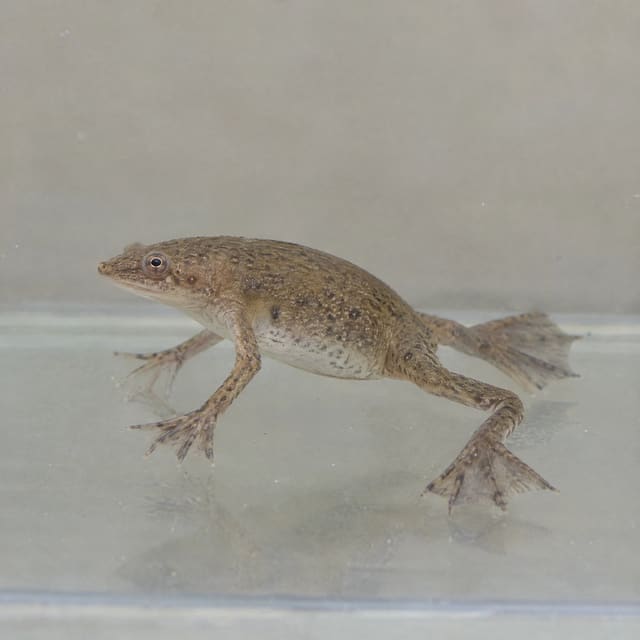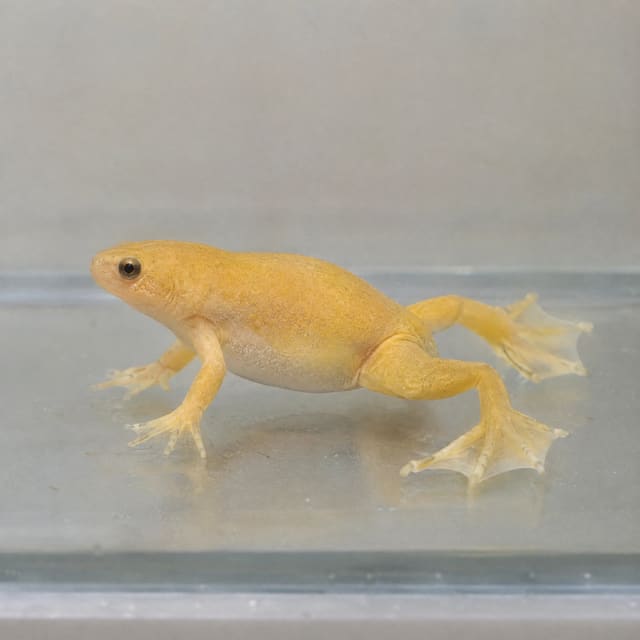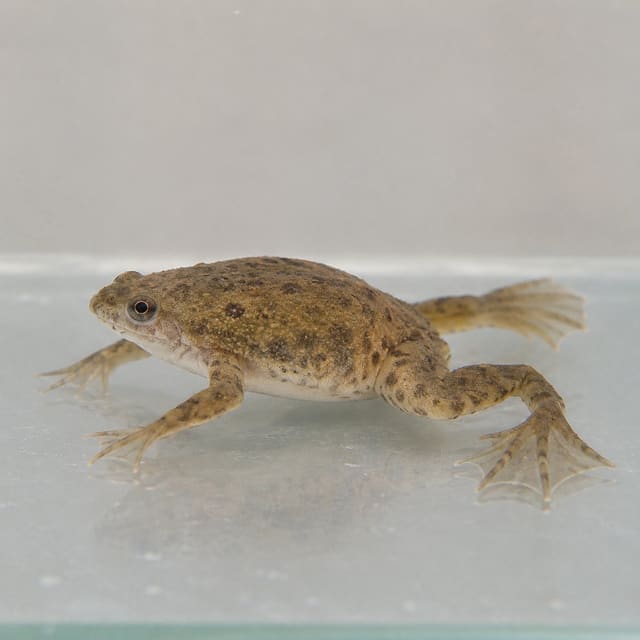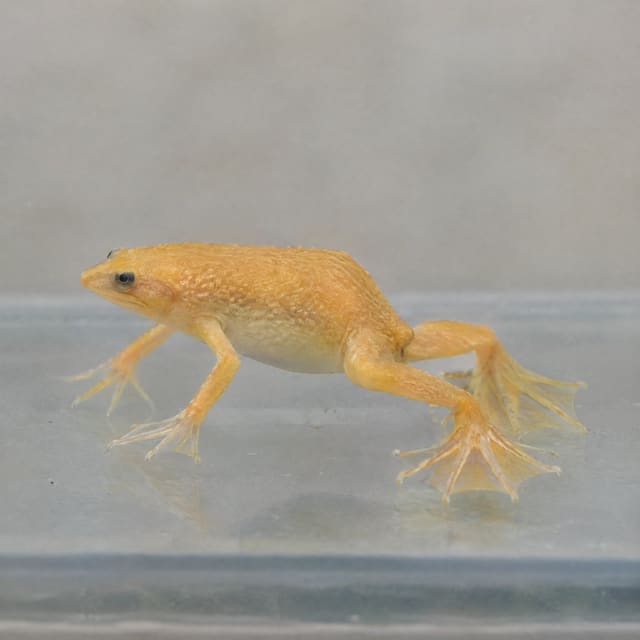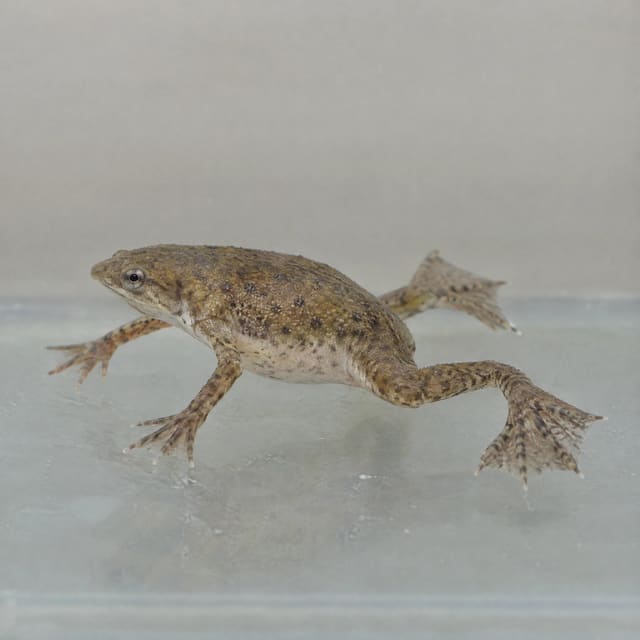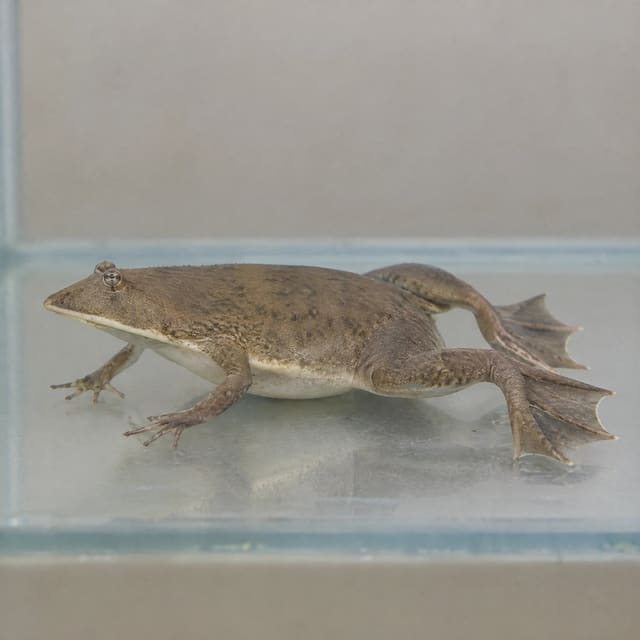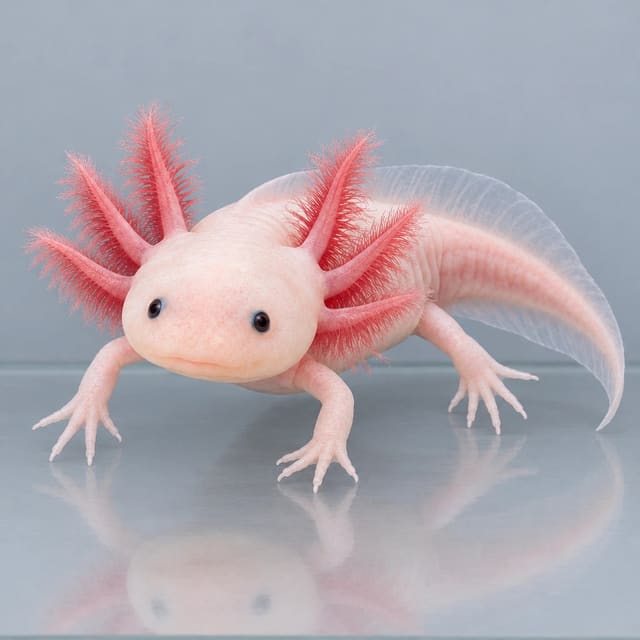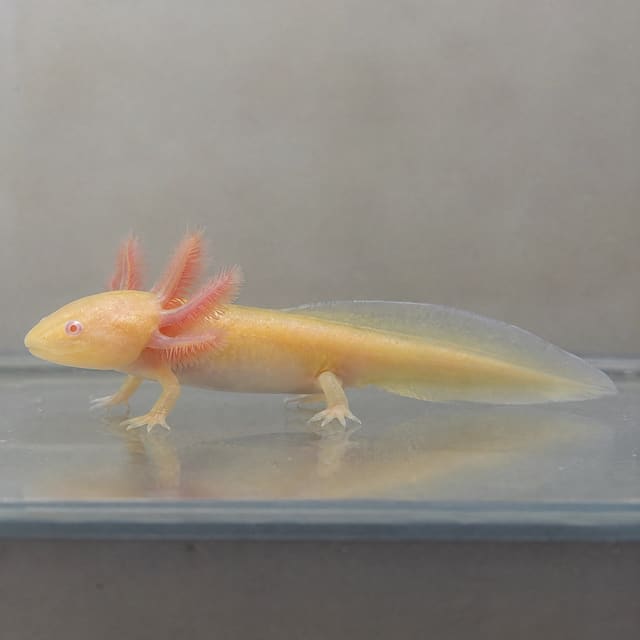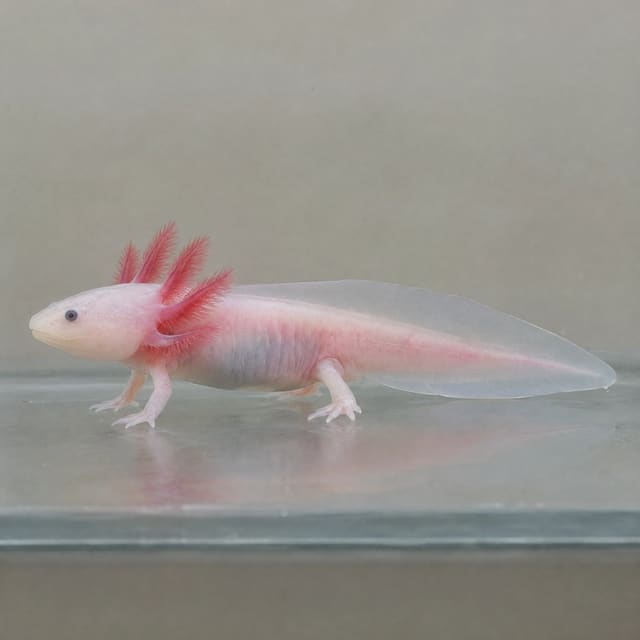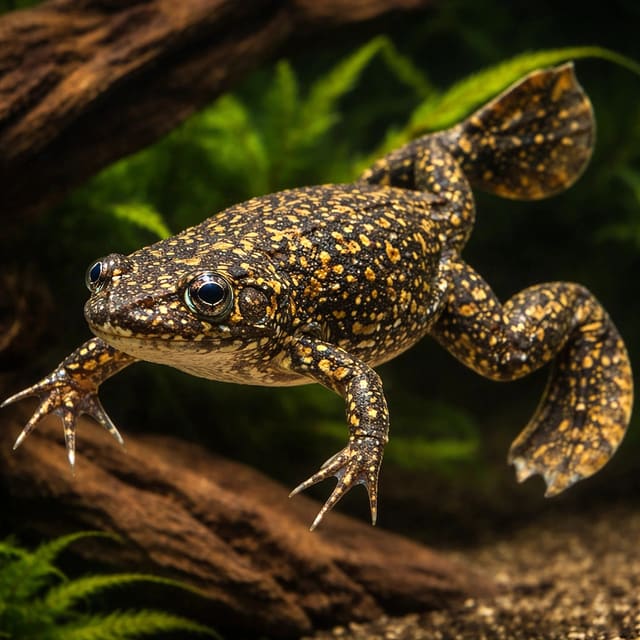
Gold African Dwarf Frog (Hymenochirus sp. 'Gold')
22–25°C · pH 7–8
£5.99
The Platinum African Dwarf Frog is a pale, captive-bred colour form of Hymenochirus boettgeri, a small, fully aquatic frog that breathes air at the surface. It needs a lidded, gently filtered aquarium of at least 50 litres at about 24–25°C, kept as a group of four or more. Sold individually as one live frog.
Adult size is the maximum length this species reaches at full maturity (scientific sources). The livestock you receive will be younger and smaller. Product-photo provenance and any image-specific limitations are stated on the listing.
Hymenochirus boettgeri
The Platinum African Dwarf Frog is a pale, captive-bred colour form of Hymenochirus boettgeri, a small, fully aquatic frog that breathes air at the surface. It needs a lidded, gently filtered aquarium of at least 50 litres at about 24–25°C, kept as a group of four or more. Sold individually as one live frog.
Adult size is the maximum length this species reaches at full maturity (scientific sources). The livestock you receive will be younger and smaller. Product-photo provenance and any image-specific limitations are stated on the listing.
Read the full care guidance when planning conditions for your aquarium.
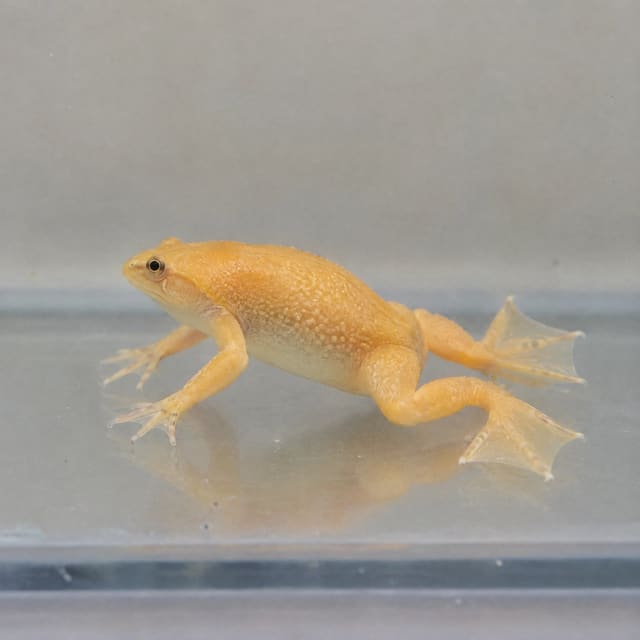
The Platinum African Dwarf Frog is a pale, captive-bred colour form of Hymenochirus boettgeri, a small, fully aquatic frog in the clawed-frog family Pipidae. In place of the usual mottled olive-brown, its rough, granular skin is ivory to pearly white with a faint pink flush, and its eyes stay dark. The species is sold under several names: African dwarf frog, dwarf clawed frog, Congo frog, Zaire dwarf clawed frog and Boettger's dwarf clawed frog all describe this frog or its very close relatives.
In the wild, H. boettgeri is recorded from southern Nigeria and Cameroon through the Congo basin to the eastern Democratic Republic of the Congo, Gabon and Equatorial Guinea. Frogs in the hobby are bred in captivity; OATA notes that most aquatic frogs found in the trade are captive bred. Pipidae.org, which documents this family in detail, points out that the classification of Hymenochirus is still unsettled and that some pet-trade dwarf frogs cannot be matched with confidence to a described species, so treat the scientific name as the best available label rather than a guarantee.
"Platinum", "leucistic" and "blonde" are all trade names for pale dwarf frogs. We have found no authoritative genetic definition that separates them, so we describe this frog by what you can see rather than by a genetic claim. Its care is identical to the normal-coloured frog's.
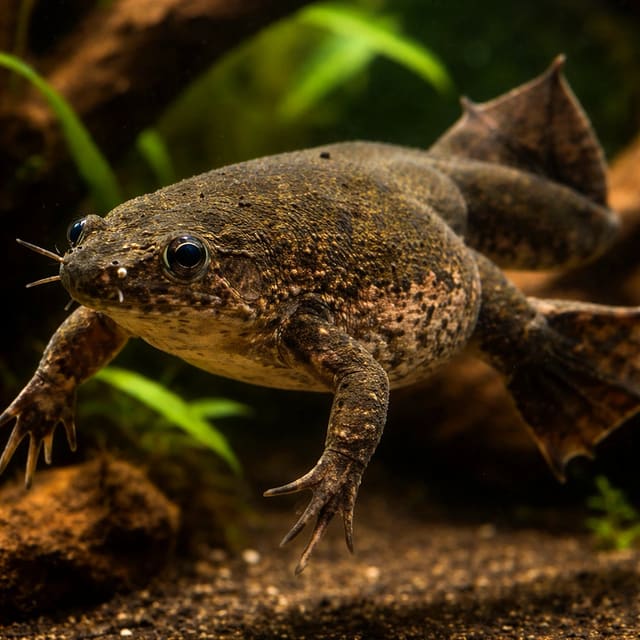
Young African clawed frogs (Xenopus) are sometimes confused with dwarf frogs, and pale or albino clawed frogs make the mix-up easier. The two need different set-ups, so check these features, taken from OATA and Pipidae.org, on any small aquatic frog:
| Feature | African dwarf frog | African clawed frog |
|---|---|---|
| Front feet | Webbed | Free fingers, not webbed |
| Eyes | On the sides of the head | Larger, on top of the head |
| Skin | Rough and granular | Smooth |
| Adult size | Up to about 4.5–5 cm | Up to about 15 cm |
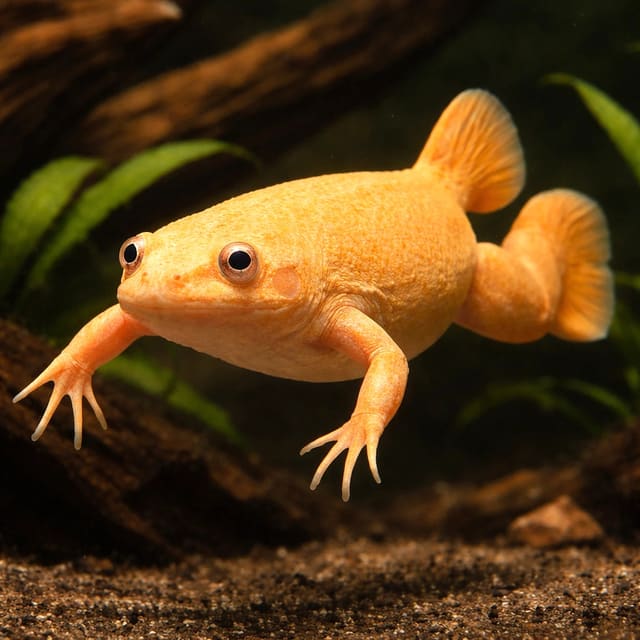
If you want a larger pale frog, our Albino African Clawed Frog is the clawed species. It grows far bigger and must never share a tank with dwarf frogs, which are small enough for it to eat. Browse every frog, newt and axolotl in our aquatic amphibians section, or compare all our Hymenochirus dwarf frogs side by side.
OATA advises keeping aquatic frogs in small groups of at least four, all of a similar size, because frogs kept singly or in groups that are too small often become stressed. To start a group, choose a quantity of four or more. You can mix platinum frogs with our normal-coloured African Dwarf Frog (Hymenochirus boettgeri) or the Gold African Dwarf Frog, provided they are a similar size; colour makes no difference to their care.
Before ordering, read our delivery and Live Arrival Guarantee information and have the aquarium running, matured and tested. The delivery day is not the time to discover that the tank has no lid or that ammonia is still present.
OATA recommends an aquarium of at least 50 litres for a small group of African dwarf frogs, and advises buying as large a tank as you reasonably can, because bigger volumes keep temperature and water quality more stable. The frogs breathe air at the surface, so a long, wide tank with plenty of surface area suits them better than a tall, narrow one of the same volume. Our tank volume calculator turns your tank's dimensions into litres.
Dwarf frogs live entirely underwater but breathe with lungs, so they swim up for every breath. Fit a cover: OATA advises one to stop escapes, and Pipidae.org warns that frogs which get out dry out quickly. With a tight lid, OATA suggests dropping the water level slightly so there is always an air gap between the surface and the lid.
| Item | Why it matters |
|---|---|
| Tank of 50 litres or more | Room for a group of four and steadier water |
| Secure lid with an air gap | Stops escapes while the frogs can still breathe |
| Gentle filter | Removes waste without pushing slow swimmers around |
| Heater and thermometer | Holds a tropical temperature all year |
| Bare floor or sand | Protects the delicate skin |
| Test kits | Ammonia, nitrite, nitrate, pH and hardness checked every week |
Check every gap a frog could squeeze into. Pipidae.org advises that the gap between the glass and a filter should be either less than 2 mm or more than 5 mm, because a small frog can wedge itself into a gap of 2–5 mm and become trapped.
Dwarf frogs spend much of their time walking slowly over the floor and resting among plants, then rising to breathe. OATA recommends either a bare floor or a layer of sand so the skin is not scratched, and plenty of cover from pipes, caves, wood and large, rounded pebbles. Pebbles must be too big to swallow. Plants are welcome but should be fixed to décor so the frogs cannot uproot them.
| Area | Purpose |
|---|---|
| Planted rear and sides | Hiding and resting places; Pipidae.org suggests planting part of the tank densely |
| Open strip at the front, about 10–15 cm deep | A clear feeding area where you can watch every frog eat |
| Caves, pipes and wood | Shade and shelter on the floor |
| Floating plants | Somewhere to rest near the surface between breaths |
Pipidae.org mentions Anubias barteri var. nana as a plant that gives the frogs hiding places, and floating Najas as one they like to climb in. Keep rockwork stable: the frogs dig, and a stone that shifts can crush them. OATA recommends relatively dim lighting, because bright light can stress aquatic amphibians; if your plants need more light, make sure there are dark refuges as well.
African dwarf frogs are not fussy about water chemistry, but they need clean, warm and stable water. Our two main sources give slightly different temperatures, so the table shows both and the range where they agree.
| Value | OATA group guidance | Pipidae.org | Aim for |
|---|---|---|---|
| Temperature | 22–25°C | 24–26°C | 24–25°C |
| pH | 7.0–8.0 | Not given; tap water that suits fish is fine | 7.0–8.0 |
| General hardness | 8–18°dH | Not given | 8–18°dH |
| Carbonate hardness | 10–15°dKH | Not given | 10–15°dKH |
Because OATA's range is medium-hard and slightly alkaline, tap water in many parts of the UK suits these frogs once it is treated with a conditioner that removes chlorine and chloramine. Supplies range from very soft to very hard, though, so measure yours rather than guess. Our water matcher compares your readings with the ranges above, and our water chemistry guide explains what each test means.
| Reading | Target |
|---|---|
| Ammonia | Zero mg/l |
| Nitrite | Zero mg/l |
| Nitrate | No more than 20 mg/l above your tap water |
OATA stresses that aquatic frogs can be stressed by even small amounts of ammonia and nitrite, which can lead to disease. A tank can sit comfortably inside the pH range and still be unsafe if waste has built up, so test both kinds of reading every week.
OATA treats a filter as essential in any aquatic frog tank: efficient enough for the waste produced, but without a strong current. Pipidae.org prefers air-driven filters for their gentle flow, and notes that some keepers run frog-only tanks without a filter, relying on large weekly water changes instead. We recommend the filtered approach, because it keeps ammonia and nitrite at zero between changes. Mature the filter fully before the frogs arrive; our guide to the aquarium nitrogen cycle explains how.
African dwarf frogs are carnivores. OATA recommends small meaty foods sized to the frog, such as brine shrimp, bloodworm and other insect larvae, supplemented with specialist prepared pellets for balanced nutrition. Pipidae.org lists frozen bloodworm, water fleas (Daphnia, Cyclops) and brine shrimp (Artemia) among the foods they take best, and notes that flakes and freeze-dried foods are usually ignored. It advises against feeding living bloodworm and treats live Tubifex as a possible risk, so use frozen foods: our frozen red mosquito larvae, frozen Daphnia and frozen Artemia are all good sizes for dwarf frogs.
Feed once a day. OATA advises leaving the food for about 15 minutes, because amphibians need time to eat, and then removing whatever is left so it does not foul the water. Pipidae.org suggests thawing frozen food and rinsing it through a sieve before feeding, which keeps the thawing liquid out of the tank.
Weaning onto pellets takes patience. OATA notes that amphibians may need frozen or live food alongside prepared food until they learn the pellets are edible. Never overfeed: rotting food raises ammonia faster than the frogs can benefit from it.
Have the aquarium matured, with ammonia and nitrite both at zero and the temperature steady, before the frogs arrive. OATA's floating-bag method suits frogs well: switch off the aquarium light, float the unopened bag for about 10 minutes so the temperatures match, then add small amounts of aquarium water to the bag over at least 30 minutes. Release the frogs with as little bag water as possible.
| Checkpoint | What to do |
|---|---|
| Before arrival | Test the water; check the lid, the air gap and the filter gaps |
| Day of arrival | Lights off, float and mix slowly, release gently |
| First feed | Next day, a small portion of thawed frozen food |
| Every day | Count the frogs; watch breathing trips, feeding and skin |
| End of week | Full water test, then the normal weekly routine |
New frogs often hide at first. A frog that rises to breathe, walks over the floor and takes food within a few days is settling normally. Add further frogs gradually rather than all at once: OATA explains that the filter bacteria need time to catch up whenever the population and feeding increase.
OATA says aquatic frogs are best kept in species-only aquariums. African dwarf frogs can live with some fish, but only fish that are not small enough to be eaten and not so large, nippy or predatory that they stress the frogs. Dwarf frogs are slow feeders, so active fish usually reach the food first; in a mixed tank you must check that the frogs actually eat.
| Suits | Avoid |
|---|---|
| Other dwarf frogs of a similar size | Fish small enough to fit in a frog’s mouth, including fry |
| Small, calm fish that keep to mid-water and share 24–25°C | Fin-nippers and fast, greedy feeders |
| A quiet, dimly lit, partly planted tank | Large or predatory fish that could eat a frog |
| A species-only group of four or more | African clawed frogs, which grow big enough to swallow dwarf frogs |
Our tank mates tool lets you check a proposed mix before you buy. If you are unsure, keep the frogs on their own: a species-only group is easier to feed and to watch. You can find other unusual animals in our loaches and oddballs collection, but browsing them together does not mean they can share a tank.
Aquatic amphibians have delicate, scaleless skin and, according to OATA, are prone to fungal infections. Learn how your frogs look and behave when they are healthy, so you notice changes early.
| If you see | Do this |
|---|---|
| Paler or darker colour, or reddened skin | Test ammonia, nitrite and temperature at once |
| White spots, fluffy growths or ulcers | Test the water and ask a vet who treats amphibians |
| Swelling of the body or limbs | Check water quality and contact an amphibian vet |
| A frog that stops feeding or hides all the time | Check water readings, food access and tank mates |
OATA advises that amphibians are sensitive to aquarium treatments and that half doses should normally be used unless the manufacturer says otherwise. Do not reach for a medicine first: test the water, because poor water quality is the most common cause of trouble.
Good hygiene matters too. In the United States, the CDC linked an outbreak of Salmonella Typhimurium in 2009–2011 to African dwarf frogs, with 224 laboratory-confirmed human cases, most of them young children, and concluded that contact with water from the frogs' tanks was the most likely route. It advised that children under five, pregnant women and people with weakened immune systems avoid contact with frogs and their tank water. OATA recommends washing your hands before and after working in any aquarium and never starting a siphon by mouth.
Pipidae.org describes small glands behind the front legs, the postaxillary glands, as the best way to recognise a male. Females are plumper and about 5 mm longer than males. OATA adds that males develop rough nuptial pads on their forelegs in the breeding season and are slimmer than females. Pipidae.org gives about six months as the age at which frogs begin to mate.
Males court females by "singing". The pair then swim up to the surface and back down while the female releases eggs, which the male fertilises. OATA warns that the adults eat the eggs and tadpoles, so eggs must be moved to a separate tank, where the tadpoles need microscopic live food such as infusoria once their yolk is used up, followed by larger foods as they grow and change into frogs.
It is a pale, captive-bred colour form of Hymenochirus boettgeri, a small, fully aquatic frog from Central Africa. It has ivory to pearly skin with a faint pink flush and dark eyes, and its care is exactly the same as for the normal-coloured African dwarf frog.
Up to about 4.5–5 cm. Pipidae.org gives up to 4.5 cm from snout to vent and OATA up to 5 cm. Females are about 5 mm longer than males.
OATA recommends small groups of at least four frogs of a similar size, because frogs kept singly or in groups that are too small often become stressed. One purchase is one frog, so choose a quantity of four or more.
At least 50 litres for a small group, with a secure lid, an air gap above the water, a gentle filter and a heater. A long, wide tank is better than a tall one because the frogs breathe at the surface.
OATA gives 22–25°C for aquatic frogs and Pipidae.org 24–26°C, so 24–25°C suits both. Keep the pH at 7.0–8.0 and ammonia and nitrite at zero.
Small meaty foods such as frozen bloodworm, brine shrimp and Daphnia, with specialist pellets once they accept them. Feed once a day, leave the food for about 15 minutes, then remove anything uneaten.
Only with fish that are too big to be eaten and not large, nippy or predatory enough to stress them. OATA says species-only tanks are best, and dwarf frogs must never share a tank with African clawed frogs.
Dwarf frogs have webbed front feet, eyes on the sides of the head and rough skin. Clawed frogs have free front fingers, larger eyes on top of the head, smooth skin, and grow to about 15 cm.
No reviews for this item yet. Bought one? Honest reviews only, good or bad.
What customers say about ordering from us
Easy website plenty of info on fish your buying great to pick a time slot
TRACEY DURRANT · 7 Oct 2026
Got some lovely fish thank you
Kevin Mackie · 7 Oct 2026
Reviews of our shop, collected by Judge.me, an independent third-party review collector. Newest first.
Moved by UK carriers licensed to handle live animals
Hand-packed with oxygen bags, poly box, heat pack
Email photos the same day; an optional unboxing video helps us review problems faster — claim terms apply
Klarna & PayPal Pay in 3 at checkout