Easy
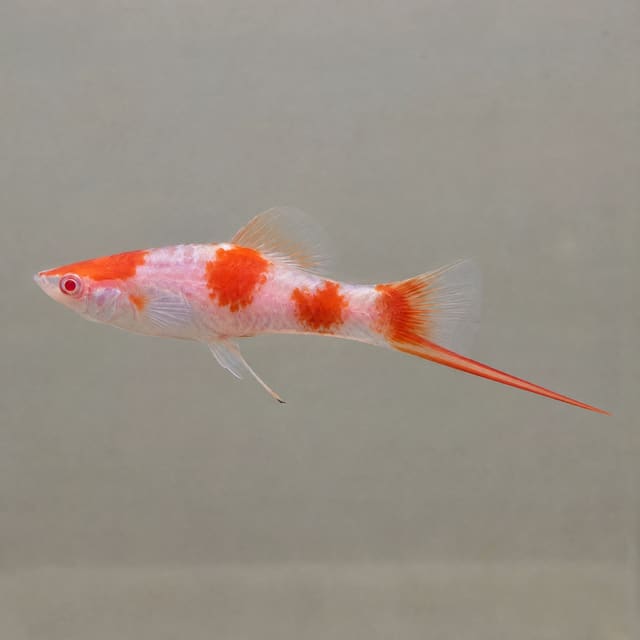
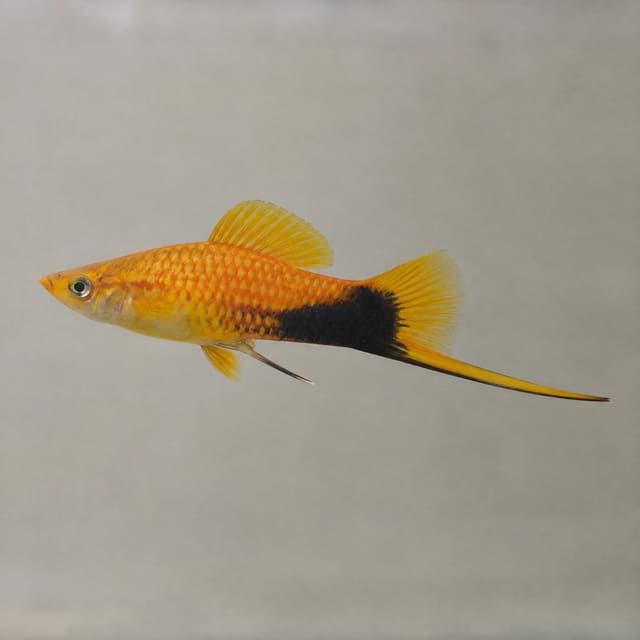
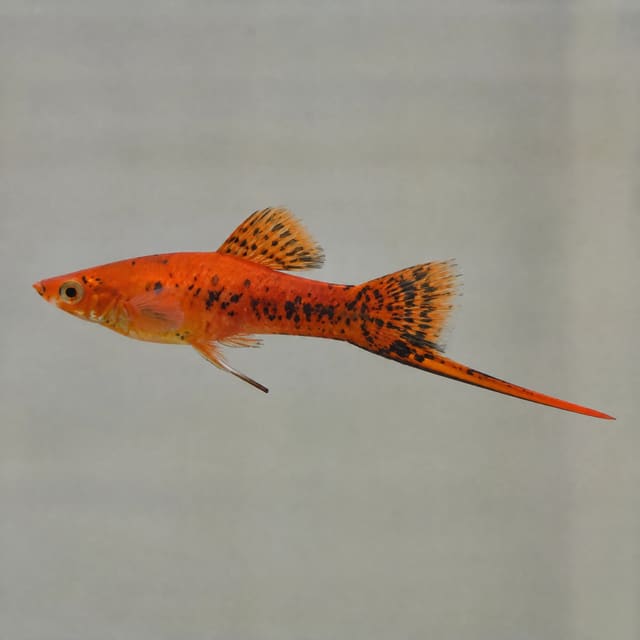
Red Calico Swordtail (Xiphophorus hellerii)
£5.19
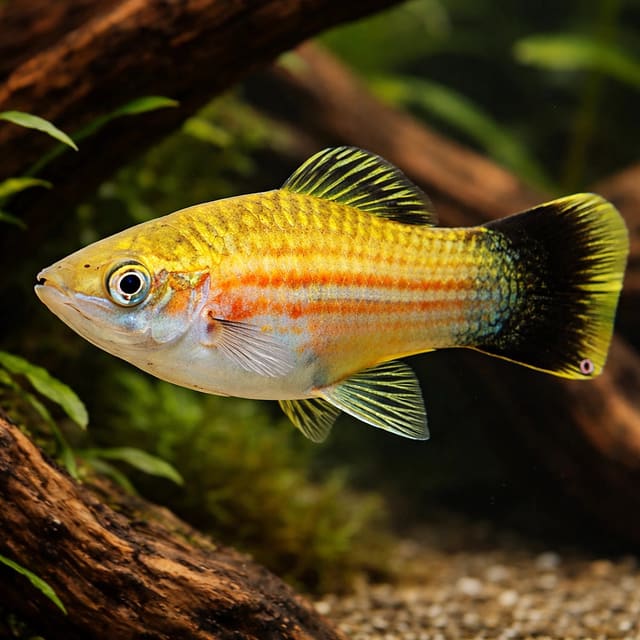
The Neon Swordtail is an aquarium-bred colour form of Xiphophorus hellerii with an orange body, a band of shining turquoise-blue scales and a thin red line along the flank; males carry a long yellow sword. It is a hardy, active livebearer for a hard-water community aquarium of 80 litres or more at 22–27°C, kept with more females than males. Sold individually as one live fish.
Adult size is the maximum length this species reaches at full maturity (scientific sources). The livestock you receive will be younger and smaller. Product-photo provenance and any image-specific limitations are stated on the listing.
Xiphophorus hellerii
Quantity discounts are pricing offers, not a group-size recommendation. Check the full care guidance and your existing animals before choosing a quantity.
The Neon Swordtail is an aquarium-bred colour form of Xiphophorus hellerii with an orange body, a band of shining turquoise-blue scales and a thin red line along the flank; males carry a long yellow sword. It is a hardy, active livebearer for a hard-water community aquarium of 80 litres or more at 22–27°C, kept with more females than males. Sold individually as one live fish.
Adult size is the maximum length this species reaches at full maturity (scientific sources). The livestock you receive will be younger and smaller. Product-photo provenance and any image-specific limitations are stated on the listing.
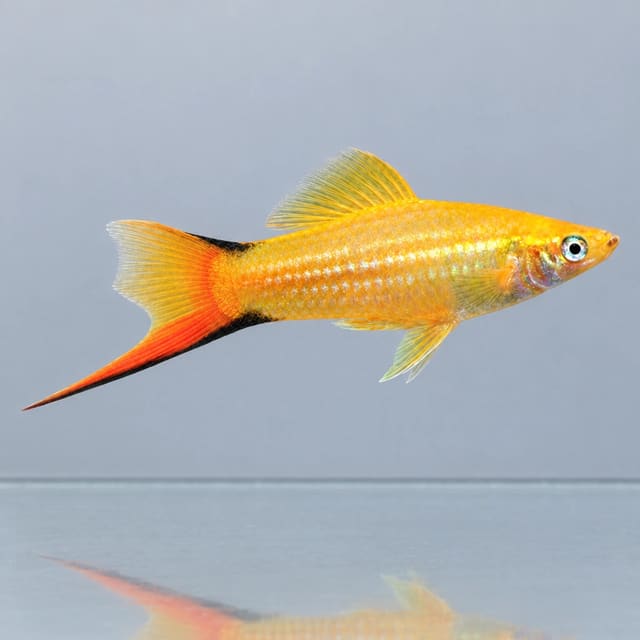
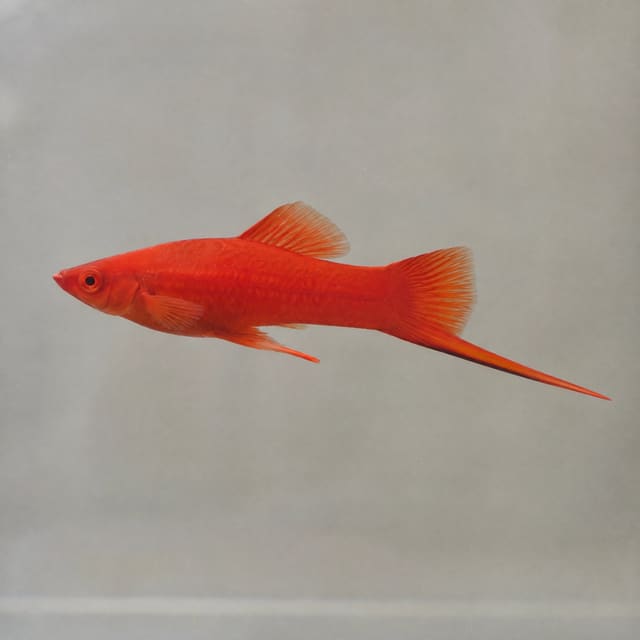
The Neon Swordtail is an aquarium-bred colour form of the swordtail, Xiphophorus hellerii, one of the best-known livebearing fish in the hobby. "Neon" is a shop name for its shine rather than a scientific term: our photographs show a fish with a silvery head, a warm orange body and a broad band of turquoise-blue scales running from the gill cover to the tail, split by a thin red line. The dorsal fin is orange with red streaks and spots, and the male's lower tail extends into a long yellow sword edged in black.
Under the colour it is an ordinary swordtail, which is good news for a UK fishkeeper. Swordtails are hardy, active and easy to feed, they suit the moderately hard to hard tap water found across much of the country, and they give birth to live young. Seriously Fish notes that selective breeding has produced many ornamental forms with colours and fins never seen in wild fish, and that some strains also carry genes from the platies X. maculatus and X. variatus.
| Name | What it means |
|---|---|
| Neon Swordtail | The shop name for this iridescent colour line |
| Xiphophorus hellerii | The scientific name; Seriously Fish notes it is often misspelt X. helleri |
| Green Swordtail | The usual common name of the species and its olive, wild-type colour |
| Swordtail | The everyday name, from the male's sword-like lower tail |
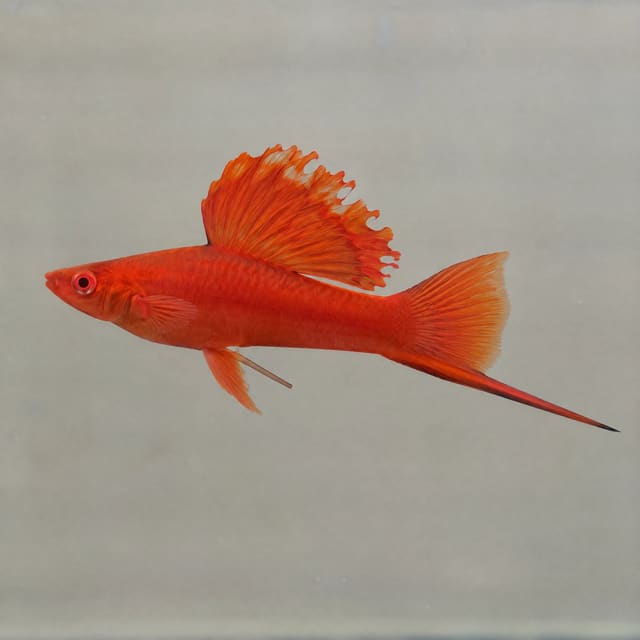
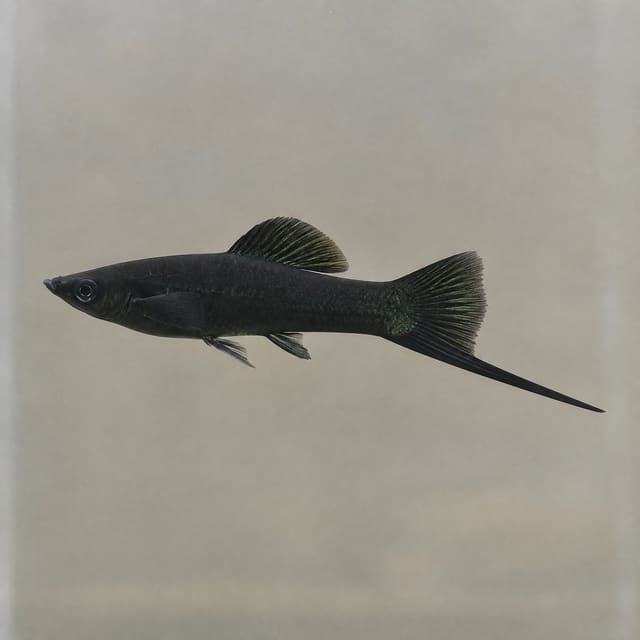
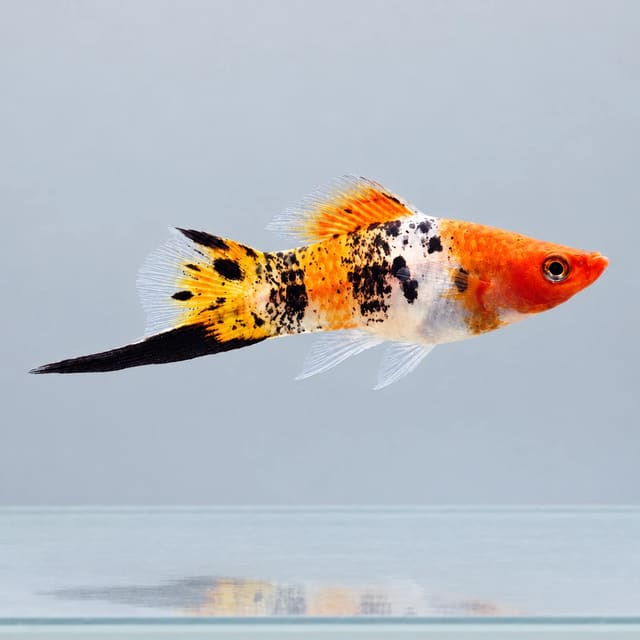
The Green Swordtail we sell is the same species in its natural colours: an olive body with a red stripe. The Neon Swordtail replaces most of that olive with orange and carries far stronger blue iridescence. Other colour lines include the Red Simpson Swordtail, with its tall dorsal fin, and the patterned Koi Kohaku Swordtail. All share the same care, and all interbreed freely, so keep one line per tank if you want the colours to stay true.
One purchase supplies one live Neon Swordtail of medium size, a young fish that is still growing. Sex is not chosen or guaranteed. Our photographs show a male; females are larger and deeper-bodied, have a normal fan-shaped anal fin and never grow a sword. Colour and shine vary from fish to fish and are usually paler for a few days after a journey.
Read our delivery and Live Arrival Guarantee information before you order, and have the aquarium running, heated and matured before the fish arrive.
Swordtails grow bigger than many community fish. OATA gives an adult size of 8–12 cm for swordtails. Seriously Fish gives the species a maximum of 140 mm standard length, measured without the tail, and FishBase records 14 cm for males and 16 cm for females. Males are the smaller sex, but the sword adds several centimetres to their overall length.
OATA asks for at least 80 litres for swordtails, and FishBase gives a minimum aquarium length of 80 cm. Seriously Fish recommends a base of 120 × 30 cm, about 108 litres. We suggest the larger figure when you keep more than one male, because extra length lets a lower-ranking male stay out of the top male's way.
Seriously Fish describes wild swordtail habitats from sea level to around 1,500 m altitude, mostly less than 1.5 m deep and often without aquatic plants, with adults in faster current and juveniles in quiet margins. FishBase, by contrast, says the species prefers heavily vegetated habitats. In the aquarium both points are useful: give the fish an open, well-oxygenated swimming lane, and plant the sides densely.
| Area | Purpose |
|---|---|
| Open central lane with gentle current | Swimming and display space for active adults |
| Dense planting at the sides and back | Refuge for females and lower-ranking males |
| Floating or fine-leaved plants | Cover where newborn fry can hide |
| Sand or fine gravel | Easy cleaning around the plant roots |
A cover glass or lid is sensible. OATA calls a secure lid optional but advisable for platies and swordtails, and fast, active fish are better kept safely inside the tank.
Swordtails come from hard-water rivers and do best in moderately hard to hard, alkaline water. Our recommendation uses the values where the three sources agree, and states clearly where they do not.
| Value | OATA | FishBase | Seriously Fish | Our recommendation |
|---|---|---|---|---|
| Temperature | 22–27°C | 22–28°C | 16–28°C | 22–27°C |
| pH | 7.0–8.0 | 7.0–8.0 | 7.0–8.0 | 7.0–8.0 |
| General hardness | 4–12°dH | 9–19 dH | 10–25 dGH | about 10–12 dGH satisfies all three; harder suits it well |
| Carbonate hardness | 3–10°dKH | — | — | 3–10°dKH |
| Ammonia / nitrite | 0 mg/l | — | — | 0 mg/l |
| Nitrate | no more than 20 mg/l above tap water | — | — | as OATA |
Many UK households, especially in the south and east of England, have hard tap water that suits swordtails with no treatment beyond a dechlorinator. If your water is soft, do not keep swordtails in it as it is; talk to us about raising hardness gradually. Compare your readings in our water matcher and read the water chemistry guide to understand what each test means.
Seriously Fish recommends a filter turning the water over four to five times an hour, which for a 108-litre tank means roughly 430–540 litres per hour, and a heater of about 75–125 W in a room near 20°C. Swordtails eat well and multiply quickly, so the filter must keep up with a growing population.
Seriously Fish describes the swordtail as a generalised omnivore that eats invertebrates, detritus, algae and plant material in the wild and accepts most foods in the aquarium. OATA recommends a quality flake or granule with a high algae content as the staple, fed once a day and only as much as the fish eat within a few minutes.
Plant-based food matters for livebearers. A diet of meaty food alone, offered in large portions, pollutes the water and does not match the mixed diet the species eats in the wild.
Before the fish arrive, confirm that the filter is mature, ammonia and nitrite are zero and the water is 22–27°C at pH 7.0–8.0. Follow OATA's floating-bag method: float the sealed bag for 10 minutes, then add small amounts of tank water over up to 20 minutes, and release the fish without pouring the bag water into your aquarium. Our guide on how to acclimatise new fish explains each step.
| Checkpoint | What to do |
|---|---|
| Arrival day | Lights off for a few hours, no food |
| Day 2 | Offer a small meal and watch every fish feed |
| Days 3–7 | Check for chasing between males and for any fish hiding constantly |
| End of week | Test the water and make the first 25% water change |
Swordtails are generally peaceful, but OATA notes that large swordtails can be boisterous and may chase timid tank mates. Seriously Fish describes groups of males forming dominance hierarchies in confined spaces and spending a lot of time maintaining their rank, and FishBase notes that males are aggressive towards each other. OATA's answer is simple: keep at least three, with two females to each male.
| Suits | Avoid |
|---|---|
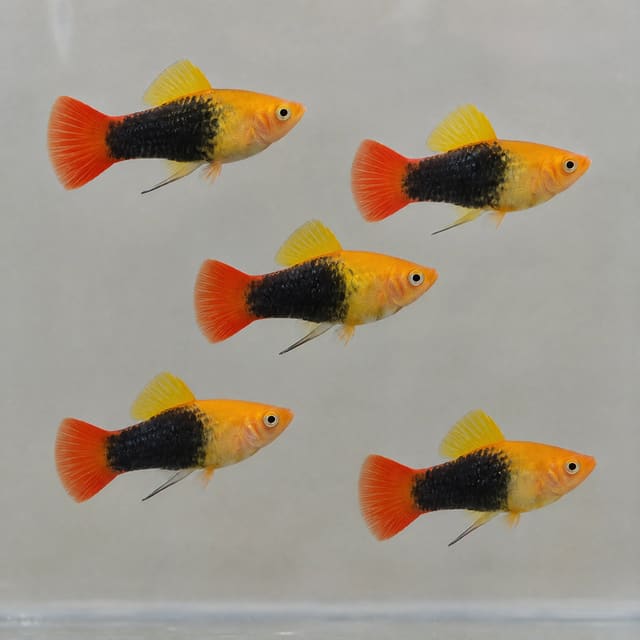
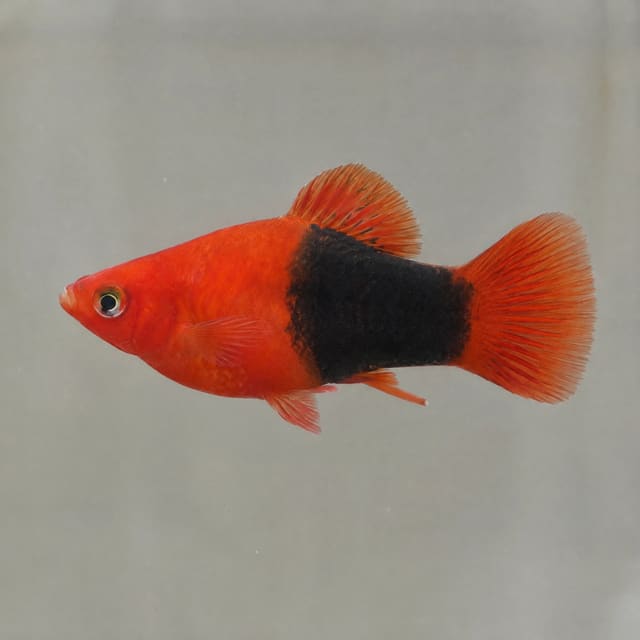
| Platies such as the Bumblebee Platy, which share the same hard water | Soft, acidic-water specialists that need very different water |
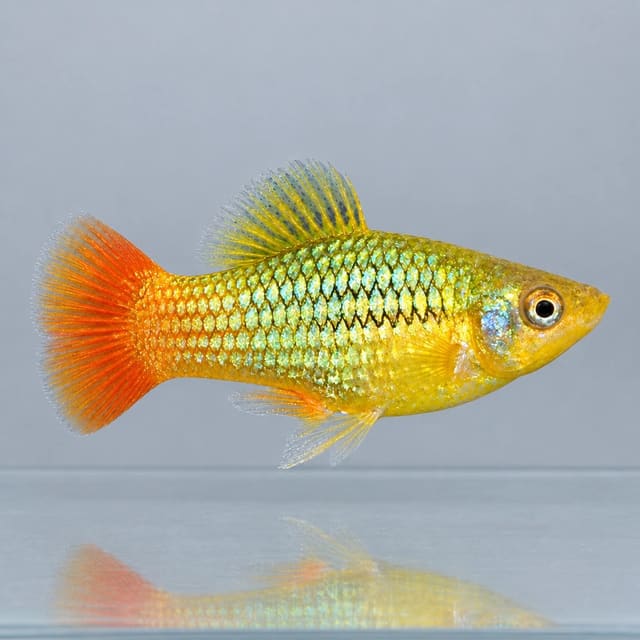
| Mollies such as the Gold Black Lyretail Molly | Large predatory fish that can swallow swordtails or their fry |
| A hardy bottom-dweller such as the Bristlenose Pleco | Very timid or slow fish that active males may chase |
| Other peaceful community fish of similar size | Several males together in a small tank |
Run any planned mix through our tank mates tool, browse more livebearers, the swordtail category and our Xiphophorus hellerii swordtails, or look through our community tank fish. Our green swordtail guide covers the species in more depth, and swordtails also feature in our list of the best beginner tropical fish.
Swordtails are livebearers. The male fertilises the female internally with his gonopodium, the modified anal fin, and Seriously Fish notes that females can store viable sperm for months, so a female may produce several broods after a single mating. FishBase gives a gestation of 24–30 days and 20–200 young per brood, with maturity at 8–12 months. OATA gives 24–30 days and 20–80 fry.
FishBase also records that swordtails tend to undergo sex reversal from female to male under certain conditions. An older female that develops a gonopodium and a short sword is a known event in this species, not a sign of illness.
OATA lists the warning signs for platies and swordtails: clamped fins, flicking against objects, shimmying, hanging at the surface or sitting on the bottom, colour change, white spots or fluffy growths, lost fins or scales, a changed breathing rate and reduced appetite.
| If you see | Do this |
|---|---|
| Shimmying or clamped fins | Test pH, hardness, ammonia and nitrite; soft or unstable water is a common cause in livebearers |
| Torn fins on one male | Add plants and sight-breaks, or rehome a male to restore the ratio |
| A female chased constantly | Add females so attention is shared, as OATA's two-to-one ratio intends |
| White spots or fluffy growths | Test the water and get fish-health advice before treating |
| Rapid breathing at the surface | Test ammonia and nitrite at once and increase aeration |
Never release unwanted swordtails or their fry. Seriously Fish lists feral swordtail populations in 34 countries or territories, and FishBase notes that several countries report adverse ecological effects after introduction.
It is an aquarium-bred colour line of the swordtail, Xiphophorus hellerii, a livebearer from Mexico and northern Central America. "Neon" is a trade name for its strong iridescence: our photographs show an orange body with a band of shining turquoise-blue scales and a thin red line along the flank, a red-marked dorsal fin and, in males, a long yellow sword edged in black.
No. The Neon Swordtail and the Green Swordtail are the same species, Xiphophorus hellerii. The Green Swordtail is the olive, wild-type colour; the Neon Swordtail is a selectively bred colour form with the same care needs.
OATA gives adult swordtails as 8–12 cm. Seriously Fish gives the species a maximum of 140 mm standard length, and FishBase records 14 cm for males and 16 cm for females. Males are the smaller sex, and the sword adds to their overall length.
OATA asks for at least 80 litres for swordtails, and FishBase gives a minimum aquarium length of 80 cm. Seriously Fish recommends a base of 120 × 30 cm (about 108 litres), which we suggest for a group with more than one male.
Hard, alkaline water: 22–27°C and pH 7.0–8.0, where OATA, FishBase and Seriously Fish all agree. For hardness the sources differ (OATA 4–12°dH, FishBase 9–19, Seriously Fish 10–25 dGH); moderately hard water of about 10–12 dGH satisfies all three, and harder water suits it well.
Keep at least three, with two females to every male, as OATA advises. Males form a pecking order and can chase each other, so one male with several females is the calmest start.
Swordtails are omnivores. Feed a quality flake or granule with a high algae content once a day, only as much as is eaten in a few minutes, and add small live or frozen foods such as Daphnia, brine shrimp or bloodworm.
Very likely, if you keep both sexes. Females give birth to live young after 24–30 days; FishBase records 20–200 young per brood. Dense plants or a breeding net help fry survive, because adults eat them.
One live fish of medium size. Sex is not chosen or guaranteed; our photographs show a male, and females have no sword.
No reviews for this item yet. Bought one? Honest reviews only, good or bad.
What customers say about ordering from us
Easy website plenty of info on fish your buying great to pick a time slot
TRACEY DURRANT · 7 Oct 2026
Got some lovely fish thank you
Kevin Mackie · 7 Oct 2026
Reviews of our shop, collected by Judge.me, an independent third-party review collector. Newest first.
Moved by UK carriers licensed to handle live animals
Hand-packed with oxygen bags, poly box, heat pack
Email photos the same day; an optional unboxing video helps us review problems faster — claim terms apply
Klarna & PayPal Pay in 3 at checkout