Sunset Variatus Platy (Xiphophorus variatus)
20–26°C · pH 7–8.2 · 54L
£5.99

Hawaii Variatus Platy (Xiphophorus variatus) is a gold, black and red colour form of a hardy, peaceful Mexican livebearer that grows to 7 cm. Each order brings five unsexed fish at about 3–4 cm. Keep them in at least 60 litres of hard, alkaline water (pH 7.0–8.0, 9–19 dGH) at 18–24°C, and plan for fry.
Adult size is the maximum length this species reaches at full maturity (scientific sources). The livestock you receive will be younger and smaller. Product-photo provenance and any image-specific limitations are stated on the listing.
Xiphophorus variatus
Each quantity is one pack containing 5 fish. Discounts count packs.
Save when buying more. Each quantity is one pack containing 5 fish. Discounts count packs. Refer to the listing for the supplied sex composition.
Hawaii Variatus Platy (Xiphophorus variatus) is a gold, black and red colour form of a hardy, peaceful Mexican livebearer that grows to 7 cm. Each order brings five unsexed fish at about 3–4 cm. Keep them in at least 60 litres of hard, alkaline water (pH 7.0–8.0, 9–19 dGH) at 18–24°C, and plan for fry.
Adult size is the maximum length this species reaches at full maturity (scientific sources). The livestock you receive will be younger and smaller. Product-photo provenance and any image-specific limitations are stated on the listing.
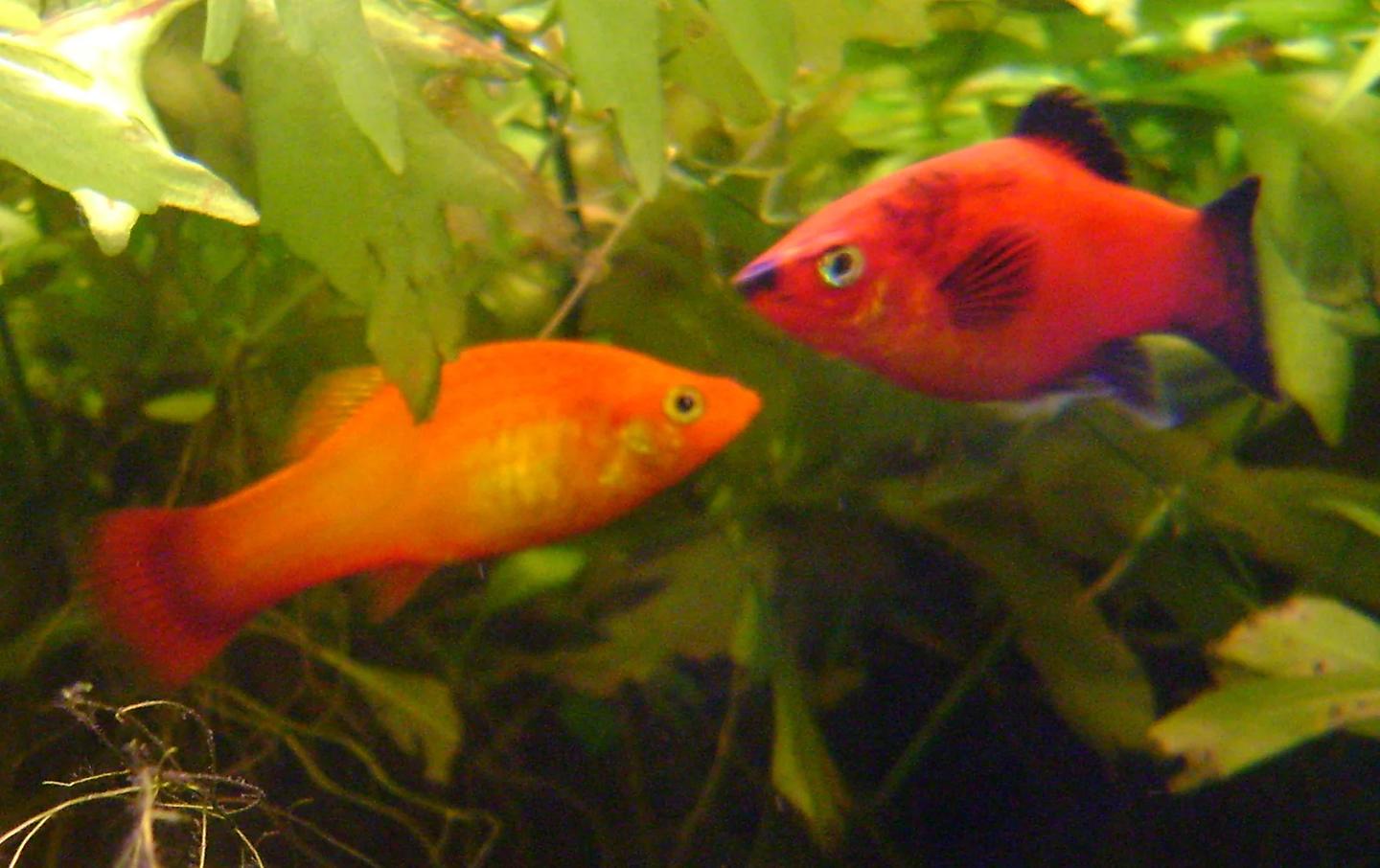
Platy is a trade name used for Xiphophorus maculatus, X. variatus and domestic forms. Start with at least three in a mature aquarium of at least 45 litres, verify the exact fish and measured water, and plan extra capacity before mixing sexes.
Maintain these water conditions for optimal health and vibrant colors
Variatus Platies are the platy for people who want a fish with some resilience built in. Xiphophorus variatus comes from the Atlantic slope of Mexico, is noted for tolerating cooler water and, in the words of Seriously Fish, is a good fish for the general community aquarium, being both peaceful and hardy. The Hawaii form on this page wears some of the most striking colours the species has been bred into: a gold head, a black flank and a red tail. Each order is a group of five.
| Scientific name | Xiphophorus variatus (Meek, 1904) |
|---|---|
| Other common names | Variable platyfish, variegated platy |
| Family | Poeciliidae, the livebearers |
| Native range | Atlantic slope of Mexico, southern Tamaulipas to northern Veracruz |
| Adult size | Up to 7.0 cm total length (FishBase); commonly around 3.9 cm |
| Temperature | 18–24°C recommended |
| pH | 7.0–8.0 |
| Hardness | 9–19 dGH; not for soft, acidic water |
| Minimum aquarium | 60 litres and at least 60 cm long for a group of five |
| Diet | Omnivore with a liking for plant matter |
| Breeding | Livebearer; females give birth to free-swimming young |
| Care level | Easy |
| IUCN Red List | Least Concern (assessed 2018) |
| What you receive | Five unsexed fish per quantity, about 3–4 cm each |
The species was described by Meek in 1904 and was once placed in a separate genus as Platypoecilus variatus, a name you may still find in older books. Seriously Fish explains both parts of the current name: Xiphophorus comes from Ancient Greek for "bearing a sword", a nod to the male's gonopodium, while variatus refers to the variegated colouring. Wikipedia lists variable platyfish, variatus platy and variegated platy as its common names.
The wild fish look nothing like the one in our photographs. Wikipedia describes wild populations as olive with black markings, with black marbling or spots on the side of the tail stem and blackish blotches on the dorsal fin of large males. The Hawaii pattern is one of the dozens of selectively bred varieties that Seriously Fish mentions, and Seriously Fish also notes that wild fish are now rare in the hobby, with most commercial fish mass-produced in the Far East and Eastern Europe. What you are buying, in other words, is a domestic colour form of a wild Mexican species.
Why choose a variatus over the more familiar common platy? Temperature is the main reason. Wikipedia notes that the species is bred commercially partly for its cold-water tolerance and can live comfortably at 16–24°C, so it suits cooler set-ups as well as a standard heated community tank. Add Seriously Fish's verdict of peaceful and hardy, and you have a livebearer that gives a newer fishkeeper some margin while still being interesting enough to hold the attention of an experienced one.
One quantity on this listing is a group of five Hawaii Variatus Platies, each about 3–4 cm when it is packed. Order two and you receive ten. The fish are sold unsexed, which means we do not choose males or females and cannot promise any particular mix within the five. It is worth planning for that before the parcel arrives, because the ratio you end up with shapes how the group behaves.
The 3–4 cm figure is the size at dispatch, not the size the fish will reach. FishBase gives a maximum of 7.0 cm total length for the species with a common length of 3.9 cm, and Wikipedia also gives 7.0 cm overall. Seriously Fish quotes 5 cm standard length, which leaves out the tail fin, so the sources sit reasonably close once you allow for how each one measures. Plan the aquarium for adults of up to 7 cm including the tail, even though many will finish smaller.
At 3–4 cm some of the group may already show these differences and some may not. Look again a few weeks after arrival, when the fish have settled and grown a little; the anal fin is the reliable feature, so check it from the side rather than judging by colour or body shape.
Seriously Fish advises that where males and females share a tank there should be more females, to spread out the attention of the males, which it describes as relentless. OATA's platy and swordtail care sheet puts it at two females to each male and recommends keeping at least three fish together. A group of five unsexed fish may land close to that or may not. If yours turns out male-heavy, the options are more plant cover so females can get out of sight, adding females later once you can sex them and the tank has room, or rehoming spare males through a local shop or aquarium club.
Each extra quantity adds five fish. Before you order a second group, count the adult population rather than the arrivals: ten variatus at up to 7 cm, plus any young they produce, is a much bigger load than ten small fish in a bag. Our care specification uses 60 litres and 60 cm of length as the starting point for one group of five, in line with FishBase's 60 cm minimum aquarium length, and a larger group needs a larger tank.
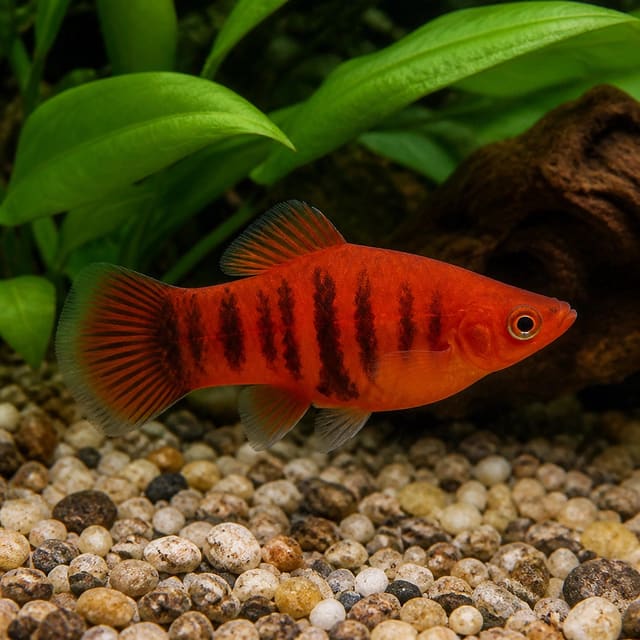
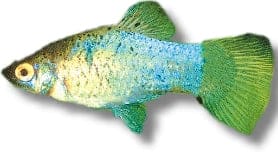
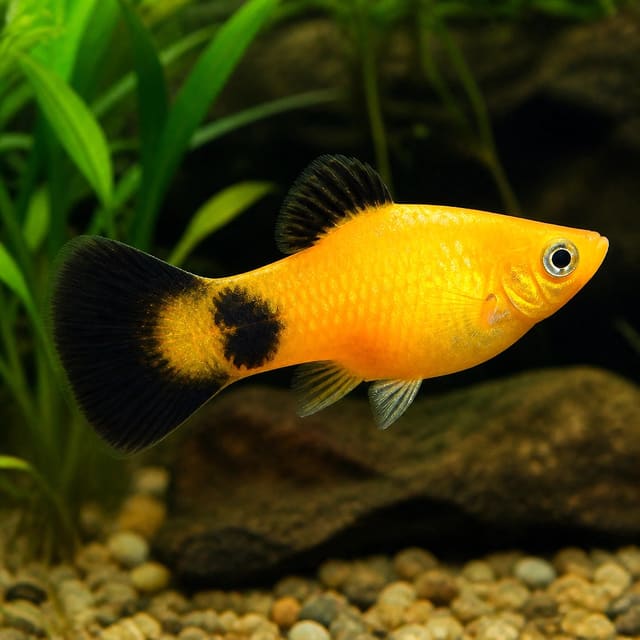
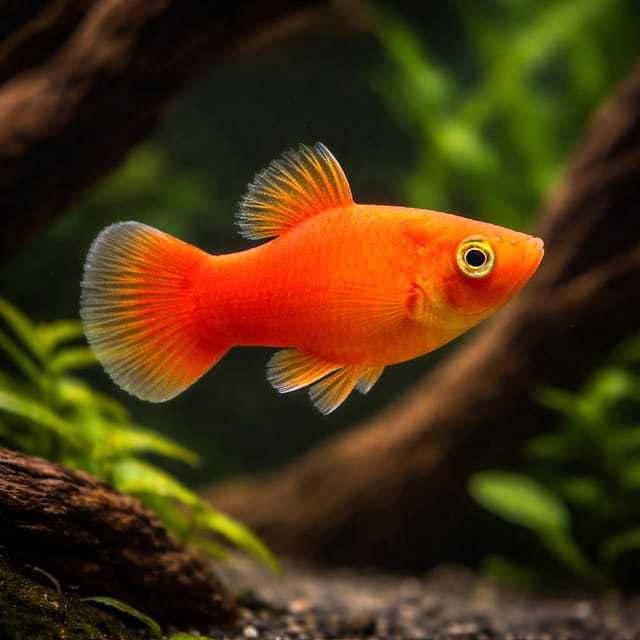
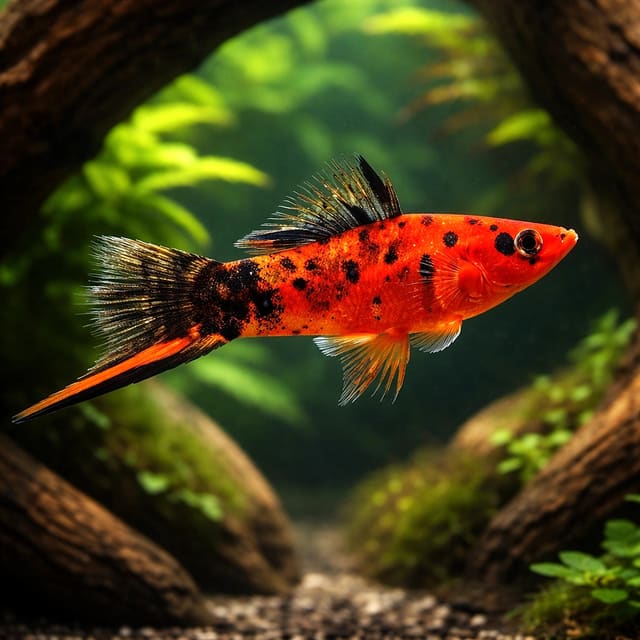
The Hawaii pattern is easy to recognise. In our photographs the head, throat and shoulders are bright gold shading to orange, with a scatter of dark speckles behind the eye. From just behind the pectoral fin a solid black area covers the flank to the base of the tail, and each scale shows as part of a fine dark mesh. The tail fin is a vivid red-orange, the dorsal fin is yellow with a pale edge, the pectoral fins are dark and the small fins underneath are pale yellow. Gold, black and red, with the black body giving the tuxedo look that several platy varieties are named for.
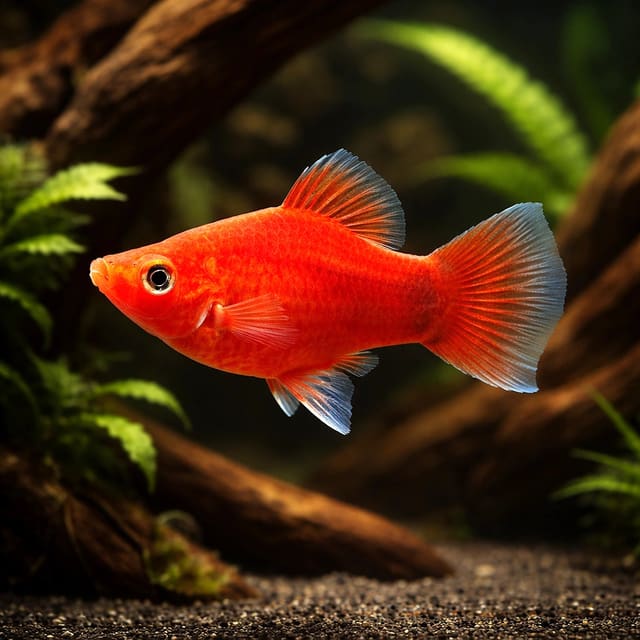
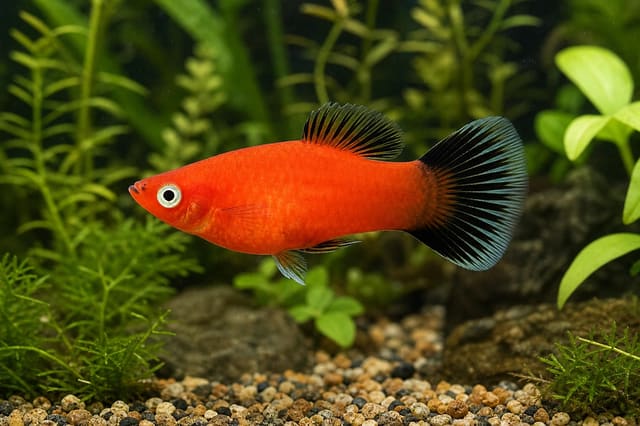
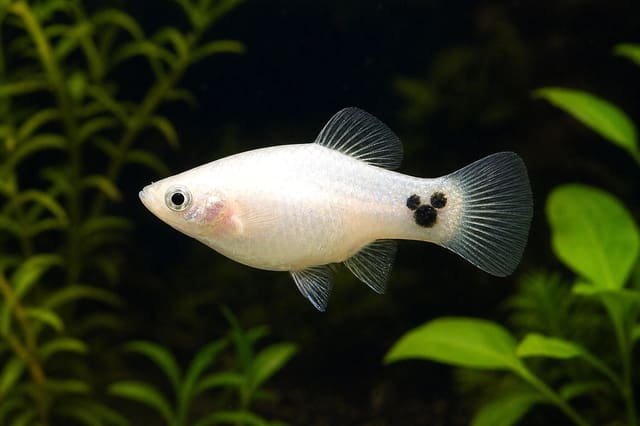
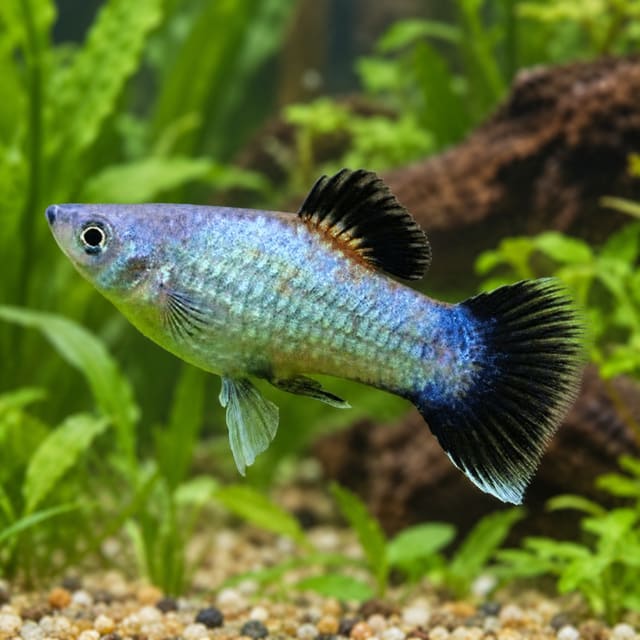
No two fish carry exactly the same version. The amount of speckling on the head, the point where the black begins and the depth of red in the tail differ from fish to fish, so the five you receive will not be copies of one another or of the pictures.
The common platy is Xiphophorus maculatus, a separate species in the same genus. Our stock records name this fish as Xiphophorus variatus, and that is the name on this listing. Seriously Fish describes wild variatus as slimmer than X. maculatus with a slightly longer dorsal fin, a trait breeders have used to develop high-finned varieties. Selective breeding blurs the line, though. Seriously Fish notes that some variatus varieties were produced by crossing with X. maculatus or with swordtails, so body shape in a domestic fish is not a reliable identification on its own.
If you want a common platy in a tuxedo variety for comparison, we list the Red Tuxedo Platy (Xiphophorus maculatus) separately with its own care notes.
Variatus comes in a range of colours. If you are building a tank around this species, we also list the Sunset Variatus Platy, the Orange Gold Variatus Platy and an Assorted Variatus Platy mix. They are all Xiphophorus variatus, so the water, temperature and tank-size guidance on this page applies to them too. Being one species, mixed colour forms will interbreed, which only matters if you intend to raise the young.
FishBase and Wikipedia both describe X. variatus as endemic to the Atlantic slope of Mexico, from southern Tamaulipas south to northern Veracruz. FishBase classes it as a subtropical, benthopelagic freshwater fish, and the subtropical label is one clue to its tolerance of cooler water. Its homes are modest ones. Seriously Fish lists shallow, heavily vegetated streams, ponds, swamps, canals and ditches; Wikipedia mentions the slow-moving water of vegetated canals, ditches and warm springs; FishBase adds warm springs and weedy waterways.
Seriously Fish highlights one detail worth knowing: the species is particularly associated with places where algae and other phytoplankton are present in large quantities. Put that together with a recorded diet of worms, crustaceans, insects and plant matter (FishBase), or zoobenthos and detritus (Seriously Fish), and you get a fish that forages through plants, over surfaces and along the bottom for small food. That is the behaviour to design the aquarium and the feeding routine around.
The IUCN Red List assesses the species as Least Concern, with the assessment dated 28 March 2018 on FishBase, although Wikipedia notes that it is considered uncommon across its range. FishBase rates its resilience as high, with a minimum population doubling time of less than 15 months. Seriously Fish adds a conservation point for anyone who keeps wild-type fish: they need protecting from crossbreeding with domestic forms.
Variatus has turned up well outside Mexico. Wikipedia records established populations in Florida (canals around Tampa Bay and in Gainesville), in springs in Montana, and in Colombia, Singapore and Hong Kong, where breeding is reported to harm native species. Seriously Fish adds Costa Rica and Hawaii to the list of places with introduced or feral populations, and FishBase flags the species as a potential pest. Despite the shared name, the Hawaii fish on this page is an aquarium colour variety; the feral fish on the islands are a separate matter.
The lesson for keepers is short. A fish that breeds as freely as this one will produce surplus young, and OATA's advice is unambiguous: never release aquarium animals or plants into the wild. Plan where spare fish will go before you need to, and the problem never arises.
Two things matter most with variatus: it is comfortable in cooler water, and it wants hard, alkaline water rather than soft. The sources agree on the direction and differ on the exact numbers:
| Source | Temperature | pH | Hardness |
|---|---|---|---|
| FishBase | 15–25°C | 7.0–8.0 | 9–19 dH |
| Seriously Fish | 20–26°C | 7.0–8.2 | 14–30 dGH |
| Wikipedia | 16–24°C (comfortable range) | not given | not given |
| OATA, platies in general | 17–27°C | 7.0–8.0 | 4–12 dGH; 3–10 dKH |
| Our recommendation | 18–24°C | 7.0–8.0 | 9–19 dGH |
Our 18–24°C sits inside the FishBase and Wikipedia ranges. Seriously Fish starts its range a little higher, at 20°C, so in a heated community tank a setting of 22–24°C keeps you inside every source in the table. The cooler end is where this species stands out: Wikipedia's 16–24°C comfort range and OATA's note that platies can live unheated mean a variatus tank does not need to be warm. If you plan to run one without a heater, check the water with a thermometer through a cold spell first and only rely on room temperature if the tank stays inside the range.
The top end deserves as much attention as the bottom. FishBase's range stops at 25°C, so avoid long spells above that. In a heatwave, keep direct sun off the tank, increase surface movement and check the temperature in the warmest part of the day.
Seriously Fish is blunt: variatus must be kept in moderately hard or harder water and will not thrive in soft, acidic water. Every source agrees on pH 7.0–8.0 or a touch higher. Hardness figures vary more. OATA's general platy figure of 4–12 dGH covers platies as a group, while the species-specific sources run higher: FishBase gives 9–19 and Seriously Fish 14–30. Our care specification uses the FishBase range, and if your tap water allows it, the 14–19 dGH band where FishBase and Seriously Fish overlap is the safest place to be. If your water is very soft, talk to us before ordering; steady, suitable water from the tap is far easier to live with than a mineral dose you have to repeat at every water change.
Livebearers that breed freely add to the load on the filter without you noticing, because the population creeps up a few fry at a time. Weekly testing is how you catch that before the fish do.
Our care specification asks for at least 60 litres and 60 cm of tank length for one group of five. That is a touch more generous than some published figures. FishBase gives a minimum aquarium length of 60 cm, Seriously Fish suggests a base of 60 × 30 cm, about 54 litres, and OATA gives 45 litres as a minimum for platies in general. We round up because these are active fish that grow to as much as 7 cm and, if both sexes are present, produce young on a regular basis.
FishBase expresses its minimum as a length, 60 cm, and for an active fish that makes sense: a long, shallow aquarium gives more swimming room than a tall one of the same volume. A 60 cm tank is the starting point; if you plan to add other fish or keep some of the young, a longer tank makes life easier for everyone.
Seriously Fish says decor is not critical but that the species appreciates a planted aquarium and is seen at its best in one, adding that dense planting is particularly useful when the fish are breeding. A practical layout has thick planting around the back and sides, an open swimming lane through the front and middle, and a few clumps of fine-leaved or floating plants where young fish and harried females can disappear.
OATA's platy sheet allows gravel, soil or sand with live or plastic plants. Live plants earn their place in a variatus tank because, given the species' association with algae-rich water, the soft growth on leaves, wood and rock gives the fish something to forage on between meals. There is no need to scrub every surface spotless; clean the front glass for viewing and leave a little growth elsewhere.
New fish should only go into an aquarium where ammonia and nitrite already read zero. If the tank is new, mature the filter fully before the order is placed, and add fish in stages so the bacteria can keep up. Hardy as variatus is, it still needs that mature filter.
Variatus is not a fussy eater. FishBase records worms, crustaceans, insects and plant matter in its natural diet; Wikipedia says it eats both plants and small crustaceans, insects and annelid worms; Seriously Fish describes it feeding on zoobenthos and detritus in the wild and says it is unfussy and will accept most foods, whether frozen, live or dried. The aim in the aquarium is not to tempt it to eat, but to give it a balanced mix and not too much of it.
OATA's guidance for platies is to feed once a day, offering what the fish can eat within a few minutes, and it warns against overfeeding. Judge the amount by what is eaten in those few minutes rather than by how keen the fish look. Remove anything left on the bottom.
Spread the food across the surface instead of dropping it in one spot. That gives the smaller and shyer fish in the group a fair share, which matters when males and females of different sizes feed together.
If fry appear, Seriously Fish says they are large enough to take brine shrimp nauplii or powdered flake from birth and grow very quickly when fed two or three times a day. Keep fry portions tiny and watch the water quality more closely while you are feeding more often.
A well-fed variatus holds a smooth, even outline, swims actively and comes forward to feed. Weight loss or a fish that stops feeding is one of the earliest signs that something is wrong, so a quick headcount at feeding time doubles as a daily health check.
Seriously Fish calls variatus a good fish for the general community aquarium, being both peaceful and hardy, and OATA describes platies and swordtails as generally peaceful and compatible. Expect a settled group to forage through the plants and over the decor, in keeping with a wild diet that includes zoobenthos, detritus and plant matter.
Most of the activity in a mixed group comes from the males. Seriously Fish describes their attention towards females as relentless, which is why it recommends more females than males, and why OATA puts the figure at two females to each male. Some following and displaying is part of normal life for a livebearer. What you do not want is one female being chased without a break, hiding all day or missing meals. If that happens, add more cover first, then look at the ratio.
The rule for variatus companions comes from its water rather than its temperament. Because Seriously Fish says it will not thrive in soft, acidic water, its tank mates need to be fish that are happy in hard, alkaline water too, and because the species sits at the cooler end of the tropical range, they need to be comfortable at 18–24°C. Within those limits, peaceful fish of a similar size make sensible companions.
OATA suggests keeping at least three platies together, and the five in each order more than covers that. Keep the group together rather than splitting it between tanks, and if you add to it later, do so with the ratio in mind rather than by colour alone.
Numbers are the thing to watch. With males and females together, Seriously Fish says batches of fry will be continual. Leave room in your stocking plan for some of them to grow up, or arrange in advance where the surplus will go.
Like every member of its family, variatus is a livebearer: Wikipedia notes that all species in the Poeciliidae bear live young. The male uses his gonopodium to mate, and the female later gives birth to free-swimming fry rather than laying eggs. With both sexes in the tank, breeding is less a project than a certainty. Seriously Fish puts it simply: batches of fry will be continual.
The sources differ here, so treat the figures as a range rather than a timetable:
| Source | Gestation | Brood size |
|---|---|---|
| FishBase | 24 days | up to 100 young |
| OATA (platies in general) | 24–30 days | 20–80 fry |
| Seriously Fish | around 4–7 weeks | broods of over 100 not uncommon |
Whatever the exact number, a single female can add dozens of fish to a tank at a time, and she can do it again and again. That is the main reason this guide keeps returning to tank size and planning.
Seriously Fish states that adult variatus will not eat their young, but still recommends moving the heavily pregnant female to a separate tank to give birth, then returning her to the main aquarium. OATA's platy sheet suggests keeping the female in a suitably large breeding net, separated from the fry once they are born. If you use a net, take OATA's word "suitably" seriously and choose the largest one that fits your tank.
If you would rather let nature take its course, dense planting and floating plants give newborn fry somewhere to hide in the main tank, and Seriously Fish says dense planting is particularly beneficial when the fish are breeding.
Variatus fry are well developed at birth. Seriously Fish says they can take brine shrimp nauplii or powdered flake straight away and grow very quickly when fed two or three times a day. Keep their water clean with small, regular changes, because frequent feeding in a small tank fouls the water fast.
If you want young that look like Hawaii platies, keep the Hawaii form on its own. Mixing it with other variatus colours or with other platy and swordtail species will produce mixed young, since Seriously Fish records that many variatus varieties were created by crossing. And whatever you breed, OATA's rule applies: never release spare fish into the wild.
Before you order, read our delivery and live-arrival information, and get the tank ready in advance: filter running, water tested, and temperature already sitting where the fish will live. Someone needs to be at the delivery address to take in the parcel, since live animals have to be received in person.
Your five platies travel in oxygen-filled bags in insulated packaging, with heat packs added when conditions require them, carried by a tracked courier licensed for live animals. The confirmed delivery date and tracking details come to you by email.
Begin a continuous unboxing video while the box is still sealed, and keep filming as you open it until the fish are visible in their still-sealed bag. If any fish is dead, dying or clearly compromised on arrival, send that video and your order number to hello@tropicalfishco.co.uk on the day of delivery. Photographs on their own do not meet the policy. Subject to the guarantee terms, affected fish are either replaced with your next order or refunded.
Watch breathing, appetite and behaviour every day for the first week and test the water during that time. OATA's description of a healthy platy is a useful checklist: clear, bright eyes, undamaged fins, intact scales, no ulcers or bumps, normal swimming and steady breathing. Signs that something is wrong include clamped fins, flicking against gravel or decor, and shimmying, a side-to-side shaking on the spot. If you see these, test the water first and contact us if you need advice.
Seriously Fish makes a frank point about commercial platies in general: many are not very hardy because of inbreeding and over-production, and are prone to disease and premature death. That is not a reason to avoid them; it is a reason to keep them well. Stable water at the right hardness, a sensible feeding routine and a group that is not overcrowded give your fish the best chance. If you already have an established community, a few weeks in a separate quarantine tank lets you watch the new group before it joins your other fish.
With good conditions OATA expects platies to live for several years in a well-matured set-up. For a hardy fish that can also stock a tank with its own young, that is plenty of time to enjoy them.
The sources behind this guide, all worth reading in full:
No reviews for this item yet. Bought one? Honest reviews only, good or bad.
What customers say about ordering from us
I have a small group of long finned mountain minnows. So was delighted to be able to order ten of this variety to increase the genetics in my tank . The ones I recieved are healthy but it’s to early to give a verdict on wether they are of a long finned type since they are small currently.
Gordon Walker · 23 Sept 2026
100% success travel and "installation". Pleased with quality of purchase. The Siamese fighter a bit "shy" so have not yet seen him at his best yet but looking good. Happy customer. GG
George E Garratt · 21 Sept 2026
Reviews of our shop, collected by Judge.me, an independent third-party review collector. Newest first.