Easy
Xiphophorus maculatus red tiger
20–25°C · pH 7–8 · 54L
£3.99
Photo coming soon
The size, price and care details on this page are for this listing.
Platy Blue-Red (Xiphophorus maculatus) is a peaceful social livebearer for a mature, planted aquarium with moderately hard or harder water. One purchase supplies one 3–4 cm fish; keep a suitable group, use a 60 × 30 cm footprint and choose calm companions with overlapping needs.
Xiphophorus maculatus
Shoaling fish: kept in a group they feel safer, stay calmer and show their best colour.
Minimum of 2 per order.
Platy Blue-Red (Xiphophorus maculatus) is a peaceful social livebearer for a mature, planted aquarium with moderately hard or harder water. One purchase supplies one 3–4 cm fish; keep a suitable group, use a 60 × 30 cm footprint and choose calm companions with overlapping needs.
Platy is a trade name used for Xiphophorus maculatus, X. variatus and domestic forms. Start with at least three in a mature aquarium of at least 45 litres, verify the exact fish and measured water, and plan extra capacity before mixing sexes.
Maintain these water conditions for optimal health and vibrant colors
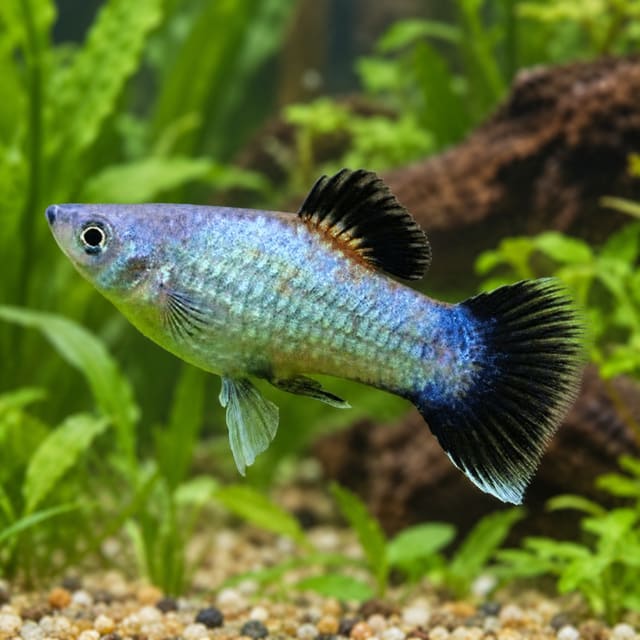
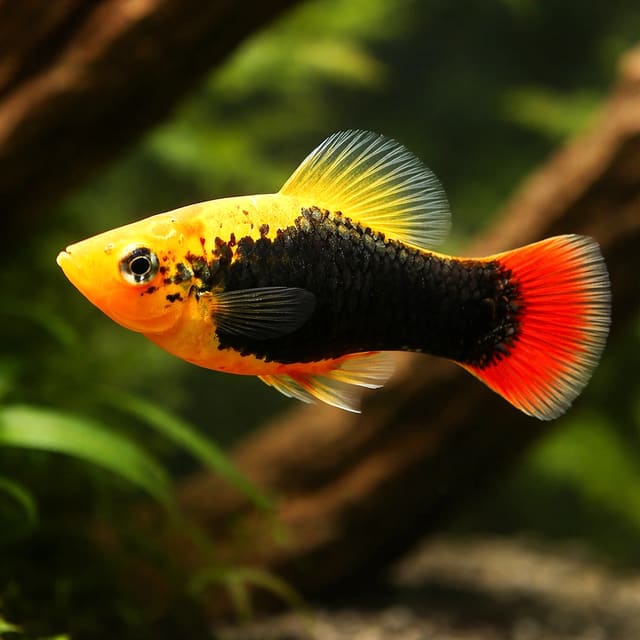
Platy Blue-Red (Xiphophorus maculatus) is a cultivated colour form of the platy, combining a dark blue-toned body with red or orange areas. The exact distribution of colour can vary between individuals. Behind the colour is a small, active livebearer that works best in a mature, planted community with stable, moderately hard or harder water.
One purchase supplies one live fish at the supplier's 3–4 cm grade. It is not a ten-pack and it is not the Coral Red Platy described in several old fields. Sex is guaranteed only when the selected option explicitly states male or female. This Platy Blue-Red listing has no sex-guaranteed option.
The name should be read clearly: “Blue-Red” is the trade colour description; the scientific binomial is Xiphophorus maculatus. FishBase places the species in Poeciliidae and records a native range from Veracruz in Mexico to northern Belize. Seriously Fish describes a wider Atlantic coastal distribution through parts of Mexico and Central America.
Adult measurement needs care because the available records are not directly comparable. FishBase lists 4 cm total length for a male or unsexed record, while Seriously Fish lists 5 cm standard length. Total length includes the tail; standard length excludes it. It would be misleading to turn those different source records into one bare “adult maximum”, so both are retained with their scope for planning.
The practical species profile recommends a 60 × 30 cm aquarium base, approximately 54 litres at the example height, with 20–26°C, pH 7.0–8.2 and 10–30°dGH. The key is not chasing an exact central number every day. Establish a stable point your source water and livestock can share, then use regular testing and measured changes to keep it there.
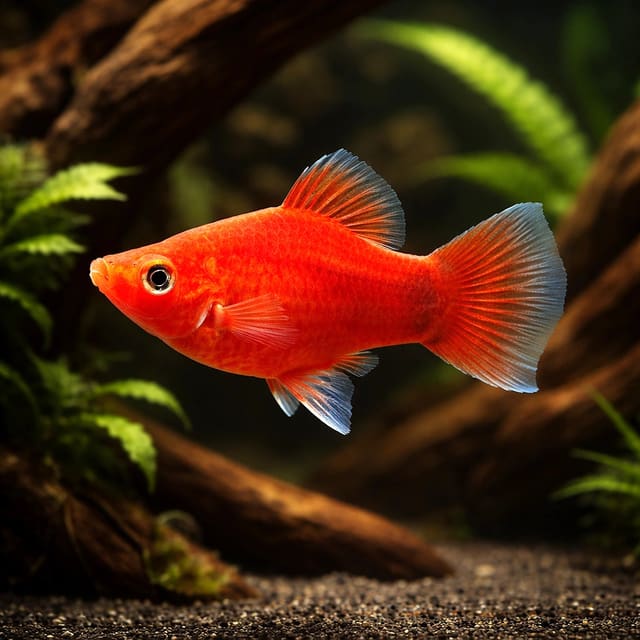
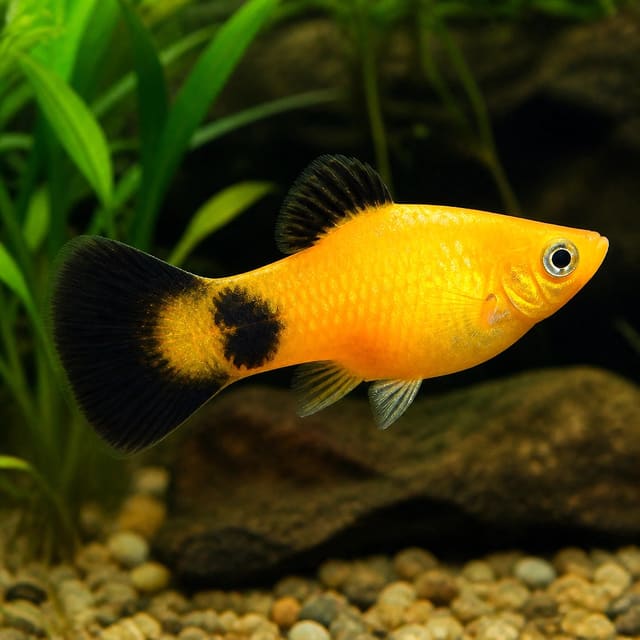
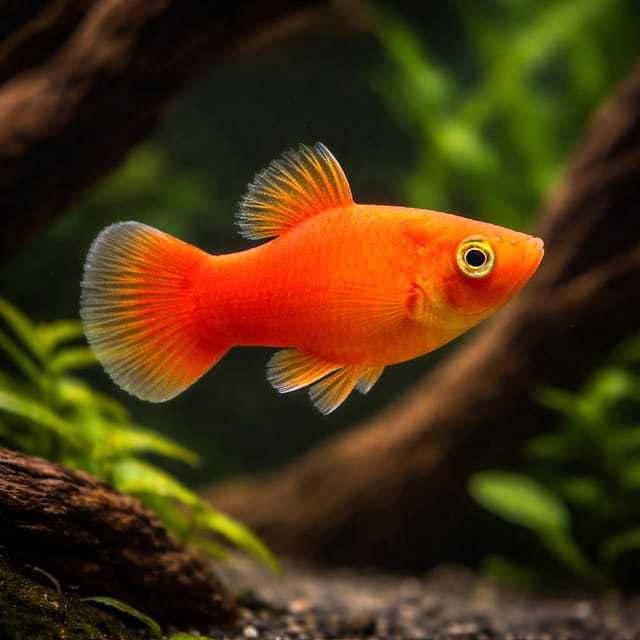
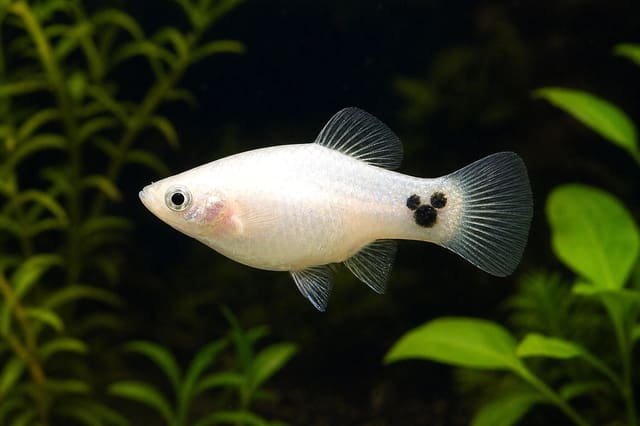
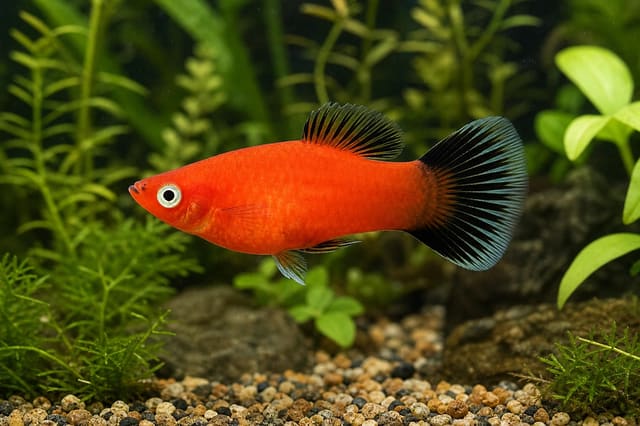
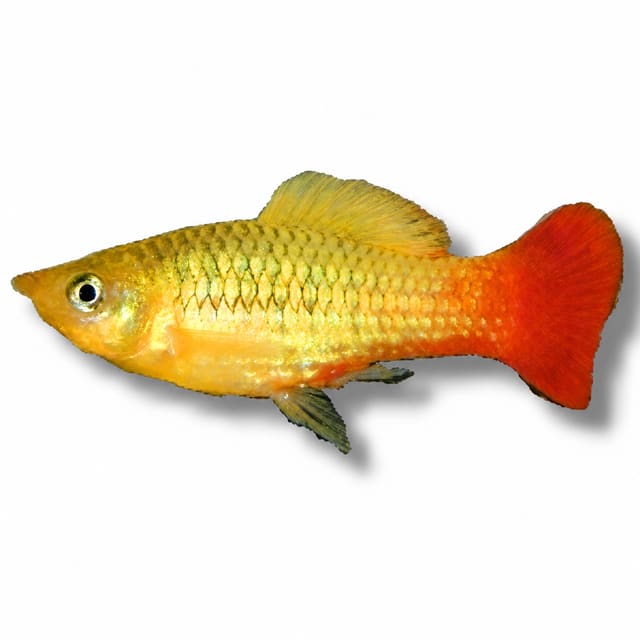
Gallery images have been digitally enhanced to improve image quality. Natural colour, pattern, size and maturity can vary between live animals. The supplied image shows one blue-and-red fish in side profile against a dark aquatic background with root-like stems. It helps communicate the intended colour form, but it cannot promise the markings of the individual delivered.
X. maculatus accepts a wide variety of suitable foods, is described as very peaceful and appreciates an ordinary planted layout rather than specialist equipment. Seriously Fish rates it for beginners when pH stays above neutral. Those traits justify the store's “easy” assessment, provided easy is understood as forgiving husbandry within correct conditions, not freedom from cycling, filtration or weekly care.
Platies are social livebearers. OATA's guidance for platies and swordtails as a group suggests keeping at least three and using two females for each male where sexes are mixed. Because this offer is unsexed, the buyer cannot assume a ratio at dispatch. Space, cover and observation remain important as the fish mature.
| A good fit | A mature, planted aquarium with measured water above neutral pH, a social group and peaceful companions with overlapping needs. |
|---|---|
| A poor fit | A new or unfiltered tank, persistently soft acidic water, a solitary display, or a community too crowded to absorb livebearer reproduction. |
Browse the platy collection to compare colours and offers. A colour alternative is a shopping comparison, not proof that every product should be added to the same tank. Check the sold unit, sex statement and current care details on each page.
| Scientific identity | Xiphophorus maculatus, family Poeciliidae |
|---|---|
| Adult records | 4 cm TL in FishBase; 5 cm SL in the species husbandry profile |
| Supplier dispatch grade | 3–4 cm; one fish per purchase |
| Aquarium footprint | At least 60 × 30 cm; about 54 litres at the profile's example dimensions |
| Routine aquarium range | 20–26°C; pH 7.0–8.2; 10–30°dGH |
| Social plan | OATA's broad platy guidance suggests at least three; where sexes are mixed, two females per male |
| Diet | Varied dried, frozen and live foods; OATA includes algae-rich flake or granules |
| Temperament | Very peaceful, with persistent male attention possible in mixed-sex groups |
The species profile recommends a 60 × 30 cm base and illustrates it as roughly 54 litres in a 60 × 30 × 30 cm aquarium. That is more useful than a volume alone because platies move horizontally through the middle areas and benefit from a clear route across the tank. A narrow ornamental vessel may hold a similar volume on paper while offering much less usable length.
Treat 54 litres as a species-profile starting point for a sensibly stocked setup. A larger social group, other active fish or rapid reproduction increases the requirement. Provide a filter sized for the total biological load and leave room for adults, not just the 3–4 cm dispatch grade. The delivered size is a point in growth, not the permanent footprint of the animal.
Cycle the aquarium before ordering. A functioning biological filter needs time to establish bacteria that process ammonia and nitrite. The first tropical tank guide covers the preparation sequence. Clear water is not proof of a mature filter, and adding several fish at once can outpace a young bacterial colony.
Use 20–26°C, pH 7.0–8.2 and 10–30°dGH as the species-level aquarium range from Seriously Fish. The same profile says X. maculatus must be maintained in moderately hard or harder water and will not thrive in soft, acidic conditions. Above-neutral pH is therefore part of the suitability decision, not a cosmetic preference.
General hardness and pH describe different aspects of the water. GH reflects mineral content; pH describes acidity or alkalinity. Ammonia, nitrite and nitrate require their own tests. The water-chemistry guide explains those roles, and the water matcher can help compare your measured values with the range. Always enter real aquarium readings rather than assuming the tank matches the tap.
Stability does not mean ignoring unsuitable water. It means choosing a sustainable target within the correct band and avoiding abrupt, unnecessary changes. Match replacement water reasonably closely for temperature and chemistry. If the tank drifts, identify the cause—source water, substrate, décor, stocking or maintenance—rather than repeatedly dosing without measurements.
No fish should be kept without a properly established filter. The RSPCA explains the biological sequence: fish waste produces toxic ammonia, bacteria convert it to toxic nitrite and further bacteria convert nitrite to safer nitrate. That does not make nitrate harmless at any level; it means routine water changes and testing complete the system.
For the profile's example 54-litre aquarium, Seriously Fish suggests four to five turnovers per hour and a filter rated around 215–270 litres per hour. Manufacturer ratings are only a starting point because media and head height reduce actual flow. Aim for circulation that distributes oxygen and carries waste without pinning fish against the glass.
Inspect the filter for reduced output or blockages. Do not rinse mature media under the tap; rinse it gently in removed aquarium water, and avoid replacing all biological media together. That protects the bacterial colony from chlorine or chloramine. A spotless-looking filter that has lost its bacteria is less useful than stable, mature media.
Seriously Fish says the species appreciates a planted aquarium and is seen at its best there. Use plants or safe artificial cover around the edges while leaving open swimming space. Dense planting also gives less assertive fish somewhere to withdraw and can provide refuge if fry appear.
Gravel or sand can both be suitable. Keep the substrate clean enough that waste does not accumulate in dead areas. Avoid sharp ornaments and very rough plastic leaves, and make sure gaps cannot trap a fish. Position the aquarium away from direct sun, draughts, heat sources, loud vibration and sudden movement so temperature and behaviour remain more predictable.
OATA's broad guidance for platies and swordtails recommends at least three, using two females for each male where sexes are mixed. Seriously Fish likewise recommends more females because male attention can be relentless. A trio is not a licence to squeeze three fish into the minimum possible space; tank size and filtration must still fit the whole community.
This listing offers no sex guarantee. Do not infer sex from the product image, colour or the 3–4 cm dispatch grade. Adult males have a gonopodium and are generally smaller; the retail offer nevertheless remains unsexed. Observe the fish as they mature and act if one individual is persistently harassed.
Prepare a suitably sized aquarium, mature filter, heater, thermometer, secure lid, water conditioner and tests for ammonia, nitrite, nitrate, pH and hardness. If using live plants, provide appropriate lighting. For its example 54-litre setup, the profile estimates roughly 50 W in a room near 20°C. Keep a dedicated siphon and bucket for aquarium use so soap or household cleaners never enter the water. Choose equipment for the aquarium's real volume and the temperature of the room, not just a generic label on the box.
Place the aquarium on a level support away from direct sunlight, radiators, draughts and strong vibration. Sun and external heat can drive temperature changes, while an exposed location can make the heater work unevenly. Leave enough access to clean the filter, test water and change water without dismantling the display. A practical layout makes consistent care much easier.
Before ordering, confirm that the heater and filter have run reliably, the nitrogen cycle is established and the intended adult community fits. Test water on more than one day. Check décor for sharp edges and make sure plants or ornaments create cover without blocking all open swimming space. Prepare conditioner and a route for safe water changes in advance.
Test the source water alongside the aquarium. A stable platy setup is easier when routine replacement water already sits near the required moderately hard or harder, above-neutral conditions. If source water is very soft or acidic, decide on a measured, repeatable plan before buying livestock. Repeatedly guessing with buffers after the fish arrive can create more variation than it solves.
Record how pH and GH respond to a normal water change, then watch the trend between changes. That helps distinguish a tank whose chemistry is naturally steady from one whose buffering is being exhausted. Note ammonia, nitrite, nitrate and temperature at the same time. The aim is a sustainable routine that can be repeated week after week.
The species profile calls this platy unfussy and says it accepts frozen, live or dried foods. OATA's broader platy guidance recommends a good-quality flake or granule with a high algae content, plus suitably small live or frozen foods such as daphnia, small bloodworm or tubifex. Variation is useful, but each item must be appropriately sized and stored.
Feed only what the fish can consume within a few minutes, once a day under the OATA routine. Remove uneaten food. Overfeeding is not kindness: decaying leftovers increase waste, challenge the filter and can destabilise water quality. Watch whether all group members reach food, and distribute small portions across more than one point if a confident fish monopolises the first pinch.
Use body condition and normal interest in food as ongoing clues. A sudden refusal, weight loss or difficulty swallowing calls for water tests and observation. Do not automatically add medication or colour-enhancing supplements without understanding the cause. The page makes no claim that a special food will lock in one exact blue-red pattern.
Watch one complete meal rather than dropping food and walking away. A confident fish may reach the surface first while a quieter individual misses out. Offer a small amount, let the group clear it, then place the next small amount where the slower fish can reach it. The goal is even access without extending the meal until food settles uneaten.
Choose food size for the mouth of the smallest fish in the group. Break or crush oversized flakes where necessary and thaw frozen food appropriately before feeding. Rotate suitable foods for variety while keeping the overall quantity modest. If a new food is ignored, remove it rather than leaving it to decay.
Feeding response also helps with daily observation. Notice whether a fish is isolated, breathing unusually, struggling to hold position or repeatedly missing food. Compare the change with water-test results and recent additions. Early investigation is more useful than compensating with larger portions, especially when only one group member has changed.
OATA recommends changing 25% of the water once each week for platies and swordtails as a group. Use a siphon to remove settled waste, condition replacement tap water against chlorine or chloramine and check temperature before adding it. Smaller consistent work is usually gentler than neglect followed by a very large emergency change.
Use the water change to inspect the aquarium methodically. Confirm the heater is operating, the filter flow has not fallen, no fish is trapped behind equipment and no plant or ornament has developed a sharp exposed edge. Clean viewing panes as needed without household chemicals. Top-ups replace evaporation but do not remove dissolved waste, so they are not a substitute for the scheduled change.
When adding more fish, test more frequently and reduce feeding if the filter shows strain. A mature aquarium can still be overloaded by a large, sudden increase in waste. Stagger additions where possible, watch the group closely and keep records long enough to see whether nitrate or maintenance demand is rising.
Test ammonia, nitrite, nitrate, pH and hardness at least weekly, with extra attention after adding fish or altering filtration. Ammonia and nitrite should be zero. OATA advises keeping nitrate no more than 20 mg/l above the normal tap-water level. Record results so a slow rise or loss of hardness becomes visible before the fish show distress.
Have the aquarium ready before delivery: temperature stable, filter running and water tested. The shop's current delivery and Live Arrival Guarantee policy says to float the sealed bag for 20–30 minutes before releasing the fish and not to pour bag water into the aquarium. Avoid unnecessary delay once the parcel is opened.
Move calmly, keep the bag away from bright light and do not make last-minute chemistry swings. After release, watch breathing, posture and swimming without repeatedly disturbing the fish. Continue checking water during the first week because every additional animal increases the filter's workload.
Healthy fish should have clear eyes, intact scales and fins, steady breathing and appropriate swimming. Changes worth investigating include hanging at the surface, sitting on the bottom, erratic movement, clamped fins, flicking, white spots, fluffy growths, colour becoming unusually darker or paler, hiding, weight change or reduced feeding. These signs do not identify one disease by themselves.
Begin with measured water quality and recent husbandry history. Check ammonia, nitrite, temperature, pH and hardness, and consider whether stocking or filter maintenance changed. Contact a knowledgeable aquatic retailer or fish vet when concern continues, and use diagnosis-specific professional guidance rather than a one-size-fits-all treatment recipe.
Xiphophorus maculatus is a livebearer and can reproduce in a community aquarium. Seriously Fish reports that mixed-sex groups can produce continual batches of fry and advises more females per male plus dense planting. That is a stocking consideration even for a buyer who is not trying to breed.
The product does not promise sex, pregnancy, fertility, a bonded pair or a brood. Plan what would happen if fry appeared and do not rely on a single purchase to produce a particular result. Never release unwanted aquarium animals into the wild.
Seriously Fish describes Xiphophorus maculatus as very peaceful and suitable with most community species. That is encouraging, but “most” still requires a species-by-species check. Start with the shared water range: 20–26°C, pH 7.0–8.2 and 10–30°dGH. A fish that requires persistently soft, acidic water is not a sound companion merely because it is gentle.
Choose animals of a comparable, non-predatory size that will not monopolise food or harass the platy. Make sure their required group numbers and adult activity fit the same footprint. Platies occupy visible open water, so balance the tank rather than crowding several active groups into one route.
Other platies can be a reasonable same-species colour comparison, but mixed varieties may interbreed. That can matter if the keeper wants to preserve a particular colour line. It also means a colourful mixed display may produce fry with unpredictable patterns rather than copies of the parent trade forms.
Add livestock gradually so the filter can adapt. Provide planted breaks and more than one feeding point. Watch for persistent chasing, hiding, missed meals, damaged fins or a fish being held away from food. If behaviour changes, test water as well as observing social interactions; poor chemistry can look like a temperament problem.
The related-products field holds checked colour-form alternatives for shopping comparison. It does not label those products as required companions. Build the group because the tank can support it, not because two fish appear beside one another in a recommendation block.
The sources use different measurement systems: FishBase records 4 cm total length for male or unsexed Xiphophorus maculatus, while the Seriously Fish profile gives 5 cm standard length. Total length includes the tail and standard length excludes it, so the figures are kept labelled rather than merged into one supposed maximum.
The species husbandry profile recommends a 60 × 30 cm base, illustrated as about 54 litres at 60 × 30 × 30 cm. Give a larger group or busier community more room; floor length, filtration and total stocking matter as much as the number printed on the tank.
OATA's broad guidance for platies and swordtails suggests at least three, with two females for each male where sexes are mixed. This listing does not guarantee sex, so observe the maturing group and prevent one fish from receiving persistent attention.
Yes, the store assessment is easy when the aquarium is mature and the keeper can provide moderately hard or harder water above neutral pH. Easy does not mean maintenance-free: test the water, keep ammonia and nitrite at zero and make regular partial water changes.
Use a good-quality flake or granule, including an algae-rich food, and vary it with suitably small live or frozen foods such as daphnia or bloodworm. Feed only what the fish can finish within a few minutes and remove uneaten food.
The species-level aquarium profile gives 20–26°C, pH 7.0–8.2 and 10–30°dGH. Keep the aquarium stable within that range and avoid persistently soft, acidic conditions.
Xiphophorus maculatus is described as very peaceful, and even males generally tolerate one another. Mixed-sex groups can still involve relentless male attention, so provide a female-biased ratio where sex is known, plus plants and room to move away.
The species profile says it can live with most community species, but that still requires matching adult size, peaceful behaviour and overlapping water. Be cautious with boisterous large swordtails around timid fish, and never treat a general community label as a substitute for checking the exact species.
Tropical Fish Co hand-packs live fish in sealed, oxygenated bags inside an insulated box, adding a heat pack when conditions require it, and uses a licensed live-animal courier. For a Live Arrival Guarantee claim, contact the shop on the day of delivery with the order number and a continuous unboxing video beginning with the parcel sealed and showing the fish in its sealed bag.
Identity, native range and the labelled 4 cm total-length record come from FishBase's Xiphophorus maculatus summary. Aquarium footprint, 5 cm standard length, water, diet and behaviour guidance come from the Seriously Fish species profile.
The OATA platy and swordtail care sheet supplies broad UK group guidance on social keeping, feeding, maintenance, acclimation and monitoring. The RSPCA aquarium guidance supports the general welfare role of established biological filtration. Group guidance is kept distinct from species-level aquarium values.
No reviews for this item yet. Bought one? Honest reviews only, good or bad.
What customers say about ordering from us
Easy website plenty of info on fish your buying great to pick a time slot
TRACEY DURRANT · 7 Oct 2026
Got some lovely fish thank you
Kevin Mackie · 7 Oct 2026
Reviews of our shop, collected by Judge.me, an independent third-party review collector. Newest first.