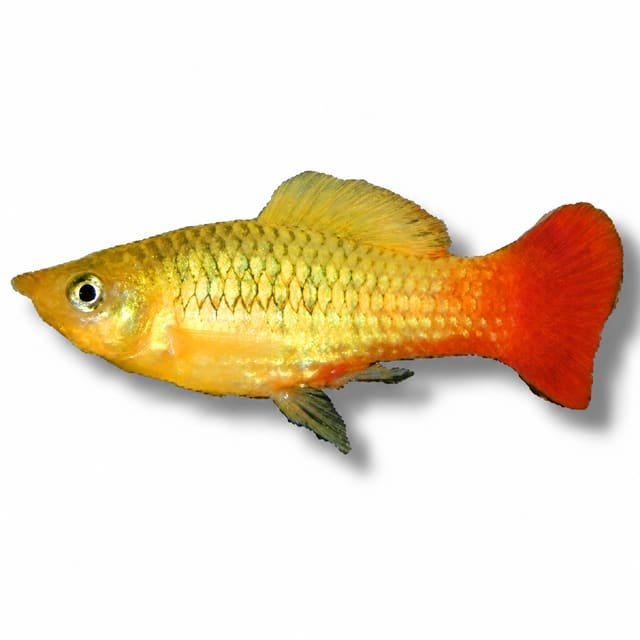
Sunset Variatus Platy (Xiphophorus variatus)
20–26°C · pH 7–8.2 · 54L
£5.99
The White Mickey Mouse Platy (Xiphophorus maculatus) is a freshwater poeciliid from Mexico to northern Belize that reaches 5 cm. It suits beginners; OATA's platy and swordtail guidance suggests keeping at least three, and the FishBase/Seriously Fish overlap is 20–25°C, pH 7.0–8.0 and 10–19 dGH. Sold individually at a dispatch size of 3–4 cm.
Adult size is the maximum length this species reaches at full maturity (scientific sources). The livestock you receive will be younger and smaller. Product-photo provenance and any image-specific limitations are stated on the listing.
Shoaling fish: kept in a group they feel safer, stay calmer and show their best colour.
The White Mickey Mouse Platy (Xiphophorus maculatus) is a freshwater poeciliid from Mexico to northern Belize that reaches 5 cm. It suits beginners; OATA's platy and swordtail guidance suggests keeping at least three, and the FishBase/Seriously Fish overlap is 20–25°C, pH 7.0–8.0 and 10–19 dGH. Sold individually at a dispatch size of 3–4 cm.
Adult size is the maximum length this species reaches at full maturity (scientific sources). The livestock you receive will be younger and smaller. Product-photo provenance and any image-specific limitations are stated on the listing.
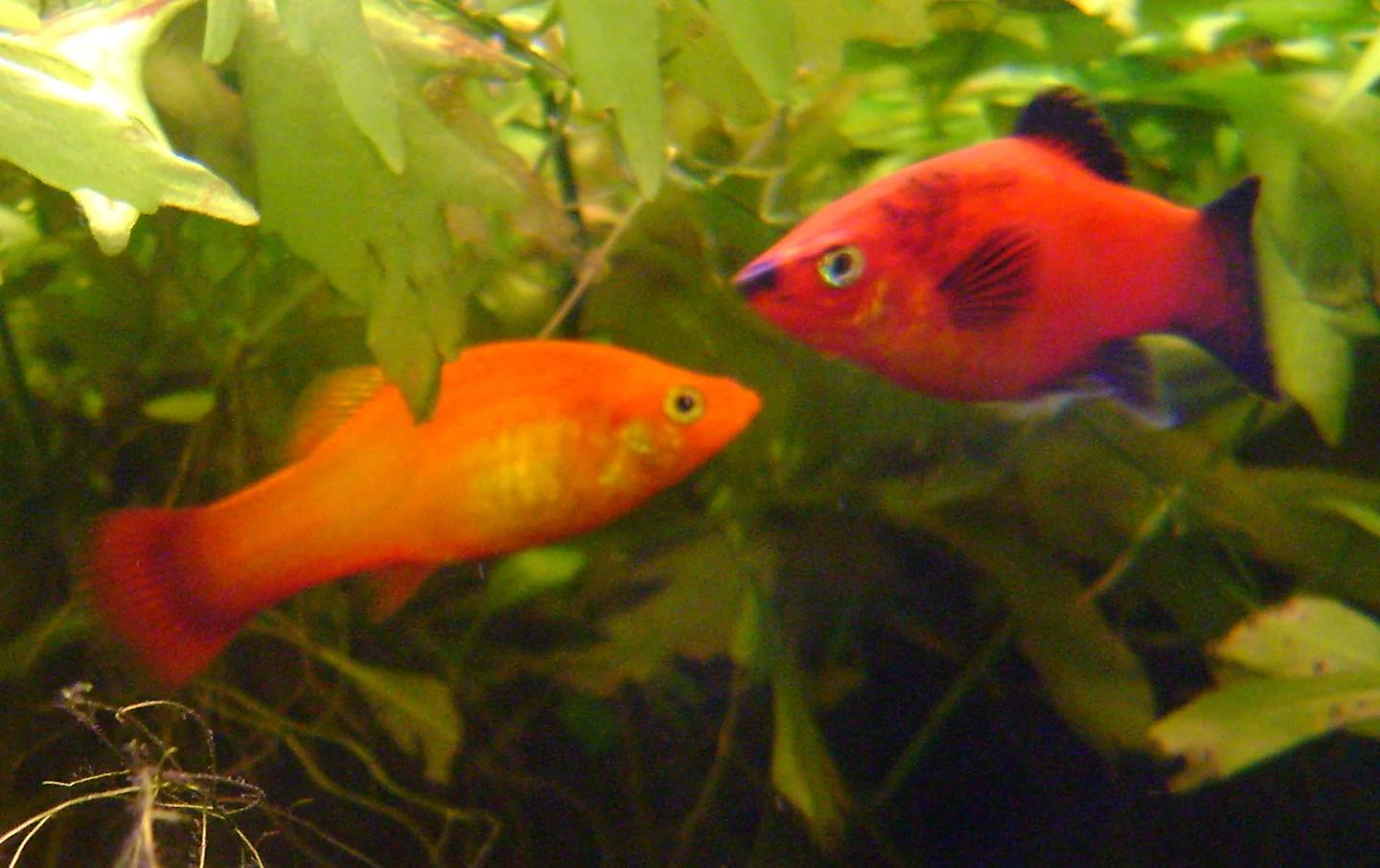
Platy is a trade name used for Xiphophorus maculatus, X. variatus and domestic forms. Start with at least three in a mature aquarium of at least 45 litres, verify the exact fish and measured water, and plan extra capacity before mixing sexes.
Maintain these water conditions for optimal health and vibrant colors
The White Mickey Mouse Platy (Xiphophorus maculatus) is a small freshwater livebearer in the Poeciliidae family. FishBase records the species from North and Central America, ranging from Veracruz in Mexico to northern Belize, and gives an adult maximum of 4 cm total length. Wild fish occupy warm springs, canals, ditches, creeks and swamps, often around slow-moving water, silt and weedy banks.
This white aquarium variety belongs to the same species and shares its practical care requirements. It suits a keeper who can provide neutral-to-alkaline, moderately hard or harder water, a mature biological filter, a planted environment and companionship from other platies. Seriously Fish describes X. maculatus as one of the best beginner species when the pH remains above neutral.
Its peaceful community temperament makes it approachable, but successful care still depends on matching the aquarium to its water chemistry. Keep the routine temperature at 20–25°C, pH at 7.0–8.0 and general hardness at 10–19 dGH. Those values are the overlap between FishBase's recorded species environment and Seriously Fish's aquarium range, giving one practical target that sits inside both.
Platies are livebearers, so mixed-sex groups may produce repeated batches of fry. Think about group composition and the aquarium's long-term capacity before combining known males and females. The fish also needs dependable filtration and weekly maintenance; its small body does not make an unfiltered or newly prepared aquarium suitable.
One purchase supplies one live White Mickey Mouse Platy. It is sold individually at a dispatch size of 3–4 cm. That measurement describes the fish at dispatch, not a promise that it has completed its growth. You can also browse the platy fish collection when comparing colour varieties and related platies.
Plan around FishBase's adult maximum of 4 cm total length. For context, Seriously Fish lists 5 cm standard length, while OATA's group guidance describes platies generally as 6–8 cm; that broader figure is not a species-specific optimum. Use the species' 60 × 30 cm aquarium footprint instead of trying to scale the home closely around body length.
Sex is guaranteed only when the selected option explicitly states male or female. This White Mickey Mouse Platy listing has no sex-guaranteed option.
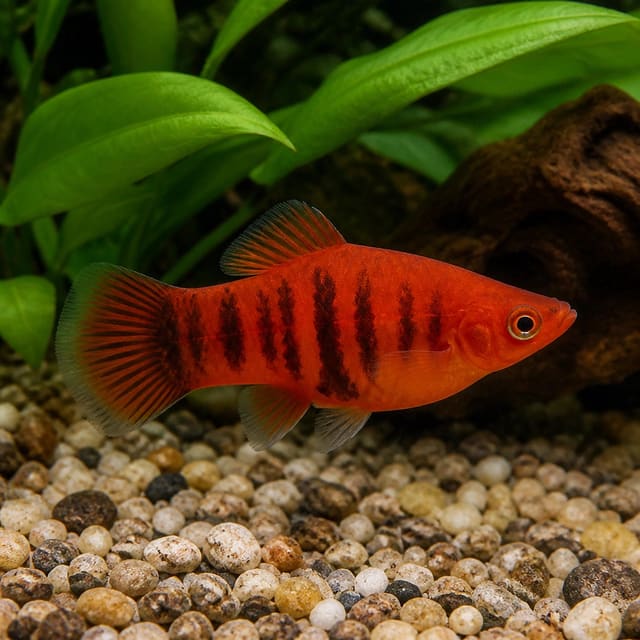
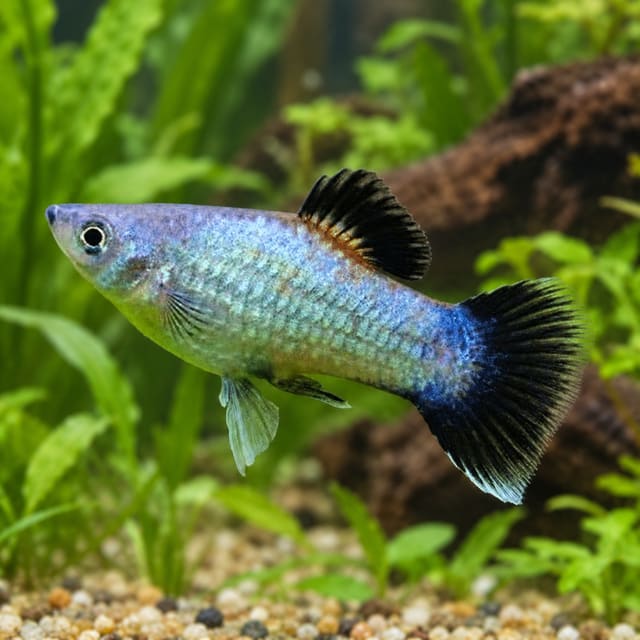
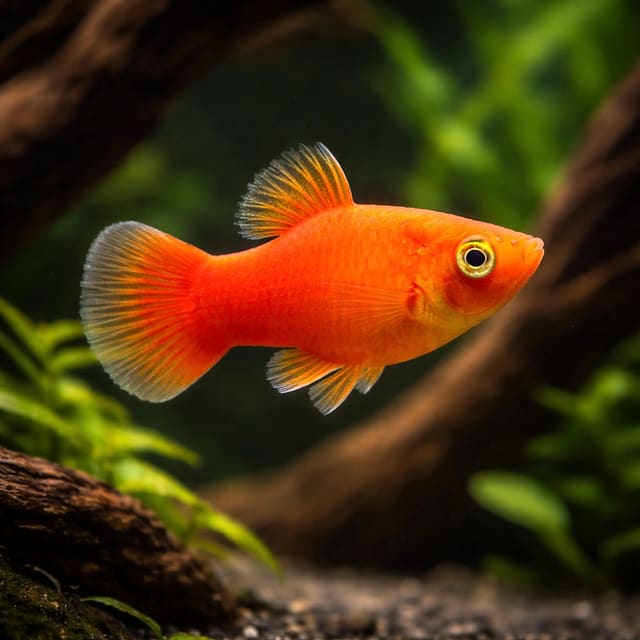
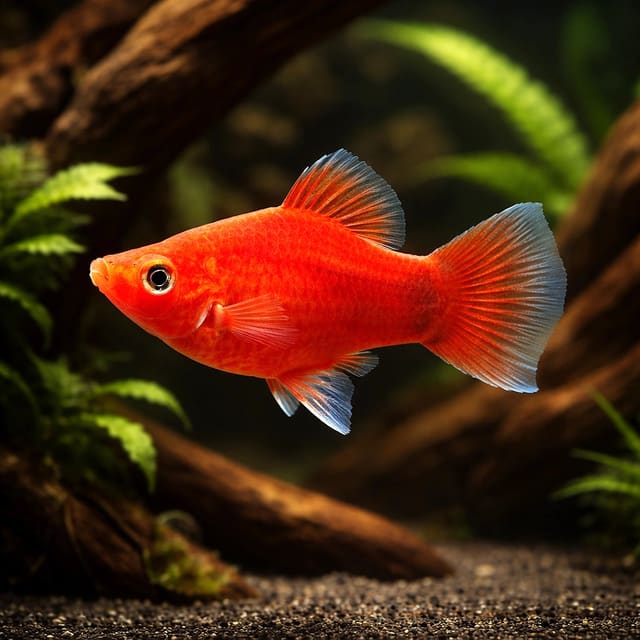
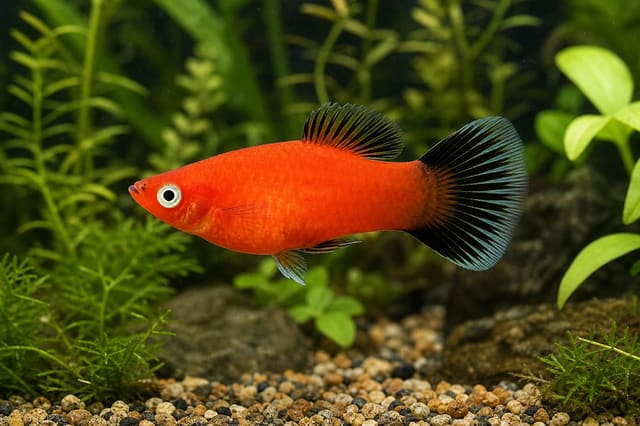
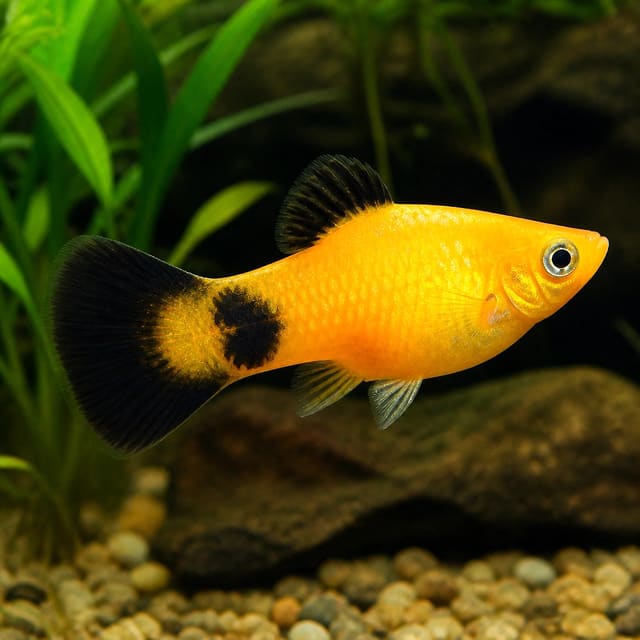
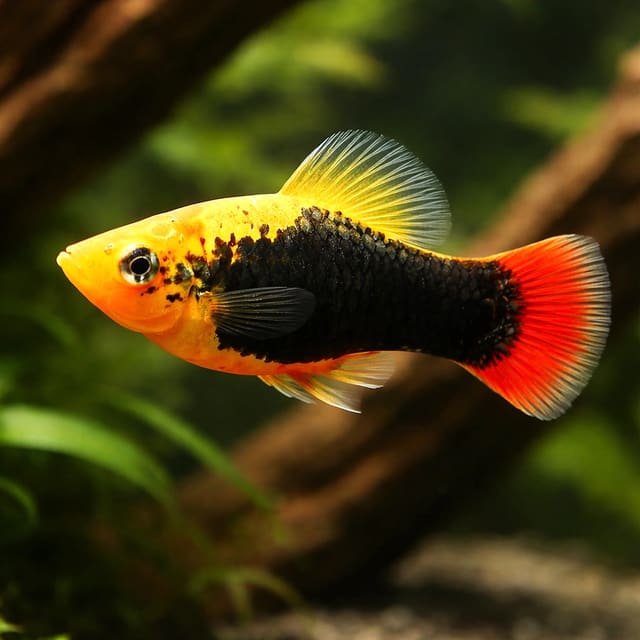
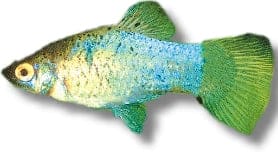
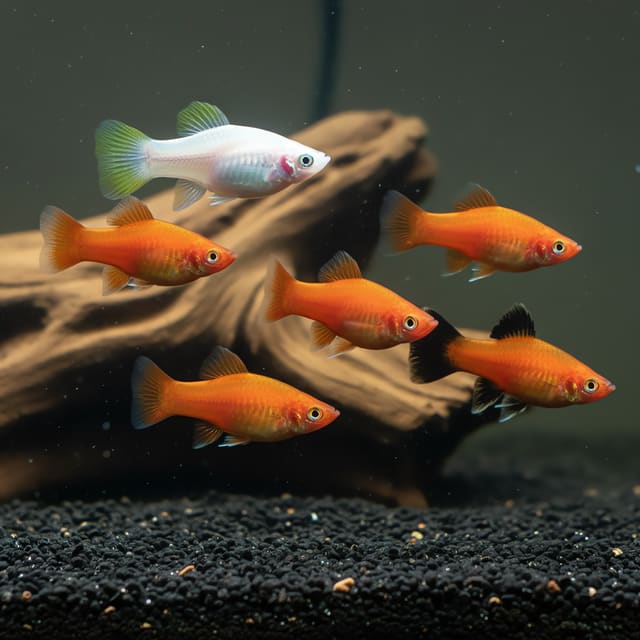
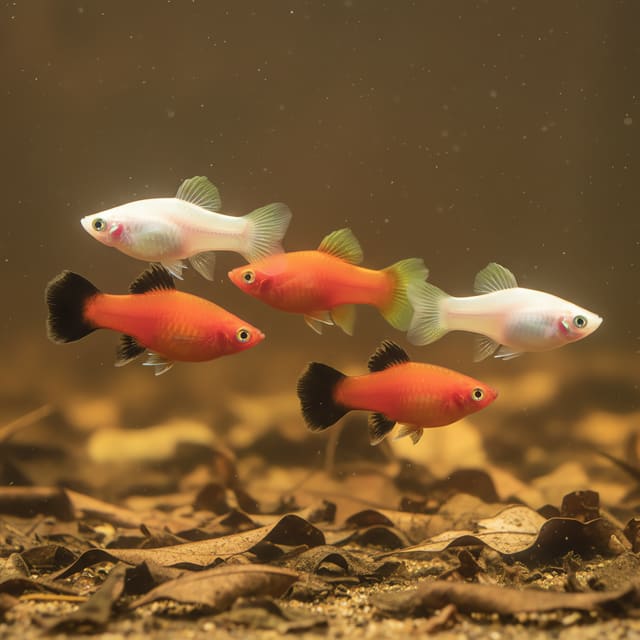
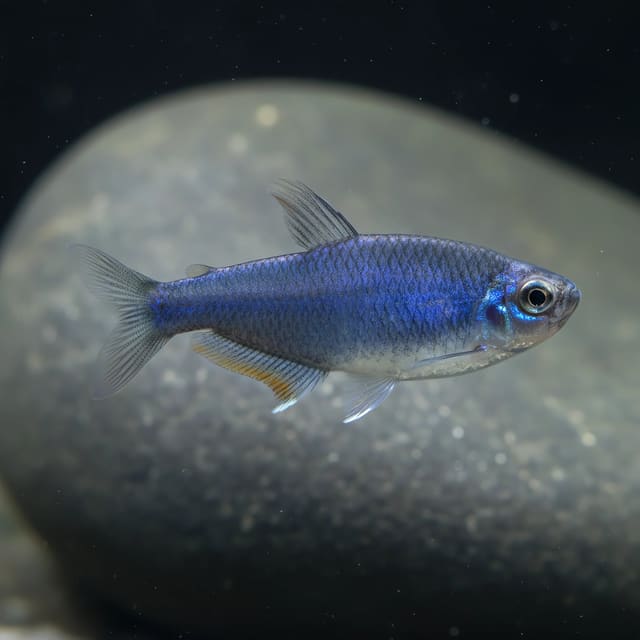
Some gallery images have been digitally enhanced to improve image quality. They show the listed type of animal rather than guaranteeing the exact markings of the individual supplied, so natural colour and pattern can vary.
The gallery illustration shows one pale fish among soft-focus plants, but the number of animals visible in an image does not set the purchase quantity. Group care is a separate husbandry decision: OATA suggests keeping at least three platies, with two females to each male when both sexes are housed together. Build that group gradually so the biological filter can adjust to each increase in fish and feeding.
Choose this platy for a mature freshwater community aquarium with neutral-to-alkaline water, a base of 60 × 30 cm and a volume of about 54 litres. The aquarium should be planted or furnished with other suitable cover while retaining open swimming space. A well-maintained filter is essential, and the fish should not be placed in soft, acidic water.
| Suits | Not suited to |
|---|---|
| Beginners who can keep pH above neutral | Soft, acidic aquariums |
| Mature, filtered freshwater aquariums | Unfiltered or biologically immature setups |
| Platy groups of at least three | A plan to keep one platy without companionship |
| Peaceful community species with matching water needs | Tankmates requiring water outside 20–25°C, pH 7.0–8.0 or 10–19 dGH |
| Planted layouts with cover and swimming room | Overcrowded aquariums with no capacity for additional waste |
The decisive test is whether your measured tap and aquarium water can remain within the required range. A fish that is peaceful and small can still be a poor match if another resident needs acidic or much softer conditions. Screen water chemistry first, then temperament, available floor space and the combined demand placed on the filter.
If known males and females will share the aquarium, keep more females so attention from males is spread across the group. Seriously Fish warns that this attention can be relentless, while OATA suggests two females to each male. Repeated fry are also likely in mixed-sex groups, so allow for the resulting increase in population rather than treating breeding as an unexpected exception.
Use an aquarium with a base of 60 × 30 cm and a volume of about 54 litres. Seriously Fish gives that footprint and approximate volume for Xiphophorus maculatus, while FishBase sets a minimum aquarium length of 60 cm. The footprint gives a small group swimming room and allows plants, shelter and equipment to be arranged without filling every part of the tank.
OATA suggests at least 45 litres for a small platy group, but the species profile's 60 × 30 cm, roughly 54-litre aquarium is the stronger planning standard for this fish. Do not treat 45 litres as a reason to reduce the footprint. Tank dimensions matter because two aquariums with similar volumes can offer very different swimming space and room for shelter.
A larger aquarium can make environmental conditions such as temperature and water quality more stable. Extra volume is particularly useful where the aquarium contains several community residents or where a mixed-sex platy group may reproduce. It does not replace maintenance, but it gives the keeper more room to respond before a small change becomes severe.
Never use the 3–4 cm dispatch measurement to justify temporary housing below the species footprint. Prepare the permanent aquarium first, then receive the fish into the environment intended for its continuing care.
Keep this platy at 20–25°C, pH 7.0–8.0 and 10–19 dGH. These routine figures are the overlap between FishBase's species environment range and Seriously Fish's aquarium range. They protect against choosing the warmer 26°C upper limit from one profile or the softer edge of another guide when those figures do not sit inside both species ranges.
Measure the aquarium rather than relying on a general description such as hard, tropical or alkaline. Our water chemistry guide explains the values to test, and the water matcher lets you compare those measurements with the target range. A reading of 23°C, pH 7.5 and 14 dGH fits all three routine values. A reading of pH 6.8 fails the match even if the temperature and hardness are suitable.
The ammonia, nitrite and nitrate figures are OATA group guidance rather than a species-specific optimum. They are practical waste-control targets for deciding whether the aquarium is ready and whether maintenance is keeping pace with feeding and stocking.
Test before introducing the fish and repeat the tests at least weekly. If ammonia or nitrite is detectable, address the water quality before adding livestock. Temperature and pH alone cannot show whether the biological filter is processing waste safely.
Run a mature, well-maintained filter before adding this fish. The RSPCA explains that fish release toxic ammonia and that a working biological filter supports bacteria which convert ammonia to nitrite and then to safer nitrate. The filter is therefore life-support equipment, not simply a way to make the water look clear.
For an aquarium of about 54 litres, Seriously Fish suggests turnover of four to five times the aquarium volume per hour. That corresponds to a filter rated at roughly 215–270 litres per hour. Use the manufacturer's rating as a starting point, then check that the filter remains free from blockages and that its flow reaches the aquarium rather than being obstructed by decoration.
Seriously Fish estimates that roughly 50 W of heating can hold 20–26°C in a 54-litre aquarium when the room is around 20°C. Treat that wattage as a worked example tied to those conditions, while keeping this fish's routine target at 20–25°C. Room temperature, aquarium dimensions and equipment performance all affect the final result, so confirm the temperature with an aquarium thermometer.
If this is your first setup, follow our first tropical aquarium guide before arranging livestock. A mature filter cannot be replaced by clear-looking water, bottled additives alone or a plan to add every fish at the same time.
Provide a planted aquarium with open swimming space. Seriously Fish says the layout is not critical but that Xiphophorus maculatus appreciates planted conditions and is seen at its best in that type of setup. OATA also recommends live plants, gravel or sand and suitable shelter for platies.
Arrange plants around the back and sides or in defined groups so the fish can move between cover and clear water. Suitable ornaments, model caves or plant pots can supply shelter when live plants are not used. Every item should leave enough unobstructed room for the group to swim and should not reduce the usable 60 × 30 cm footprint to a narrow channel.
| Include | Reason |
|---|---|
| Live or artificial plants | Provide cover and visual shelter |
| Aquarium gravel or sand | Create the recommended furnished base |
| Open water | Preserve swimming room for the group |
| Accessible filter flow | Prevent decoration from blocking circulation |
Dense planting can also help spread attention where known males and females live together, but planting does not replace the recommended female-to-male ratio. Keep more females than males and use the layout as an additional way to provide separation and cover.
Check the arrangement during routine maintenance. Remove trapped waste with a siphon and make sure plants or ornaments have not shifted into the filter intake or outlet. If a fish begins hiding more than normal, first test the water and observe interactions rather than immediately stripping out all its cover. Hiding can be a useful early warning when assessed alongside breathing, colour, feeding and the behaviour of other residents.
Use a quality dried flake or granule with a plant or algae component as the routine food, then add small live or frozen foods for variety. FishBase records worms, crustaceans, insects and plant matter in the wild diet, while Seriously Fish says the aquarium fish accepts dried, frozen and live foods. That combination supports an omnivorous feeding plan rather than a single-food routine.
OATA's platy and swordtail feeding guidance recommends a good-quality flake or granule with a high algae content, supplemented with small live or frozen items such as daphnia, small bloodworm or tubifex. Offer only what the fish can eat within a few minutes, once a day. Remove the idea that a generous leftover portion is insurance: uneaten food breaks down and adds toxic waste to the water.
Feeding is also a daily observation point. Look for reduced intake, complete loss of interest, changes in body condition or a fish that repeatedly fails to reach food. Those signs should prompt water tests and closer observation of the group's interactions. Do not respond automatically by adding more food, because a water-quality or social problem can be made worse by uneaten material.
A practical portion is defined by the outcome, not by a fixed number of flakes: the group should finish the food within a few minutes. Reduce the next serving if food reaches the substrate uneaten. If every fish finishes promptly while maintaining stable body condition, keep the portion consistent rather than increasing it simply because the aquarium looks empty after feeding.
At least once every week, change 25% of the aquarium water and use a siphon to remove solid waste from the substrate. OATA recommends that frequency and amount for platies and swordtails. Treat replacement water with tap-water conditioner to remove chlorine or chloramine before adding it to the aquarium.
Test ammonia and nitrite at least once per week and keep both at zero mg per litre. Check nitrate against the target of no more than 20 mg per litre above the normal tap-water level. Record temperature, pH and hardness often enough to recognise drift before the readings leave 20–25°C, pH 7.0–8.0 or 10–19 dGH.
Tap water may contain chlorine or chloramine that can kill beneficial bacteria living in the filter media. Cleaning the media too aggressively can also reduce the bacterial population that processes fish waste. The goal is to clear obstructing debris while preserving the biological function.
Use each maintenance session to inspect the fish. OATA advises watching for surface hanging, bottom sitting, erratic swimming, darker or paler colour, increased aggression, unusual hiding, faster or slower gill movement, white spots, fluffy growths, damaged fins or scales, altered body condition and reduced feeding.
If you see a change, test the water first and compare the result with the aquarium's normal readings. Correct husbandry problems promptly and seek suitable help for continuing health concerns. Avoid choosing a disease treatment from appearance alone, because these signs can accompany several different problems and water quality must be checked before the next decision.
Prepare the mature aquarium before the delivery day. Confirm 20–25°C, pH 7.0–8.0, 10–19 dGH, zero ammonia and zero nitrite. These aquarium checks come from the species ranges and OATA's water-quality guidance; they should be completed before the parcel is received.
These steps follow the Tropical Fish Co delivery and Live Arrival Guarantee policy. The fish is hand-bagged in pure oxygen, placed in an insulated poly box and given a heat pack when the weather calls for it. Someone must be at the address to receive live fish because the parcel cannot be left unattended.
Keep the continuous unboxing video and order number. If anything has gone wrong, contact us the same day with both items so the condition of the sealed parcel, opening and fish in the bag can be assessed under the policy.
After release, observe swimming, breathing, colour, hiding and access to food. Test ammonia and nitrite rather than assuming that a previously mature filter has remained unaffected by the additional waste. Both readings should stay at zero mg per litre.
Add no further fish merely because the new platy appears settled. OATA advises increasing aquarium stocking slowly so beneficial bacteria can respond when waste production and feeding increase. Continue the established once-daily feeding and weekly testing routine, reducing food if any remains after a few minutes.
Keep the White Mickey Mouse Platy with peaceful community species that share its routine water values. Seriously Fish describes Xiphophorus maculatus as very peaceful and says it can be kept with most community species. That permission still requires a complete match: every resident must suit 20–25°C, pH 7.0–8.0 and 10–19 dGH, and the aquarium must have enough capacity for the combined group.
Avoid soft, acidic community setups because this platy will not thrive in those conditions. Do not compromise at a pH below 7.0 merely because another species prefers it. Select residents whose acceptable ranges overlap all three platy values rather than matching temperature alone.
| Check | Pass condition |
|---|---|
| Water | All residents suit 20–25°C, pH 7.0–8.0 and 10–19 dGH |
| Temperament | Peaceful community behaviour |
| Space | The 60 × 30 cm footprint and filter can support the complete group |
| Feeding | Each fish can reach suitable food without persistent interference |
Observe the aquarium after introduction. Look for repeated chasing, a fish hiding more than normal, damage to fins or scales, altered breathing or failure to feed. Water tests should accompany that observation because poor water quality can change behaviour and cannot be diagnosed by watching interactions alone.
The source profiles do not name a fixed list of companion species, so compatibility should be decided from the complete adult community. Ask us to assess a proposed combination using the aquarium dimensions, measured water values, filtration and existing residents. A broad label such as tropical fish or community fish is not enough to establish a match.
Plan for at least three platies. OATA's platy and swordtail guidance suggests that minimum for companionship and recommends two females to each male when both sexes are kept together. More can be kept in the same ratio when aquarium capacity, filtration and maintenance are increased to support them.
Seriously Fish also advises keeping more females than males because male attention can be relentless. Even males tolerate one another, and the species is described as lacking the aggression associated with some swordtails and mollies. Those observations support its peaceful reputation, but they do not remove the need to watch each group after introduction.
Platies are livebearers, and FishBase records that aquarium varieties reproduce easily. Seriously Fish says batches of fry can be continual when males and females share a tank. Before building a known mixed-sex group, decide whether the aquarium has space for population growth and how that increase would affect waste, feeding and maintenance.
Do not rely on colour, body size or a gallery image to decide the sex of the animal being purchased. For fish already in front of you, OATA describes the male as having a specialised gonopodium and the female as having a triangular anal fin. Base any ratio adjustment on a clear examination of the individual fish rather than assumptions about the white colour variety.
Group size is not a substitute for compatibility. Three platies still need matching water, a suitable footprint and dependable filtration, while a larger group needs correspondingly more capacity.
FishBase records an adult maximum of 4 cm total length. Plan its space around that adult figure rather than its 3–4 cm dispatch size.
Use a 60 × 30 cm base with a volume of about 54 litres; Seriously Fish gives those dimensions for this species, while FishBase sets a minimum aquarium length of 60 cm.
For the White Mickey Mouse Platy, OATA's platy and swordtail group guidance suggests keeping at least three, with two females to each male when both sexes are housed together. Increase aquarium capacity as the group grows.
Yes, when kept above neutral pH in moderately hard or harder water; Seriously Fish describes the species as one of the best beginner choices under that condition. The routine FishBase/Seriously Fish overlap is 20–25°C, pH 7.0–8.0 and 10–19 dGH.
Feed a quality dried flake or granule containing plant material, with small live or frozen foods such as daphnia, small bloodworm or tubifex for variety. Offer only what it can finish within a few minutes, once a day.
Keep it at 20–25°C, pH 7.0–8.0 and 10–19 dGH. These routine values are the overlap between FishBase's species environment range and Seriously Fish's aquarium range.
Seriously Fish describes it as very peaceful and says even males tolerate one another. Observe every introduction for chasing, hiding, damaged fins or feeding problems.
Seriously Fish says it can live with most community species. Choose peaceful residents that also suit 20–25°C, pH 7.0–8.0 and 10–19 dGH, then check that the aquarium and filter can support the complete group.
Start filming the sealed parcel before opening it, keep the take continuous through the fish in the sealed bag, then float the bag for 20–30 minutes before releasing. Tropical Fish Co's policy says fish are hand-bagged in pure oxygen, placed in an insulated poly box and given a heat pack when the weather calls for it; someone must receive the parcel, and it must be opened and inspected the same day.
Independently collected by Judge.me from customers who bought this item. All reviews are shown.
One was a bit off in the first 24 hours but has now settled in and the company gave me excellent advice on how to care for it if it needed it. Happily swimming around the its buddies now