By Tropical Fish Co Editorial Team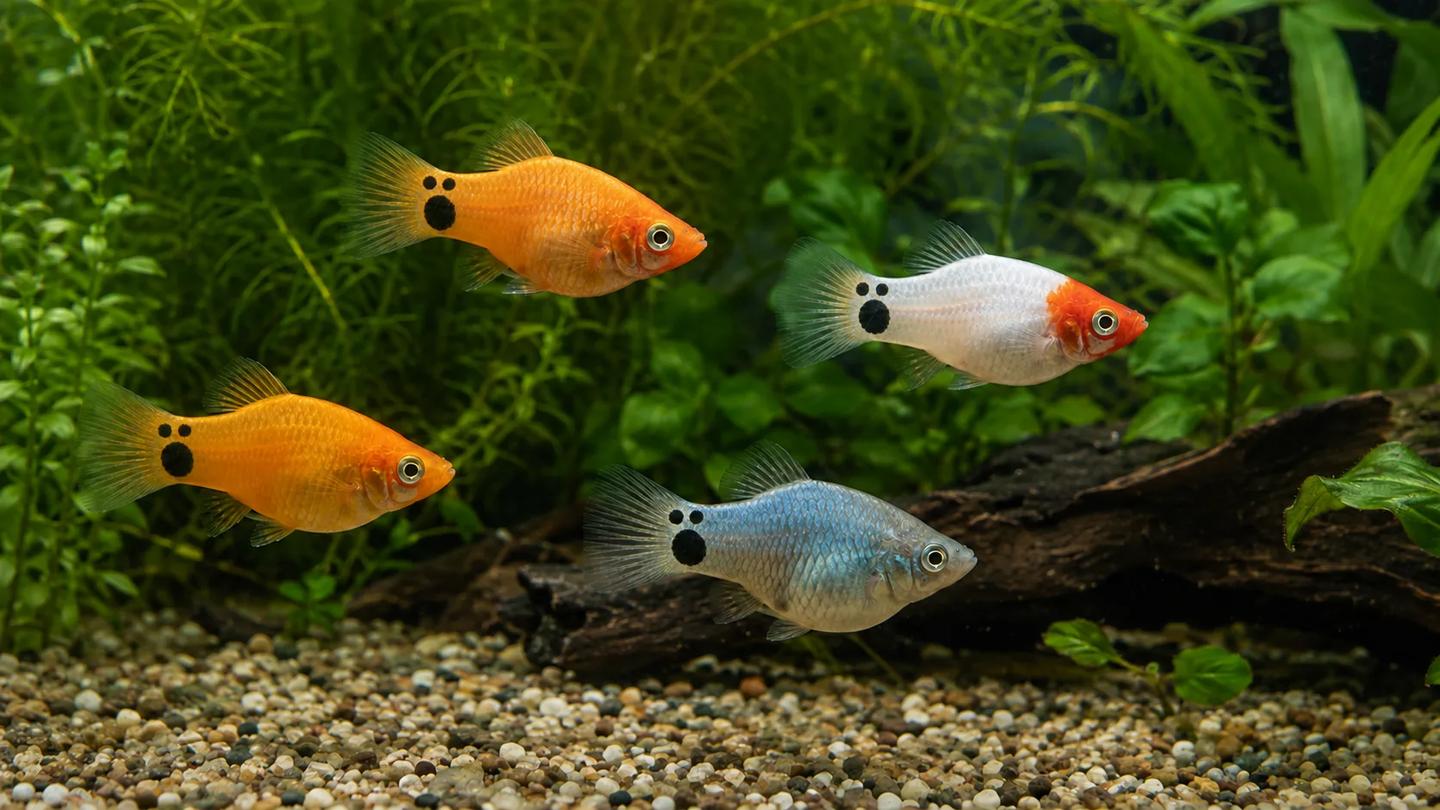
The direct answer
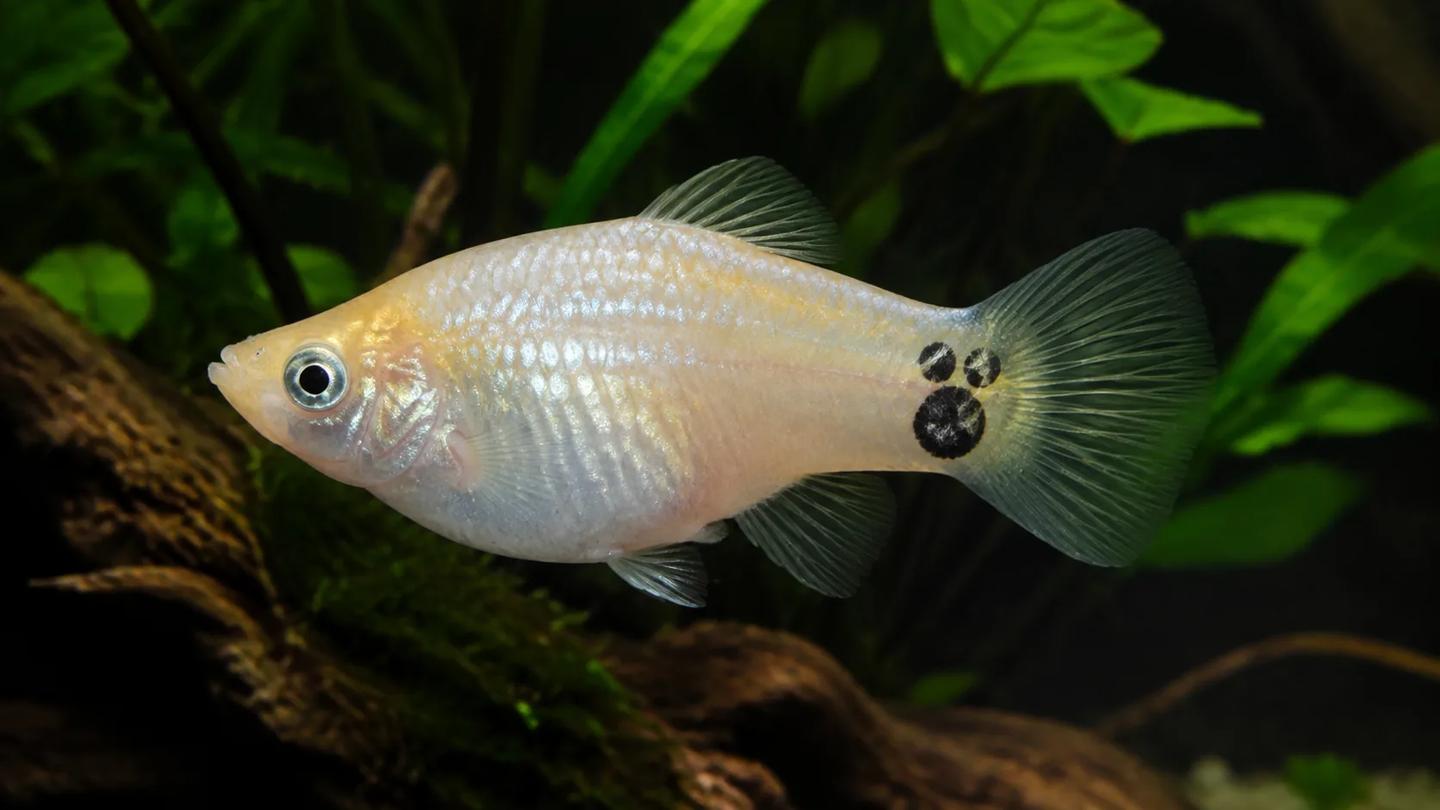
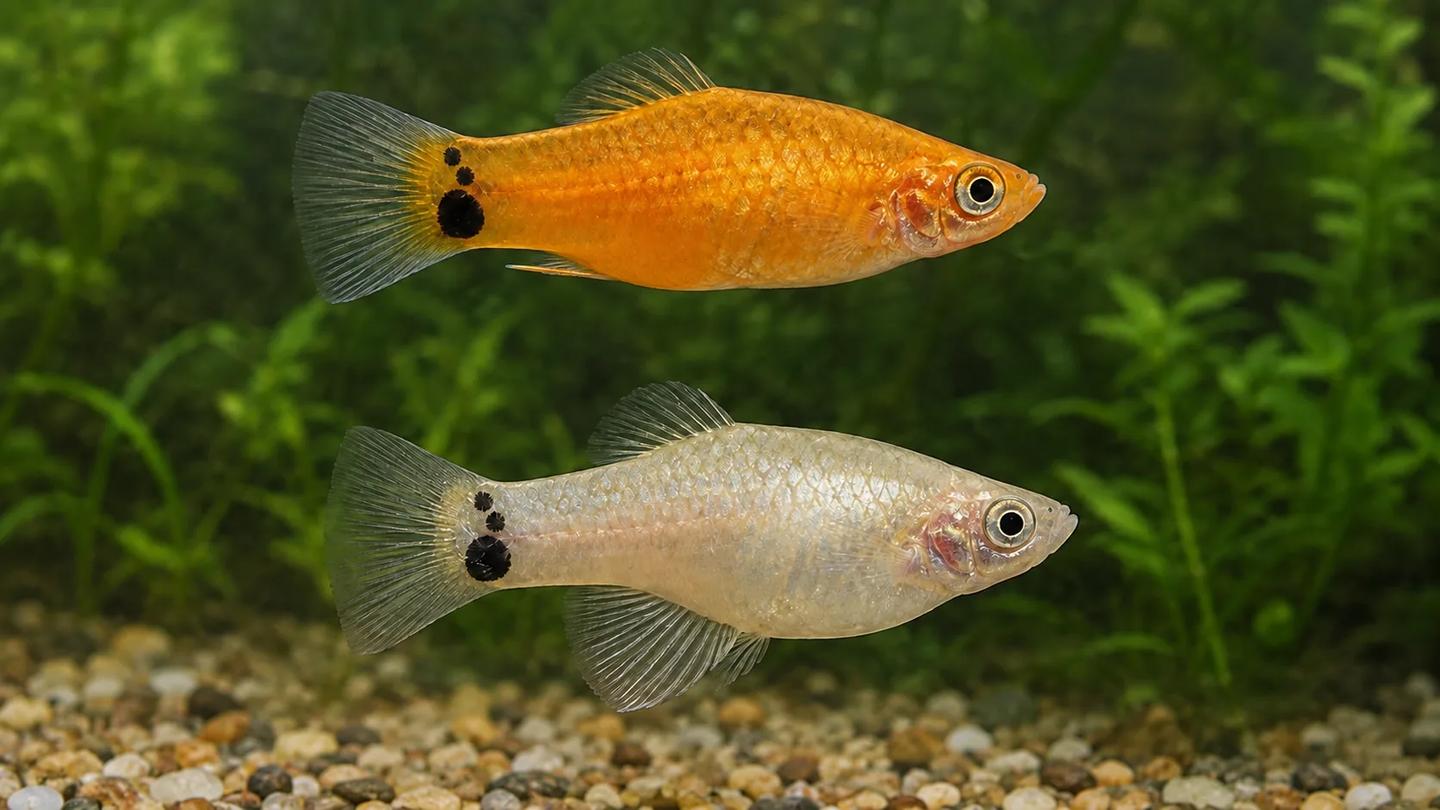
A Mickey Mouse platy is a domestic platy with a rounded three-part dark mark at the base of the tail. The expected pattern is one larger mark with two smaller marks above it. UK shops usually place these fish under Xiphophorus maculatus, the southern platyfish, but the trade name itself is not a separate species or proof of pure ancestry.
Check three things together before buying: the tail-base pattern, a current photograph of the actual type being sold and the seller's scientific name. Body colour can be orange, red, white, gold, blue or mixed. Colour does not tell you the fish's sex, pregnancy status, health or water history.
For care planning, current OATA guidance says:
- keep at least three platies and, in a mixed-sex group, use two females per male;
- start a small group at 45 litres or more, then increase space for the full adult community and any fry;
- screen 17–27°C, pH 7–8, 4–12 dGH and 3–10 dKH, then confirm the actual fish and seller water;
- use a mature filtered aquarium with cover and open swimming space;
- expect live young when sexes are mixed, while avoiding a promised fry count or timetable.
FishBase separately records maximum total lengths of 6.0 cm for females and 4.0 cm for male or unsexed fish, plus 18–25°C, pH 7–8 and 9–19 dH for X. maculatus [2]. Those compiled figures and OATA's broader trade-body guidance are useful evidence bounds—not an invitation to move a fish rapidly between different water conditions.
For current availability, use the live Platy category, then open the exact product page. That is where the photographed fish, sale unit, size, water, price and checkout status must be checked. This guide does not freeze those changing facts into evergreen copy.
What the Mickey Mouse name means
The name describes the ornamental mark on the caudal peduncle, the narrow part of the body immediately before the tail fin. On a clear example, two smaller dark marks sit above a larger rounded mark. The resemblance gives the fish its shop name.
The mark is a useful pattern check, but not a complete identification. Domestic platies carry extensive colour-pattern variation: a scientific review describes more than 40 polymorphic colour patterns in X. maculatus [3]. Commercial lines may also have an ancestry that a photograph cannot resolve. Therefore:
- do not call every platy with a dark tail a Mickey Mouse platy;
- do not reject a fish solely because the three marks overlap slightly;
- do not infer sex or pregnancy from the dark area;
- do not advertise an exact genetic line without breeder records;
- ask the seller when the photo, name and scientific identity disagree.
A 2022 fin-development study explicitly reports using a commercial Mickey Mouse platy strain [4]. That is an unusual link between an aquarium trade name and laboratory research. The paper does not define home care or prove the ancestry of fish in a shop, so this guide keeps those questions separate.
Species, strain and the broader platy guide
The accepted species name Xiphophorus maculatus is supported by Eschmeyer's Catalog of Fishes and FishBase [1] [2]. FishBase records a native distribution from Veracruz in Mexico to northern Belize. That wild-species record does not mean an ornamental fish in the UK was collected there; commercial Mickey Mouse platies are domestic aquarium fish.
This page owns the exact Mickey Mouse search decision: what the mark means, how to inspect it, how to sex an adult and what to verify in a live listing. The evidence-led Platy care guide owns the wider comparison of platy types and the family's general husbandry. Keeping those roles distinct helps a reader and a search engine reach the most specific answer.
Platyfish also have a long research history. Their genome has been used to study pigmentation, melanoma and other inherited traits [5]. That history is interesting evidence of the genus's scientific importance, but it should not be converted into a marketing claim that one ornamental pattern is healthier, rarer or genetically “better”.
Size, group and tank space
FishBase lists maximum total-length records of 6.0 cm for females and 4.0 cm for male or unsexed fish [2]. OATA's combined platy-and-swordtail sheet gives a broader 6–8 cm overview and says males are generally smaller than females [7]. Keep the dataset and measurement label attached: neither record predicts the final length of an individual domestic fish.
Plan from adult capacity, not the smaller size visible in a sales photograph. OATA suggests at least three platies and at least 45 litres for a small group. The same sheet says a larger aquarium is more stable and more groups need more volume [7].
Use this sequence instead of a litres-per-fish shortcut:
- Group: can you keep at least three compatible platies without leaving one female under persistent male attention?
- Footprint: is there useful swimming length as well as planting or other cover?
- Maturity: is biological filtration established, with ammonia and nitrite testing at zero?
- Adult community: will every resident fit after growth, including possible fry?
- Feeding and observation: can you see every fish and confirm it reaches food?
The RSPCA likewise combines adequate dimensions, fishless cycling, filtration, heating, oxygen and testing in its aquarium guidance [10]. A nominal 45-litre volume cannot rescue an unsuitable shape, immature filter or overloaded community.
Water parameters in a UK home
OATA gives platies and swordtails 17–27°C, pH 7–8, 4–12 dGH and 3–10 dKH [7]. FishBase records 18–25°C, pH 7–8 and 9–19 dH for X. maculatus [2]. England's current animal-selling guidance lists 18–28°C as a broad retail holding range for guppies, swordtails, mollies and platies and says temperatures should remain stable [11].
These sources answer different questions. The licensing range governs a broad retail category; FishBase compiles species data; OATA supplies practical UK aquarium guidance. None identifies your fish's current water.
Before checkout, record:
| Measurement | Evidence screen | What still needs checking |
|---|---|---|
| Temperature | OATA 17–27°C; FishBase 18–25°C | Seller water, complete community and stability |
| pH | Both sources give 7–8 | Actual aquarium and source-water readings |
| GH | OATA 4–12 dGH; FishBase 9–19 dH | Local supply, seller water and interpretation of units |
| KH | OATA 3–10 dKH | Buffering in the actual aquarium |
| Nitrogen waste | Ammonia and nitrite should test zero | Current liquid-test results and nitrate trend |
UK tap water is not universally hard. The Drinking Water Inspectorate explains that hardness varies with geology and that the local water company can provide the supply value [9]. It also says ion-exchange softeners replace calcium and magnesium with sodium, so household softened water is not automatically suitable aquarium water.
Choose stable conditions supported by the retailer and all residents. Do not chase a target pH with abrupt chemical changes. The water-chemistry guide explains why GH, KH and pH are different measurements.
Male or female: inspect the anal fin
The tail marking appears in both sexes. On a sexually mature platy, OATA identifies the male by a narrow modified anal fin called a gonopodium; the female has a broader triangular anal fin and is generally larger [7].
Use a clear side view and inspect the fin below the rear half of the abdomen. Do not diagnose sex from body roundness alone: age, feeding, body form and health can alter the outline. A dark abdominal area is also not a reliable stand-alone pregnancy test.
A shop's sex label can be wrong, especially for juveniles. If avoiding breeding matters, ask for a current side-view image and the seller's confidence, then recheck after maturity. A single-sex plan can reduce mating pressure, but it cannot guarantee no fry when a female has previously encountered a male.
Fry and stored sperm: plan before mixing sexes
Platies are livebearers. OATA reports possible pregnancy and fry ranges, but an individual female's timing and number vary [7]. This guide therefore does not promise a fixed monthly brood or treat a round abdomen as a schedule.
Female X. maculatus can store viable sperm for up to several months after mating. Potter and Kramer observed the storage structures in the ovary and gonoduct [6]. That means a female separated from males can still produce later young. It does not mean every female is inseminated or pregnant.
Before keeping mixed sexes, decide:
- whether the aquarium can support adults and growing young;
- how water quality and feeding will be monitored as numbers change;
- where offspring can be housed responsibly;
- what you will do if the intended sex ratio proves wrong;
- whether a single-sex group is the better plan.
Do not assume adult predation will control numbers humanely or predictably. Dense planting may change survival, but it does not create unlimited filtration or space.
Feeding, layout and tank mates
OATA describes platies and swordtails as omnivorous and recommends a suitable complete food with variety, including appropriate vegetable matter and small live or frozen items [7]. Feed an amount the group can consume without leaving waste to degrade the water. Watch individuals rather than assuming a missing ration was shared evenly.
Provide a mature filter, swimming room and planting or other safe cover. Protect fish from unsuitable filter intakes and maintain oxygenation. The nitrogen-cycle guide explains why clear water does not prove biological readiness.
Tank mates require a screen, not a confident list:
| Check | Suitable direction | Warning sign |
|---|---|---|
| Water | Stable overlap in measured temperature, pH and hardness | One fish sits near an outer evidence limit |
| Adult size | Neither animal can swallow or dominate the other | Predator-sized mouth or major size gap |
| Behaviour | Calm interaction with retreats and visual breaks | Fin nipping, persistent chasing or exclusion |
| Feeding | Every fish reaches appropriate food | One species clears the ration first |
| Capacity | Full adult and possible fry load fits | Stocking is justified by juvenile size |
Platies are not cleaners. Shrimp, snails and Corydoras are not cleaners either, and no source in this evidence set proves them safe companions for every Mickey Mouse platy. If shrimp breeding or survival is the priority, a fish-free aquarium removes an avoidable uncertainty.
Buying and acclimation without stale promises
Open the live Platy category for current availability, then verify the exact product page:
- does the current photo show the expected three-part tail-base mark?
- does the scientific name agree with the photographed fish?
- is the sale unit one fish, a pair, a sexed fish or an assortment?
- what size measure and holding-water values does the seller provide?
- can the purchase create a responsible group and sex ratio?
- are price, stock and checkout status live now?
This information-first page deliberately avoids Product or Offer promises. A category or product page must own current inventory, price and purchase eligibility.
Do not copy a fixed drip rate or timer from evergreen text. OATA describes floating and drip methods and says acclimation depends on the water difference and fish involved [8]. Follow the current seller instructions, minimise transport and light stress, and monitor the fish and water closely after arrival.
Health checks and escalation
Choose active fish with clear eyes, an appropriate body profile, intact fins and ordinary respiration. After introduction, investigate appetite loss, clamped or damaged fins, rapid breathing, loss of balance, white spots, wounds, unexplained hiding or a fish separating from the group.
Start with evidence:
- test temperature, ammonia, nitrite, nitrate, pH and hardness;
- inspect every animal, not only the most visible symptom;
- record recent livestock, food, maintenance and equipment changes;
- contact the retailer promptly when an arrival concern is possible;
- seek an aquatic-experienced veterinary professional when signs are severe, persist or spread.
The MSD Veterinary Manual places water quality, environment and stocking history inside diagnosis and supports targeted treatment [12]. This page therefore does not map one symptom to a medicine or dose.
A six-step Mickey Mouse platy decision
- Confirm the pattern: look for one larger and two smaller marks at the tail base, while allowing natural variation in clarity.
- Confirm the listing identity: current photograph, common name and scientific name should agree; ask when they do not.
- Plan the social group: keep at least three, and use two females per male when sexes are mixed.
- Test space and water: use adult capacity, mature filtration and actual measurements—not “hard UK water” or a litres-only shortcut.
- Plan for fry: stored sperm makes later young possible even after removing males; do not promise a fixed schedule.
- Verify commerce live: current sex, quantity, size, water, price, stock and delivery terms belong to the exact product page at checkout time.
If one of those answers is missing, pause the purchase and ask for evidence. The goal is to decide whether this exact fish and aquarium match—not to find a slogan that makes every sale suitable.
Evidence and correction policy
Taxonomy follows Eschmeyer's Catalog of Fishes and FishBase. Care bounds are clearly attributed to OATA, FishBase and current UK licensing guidance. Reproduction statements distinguish peer-reviewed sperm-storage evidence from OATA's broad care ranges. No source is used to prove the identity, sex, pregnancy, health or availability of a particular shop fish.
The three page visuals are original reference-informed editorial scenes. They illustrate the expected pattern, a group setting and adult sexing cues; they are not photographs of current inventory. If you find a factual or identification problem, send the exact claim and supporting source through contact. Feedback is a correction route, not a lead or ecommerce conversion.