Easy
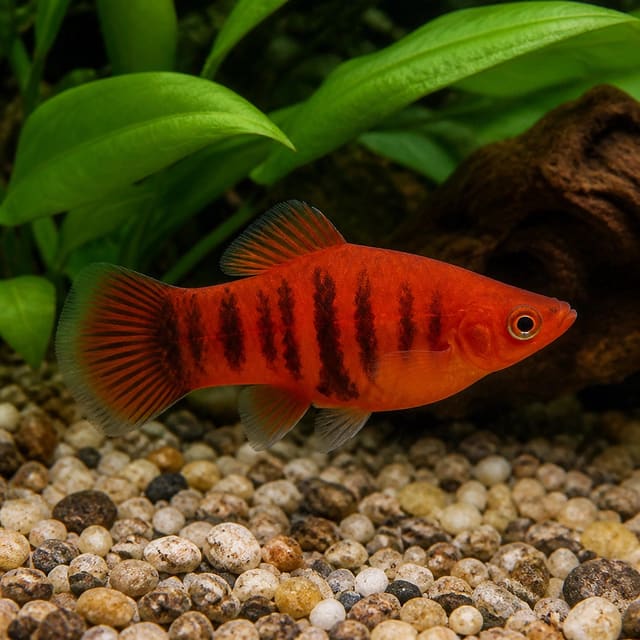
Xiphophorus maculatus red tiger
20–25°C · pH 7–8 · 54L
£3.99
Photo coming soon
The size, price and care details on this page are for this listing.
Moscow Platy (Xiphophorus maculatus) is a peaceful, beginner-friendly livebearer for a mature, planted community aquarium with moderately hard or harder water. One purchase supplies one unsexed live fish at the supplier's 3–4 cm dispatch grade; plan a small social group, stable 20–26 °C water and the possibility of fry.
Adult size is the maximum length this species reaches at full maturity (scientific sources). The livestock you receive will be younger and smaller. Product-photo provenance and any image-specific limitations are stated on the listing.
Xiphophorus maculatus
Shoaling fish: kept in a group they feel safer, stay calmer and show their best colour.
Minimum of 2 per order.
Moscow Platy (Xiphophorus maculatus) is a peaceful, beginner-friendly livebearer for a mature, planted community aquarium with moderately hard or harder water. One purchase supplies one unsexed live fish at the supplier's 3–4 cm dispatch grade; plan a small social group, stable 20–26 °C water and the possibility of fry.
Adult size is the maximum length this species reaches at full maturity (scientific sources). The livestock you receive will be younger and smaller. Product-photo provenance and any image-specific limitations are stated on the listing.
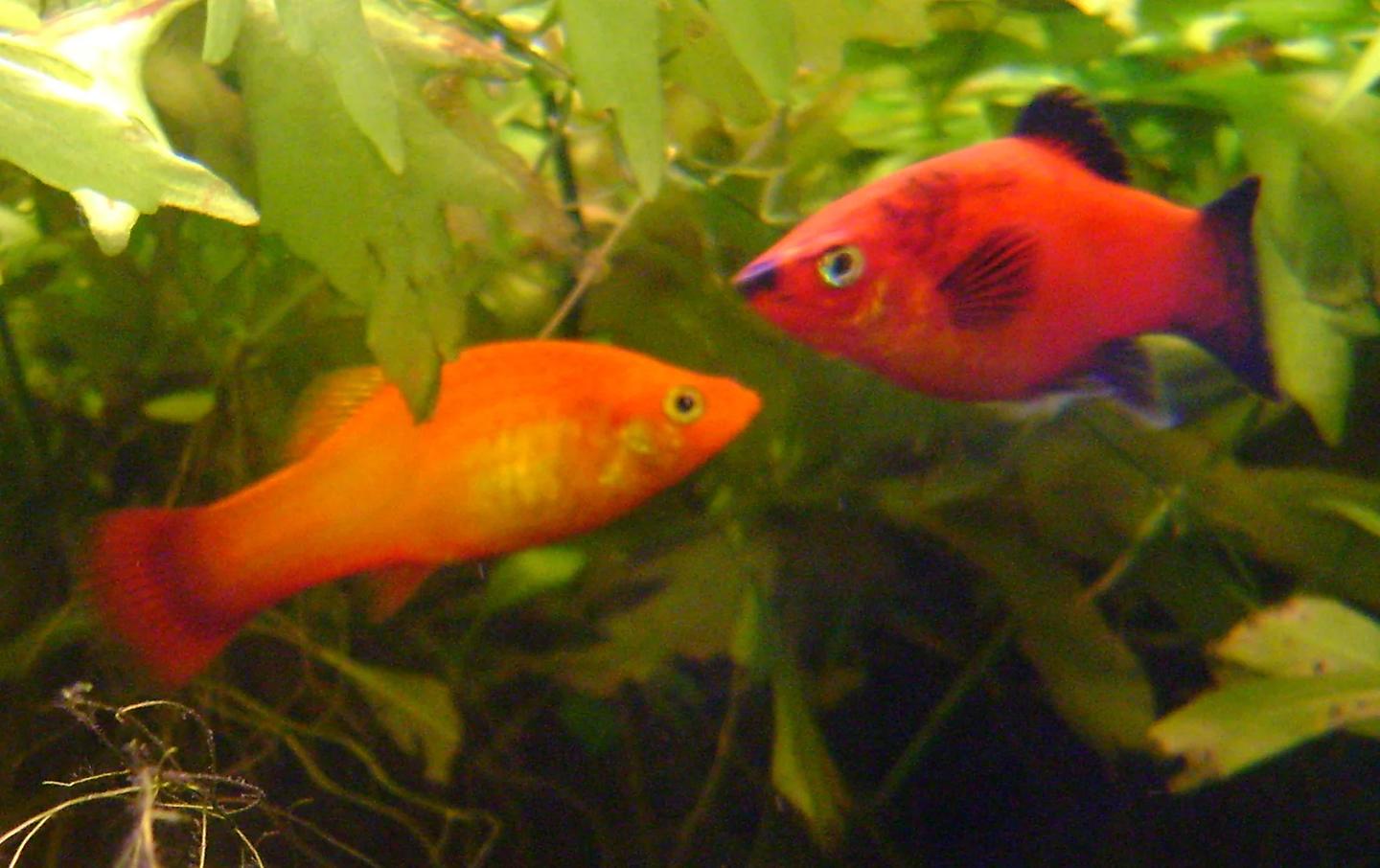
Platy is a trade name used for Xiphophorus maculatus, X. variatus and domestic forms. Start with at least three in a mature aquarium of at least 45 litres, verify the exact fish and measured water, and plan extra capacity before mixing sexes.
Maintain these water conditions for optimal health and vibrant colors
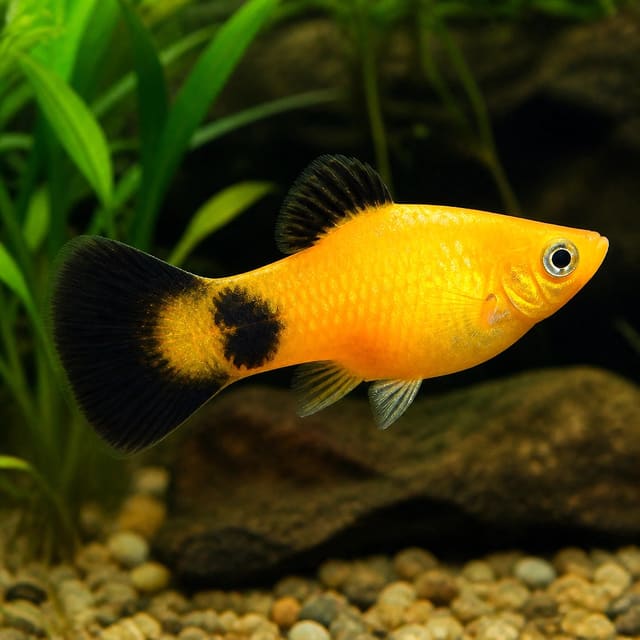
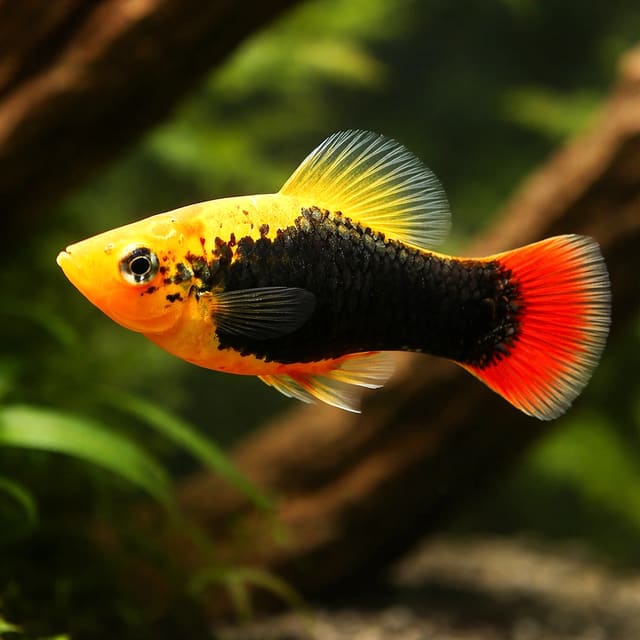
Moscow Platy (Xiphophorus maculatus) is a selectively bred form of the familiar platy: a compact, active livebearer with the rounded body and steady, sociable movement that make platies easy to enjoy in a community display. “Moscow” is the trade-form name here; it is not an extra word in the scientific name. The accepted species identity is Xiphophorus maculatus, a member of the Poeciliidae family native to Atlantic drainages of Mexico and Central America. Aquarium strains are captive-bred colour forms, so the fish you keep should be planned around sound aquarium husbandry rather than an attempt to recreate a single wild collecting site.
This listing supplies one live fish per purchase. Its 3–4 cm dispatch grade describes the approximate size sent and not an adult ceiling. There is one standard purchase option rather than a choice of sizes or sexes. Sex is guaranteed only when the selected option explicitly states male or female. This Platy Moscow listing has no sex-guaranteed option.
The strongest reasons to choose this fish are its generally peaceful manner, flexible omnivorous diet and suitability for a planted, hard-water community. It is a good candidate for a first livebearer aquarium when the keeper has already matured the filter, tested the tap water and allowed enough space for a small social group. It is a poor match for soft, acidic water, an uncycled bowl, persistent bullies or a household that has not planned for the possibility of fry.
| Accepted scientific name | Xiphophorus maculatus |
|---|---|
| Trade form | Moscow Platy |
| Sold unit | One live fish per purchase |
| Dispatch grade | 3–4 cm; this is not the adult size |
| Published aquarium starting point | 60 × 30 cm base, about 54 litres |
| Routine aquarium range | 20–26 °C; pH 7.0–8.2; 10–30 dGH |
| Temperament | Generally peaceful community livebearer |
| Diet | Varied omnivore diet using suitable dried, frozen and live foods |
| Social planning | Plan a small group; manage the sex balance if it becomes known |
| Experience level | Beginner-friendly once the aquarium is cycled and the water is suitable |
| Suits | A planted, mature community with stable moderately hard or harder water |
Published measurements need a little care. FishBase records a maximum of 4 cm total length for its male/unsexed record, whereas the specialist aquarium profile lists 50 mm standard length. Total length includes the tail and standard length does not, so those entries do not combine into a neat conversion or one unquestionable adult ceiling. OATA’s broader platy-and-swordtail sheet describes platies as 6–8 cm at group level. For practical planning, do not treat a 3–4 cm arrival as fully grown and do not build a cramped aquarium around one isolated number. The 60 × 30 cm species-profile footprint gives swimming length and water stability that a small desktop container cannot.
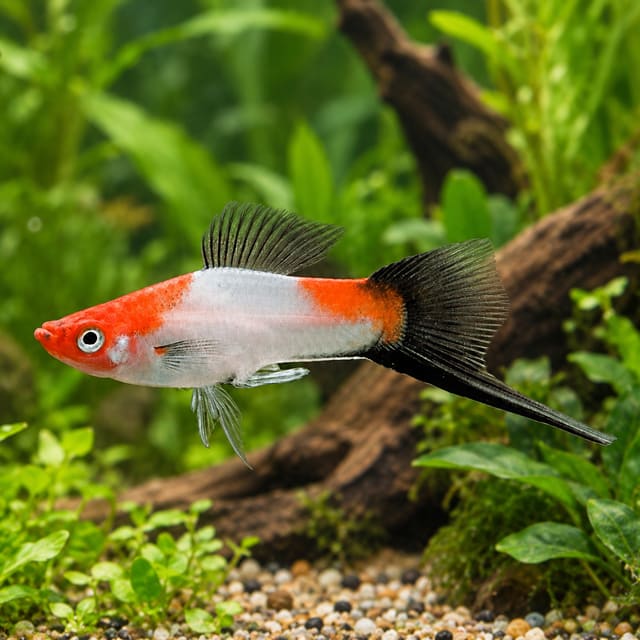
If you are comparing colour forms before settling on this one, the current platy collection keeps those alternatives together. Colour is the main attraction of a named form, but stable water, sensible stocking and a suitable group remain more important than choosing a particular pattern.
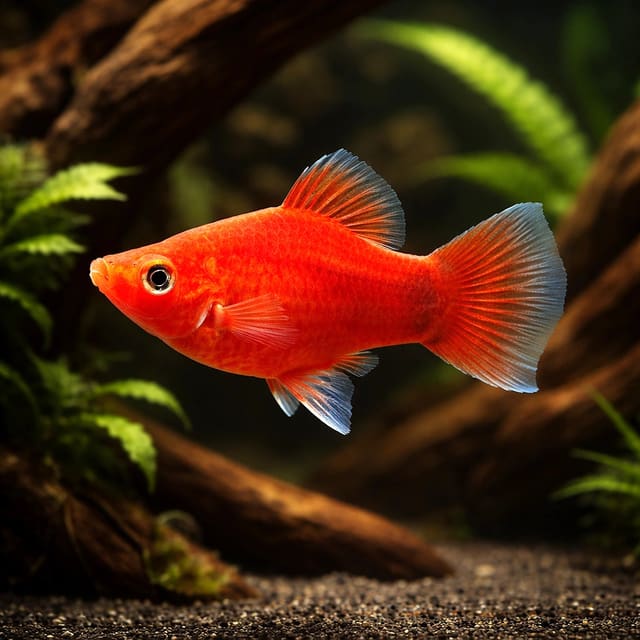
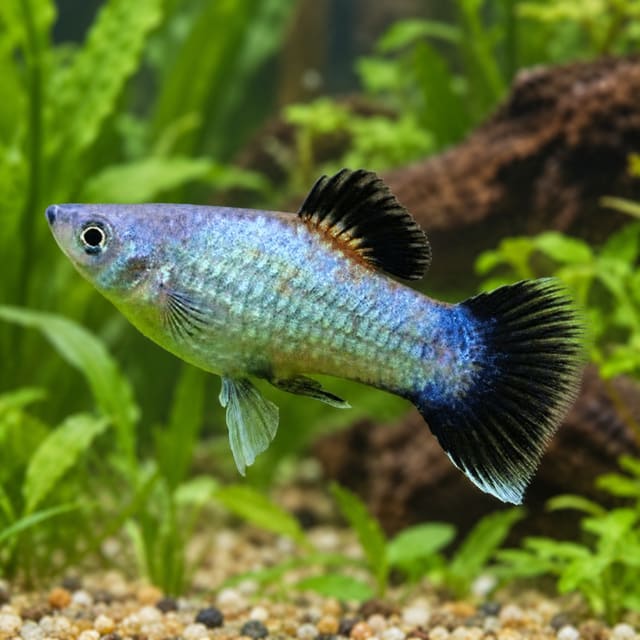
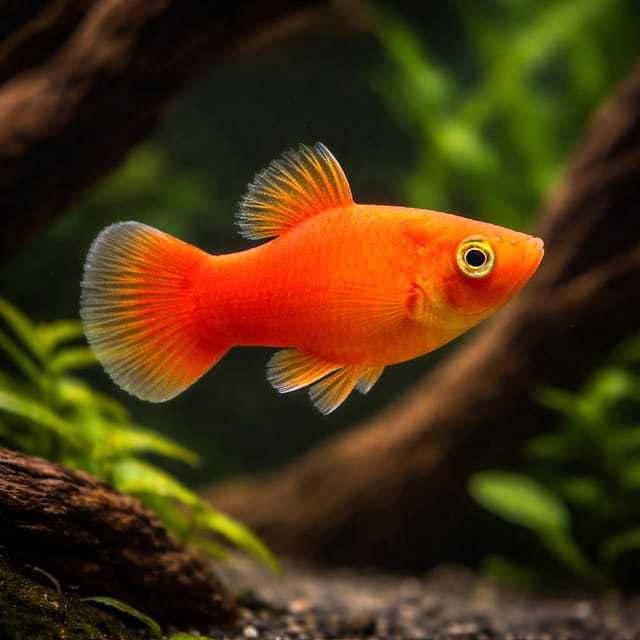
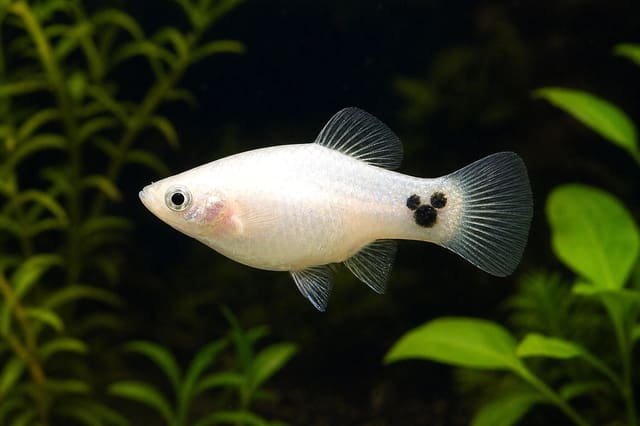
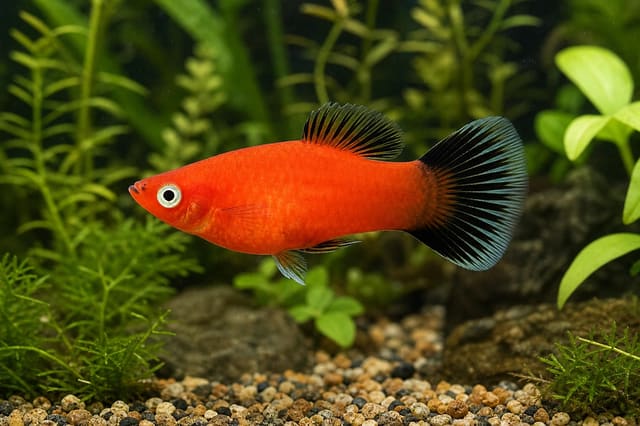
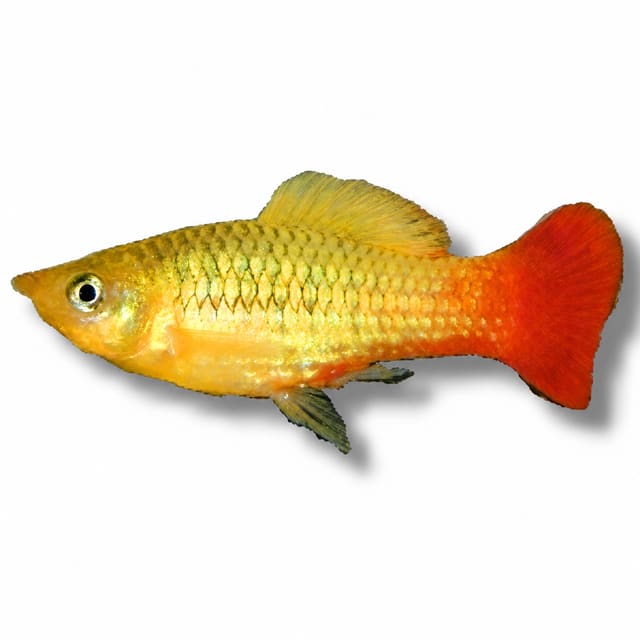
A colour-form name cannot predict the exact shade, pattern boundary, fin colour or maturity of an individual live fish. Aquarium lighting, stress, age and background can change how colour appears from moment to moment. Choose the Moscow form because you like the overall type, while allowing each live animal to develop its own appearance. The same species-level care applies even when another Xiphophorus maculatus colour form looks quite different.
Gallery images have been digitally enhanced to improve image quality. Natural colour, pattern, size and maturity can vary between live animals.
The species aquarium profile gives a 60 × 30 cm base and about 54 litres. Treat that as a starting point for a sensibly stocked setup, not as permission to fill every litre. A longer aquarium is easier for a small group to use because the fish can move away from attention, feed in more than one place and choose between cover and open water. Extra volume also slows sudden temperature and chemistry changes. If the aquarium already contains other fish, calculate the space from the adult community and its waste load rather than adding a platy simply because the tank’s headline volume sounds large enough.
A planted layout is useful without needing to be dense from glass to glass. Plants around the back and sides, along with a few pieces of smooth décor, give fish places to pause and allow less confident individuals to move out of view. Leave an open central or front swimming lane and unobstructed surface movement. Fine gravel or sand can both work. Secure décor so there are no sharp edges, narrow traps or unstable piles, and protect heater intakes or gaps that could catch an inquisitive fish.
OATA’s broader guidance for platies and swordtails recommends at least 45 litres for a small platy group, but the species profile’s 54-litre, 60 × 30 cm starting point is the better planning figure for this listing. Neither number replaces a stocking calculation. A larger group, active tank mates, repeated fry or a dominant individual can all make more space necessary. A wider tank is generally more forgiving than a tall tank with the same nominal volume because it provides more swimming length and a larger surface for gas exchange.
A clear tank is not automatically a safe tank. Fish excrete ammonia, which is toxic; an established biological filter supports bacteria that convert it first to nitrite, also toxic, and then to nitrate. Add this fish only after the aquarium has completed a fishless cycle and tests show ammonia and nitrite at zero. The first tropical tank guide sets out the preparation sequence if this is your first aquarium.
Choose a filter that turns the aquarium over steadily without creating a harsh current that drives the fish into corners. Make sure the outlet disturbs the surface enough for gas exchange. Preserve the established biological media, and never run it under the tap: chlorine or chloramine can damage the bacteria that make the filter work. Swish dirty media gently in water removed from the aquarium, then return it promptly.
Stock gradually. The bacterial population adjusts to the amount of waste it receives, so adding many fish at once can overwhelm a filter that was stable with a smaller population. Test more often after any new addition, a missed maintenance session, a filter problem, unexpected overfeeding or a sudden increase in fry. Reduced appetite, surface hanging, clamped fins, unusual hiding or rapid gill movement should prompt an immediate water test before guessing at a disease.
The specialist species profile gives a practical aquarium range of 20–26 °C, pH 7.0–8.2 and 10–30 dGH. It also warns that Xiphophorus maculatus should be kept in moderately hard or harder water and will not thrive in soft, acidic conditions. Aim for a steady point inside that range that also suits every other animal in the aquarium. The water chemistry guide explains what pH and hardness describe, while the water matcher can help compare measured aquarium water with the range on this page.
| Temperature | 20–26 °C for routine aquarium care |
|---|---|
| pH | 7.0–8.2; avoid soft, acidic conditions |
| General hardness | 10–30 dGH from the species aquarium profile |
| Ammonia | 0 mg/l |
| Nitrite | 0 mg/l |
| Nitrate | OATA’s broad group guide says no more than 20 mg/l above the normal tap-water level |
Other published ranges describe different contexts. FishBase reports 18–25 °C, pH 7.0–8.0 and 9–19 dH for the species’ natural environment. OATA gives 17–27 °C, pH 7.0–8.0 and 4–12 dH for platies and swordtails as a combined group. These figures are useful context, but a wild environmental record and a broad multi-species sheet are not better routine targets than the species aquarium profile. The practical choice here is to keep the species-level 20–26 °C, pH 7.0–8.2 and 10–30 dGH range stable.
Avoid chasing pH with repeated doses of quick-fix chemicals. Rapid change is often more stressful than a stable reading within the routine range. Test the source water as well as the aquarium, because knowing the tap-water baseline makes water changes more predictable. If your water is naturally very soft and acidic, plan the mineral strategy before buying rather than experimenting after the fish arrives. Any adjustment should be measurable, repeatable and applied to replacement water consistently.
A single test describes one moment; a simple written log shows whether the aquarium is drifting. Record temperature, ammonia, nitrite, nitrate, pH and hardness at a consistent time, particularly through the first weeks after stocking. If nitrate climbs faster than usual, look at feeding, stocking, plant health and missed water changes. If pH moves between water changes, compare the tap reading after it has stood with the aquarium reading and consider whether carbonate hardness is sufficient for stability.
Test-kit technique matters. Check expiry dates, follow the stated shaking and timing instructions, use clean vials and view colours in neutral light. When a result is surprising, repeat it before making a major adjustment. A result that shows ammonia or nitrite above zero needs prompt action: check the fish, confirm that the filter is operating, stop adding livestock, reduce unnecessary feeding and carry out an appropriate conditioned water change while continuing to test.
Temperature deserves the same attention. A heater thermostat setting is a request, not an independent measurement. Use a separate thermometer and look for daily stability, including overnight and during unusually warm weather. Allow replacement water to come close to the aquarium temperature before it enters. A steady 23 or 24 °C inside the species range is preferable to repeatedly swinging between the edges.
OATA recommends a weekly 25% partial water change for platies and swordtails as a group, alongside weekly tests for ammonia, nitrite, nitrate, pH and hardness. Use that as a sensible starting routine and adjust the amount from actual test results, stocking and feeding. Condition tap water before it enters the aquarium, match its temperature closely and siphon debris from accessible areas without stripping the tank bare.
Observe the fish while you work. Normal behaviour varies between individuals, but changes are informative: a fish that suddenly hangs at the surface, sits alone, swims erratically, becomes unusually pale, breathes faster or refuses food needs attention. Test the water first, inspect the heater and filter, and compare every fish rather than focusing only on the most obvious individual. Clean water and stable equipment are the foundation; medication should never be used as a substitute for finding a husbandry problem.
Check the heater with a separate thermometer. Keep the aquarium away from radiators, cold draughts, direct sun, aerosol sprays and repeated vibration. A regular light-and-dark cycle supports normal activity, and live plants need predictable lighting, but avoid turning the aquarium into a brightly lit stage for every hour of the day. Provide quiet periods and a consistent household routine.
Arrival is only the beginning of settling in. During the first month, note where the fish rests, how quickly it approaches food, which areas it uses and how it responds to each resident. These ordinary observations create a personal baseline, making a real change easier to recognise later. A newly arrived fish may be reserved, but the overall direction should be towards regular swimming, interest in food and comfortable use of the aquarium.
Keep changes modest during this period. Maintain the existing water-change rhythm, offer familiar appropriately sized foods and resist the urge to add more livestock immediately. A quiet week makes it easier to distinguish transport stress from a compatibility or water-quality problem. If several residents alter their behaviour together, inspect temperature, filtration and water chemistry first. If one individual alone is affected, examine its fins, body condition, breathing and interactions closely.
Weight and condition are easier to judge from repeated side views than from memory. A brief weekly photograph can help you notice gradual thinning, swelling, fin damage or colour change, but appearance is only one part of the check. Appetite, faeces, balance, respiration and social access all add context. Seek qualified aquatic-veterinary help for persistent or serious symptoms; avoid mixing treatments without a diagnosis, because medication can affect both fish and biological filtration.
This species is an unfussy omnivore. The specialist profile says it accepts dried, frozen and live foods. OATA’s broader platy-and-swordtail guidance suggests a good flake or granule with a high algae content, supplemented with small live or frozen foods such as daphnia, small bloodworm or tubifex. Use those as examples of variety, not as a demand to feed every item or as a reason to rely on colour-enhancing marketing claims.
Offer an amount the fish can finish within a few minutes and watch who actually eats. A small portion once daily follows OATA’s group guidance, although the correct quantity depends on food density, fish size and the rest of the community. Crumble or choose food small enough for the fish to take easily. Rotate a reliable staple with suitable supplementary foods rather than feeding one rich frozen food every day.
Remove obvious uneaten food. Excess breaks down into waste and can raise ammonia, nitrite and nitrate, especially in a young tank or one containing fry. Feeding is also a daily health check: note whether a fish approaches promptly, chews and spits repeatedly, is excluded by faster tank mates or loses body condition. Spread a meal across more than one point when a dominant fish intercepts everything.
Platies give birth to live young and can reproduce readily in a community aquarium. The specialist profile describes continual batches of fry where males and females are present, with a gestation of roughly four to six weeks, while OATA’s group sheet gives 24–30 days and broods of 20–80. Those ranges are context, not a promise for this particular fish. Age, condition, temperature, history and individual variation all affect what happens.
Dense planting gives females places to move away from attention and gives some fry cover. If you do not want numbers to increase, decide in advance how any fry will be managed responsibly. Buying one fish from this listing does not establish its sex and does not guarantee a single-sex aquarium. The specialist profile advises more females than males when both sexes are kept because male attention can be relentless; OATA’s broader guide suggests two females per male. Apply the principle only after sexes are reliably known.
The supplied care sources disagree about breeding nets: OATA’s group sheet mentions a suitably large net, while the species profile advises against nets or traps because their small space is unsuitable for raising fry. This listing therefore does not prescribe a breeding container. A keeper actively intending to raise fry should plan a separate, appropriately filtered rearing arrangement and feeding routine rather than improvising after birth.
Confirm that temperature and chemistry have been stable, ammonia and nitrite are zero, the filter is running and all planned companions are healthy. Avoid a large rescape or filter overhaul immediately before arrival. Have a clean container or jug for controlled water additions, a net if needed, and your order number to hand. Read the current delivery and Live Arrival Guarantee policy before the parcel is due, because the evidence step begins while the outer box is still sealed.
If the fish arrives dead, dying or clearly compromised, contact Tropical Fish Co on the same day with the order number and the continuous video. The policy explains the replacement or refund route and the requirement that somebody received the parcel. The video is not an optional afterthought: recording from the sealed box protects the evidence needed to assess the condition before the parcel is opened.
Xiphophorus maculatus is described by the specialist profile as very peaceful and suitable with most community species. That is a useful temperament guide, not a guarantee that every fish sold as “community” is compatible. The first screen is water: companions should thrive in the same moderately hard or harder, neutral-to-alkaline conditions. The second is behaviour: choose fish that do not persistently chase, bite, crowd or monopolise every meal. The third is space: the aquarium must accommodate all adults and the waste they produce, not just today’s juveniles.
| Usually promising | Calm community fish of comparable size whose published needs overlap 20–26 °C, pH 7.0–8.2 and moderately hard or harder water |
|---|---|
| Needs caution | Very fast feeders, markedly larger fish, mixed-sex livebearer groups, or any community already close to its stocking limit |
| Avoid | Large predators, persistently aggressive fish, animals requiring soft acidic water, and combinations in which this fish would be easy prey |
| Never infer | That sharing a shop category, colour, adult length or peaceful label proves compatibility |
OATA’s platy-and-swordtail sheet suggests at least three fish, with two females to each male, to reduce pressure on females and other residents. That is broad group guidance rather than a species experiment, but it is a useful stocking principle. This product has no sex-selected option, so it cannot guarantee that a purchase will create the desired ratio. If the sex balance becomes clear later, watch for one fish receiving repeated attention and be prepared to adjust the group or layout.
Do not solve social pressure simply by adding more fish to a tank without spare capacity. Extra animals increase waste and can worsen the problem if the aquarium is already crowded. More cover, separate resting areas, a larger footprint and a correctly planned ratio work together. In a mixed livebearer community, remember that repeated fry can change both the head count and filtration demand faster than expected.
A peaceful species can still contain assertive individuals, especially around food or courtship. Healthy activity includes exploring the aquarium, approaching food and moving between cover and open water. Warning signs include relentless pursuit, damaged fins, one fish pinned behind equipment, repeated hiding at feeding time, loss of weight or a newcomer kept at the surface or bottom. Act on the pattern before injuries become severe.
Fin condition matters. Moscow Platies are generally peaceful, yet individuals can still chase or nip when space, sex balance, feeding or companion choice is poor. Select calm companions, provide enough room, feed so shy fish get access and investigate any damage. A torn fin can result from chasing, décor, handling or poor water, so test the aquarium and observe interactions rather than assuming one cause.
Matching numbers are necessary but incomplete. A fast, forceful fish can keep a peaceful platy away from food even when both enjoy the same pH and temperature. A large nocturnal fish may repeatedly disturb resting areas. A very timid species may be unsettled by the platy group’s constant movement. Watch the actual aquarium at feeding time, after lights come on and during courtship rather than relying on labels alone.
If one fish is under pressure, first create several food-entry points and make sure cover is accessible without trapping it in a dead end. Check whether the tank is crowded, whether repeated fry have changed the load and whether one male is focusing on a single female. Persistent injury or exclusion calls for separation or a revised stocking plan; simply waiting can turn a manageable pattern into a welfare problem.
Tank mates can share water yet compete badly at meals. Watch whether every platy reaches appropriately sized food before it sinks or is taken. Spread food across the surface when one fish controls a single feeding point, and do not increase the total portion so much that leftovers accumulate. Bottom-feeding animals still need their own diet; they are not a clean-up system for food the platies fail to eat.
Quarantine and biosecurity planning are also part of a stable community. Do not add a new fish when existing residents show unexplained symptoms. Use separate equipment where practical, wash hands before and after aquarium work, and never release unwanted fish, plants or aquarium water into natural watercourses. If the established community is already unstable, correct that before adding another animal.
Choose peaceful community fish of similar scale that share the Moscow Platy’s hard, neutral-to-alkaline water, then verify the exact species’ adult size, feeding style and social needs. Avoid large aggressive fish, likely predators and soft-acidic specialists. Leave capacity for a small platy group and possible fry, and reassess the arrangement whenever one fish is persistently excluded.
FishBase records 4 cm total length for its male/unsexed maximum, while the specialist aquarium profile lists 50 mm standard length; those measuring conventions are not directly interchangeable. OATA’s broader platy guide gives 6–8 cm for the group. Plan beyond the 3–4 cm dispatch grade and provide a 60 × 30 cm footprint rather than treating arrival size as adult size.
The species aquarium profile gives a 60 × 30 cm base and about 54 litres as its published starting point. OATA’s 45-litre figure is broader guidance for a small platy group. Use more space when the community is busy, the group grows or fry increase the stocking and waste load.
OATA’s broad platy-and-swordtail guidance suggests at least three, with two females per male when both sexes are present. This Moscow Platy listing is not sex-selected, so it cannot guarantee that ratio. Make sure the aquarium has capacity before adding a group, then manage persistent male attention if the eventual balance is unsuitable.
Yes, a Moscow Platy can suit a beginner who has already cycled the aquarium and whose water is moderately hard or harder, neutral to alkaline and stable. It is not suitable for an unfiltered bowl or a newly filled tank. Test ammonia and nitrite, maintain the filter and plan for a social group and possible fry.
A Moscow Platy is an unfussy omnivore that accepts suitable dried, frozen and live foods. OATA’s group guidance suggests a quality flake or granule with a high algae content plus small live or frozen foods for variety. Feed only what is eaten within a few minutes, remove leftovers and check that every fish gets access.
Use the species aquarium range of 20–26 °C, pH 7.0–8.2 and 10–30 dGH. Keep the values steady and avoid soft, acidic water. FishBase’s 18–25 °C wild range and OATA’s broader 17–27 °C group range describe different contexts rather than better routine targets for this aquarium listing.
The specialist profile describes the species as very peaceful, and males generally tolerate one another. No listing can guarantee that an individual will never chase or nip. Provide enough room and cover, avoid persistent bullies, manage mixed-sex pressure and investigate repeated chasing, torn fins, hiding or missed meals promptly.
Choose calm community fish of comparable size that also thrive in moderately hard or harder, neutral-to-alkaline water. Avoid large predators, persistently aggressive fish and soft-acidic specialists. Check each proposed species’ adult size, diet and social needs; a general community label or similar shop category does not prove a safe match.
Tropical Fish Co packs each fish in an oxygen-filled bag inside an insulated box and uses a tracked, licensed live-animal courier. Someone must receive it. Record one continuous video from the sealed parcel to the fish in the sealed bag, inspect it that day, and contact the store the same day with the order number and video if a Live Arrival Guarantee claim is needed.
The numerical care range above uses the species aquarium profile, while broader trade-body and welfare pages are labelled as group or general guidance. Wild environmental values are retained as context rather than turned into routine captive targets.
No reviews for this item yet. Bought one? Honest reviews only, good or bad.
What customers say about ordering from us
Easy website plenty of info on fish your buying great to pick a time slot
TRACEY DURRANT · 7 Oct 2026
Got some lovely fish thank you
Kevin Mackie · 7 Oct 2026
Reviews of our shop, collected by Judge.me, an independent third-party review collector. Newest first.