Easy
Koi Kohaku Swordtail (Xiphophorus hellerii)
22–27°C · pH 7–8 · 108L
£9.99
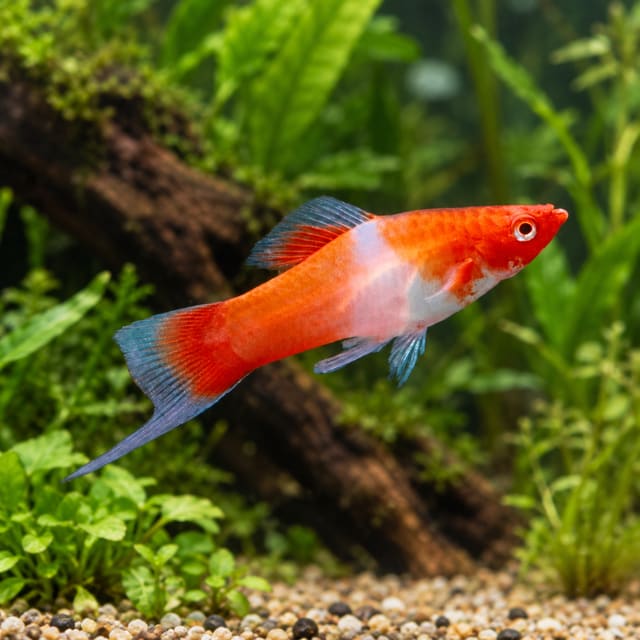
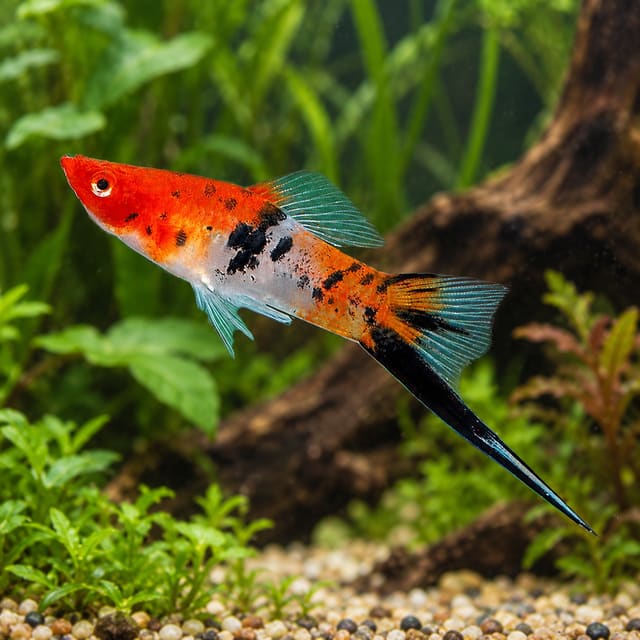
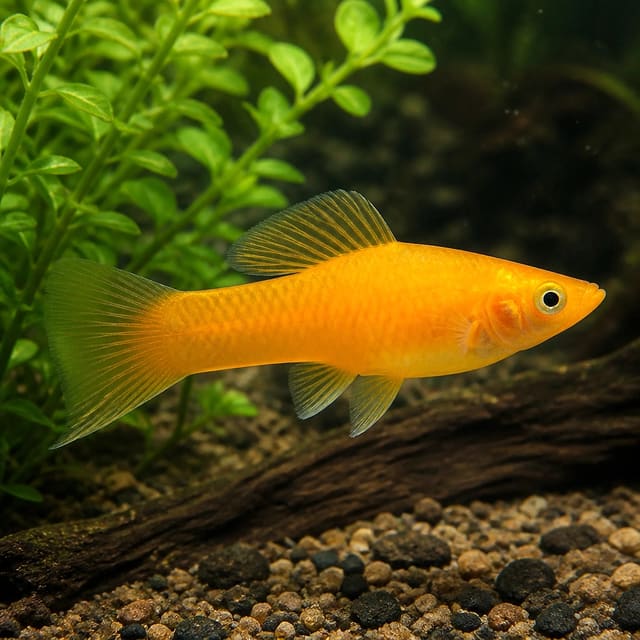
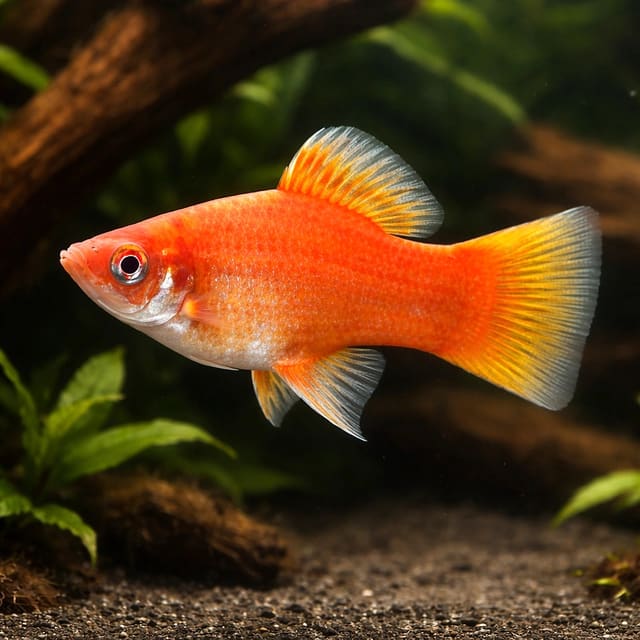
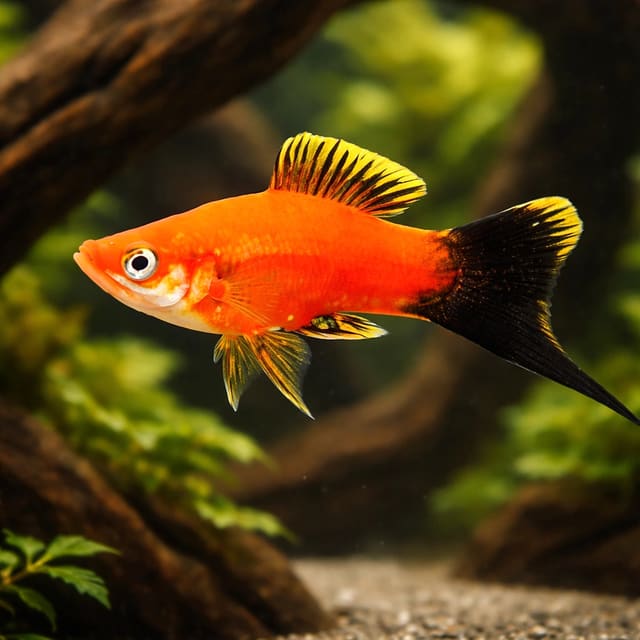
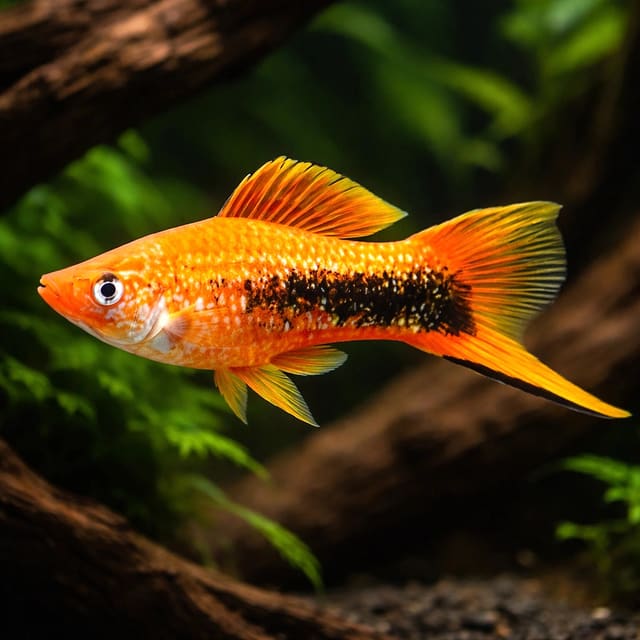
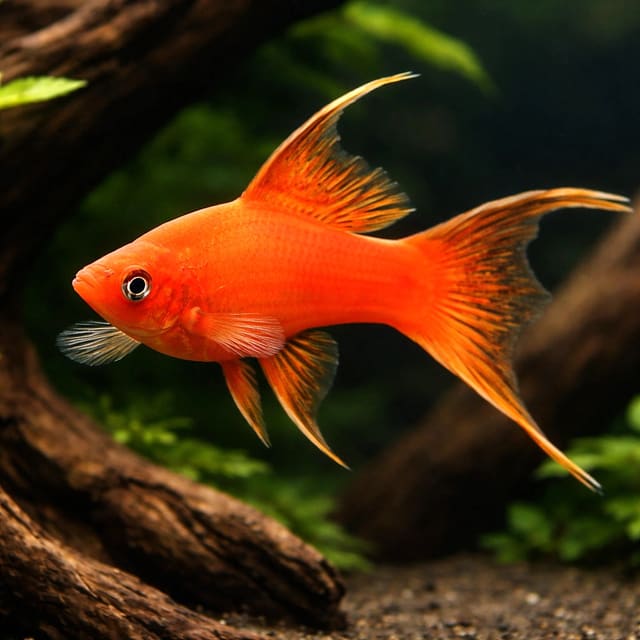
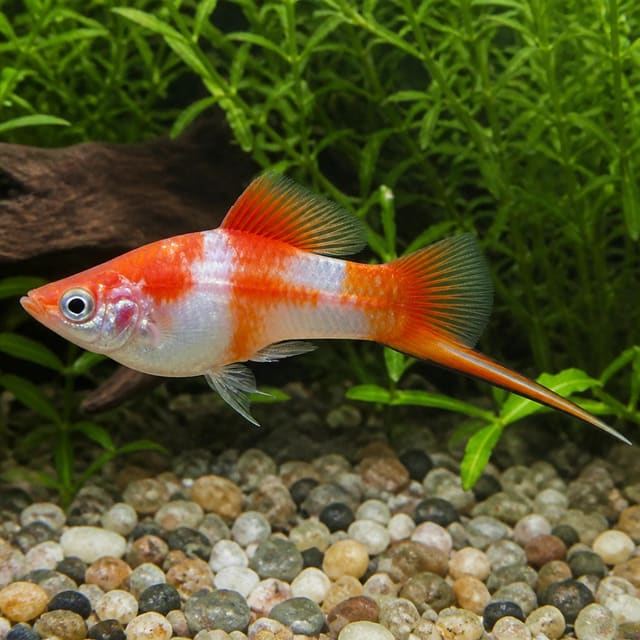
Xiphophorus hellerii santa claus kohaku WG is a koi-type swordtail line named for the red-and-white Kohaku koi, sold as one fish per unit with the sex not selected. Most adults reach 8–12 cm and females are recorded to 16 cm, so keep three or more in 80 litres or more of hard, alkaline water at 22–28 °C.
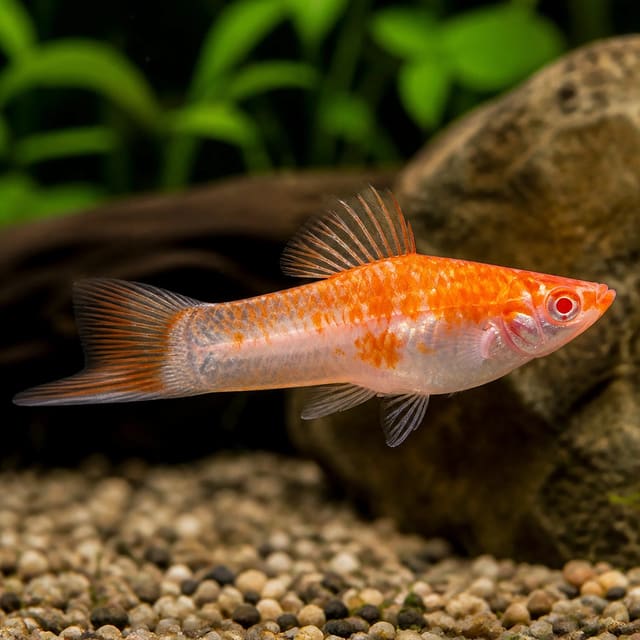
Adult size is the maximum length this species reaches at full maturity (scientific sources). The livestock you receive will be younger and smaller. Product-photo provenance and any image-specific limitations are stated on the listing.
Xiphophorus hellerii
Shoaling fish: kept in a group they feel safer, stay calmer and show their best colour.
Xiphophorus hellerii santa claus kohaku WG is a koi-type swordtail line named for the red-and-white Kohaku koi, sold as one fish per unit with the sex not selected. Most adults reach 8–12 cm and females are recorded to 16 cm, so keep three or more in 80 litres or more of hard, alkaline water at 22–28 °C.
Adult size is the maximum length this species reaches at full maturity (scientific sources). The livestock you receive will be younger and smaller. Product-photo provenance and any image-specific limitations are stated on the listing.
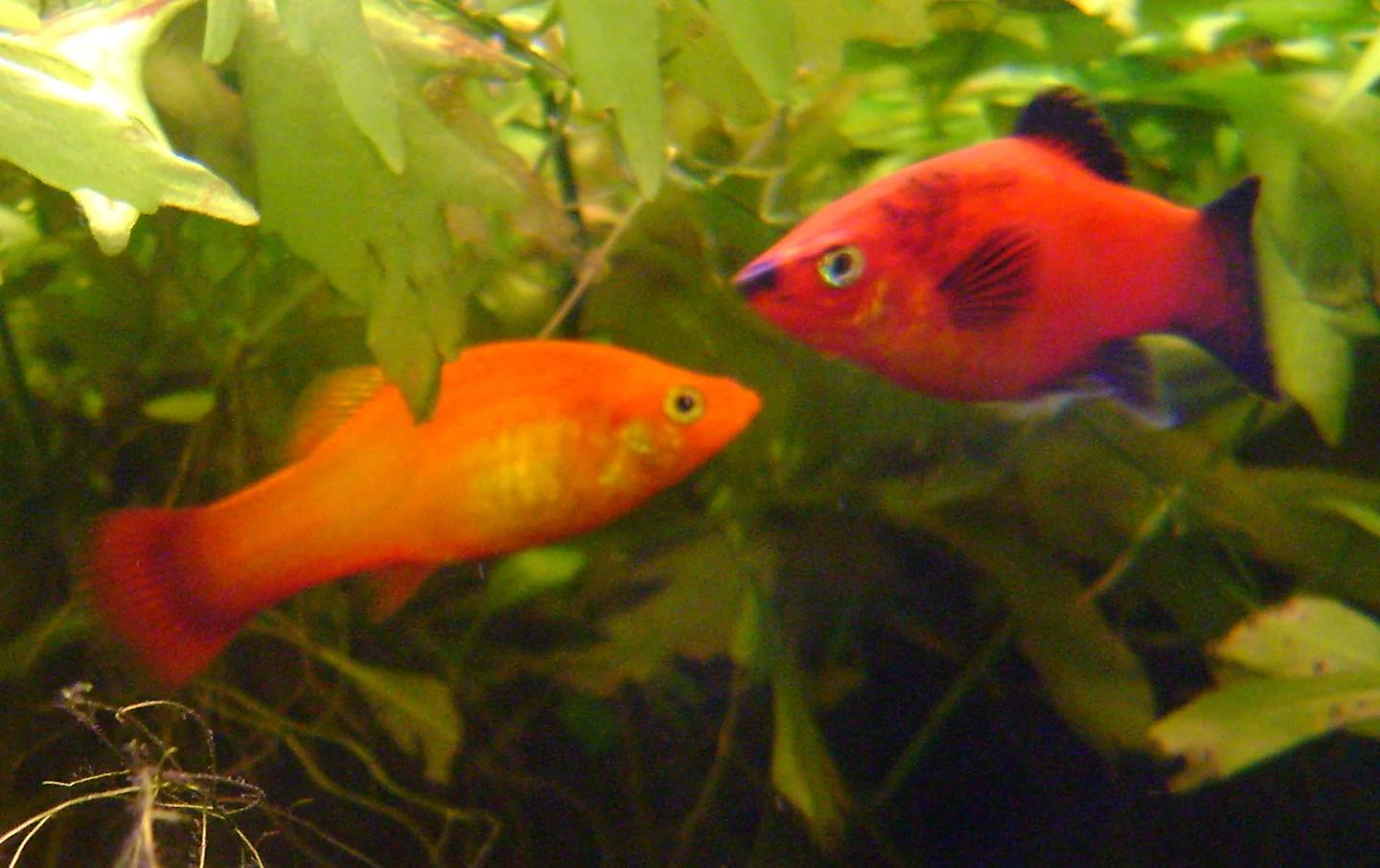
Platy is a trade name used for Xiphophorus maculatus, X. variatus and domestic forms. Start with at least three in a mature aquarium of at least 45 litres, verify the exact fish and measured water, and plan extra capacity before mixing sexes.
Maintain these water conditions for optimal health and vibrant colors
Long strain names like this one look like a code, and in a way they are. Read from left to right, Xiphophorus hellerii is the species, the green swordtail; "santa claus" and "kohaku" are names for the colour line; and "WG" is a short code that travels with this line in our stock records. Each part tells you something different, so it is worth taking them one at a time.
Kohaku is a Japanese koi variety. Wikipedia describes a Kohaku koi as white-skinned with large red markings on the top, and gives the meaning of the name as "red and white". Swordtail lines carrying koi names are bred towards the koi pattern they are named after, so a kohaku swordtail is a red-and-white fish. Our Koi Kohaku swordtail belongs to the same red-and-white family.
Santa claus is a breeder's line name rather than a scientific or koi term, and there is no published standard that pins it down. It sits here beside kohaku, so the colour scheme being aimed for is red and white. We would rather tell you that plainly than invent a description we cannot back up.
We do not have a published definition of WG, and we are not going to guess at one. It stays in the title because it identifies this particular line, and changing it would mean selling you something we could not vouch for.
The earlier version of this page spelt the species helleri. That single-i form is everywhere in the trade, but Seriously Fish and Wikipedia both note that it is a misspelling. The species honours Karl Bartholomaeus Heller, the Austrian botanist who found it in Mexico, and FishBase records the accepted name as Xiphophorus hellerii Heckel, 1848. We have corrected the spelling and kept every other word of the name.
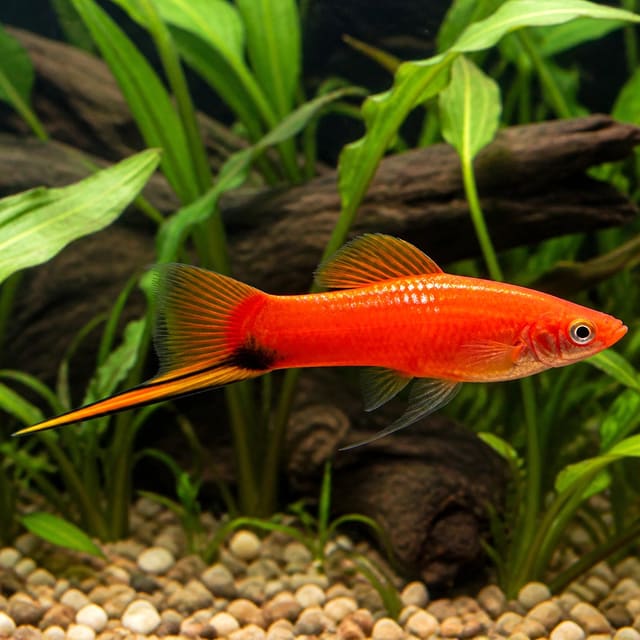
Strip away the colour and this is the green swordtail, a livebearer in the family Poeciliidae, and it is kept exactly like any other swordtail. The features that matter for telling the sexes apart are the same in every line:
None of the colour is wild. Seriously Fish explains that the ornamental forms of this species are the product of selective breeding and do not occur in wild fish, and that breeders also crossed swordtails with the platies Xiphophorus maculatus and X. variatus along the way. A red-and-white line like this one is a long way from the wild fish Wikipedia describes, whose males carry a yellow sword edged with black below.
The listing has one option and no choices within it. Every unit you order is one swordtail, so a quantity of four in the basket means four fish. There is no size grade to pick and no male or female option: the sex of each fish is not selected, and we do not promise one.
Because the sex is left open, the number you order is the main thing you control. OATA, the Ornamental Aquatic Trade Association, recommends at least three swordtails kept together, with two females to each male, to reduce stress. A single fish on its own misses out on that, and two fish could turn out to be a pair of males, which is the least comfortable combination of all.
How we would decide how many to order:
| Your situation | What we would order | Reasoning |
|---|---|---|
| New to swordtails, tank of 80–110 litres | Three to five | Meets OATA's minimum group with room for an uneven mix |
| Larger tank, 120 cm long or more | Five or six | More fish spread the attention of the males |
| Already keeping a swordtail group | As many as your stocking allows | New fish join an existing balance |
| Want a single fish for a mixed tank | We would advise against it | OATA recommends at least three together |
Do not rely on sexing young fish by eye. Swordtails only show the full sword and gonopodium once they mature, and Wikipedia reports that a well-endowed male can suppress the maturity of juvenile males close to him. A fish that has no sword when it arrives may simply be a male that has not developed yet.
The size that arrives is not the size to plan for. OATA gives 8–12 cm as the usual adult size for swordtails, and FishBase records maxima of 14 cm total length for males and 16 cm for females, with Seriously Fish quoting 140 mm standard length. Those maxima are the largest fish on record rather than what you should expect in a home aquarium, but the tank you choose should leave room for a big female.
FishBase traces the wild range from the Río Nantla in the Mexican state of Veracruz down to north-western Honduras. Seriously Fish names the countries as south-eastern Mexico, Guatemala, Belize and Honduras, and puts the species anywhere from sea level up to around 1,500 m.
The water it lives in is varied. According to FishBase, adults are found mainly in rapidly flowing streams and rivers and prefer heavily vegetated places; the species also turns up in warm springs and the streams running out of them, in weedy canals and in ponds. Seriously Fish describes the water as clear to turbid. FishBase lists the environment as freshwater and brackish, and the species as benthopelagic, the FishBase term for a fish that lives and feeds near the bottom as well as in the water above it.
That brackish entry often prompts the question of whether swordtails need salt. It describes where the species has been recorded; it is not a husbandry instruction. The aquarium ranges from Seriously Fish and OATA are freshwater ranges, and a koi line kept in fresh, hard water is being kept correctly.
Two habitat details are worth carrying into your tank. The first is vegetation: these are fish of weedy, well-planted water. The second is movement. The streams and rivers FishBase describes are not still, and Seriously Fish recommends moderate water movement in the aquarium, while noting that strong filtration is not needed.
The swordtail's adaptability has a downside. Wikipedia lists established feral populations in southern Africa, Madagascar, Puerto Rico, Hawaii and eastern Australia, and FishBase names Natal, the eastern Transvaal and Lake Otjikoto in Namibia, describing the species as a potential pest. OATA's care sheet is unambiguous: never release aquarium animals or plants into the wild. It is illegal, and the animal is likely to die slowly. If your fish ever need a new home, a local aquatic shop or club is the answer. The wild species itself is listed as Least Concern on the IUCN Red List, in an assessment FishBase dates to 2018.
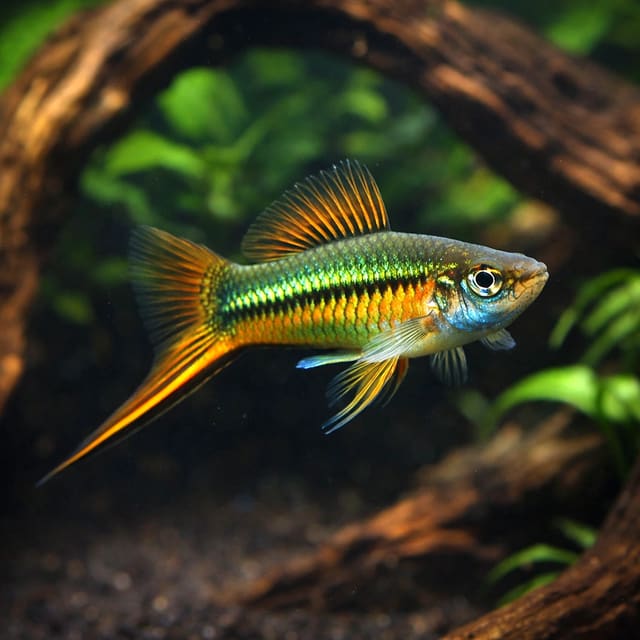
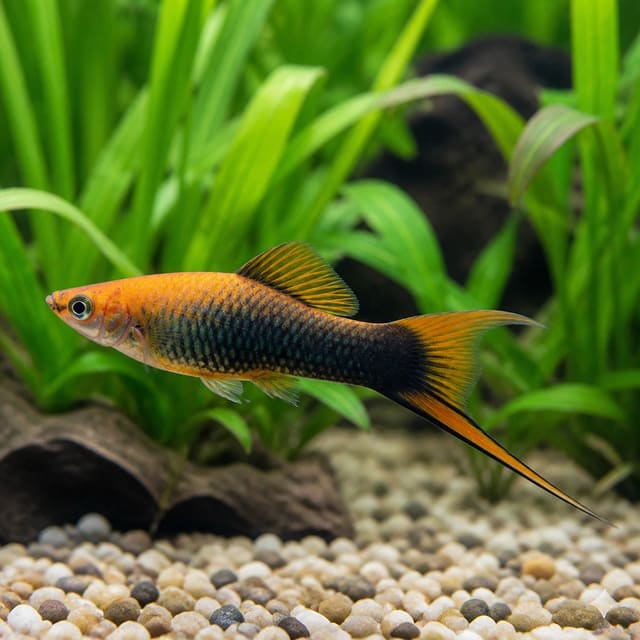
If you would like to see the wild colour beside this line, the green swordtail is the form closest to the fish in those rivers.
The easiest way to size a swordtail tank is to start from the biggest fish it might hold. FishBase's 16 cm maximum for females is a record, not a promise, but a female of even 10–12 cm is a substantial fish, and a group of them with males needs real space.
OATA sets 80 litres as the minimum for swordtails. Seriously Fish goes further and recommends a base measuring 120 × 30 cm, around 108 litres. We would treat 80 litres as the floor for a small group and the 120 cm footprint as the tank to aim for if you can, especially with more than one male. Length is the dimension that counts; a tall, narrow tank gives a swordtail less useful swimming space than its volume suggests.
Seriously Fish describes the ideal as a heavily planted tank with a dark substrate, and says floating plants and driftwood are appreciated. OATA asks for gravel or sand with live plants for cover where possible, or plastic plants and suitable ornaments if not. Put together, that gives you:
Seriously Fish recommends moderate water movement and says strong filtration is unnecessary. In practice that means a filter rated for the tank's volume, with the outlet set so there is visible movement across the surface but the plants are not flattened. If your fish spend all their time hiding from the current, it is too strong.
A swordtail tank needs a reliable thermostatic heater sized for its volume, and a separate thermometer you can read at a glance, so you are not relying on the heater's own dial. Place the tank away from radiators, draughty doors and direct sunlight; all three push the temperature around during the day, and the aim is a steady reading inside 22–28 °C rather than one that climbs every sunny afternoon. A tight-fitting cover glass also reduces heat loss and evaporation in a cold room.
The tank should be mature, with ammonia and nitrite both reading zero on a test kit, which is the standard OATA sets. A brand-new tank filled the day before the fish arrive is not ready, however clean it looks. OATA links the several-year lifespan a swordtail can reach to a well-matured set-up with good water quality, and that starts before the first fish goes in.
All three of our sources put the pH at 7.0–8.0, and that agreement is the clearest message about the water: this is a fish for neutral to alkaline, harder water. The remaining figures differ a little between sources, so the table shows what we would aim for, the range we list on this page and where each comes from.
| Measure | Our everyday aim | Range on this listing | Other published ranges |
|---|---|---|---|
| Temperature | Mid-range, held steady | 22–28 °C (FishBase) | OATA 22–27 °C; Seriously Fish 16–28 °C |
| pH | Stable within range | 7.0–8.0 (FishBase) | OATA and Seriously Fish 7.0–8.0 |
| General hardness | Moderately hard | 9–19 dGH (FishBase) | OATA 4–12 dGH; Seriously Fish 10–25 dGH |
| Carbonate hardness | Enough to hold pH steady | not set | OATA 3–10 dKH |
| Ammonia and nitrite | Zero | zero (OATA) | none |
| Nitrate | As low as you can keep it | up to 20 mg per litre (OATA) | none |
The bottom of the Seriously Fish temperature range, 16 °C, is worth a comment. It is far cooler than a tropical community aquarium is ever run, and we would not use it as a guide to heater settings. Treat it as a sign of how much the species can tolerate rather than how it should be kept.
Hardness is where the sources part company most. OATA's 4–12 dGH reaches down into softer water than the FishBase or Seriously Fish figures, and Seriously Fish's range goes well above both. The common ground is moderately hard water, somewhere around 10–12 dGH, and none of the three would support very soft water. If your test kit shows your tap water is soft and acidic, a swordtail is a poor match for it without long-term changes to the water, and we would suggest talking to us before ordering.
Carbonate hardness is the measure that keeps pH where it should be. Water with a decent KH resists the gradual acidification that comes from fish waste and the filter's work, so the pH holds steady between water changes. In very low-KH water the pH can slide, and for a fish that every source places at pH 7.0 or above, that slide is worth preventing.
Before you order, test the water that comes out of your tap, not just the water already in the tank. Use a liquid test kit or reliable strips that read pH, general hardness (GH) and carbonate hardness (KH), and write the numbers down. Test a sample that has stood overnight as well as one straight from the tap, because dissolved gases can make a fresh sample read differently for pH. If the overnight reading sits at pH 7.0 or above, with moderate GH and some KH, your weekly water changes will keep the tank inside the swordtail ranges without any extra work. If the readings are low, you will be fighting your own water supply every week, and that is worth knowing before any fish are bought.
OATA strongly recommends changing 25% of the water at least once a week. Dechlorinate the new water and bring it to tank temperature before it goes in. Test ammonia, nitrite and nitrate regularly, and test pH and KH as well if your tap water is borderline. Remember that swordtails breed readily: a tank that is comfortably stocked in spring can be crowded by autumn, and the water routine has to keep pace with the number of fish actually in the tank.
Swordtails are easy to feed. FishBase lists the wild diet as worms, crustaceans, insects and plant matter, and Seriously Fish describes the species as a generalised omnivore that is unfussy in captivity and will take just about anything it is offered. The challenge is not getting them to eat; it is giving them a balanced diet without fouling the water.
OATA recommends a good-quality flake or granule with a high algae content as the base of the diet. That suits a fish whose wild diet includes plant matter. Seriously Fish similarly builds the diet on good-quality dried products.
Both sources add smaller live or frozen foods. Seriously Fish names daphnia, Artemia (brine shrimp) and chironomid larvae, which most shops sell as bloodworm. OATA lists daphnia, small bloodworm and tubifex. Rotating two or three of these through the week gives variety and brings the insect and crustacean side of the wild diet into the tank.
OATA's rule is to feed once a day, and only as much as the fish will eat within a few minutes. Anything left after that breaks down into ammonia and then nitrate, which undoes the work of your water changes. If you are not sure you have it right, feed a little less than you think and watch: food should disappear in the water column, not settle on the gravel.
| Day | Food |
|---|---|
| Monday, Wednesday, Friday, Sunday | Algae-rich flake or granule |
| Tuesday | Frozen daphnia, thawed first |
| Thursday | Frozen brine shrimp |
| Saturday | Small bloodworm, a modest portion |
Watch the quieter fish when you feed. In a group, the boldest swordtails get to the food first, and a female carrying a brood still needs her share. Scattering food at two points in the tank, rather than one, gives every fish a fair chance. Feeding time is also your daily health check: a swordtail that ignores food it would normally chase deserves a closer look.
OATA describes swordtails as generally peaceful and compatible with other species. The friction to watch for in a swordtail tank is mostly among the swordtails themselves, and in particular among the males.
Seriously Fish notes that males form dominance hierarchies in confined spaces. A bigger tank, more cover and fewer males all reduce the pressure. The sword is part of this competition: Seriously Fish reports that females have preferences for traits such as sword length, and Wikipedia cites research finding that the elongated tail fin significantly affects mating success. Wikipedia also notes that a well-endowed male can hold back the maturity of young males nearby, so the pecking order can even shape how quickly other males develop.
The two-females-to-one-male ratio OATA recommends is there to protect the females. Spreading the males' attention across more than one female means no single female has to carry all of it. Because this listing is unsexed, watch what you receive. If the group turns out male-heavy, adding females or moving a male to another tank are both better options than leaving the tank as it is.
OATA's one caution is that large swordtails may chase more timid tank mates. A grown swordtail is a sizeable, active fish, so the best companions are confident community fish of a similar size that share hard, alkaline water at 22–28 °C. Be cautious with shy, slow-moving species that would be pushed away from food, and avoid soft-water specialists and any predator big enough to eat a swordtail.
Add swordtails to a community after the existing fish have settled, and rearrange a little of the decor at the same time so that resident fish lose their established patches and everyone starts on a more equal footing. Offer a little food once the newcomers are in, which gives the residents something to do other than investigate. For the next few days, check at each feed that the new swordtails are eating and that nobody is being chased into a corner and kept there. If one fish is clearly being singled out, a breeding net or a spare tank can give it a break while you add cover.
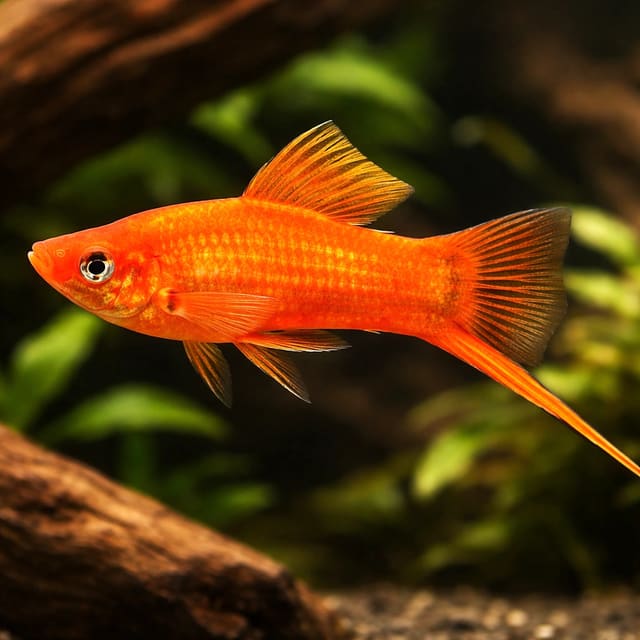
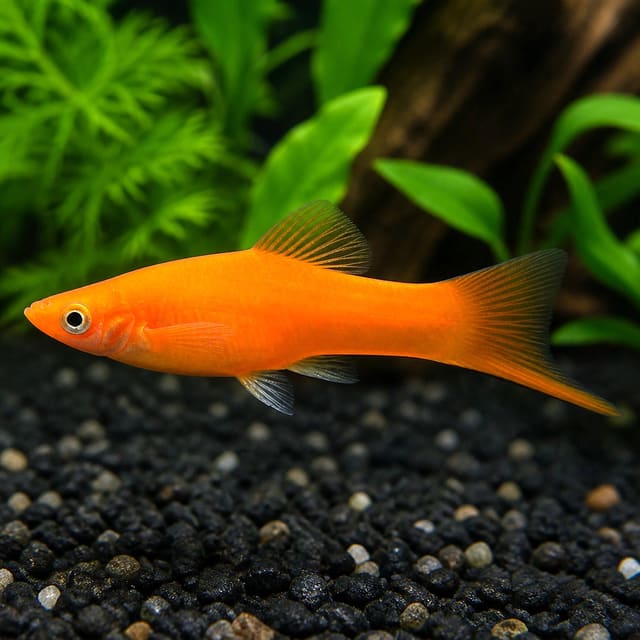
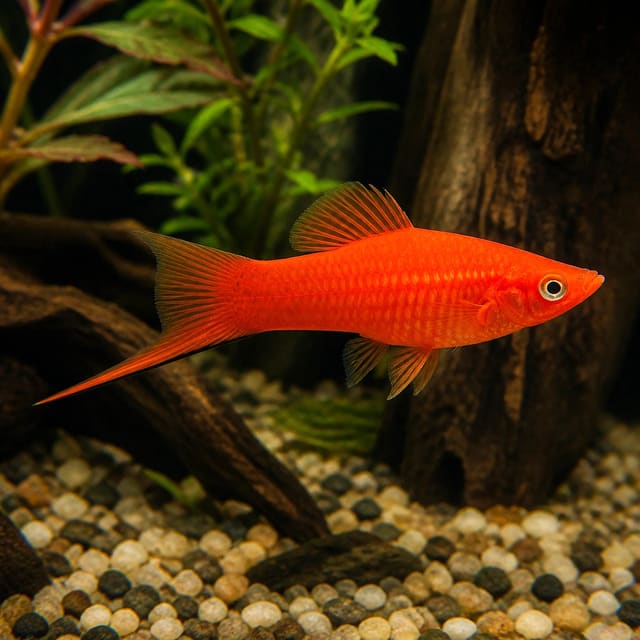
All swordtail colour lines are one species, so a santa claus kohaku will breed with a red, black, albino or green swordtail kept alongside it. Platies are close relatives as well, and Seriously Fish records deliberate crosses between swordtails and both Xiphophorus maculatus and X. variatus. If you are happy with a mixed tank of livebearers, none of this is a problem. If you want to keep the red-and-white line going, give the breeding fish a tank of their own. The Albino Koi swordtail and the red swordtail are good examples of other lines that would mix their colours into a santa claus kohaku brood.
Fertilisation in swordtails is internal, and the young are born live and swimming. Wikipedia describes swordtails as among the easiest fish for an amateur to breed when the tank conditions are suitable, and a mixed group in a well-kept tank usually proves that without any help.
Wikipedia notes that in the later stages of pregnancy a dark gravid spot shows near the female's anal fin. FishBase and OATA both give a pregnancy of 24–30 days.
FishBase records broods of 20 to 200 young. OATA's figure is 20–80. The 200 is the upper end of what has been recorded; plan for numbers in the OATA range and be pleasantly surprised if you get more.
Seriously Fish notes that females can store viable sperm for months. A female that has lived among males can go on producing broods after she is moved away from them, so a female-only tank is not a guarantee of no fry.
OATA advises keeping a pregnant female in a suitably large breeding net so the young can be separated as they are born. Dense plants, especially fine-leaved or floating ones, give a few fry somewhere to hide in the main tank, but a net or a separate rearing tank saves far more. Move the female back once she has given birth. The fry need food fine enough to swallow, offered in small amounts so the rearing water stays clean.
If you expect to raise more than the odd brood, a small second tank is worth setting up. Fill it with water from the main aquarium so the chemistry matches, run a gentle air-driven sponge filter that cannot draw fry in, and add a heater set to the same temperature as the main tank. A few floating plants give the young cover. Keep the water clean with small, frequent partial changes, because fry tanks hold little water and fouled food builds up quickly. Once the young are large enough not to fit in an adult's mouth, they can join the main group, space and stocking permitting.
Wikipedia puts sexual maturity at around three months, while FishBase gives eight to twelve months. We have not found anything that settles the difference, so we show both. Either way, plan to separate or rehome young fish before the tank fills.
There is no source we can point to on how reliably this line passes on its red-and-white pattern, so we make no promise about the colour of any fry. The practical rule for any colour line is the same: breed only from fish that show the pattern you want, and keep them away from other swordtail colours and platies while they breed.
A swordtail in good water, at the right temperature and in a sensible group is a resilient fish. OATA notes it can live several years in a well-matured aquarium with good water quality. The best health care is a routine that catches small problems early.
OATA's care sheet lists the signs of a fish in good health: clear, bright eyes; undamaged fins; intact scales; and no ulcers or bumps on the body. Learn what your fish look like when they are well, because that is the baseline you will compare against.
The same care sheet lists early signs of disease. Watch for:
When you see any of these, test the water first. A reading of ammonia or nitrite above zero, or nitrate above OATA's 20 mg per litre, points to the cause and to the first fix, a partial water change. Check the thermometer too. After that, look at the social picture: a female who is never left alone by the males, or a subordinate male hiding all day, can look off-colour even in perfect water, and the remedy is more space, more cover or a better ratio rather than medicine.
| How often | Task |
|---|---|
| Daily | Count the fish at feeding time; check eyes, fins and appetite; glance at the thermometer |
| Weekly | 25% water change (OATA); test ammonia, nitrite and nitrate |
| Monthly | Test pH and KH; rinse filter media in old tank water rather than tap water; thin out plants |
| Every few months | Review numbers, since broods add up; rehome surplus fish through a shop or club |
If you are unsure about something, email hello@tropicalfishco.co.uk with a description of what the fish is doing and a short video if you can, and we will help you work out the next step. If you keep a separate quarantine tank, newcomers belong there before they join your main group.
Read our delivery and live-arrival information before ordering, so you know how the process works. Have the aquarium completely ready before your fish set off, with the filter running, the water tested and the temperature already matched to what a swordtail needs. Make sure someone is at the delivery address to receive the box; live fish should not be left unattended.
The fish are packed in oxygen-filled bags inside insulated packaging, with heat packs included when conditions call for them, and are carried by a tracked courier that is licensed to transport live animals. You will receive your confirmed delivery date and tracking information by email.
To make a live-arrival claim, you need one unbroken video. Begin filming with the box still sealed, open it without stopping the recording, and show the fish inside the bag before the bag is opened. If any fish is dead, dying or plainly unwell, send an email to hello@tropicalfishco.co.uk on the day of delivery, including your order number and the video. Photographs alone are not enough under the policy. We will then replace the affected fish with your next order or refund them, subject to the terms of the guarantee.
Keep the lighting subdued to start with, and spend a few minutes each day watching how the new fish breathe, eat and behave. Feed lightly and check that each newcomer is getting food. Where you are adding to an established group, keep an eye on the resident males, and be ready to add cover if one of them takes too close an interest in the new arrivals. By the end of the first week you should be seeing normal feeding, open fins and steady breathing.
Every species fact on this page comes from the sources below. They are the best places to read more about the species behind this line.
We also used the Ornamental Aquatic Trade Association's care sheet, How to look after platies and swordtails, which is published in the care sheet section of the OATA website at ornamentalfish.org. It is the UK trade body's own guidance on tank size, water quality, feeding, group sizes and health checks, and every OATA figure on this page comes from it.
No reviews for this item yet. Bought one? Honest reviews only, good or bad.
What customers say about ordering from us
Easy website plenty of info on fish your buying great to pick a time slot
TRACEY DURRANT · 7 Oct 2026
Got some lovely fish thank you
Kevin Mackie · 7 Oct 2026
Reviews of our shop, collected by Judge.me, an independent third-party review collector. Newest first.