Easy
Swordtail Red (Xiphophorus helleri red)
22–27°C · pH 7–8 · 108L
£3.99
Swordtail Ada Red (Xiphophorus helleri) is an active red ornamental swordtail sold as one live fish in 4–5 cm or 5–6 cm size choices. Plan a mature aquarium at least 120 × 30 cm (about 108 litres), stable pH 7.0–8.0 water, open swimming room and a thoughtfully structured group.
Adult size is the maximum length this species reaches at full maturity (scientific sources). The livestock you receive will be younger and smaller — pick a size above for the actual shipping size. Product-photo provenance and any image-specific limitations are stated on the listing.
Xiphophorus helleri
Shoaling fish: kept in a group they feel safer, stay calmer and show their best colour.
Swordtail Ada Red (Xiphophorus helleri) is an active red ornamental swordtail sold as one live fish in 4–5 cm or 5–6 cm size choices. Plan a mature aquarium at least 120 × 30 cm (about 108 litres), stable pH 7.0–8.0 water, open swimming room and a thoughtfully structured group.
Adult size is the maximum length this species reaches at full maturity (scientific sources). The livestock you receive will be younger and smaller — pick a size above for the actual shipping size. Product-photo provenance and any image-specific limitations are stated on the listing.
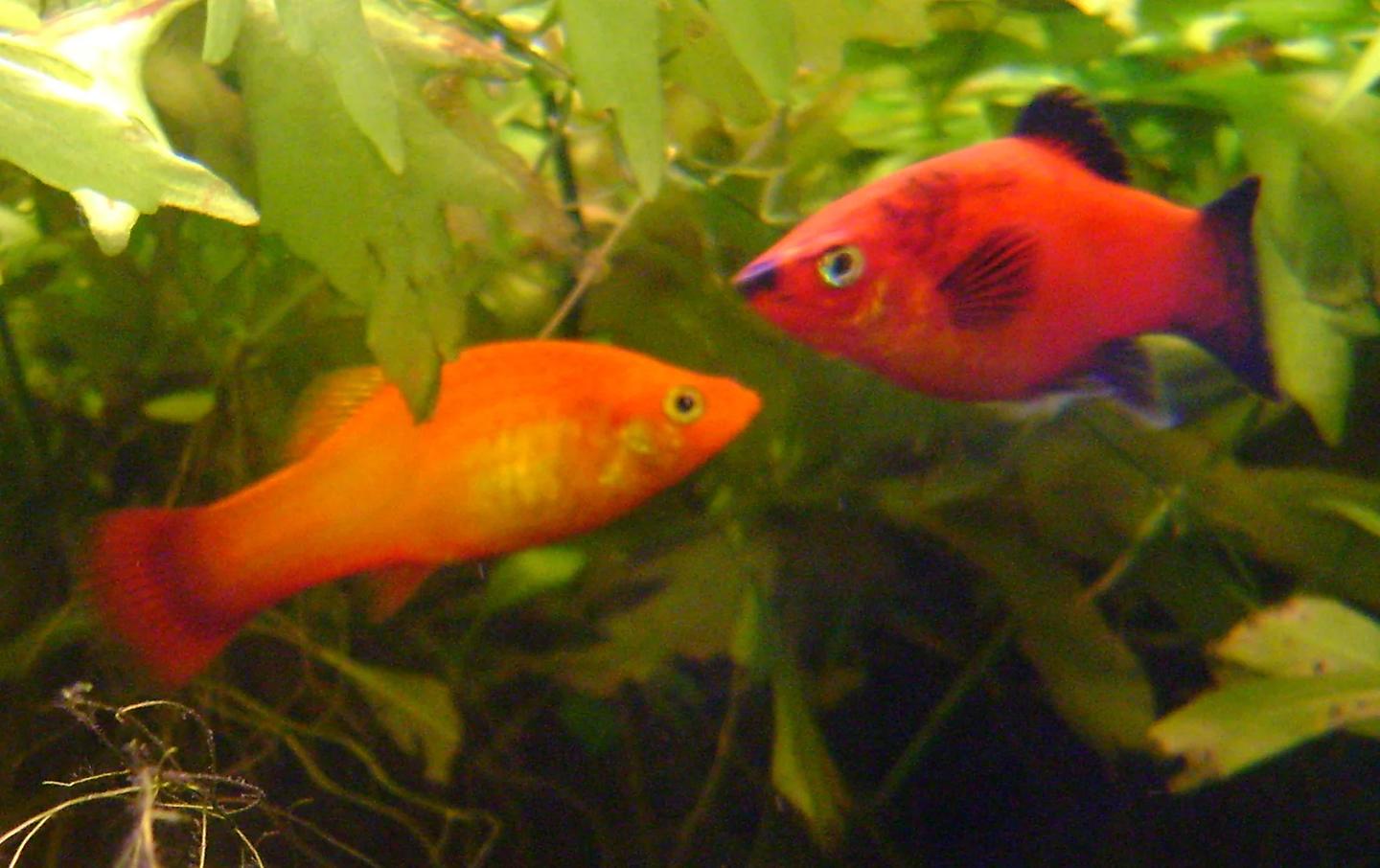
Platy is a trade name used for Xiphophorus maculatus, X. variatus and domestic forms. Start with at least three in a mature aquarium of at least 45 litres, verify the exact fish and measured water, and plan extra capacity before mixing sexes.
Maintain these water conditions for optimal health and vibrant colors
Swordtail Ada Red is a red ornamental form of the green swordtail, a lively poeciliid kept for its colour, confident swimming and recognisable livebearer shape. The product identity is Xiphophorus helleri with Ada Red naming the ornamental form. Scientific references accept the spelling Xiphophorus hellerii; the familiar single-i spelling remains in the offer name. That spelling bridge helps keep the fish and its species care clearly connected.
One purchase supplies one live fish in the size you choose: 4–5 cm or 5–6 cm. These are dispatch sizes, not two different varieties. The size you select is the size supplied, not the adult size. Both size choices need the same permanent aquarium plan, and neither option guarantees sex. Sex is guaranteed only when the selected option explicitly states male or female. This Swordtail Ada Red listing has no sex-guaranteed option.
The Ada Red form is best treated as an active swordtail first and a colour variety second. A sound home provides a long swimming footprint, plants and wood around the margins, open water through the middle, stable neutral-to-alkaline chemistry, and a social plan that does not leave one fish receiving all the attention from a dominant male. It can suit a newer keeper who has already cycled the aquarium and is willing to test the water, but “easy” should never be read as “works in any tank”.
Seriously Fish recommends a base of at least 120 × 30 cm, approximately 108 litres, and reports 16–28°C, pH 7.0–8.0 and 10–25 dGH for aquarium maintenance. FishBase records a maximum 14.0 cm total length for a male or unsexed fish, while Seriously Fish reports 140 mm standard length. Standard length stops at the base of the tail; total length includes the tail. Those measurements should stay labelled rather than being collapsed into one misleading “adult size” promise.
| What one quantity buys | One live Ada Red Swordtail at the selected dispatch size |
|---|---|
| Size choices | 4–5 cm or 5–6 cm |
| Scientific identity | Offer name Xiphophorus helleri; accepted species spelling Xiphophorus hellerii |
| Recorded length | 14.0 cm total length in FishBase (male/unsexed); 140 mm standard length in Seriously Fish |
| Aquarium starting point | At least 120 × 30 cm, approximately 108 litres, for a properly planned group |
| Aquarium water | 16–28°C, pH 7.0–8.0 and 10–25 dGH from the species husbandry profile |
| Diet | Omnivorous: good dried foods with small live or frozen foods and plant matter |
| Social point | Males may form dominance hierarchies; space, cover and a considered sex ratio matter |
| Suits | A keeper with a mature, tested aquarium who wants an active visible livebearer and can manage a group, plants and open swimming room |
|---|---|
| Think twice | A short aquarium, very soft acidic water, timid slow feeders, no plan for possible fry, or no way to respond if the developing sex ratio creates pressure |
Choose this fish if you want an active, visible livebearer and can provide a long, covered, mature aquarium. It is less suitable for a cramped tank, very soft acidic water, a timid slow-feeding community, or a setup where future fry cannot be managed. The broad UK trade guidance for swordtails suggests at least three fish and, where the sexes are known, two females for each male. Because this offer is not sexed, decide in advance how you will observe and adjust the group rather than assuming the first purchase creates the ideal ratio.
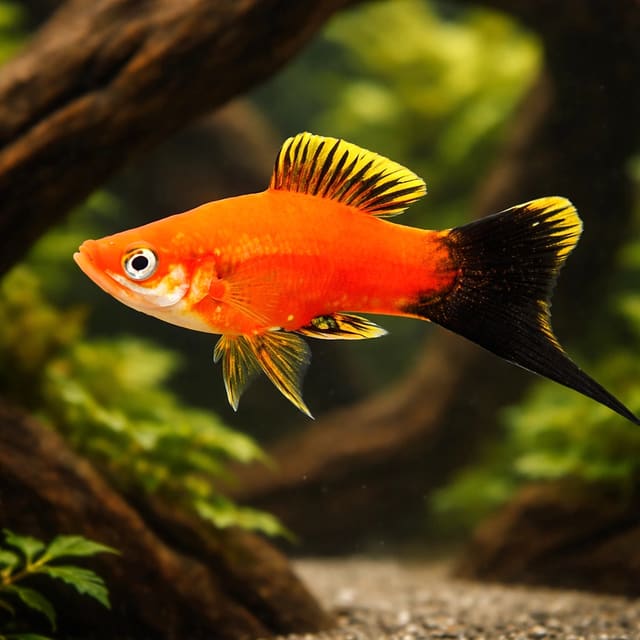
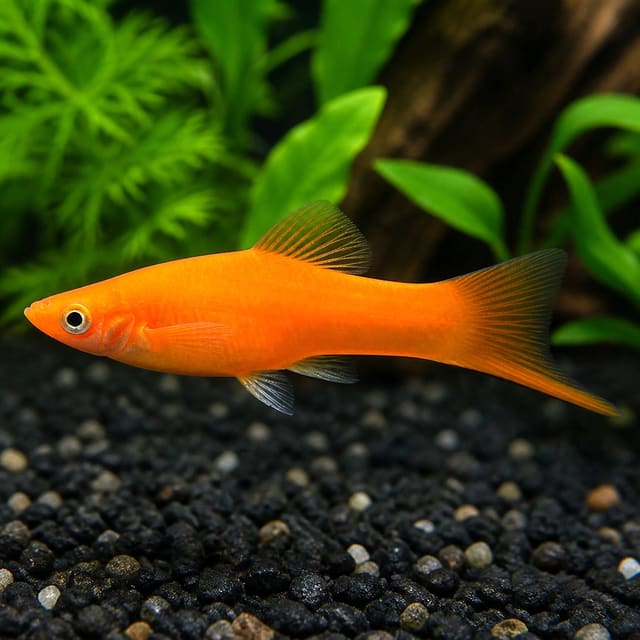
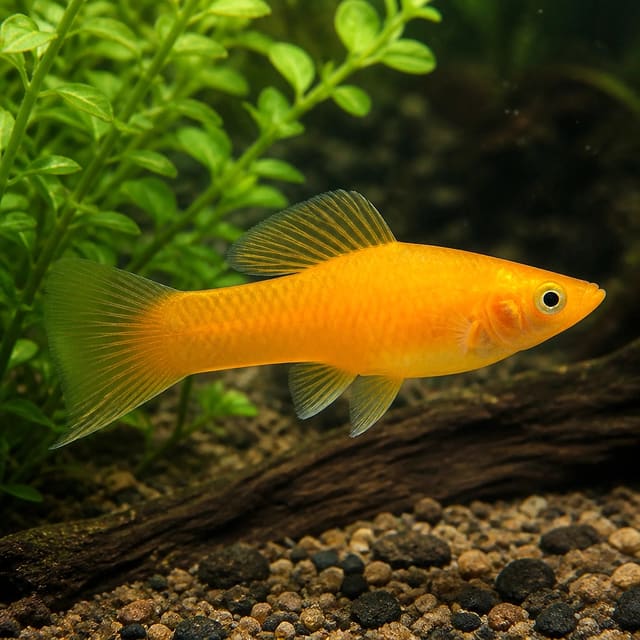
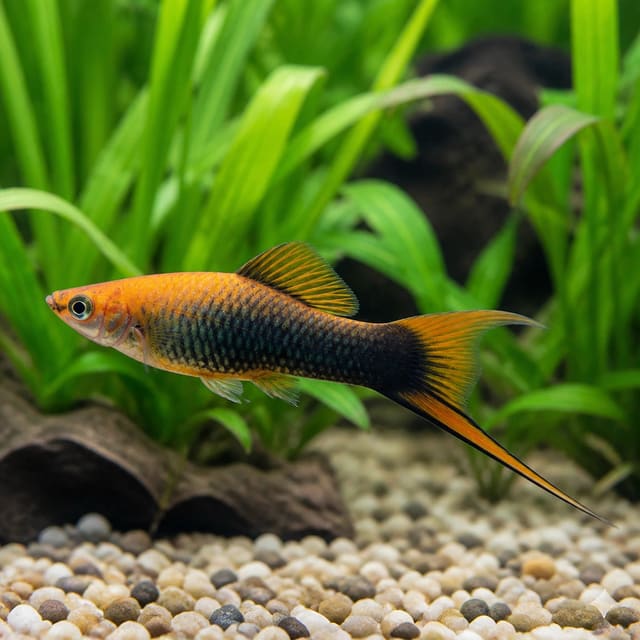
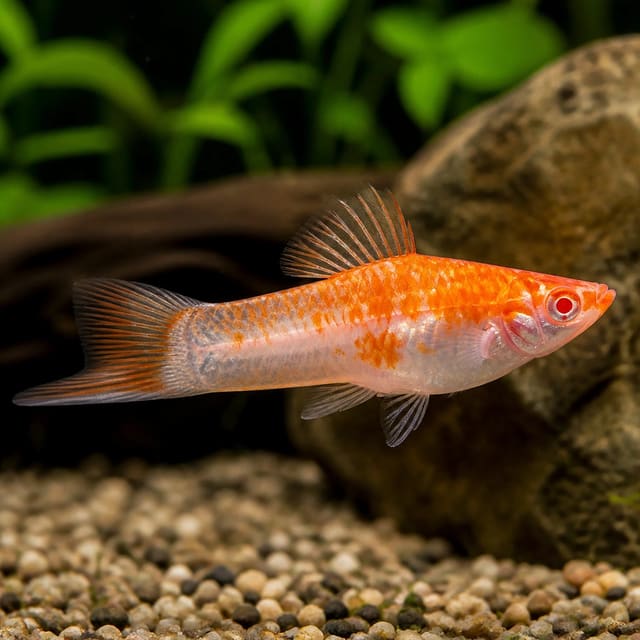
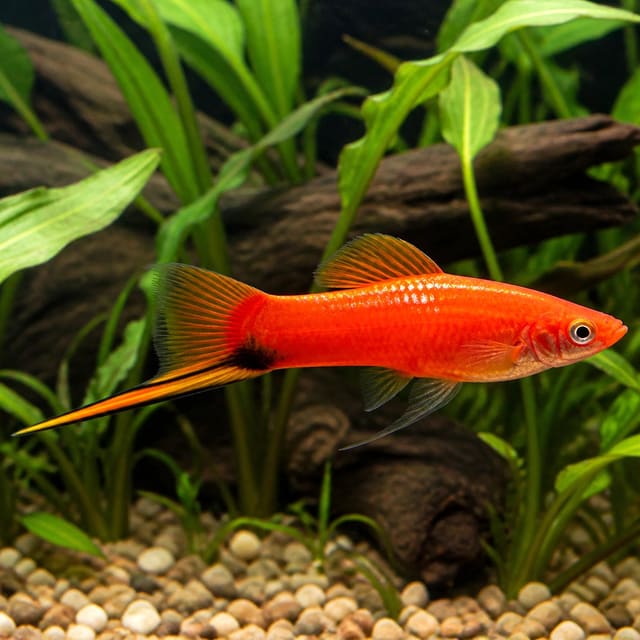
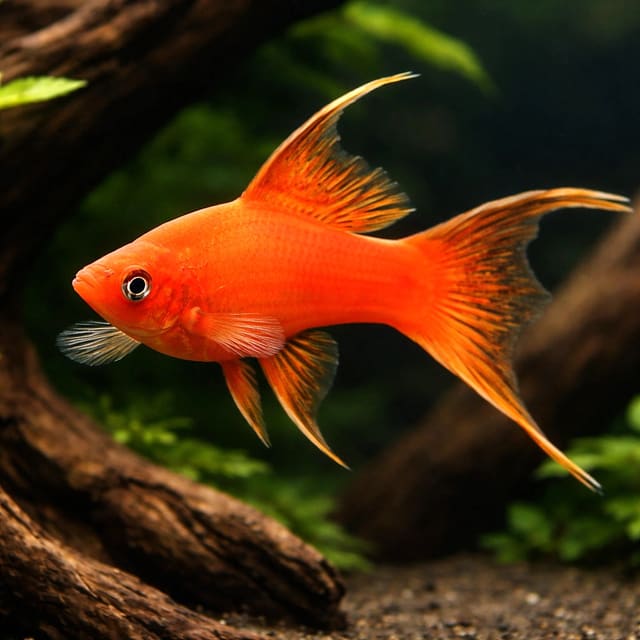
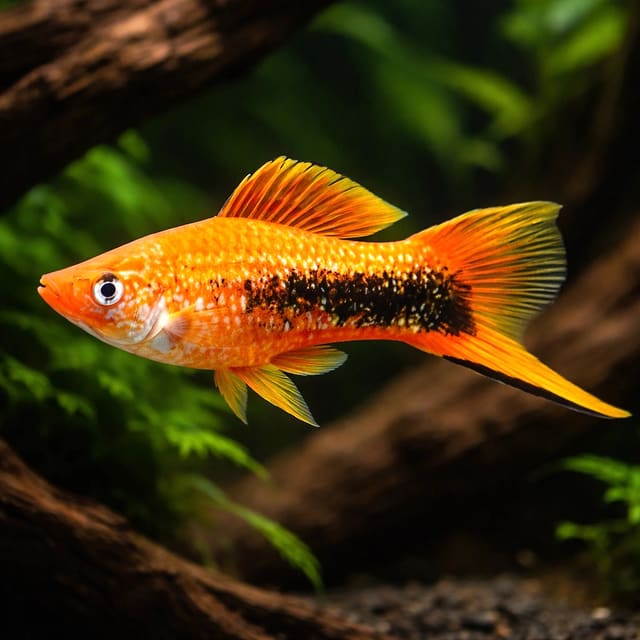
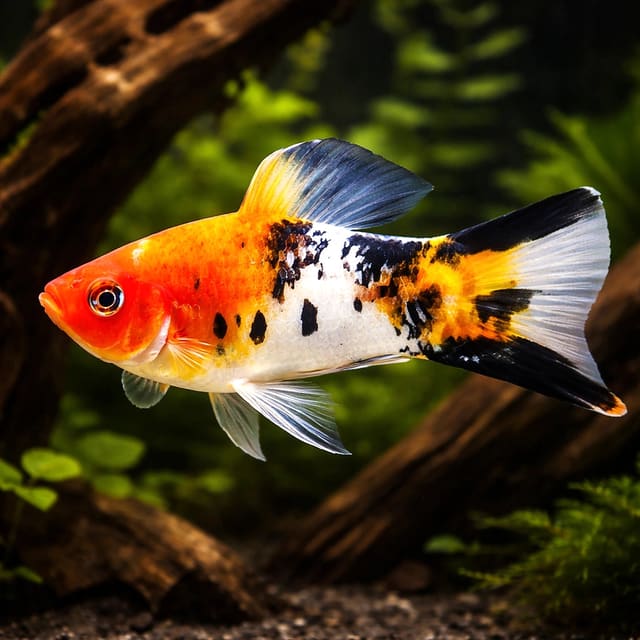
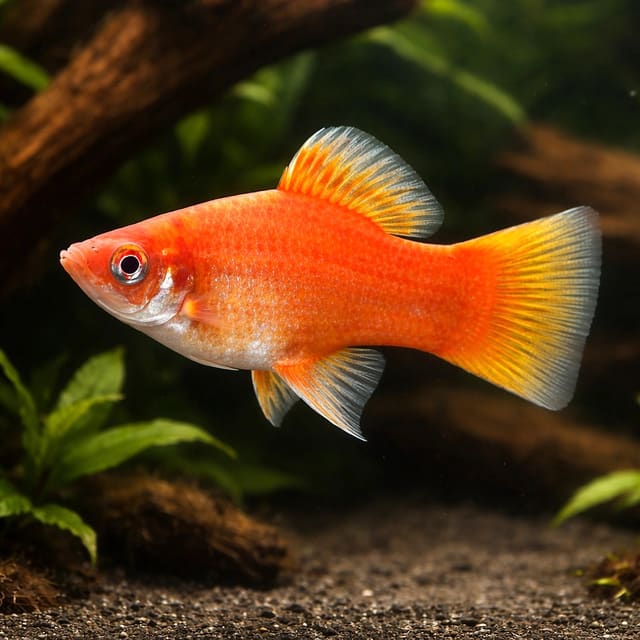
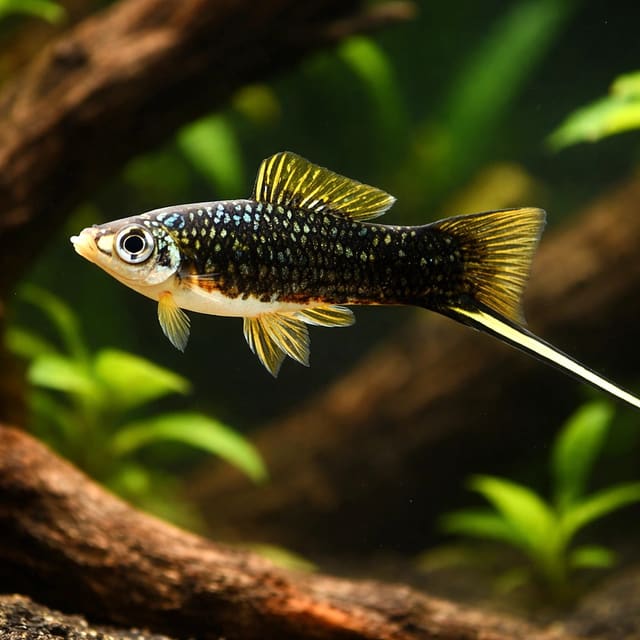
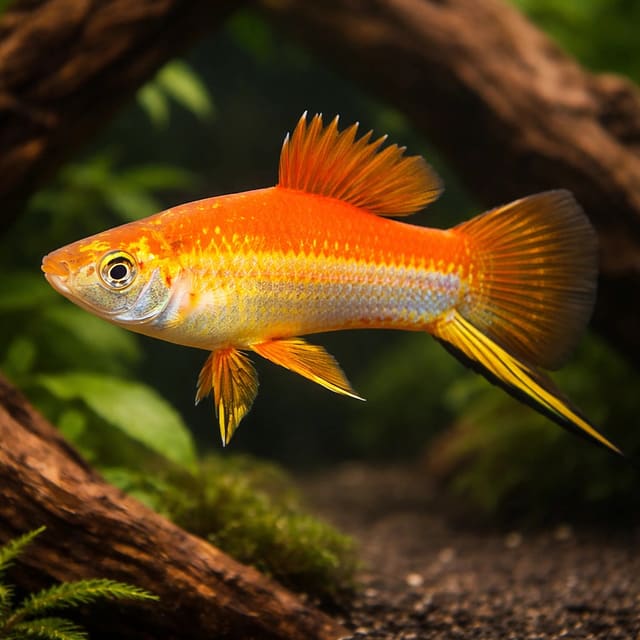
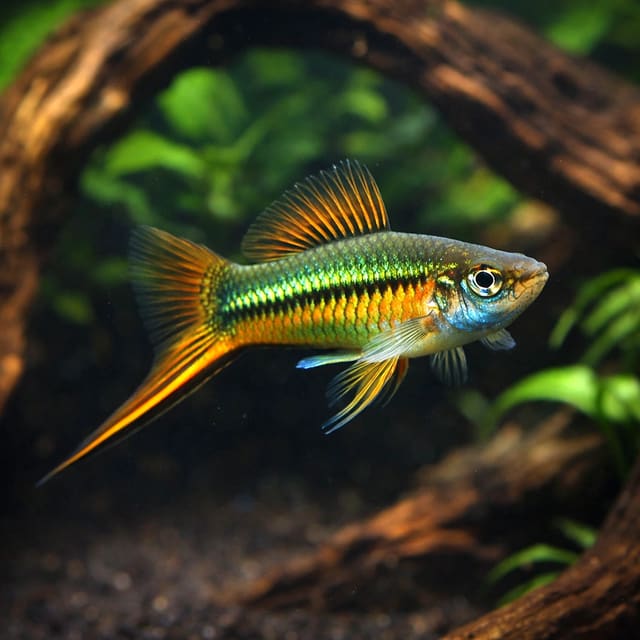
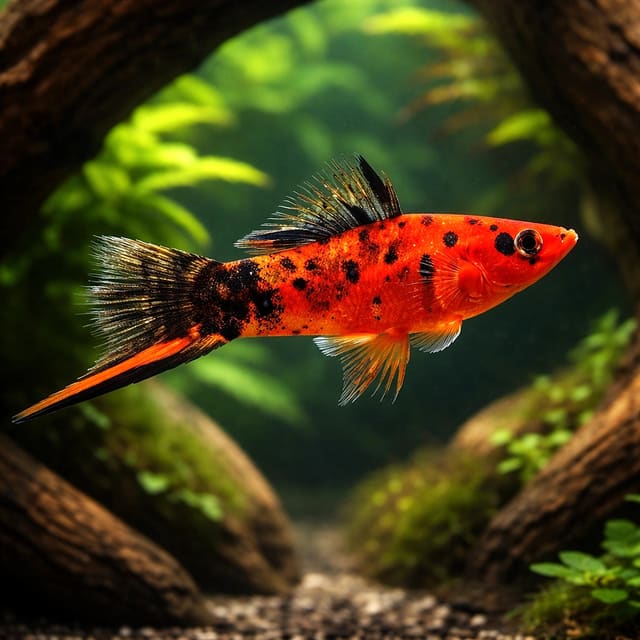
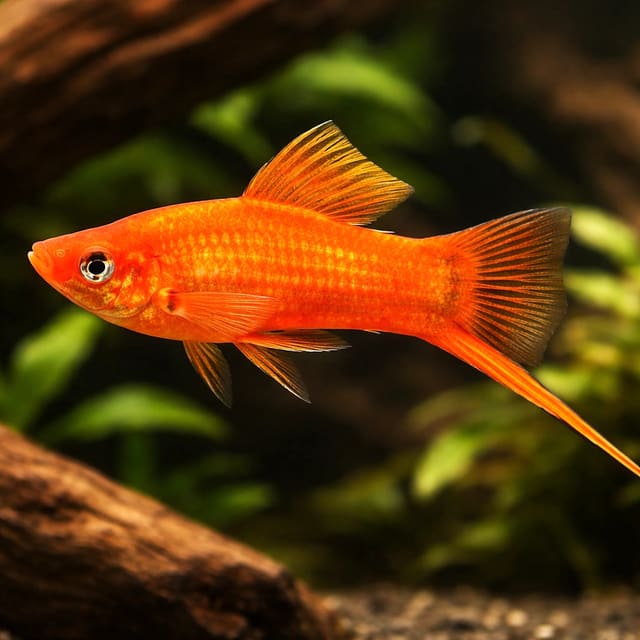
Gallery images have been digitally enhanced to improve image quality. Natural colour, pattern, size and maturity can vary between live animals. The reviewed hero shows one bright red fish with a long lower tail extension in a planted aquarium with wood and rounded gravel. It is useful for colour and scene context, but an image cannot guarantee the sex, exact shade or markings of the individual delivered.
For more livebearer choices, browse the current livebearers collection. Compare each candidate by adult dimensions, water requirements, group behaviour and feeding style, not simply by colour or juvenile size.
Xiphophorus hellerii belongs to the Poeciliidae, the family that includes many familiar livebearers. FishBase places the native range from the Río Nautla region of Veracruz, Mexico, through parts of Central America to north-western Honduras. Introduced populations occur elsewhere, which is a useful reminder never to release aquarium fish or water into local waterways. The Ada Red colour form is an ornamental trade fish; its bright appearance should not be used to invent a wild collection point or a particular breeding lineage.
Wild green swordtails occupy varied freshwater habitats, including flowing streams and rivers as well as vegetated canals, ponds and warm springs. FishBase notes a preference for heavily vegetated places and reports worms, crustaceans, insects and plant matter in the diet. An aquarium does not need to imitate one precise river bend, but it should offer the functional ingredients behind those observations: usable swimming length, shelter, plant cover, clean water, oxygen and a varied omnivorous diet.
The accepted spelling deserves one clear note. FishBase and the specialist husbandry profile use Xiphophorus hellerii. The offer uses Xiphophorus helleri, a common single-i spelling in the aquarium trade. “Ada Red” names the ornamental form; it is not part of the scientific binomial. Both spellings point to the same species context used for care here.
Plan the permanent home around adult activity rather than the 4–6 cm dispatch range. Seriously Fish gives 120 × 30 cm, about 108 litres, as the smallest aquarium base to consider. That length provides room for cruising and for subordinate fish to move away from social pressure. A shorter but taller aquarium with a similar litre figure does not offer the same horizontal escape routes. More fish, more males or a mixed community may justify substantially more space.
Use planting and hardscape to create structure without turning the whole tank into an obstacle course. Dense planting at the rear and ends can interrupt sight lines. Floating plants and branching wood diffuse the light and offer refuge, while an open central lane preserves the swimming room an active swordtail uses. Water-worn stones, sand or fine gravel can all work when they are stable and easy to clean. Leave enough access to siphon detritus from feeding areas.
A lid is sensible for any active livebearer. Cover gaps around filter hoses, airlines and cables, and replace the lid as soon as feeding or maintenance is finished. Check that decorations cannot shift when fish chase through them. A dark background and planted margins can help a new arrival settle, but avoid relying on visual styling as a substitute for water quality or space.
If this is your first livestock aquarium, follow the step-by-step first tropical tank guide before ordering. Cycling means establishing a biological filter capable of processing waste; it does not mean leaving a new tank running for an arbitrary number of days. Add livestock only after testing shows that the system can maintain safe ammonia and nitrite readings.
The species husbandry profile gives a broad aquarium range of 16–28°C, pH 7.0–8.0 and 10–25 dGH. FishBase reports 22–28°C, pH 7.0–8.0 and 9–19 dH as environmental records. These figures come from different contexts. They show that swordtails favour mineral-bearing neutral-to-alkaline water, but they do not justify moving a fish sharply between extremes or chasing a different number every day.
Choose a stable point inside the overlap that also suits every tank mate. Measure your tap water after it has stood or been prepared as you normally use it. If it already falls within an appropriate stable band, repeated chemical adjustment is usually more hazardous than accepting a sensible natural value. The water parameter matcher can help compare measured aquarium values with the stated guidance, while the water chemistry guide explains what each test means.
Temperature affects metabolism and oxygen demand. At the warmer end, increase surface movement and watch for rapid breathing. At the cooler end, confirm that feeding and activity remain normal and that the whole community shares the same range. Use a reliable thermometer; a heater dial alone is not a measurement. Changes during a water change should be gradual, especially for a newly arrived fish.
Hardness is often neglected. Swordtails are not a sound choice for a deliberately very soft, acidic display simply because they appear colourful and peaceful in a shop. General hardness reflects dissolved calcium and magnesium, which contribute to normal physiological function. Test before buying rather than attempting large mineral corrections after the fish arrive. If source water is far outside the species range, choose livestock that naturally fits it or seek experienced advice on a stable preparation method.
A biologically mature filter is essential. The RSPCA explains that fish excrete toxic ammonia, which established beneficial bacteria convert first to nitrite and then to less harmful nitrate. Ammonia and nitrite should remain undetectable in normal operation. A clear-looking tank can still be chemically unsafe, so use tests rather than appearance or smell as the deciding evidence.
Seriously Fish describes some water movement as appreciated and, for an aquarium around 108 litres, illustrates a turnover of roughly four to five times the volume per hour. Treat equipment ratings as a starting point rather than a guarantee: media, head height and dirt reduce real flow. The fish should have oxygenated water without being pinned in one place. Direct the outlet along the surface or across the length, then observe whether there are calmer pockets for resting.
Set a repeatable maintenance routine. Test new systems frequently and established systems often enough to notice trends. Carry out partial water changes based on stocking, feeding and nitrate accumulation. Condition replacement tap water, match temperature reasonably closely and avoid stripping the filter and whole aquarium clean on the same day. Rinse reusable filter media gently in removed aquarium water when flow drops, unless the manufacturer specifies another safe method.
The OATA group sheet recommends a weekly 25% partial water change as broad guidance for platies and swordtails. Your aquarium may need a different amount, but the principle is sound: remove accumulated waste regularly and replace minerals without creating sudden swings. Record results for a month. A simple log of temperature, pH, ammonia, nitrite and nitrate is more useful than trying to remember whether the tank “looked fine” last week.
Aquarium conditions are not fixed after setup. Fish grow, plants fill space, filter media collects debris and summer room temperatures rise. Reassess the tank as the group matures. The swimming lane that looks generous around 4–5 cm fish may feel much narrower around adults, particularly once wood and plants have spread. Trim selectively, keep routes open and resist filling every empty area with another species.
Watch trends rather than isolated readings. A gradual rise in nitrate may show that feeding or biomass has outgrown the current water-change routine. Falling flow can point to a clogged pre-filter, trapped plant matter or overdue mechanical-media cleaning. A pH shift can reflect source-water variation or changes in buffering. Respond to the cause in measured steps instead of making several large adjustments at once.
During warm weather, check the aquarium at the hottest part of the day. Warmer water carries less dissolved oxygen, while fish metabolism and bacterial oxygen demand increase. Keep the surface moving, clear blocked intakes and make sure the room has safe ventilation. Do not add ice or large quantities of cold water directly; sudden temperature and chemistry changes create a different stress.
Power cuts deserve a simple plan. Keep the filter media wet and oxygenated, avoid feeding during an extended outage, and restore circulation as soon as it is safe. Battery air pumps can be useful where outages are recurrent. After power returns, confirm flow and temperature and test the water before returning to the normal feeding routine.
Green swordtails are generalised omnivores. Wild records include animal prey, detritus, algae and plant matter. In the aquarium, Seriously Fish recommends good-quality dried food alongside small live or frozen foods such as daphnia, Artemia and bloodworm. OATA similarly suggests a good flake or granule with a meaningful algae component, supplemented with small live or frozen items.
Build the diet around a complete, appropriately sized staple rather than one favourite treat. Rotate a quality flake or small granule with a plant-containing food, then use small frozen or live foods for variety. Break food into particles that every fish can take. A 4–5 cm arrival should not have to wrestle with a pellet intended for a much larger fish.
Feed what the group can consume without a carpet of leftovers. OATA's broad livebearer guidance is one small daily feeding finished within a few minutes, but observe your actual fish and product instructions. Distribute food across the surface if one individual controls the first drop point. Remove substantial uneaten food and investigate when appetite changes; adding more is not the right response to a fish that cannot reach the food.
Algae grazing can supplement natural behaviour, but this swordtail is not an algae-control tool. Persistent nuisance algae usually reflects light, nutrients, plant competition or maintenance. Do not underfeed fish to make them work harder on the glass. A varied diet, stable body condition and clean water matter more than whether a patch of algae disappears.
OATA's broad swordtail guidance recommends at least three, with two females for each male, to reduce persistent pressure on females and other residents. Seriously Fish notes that males in confined quarters can form dominance hierarchies. Those points support keeping a thoughtfully structured group, but this listing does not provide sex-selected fish. Do not assume a sword-shaped tail on a juvenile image proves what will arrive, and do not buy an exact ratio that the offer cannot guarantee.
Start with enough space and cover to manage more than one outcome. Watch who initiates chases, who is repeatedly displaced and whether every fish feeds. A short chase followed by normal swimming can be routine. One fish being kept in a corner, losing weight or showing damaged fins calls for intervention. Additional cover, rearranged hardscape and more room can reduce visual pressure; simply adding more fish to a crowded aquarium usually makes the problem worse.
Swordtails are livebearers. Females can store sperm, so fry may appear even when no male seems present at the time. Decide before purchase whether fry can remain, be separated or be responsibly rehomed. Dense plants give young fish refuge, while adult fish may eat some fry. Do not present breeding as guaranteed and do not use the aquarium as a production project unless you can house the offspring.
Adult males generally develop a gonopodium and the characteristic lower caudal extension; females usually retain a fan-shaped anal fin and lack the typical male sword. Ornamental strains can complicate fin shape, and juveniles may not show mature differences reliably. Those features are useful for observation after growth, not a promise that this unsorted offer will supply a particular sex.
Prepare the aquarium before the parcel arrives. Confirm stable temperature, zero ammonia and nitrite, an unobstructed filter, a secure lid and places for a new fish to rest. Follow the supplied acclimation instructions and avoid exposing opened transport water to air for longer than necessary.
Tropical Fish Co's delivery and Live Arrival Guarantee policy explains the current receiving conditions. Someone must be present to receive the parcel, it should be opened and inspected on arrival, and any claim needs same-day contact plus a continuous unboxing video showing the sealed parcel being opened and the fish still in the sealed bag. The video is evidence for a claim, not part of routine biological care.
Once introduced, allow the fish to explore without repeated netting or rearrangement. A brief period of paler colour or hiding can follow transport, but breathing, balance and posture should remain normal. Offer a modest familiar food after settling rather than a heavy meal immediately. Check that established residents do not monopolise food or pursue the newcomer continuously.
Quarantine is valuable when a suitable mature spare system is available. It must meet the same temperature, water and oxygen needs; an uncycled container is not protective. Use separate equipment, observe the fish carefully and avoid speculative medication. If breathing, skin, fins or behaviour cause concern, test the water first and seek advice from an aquatic veterinarian or experienced fish-health professional.
Healthy routine behaviour includes purposeful swimming, prompt interest in food, intact fins and an even body shape. Learn the normal colour and activity of each fish so change is easier to spot. Watch for clamped fins, rapid breathing, rubbing, white spots, loss of appetite, isolation, damaged scales or repeated surface-gasping. None of these signs identifies one disease on its own.
Test water immediately when several fish change behaviour together. Check equipment, temperature and oxygen before reaching for treatment. Do not combine medicines casually; some affect plants, invertebrates or filter bacteria. Follow a labelled product only for a defined need and use professional diagnosis for persistent or serious symptoms.
A weekly check should include the lid, heater, filter flow, cable gaps and any unstable hardscape. Look behind wood for trapped food and dead plant matter. Trim plants without removing all cover at once. As the fish grow, revisit the stocking plan: a community that works at 5 cm may feel crowded when several fish approach adult dimensions.
FishBase records a maximum 14.0 cm total length for a male or unsexed green swordtail, while Seriously Fish gives 140 mm standard length. Total length includes the tail and standard length does not, so keep those measurements labelled and plan a roomy adult aquarium.
Seriously Fish recommends a base of at least 120 × 30 cm, approximately 108 litres. Length and swimming footprint matter, and a larger group or mixed community may need more space.
Broad OATA swordtail guidance suggests at least three, with two females per male when sex is known. This offer is not sex guaranteed, so provide space and cover, observe the developing group, and adjust responsibly if one fish receives persistent attention.
It can suit a newer keeper who has a mature filtered aquarium, tests the water and can meet its adult space and social needs. Its store care assessment is easy, but it is not suitable for an uncycled tank or a very soft acidic setup.
Offer a good-quality flake or small granule with plant matter as the staple, varied with modest portions of small live or frozen foods such as daphnia or Artemia. Feed controlled amounts and remove substantial leftovers.
The species husbandry profile gives 16–28°C, pH 7.0–8.0 and 10–25 dGH. Choose stable values inside that range that also suit every tank mate, and avoid abrupt movement between the extremes.
It is generally a community fish, but males can form dominance hierarchies and large swordtails may be boisterous. Avoid cramped groups and known fin nippers, and watch for repeated chasing, food exclusion or damaged fins.
Consider robust peaceful community fish whose adult size, temperature, neutral-to-alkaline water needs and feeding pace overlap. Check the exact species rather than assuming every tetra, barb, catfish or livebearer is suitable.
Tropical Fish Co hand-packs livestock in oxygenated bags, an insulated box and a heat pack when weather calls for it, then uses a tracked licensed live-animal courier. Someone must receive and inspect the parcel; a Live Arrival Guarantee claim requires same-day contact and a continuous unboxing video from sealed parcel to fish still in the sealed bag.
These references support the species identity, labelled measurements and practical husbandry on this page. Aquarium ranges describe responsible captive planning; wild environmental records are not automatically an ideal household target.
Trade-form colour and individual appearance vary. The shop's live controls show current size availability, price and checkout information.
No reviews for this item yet. Bought one? Honest reviews only, good or bad.
What customers say about ordering from us
Easy website plenty of info on fish your buying great to pick a time slot
TRACEY DURRANT · 7 Oct 2026
Got some lovely fish thank you
Kevin Mackie · 7 Oct 2026
Reviews of our shop, collected by Judge.me, an independent third-party review collector. Newest first.