Easy
Swordtail Red (Xiphophorus helleri red)
22–27°C · pH 7–8 · 108L
£3.99
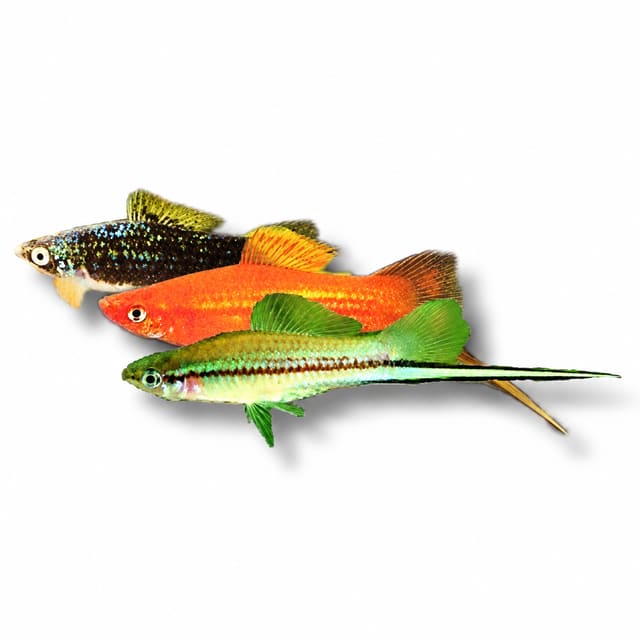
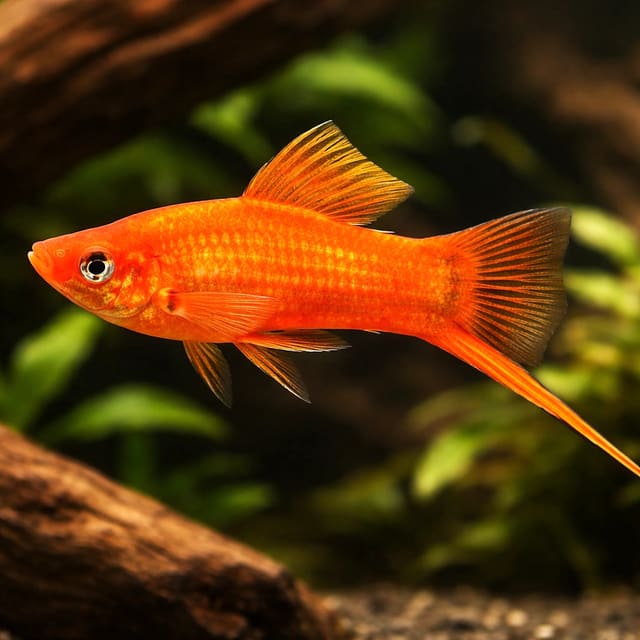
Xiphophorus helleri orange comet (Xiphophorus helleri) is a poeciliid livebearer from Mexico to north-western Honduras that reaches 14 cm. It suits prepared beginners with at least 108 litres; OATA suggests at least three, and the overlap of FishBase, Seriously Fish and OATA guidance is 22–27°C, pH 7.0–8.0 and 10–12 dGH. Sold individually as one live fish.
Adult size is the maximum length this species reaches at full maturity (scientific sources). The livestock you receive will be younger and smaller. Product-photo provenance and any image-specific limitations are stated on the listing.
Xiphophorus helleri
Shoaling fish: kept in a group they feel safer, stay calmer and show their best colour.
Minimum of 2 per order.
Xiphophorus helleri orange comet (Xiphophorus helleri) is a poeciliid livebearer from Mexico to north-western Honduras that reaches 14 cm. It suits prepared beginners with at least 108 litres; OATA suggests at least three, and the overlap of FishBase, Seriously Fish and OATA guidance is 22–27°C, pH 7.0–8.0 and 10–12 dGH. Sold individually as one live fish.
Adult size is the maximum length this species reaches at full maturity (scientific sources). The livestock you receive will be younger and smaller. Product-photo provenance and any image-specific limitations are stated on the listing.
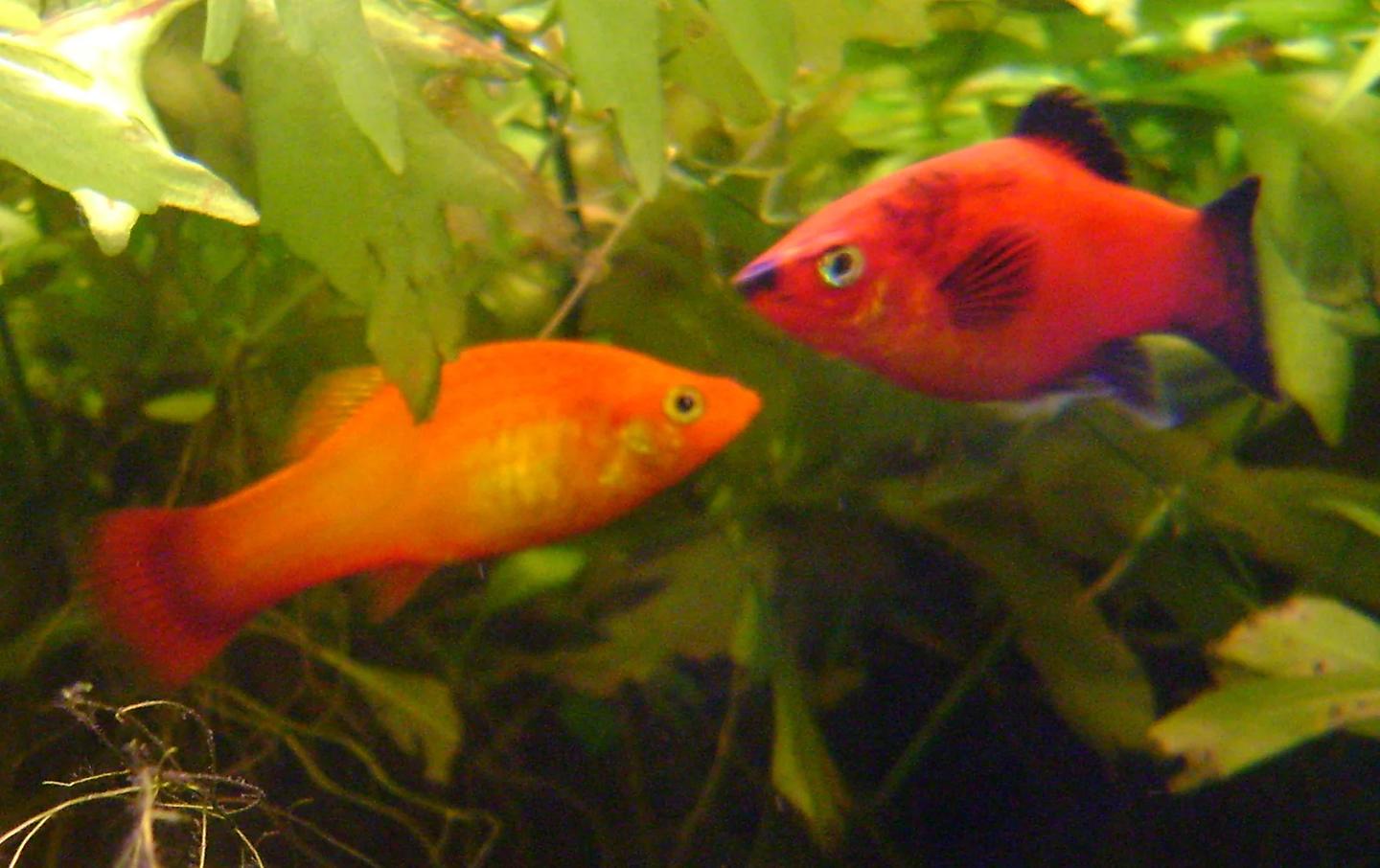
Platy is a trade name used for Xiphophorus maculatus, X. variatus and domestic forms. Start with at least three in a mature aquarium of at least 45 litres, verify the exact fish and measured water, and plan extra capacity before mixing sexes.
Maintain these water conditions for optimal health and vibrant colors
The orange comet swordtail (Xiphophorus helleri) is a freshwater poeciliid livebearer whose underlying species is native from the Río Nantla in Veracruz, Mexico, to north-western Honduras. FishBase records a maximum adult length of 14 cm. It suits a prepared beginner who can provide a spacious, filtered aquarium, alkaline water and the companionship swordtails need. Its bright ornamental appearance does not change the adult space, water-quality or social decisions required for the species.
FishBase now lists it as Xiphophorus hellerii. The familiar spelling Xiphophorus helleri remains the scientific label for this orange comet form here. It belongs to Poeciliidae, the family that includes platies and other livebearers, and it gives birth to live young rather than laying eggs.
Wild members of the species occur in rapidly flowing streams and rivers as well as warm springs, weedy canals and ponds. Heavily vegetated habitat is a recurring feature, while the recorded wild diet includes worms, crustaceans, insects and plant matter. These facts explain why an aquarium should combine planted shelter, open swimming room and a varied omnivorous diet instead of treating this fish as a decorative addition for a small tank.
| Suits | Not suited to |
|---|---|
| A filtered aquarium with a 120 × 30 cm footprint or equivalent | Aquariums below the recommended adult footprint |
| Planted layouts with shelter and open swimming room | Unfiltered or biologically immature aquariums |
| A planned swordtail group with enough room for social behaviour | Keeping one fish as a permanent substitute for companionship |
| Water maintained within the stated alkaline range | Water outside the stated temperature, pH or hardness range |
| Peaceful companions screened for space and temperament | Timid tankmates likely to be stressed by chasing |
Use the adult requirements as the deciding test before adding this fish to a community. If you are comparing related animals rather than choosing companions, browse the livebearers collection and assess each animal separately.
This fish is sold individually, so one purchase supplies one live fish. Sex is guaranteed only when the selected option explicitly states male or female. This Xiphophorus helleri orange comet listing has no sex-guaranteed option.
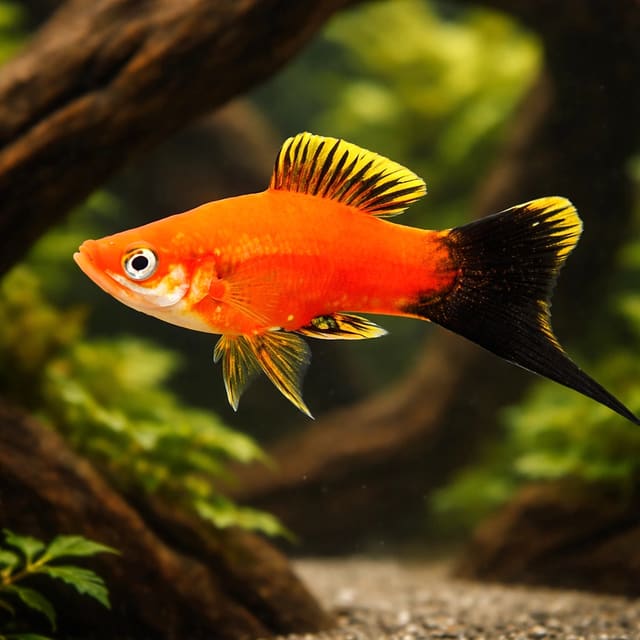
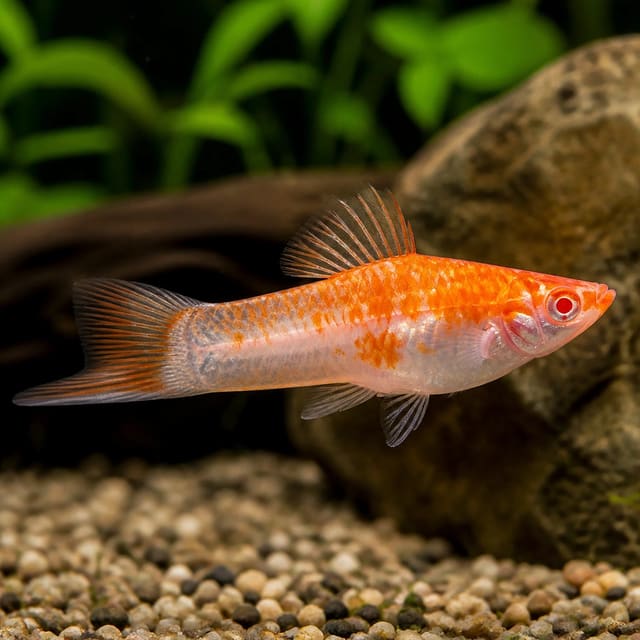
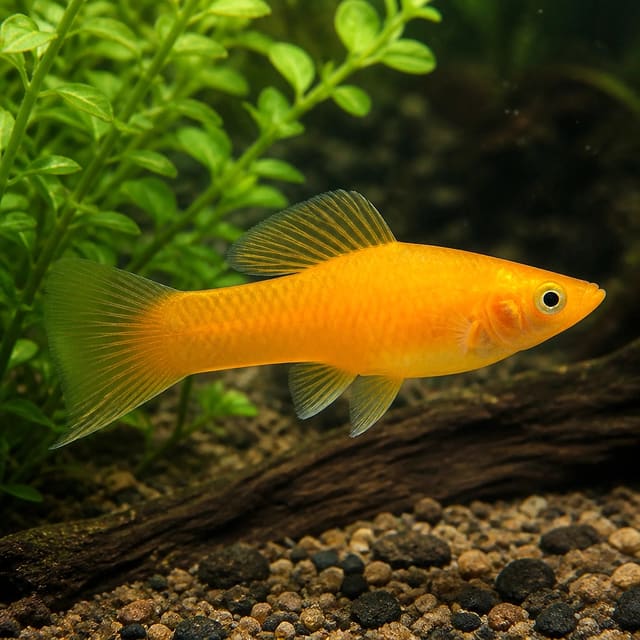
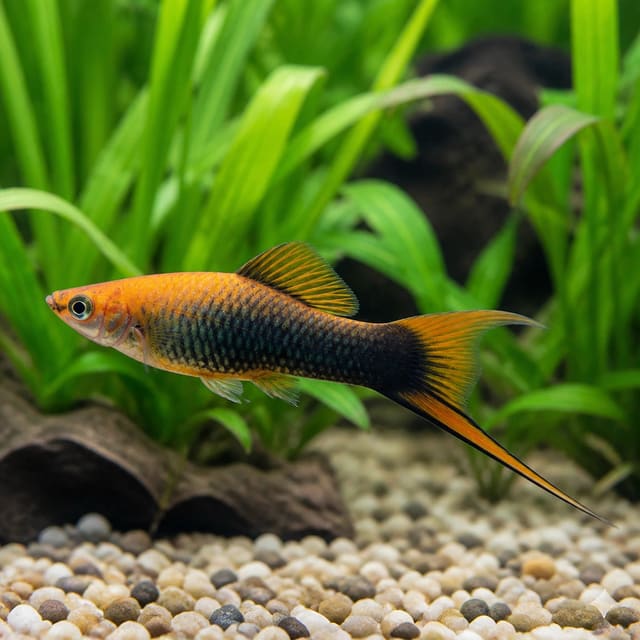
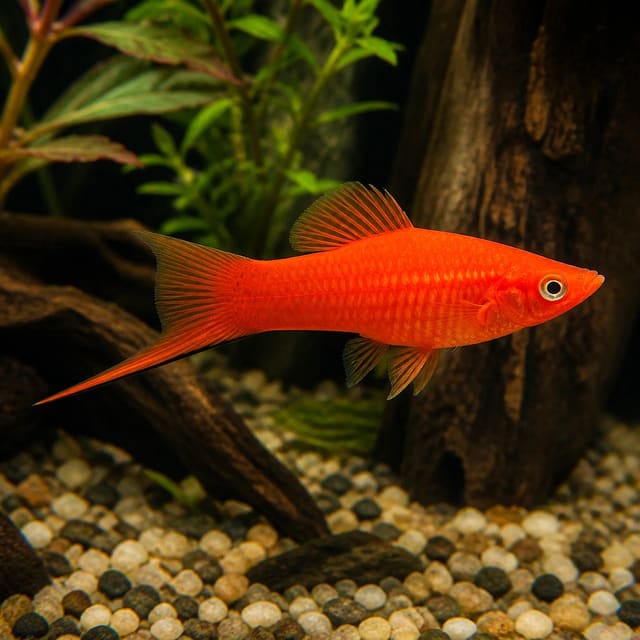
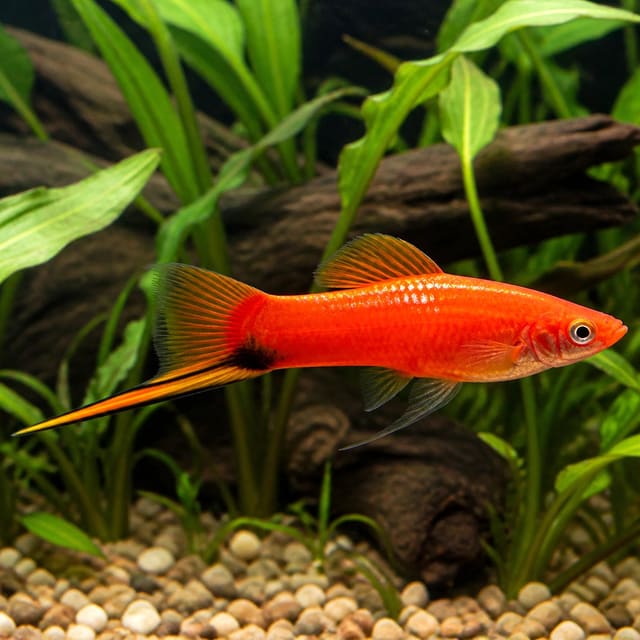
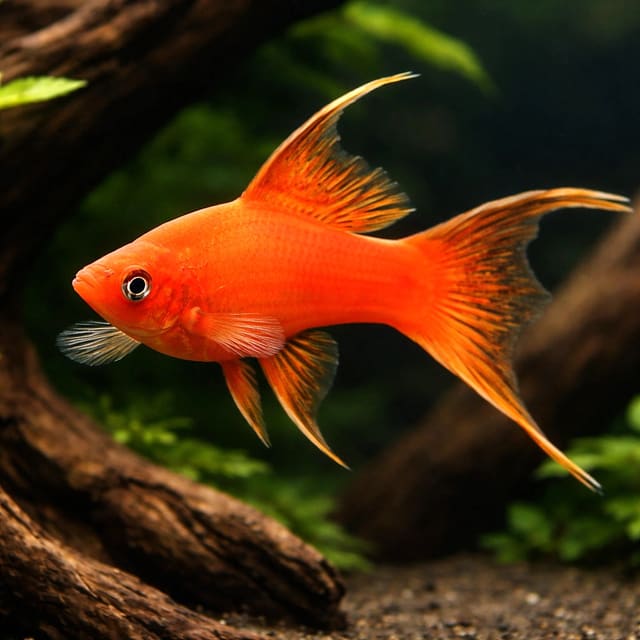
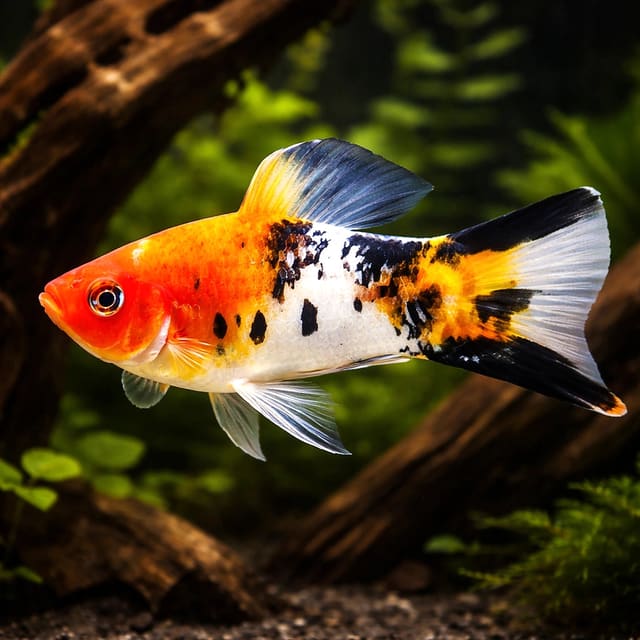
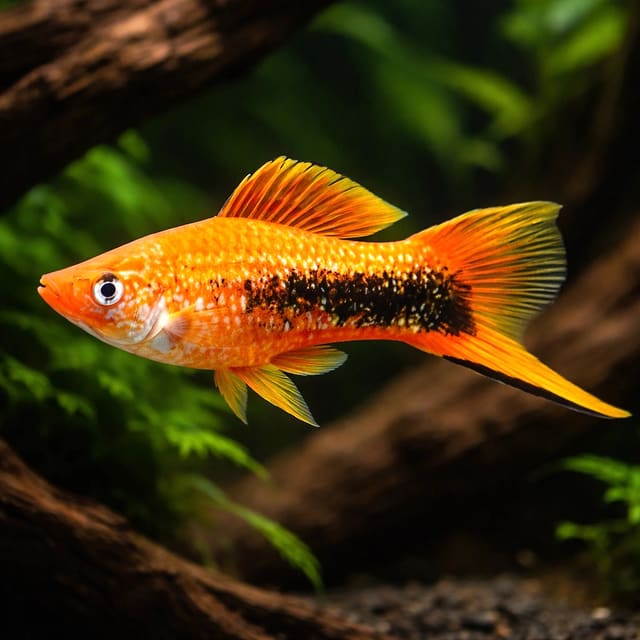
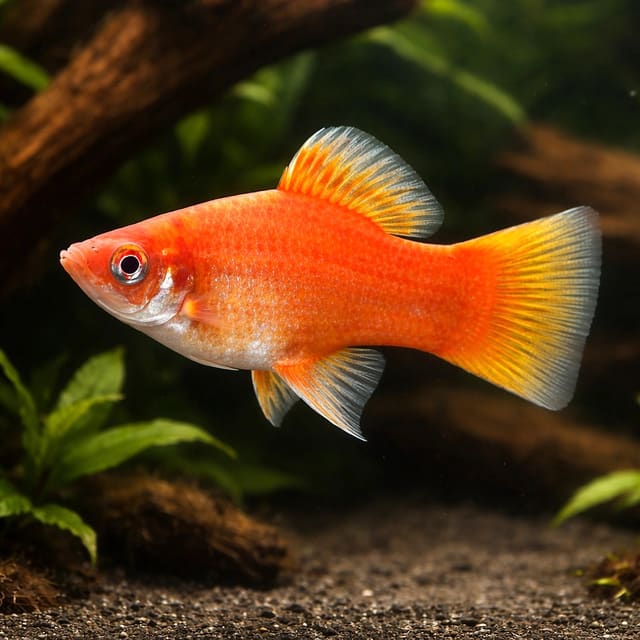
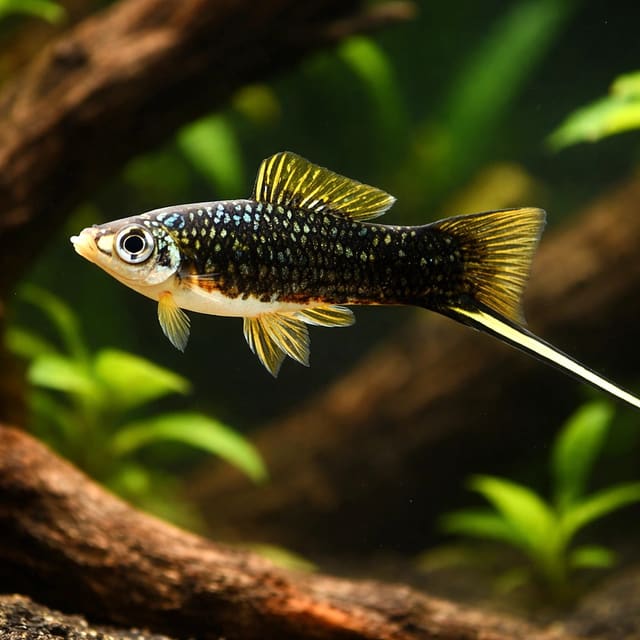
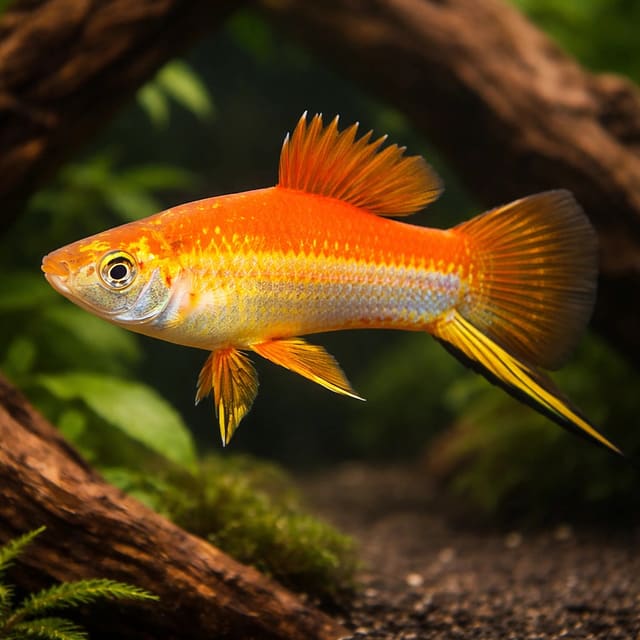
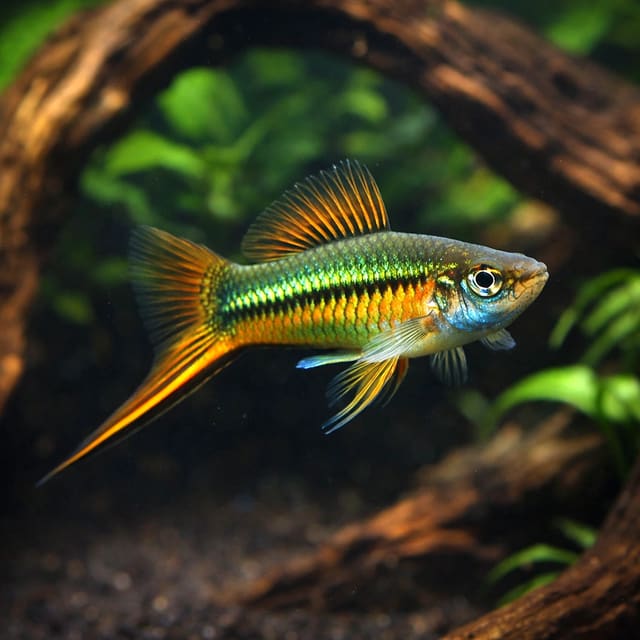
The gallery images are representative of this type of animal rather than photographs of the exact animal supplied, so colours can look slightly different from the live animal. Use the gallery to understand the general body shape and scene, not to predict the precise markings or sex of the fish received.
Plan for an adult length of 14 cm. FishBase records 14 cm total length, while the Seriously Fish species profile also uses 14 cm as its aquarium-planning length. OATA's broader swordtail sheet describes swordtails as 8–12 cm; use the 14 cm species figure when deciding permanent space. A fish's length on arrival is not the endpoint for its aquarium.
Provide an aquarium with surface dimensions of at least 120 × 30 cm or an equivalent footprint, around 108 litres. Seriously Fish describes this as the smallest aquarium that should be considered. Length and footprint matter because swordtails need open swimming room as well as planted cover; a differently shaped aquarium should preserve that usable horizontal space.
Keep routine water at 22–27°C, pH 7.0–8.0 and 10–12 dGH. These values are the overlap of FishBase's species environment range, the Seriously Fish aquarium profile and OATA's swordtail group guidance. OATA gives 22–27°C, pH 7.0–8.0 and 4–12 dGH for the group, while the species ranges bound the working target.
OATA suggests keeping at least three swordtails, using two females to each male to reduce stress on females and other inhabitants. More fish require more aquarium volume, filtration capacity and social planning. The easy care assessment reflects their generally undemanding husbandry, but it assumes the keeper can meet the adult footprint, maintain stable water and manage the group rather than relying on the label alone.
Keep the aquarium at 22–27°C, pH 7.0–8.0 and 10–12 dGH. Hold ammonia at zero mg/l and nitrite at zero mg/l. Nitrate should not exceed 20 mg/l above the normal tap-water level. These measurements turn a broad description such as “hard, alkaline water” into values you can test before the fish is introduced and throughout its care.
The water chemistry guide explains what the tests measure, while the water matcher helps compare measured aquarium values with this fish's working range. Enter readings from tests rather than estimates so a close boundary, such as 12 dGH, is handled accurately.
| Reading | Decision |
|---|---|
| Inside all three water ranges | Maintain the established routine and continue weekly testing |
| Ammonia or nitrite above zero | Do not add more fish; check the biological filter and recent stocking |
| Nitrate more than 20 mg/l above tap water | Review water changes, feeding and aquarium stocking |
| Temperature, pH or hardness outside range | Correct the aquarium conditions before introducing this swordtail |
Consistency matters because even small amounts of ammonia can stress platies and swordtails. A test result is also more useful than judging water by clarity: clear water can still contain dissolved ammonia, nitrite or nitrate. Record the weekly figures so changes can be linked to feeding, maintenance or an increase in livestock.
Start with at least a 120 × 30 cm aquarium footprint or an equivalent layout, around 108 litres. This is the minimum species recommendation from Seriously Fish, so do not reduce it because the fish is smaller when it arrives. The aquarium must support the 14 cm adult fish, its companions and the waste produced by the complete community.
Footprint is the first comparison when considering an aquarium of a different shape. A tall aquarium can hold a similar volume while offering less horizontal swimming length, so preserve the 120 cm length and 30 cm front-to-back dimension or an equivalent usable footprint. OATA also advises that larger aquariums provide more stable environmental conditions and that more groups require more volume.
Use aquarium gravel or sand, live plants and open water for swimming. Seriously Fish notes that the species looks particularly effective in a heavily planted layout with a dark substrate. Floating plants and driftwood roots or branches can diffuse incoming light and create additional structure without filling every swimming route.
Arrange plants, wood and ornaments as shelter zones rather than as a solid barrier across the aquarium. The species' wild relatives use heavily vegetated habitats, rapidly flowing streams, warm springs, weedy canals and ponds, so planted cover and some water movement both fit its recorded biology. Filtration need not create particularly strong flow, although a degree of water movement is appreciated.
| Area | What to provide |
|---|---|
| Swimming route | Unbroken horizontal room through the aquarium |
| Shelter | Live plants or suitable artificial plants and ornaments |
| Substrate | Aquarium gravel or sand; a dark substrate suits the display |
| Upper cover | Floating plants where they do not remove essential swimming room |
| Structure | Driftwood roots, branches or suitable ornaments |
View the finished layout before adding fish. A planted aquarium is suitable only when it still leaves open space for an active adult swordtail. If an ornament breaks the main swimming path or creates a confined pocket where males repeatedly meet, reposition it before building the group.
Use a well set up, maintained biological filter and mature it before adding fish. The RSPCA explains that fish release toxic ammonia; filter bacteria convert it first to nitrite, which is also toxic, and then to the safer nitrate. A filter is therefore life-support equipment rather than simply a way to make the aquarium look clean.
For an aquarium of around 108 litres, Seriously Fish gives a turnover of four to five times the aquarium volume per hour and a filter rating of about 430–540 litres per hour. Use those figures to compare equipment while allowing for the actual aquarium layout. The resulting movement should circulate the aquarium without creating a needlessly forceful flow.
Our first tropical aquarium guide helps organise preparation and filter maturation before the animal arrives. Adding too many fish too quickly can cause new tank syndrome because the nitrifying bacteria cannot process the increased waste. That can raise ammonia and nitrite to levels that make fish ill or cause death.
Keep the measured water temperature between 22°C and 27°C. For an aquarium of around 108 litres in a room near 20°C, Seriously Fish estimates roughly 75–125 W of heating. Treat this as an equipment-planning range and confirm performance with the aquarium thermometer, because the target is the water temperature rather than the number printed on the heater.
Before stocking, check that water circulates around plants and wood, the filter is free of blockage and the heater maintains the target range. A mature filter, zero ammonia, zero nitrite and a stable temperature form the essential starting conditions. Decorative planting can then be arranged around that working equipment without blocking circulation.
Feed once a day, offering only what the fish can eat within a few minutes. Use a good-quality flake or granule with algae content as the regular dried food, then vary the diet with small live, frozen or freeze-dried items. Suitable examples named by the care references include Daphnia, Artemia, small bloodworm, chironomid larvae and tubifex.
This balance fits the species' recorded biology. Wild stomach analyses describe a generalised omnivore eating aquatic and terrestrial invertebrates, organic detritus, algae and other plant material. FishBase also records worms, crustaceans, insects and plant matter. The regular menu should therefore include both plant-based content and appropriately small animal foods.
| Food role | Suitable choice |
|---|---|
| Regular dried food | Good-quality flake or granule with algae content |
| Small live or frozen variety | Daphnia, Artemia, small bloodworm or tubifex |
| Freeze-dried variety | Bloodworm or Artemia |
| Portion limit | Only the amount eaten within a few minutes |
Watch the serving rather than relying on a fixed pinch. If food remains after a few minutes, offer less at the next daily feed. Uneaten food breaks down and releases toxic waste, so increasing the portion to make every fish visibly full creates a water-quality problem rather than better care.
Distribute appropriately small food where the group can reach it, then observe whether every fish participates. Reduced intake or loss of interest in food is a health warning that should trigger a water-quality test and a wider check of behaviour and appearance. Do not use extra feeding to compensate for persistent chasing or poor group structure; resolve the social and space decision instead.
Variety means rotating suitable foods within the once-daily routine, not adding several full meals. Maintain the same few-minute portion limit when live or frozen foods are used. This keeps the diet broad while controlling waste and preserving the zero-ammonia, zero-nitrite conditions required by swordtails.
At least once every week, change 25% of the aquarium water. Use a siphon to remove solid waste from the gravel where needed. Treat replacement tap water with a water conditioner to remove harmful chlorine or chloramine before adding it to the aquarium.
Test the water at least once per week. Ammonia and nitrite must remain at zero mg/l, while nitrate must not rise more than 20 mg/l above the normal tap-water level. Check temperature, pH and hardness often enough to confirm that the aquarium remains within 22–27°C, pH 7.0–8.0 and 10–12 dGH.
Check the filter for blockages as part of the routine. If the filter needs cleaning, do not run it under the tap. Rinse it lightly in aquarium water removed during the partial water change; this reduces the number of beneficial bacteria lost from the media.
| Routine point | Action |
|---|---|
| At least weekly | Change 25% of the water and test ammonia and nitrite |
| Replacement water | Treat it with tap-water conditioner before addition |
| Gravel | Siphon solid waste during the partial change |
| Filter flow | Check for blockages |
| Filter cleaning | Rinse lightly in removed aquarium water |
Do not add more fish while ammonia or nitrite is above zero. The filter's bacterial population must expand whenever the aquarium population and feeding increase, so additions should be gradual. A larger aquarium can make conditions more stable, but it still needs testing, maintenance and an established filter.
Pair the water results with observations of the fish. A change in swimming, breathing, colour, appetite or aggression can appear before a routine maintenance date. Test the water when a change is noticed rather than waiting for the next scheduled check. Good husbandry is especially important because even small amounts of ammonia can stress swordtails.
Prepare the mature, filtered aquarium before the parcel arrives, with temperature, pH and hardness inside the working range and ammonia and nitrite at zero mg/l. The Tropical Fish Co delivery and Live Arrival Guarantee policy explains that live fish are hand-bagged in pure oxygen, placed in an insulated poly box and given a heat pack when the weather calls for it.
Film every delivery from the sealed parcel onward. If anything has gone wrong, send the video with the order number on the day the fish arrives. The continuous sequence should show the sealed parcel, its opening and the fish inside the sealed bag so the condition can be assessed before release.
OATA advises checking that ammonia and nitrite are zero before any fish is introduced. It also recommends increasing the aquarium population slowly because filter bacteria must expand as the amount of livestock, waste and feeding rises. Complete those water checks independently of the parcel-opening sequence.
Do not use the arrival of a smaller fish as a reason to postpone the adult aquarium. The 120 × 30 cm footprint, approximately 108-litre volume, planted shelter and open swimming room should already be in place. Once released, observe swimming, breathing, colour and interest in food so any change can be compared with the normal behaviour established after settling.
Observe swimming, colour, temperament, breathing, appearance, body condition and feeding. Individual fish vary, so look for a change from the animal's normal pattern rather than waiting for several severe signs to appear together.
Healthy fish should have clear, bright eyes, undamaged fins, intact scales and no ulcerations or bumps. Use those visible features together with normal swimming, breathing and feeding as a baseline. One observation cannot replace a water test, because poor water quality may be present even when the aquarium looks clear.
Test temperature, pH, hardness, ammonia, nitrite and nitrate whenever you are concerned. Ammonia or nitrite above zero requires attention to the aquarium and biological filter, while a nitrate rise should trigger a review of water changes, feeding and stocking. Check the filter for blockages and confirm that the heater is holding 22–27°C.
Do not select a disease treatment from appearance alone. Water quality, physical injury and social pressure can create overlapping signs, and adding an unsuitable treatment does not resolve a filtration or stocking problem. Record what changed, when it began and the measured water values, then contact us for guidance if the fish remains abnormal or any sign is severe.
OATA suggests keeping at least three swordtails because they require companionship. Where males and females are kept together, use two females to each male to reduce stress on females and other aquarium inhabitants. This is a suggested social structure, and every increase in group size still has to fit the aquarium's adult space and filtration capacity.
| Planned group | Decision |
|---|---|
| One male | Plan for two females, giving at least three fish |
| Two males | The same ratio gives four females; reassess volume and space for six adults |
| More than one group | Increase aquarium volume rather than relying on the minimum |
| Sexes still unclear | Do not assume the group meets the ratio until adult features can be assessed |
Male behaviour requires particular attention. FishBase notes that males can be aggressive towards one another, and Seriously Fish describes groups of males forming dominance hierarchies in confined spaces. They may spend a significant amount of time maintaining their positions. More horizontal room and a carefully planned group reduce confinement, but they do not turn male rivalry into a harmless trait.
Adult males possess a gonopodium, a modified anal fin used for internal fertilisation, while OATA describes the female anal fin as triangular. The characteristic lower tail “sword” is associated with males, but ornamental strains may have other extended fins, including extensions in females. Do not use an elongated fin in a gallery image as a sex guarantee.
Swordtails give birth to live young. Seriously Fish also notes that females can store viable sperm for months, so population planning should not assume that separating a female from males prevents later young. Before increasing the adult group, consider whether the aquarium and filter can absorb further livestock without crowding or a rapid rise in waste.
Add fish slowly rather than building a large group in one step. Check ammonia and nitrite after livestock and feeding increase, and do not continue adding fish if either reading rises above zero. Social planning, adult space and biological capacity have to work together.
OATA describes platies and swordtails as generally peaceful and compatible with other species, but larger swordtails can be boisterous and may chase more timid tankmates. Treat that as a screening rule rather than a universal community-fish label. A generally peaceful description is not a promise that every combination will work.
| Situation | Decision |
|---|---|
| Peaceful fish sharing the water range | Consider after checking adult space and behaviour |
| Timid tankmate | Use caution because larger swordtails may chase it |
| Several male swordtails | Allow for rivalry and dominance behaviour |
| Water needs outside the stated range | Choose a different combination |
| Ammonia or nitrite above zero | Do not increase the aquarium population |
Observe the first week after any introduction for changes in aggression, hiding, feeding, breathing or swimming. A tankmate that remains hidden, cannot feed normally or is repeatedly chased is showing that the combination needs intervention. Test the water at the same time so social behaviour is not assessed while ammonia, nitrite or temperature is outside the required conditions.
Do not assume that fish sharing a shop category are automatically compatible. The useful comparison is the complete set of adult size, water requirements, behaviour and space. If you want a stocking assessment, contact us with the aquarium dimensions, measured water values, filter details and every resident animal.
It reaches 14 cm as an adult. FishBase records a maximum of 14 cm total length, and permanent aquarium planning should use that figure.
Provide at least a 120 × 30 cm footprint or equivalent, around 108 litres. Seriously Fish describes this as the smallest aquarium that should be considered for the species.
OATA's swordtail guidance suggests at least three, with two females to each male. Larger groups require more aquarium volume and filtration capacity.
OATA describes swordtails as generally easy to keep, so this fish can suit a prepared beginner who provides at least 108 litres, a mature filter, stable alkaline water and a planned group.
Feed a good-quality flake or granule with algae content once daily, offering only what it eats within a few minutes. Add variety with small Daphnia, Artemia, bloodworm or tubifex; the species is an omnivore that eats invertebrates and plant material.
Keep it at 22–27°C and pH 7.0–8.0, with hardness of 10–12 dGH. These values are the overlap of FishBase, Seriously Fish and OATA guidance.
Plan for male rivalry rather than assuming completely peaceful behaviour: males can be aggressive towards one another and may form dominance hierarchies in confined spaces. Larger swordtails may also chase timid tankmates.
Consider peaceful fish that share 22–27°C, pH 7.0–8.0 and 10–12 dGH, then check adult space and temperament. OATA warns that larger swordtails may chase timid tankmates, so no companion should be treated as an automatic match.
Tropical Fish Co's delivery policy says it is hand-bagged in pure oxygen, packed in an insulated poly box with a heat pack when weather calls for it, and carried by a licensed live-animal courier. Be present to receive it, film continuously from the sealed parcel through opening to the fish in its sealed bag, inspect it the same day and float the bag for 20–30 minutes before release.
No reviews for this item yet. Bought one? Honest reviews only, good or bad.
What customers say about ordering from us
Easy website plenty of info on fish your buying great to pick a time slot
TRACEY DURRANT · 7 Oct 2026
Got some lovely fish thank you
Kevin Mackie · 7 Oct 2026
Reviews of our shop, collected by Judge.me, an independent third-party review collector. Newest first.