By Hannah Nielsen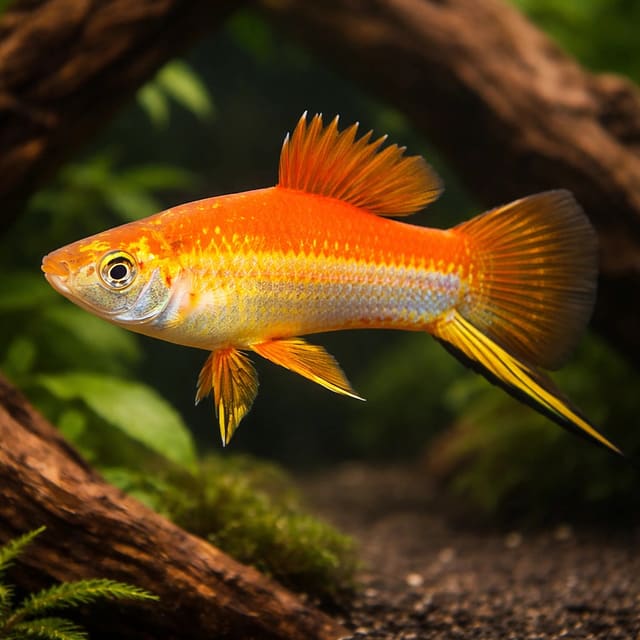
Easy
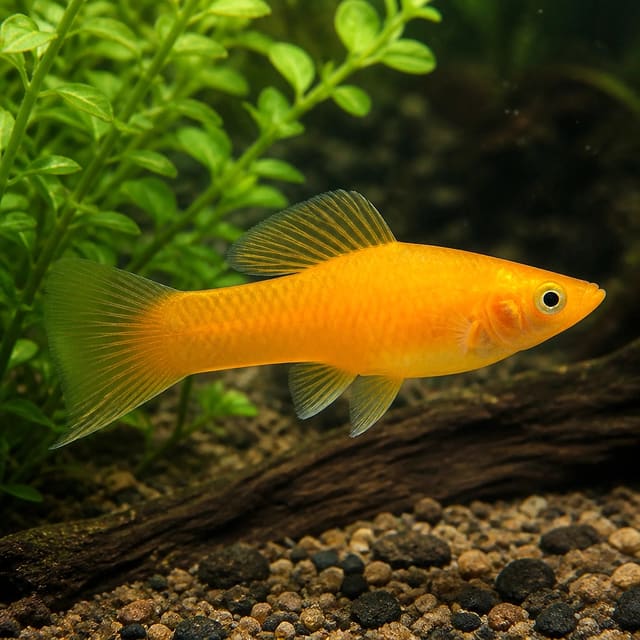
Swordtail Marry Gold (Xiphophorus helleri mary gold)
22–27°C · pH 7–8 · 108L
£3.99
Livebearers · Buying Guide
Read or listen to our UK green swordtail guide — sword vs no sword, ratios, jumping lids, tank size, strains and live delivery. Shop swordtails in stock.
11 products in stock today
Live prices and stock. Every fish covered by our Live Arrival Guarantee.
22–27°C · pH 7–8 · 108L
22–27°C · pH 7–8 · 108L
22–27°C · pH 7–8 · 108L
22–27°C · pH 7–8 · 108L
22–27°C · pH 7–8 · 108L
22–27°C · pH 7–8 · 108L
22–27°C · pH 7–8 · 108L
22–27°C · pH 7–8 · 108L
22–27°C · pH 7–8 · 108L

22–27°C · pH 7–8 · 108L
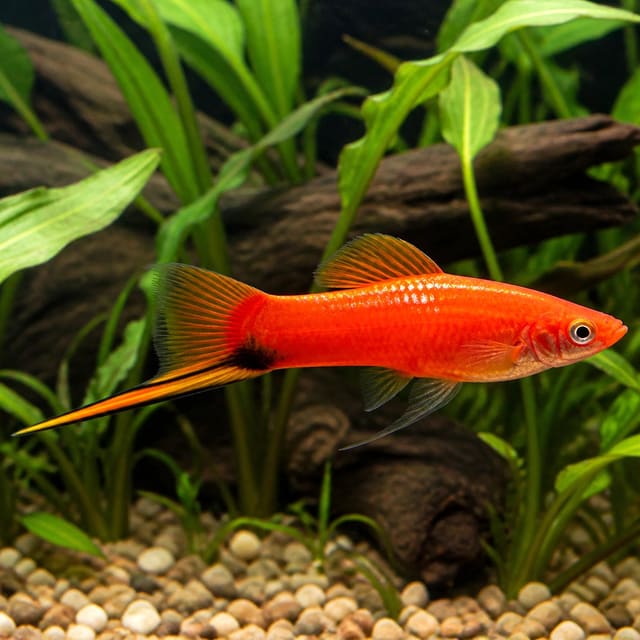
22–27°C · pH 7–8 · 108L
The shaded band shows the range green swordtail is comfortable in. Match it to your tap water before you buy.
Our trained assistant knows this green swordtail page inside out. Ask it anything — water parameters, tank mates, how many to buy — or have it read the guide aloud while you set up your tank.
You're after green swordtails, and almost every guide online tells you the same flat list: hardy, livebearer, easy. All true. None of it prepares you for the three things that actually catch UK keepers out — the male that appears out of a tank of "females", the fish that launches itself onto the carpet overnight, and the single pair that turns into a chase scene.
I'm Hannah Nielsen. I write our livebearer and community-tank guides and I've spent more hours than I'd admit photographing swordtails for this site — which means I've watched a lot of them behave, not just read about them. The green swordtail, Xiphophorus hellerii, is the fish I'd put near the top of any "second tank" list: more presence than a guppy, hardier than most tetras, and available in a genuinely silly number of colour strains.
This is the answer we'd give a customer leaning on the counter asking "are swordtails actually easy?" — yes, with a lid, a sensible group, and hard water you almost certainly already have out of the tap. Here's the green swordtail, properly.
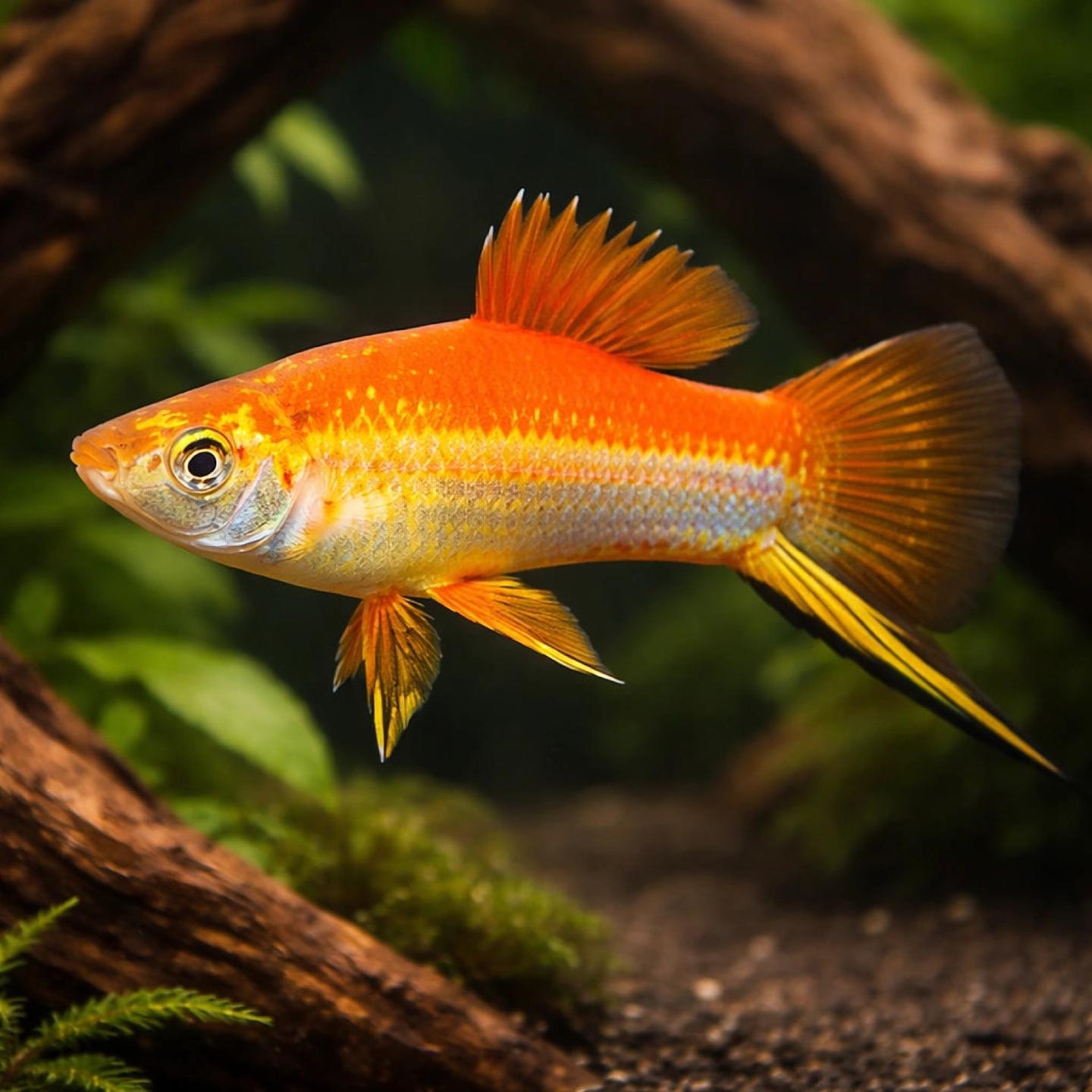
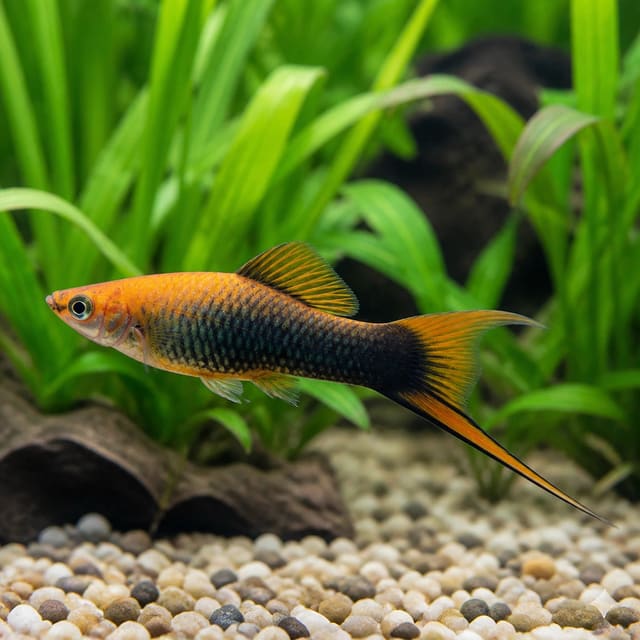
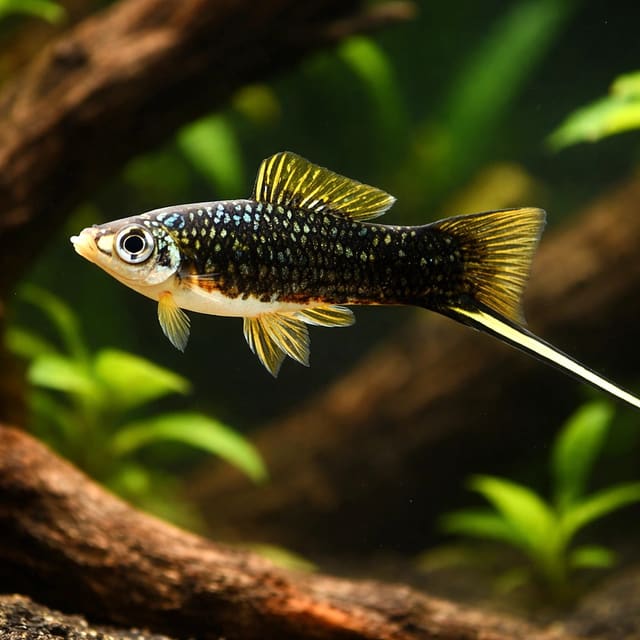
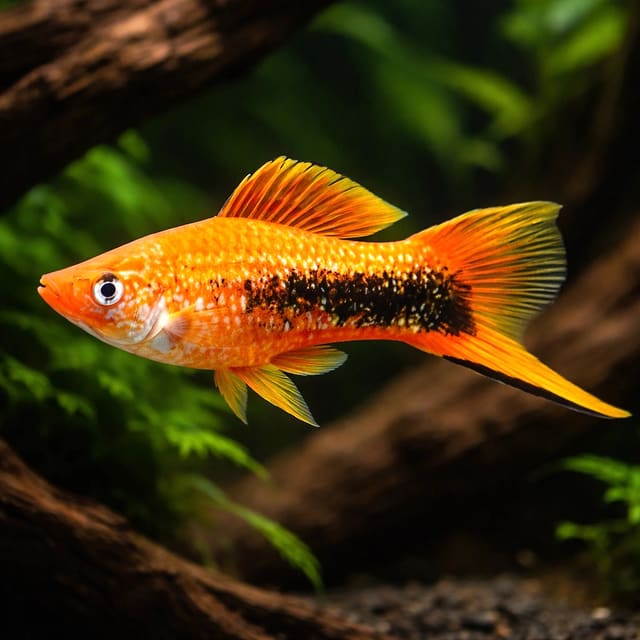
A Marigold swordtail (Xiphophorus hellerii) from our stock — the long lower-tail extension is the male's "sword". Photo: Tropical Fish Co warehouse.
This is where swordtails get genuinely interesting, because the sword isn't just decoration — it's one of the most-studied ornaments in animal behaviour.
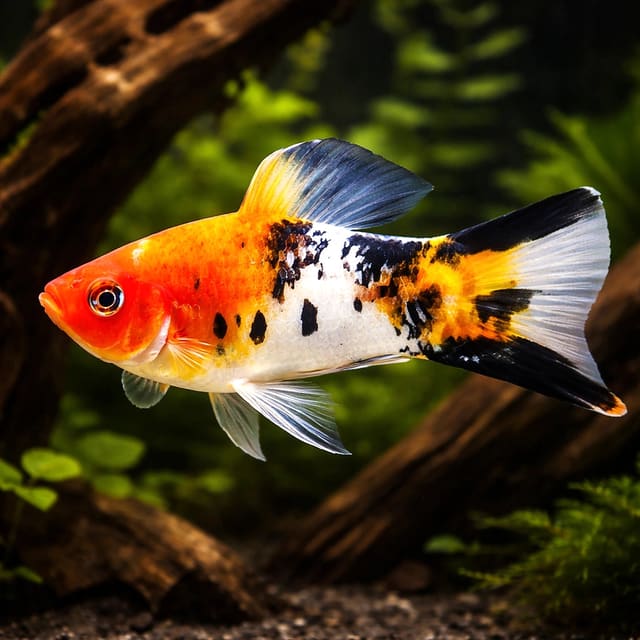
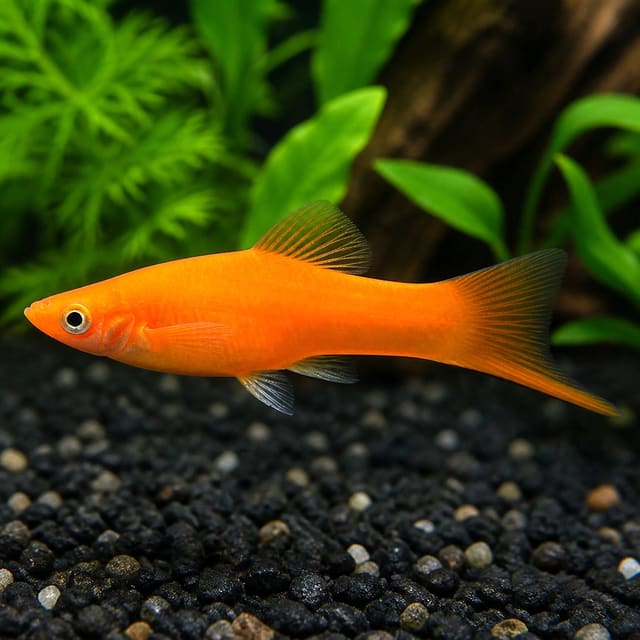
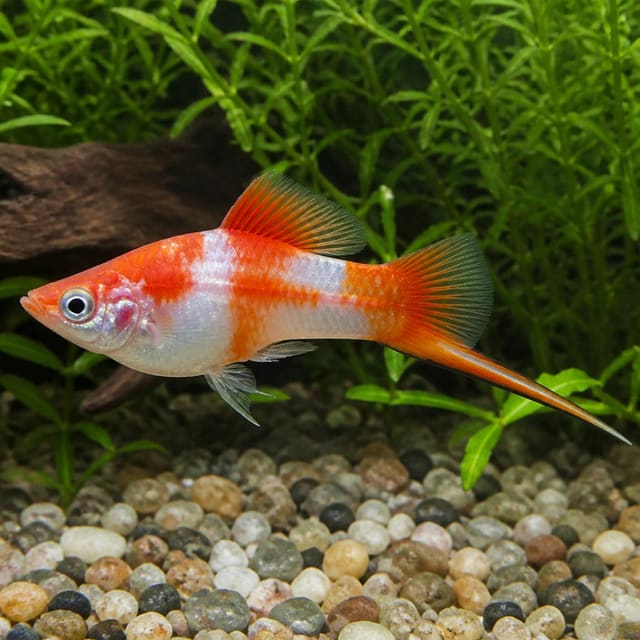
Red, black, tuxedo, koi, marigold, pineapple, lyretail — they are all Xiphophorus hellerii, the same fish Heckel described in 1848. Colour strains are selectively bred lines, not separate species, which is why they interbreed freely and why a mixed tank drifts back toward muddy wild-type over a few generations [1].
Swordtails rarely get bought in isolation — they're chosen against the other two big community livebearers. Here's how they actually compare, using the parameters we keep ours at:
| Attribute | Green Swordtail | Platy | Molly |
|---|---|---|---|
| Scientific name | Xiphophorus hellerii | Xiphophorus maculatus | Poecilia spp. |
| Adult size | 12–16 cm (males swordy) | 4–6 cm | 6–12 cm |
| Male sword | Yes | No | No |
| Min tank | 90 L | 54 L | 75 L |
| Temperament | Active, males pushy | Peaceful | Mostly peaceful |
| Hard-water lover | Yes | Yes | Yes (some need salt) |
| Jumper | Strong — lid essential | Mild | Moderate |
| Best for | Bigger community / display | Small first community | Planted hard-water tanks |
If you want the most movement and the showiest males, swordtails win — but they need the most space and the tightest lid. Want the same easy care in a smaller tank? A platy is the swordtail's smaller, calmer cousin. For comparison with the third common livebearer, the molly care guide covers the salt question.
The single most common swordtail mistake is buying a pair. Two swordtails — one male, one female — looks tidy on paper and becomes a relentless chase in a tank. Males pursue females constantly, and with nowhere for her to escape, the female is stressed thin.
Buy a group, skewed female: one male to two or three females. The males' attention spreads out, the chasing diffuses, and the tank settles. Practical Fishkeeping makes the same point — the males "can be real pests if the group isn't large enough to spread out any aggression" [5]. An all-female group is calm and just as colourful, because the colour lives in the strain, not the sex.
On space: 90 litres is our sensible floor for a starter group, and a long tank beats a tall one — Seriously Fish suggests roughly a 120 × 30 cm footprint for a proper group of these fast mid-water swimmers [4].
Swordtails are the jumpiest common livebearer we stock. A startled fish will go straight up and out through any gap — around the filter pipe, through a feeding hole, off the back of an open tank. Fit a tight cover glass or a proper hood before the fish go in. This single step prevents the most common swordtail loss there is.
The rule with swordtails is simple: same water, same pace. They want hard, alkaline water and they move fast, so the best companions are other hard-water community fish that won't be outpaced or out-eaten.
Avoid the obvious mismatches: large or aggressive cichlids, fin-nippers like tiger barbs, slow long-finned fish (fancy guppies, male bettas), and anything small enough to become a snack. For the broader hard-water shortlist, the livebearers hub is the place to browse.
Reading about how fast swordtails cruise is one thing; seeing it makes the "give them a long tank" advice click into place.
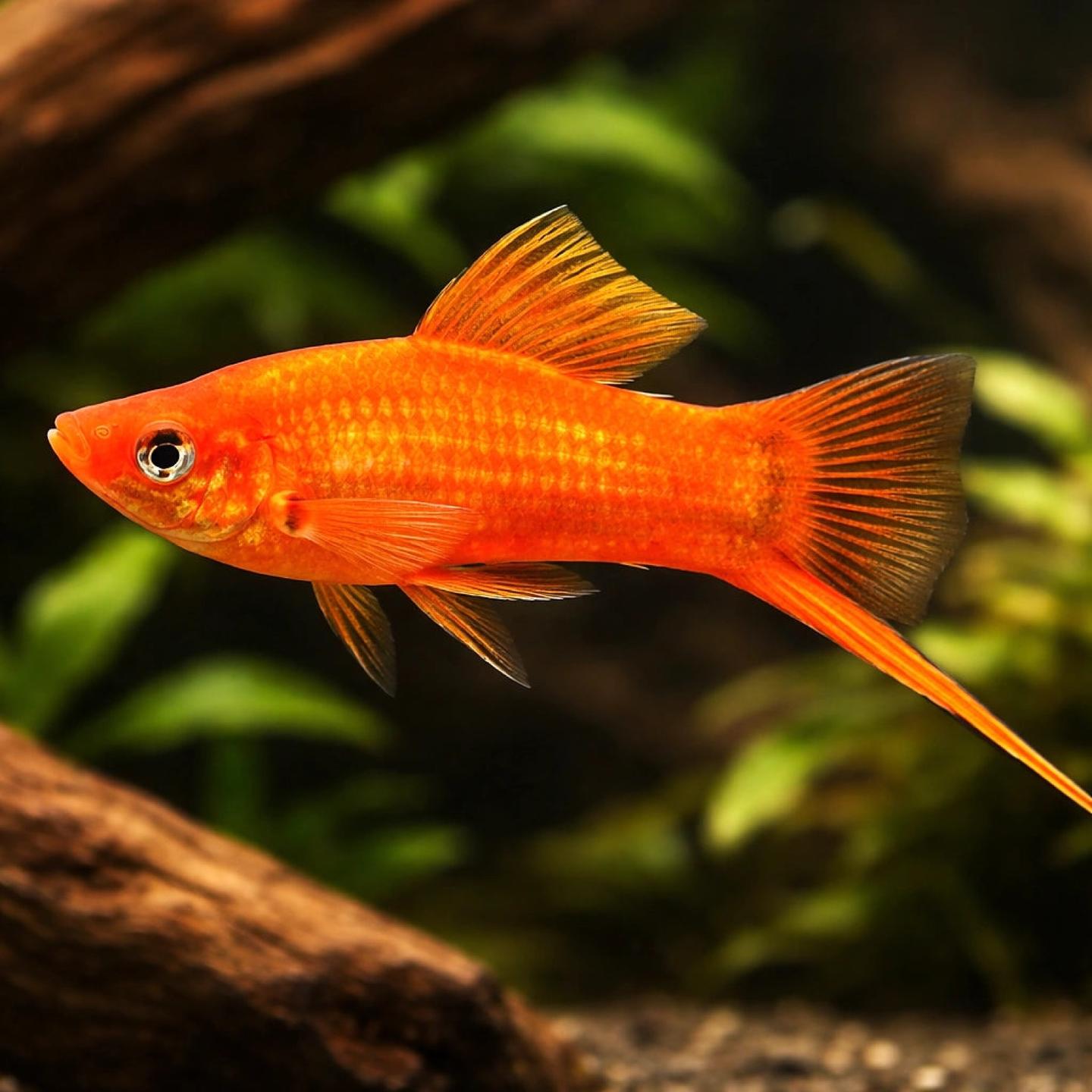
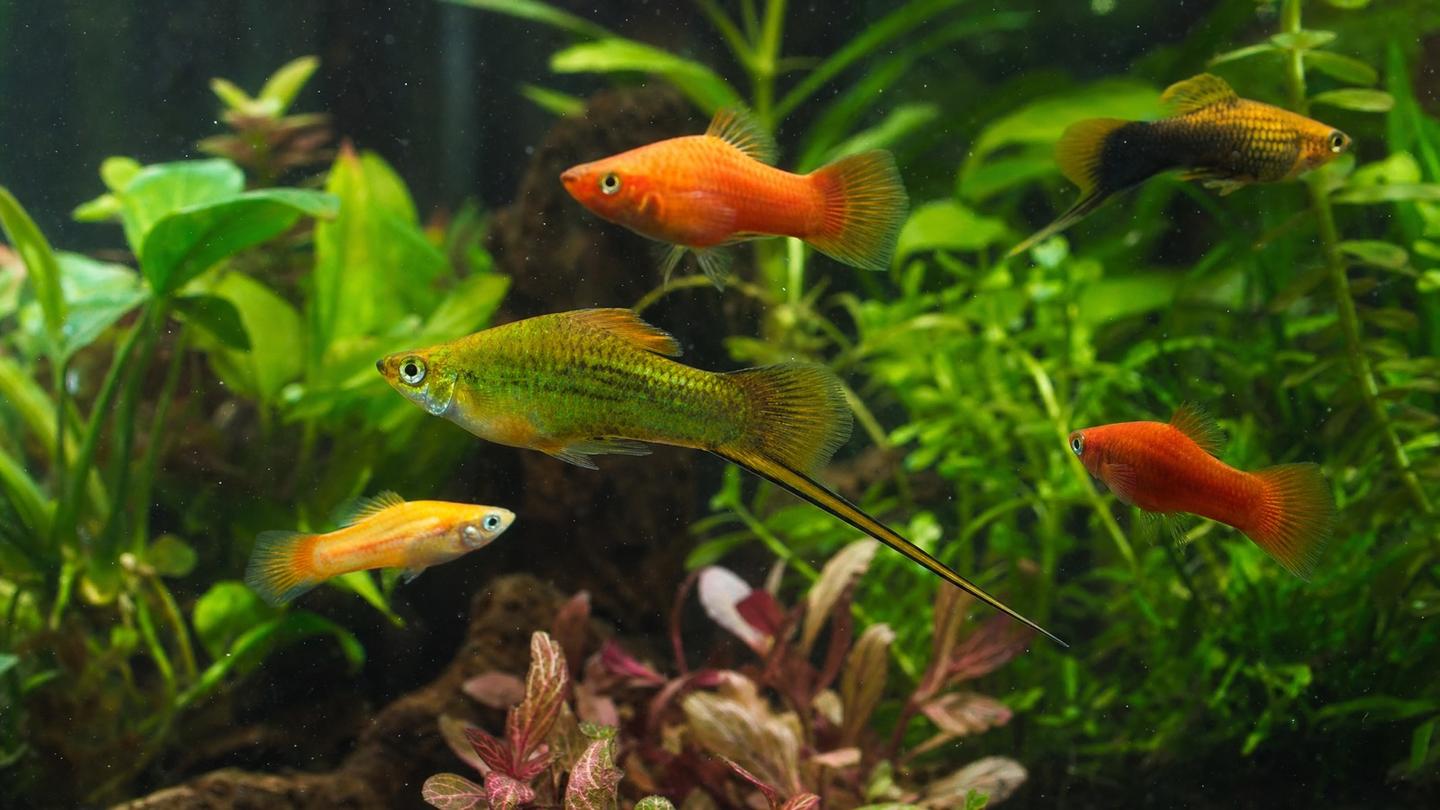
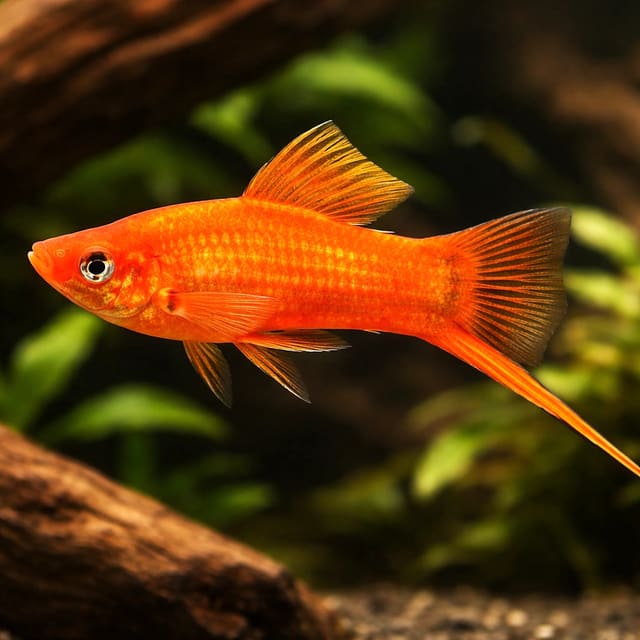
The classic Red swordtail (Xiphophorus hellerii) — the strain most people picture when they hear "swordtail". Photo: Tropical Fish Co warehouse.
Swordtails ship well — they're robust, hard-water fish — but two species-specific things matter on arrival: they're sensitive to a sharp water-chemistry change, and they'll bolt the moment the bag opens [7].
Swordtails evolved in hard, mineral-rich Central American streams, so most British tap water suits them with nothing more than a dechlorinator. Thames Water classes all of its supply as hard [6], and the same is true across much of England — the very thing soft-water keepers fight is exactly what a swordtail wants. No remineralising, no buffering, no fuss.
Live arrival guarantee: if a fish arrives in poor condition, photograph the unopened bag within two hours and we'll refund or replace at our cost.
Healthy swordtails advertise their condition before you commit. Whether you're buying from us or anywhere else, this is the 30-second check that separates a fish that'll thrive from one that's already struggling:
If you're stocking a new tank, add the female group first and let them settle for a week before the male goes in. The females establish the space, and the single male arriving into an established group has far less of a chase reflex than a male and females dropped in together.
One thing retail rarely tells you: the most interesting swordtail lines move through hobbyist hands, not shop tanks. Livebearer keepers are an active, generous bunch in the UK.
If you catch the livebearer bug, a local society is the cheapest route to better genetics — and to people who'll happily talk swordtails for an hour.
If swordtails are your entry into livebearers, the natural next reads are the platy care guide — the smaller, calmer cousin that shares their water — and the molly care guide for the third member of the hard-water community trio.
Comparing them with the most popular livebearer of all? Our guppy care guide covers social groups, breeding control and hard-water care for the fish swordtails are most often kept alongside.
Already know you want swordtails? The full in-stock range lives on the livebearers hub, and the wider tropical fish for sale page is the place to build the rest of the community around them.
Visual route into the rest of our UK live-fish range.
Material factual claims cite the sources below; store policy and cautious inference are labelled in the article. Sources are grouped by type so you can judge their weight at a glance.
The 'pre-existing bias' study — females preferred swords even in a swordless relative, cited in Fun Facts.
In five tests females preferred males with longer swords — used in the sword-function discussion.
Source for maximum size (males 14 cm, females 16 cm TL), water-parameter ranges, native range and diet.
Independent cross-check on sword anatomy, male dominance hierarchies and recommended tank footprint.
UK-specific husbandry — swordtails dislike 'old' water, need swimming space and a large enough group to diffuse male aggression.
UK fishkeeping clubs directory — livebearer keepers trade strains through regional societies.
A practical walk-through of a 20-gallon swordtail set-up with eight fish — referenced in the acclimation section.
Used in the 'UK hard water is ideal for swordtails' argument — all Thames-region water is classified hard.
Fishkeeping moves fast and we want every guide spot-on. If you think something here is wrong, out of date, or could be clearer, tell us — our team reads every message and updates the page.
Suggest an editMolly fish care for UK keepers: compare common and sailfin types, tank sizes, temperature, hard-water needs, groups, feeding and tank mates.
Platy fish care for UK keepers: compare platy types, tank size, temperature, water, lifespan, groups, male vs female, pregnancy and tank mates.
Evidence-checked guppy care for UK aquariums: tank size, social and sex planning, water, feeding, tank mates, health, breeding and buying.

Planted-Tank Photographer & Writer · 10+ years in the hobby
Hannah is a Cambridge-based aquarium photographer and writer whose planted-tank work has appeared in Practical Fishkeeping and the ADA Aqua Journal digital edition. She writes Tropical Fish Co's deep species guides on schooling tetras and planted-tank communities — always accompanied by her own photography, never stock imagery.