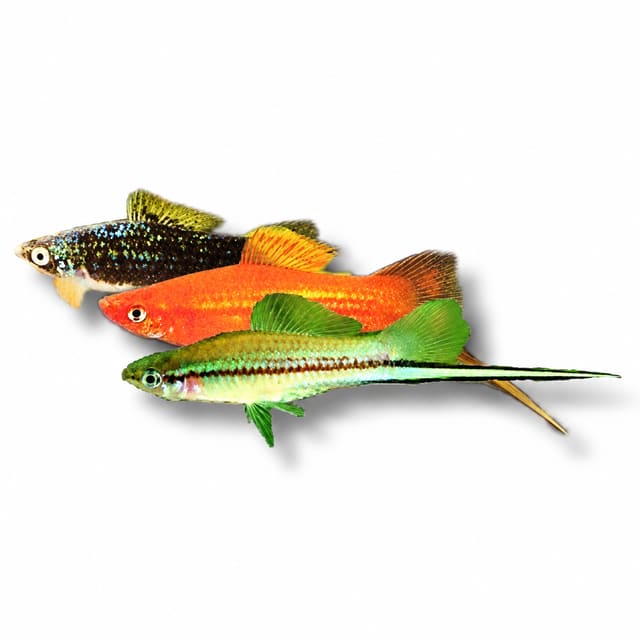
Easy
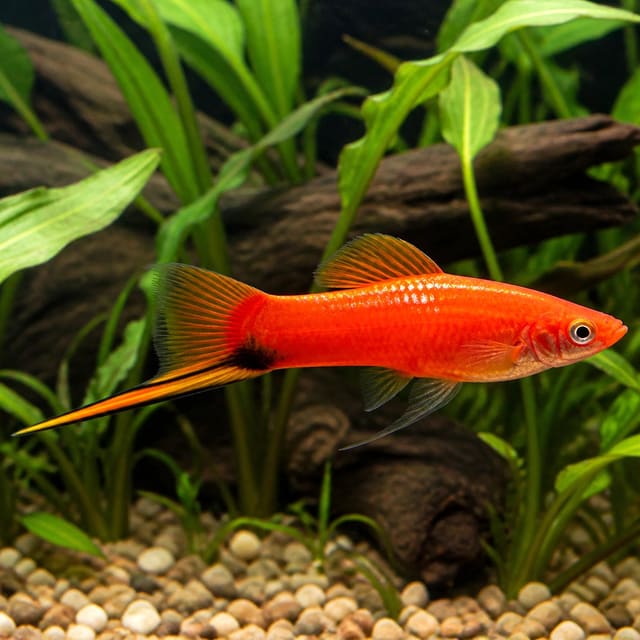
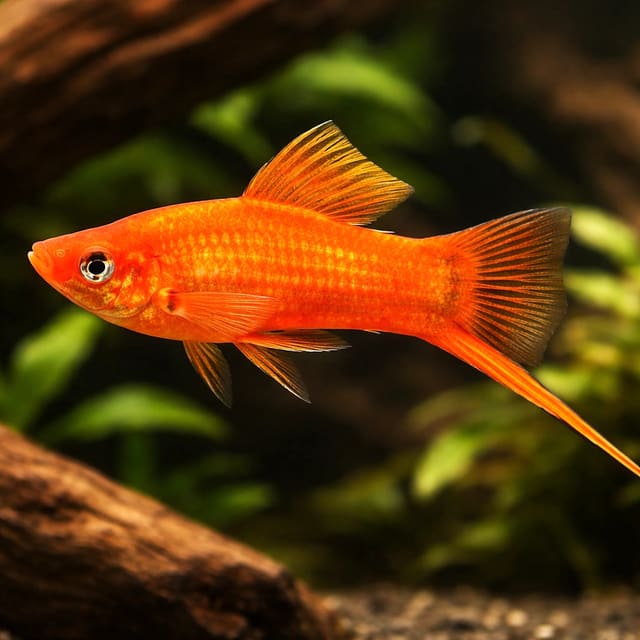
Swordtail Red (Xiphophorus helleri red)
22–27°C · pH 7–8 · 108L
£3.99
Swordtail Lyra Assorted Colours (Xiphophorus hellerii) is an active ornamental livebearer supplied as one fish in the selected 4–5 cm or XL grade. Plan a mature 120 × 30 cm aquarium, neutral-to-alkaline mineral-rich water and a carefully managed group.
Adult size is the maximum length this species reaches at full maturity (scientific sources). The livestock you receive will be younger and smaller — pick a size above for the actual shipping size. Product-photo provenance and any image-specific limitations are stated on the listing.
Xiphophorus hellerii
Shoaling fish: kept in a group they feel safer, stay calmer and show their best colour.
Swordtail Lyra Assorted Colours (Xiphophorus hellerii) is an active ornamental livebearer supplied as one fish in the selected 4–5 cm or XL grade. Plan a mature 120 × 30 cm aquarium, neutral-to-alkaline mineral-rich water and a carefully managed group.
Adult size is the maximum length this species reaches at full maturity (scientific sources). The livestock you receive will be younger and smaller — pick a size above for the actual shipping size. Product-photo provenance and any image-specific limitations are stated on the listing.
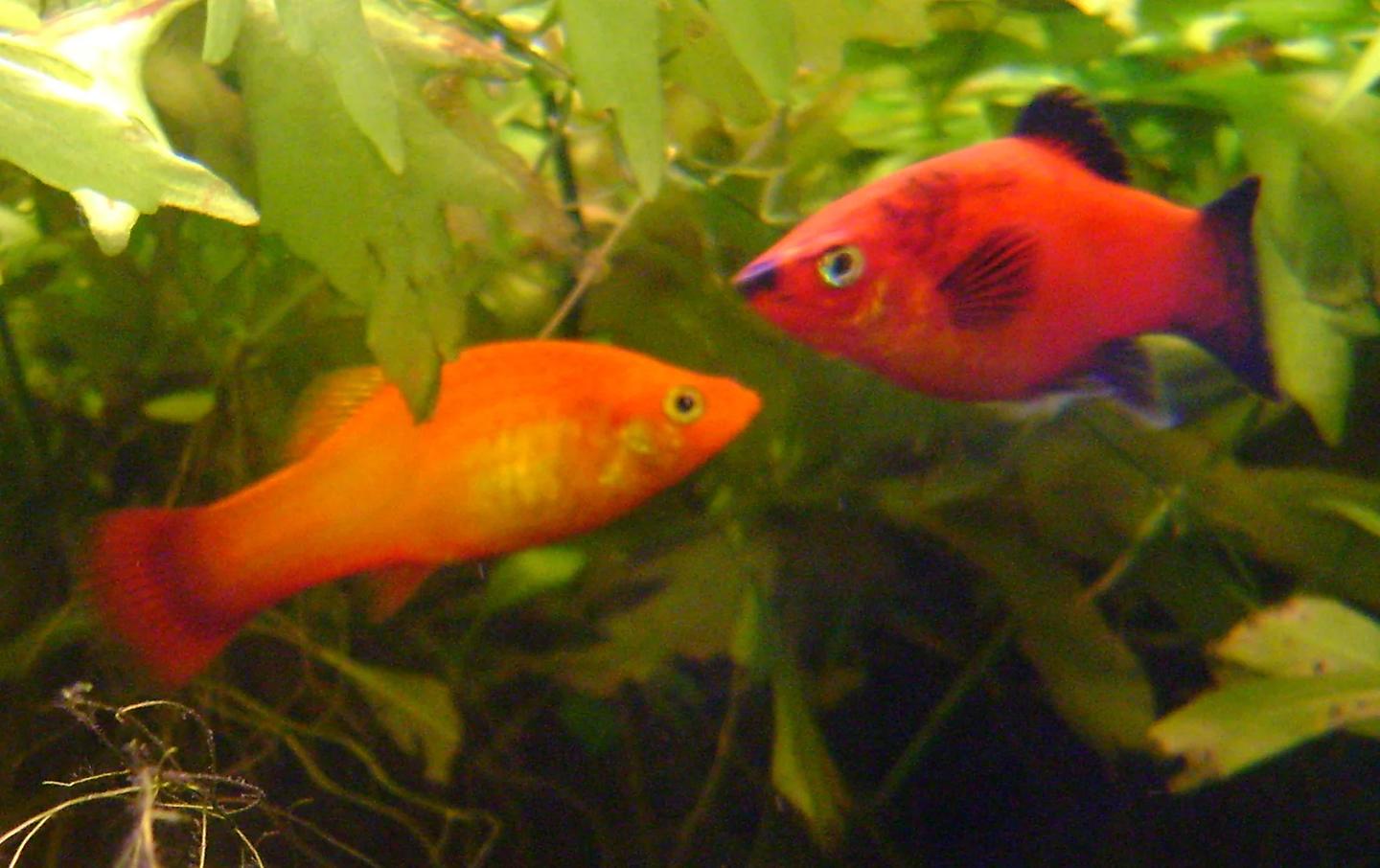
Platy is a trade name used for Xiphophorus maculatus, X. variatus and domestic forms. Start with at least three in a mature aquarium of at least 45 litres, verify the exact fish and measured water, and plan extra capacity before mixing sexes.
Maintain these water conditions for optimal health and vibrant colors
Swordtail Lyra Assorted Colours is an ornamental form associated with Xiphophorus hellerii, the green swordtail. This listing supplies one live fish per purchase, in the size chosen at the time of ordering. The catalogue grades are 4–5 cm and XL. The size you select is the size supplied, not the adult size. Those labels describe dispatch grade: they should not be used as a prediction of the fish's final length.
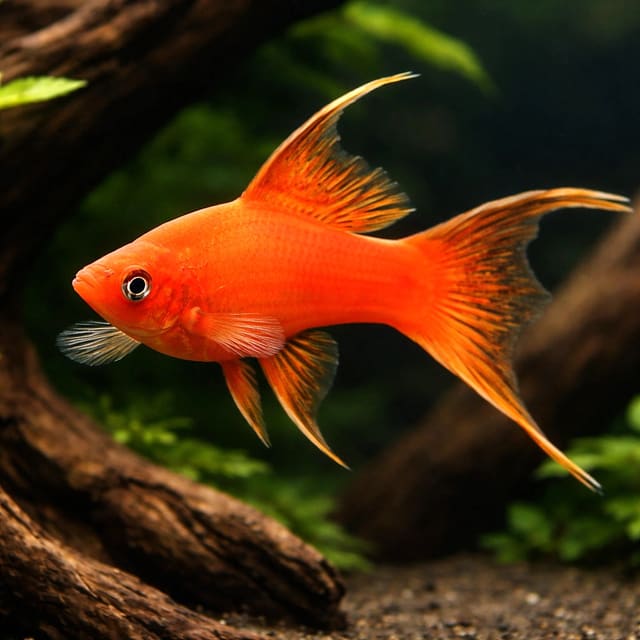
"Assorted colours" is a useful, literal part of the offer. It means colour and pattern can vary; it does not promise a particular red, orange, green, black or mixed pattern. "Lyra" refers to the ornamental fin form. Selective breeding has produced many swordtail colours and fin shapes, and published species notes also explain that some ornamental forms involve crosses with other Xiphophorus. It is therefore more honest to buy this fish for the general lyretail look and the character of a lively swordtail than for a guaranteed shade or a claimed pure strain.
This is an active livebearer for a properly matured, roomy aquarium. It is often approachable for a newer keeper, but the long swimming footprint, preference for mineral-rich water and social management matter more than the simple label "beginner fish". The strongest starting point is a tank with a base of at least 120 × 30 cm, roughly 108 litres, stable filtration, planted shelter and open swimming room. A small decorative tank is a poor fit even when the fish supplied is only 4–5 cm.
| Suits | Think carefully if |
|---|---|
| You have a mature aquarium with a 120 × 30 cm or larger base | Your aquarium is short, newly set up or lightly filtered |
| Your water is neutral to alkaline and has useful mineral content | Your water is very soft and acidic and you do not intend to adjust stocking choices |
| You want an energetic livebearer for a robust peaceful community | Your present fish are shy, slow at meals or easily unsettled by bustling tank mates |
| You can plan a social group and watch how males interact | You need a guaranteed male, female or exact colour from this unsexed assorted offer |
The accepted species name used here is Xiphophorus hellerii. The supplier spelling Xiphophorus helleri is a commonly encountered synonym or misspelling, while "mixture lyra" is trade wording for the assorted ornamental form rather than part of the scientific name. FishBase gives the species in the family Poeciliidae and records a maximum length of 14 cm total length. A specialist aquarium profile also lists 140 mm standard length. Standard length and total length do not include exactly the same parts of a fish, so 14 cm is best treated as a conservative planning figure, not a promise that every individual will reach precisely that size.
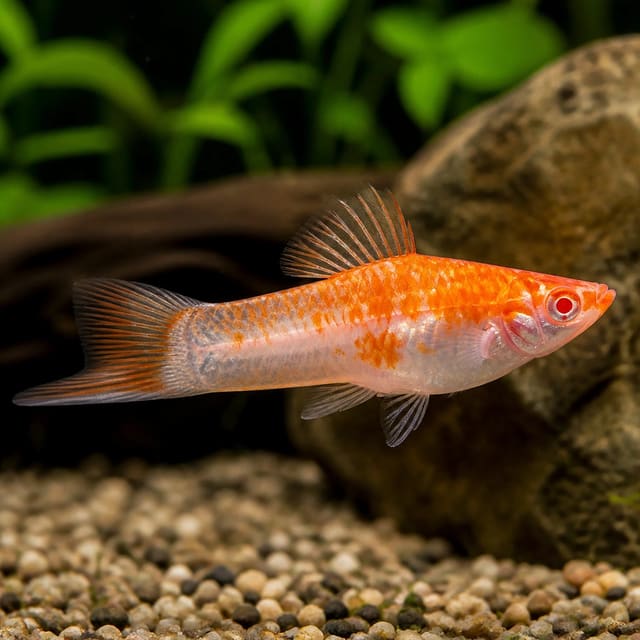
Adult males of the species normally have a gonopodium and the familiar extension of the lower tail lobe. Ornamental strains can also carry extended upper tail lobes or other long fins, and the specialist profile notes that such extensions can occur in females too. Fin shape or colour in a single photograph is therefore not a sound basis for promising sex. Sex is guaranteed only when the selected option explicitly states male or female. This Swordtail Lyra Assorted Colours listing has no sex-guaranteed option.
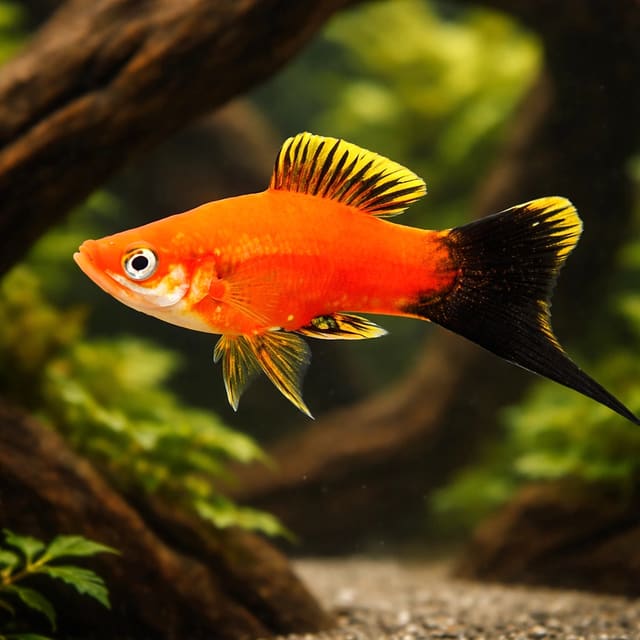
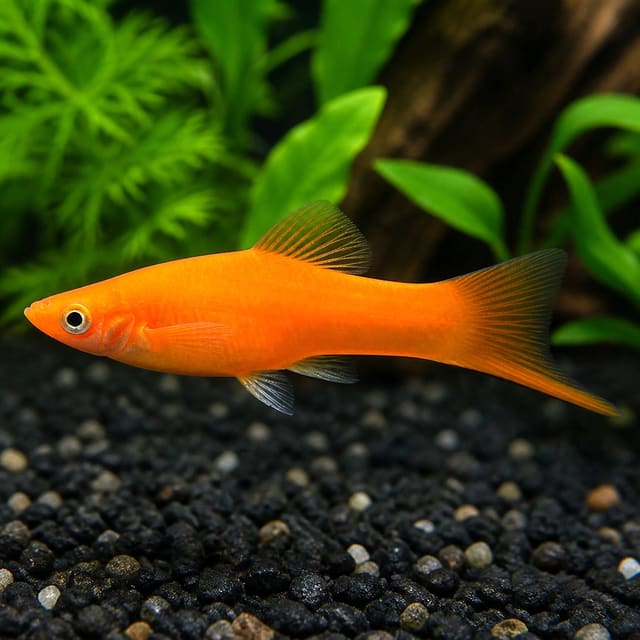
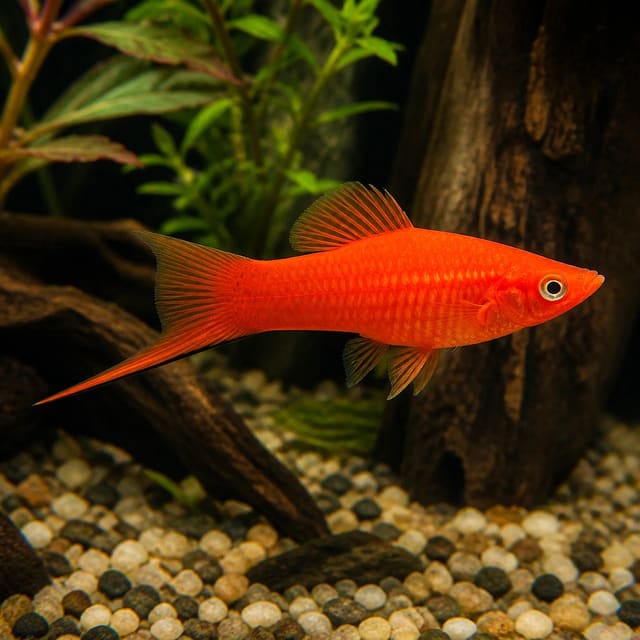
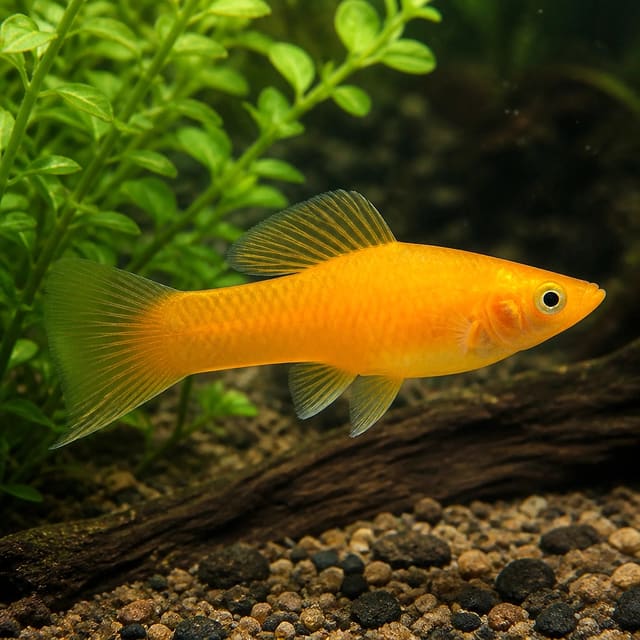
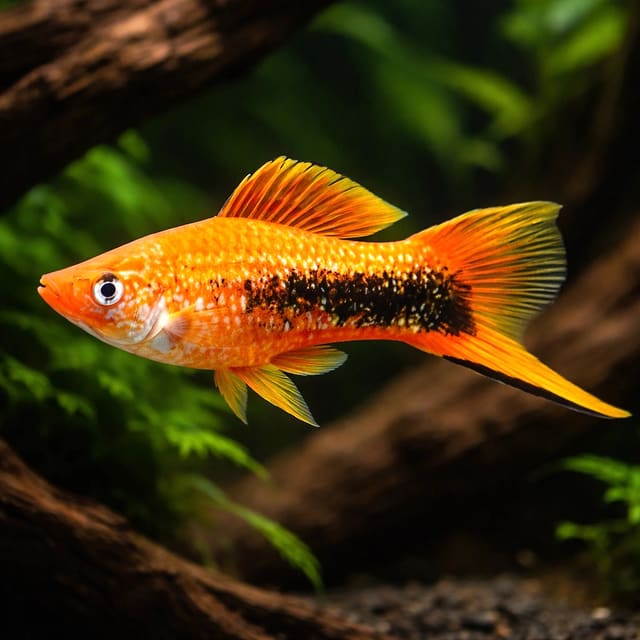
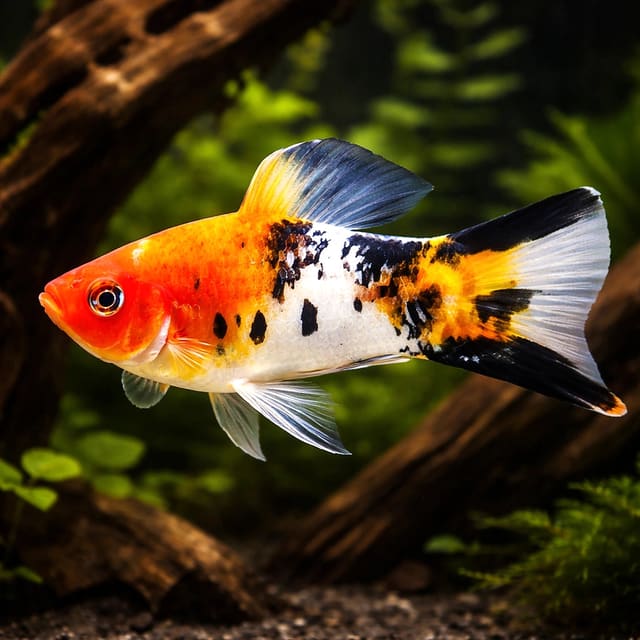
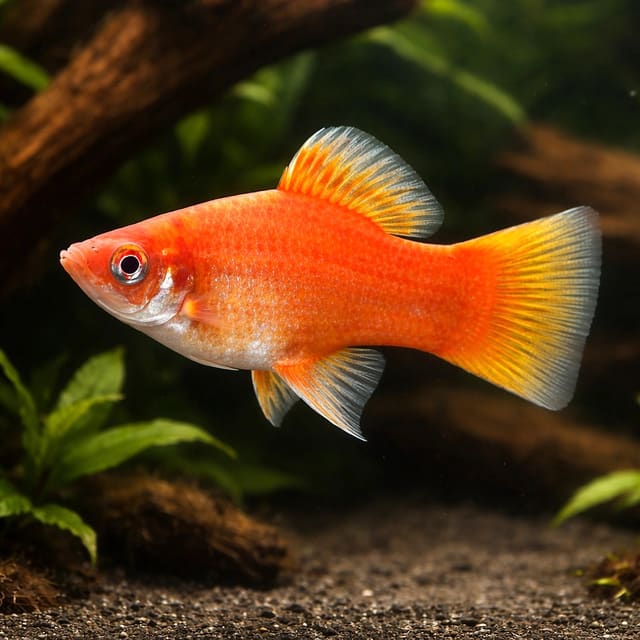
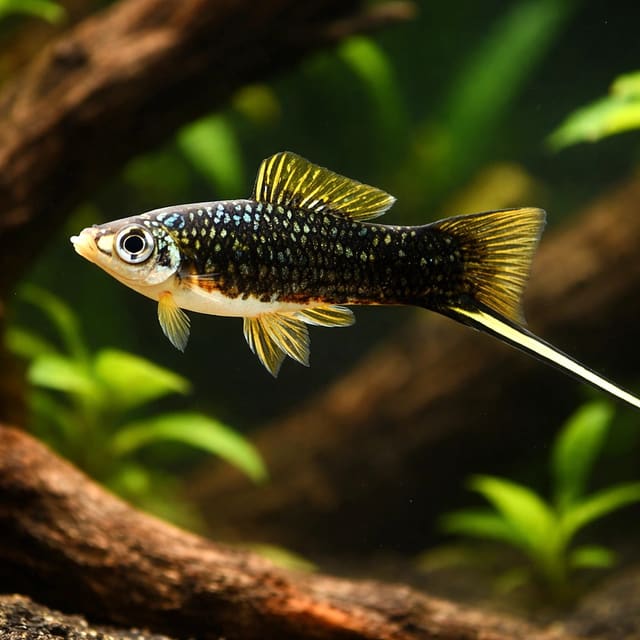
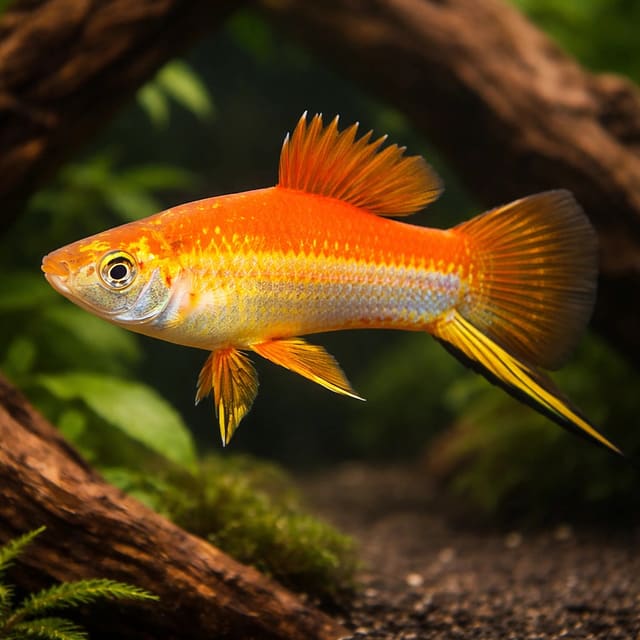
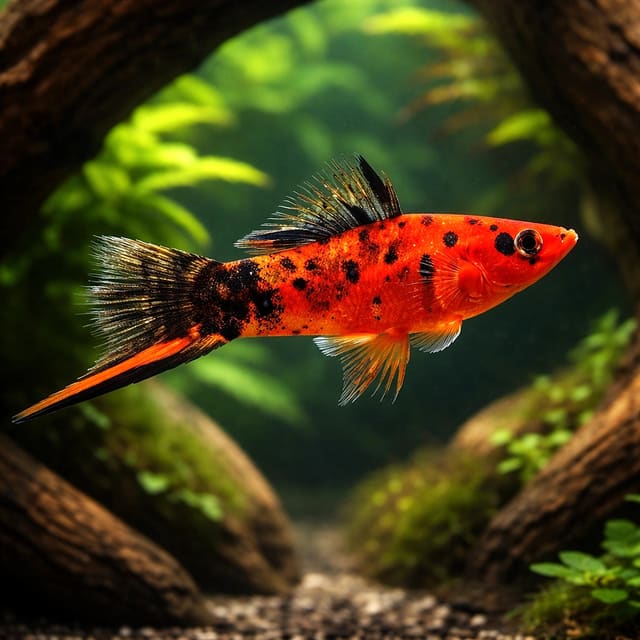
The gallery shows an orange-and-dark swordtail-shaped fish in a planted aquarium, with elongated upper and lower tail rays visible. The image is useful for understanding the general lyretail silhouette, but the assorted offer means the animal supplied can differ in colour, pattern, size and maturity. Gallery images have been digitally enhanced to improve image quality. Natural colour, pattern, size and maturity can vary between live animals.
Swordtails are commonly recommended for neutral to alkaline, moderately mineralised water. The species aquarium profile gives pH 7.0–8.0 and 10–25 dGH. UK trade-body guidance for platies and swordtails gives a narrower routine temperature of 22–27 °C for swordtails and pH 7.0–8.0; that temperature is broad group guidance rather than a unique optimum for this colour form. If you do not know your tap-water profile, use the water chemistry guide to understand the readings, then compare your measured values with the care range using the water matcher.
Choose this fish because your aquarium can meet its adult needs, not because the supplied juvenile fits today. When those conditions line up, the reward is a colourful, mobile fish that brings movement to the middle and upper areas of a planted community. Keep reading for the practical tank, feeding and social plan before adding it.
The specialist species profile recommends a base of 120 × 30 cm, or an equivalent footprint, and estimates about 108 litres as the smallest aquarium to consider. That footprint is especially useful for an active swordtail because it provides a long route for normal swimming and space for fish to move away from one another. Volume alone can mislead: a tall, narrow aquarium may hold a similar number of litres without providing the same horizontal room.
Use 108 litres and the 120 × 30 cm base as the starting minimum for this species, then increase space for a larger group or a busy community. Do not calculate capacity from body length alone. Décor, the number and adult size of tank mates, filter performance and the amount of open water all affect what the aquarium can support. A well-planned larger tank also changes temperature and water chemistry more slowly, which makes routine care more forgiving.
If this is your first aquarium, prepare it before ordering livestock. The first tropical tank guide explains maturation, equipment and the role of beneficial bacteria. A clear tank can still be biologically immature. Fish release ammonia, and a working biological filter houses bacteria that convert ammonia to nitrite and then nitrate. Ammonia and nitrite are toxic, so both should read zero before the swordtail is introduced.
Swordtails do not demand a specialised aquascape, but the species profile says they look particularly good in a heavily planted aquarium with a dark substrate. Plants around the back and sides can create shelter and visual separation while leaving a generous open route across the front or centre. Floating plants and driftwood roots or branches can diffuse overhead light and make the layout feel less exposed without filling every swimming lane.
Wild green swordtails occur in flowing streams and rivers as well as warm springs, weedy canals and ponds. That variety is a useful reminder not to turn one habitat detail into a rigid decorative recipe for this ornamental fish. Water-worn rocks and small boulders can suit a stream-inspired display, while a planted community is equally practical. What matters is a stable, clean aquarium with both cover and unobstructed movement.
The same profile says especially strong filtration is unnecessary, although the species appreciates some water movement. Size the filter for the actual tank and stocking rather than chasing a dramatic current. Ensure the whole aquarium receives circulation, avoid leaving stagnant pockets behind dense décor, and keep the intake safe for the smallest residents. A filter is essential; plants complement biological filtration but do not replace it.
For routine home care, 22–27 °C is a practical UK swordtail-group range. The species profile publishes a wider 16–28 °C range, but the ends of a broad range are not a reason to let a community aquarium swing between them. Choose a stable point within the routine range that also suits the other residents, and check it with a thermometer. Stability and a correctly functioning heater are more useful than repeatedly adjusting the thermostat to chase a nominal perfect number.
Aim for pH 7.0–8.0. The species profile gives 10–25 dGH, while FishBase records wild environmental values of 9–19 dH and the OATA group sheet gives softer broad guidance. These figures arise from different scopes. For this listing, the species aquarium profile provides the clearest planning range: neutral-to-alkaline water with appreciable mineral hardness. Test the water that actually enters the tank rather than assuming every UK tap supply is hard.
Do not make abrupt pH or hardness changes around livestock. If your tap water falls far outside the range, it is usually more dependable to choose fish suited to that water than to rely on constant correction. If you already manage remineralised or blended water, measure each batch consistently. Any change should be gradual, repeatable and checked, because a numerically correct reading reached through instability is not good husbandry.
| Planning value | How to use it |
|---|---|
| 22–27 °C | Broad UK swordtail guidance for routine aquarium care; keep the chosen temperature stable |
| pH 7.0–8.0 | Supported by both the species profile and the UK group sheet |
| 10–25 dGH | Species-profile hardness range; measure your source water before stocking |
| Ammonia 0 mg/l; nitrite 0 mg/l | Essential checks for a mature, functioning biological filter |
| Nitrate no more than 20 mg/l above tap-water level | OATA group guidance; compare tank and source-water readings rather than viewing one number alone |
Test the aquarium regularly, especially after adding fish, increasing food or changing filter equipment. Rising ammonia or nitrite calls for immediate investigation of stocking, feeding and filtration. Nitrate trends help show whether the maintenance routine is keeping pace with waste. Look at results over time; a notebook or simple phone log makes gradual drift much easier to spot.
OATA strongly recommends a partial water change of 25% at least once every week for platies and swordtails. Treat replacement tap water with a suitable conditioner before it enters the aquarium. Try to match its temperature reasonably closely and add it without disturbing the fish. Siphoning exposed substrate during the change removes trapped debris, but planted areas can be handled gently so roots and useful micro-life are not repeatedly disrupted.
Check the filter for reduced flow and blockages. When media needs cleaning, rinse it lightly in water removed from the aquarium and do not run it under the tap. This protects the beneficial bacterial community from chlorine or chloramine. If flow falls again quickly, investigate clogged pre-filters, excessive feeding or overstocking rather than simply washing the media more aggressively.
Watch the fish as part of maintenance. Clear eyes, intact fins, steady breathing, normal appetite and confident swimming give a useful baseline. A sudden change in colour, breathing, position in the water, feeding or social behaviour deserves attention. Start with water tests and recent husbandry changes. General warning signs can have many causes, so diagnosis and treatment should be based on the actual problem rather than a routine medication added on guesswork.
FishBase describes wild Xiphophorus hellerii eating worms, crustaceans, insects and plant matter. The species aquarium profile calls it a generalised omnivore and recommends good-quality dried food together with small live or frozen foods such as daphnia, Artemia and chironomid larvae. The OATA sheet adds that flake or granules with a high algae content can form a useful part of a platy or swordtail diet.
Build variety across the week rather than offering a large collection at every meal. A well-sized quality flake or small granule can be the regular base; rotate suitable frozen or live items in modest portions. Some vegetable or algae content reflects the plant material recorded in the natural diet. Match particle size to the mouth of the fish supplied, and make sure food reaches quieter individuals rather than letting the fastest fish take everything at the surface.
The UK group sheet advises feeding once a day and only what the fish can eat within a few minutes. That is a practical starting routine, not an invitation to keep adding food while one dominant fish continues to feed. Uneaten food decomposes, burdens the filter and can raise toxic waste. Observe body condition over time, adjust portions to the whole group and remove food that is clearly not being eaten.
OATA advises keeping at least three platies or swordtails and, where both sexes are present, using two females to each male to reduce stress from persistent attention. This assorted listing does not let the buyer choose sex, so do not assume that ordering three guarantees that ratio. The sensible approach is to plan enough space for a group, identify sex only when the fish mature sufficiently for reliable assessment, then manage the group you actually have.
Seriously Fish notes that males can form dominance hierarchies in confined spaces and spend considerable time maintaining position. A long tank, planted partitions and more than one route through the décor help fish disengage. Space does not turn incompatible personalities into a perfect group, but it reduces forced contact. Watch for repeated chasing that prevents a fish from feeding or resting; that is different from a brief display followed by separation.
Because swordtails are livebearers and females can store viable sperm for months, mixed-sex groups may produce young even when a new male is not obvious in the tank. That fact belongs in stocking plans: leave capacity rather than filling the aquarium to its limit on day one. The exact genetics and breeding performance of this assorted lyretail offer are not promised, so it should be kept primarily as a display and community fish, with any reproduction managed responsibly.
A dispatch grade is only the starting point. Sketch the adult stocking plan before adding the fish: one swordtail can reach the 14 cm planning figure, a social group needs room to spread out, and every companion adds waste as well as visual activity. Keep some capacity in reserve for growth and for the possibility of livebearer young. This gives the filter and keeper more margin than a plan that fills every litre immediately.
Think in three layers. First, check the fixed limits: tank footprint, mature filtration and source-water chemistry. Second, arrange the habitat so plants and branches form several loose zones while the front or centre stays open. Third, watch the actual fish and adjust feeding points or group composition if one individual monopolises food or space. This sequence turns a list of specifications into decisions that can be checked in the aquarium.
The supplied 4–5 cm fish may appear modest beside a 120 cm tank, but choosing the adult tank at the outset avoids a disruptive move later. An XL grade is still not an adult-size definition. Body growth, extended fins and normal swimming all need clearance, and the other residents will also mature. If a future move is unavoidable, prepare and mature the larger aquarium before the existing one becomes crowded.
Pair the weekly 25% water change with a short repeatable inspection. Record temperature, pH when relevant, ammonia, nitrite and nitrate; look along the tank for even flow; check the filter intake; and compare each fish's breathing, appetite, fins and swimming with its normal pattern. Consistency makes small changes visible. A single test result is less informative than a trend linked to feeding, maintenance and new livestock.
Use the same session to review social pressure. Count that every fish comes forward to eat, note whether a chase ends quickly, and look for an individual staying behind plants throughout the day. A fish that repeatedly misses food needs action before it loses condition. Spreading a measured ration across more than one point can help, but persistent pursuit may require a change to stocking rather than extra food.
After the water change, confirm that the heater and filter have restarted and that no intake or outlet has been obstructed. Recheck the aquarium later rather than assuming the job is finished when the new water goes in. Simple, regular checks protect the stable conditions swordtails need and reduce the temptation to make large reactive changes after a problem has developed.
Reassess the plan as the fish grow. An aquarium that felt open around a newly supplied fish can become visually crowded once the swordtail and its companions reach adult proportions. Preserve a clear swimming lane, keep plant growth from closing every route, and compare filter performance with the increasing biological load. This is routine planning rather than a reason to delay normal maintenance until the tank looks crowded.
Before the parcel arrives, check temperature, ammonia and nitrite, and make sure the planned aquarium is ready. Read the current delivery and Live Arrival Guarantee policy in full. Someone must be at the delivery address, and the parcel should be opened and inspected on the day it arrives.
Once introduced, keep the environment steady and observe breathing, swimming and interactions. Offer an appropriate small meal according to the normal routine rather than compensating for travel with a large feed. Recheck water quality after the addition because the filter now has a greater waste load. Add further livestock gradually so the biological filter can adapt.
Swordtails are generally peaceful, but peaceful does not mean passive. OATA warns that large swordtails can be boisterous and may chase timid tank mates, while the species profile notes rivalry among males in confined quarters. Choose companions that are peaceful, similarly sized, confident enough to feed alongside active livebearers and comfortable in the same neutral-to-alkaline, mineral-rich water.
Start with environmental compatibility. A fish that prefers soft, acidic water is not a sensible companion merely because both species are described as peaceful. Compare adult length, activity, feeding speed, preferred temperature, pH and hardness. Then consider space: a combination that works in a long, lightly stocked aquarium can become stressful in a cramped tank with no visual separation.
| Situation | Decision |
|---|---|
| Peaceful, similarly sized community fish with overlapping water needs | A reasonable starting category, followed by species-by-species checks |
| Timid fish or slow feeders | Use caution; an active swordtail group can dominate space and meals |
| Several male swordtails in a short or crowded aquarium | Use caution because dominance behaviour can become persistent |
| Fish requiring distinctly soft, acidic water | Choose a different combination because the basic water plan conflicts |
| Predatory or strongly aggressive fish | Avoid combining them with these community livebearers |
Do not treat the two alternative swordtail listings shown elsewhere on the page as automatic tank mates. They are shopping alternatives, not a stocking recommendation. Combining several swordtail colour forms may also increase the number of males or livebearer young, so adult capacity and sex balance still govern the decision.
Brief displays or short chases can occur as fish establish position. Concern rises when the same individual is repeatedly cornered, cannot reach food, clamps its fins, hides continuously or shows altered breathing. Check water quality and the whole stocking arrangement before attributing every problem to temperament. Poor water, insufficient room and visual exposure can all intensify social pressure.
Plants and branching décor can break direct lines across the tank, but retain an open swimming route. Feed in a way that lets more than one fish access food, and observe rather than relying on a generic compatibility chart. If one individual remains persistently harassed, changing group composition or moving fish may be kinder than repeatedly rearranging decorations.
For other livebearer forms, browse the livebearers collection. Use each product's adult care needs to decide whether it is an alternative purchase or a possible companion; similarity in shop category alone is not enough.
FishBase records Xiphophorus hellerii at up to 14 cm total length, while a specialist aquarium profile lists 140 mm standard length. Plan around 14 cm as a conservative adult figure and remember that the supplied 4–5 cm or XL grade is a dispatch size, not an adult-size promise.
Use an aquarium with a base of at least 120 × 30 cm, roughly 108 litres, for Xiphophorus hellerii. A longer footprint provides swimming room and separation space; increase capacity for a larger group or additional community fish.
Broad UK guidance for platies and swordtails suggests at least three, with two females to each male where both sexes are present. This assorted offer is not sex-guaranteed, so assess the group you actually receive and leave room to adjust it as the fish mature.
Swordtails can suit an informed beginner who has a fully matured, filtered aquarium and compatible tap water. The key challenges are providing a 120 × 30 cm footprint, keeping stable neutral-to-alkaline mineral-rich water and managing an active social group.
Offer a good-quality flake or small granule, including some algae or vegetable content, and rotate modest live or frozen foods such as daphnia, Artemia or bloodworm. Broad UK guidance advises one daily feed limited to what the fish consume within a few minutes.
Broad UK swordtail guidance gives 22–27 °C for routine care and pH 7.0–8.0. A species aquarium profile gives 10–25 dGH. Keep the chosen temperature stable and test the aquarium rather than relying on an assumed tap-water value.
Swordtails are generally peaceful, but large individuals can be boisterous and males may maintain a dominance order in confined spaces. Provide a long, planted tank and watch for persistent chasing that stops another fish feeding or resting.
Consider peaceful, similarly sized community fish that share neutral-to-alkaline, mineral-rich water and can feed confidently beside active livebearers. Be cautious with timid or slow-feeding fish, and avoid predatory or strongly aggressive companions.
Tropical Fish Co hand-packs live fish in oxygenated bags inside an insulated box, using a heat pack when conditions call for it, and sends them with a licensed live-animal courier. Be present to receive the parcel; for any Live Arrival Guarantee claim, make a continuous unboxing video from sealed parcel to fish still in the sealed bag and contact the team the same day.
Tropical Fish Co delivery and Live Arrival Guarantee — current packing, receipt, acclimatisation and claim steps. The policy is linked once in the care guidance above.
No reviews for this item yet. Bought one? Honest reviews only, good or bad.
What customers say about ordering from us
Easy website plenty of info on fish your buying great to pick a time slot
TRACEY DURRANT · 7 Oct 2026
Got some lovely fish thank you
Kevin Mackie · 7 Oct 2026
Reviews of our shop, collected by Judge.me, an independent third-party review collector. Newest first.