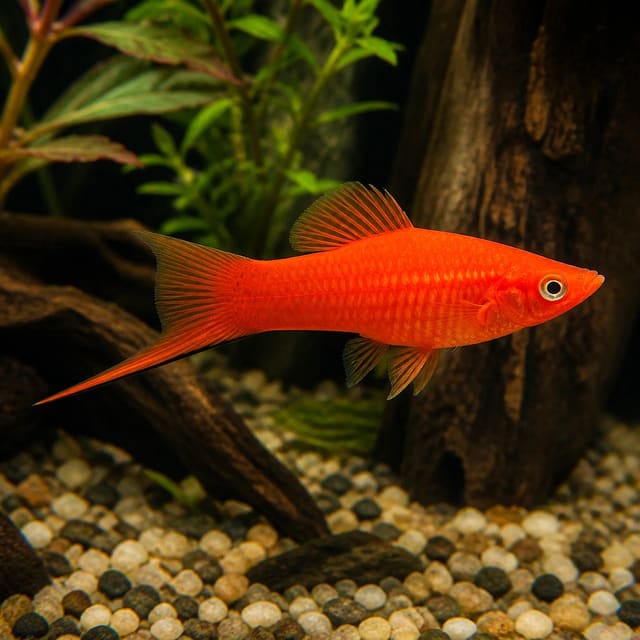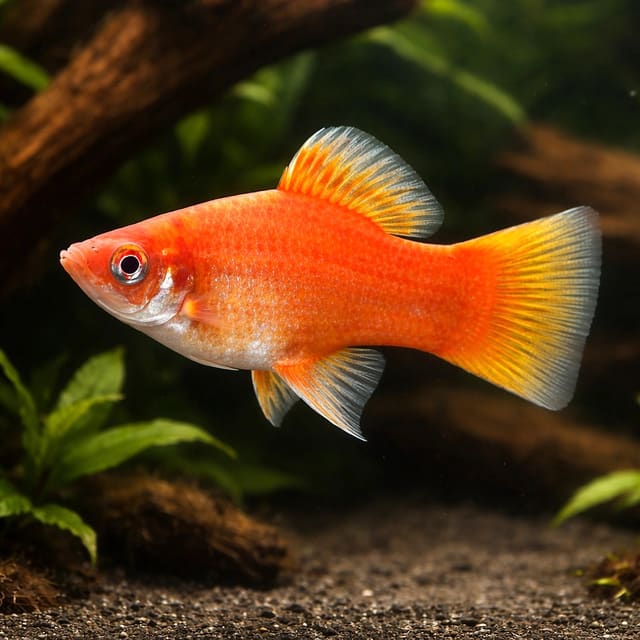
Wien Swordtail (Xiphophorus helleri Wien)
22–27°C · pH 7–8 · 108L
£4.99

One live, unsexed Green Swordtail (Xiphophorus hellerii) in the selected approximate 4-5 cm or 5-6 cm size. An active hard-water livebearer for a mature 100L+ aquarium with about 90 cm swimming length.
Xiphophorus hellerii
Save when buying multiple fish. Each quantity is one fish; sex and pair formation are not guaranteed unless the selected variant explicitly states them.
Minimum of 2 per order.
One live, unsexed Green Swordtail (Xiphophorus hellerii) in the selected approximate 4-5 cm or 5-6 cm size. An active hard-water livebearer for a mature 100L+ aquarium with about 90 cm swimming length.
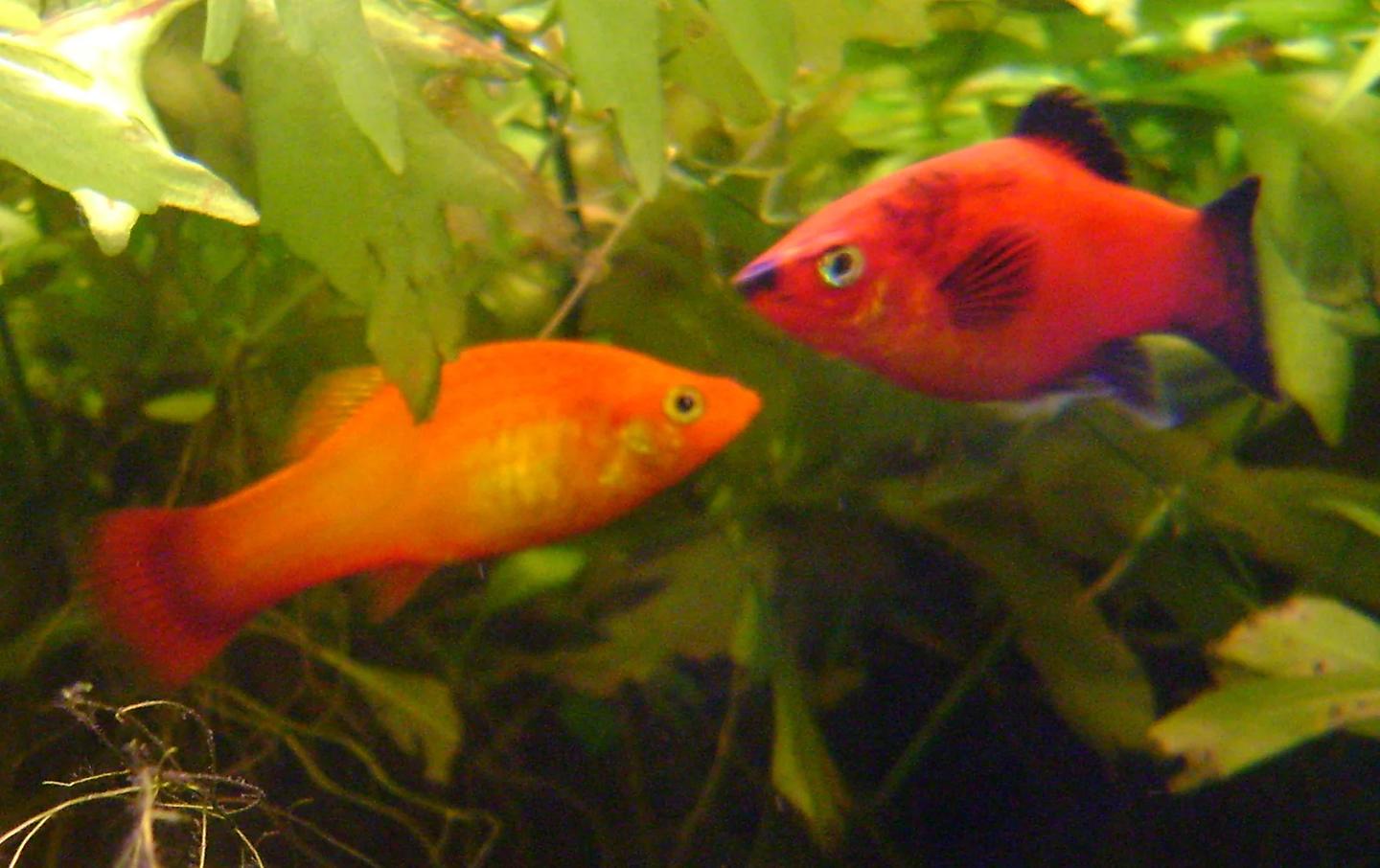
Platy is a trade name used for Xiphophorus maculatus, X. variatus and domestic forms. Start with at least three in a mature aquarium of at least 45 litres, verify the exact fish and measured water, and plan extra capacity before mixing sexes.
Maintain these water conditions for optimal health and vibrant colors
The Green Swordtail (Xiphophorus hellerii) is an active Central American livebearer with an olive-green to metallic body, clear social behaviour and the distinctive lower tail extension developed by mature males. It suits a well-planned hard-water community aquarium with generous swimming length, plant cover and a secure lid. This is a substantial, energetic fish rather than a tiny livebearer for a desktop tank.
This listing is for one unsexed live fish in the size selected. The product has two size options: approximately 4-5 cm and approximately 5-6 cm. Price and availability are shown separately by the live selector, so choose the size that is currently available and appropriate for your existing stock. Sex, exact shade, fin development and the length of a male's sword cannot be guaranteed at these juvenile sizes.
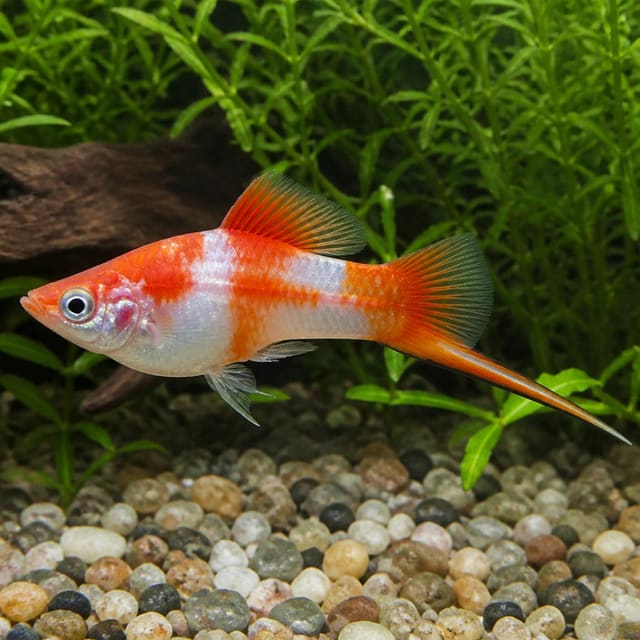
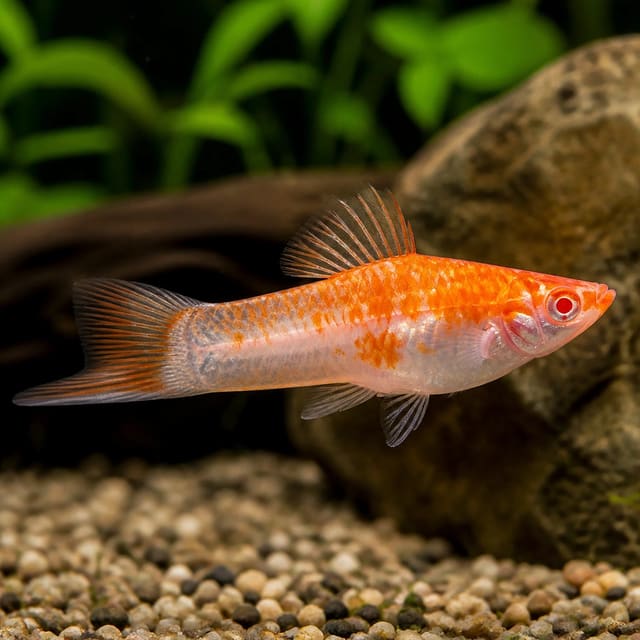
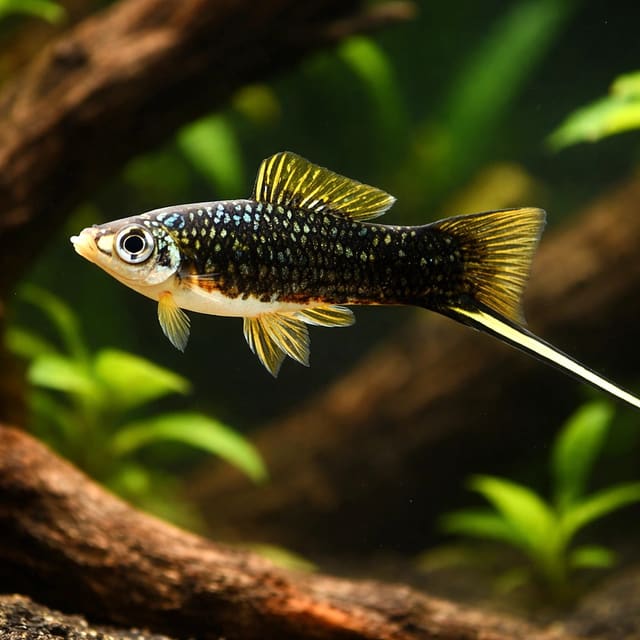
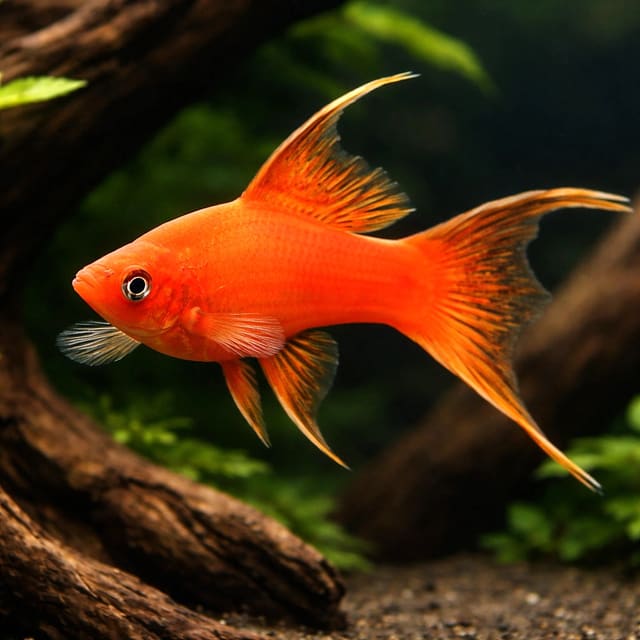
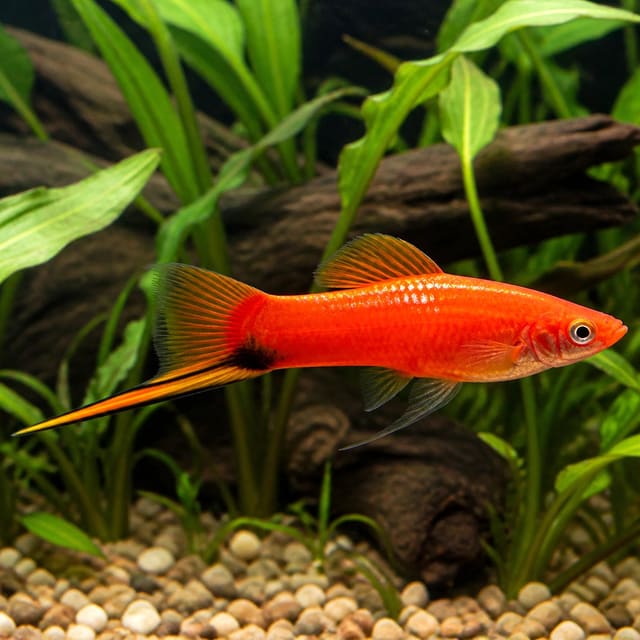
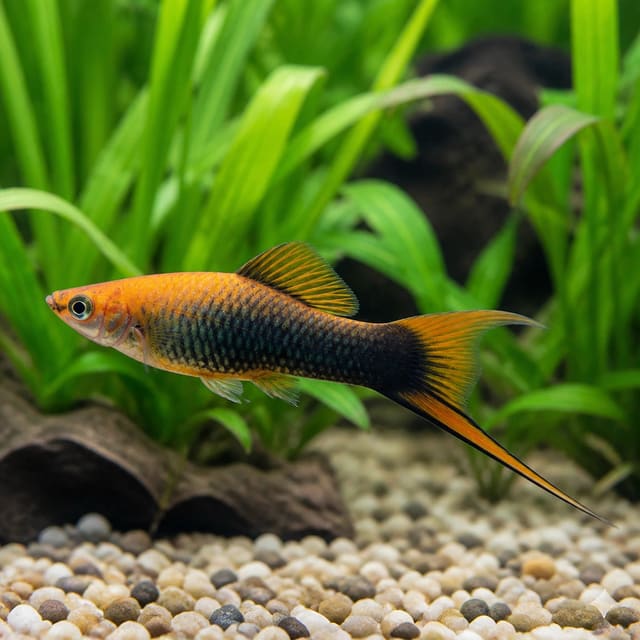
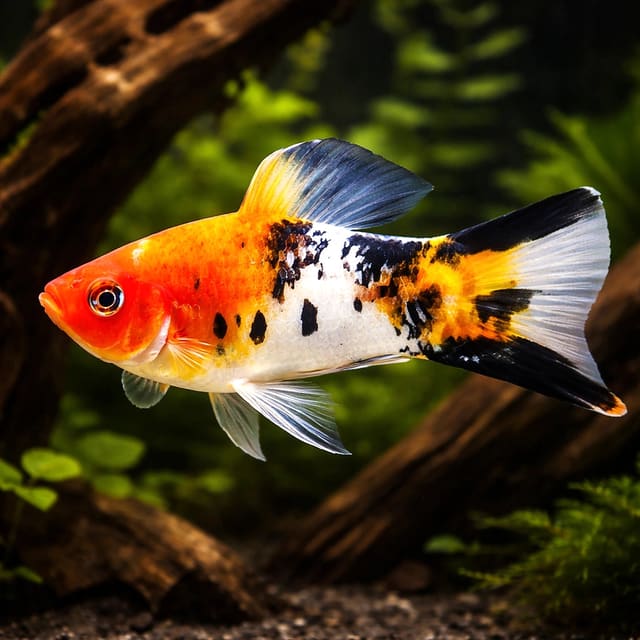
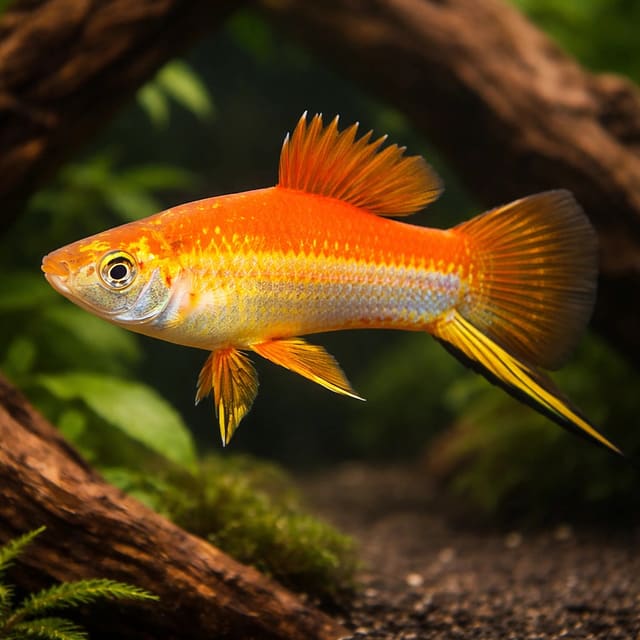
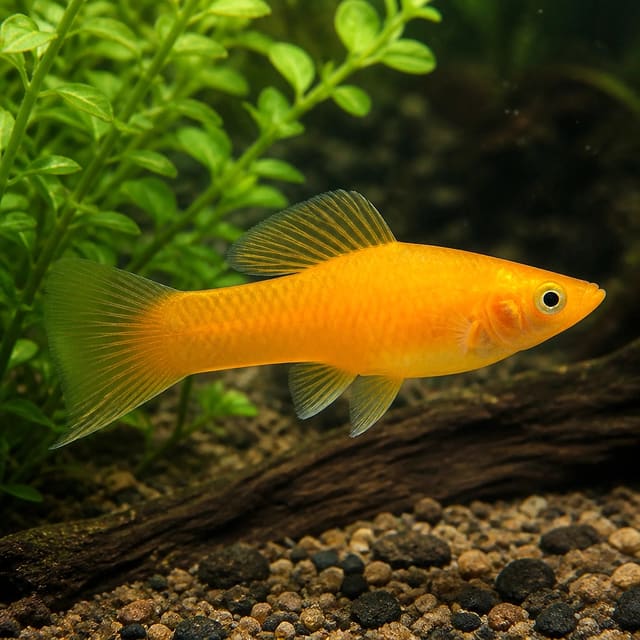
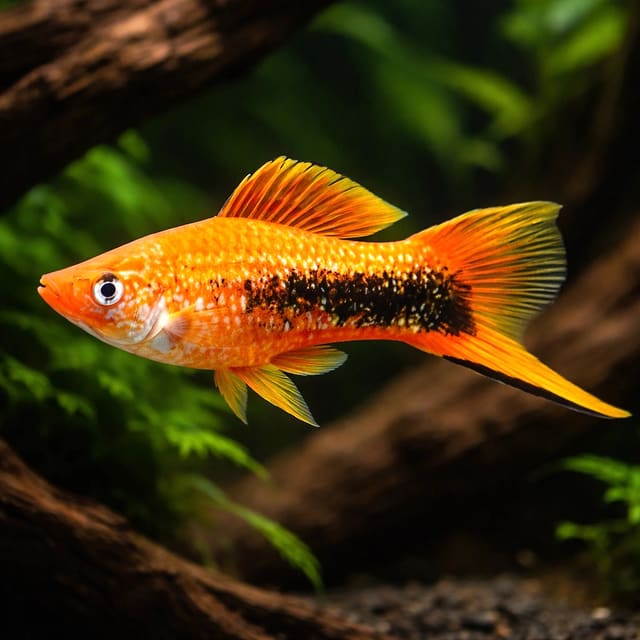
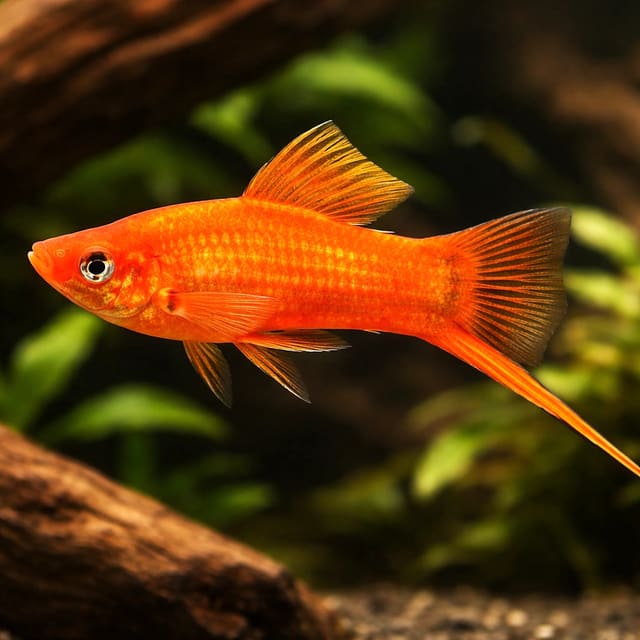
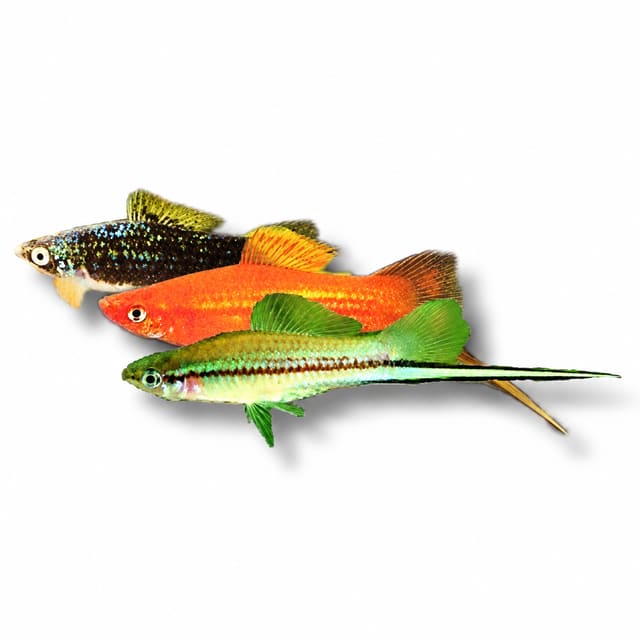
The four gallery images are representative illustrations, not photographs of the exact fish dispatched. They show the expected Green Swordtail character, but living fish vary in olive tone, reflective colour, body depth and fin shape. Some illustrated individuals show developed male features; that does not turn this unsexed listing into a male-only product.
| Common name | Green Swordtail |
|---|---|
| Scientific name | Xiphophorus hellerii |
| Sale unit | One unsexed live fish in the selected size |
| Size options | Approximately 4-5 cm or 5-6 cm; live availability varies by option |
| Adult planning size | Usually plan for a 10-12 cm body; total length may reach about 14 cm, or 16 cm in large females |
| Temperature | 23-27 C practical target |
| pH | 7.0-8.0 |
| General hardness | 9-19 dGH |
| Practical minimum aquarium | 100 litres and about 90 cm long for a suitable small group |
| Temperament | Active and generally peaceful; males can compete and may pursue females |
| Diet | Omnivore: complete staple food, plant matter and modest small animal foods |
| Swimming area | Middle and upper levels with long open lanes |
| Care level | Moderate |
The Green Swordtail is the aquarium trade name for a green or olive form of Xiphophorus hellerii. Green describes the colour form and is not part of the scientific name.
Wild-type swordtails are often greenish olive with reflective scales and a lateral stripe, while domestic lines have been selected into many colours and patterns. Aquarium stocks can also carry hybrid ancestry involving related Xiphophorus species. That history is useful context, but appearance alone cannot prove the full ancestry of one fish. This page therefore identifies the sale line honestly without claiming genetic purity from an illustration.
In a mature male, lower rays of the caudal fin extend into the narrow structure known as the sword. Females normally lack that extension and have a broader fan-shaped anal fin. A juvenile may not yet display reliable adult characters, and some domestic fin forms complicate quick visual sexing. The name describes the species group, not a guarantee that every fish at dispatch will already have a long sword.
Expect an olive, mossy or grey-green ground colour with variable metallic sheen. Lighting spectrum, background, stress, age and sex can all change how green the fish appears. A settled adult under planted-aquarium lighting can look richer than a newly arrived juvenile in a clear bag. Small differences in stripe strength, fin tint or body tone are natural and do not mean the wrong fish has been supplied.
Xiphophorus hellerii is native from Mexico through parts of Central America to Honduras. FishBase records it from streams and rivers, as well as springs, canals and ponds, particularly where vegetation provides cover and feeding opportunities. The fish uses moving space as well as shelter, which explains why a long planted aquarium works better than a small box filled edge to edge with decor.
Green Swordtails spend much of the day cruising, inspecting surfaces and reacting to other fish. They are alert livebearers with stronger sustained swimming than their compact juvenile sale size suggests. Adults can be assertive during courtship and male rivalry, but they are not normally predators of similarly sized community fish. They will, however, eat very small fry and invertebrate young if they can catch them.
Copy the useful functions of habitat rather than trying to build a literal riverbank. Use stable mineral-rich water, plant groups that interrupt sight lines, gentle to moderate current, good oxygenation and clear routes across the tank. Floating roots and tall plants offer refuge, while open central space lets the fish swim without weaving constantly around hardscape.
| Measure | Practical target | Reason |
|---|---|---|
| Temperature | 23-27 C | Sits within the 22-28 C species range while leaving a sensible buffer at both ends. |
| pH | 7.0-8.0 | Matches neutral to alkaline conditions without repeated chemical adjustment. |
| GH | 9-19 dGH | Provides the mineral content expected by this hard-water livebearer. |
| Ammonia | 0 mg/l | Any reading is unsafe and requires immediate investigation. |
| Nitrite | 0 mg/l | Nitrite interferes with oxygen transport even when the aquarium looks clear. |
| Nitrate | Low and stable | Use measured trend, stocking and tap-water baseline to set the maintenance schedule. |
Stable water inside the suitable range matters more than chasing a single perfect number. Avoid daily pH-correcting chemicals that create a cycle of sudden rises and falls. Test the tap supply for GH, KH and pH, then decide whether the aquarium naturally suits swordtails. If the water is persistently soft and acidic, another species may be the more responsible choice unless remineralisation can be measured and repeated consistently.
Use a mature biological filter and keep ammonia and nitrite at zero. Increase aeration during hot weather because warmer water holds less dissolved oxygen. Large active livebearers eat well and produce a meaningful waste load, so clear water should never be mistaken for proven water quality.
Use at least 100 litres with around 90 cm of swimming length for a suitable small group. This is a practical recommendation, not a claim that every 100-litre aquarium has spare capacity. FishBase gives 80 cm as a species minimum, but an extra margin is sensible for adult total length, sustained activity, male display and a pursued fish's need to move away.
Footprint matters. A long rectangular aquarium gives more usable territory than a tall narrow one of the same volume. Stock for adult size and behaviour, not the 4-5 cm or 5-6 cm size selected today. Increase the aquarium size when keeping several males, a larger mixed group or tank mates that share the same swimming zone.
Swordtails can jump, especially after a sudden movement, during courtship or when unsettled after arrival. Use a fitted lid and close gaps around pipes and cables without restricting ventilation. Check that a fish cannot enter a filter chamber or become trapped behind a rigid background.
Plant the back and sides with robust species suited to the same hardness, then retain a broad open lane. Wood and smooth rock can create visual barriers, but avoid sharp edges and narrow traps. A male should be able to display without controlling the entire aquarium, and a female should be able to leave his line of sight without being forced into a dead end.
Gentle to moderate flow is suitable when it distributes oxygen and waste without making the fish struggle all day. Sand or smooth fine gravel both work; choose according to planting and cleaning needs. Give a regular day-night cycle and avoid continuous bright light. Floating plants can provide security, but leave open surface space for gas exchange and feeding.
Swordtails are adaptable omnivores. FishBase records plant matter alongside worms, crustaceans and insects in the natural diet, so neither a protein-only menu nor plain vegetable food is complete. Use a quality flake or small granule as the base, preferably with varied plant ingredients, and rotate modest supplements.
| Food | Role | Practical note |
|---|---|---|
| Complete tropical flake or small granule | Regular staple | Choose pieces the selected juvenile can swallow without repeated spitting. |
| Spirulina or vegetable-rich food | Plant-based variety | Rotate with a complete food rather than relying on one ingredient. |
| Daphnia or brine shrimp | Small animal food and enrichment | Feed modest portions; rich foods are additions, not the whole diet. |
| Suitable frozen or live foods | Behavioural variety | Use clean, correctly sized food from a reliable source. |
| Biofilm and soft algae | Incidental grazing | Useful between meals but not a substitute for complete nutrition. |
| Blanched vegetable | Occasional extra | Remove uneaten material before it affects water quality. |
Feed small portions once or twice daily and watch the whole group eat. Spread food across two areas if dominant fish collect everything at the surface. A healthy swordtail should respond promptly but should not be made obese through constant feeding. Review the portion if food reaches the bottom untouched, if faeces are persistently abnormal or if nitrate rises faster than the maintenance routine can control.
Green Swordtails are social fish, but social does not mean that any number or sex mix will work. Mature males can display, chase and compete. Females may receive persistent courtship. Where sexes are known, one male with two or three females is a useful starting ratio because attention is less concentrated on one fish. The aquarium still needs enough capacity and visual separation for that group.
This product is sold unsexed, and sex cannot be promised for either size option. A buyer building a precise ratio should be prepared to adjust the group as fish mature. Multiple males generally require more swimming length, more barriers and enough females that no individual is continually targeted. Do not add extra fish merely to satisfy a ratio if the aquarium cannot support their adult size.
| Observation | Often normal | Needs action |
|---|---|---|
| Male display | Fins spread, lateral presentation, brief pursuit | Repeated attack with no opportunity for the other fish to disengage |
| Group movement | Active cruising with individuals using different areas | One fish continuously hidden, pinned at the surface or excluded |
| Feeding | Fast interest with all fish obtaining food | One fish unable to approach either feeding area |
| Fins | Open and intact | Clamped, torn or repeatedly bitten |
| Breathing | Steady gill movement after routine swimming | Persistent gasping or rapid respiration at rest |
If a fish remains cornered, stops feeding or develops fin damage, change the arrangement. Add sight breaks, increase space, separate a persistent aggressor or revise the sex mix. Calling severe pursuit normal does not make it harmless.
Match water chemistry, adult size and activity before temperament labels. A peaceful soft-water fish is not a good companion if the aquarium must be kept outside its healthy range. Suitable tank mates are robust enough for an active community, unlikely to nip fins, and comfortable in neutral to alkaline moderately hard water.
| Potential companion | Assessment | Conditions |
|---|---|---|
| Other swordtails | Usually suitable | Provide adult space, manage males and expect colour lines to interbreed. |
| Platies | Often suitable | Share broad water needs, but related Xiphophorus fish may hybridise. |
| Mollies | Often suitable in a larger hard-water aquarium | Check that hardness, temperature, feeding speed and final stocking all match. |
| Guppies and Endlers | Possible with care | Watch food competition, male attention and overall livebearer population growth. |
| Peaceful hard-water barbs or rainbowfish | Species dependent | Verify the exact adult size and avoid known fin nippers. |
| Bottom dwellers | Species dependent | Confirm pH, hardness, temperature, floor space and diet for the exact fish. |
| Soft acidic-water specialists | Usually avoid | A compromise range can leave both groups outside their best conditions. |
| Aggressive cichlids or large predators | Avoid | Swordtails should not be treated as target fish or prey. |
| Small shrimp and fry | Predation risk | Adults may coexist with cover, but young can be eaten. |
Use the water matcher for an initial comparison, then check the exact species rather than relying on a shop category. The dedicated Green Swordtail guide provides broader topic context beyond this live stock listing.
A mature male normally develops the lower caudal-fin sword and has a narrow modified anal fin called a gonopodium. A mature female has a broader fan-shaped anal fin and generally a deeper body. Females can also become larger in total body bulk, while a male's sword adds conspicuous tail length.
Do not rely on colour alone. Both sexes can show green or olive colour, and juveniles may change as they mature. At approximately 4-5 cm or 5-6 cm, some individuals may be readable while others remain uncertain. Because the live variants are size choices only, neither a male nor female is promised.
Plan for a body around 10-12 cm and allow for a total length around 14 cm in a developed male, including the tail extension. FishBase and USGS report females reaching about 16 cm. These are upper planning figures, not a guarantee that every aquarium fish reaches the same measurement. Genetics, sex, nutrition and long-term conditions all influence growth.
Swordtails are livebearers. Embryos develop inside the female and free-swimming young are born rather than eggs being laid on a surface. FishBase reports broods from roughly 20 to 200 young and a gestation of about 24-30 days, although actual brood size and timing vary with female size and conditions.
A female may produce young after purchase even when no male is currently visible because poeciliid females can retain sperm. Fine-leaved plants and floating roots increase fry survival, but adults may eat young. Decide before buying whether the aquarium can support fry and where excess fish will go. Do not use a small permanent breeding trap as a substitute for space and welfare planning.
Swordtails can interbreed with other swordtail colour forms, and related platies can hybridise with swordtails. Mixed groups may produce attractive but unpredictable offspring. Keep strains separate if maintaining a consistent green appearance matters, and avoid describing mixed descendants as a pure wild line without documented provenance.
Good observation finds problems before a generic treatment is added. Learn the normal swimming speed, posture, appetite and social position of each fish. A healthy swordtail should hold level, respond to food, use open water confidently and rest without gasping. It may briefly hide after a disturbance, but persistent isolation deserves investigation.
If several fish behave abnormally at once, test temperature, ammonia, nitrite, pH and oxygenation immediately. If one fish is affected, still test the water, then assess injury, social stress and disease. Avoid combining medicines or adding salt by guesswork. Quarantine new livestock where practical and seek a qualified aquatic veterinarian for persistent or severe symptoms.
| Problem | Possible contributor | Prevention |
|---|---|---|
| Shimmying or weakness | Chill, unsuitable mineral content, ammonia, nitrite or abrupt change | Use mature filtration, match water and acclimate without sudden parameter swings. |
| Fin damage | Male rivalry, persistent nipping or sharp decor | Increase room and sight breaks; choose compatible fish and smooth furnishings. |
| Gasping | Low oxygen, gill irritation, overheating or toxic nitrogen compounds | Test first, improve aeration and correct the underlying cause. |
| Rapid population growth | Mixed sexes and retained sperm | Plan capacity before purchase and arrange responsible homes for young. |
| Jumping injury | Open gaps, fright or social pressure | Use a secure lid, calm surroundings and enough refuge. |
| Poor colour | Stress, unsuitable lighting, diet or water quality | Judge health by function and conditions, not by chasing colour with supplements. |
| Choice | Appearance | Good reason to choose it | Planning point |
|---|---|---|---|
| Green Swordtail | Olive to green body with variable metallic sheen | You value a natural-looking colour and active livebearer behaviour | Allow substantial adult length and do not expect a sex guarantee |
| Red Swordtail | Selected red or orange body | You want stronger warm colour in the same general care group | Colour lines can interbreed with green fish |
| Koi or patterned Swordtail | White, red, black or mixed pattern | You prefer high-contrast ornamental markings | Exact pattern varies between individuals |
| Platy | Shorter body without a male sword extension | You need a somewhat smaller related livebearer | Still social, prolific and usually suited to harder water |
| Molly | Deeper body with many domestic forms | You have mineral-rich water and prefer molly behaviour | Some mollies need more hardness and can be heavy waste producers |
Compare current stock through the livebearer shop. Choose by adult needs and your water supply before choosing by colour alone.
Both options represent the same Green Swordtail listing at different approximate supplied sizes. Each selected option is one unsexed fish. The smaller fish may need more time before adult sex characters are visible, while the larger fish is not automatically a mature or confirmed male. A living animal may measure slightly outside the band because body posture and natural growth do not behave like manufactured dimensions.
| Option | What it means | What it does not promise |
|---|---|---|
| 4-5 cm | One juvenile fish supplied at approximately 4-5 cm | Not a dwarf adult, fixed sex or exact colour sample |
| 5-6 cm | One larger juvenile or young fish supplied at approximately 5-6 cm | Not automatically male, fully coloured or mature |
Use the live selector as the authority for price and availability. If a size option is unavailable, it is not dispatchable stock.
Living fish are individually variable. Look for alertness, level swimming, steady breathing, intact fins and interest in the environment. A juvenile can arrive paler after transport and deepen in colour once settled. The male sword may be absent or only beginning to develop, and a female can be larger-bodied without being pregnant.
The gallery is useful for recognising the general form, but it is illustrative. Do not compare a delivered juvenile millimetre by millimetre with an image. Judge identity from the whole set of features and judge welfare from function. Contact us promptly with clear photographs or video if the fish shows an arrival concern.
| Question | Why it matters |
|---|---|
| Is my water neutral to alkaline and at least moderately hard? | The species is a poor fit for a persistently soft acidic aquarium. |
| Is the tank mature, covered and at least about 90 cm long? | Clear water and adequate litres alone do not prove suitability. |
| Can every fish reach food? | Active livebearers can create intense surface competition. |
| Can I adjust the group when sexes become clear? | This listing is unsexed and male pressure may change with maturity. |
| What will happen if fry appear? | One female can produce repeated broods after previous contact with a male. |
| Are current tank mates safe at adult size? | The selected juvenile size is not the final stocking size. |
| Will someone receive the delivery promptly? | Live fish should not wait outdoors or in a depot after arrival. |
Prepare before dispatch day. Confirm temperature, ammonia, nitrite, pH and hardness; check the heater and filter; dim the aquarium lights; and review the current livestock delivery information. Do not order first and plan to cycle the aquarium later.
Photograph the unopened bag and contact us promptly if there is an arrival concern. The live arrival process and applicable conditions are set out on the current delivery page.
Eligible UK livestock orders use tracked delivery with live arrival support under the published terms. Because the product is a living animal, exact shade, sex and fin proportions vary, and the representative gallery cannot promise the individual dispatched.
The scientific name is Xiphophorus hellerii. Green describes the colour form and is not part of the binomial.
One unsexed live fish is included in the size selected. The size options are not multi-fish packs.
Choose approximately 4-5 cm or 5-6 cm where available. Natural variation means an individual can be slightly outside the stated band.
No. The live variants are size options only and this listing is unsexed. Adult characteristics may not be reliable at the supplied size.
Plan for a body around 10-12 cm and total length up to roughly 14 cm, including a developed male sword. Large females are reported to about 16 cm.
Use at least 100 litres with around 90 cm of swimming length for a suitable small group, then increase space for multiple males, more fish or active tank mates.
A stable 23-27 C is a practical target. FishBase records a broader species range of 22-28 C.
Yes. Aim for pH 7.0-8.0 and around 9-19 dGH. Avoid persistently soft acidic conditions or sudden chemical corrections.
They are social fish and are better planned as a compatible group where adult capacity allows. Sex ratio, male behaviour and aquarium length still matter.
Use a complete flake or small granule with plant ingredients, then rotate modest portions of foods such as daphnia, brine shrimp and suitable vegetable-rich options.
They can. Swordtails give birth to live young, and a female may produce fry after previous contact with a male. Adults and tank mates may eat some fry.
No. All four are representative illustrations. The dispatched fish varies naturally in exact colour, sex, body depth, sword development and fin shape.
Species identity, habitat, size, water parameters, diet, behaviour and reproduction were checked against FishBase: Xiphophorus hellerii. The accepted spelling was checked against NCBI Taxonomy. Ornamental-history and maximum-size context was cross-checked with the USGS Green Swordtail factsheet. Practical aquarium targets apply conservative husbandry judgement to those species-level sources; they are not veterinary diagnosis.
No reviews for this item yet. Bought one? Honest reviews only, good or bad.
What customers say about ordering from us
I have a small group of long finned mountain minnows. So was delighted to be able to order ten of this variety to increase the genetics in my tank . The ones I recieved are healthy but it’s to early to give a verdict on wether they are of a long finned type since they are small currently.
Gordon Walker · 23 Sept 2026
100% success travel and "installation". Pleased with quality of purchase. The Siamese fighter a bit "shy" so have not yet seen him at his best yet but looking good. Happy customer. GG
George E Garratt · 21 Sept 2026
Reviews of our shop, collected by Judge.me, an independent third-party review collector. Newest first.