Easy
Swordtail L mixture (Xiphophorus hellerii)
22–27°C · pH 7–8 · 108L
£10.99
One live, unsexed Papagaj Swordtail per selected quantity in the chosen 4-5 cm or 5-6 cm size option. Colour, sex and sword development vary; the gallery image is representative rather than the exact fish.
Adult size is the maximum length this species reaches at full maturity (scientific sources). The livestock you receive will be younger and smaller — pick a size above for the actual shipping size. Product-photo provenance and any image-specific limitations are stated on the listing.
Xiphophorus hellerii
Save when buying multiple fish. Each quantity is one fish; sex and pair formation are not guaranteed unless the selected variant explicitly states them.
Confirm your email, then we’ll send an availability message for this exact item if it returns within 180 days.
This request is only for this product—no newsletter or other promotions. A mail-provider retry may very rarely duplicate the same availability message. Unconfirmed addresses are removed after 48 hours. See our privacy policy.
One live, unsexed Papagaj Swordtail per selected quantity in the chosen 4-5 cm or 5-6 cm size option. Colour, sex and sword development vary; the gallery image is representative rather than the exact fish.
Adult size is the maximum length this species reaches at full maturity (scientific sources). The livestock you receive will be younger and smaller — pick a size above for the actual shipping size. Product-photo provenance and any image-specific limitations are stated on the listing.
Platy is a trade name used for Xiphophorus maculatus, X. variatus and domestic forms. Start with at least three in a mature aquarium of at least 45 litres, verify the exact fish and measured water, and plan extra capacity before mixing sexes.
Maintain these water conditions for optimal health and vibrant colors
An active livebearer sold under the distinctive Papagaj trade name. This listing supplies one unsexed swordtail in the size option selected. Choose approximately 4-5 cm or 5-6 cm from the available options. The fish may still be juvenile, so adult sex, final colour balance and the length of a male's sword extension cannot be selected or guaranteed.
Xiphophorus hellerii is a robust, social fish for a mature, heated aquarium with open swimming room, planted refuge and stable neutral-to-alkaline water. It is often described as a beginner fish, but its adult size, active behaviour and livebearing reproduction deserve more planning than a small juvenile suggests.
Sale unit: one live, unsexed fish per selected quantity in the chosen size option. This is not a pair, trio, sexed specimen or choice of the exact fish shown in the gallery.
| Scientific name | Xiphophorus hellerii |
|---|---|
| Fish supplied | One unsexed fish per selected quantity |
| Size options | Approximately 4-5 cm or 5-6 cm |
| Expected adult size | Usually around 8-12 cm in domestic aquariums; larger wild records exist |
| Care level | Easy to moderate when the aquarium is mature, spacious and stable |
| Temperament | Generally peaceful and active; males can display, chase and establish dominance |
| Minimum aquarium | At least 80 litres and 80 cm long for a small group; more space is preferable |
| Temperature | 23-27 C |
| Water | pH 7.0-8.0; aim around 9-12 dGH and 3-10 dKH |
| Diet | Omnivore: algae-rich prepared food plus measured frozen or live variety |
| Swimming area | Mostly middle and upper levels |
| Social plan | Keep at least three; where sexes are known, use at least two females per male |
Each quantity adds one live fish in the size option selected. A quantity of three means three fish, not a breeding trio unless the individual sexes happen to support that arrangement. The smaller option is approximately 4-5 cm and the larger option approximately 5-6 cm. These are live grading bands, so minor individual variation is normal.
The larger size can offer a more developed body and may show more mature features, but it is not a promise of a male, a longer sword, stronger colour or breeding readiness. The smaller size is not a different species or strain. Both options refer to the same trade-labelled fish and should be chosen according to the existing aquarium community, not simply visual preference.
Sex is not specified for either option. A juvenile that appears female-shaped can later develop male characteristics, while a genuine female may already have mated before sale. Plan the aquarium so either sex can be housed responsibly and so an unexpected brood does not create an emergency.
Papagaj is retained because it is the name attached to this supplier line. It is not a separate species, and the available source record does not define a fixed colour recipe, fin standard or documented genetic lineage. Online trade usage is inconsistent, so translating it to "Parrot Swordtail" or promising a particular red, orange or patterned appearance would create certainty that the evidence does not support.
The scientifically accepted species name is Xiphophorus hellerii, with two final "i" characters. Older supplier material and many retail pages use the one-i spelling Xiphophorus helleri. That spelling can help explain historic labels, but the corrected name is used here for accuracy and entity clarity.
| Established by the record | Expected natural variation | Not promised |
|---|---|---|
| Xiphophorus hellerii | Colour intensity and pattern placement | A certified genetic line |
| Papagaj supplier trade label | Fin proportions and maturity | A universal "Papagaj" colour standard |
| Choice of two supplied size bands | Exact measurement within the live grade | A selected sex or breeding pair |
| One fish per quantity | Whether a juvenile male has developed its sword | The exact gallery individual |
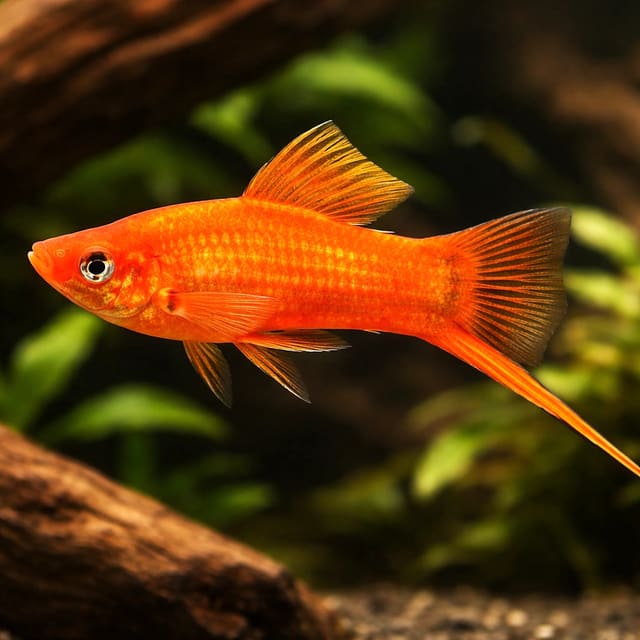
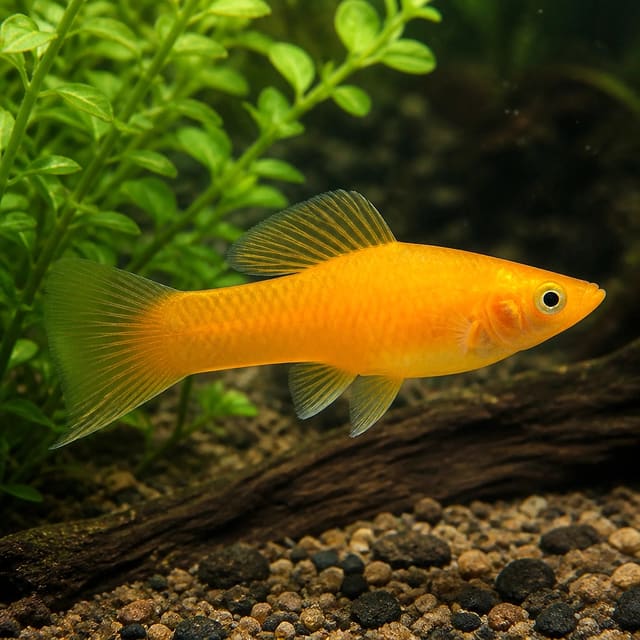
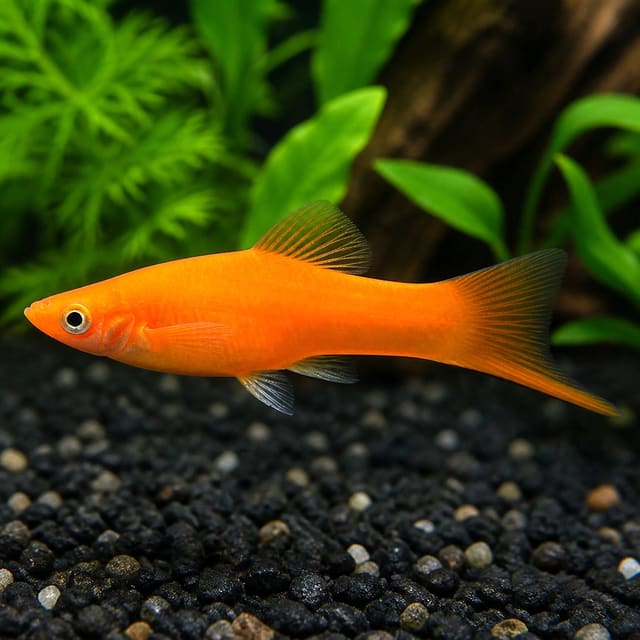
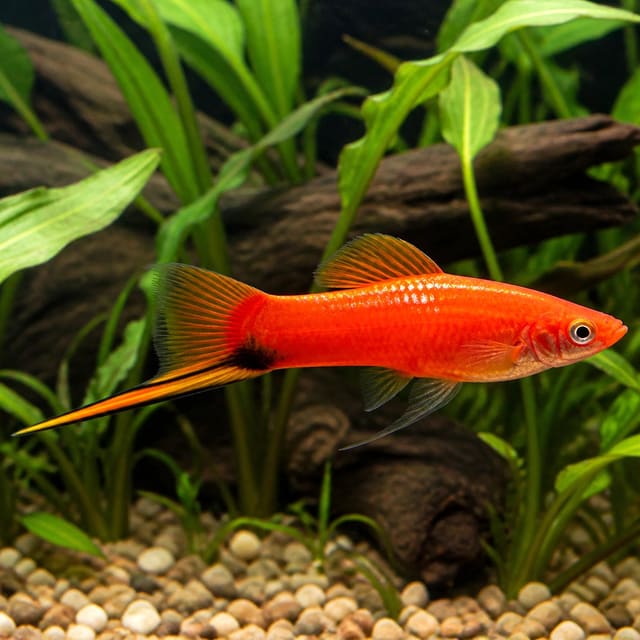
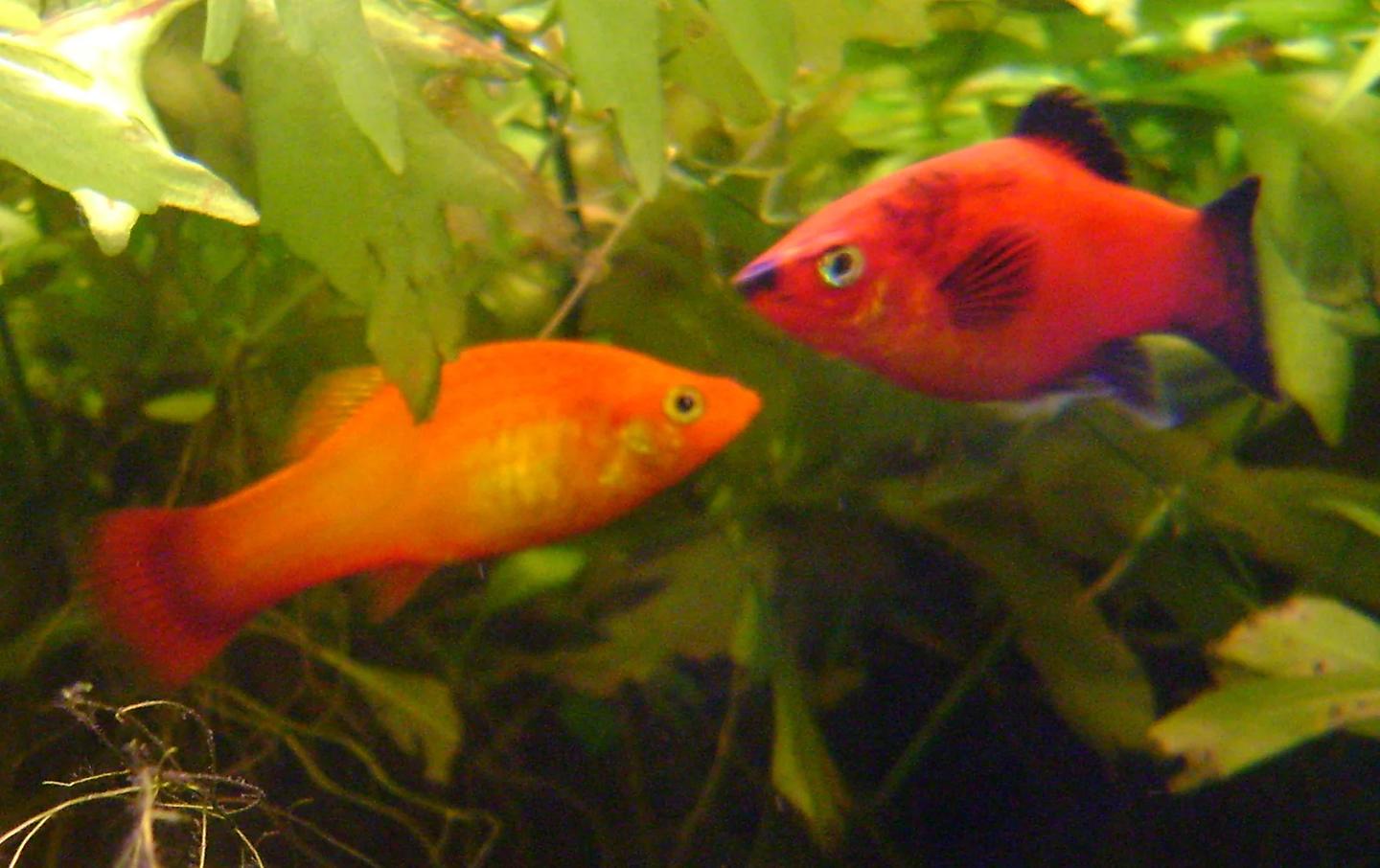
The current gallery picture is a representative aquarium image. It shows a red/orange, male-style swordtail in a planted setting. It is useful for recognising the general swordtail body form, but it is not a supplier photograph, not the exact fish selected for an order, and not proof that every Papagaj fish has that colour, pattern or sex.
The gallery image's role is disclosed here because a photorealistic image can otherwise imply more precision than the source evidence allows. Use the size selector and written variation notes as the buying specification; treat the gallery as a representative visual reference.
A male's lower tail rays may lengthen into the familiar "sword" as he matures. Females do not normally develop the same extension. An unsexed juvenile may therefore arrive without the feature that gives the species its common name.
Domestic swordtails have an elongated livebearer profile, a slightly upturned mouth and a tail built for active swimming. OATA gives a normal domestic adult range of about 8-12 cm. Our stock records give 10 cm, which sits comfortably within that range. FishBase lists larger wild maximum records, so the aquarium should be selected for a substantial adult rather than for the juvenile measurement at dispatch.
Mature males are usually slimmer and carry a pointed reproductive fin called a gonopodium. Their lower tail rays can form a sword extension, and adult males may display to rivals. Females are commonly deeper-bodied and have a fan-shaped anal fin. Sexing small or late-developing juveniles can be uncertain, which is why this product remains honestly unsexed.
Colour can change in strength as a fish settles, grows and moves between lighting conditions. Diet and health affect condition, but they cannot turn an inherited pattern into a guaranteed screen match. Choose this product when the trade identity and natural variation are acceptable; choose a more precisely described listing when a particular named appearance matters.
Swordtails bring movement, an easily recognised silhouette and interesting social behaviour to a medium-sized community aquarium. They feed readily, use the open water and remain visible for much of the day. The Papagaj label adds an element of individual variation for aquarists who do not require every fish to look identical.
This is a sensible choice for a keeper with tested hard or moderately hard water, a mature filter and room for a group. It also suits someone prepared to observe social dynamics rather than relying on the word "peaceful" as an absolute guarantee. Active livebearers can be assertive at feeding time, and adult males may challenge one another.
It is less suitable for a very small aquarium, a newly established system, a strong-flow specialist setup, or a soft acidic community where water chemistry would be a compromise. Browse the wider Swordtails collection to compare current sizes and trade varieties before deciding.
Use an aquarium of at least 80 litres and 80 cm in length for a small group. The footprint and swimming length matter because swordtails are active and adults are much larger than their supplied size. Where several adults, more than one male or a broader community are planned, 100 litres or more gives better water stability and more room to separate social pressure.
Keep an open swimming lane through the middle and upper water. Add live or soft artificial planting around the rear and sides, with wood or smooth decor arranged to interrupt long sight lines. This lets a subordinate fish leave a display or chase without turning the entire aquarium into dense cover. Floating roots can offer additional refuge, especially if fry appear.
Fit a secure lid and cover cable gaps because startled livebearers can jump. Avoid sharp decor and narrow traps that could damage fins. Stock according to adult body size, filtration and the entire community's waste load; a rule based only on centimetres of juvenile fish is not enough.
Swordtails are often called adaptable, but that should not be confused with immunity to poor water. They favour neutral-to-alkaline water with useful mineral content. OATA's domestic guidance and FishBase's species range are not identical, so this page uses their practical overlap rather than stretching every number to the widest possible limit.
| Measure | Practical target | Why it matters |
|---|---|---|
| Temperature | 23-27 C | Overlaps the supplier, OATA and FishBase guidance |
| pH | 7.0-8.0 | Neutral-to-alkaline conditions suit this livebearer |
| General hardness | Around 9-12 dGH | Overlaps OATA's 4-12 dGH and FishBase's 9-19 dH ranges |
| Carbonate hardness | 3-10 dKH | Supports buffering when kept stable |
| Ammonia | 0 mg/l | Any detectable result needs immediate investigation |
| Nitrite | 0 mg/l | Any detectable result needs immediate investigation |
| Nitrate | Controlled | OATA advises no more than 20 mg/l above the tap-water level |
Test the source water before ordering. Do not add salts, buffers or mineral products automatically, and never chase a preferred number through sudden chemical changes. A fish acclimated to stable water slightly outside an ideal midpoint can fare better than one exposed to repeated swings. Use the Water Matcher to compare measured conditions, then confirm with reliable aquarium tests.
Filtration, flow and maintenance. The aquarium must be biologically mature before livestock is introduced. Use a filter sized for the full adult community and maintain enough surface movement for gas exchange. Swordtails appreciate clean, oxygenated water but should also be able to rest away from a concentrated jet, so diffuse strong returns or aim them across the surface.
Check temperature with a separate thermometer rather than trusting the heater dial. Test ammonia and nitrite whenever behaviour changes, after a filter interruption, or when stocking increases. Routine partial water changes should use conditioned, temperature-matched water. The amount and frequency depend on test results, stocking, feeding and the source-water nitrate level.
Rinse reusable filter media in removed aquarium water when flow falls. Replacing all mature media or washing it under untreated tap water can remove the bacteria that process fish waste. Clean accumulated debris without stripping every surface at once, and record results so gradual changes are easier to spot.
This species is omnivorous. Use a quality flake or granule with a meaningful algae or plant component as the staple, then rotate suitably sized frozen or live foods such as daphnia, brine shrimp or small bloodworm. FishBase also records worms, crustaceans, insects and plant material in the natural diet, supporting a varied rather than single-food approach.
Feed portions the group can finish promptly, usually once or twice a day according to age, temperature and body condition. Spread food across more than one point so quieter fish can eat. Crush pieces when necessary for smaller juveniles, and watch the fish take food rather than assuming every member of an active group received enough.
Overfeeding creates waste, unstable water and poor long-term condition. Remove persistent leftovers and reduce the next portion. A thin fish, swollen abdomen, stringy waste or sudden appetite loss needs investigation of water quality, social access and health; it should not trigger an unmeasured increase in food.
Plan for at least three swordtails rather than permanent solitary housing. If the sexes are known, keep at least two females per male so one female does not receive all courtship attention. This product is unsexed, so a small purchase cannot promise the intended ratio. Be prepared to adjust the group as the fish mature.
Male swordtails can display, chase and establish dominance. More swimming length, broken sight lines and multiple feeding points reduce pressure, but they do not guarantee that every combination will work. Watch for repeated cornering, torn fins, missed meals, clamped fins or a fish that remains isolated. These are reasons to change the layout, group or stocking plan.
A female-only group can still produce fry if one fish mated before arrival. A male-only group avoids new matings within that aquarium, but males may still challenge one another. Sex labels and ratios guide planning; individual behaviour remains the final test.
Choose active, peaceful companions that share similar temperature and neutral-to-alkaline mineral-rich water. Other appropriately housed livebearers and robust peaceful bottom fish can work when the aquarium is large enough. Account for adult size, group requirements and waste production for every species before adding the totals together.
Avoid confirmed fin nippers, aggressive territorial fish and predators large enough to swallow a juvenile. Very timid fish may be unsettled by persistent swordtail movement even when no attack occurs. Soft, acidic-water specialists are also a poor compromise because one side of the community would be kept outside its preferred chemistry.
Small ornamental shrimp and shrimplets may be eaten. Closely related Xiphophorus species can hybridise, so keep breeding projects separate when lineage matters. Compatibility depends on tank dimensions, group sizes, sex balance, layout and individual temperament; no product description can guarantee harmony without that context.
Swordtails are livebearers, so females release developed free-swimming fry rather than laying eggs for external incubation. Breeding is likely when mature males and females share a suitable aquarium. Fine-leaved plants and floating roots increase refuge, although adults and tank mates may still eat young.
Research on Xiphophorus shows that females can store sperm for months and produce later broods without a male remaining in the aquarium. An unsexed fish that matures female may therefore arrive already capable of future broods. Removing males later is not a reliable immediate stop to reproduction.
Plan growing space, filtration, suitable small food and responsible homes before encouraging fry survival. A small breeder box is not permanent accommodation for an adult female or a growing brood. This trade-labelled fish is sold as an aquarium animal, not as certified pure-line breeding stock.
| Listing | Useful distinction | Choose it when |
|---|---|---|
| This Papagaj trade line | Two size options; colour and sex are not selectable | You value the trade identity and accept natural variation |
| Koi Kohaku Swordtail | Named koi/kohaku colour direction | A red-and-white trade direction is central to your choice |
| Pineapple Swordtail | Named pineapple trade direction | You prefer a warm-toned alternative |
| Green Swordtail | Green trade direction | You want a contrasting darker livebearer display |
| Berlin Swordtail | Different named ornamental line | You want to compare pattern-focused swordtails |
Every live fish varies within its line. A named colour direction can narrow expectations, but it does not turn a standard product into an exact-fish selection unless the individual listing explicitly says so. Compare water, size, sale unit and social needs as carefully as appearance.
Prepare before dispatch day. Confirm the aquarium is mature, the heater and filter are operating, ammonia and nitrite are zero, and temperature and pH are suitable. Keep the lights low when the parcel arrives. Follow the current acclimation instructions supplied with the order and avoid leaving an opened transport bag standing for longer than directed.
Transfer the fish without adding transport water when the supplied instructions call for separate transfer. Give the newcomer quiet time and offer only a small feed after normal swimming resumes. Temporary hiding or reduced colour can follow transport; persistent rapid breathing, loss of balance or inability to swim normally needs prompt attention.
Where practical, use a mature quarantine aquarium for all new livestock. It should be heated, filtered and large enough for normal movement, not an uncycled container. Quarantine protects the established community and makes feeding, waste and behaviour easier to observe.
Look at every fish daily. Check breathing, swimming, appetite, body shape, fins and position within the group. A healthy swordtail is usually alert and interested in activity around the aquarium. Repeated hiding, shimmying, clamped fins, surface gasping, rubbing, weight loss or inability to reach food calls for investigation.
Start with measured conditions: ammonia, nitrite, nitrate, temperature, pH and, where relevant, hardness. Review recent water changes, filter work, new livestock, social conflict and feeding access. Treating an assumed disease before checking the environment can add stress and may conceal the original cause.
Do not use salt or medication automatically. Product choice depends on the likely problem, the full community and the manufacturer's instructions. Some tank mates, plants and filter organisms are more sensitive than swordtails. Seek qualified aquatic-veterinary advice for persistent, severe or unexplained signs.
This listing is a good fit when you have a mature aquarium at least 80 litres and 80 cm long, neutral-to-alkaline mineral-rich water, room for a social group and a plan for either sex. It also suits a buyer comfortable with a trade-labelled fish whose exact colour is not guaranteed by the source record.
Choose another setup or delay the order if the aquarium is newly filled, too short for active adults, unheated, strongly turbulent, or designed around soft acidic specialists. Pause if you cannot accommodate a group, separate persistent rivals, or manage fry that may appear unexpectedly.
The supplied sizes and Papagaj identity come from the product and our stock records. The sources establish species-level care, but none defines a universal Papagaj colour standard or predicts the exact fish selected for an order.
Live-fish dispatch is scheduled around suitable routes and conditions. Read the current UK delivery information before ordering so someone can receive and inspect the parcel promptly.
Eligible UK livestock orders are covered by the Live Arrival Guarantee when the current delivery, receipt, evidence and reporting terms are followed. The guarantee protects qualifying arrival outcomes; it does not turn a live size band, unsexed sale unit or natural colour variation into an exact-specification promise.
Eligible first-time customers can use WELCOME5 for 5% off while the offer is active and its checkout conditions are met. Promotions can change, so the checkout remains authoritative.
One live, unsexed swordtail is supplied for each quantity selected. It is not a pair, trio or guaranteed sex.
The listed size bands are approximately 4-5 cm and 5-6 cm. Select the option required before adding the fish to the basket.
No. A larger juvenile may show more developed features, but neither size option carries a sex guarantee.
Plan around 8-12 cm for a domestic adult. Larger wild maximum records are known, so choose an aquarium with meaningful swimming length.
It is the supplier's trade label for this line. The available evidence does not establish one universal colour pattern, translation or certified genetic standard.
The currently accepted spelling is Xiphophorus hellerii. The one-i spelling remains common in older supplier and retail material.
Not necessarily. The image is a representative visual, not the exact fish or a guarantee of colour, pattern, fin development or sex.
Not always. The extended lower tail rays are a mature male feature, and a juvenile male may not have developed them at the supplied size.
Use at least 80 litres and 80 cm of swimming length for a small group. More space is preferable for several adults, multiple males or a wider community.
A stable 23-27 C and pH 7.0-8.0 provide a practical overlap across the checked care sources.
They suit mineral-rich neutral-to-alkaline water. Around 9-12 dGH and 3-10 dKH is a useful overlap, but stability and careful acclimation matter more than rapid chemical adjustment.
Plan for at least three. Because this product is unsexed, be ready to adjust the group as sex and adult behaviour become clear.
Where the sexes are known, keep at least two females per male to spread courtship attention.
Males can display, chase and establish dominance. Space, visual barriers and a suitable group help, but repeated bullying still requires intervention.
Choose active peaceful species that share similar temperature and mineral-rich water. Avoid fin nippers, predators, very timid fish and soft acidic-water specialists.
Use a quality algae-rich omnivore flake or granule, varied with appropriately sized frozen or live foods in measured portions.
A fish that is female may have mated before arrival and can store sperm, so later broods are possible even without a male remaining in the aquarium.
Eligible UK livestock orders are covered by the Live Arrival Guarantee when the current delivery, receipt, evidence and reporting terms are followed.
No reviews for this item yet. Bought one? Honest reviews only, good or bad.
What customers say about ordering from us
Easy website plenty of info on fish your buying great to pick a time slot
TRACEY DURRANT · 7 Oct 2026
Got some lovely fish thank you
Kevin Mackie · 7 Oct 2026
Reviews of our shop, collected by Judge.me, an independent third-party review collector. Newest first.