Easy
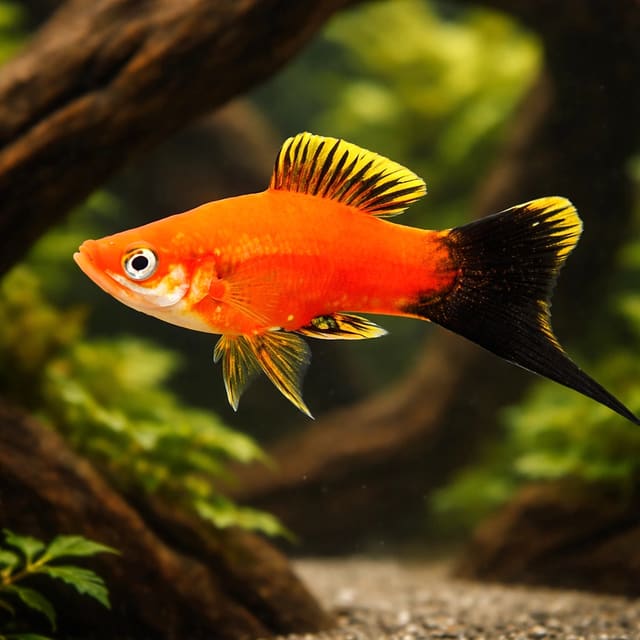
Swordtail Red Wagtail (Xiphophorus helleri red wagteil)
22–27°C · pH 7–8 · 108L
£4.99

One live, unsexed Wagtail Simpson Swordtail per quantity, approximately 4-5 cm. The trade label suggests dark-fin and high-fin directions, but exact colour, fin expression, sex and sword development vary. No product-matched source photograph is currently available.
Adult size is the maximum length this species reaches at full maturity (scientific sources). The livestock you receive will be younger and smaller — pick a size variant above for the actual shipping size. Product-photo provenance and any image-specific limitations are stated on the listing.
Xiphophorus hellerii
Save when buying multiple fish. Each quantity is one fish; sex and pair formation are not guaranteed unless the selected variant explicitly states them.
One live, unsexed Wagtail Simpson Swordtail per quantity, approximately 4-5 cm. The trade label suggests dark-fin and high-fin directions, but exact colour, fin expression, sex and sword development vary. No product-matched source photograph is currently available.
Adult size is the maximum length this species reaches at full maturity (scientific sources). The livestock you receive will be younger and smaller — pick a size variant above for the actual shipping size. Product-photo provenance and any image-specific limitations are stated on the listing.
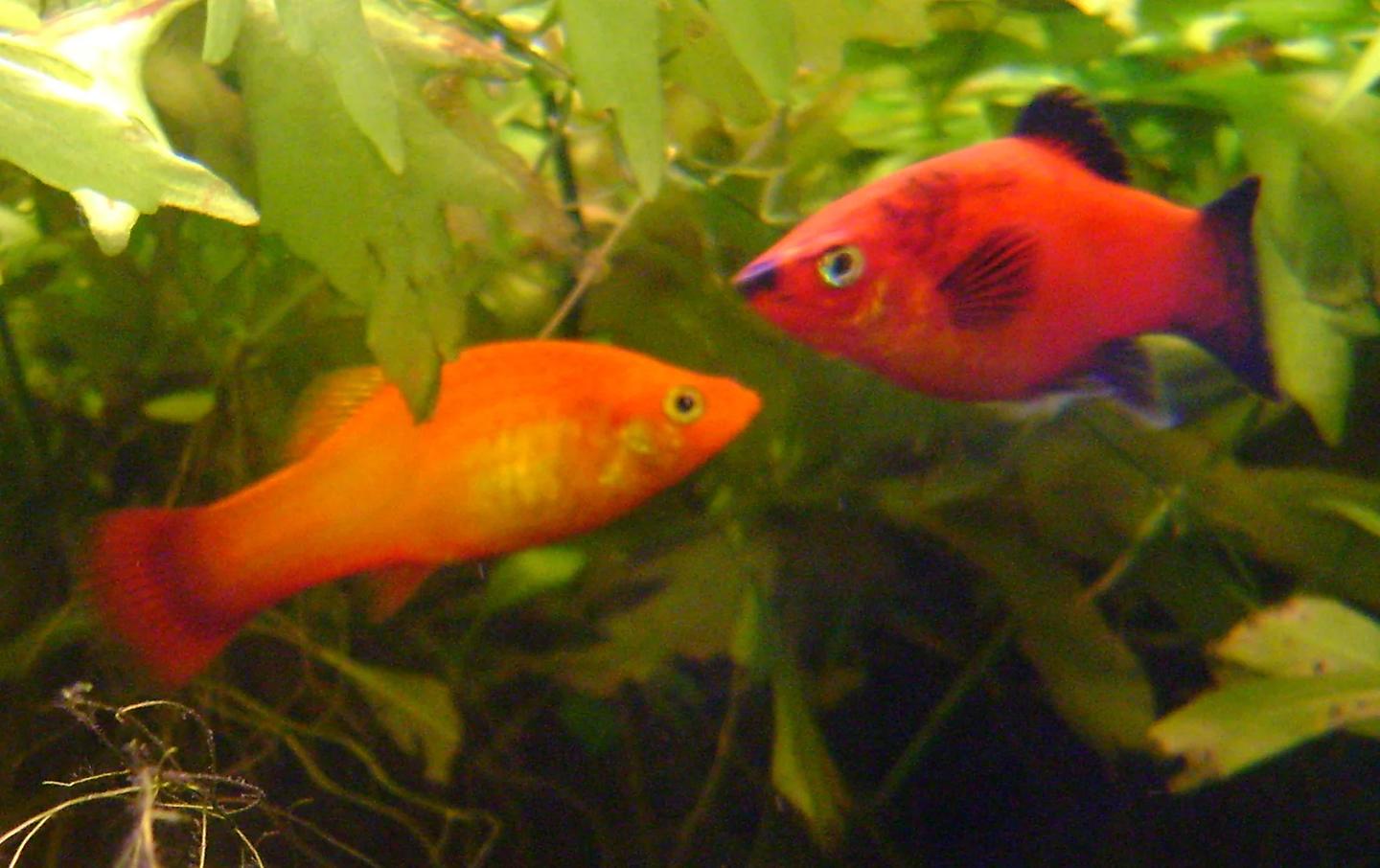
Platy is a trade name used for Xiphophorus maculatus, X. variatus and domestic forms. Start with at least three in a mature aquarium of at least 45 litres, verify the exact fish and measured water, and plan extra capacity before mixing sexes.
Maintain these water conditions for optimal health and vibrant colors
A lively domestic swordtail sold under a combined Wagtail and Simpson trade label. This Wagtail Simpson Swordtail listing supplies one unsexed fish measuring approximately 4-5 cm. The fish may still be juvenile, so sex, final fin development, body colour and the mature sword of a male cannot be selected or guaranteed.
The two trade terms describe ornamental directions rather than a separate species. Wagtail is commonly associated with dark fin expression, while Simpson is an older name for a high-fin or enlarged-dorsal trait. This supplier supplied no photograph or written phenotype standard, so the page explains those usual meanings without pretending that every individual will show the same contrast or fin height.
Sale unit: one live, unsexed fish per quantity, approximately 4-5 cm. This is not a pair, trio, sexed specimen or choice of a photographed individual.
| Scientific name | Xiphophorus hellerii |
|---|---|
| Ornamental identity | Domestic Wagtail and Simpson trade-line combination |
| Fish supplied | One unsexed fish per selected quantity |
| Supplied size | Approximately 4-5 cm |
| Expected adult size | Usually around 8-12 cm in domestic aquariums; larger species records exist |
| Care level | Easy to moderate in a mature, spacious and stable aquarium |
| Temperament | Active and generally community-suitable; males can display, chase and form a hierarchy |
| Minimum aquarium | At least 80 litres and 80 cm long for a small group; more room is preferable |
| Temperature | 23-27 C |
| Water | pH 7.0-8.0; aim around 9-12 dGH and 3-10 dKH |
| Diet | Omnivore: varied prepared food with plant content plus measured frozen or live foods |
| Swimming area | Mostly middle and upper levels |
| Social plan | Keep at least three; where sexes are known, allow at least two females per male |
Each quantity adds one live fish in the approximate 4-5 cm grade. A quantity of three means three individually supplied fish. It does not automatically mean a breeding trio, because sex is not specified. Live grading also allows small natural differences in measurement and body build.
The dispatch size describes the fish at sale, not its adult requirement. A juvenile can grow substantially and may develop stronger ornamental features as it matures. A fish within this grade is not guaranteed to be male, to show a sword, to carry a fully enlarged dorsal fin or to be ready to breed.
Plan the aquarium for either sex before ordering. A small fish that appears female-shaped can later develop male characteristics, while a genuine female may have mated before sale. Buying an unsexed group therefore requires flexibility as its adult composition becomes clear.
Wagtail is an aquarium-trade term usually used for darker fin pigmentation, especially around the tail. It appears across several body-colour lines, so the word alone does not establish whether a fish will be red, green, gold or another colour. Simpson is an older livebearer name associated with an enlarged or elongated dorsal fin and is now often described as high-fin.
The exact supplier entry combines those words but gives no photograph, colour description, fin standard or pedigree. That gap matters. The normal trade meanings are useful for understanding the intended ornamental direction, but they are not evidence for a fixed body colour, a competition-grade dorsal or uniform black finnage in every fish.
| Established | Reasonable expectation | Not promised |
|---|---|---|
| Xiphophorus hellerii identity | Active domestic swordtail form | A separate species called Wagtail or Simpson |
| Combined supplier trade label | Possible dark-fin and high-fin influence | A certified or genetically documented strain |
| Approximate 4-5 cm sale grade | Further growth and development | A selected sex or mature male sword |
| One unsexed fish per quantity | Individual variation within the line | A fixed body colour or exact fin proportions |
The scientifically accepted spelling is Xiphophorus hellerii, with two final "i" characters. The one-i spelling Xiphophorus helleri remains common in older aquarium and supplier material, but the accepted form is used here for clearer species recognition.
This product currently has no gallery photograph. The supplier did not provide an owned source image, and no image from another swordtail has been reused. That is deliberate: a related red, green or high-fin fish could look plausible while still misrepresenting the individual line offered here.
Until a verified product-matched image becomes available, the written sale grade and trade identity are the buying specification. There is no hidden promise that the arriving fish matches a competitor's photograph or another product page. Natural changes in age, condition, lighting and settling can also affect how colour and fin posture appear.
The missing image does not change the care requirements, but it may matter if a precise colour pattern is central to your choice. In that case, compare a listing with a verified named colour direction or contact the team before ordering rather than inferring appearance from the words Wagtail or Simpson alone.
Domestic swordtails have a streamlined livebearer body, an active swimming style and a slightly upturned mouth. OATA gives a normal domestic adult range of about 8-12 cm, while FishBase records larger species maxima. The supplier's 10 cm expectation sits within the domestic range, so the aquarium should be chosen for a meaningful adult rather than the juvenile supplied.
Mature males have a modified pointed anal fin called a gonopodium. Their lower caudal-fin rays can lengthen into the feature that gives swordtails their common name. Peer-reviewed developmental research shows that this sword is a male ornament associated with maturation, which is why a small unsexed fish may arrive without one.
Females are commonly deeper-bodied and retain a fan-shaped anal fin. Juveniles and late-developing males can be difficult to classify confidently at a glance. Fin size and ornamental expression can also strengthen with growth, so neither the supplied measurement nor the Simpson label is a dependable sex selector.
This fish suits an aquarist who wants an active livebearer and accepts honest variation within a supplier trade line. Swordtails remain visible through much of the day, feed readily and add movement to the middle and upper water. A mature planted community with open swimming space lets those qualities show without crowding.
It is a good fit when the source water is neutral to alkaline and carries useful mineral hardness, the filter is established, and there is room for a social group. It is also important to be willing to review the group after sex and adult behaviour become clearer, because an unsexed purchase cannot guarantee the ideal ratio in advance.
It is a poor fit for a tiny aquarium, a newly filled system, a strongly acidic soft-water community or a tank where every fish must match a precise photograph. Browse the live Swordtails category to compare the available ornamental directions and size grades.
Use at least 80 litres and 80 cm of swimming length for a small group. Length matters because swordtails are active and adults take up more space than a 4-5 cm sale grade suggests. A larger aquarium is preferable for several adults, more than one male or a mixed community because it improves both swimming room and water stability.
Keep a clear lane through the middle and upper levels. Plant the back and sides, then use wood, smooth stones or robust plants to interrupt long sight lines. This combination gives active fish room to move while allowing a subordinate individual to leave a display or chase. Floating roots and fine planting can provide additional cover if fry appear.
Fit a secure lid and close cable gaps. Startled livebearers can jump, and an enlarged fin can be damaged by sharp decor or narrow openings. Aim filter returns across the surface or diffuse them so the water remains well oxygenated without forcing every fish to swim against a concentrated jet.
Swordtails are often called adaptable, but repeated swings and unprocessed waste remain harmful. The practical targets below use the overlap between our stock records, OATA's domestic care sheet and FishBase rather than treating the widest recorded limits as an ideal.
| Measure | Practical target | Management note |
|---|---|---|
| Temperature | 23-27 C | Keep stable and verify with a separate thermometer |
| pH | 7.0-8.0 | Neutral-to-alkaline water suits this livebearer |
| General hardness | Around 9-12 dGH | Useful overlap across domestic and species guidance |
| Carbonate hardness | 3-10 dKH | Supports buffering when the level remains stable |
| Ammonia | 0 mg/l | Any detectable result needs prompt investigation |
| Nitrite | 0 mg/l | Any detectable result needs prompt investigation |
| Nitrate | Controlled | OATA advises no more than 20 mg/l above the tap-water level |
Test the source water before buying. Use the Water Matcher to compare measured conditions, but confirm decisions with reliable liquid or calibrated tests. Do not add salt, buffer or mineral powder automatically. Sudden correction can be more stressful than a stable reading near the edge of a suitable range.
Filtration and maintenance. The aquarium must be biologically mature before the fish arrives. Size the filter for the adult community, not the present juvenile biomass. Make partial water changes with conditioned, temperature-matched water according to test results, stocking and feeding rather than waiting for visible cloudiness.
Rinse reusable biological media in removed aquarium water when flow declines. Replacing all mature media or cleaning it aggressively under untreated tap water can damage the bacterial population that processes waste. Record temperature, ammonia, nitrite, nitrate and pH so gradual changes are visible before they become a crisis.
Xiphophorus hellerii is omnivorous. Use a good flake or small granule with a useful plant or algae component as the staple, then rotate appropriately sized frozen or live foods such as daphnia, brine shrimp or small bloodworm. FishBase records worms, crustaceans, insects and plant material in the natural diet, while the commercial production manual also treats swordtails as omnivores.
Feed measured portions that the group can finish promptly, usually once or twice daily according to size, temperature and condition. Spread food across two or more points so a dominant fish cannot control the entire meal. Crush pieces for a smaller juvenile and watch it eat rather than assuming that food entering the tank reached every fish.
Persistent leftovers increase waste and destabilise water. Remove them and reduce the next portion. A thin body, swollen abdomen, stringy waste, repeated spitting or a sudden loss of appetite needs a check of water quality, social access and health; it is not a reason to pour in more food without diagnosis.
Plan for at least three swordtails rather than permanent solitary housing. Where sexes are confidently known, allow at least two females per male so one female does not receive all courtship attention. This item is unsexed, so a purchase of three cannot guarantee that ratio and may need adjustment after maturation.
Male swordtails can display, chase and form dominance relationships. Experimental work on the species supports treating male hierarchy as real behaviour rather than dismissing every chase as harmless play. More swimming length, visual breaks and several feeding points help distribute pressure, but no layout guarantees that every individual combination will work.
Watch for repeated cornering, torn fins, clamped fins, missed meals or one fish remaining isolated. Early intervention can include rearranging sight lines, increasing appropriate cover, changing the social group or separating a persistent aggressor. Do not wait for serious injury simply because the species is generally described as peaceful.
Choose active, peaceful companions that share similar temperature and neutral-to-alkaline mineral-rich water. Appropriately housed livebearers and robust peaceful bottom fish can work in a sufficiently large aquarium. Add the adult sizes, group requirements and waste load of the whole community rather than judging each proposed fish in isolation.
Avoid confirmed fin nippers, highly territorial fish and predators large enough to swallow the supplied juvenile. Very timid species may be stressed by constant swordtail movement even without direct aggression. Soft, acidic-water specialists are also a poor compromise because one side of the community would be maintained outside its preferred chemistry.
Small ornamental shrimp and shrimplets may be eaten. Closely related Xiphophorus forms can hybridise, so breeding projects should be kept separate when lineage matters. Compatibility always depends on aquarium dimensions, stocking, sex balance, layout and the temperaments of the actual fish.
Swordtails are livebearers. Females release developed, free-swimming young rather than laying eggs for external incubation. If mature males and females share suitable conditions, breeding can occur readily. Dense fine-leaved plants and floating roots provide refuge, although adults and tank mates may still eat some fry.
An unsexed fish can mature into either sex, and a female may have mated before sale. Removing males later does not guarantee that no further brood will appear. Plan growing space, filtration, suitable small foods and responsible homes before deliberately trying to maximise fry survival.
This product is sold as an ornamental aquarium fish, not as certified pure-line breeding stock. The combined trade name does not document its genotype, and keeping it with other swordtail or platy lines may make offspring even less predictable. A small breeder box is not suitable as permanent accommodation for an adult female or a growing brood.
| Listing | Main distinction | Useful when |
|---|---|---|
| This combined trade line | Wagtail and Simpson direction; body colour not specified | You accept variation and value the combined ornamental label |
| Red Wagtail Swordtail | Explicit red Wagtail colour direction | A red body direction is important to your choice |
| Red Simpson Swordtail | Explicit red Simpson/high-fin direction | You want the high-fin term with a named red direction |
| Green Wagtail Swordtail | Explicit green Wagtail direction | You prefer a darker green-oriented comparison |
| Koi Kohaku Swordtail | Named koi/kohaku ornamental direction | A red-and-white trade direction is central to the decision |
A named colour direction can narrow a buyer's expectation, but every live fish still varies. Compare the sale unit, supplied size, water requirements and social plan as carefully as colour terminology. An exact-fish choice exists only where a product explicitly offers the photographed individual.
Prepare the aquarium before dispatch day. Confirm that the filter is mature, the heater is stable, ammonia and nitrite are zero, and the measured pH and temperature are suitable. Keep the room and aquarium lights low when the parcel arrives, then follow the current acclimation instructions supplied with the order.
Do not leave an opened transport bag standing longer than instructed. Transfer the fish without adding transport water when the supplied directions call for a separate transfer. Offer a small meal only after normal swimming resumes. Reduced colour or short-term hiding can follow transport, but persistent rapid breathing, loss of balance or inability to swim normally needs prompt attention.
Where practical, quarantine all new livestock in a mature, heated and filtered aquarium with enough room for normal movement. Quarantine protects the established community and makes appetite, waste, breathing and behaviour easier to observe. An uncycled bowl or tiny container is not an adequate quarantine system.
Observe the fish every day. Check breathing, swimming, appetite, body shape, fin condition and access to the group. A settled swordtail is normally alert and responsive. Repeated hiding, shimmying, clamped fins, surface gasping, rubbing, weight loss or inability to reach food calls for investigation.
Begin with measured conditions: ammonia, nitrite, nitrate, temperature and pH, plus hardness where relevant. Review recent water changes, filter work, power interruptions, new livestock, feeding and social conflict. Treating an assumed infection before checking the environment can add stress and obscure the original problem.
Do not add salt or medication automatically. Treatment choice depends on the likely cause, the complete community and the manufacturer's directions. Some plants, invertebrates, catfish and filter organisms tolerate products differently. Persistent, severe or unexplained signs need advice from a suitably qualified aquatic veterinary professional.
This fish is suitable when the aquarium is mature, at least 80 litres and 80 cm long, and filled with stable neutral-to-alkaline mineral-rich water. There should be space for a social group, a plan for either sex, and a practical way to respond if male pressure or unexpected fry changes the stocking.
Delay the order if the aquarium is newly filled, unheated, too short for active adults, strongly acidic and soft, or already close to its filtration and stocking limit. Also pause when a precise body colour or photographed individual is essential, because the exact supplier line does not currently have verified visual evidence.
Before checkout, confirm the adult community, test results, secure lid, delivery availability, acclimation supplies and contingency space. This preparation matters more to welfare than choosing a fish solely because its juvenile sale size looks small.
The supplied size and combined trade identity come from the exact product and our stock records. Species-level sources cannot predict the body colour, sex, dorsal height or fin darkness of the individual selected for an order.
Live-fish dispatch is scheduled around suitable routes and conditions. Read the current UK delivery information before ordering so someone can receive and inspect the parcel promptly.
Eligible UK livestock orders are protected by the Live Arrival Guarantee when the current delivery, receipt, evidence and reporting terms are followed. The guarantee covers qualifying arrival outcomes; it does not convert an unsexed live grade or variable trade line into an exact-colour or exact-fin promise.
Eligible first-time customers can use WELCOME10 for 10% off while the offer is active and its checkout conditions are met. Promotions can change, so the checkout remains authoritative.
One live, unsexed swordtail measuring approximately 4-5 cm is supplied for each quantity. It is not a pair or trio.
Sex is not selected or guaranteed. The fish may still be juvenile, so plan the aquarium for either outcome.
It is a trade term usually associated with dark fin expression, especially around the tail. It does not establish a specific body colour on its own.
Simpson is an older aquarium term associated with an enlarged or elongated dorsal fin, now commonly described as a high-fin trait.
No exact expression is guaranteed. The supplier supplied the combined trade label but no photograph, phenotype standard or genetic documentation.
The exact source record does not specify red or any other body colour, so this listing does not promise one.
No owned, product-matched source image was available. A related fish has not been reused because that could misrepresent this line.
The accepted name is Xiphophorus hellerii. The older one-i form remains common in supplier and aquarium material.
Plan around 8-12 cm for a domestic adult. Larger species records exist, so meaningful swimming length is important.
Not necessarily. The lower-tail sword is associated with mature males and may not yet be developed at the supplied size.
Use at least 80 litres and 80 cm of swimming length for a small group. More room is advisable for multiple males or a wider community.
A stable 23-27 C and pH 7.0-8.0 provide a practical overlap across the checked sources.
They favour mineral-rich neutral-to-alkaline water. Around 9-12 dGH and 3-10 dKH is a useful practical target, provided changes are gradual and stable.
Plan for at least three. Because this product is unsexed, the group may need adjustment once sex and adult behaviour are clear.
Yes. Males can display, chase and form a hierarchy, so provide space and visual breaks and intervene if pressure becomes persistent.
Offer a quality omnivore staple with plant content, varied with appropriately sized frozen or live foods in measured portions.
Yes. An unsexed fish may mature female or may have mated before sale, so prepare for possible live young.
Eligible UK livestock orders are covered by the Live Arrival Guarantee when the current delivery, receipt, evidence and reporting conditions are met.
Max adult size is the length this species reaches at full maturity (from scientific sources). The livestock you receive will be younger and smaller — pick a size variant on the buy box for the actual shipping size. Product-photo provenance and any image-specific limitations are stated on the listing.
Observe the actual fish. Space, planting and broken sight lines help, but they do not correct crowding, an unsuitable sex ratio or incompatible water.
Always research specific species before adding them to your tank. Consider:
No reviews for this item yet. Bought one? Honest reviews only, good or bad.
What customers say about ordering from us
I have a small group of long finned mountain minnows. So was delighted to be able to order ten of this variety to increase the genetics in my tank . The ones I recieved are healthy but it’s to early to give a verdict on wether they are of a long finned type since they are small currently.
Gordon Walker · 23 Sept 2026
100% success travel and "installation". Pleased with quality of purchase. The Siamese fighter a bit "shy" so have not yet seen him at his best yet but looking good. Happy customer. GG
George E Garratt · 21 Sept 2026
Reviews of our shop, collected by Judge.me, an independent third-party review collector. Newest first.
22–27°C · pH 7–8 · 108L
22–27°C · pH 7–8 · 108L
22–27°C · pH 7–8 · 108L
22–27°C · pH 7–8 · 108L
22–27°C · pH 7–8 · 108L
22–27°C · pH 7–8 · 108L
22–27°C · pH 7–8 · 108L
22–27°C · pH 7–8 · 108L
22–27°C · pH 7–8 · 108L
22–27°C · pH 7–8 · 108L
22–27°C · pH 7–8 · 108L
23–27°C · pH 7–8
22–27°C · pH 7–8 · 108L
16–28°C · pH 7–8 · 108L

16–28°C · pH 7–8 · 108L
22–27°C · pH 7–8 · 108L

22–28°C · pH 7–8 · 41L

21–25°C · pH 5–7
24–29°C

24–27°C · pH 6.5–6.5

22–27°C · pH 6–8 · 72L
24–27°C · pH 6.5–8 · 200L

23–27°C · pH 5.5–7 · 60L

22–27°C · pH 6–8