Easy
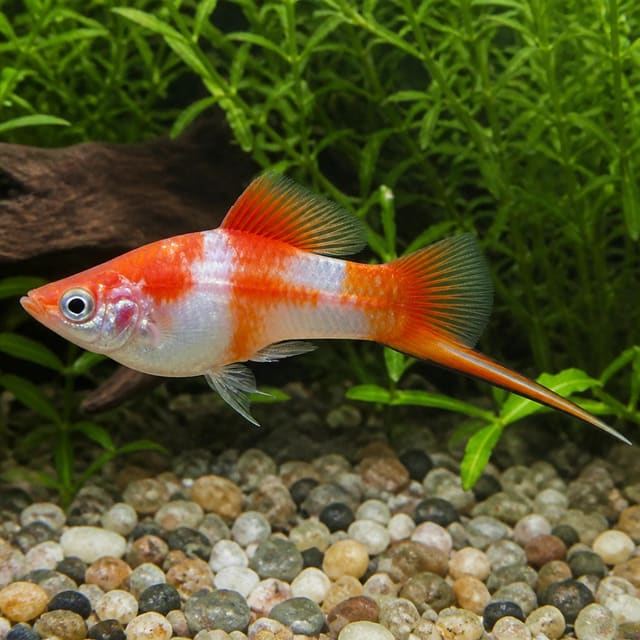
Koi Kohaku Swordtail (Xiphophorus hellerii)
22–27°C · pH 7–8 · 108L
£9.99
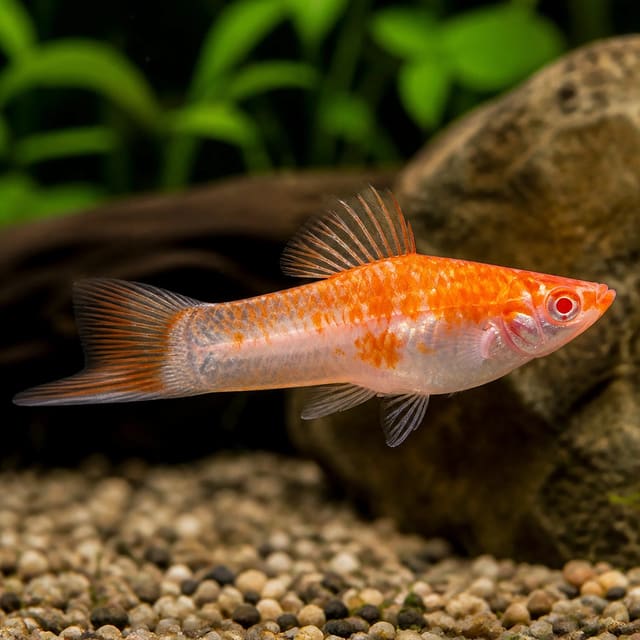
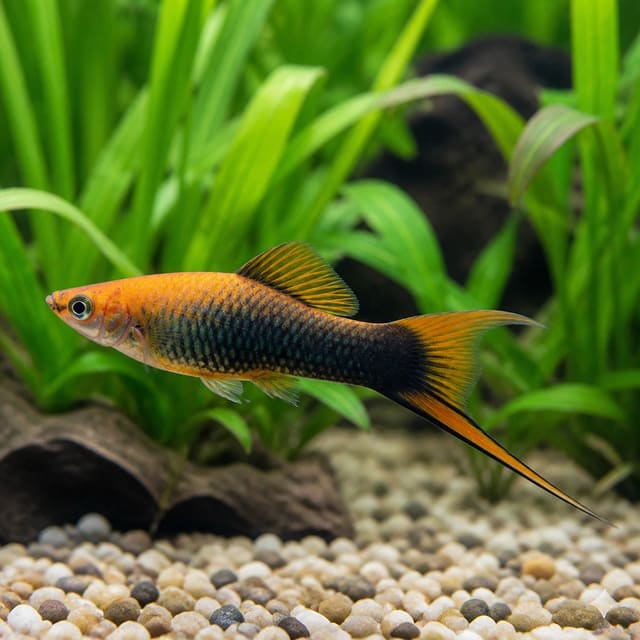
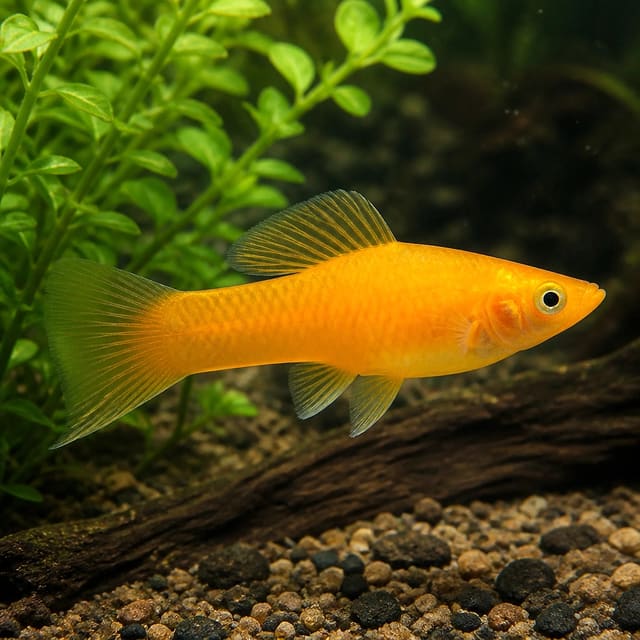
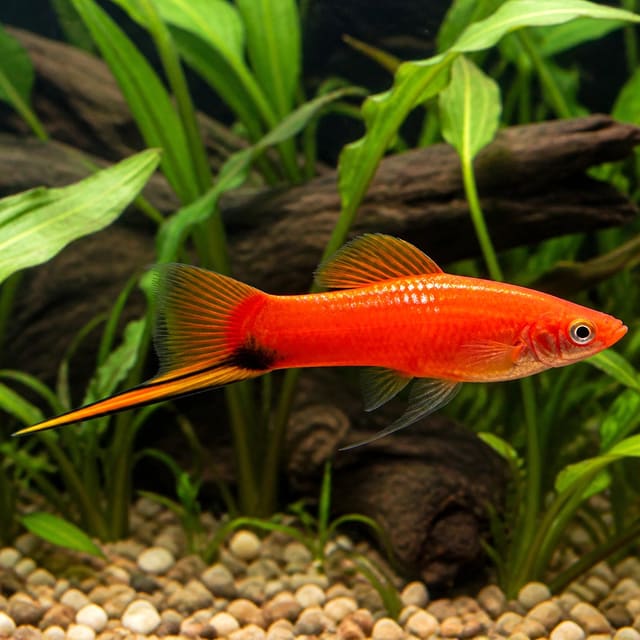
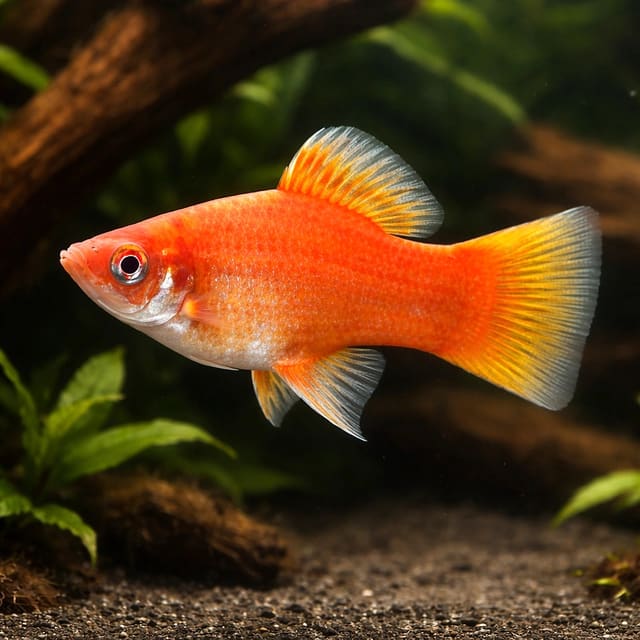
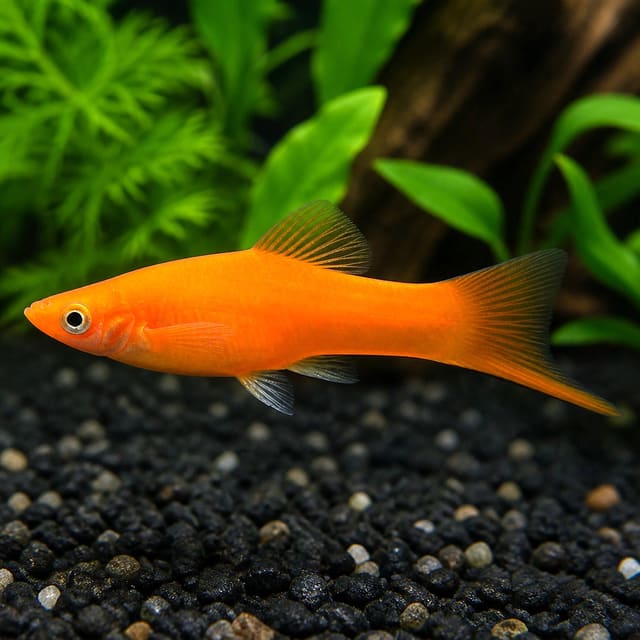
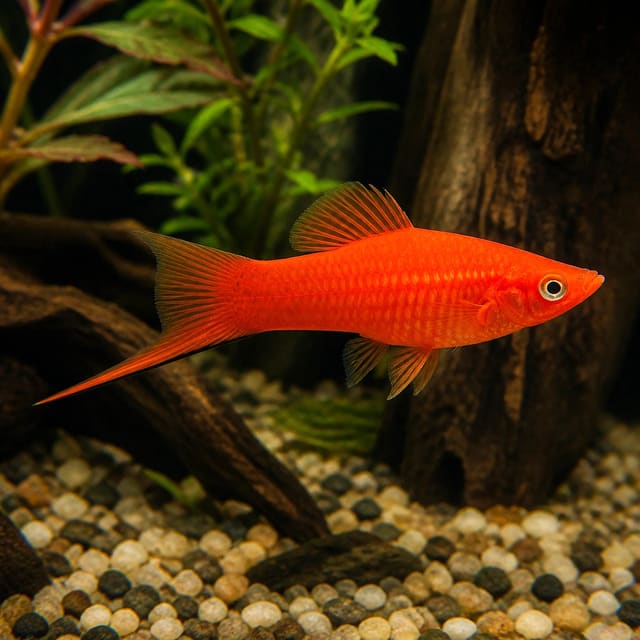
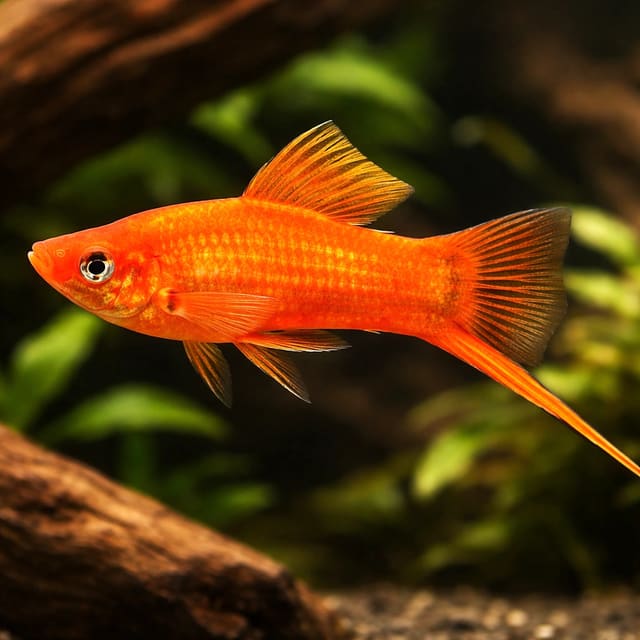
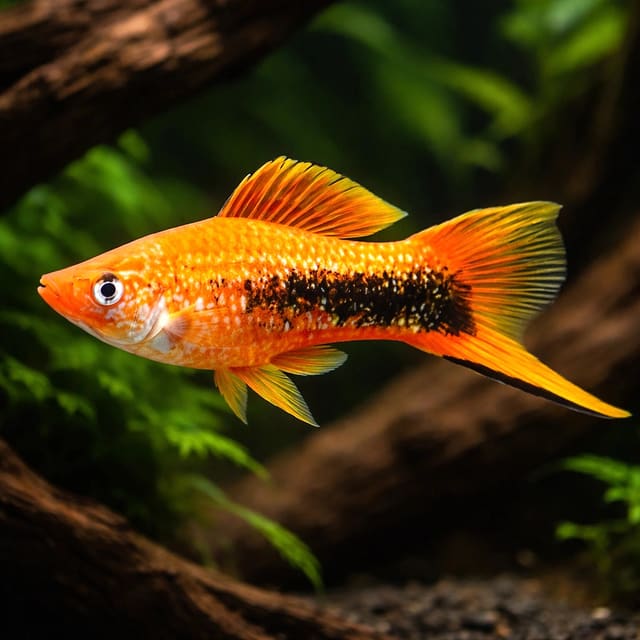
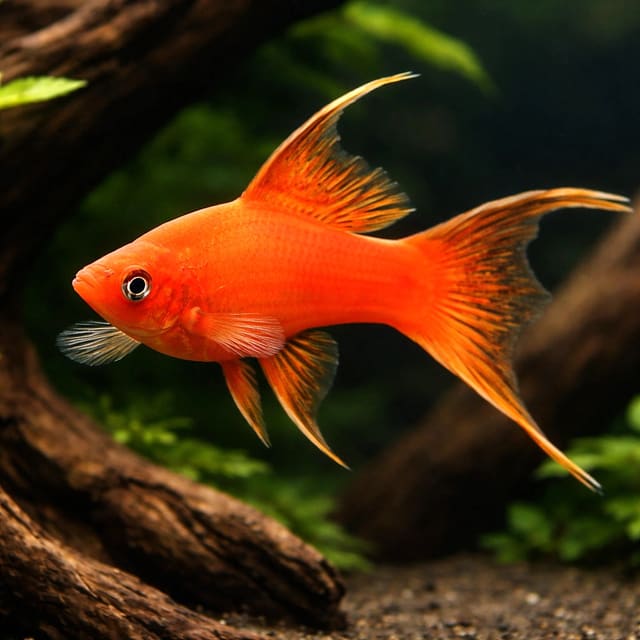
One Albino Kohaku Swordtail, Xiphophorus hellerii, sold singly with the sex not specified. An albino, red-and-white koi-pattern swordtail that grows to 14 cm (males) or 16 cm (females) and needs hard, alkaline water at 22-28 °C, a 120 x 30 cm tank base and gentle lighting.
Adult size is the maximum length this species reaches at full maturity (scientific sources). The livestock you receive will be younger and smaller. Product-photo provenance and any image-specific limitations are stated on the listing.
Xiphophorus hellerii
Shoaling fish: kept in a group they feel safer, stay calmer and show their best colour.
One Albino Kohaku Swordtail, Xiphophorus hellerii, sold singly with the sex not specified. An albino, red-and-white koi-pattern swordtail that grows to 14 cm (males) or 16 cm (females) and needs hard, alkaline water at 22-28 °C, a 120 x 30 cm tank base and gentle lighting.
Adult size is the maximum length this species reaches at full maturity (scientific sources). The livestock you receive will be younger and smaller. Product-photo provenance and any image-specific limitations are stated on the listing.
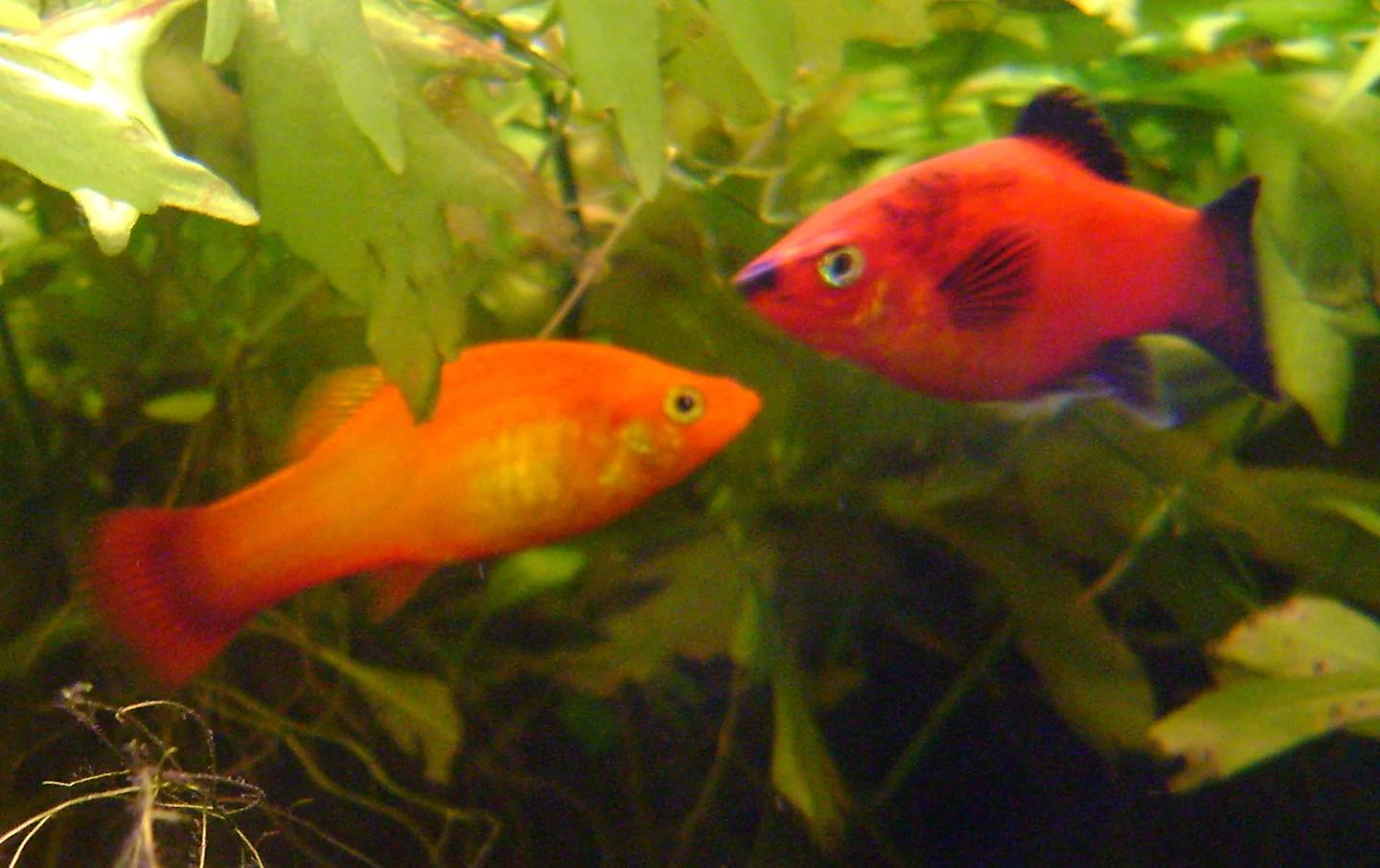
Platy is a trade name used for Xiphophorus maculatus, X. variatus and domestic forms. Start with at least three in a mature aquarium of at least 45 litres, verify the exact fish and measured water, and plan extra capacity before mixing sexes.
Maintain these water conditions for optimal health and vibrant colors
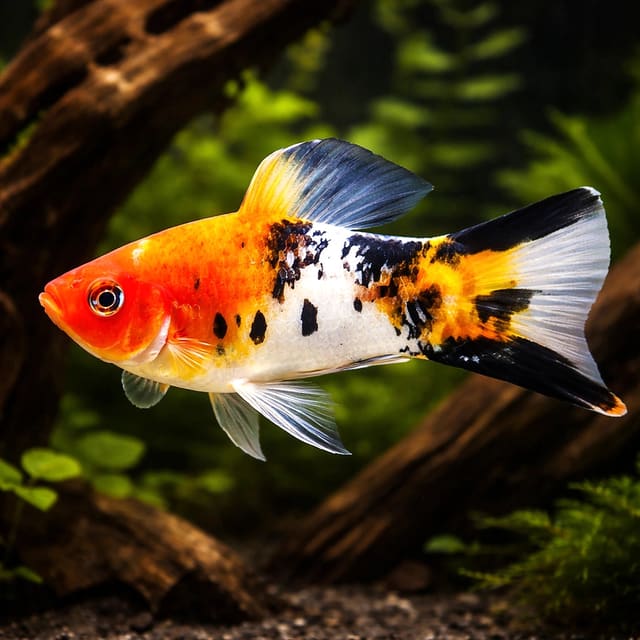
This is an ornamental form of the swordtail, Xiphophorus hellerii, a livebearer whose wild ancestors are olive-green fish from the rivers and springs of Mexico and northern Central America. Two words in the name describe what breeders have done with it. Kohaku is a koi carp term for a white fish with red markings. Albino means the fish lacks melanin, the dark pigment. Put together, you have a pale, red-marked swordtail without the black of wild fish, and, as with albino animals generally, eyes that look red.
| At a glance | Detail |
|---|---|
| Species | Xiphophorus hellerii, family Poeciliidae |
| What you receive | One fish per unit, sex not specified |
| Adult length | Up to 14 cm in males and 16 cm in females, total length (FishBase) |
| Temperature | 22–28 °C |
| pH and hardness | pH 7.0–8.0, 9–19 dGH |
| Tank | Base of 120 × 30 cm, roughly 108 litres, as a minimum (Seriously Fish) |
| Diet | Omnivore |
| Temperament | Community fish; males fight among themselves |
| Breeding | Livebearer; 20–200 young after 24–30 days (FishBase) |
| Care level | Easy, given space and hard water |
Each unit you add to the basket is a single fish, and this listing does not offer a choice of male or female, so neither is promised. If you would like a small group, order several and let the sexes reveal themselves as the fish mature. The section on males and females explains why the final mix matters so much with this species.
Whatever size your fish is when it reaches you, please plan for the adult. Swordtails grow into long-bodied fish, and a tank that looks generous for a small fish can become cramped for a 14 cm male and his rivals. If you are unsure whether your aquarium is big enough, the tank section below gives the figures.
An Albino Kohaku is a good choice if you have, or are planning, a long community tank with hard, alkaline water and you want a large livebearer with clean red-and-white colouring and no black at all. It is a poor fit for a small or tall tank, for a soft-water set-up built around fish from acidic rivers, or for a display run under very bright lighting with nowhere shaded to retreat. If your plans match the first description, you are buying a hardy fish, as Wikipedia notes of the species, and most of the work is in getting the tank right before it arrives.
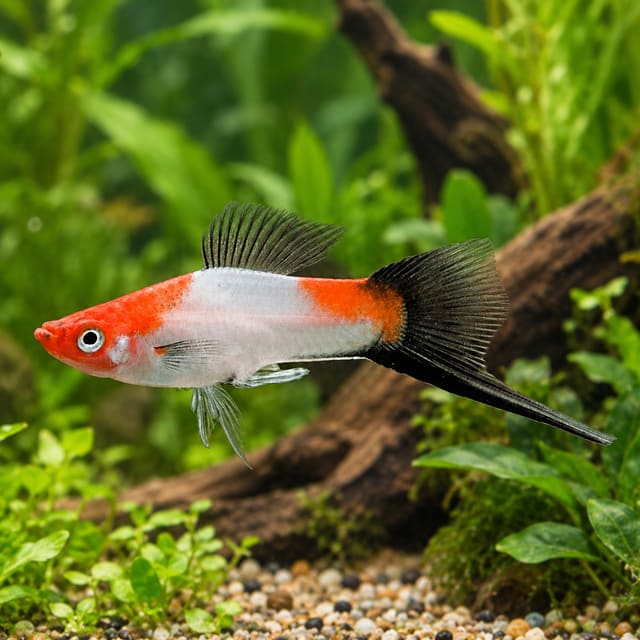
Swordtail names in the trade borrow freely from koi carp, and kohaku is one of the best-known koi terms. Wikipedia's koi article defines a kohaku as a white-skinned koi with large red markings on top, and translates the word as "red and white". On a swordtail the term signals a fish bred towards that same two-colour scheme. Patterned fish are individuals, though, so the size and placement of the red on any one fish is its own. Treat the name as a guide to the look of the line rather than a promise about a particular fish.
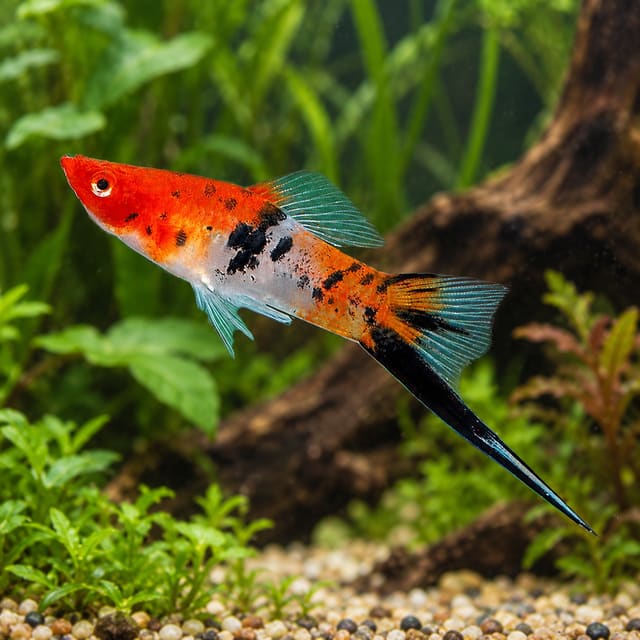
The same pattern name appears on our Koi Kohaku Swordtail; the word albino is what sets this fish apart. Tri-colour koi names such as sanke add small black markings (sumi) to the red and white. An albino cannot show those black markings. Albinism is, in Wikipedia's words, the congenital absence of pigmentation, and the dark pigment melanin is exactly what an albino lacks. That is the practical difference between an albino kohaku and the pigmented koi forms: no black anywhere, and the characteristic pale eye.
Wikipedia explains that albino animals have red-looking eyes because, with no pigment in the iris, the colour of the blood in the retina shows through. It is a handy way to recognise an albino: body colour on ornamental strains can be bred in many directions, but an unpigmented eye is hard to mistake.
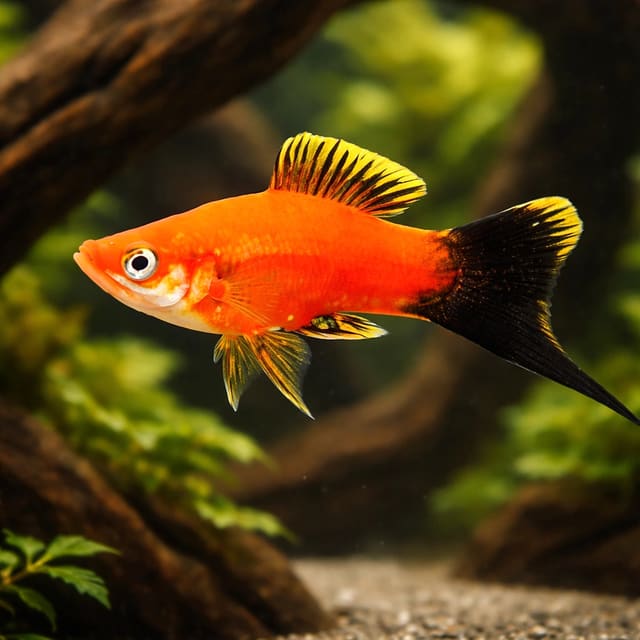
Seriously Fish notes that selective breeding has produced many ornamental swordtail forms with colours and fin shapes not found in nature, and that swordtails hybridise with the platies Xiphophorus maculatus and X. variatus. Wikipedia goes further and states that most aquarium swordtails are hybrids with the southern platyfish. It does not change the care: an Albino Kohaku is kept exactly as you would keep any swordtail, with one or two extra thoughts about light, covered below.
The species name is often printed Xiphophorus helleri, and that is how this listing first named the fish. FishBase, Seriously Fish and Wikipedia use hellerii, the form now treated as correct. The name honours Karl Bartholomaeus Heller, the Austrian botanist who found the fish in Mexico in the 1840s, and Johann Jakob Heckel published the description in 1848. If a book or label uses the shorter spelling, it means the same species.
Albinism is more than a colour. Wikipedia's article on albinism in animals notes that in albino animals the centre of the retina is under-developed and there are fewer rod cells, the cells that detect light levels. It also records that albino vertebrates exposed to intense light typically lose photoreceptors. We have not found a study on albino swordtails specifically, so we treat that as a sensible general caution rather than a known swordtail problem. It costs nothing to act on.
The same article points out that albino animals may lack protective camouflage. In a home aquarium predation is down to your choice of tank mates, but the point is worth keeping in mind: a pale fish stands out, so make sure nothing in the tank sees it as food.
Wikipedia credits the swordtail's popularity partly to its hardiness, and a healthy Albino Kohaku is not a delicate fish. Most problems trace back to the tank rather than the fish: an immature filter, too many fish, too much food, too many males or sudden changes in temperature or chemistry. Spend half a minute watching the tank at each feed. These are the things to notice:
On a pale fish, marks, redness and fin damage are easy to see, which is a small advantage. Test the water as your first response to any of these signs, then look at behaviour in the tank. Keep a spare tank with a mature sponge filter for quarantining new arrivals and separating a sick or bullied fish; it is one of the most useful pieces of equipment a livebearer keeper can own.
Every Albino Kohaku traces back to a swordtail from Mexico and Central America, and the wild fish explains a lot about what the aquarium version wants. FishBase puts the native range from Veracruz, Mexico, to northwestern Honduras. Seriously Fish fills in the detail: southeastern Mexico, central Guatemala, southern Belize and northwestern Honduras, running south from the Río Nautla in Veracruz as far as the Río Usumacinta drainage. The first scientific specimens came from Orizaba, in Veracruz.
The habitats are varied. Seriously Fish lists fast-flowing rocky streams, springs, ditches, ponds and rivers, from sea level up to about 1,500 m, with water that may be clear or turbid and is usually less than 1.5 m deep. Grown fish favour the stronger current, and young fish stay in the quiet edges. FishBase describes adults mainly in rapidly flowing, heavily vegetated streams and rivers, and Wikipedia also mentions warm springs and canals. On plant cover the sources part company: FishBase and Wikipedia describe dense vegetation, Seriously Fish says aquatic plants are often sparse. FishBase also records the species in brackish water.
Three practical lessons come out of that picture. The fish likes some current. It uses open water as an adult. And the young need somewhere sheltered and slow. Each of those shapes the tank set-up below.
Swordtails have spread far beyond their home range. Seriously Fish records feral populations on every continent apart from Antarctica, and FishBase lists the species as a potential pest, with reports of harmful ecological effects after introductions in several countries and feral fish in South Africa and Namibia. Wikipedia links the damage to how quickly and in what numbers the species reproduces. Globally it is assessed as Least Concern by the IUCN. Please never release any swordtail, including unwanted young, into a garden pond or natural water. Pass surplus fish to another fishkeeper or a shop instead.
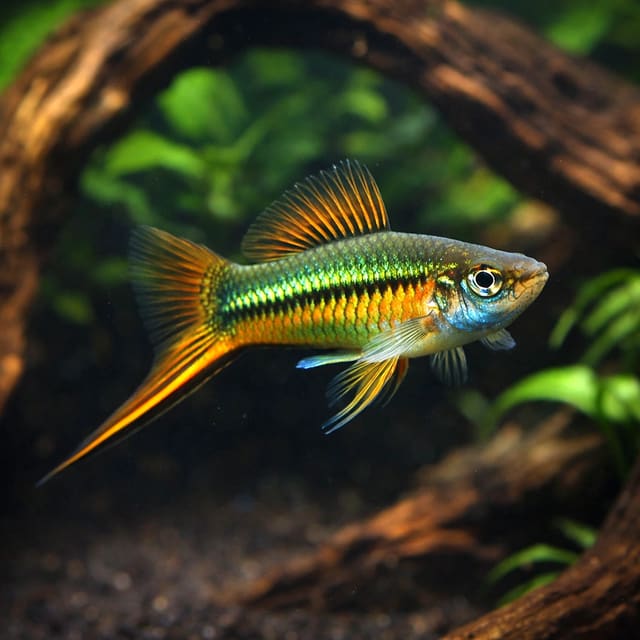
Wikipedia describes the wild fish as olive green with a red or brown stripe along the side, and the male's sword as yellow edged with black below. FishBase notes that the side stripe may be dusky or brownish in northern populations and red in others. None of that dark colouring can appear on an albino. Compare the Green Swordtail to see roughly how the species looks before breeders get to work.
Seriously Fish recommends a tank with a base of at least 120 × 30 cm, which it puts at about 108 litres. FishBase's aquarium note sets a minimum length of 80 cm, and the reason it gives alongside is telling: males are aggressive towards each other. Length gives a chased fish somewhere to go. We would treat 120 cm as the starting point for an adult group, and we give 108 litres as the minimum volume in the care details for this fish.
Shape matters as much as size. A long, low tank suits a fish that swims back and forth along its length. A tall tank of the same volume gives less swimming length and less distance between rivals. If you have a choice, go long.
For the wild form, Seriously Fish suggests heavy planting over a dark substrate, with floating plants and driftwood roots or branches to soften the light. That suits an albino even better. A dark base makes red and white look crisp, while pale gravel under bright lights can leave a white-bodied fish looking washed out and the tank feeling glaring.
Seriously Fish says filtration does not need to be especially strong, but the species does appreciate some movement in the water. It suggests a filter rated around 430–540 litres per hour and a heater of 75–125 watts for the tank size it recommends. Point the filter return along the tank to create a gentle flow, and let the planted end act as a calm zone. A thermostatic heater with a separate thermometer you can read at a glance is worth the small extra cost.
Run the tank for several weeks before any fish arrive, so the filter has time to mature, and check that ammonia and nitrite read zero. Have the heater holding a steady temperature within the range below. A tank filled and stocked too quickly is a common cause of early losses with any fish, and a mature, stable set-up is the best start you can give a new swordtail.
Swordtails come from hard, alkaline water and do best when the aquarium matches it. FishBase gives the following ranges, which we use in the care details on this page:
Seriously Fish agrees on the pH, allows a broader 10–25 dGH for hardness, and lists temperatures from 16 °C up to 28 °C. That low figure reflects how widely the species ranges in altitude and what it can tolerate; it is not a target for a tropical tank. We would aim for a steady temperature in the middle of the FishBase band, where a few degrees of drift either way still leaves the fish comfortable.
Before ordering, test your tap water for pH and general hardness, or check your water company's published report. If the numbers already sit in or near the ranges above, you have an easy job: treat new water with a dechlorinator and match its temperature at water changes. If your supply is soft or acidic, get in touch before you buy. Bringing hardness up is possible, but it should be done gradually in a running tank, well before fish arrive.
The fish's ability to live in brackish water, recorded by FishBase, is a measure of its toughness rather than a reason to salt the tank. A freshwater set-up at the right hardness is all it needs.
Swordtails are productive fish. They eat well, grow, and in a mixed group add young to the tank regularly, so waste builds up faster than in a lightly stocked tank of small fish. A weekly change of part of the water keeps nitrate in check and replaces minerals. Rinse filter sponges in water taken from the tank, not under the tap, so you keep the bacteria that break down waste. Vacuum the open areas of substrate where uneaten food collects, and trim plants so that dead leaves do not rot in place.
Test kits are worth owning. Ammonia and nitrite should always read zero in an established tank; nitrate should be kept low with regular water changes; pH and hardness are worth checking every few weeks so a slow drift does not catch you out. Seriously Fish reports that feral swordtails tolerate polluted conditions. That is a fact about how invasive populations survive, not a care target.
In the wild, FishBase lists worms, crustaceans, insects and plant matter as food, and Seriously Fish describes a generalised omnivore that eats invertebrates from the water and from land, organic detritus, algae and other plants. In the aquarium Seriously Fish calls the species unfussy, taking just about anything offered, and suggests quality dried foods with freeze-dried bloodworm and freeze-dried Artemia.
That makes feeding easy, but variety still pays. Here is the weekly pattern we would use for an Albino Kohaku:
| Food | How often | Why |
|---|---|---|
| Quality flake or small pellets | Daily | The staple, sized to the mouth |
| Algae or spirulina-based food | Three or four times a week | Plant matter and algae are part of the wild diet |
| Freeze-dried or frozen bloodworm, brine shrimp or daphnia | Two or three times a week | Invertebrates make up much of what wild swordtails eat |
| Nothing | One day a week for adults | Helps prevent overfeeding |
Give small amounts once or twice a day, no more than the fish clear in two or three minutes. A growing youngster does well on two light meals; adults are fine with one or two. Watch where the food goes. If flakes are drifting into the plants and settling, you are feeding too much, and that excess will turn into ammonia and nitrate.
We have not found a source on how well albino swordtails see their food. The general point from Wikipedia about reduced rod cells in albino animals is still a fair reason not to make feeding a scramble. Feed at the same spot each time, in reasonable light rather than just after lights-on or at dusk, and spread food across the surface so a single dominant fish cannot take it all. If you keep bottom feeders in the same tank, add sinking food at the other end while the swordtails are busy above.
Given Seriously Fish's description of males defending their rank, it is no surprise if one fish tries to guard the food as well. If you notice one swordtail chasing the others away at mealtimes, use two feeding spots at opposite ends of the tank and drop food at both, so lower-ranking fish and females get their share. A thin fish in an otherwise well-rounded group often means the food is not being shared fairly, though one that stays thin while clearly eating needs a closer look for illness.
If you are going away for a few days, healthy adults in an established tank cope with a short fast better than with an overenthusiastic helper. For longer absences, portion the food into daily doses in advance so nobody has to guess.
An adult male swordtail is easy to recognise. Seriously Fish describes males as smaller than females, with a prominent gonopodium (the anal fin reshaped for mating) and the characteristic extension of the lower lobe of the tail: the sword. Wikipedia notes that females are larger and lack the sword. One caution from Seriously Fish: some ornamental strains grow fin extensions in both sexes, so on fancy lines the gonopodium is the sign to trust. FishBase gives eight to twelve months for sexual maturity, so a young fish may take time to show which it is.
Seriously Fish also records how much females care about male appearance. They show preferences for sword length, colour pattern, body size, vertical barring, chemical cues and particular courtship behaviours. Wikipedia adds that the length of the sword has been found to make a significant difference to a male's mating success.
FishBase is blunt about it: males are aggressive towards each other. Seriously Fish explains that in a confined space, males settle into a dominance hierarchy and spend a lot of their time defending their rank. The fish lower down the order get chased, and that is a common source of stress in a swordtail tank. Wikipedia's recommended ratio is one male to three or four females, which also spreads the male's attention across several females.
Because this fish is sold without a chosen sex, the simplest approach is:
A newcomer walks into whatever pecking order the tank already has. Adding a new male to a tank with a settled top male is the moment trouble is most likely, because the hierarchy Seriously Fish describes has to be worked out again. Add new fish in twos or threes rather than one at a time, so attention is shared, and watch closely for the first few days. If one fish is singled out and harried constantly, separate it before it loses condition.
Seriously Fish and Wikipedia both describe the swordtail as suitable for community tanks. The best companions are peaceful fish of a broadly similar size that want the same hard, alkaline water at 22–28 °C. Leave out anything big or predatory enough to eat a swordtail, and anything that needs soft, acidic water. Very slow or shy feeders may go hungry beside a group of swordtails at mealtimes.
Platies deserve a specific mention, because Seriously Fish records them hybridising with swordtails. That includes both the common platy and the variatus platy. If both sexes of both species share your tank, cross-bred young are likely. Other swordtail colour forms, such as the Albino Koi Swordtail, are the same species, so they share this fish's needs and behaviour, and the male-to-female balance applies to the tank as a whole rather than to each colour.
If you keep males and females together, young will follow. Wikipedia counts swordtails among the easiest fish for an amateur to breed. Fertilisation is internal, through the male's gonopodium, and the female gives birth to live young. FishBase records a gestation of 24 to 30 days and a brood size of anything from 20 to 200.
A pregnant female develops a dark gravid spot near the anal fin, as Wikipedia describes. On an albino, which has no melanin, that dark spot may look different or be harder to see; we can't point to a source on how it shows in albino swordtails, so judge pregnancy by the female's shape as well. Seriously Fish adds an important detail: females can keep viable sperm for months. A female may therefore produce young some time after she has been separated from males, which is worth knowing before you assume a single-sex tank will never breed.
Seriously Fish describes wild juveniles living in quiet marginal water away from the main current. A densely planted, slow-flowing area of the main tank recreates that, and some young will survive there among fine-leaved plants and floating roots. For more reliable results, set up a small rearing tank with a sponge filter and heater, move the female across when she is close to giving birth, and return her afterwards. Feed the young finely ground flake or a fry food in small amounts several times a day, and keep their water exceptionally clean.
Broods of up to 200 young, after a gestation of under a month, can overwhelm a tank. If breeding is not your aim, a single-sex group is the simplest way to keep numbers down, bearing in mind stored sperm. Whatever you choose, plan where any surplus will go. FishBase classes the species as a potential pest, so a garden pond or local stream is never the answer.
If you set out to breed Albino Kohakus deliberately, keep them apart from platies, given the hybridisation Seriously Fish records, and remember that red-and-white patterns vary from fish to fish. Choose the parents whose colour and finnage you like best and keep notes on which pairings give the results you want.
Please read our delivery and live-arrival page before placing an order. Your aquarium needs to be ready on the day: filter up and running, water tested, temperature steady. A person has to be at the delivery address to take in the parcel, since it contains live animals.
Fish are packed in bags filled with oxygen and placed inside insulated packaging, with heat packs added when the weather calls for them. A tracked courier licensed to carry live animals brings the parcel, and you will receive the confirmed delivery date and tracking details by email.
Before you break the seal, start recording a video and keep it running without a break while you open the box and show the fish in the bag, still sealed. Should any fish arrive dead, dying or obviously in poor condition, send that video with your order number to hello@tropicalfishco.co.uk on the same day the parcel arrives. Photographs alone are not enough under the policy. Depending on the guarantee terms, the affected fish are replaced with your next order or refunded.
Dim the room and switch off the tank lights before you start. That is good practice for any new fish and especially kind to an albino.
Leave the lights off for the rest of the day. Feed lightly from the next day, and for the first week keep an eye on how the fish breathes, whether it eats and how it behaves. A settling swordtail explores, comes out into open water and takes food within a day or two. Laboured breathing, refusing food or staying wedged in a corner are reasons to test the water straight away and then watch the existing fish for bullying. If your tank already holds adult swordtails, moving a few plants or a piece of wood before the newcomer goes in can unsettle existing territories and spread attention more evenly.
Everything on this page about the species comes from the sources below.
No reviews for this item yet. Bought one? Honest reviews only, good or bad.
What customers say about ordering from us
Easy website plenty of info on fish your buying great to pick a time slot
TRACEY DURRANT · 7 Oct 2026
Got some lovely fish thank you
Kevin Mackie · 7 Oct 2026
Reviews of our shop, collected by Judge.me, an independent third-party review collector. Newest first.