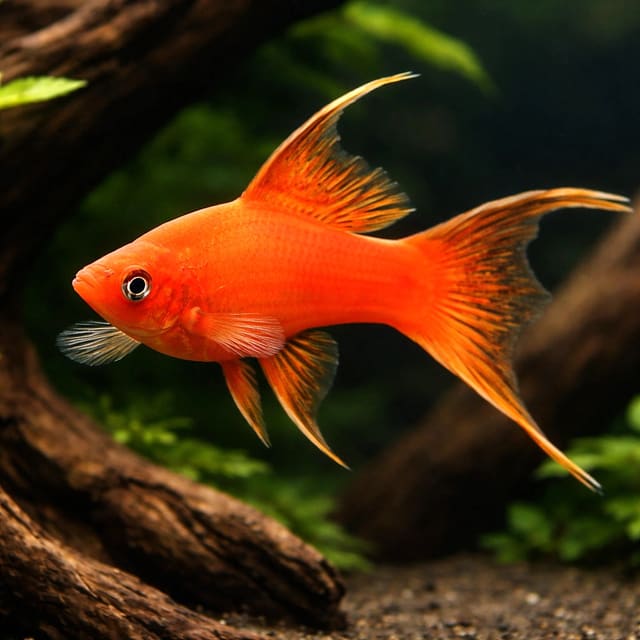
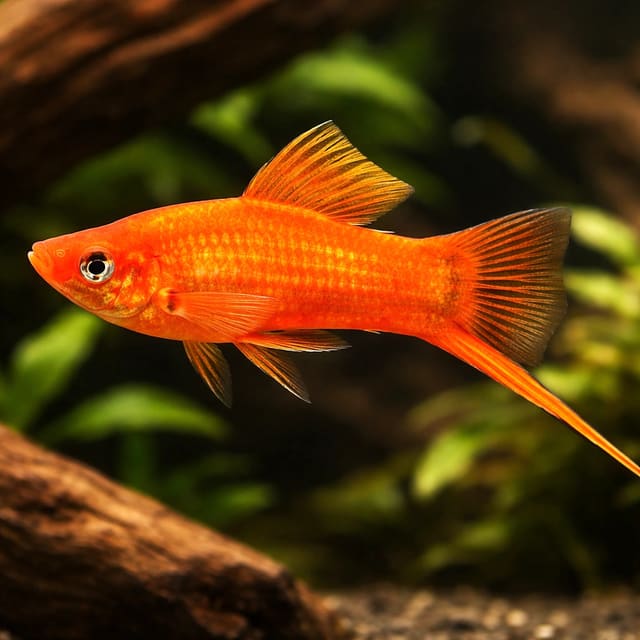
Easy
Pineapple Swordtail (Xiphophorus hellerii)
22–27°C · pH 7–8 · 108L
£5.99
Photo coming soon
The size, price and care details on this page are for this listing.
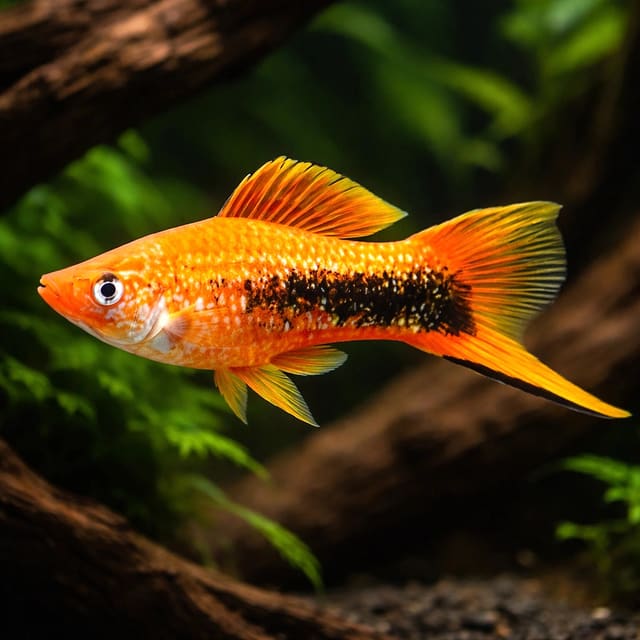
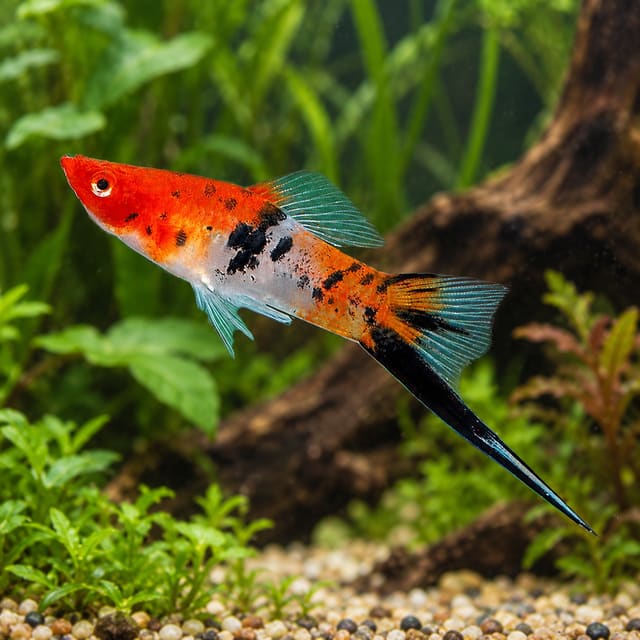
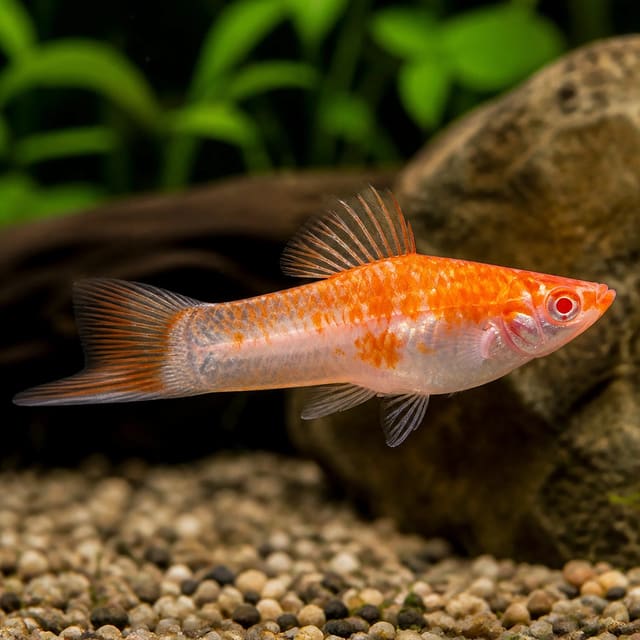
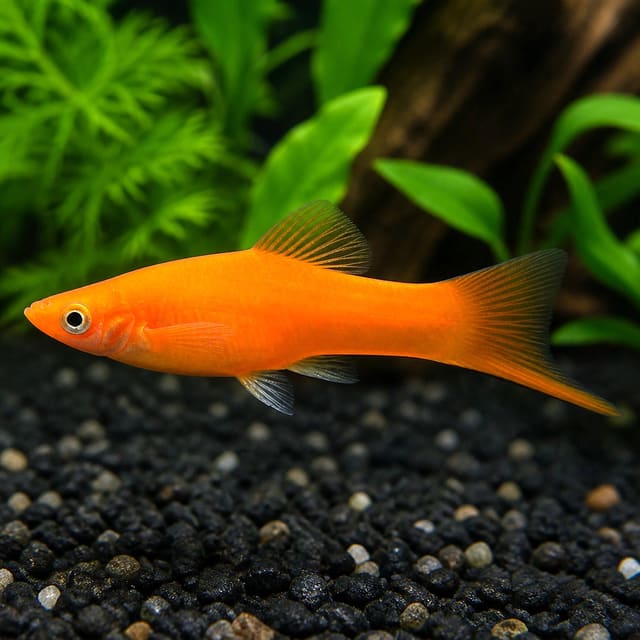
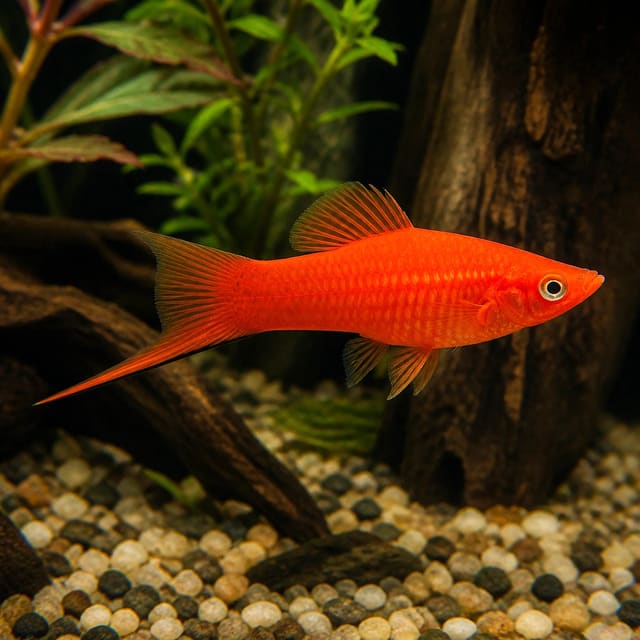
One live Pineapple Tuxedo Swordtail, a bred colour form of the green swordtail Xiphophorus hellerii; sex not specified. FishBase records adults up to 14 cm (males) and 16 cm (females) total length, so plan a 120 cm tank with hard, alkaline water at 22-28 °C and pH 7-8.
Adult size is the maximum length this species reaches at full maturity (scientific sources). The livestock you receive will be younger and smaller. Product-photo provenance and any image-specific limitations are stated on the listing.
Xiphophorus hellerii
Shoaling fish: kept in a group they feel safer, stay calmer and show their best colour.
One live Pineapple Tuxedo Swordtail, a bred colour form of the green swordtail Xiphophorus hellerii; sex not specified. FishBase records adults up to 14 cm (males) and 16 cm (females) total length, so plan a 120 cm tank with hard, alkaline water at 22-28 °C and pH 7-8.
Adult size is the maximum length this species reaches at full maturity (scientific sources). The livestock you receive will be younger and smaller. Product-photo provenance and any image-specific limitations are stated on the listing.
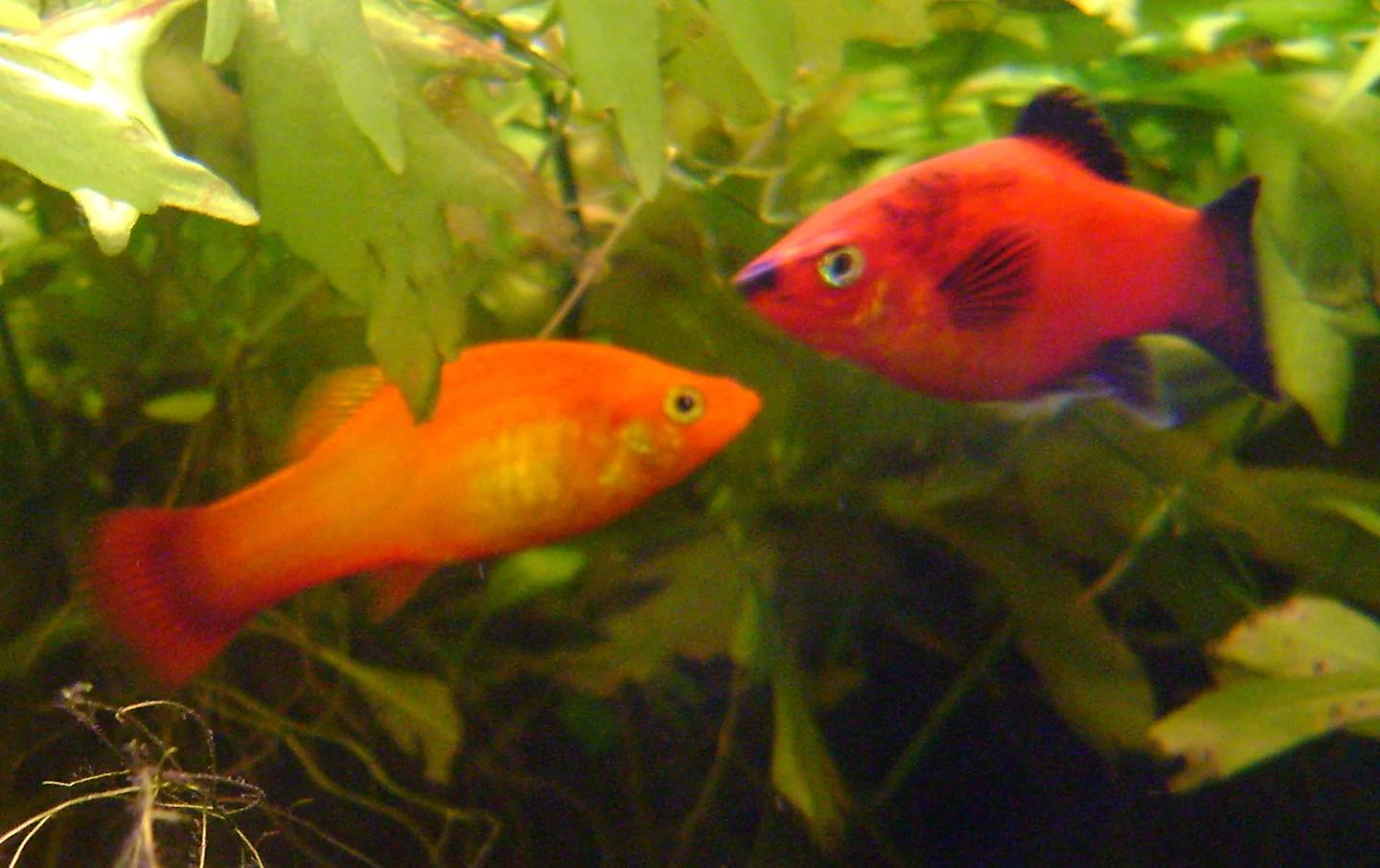
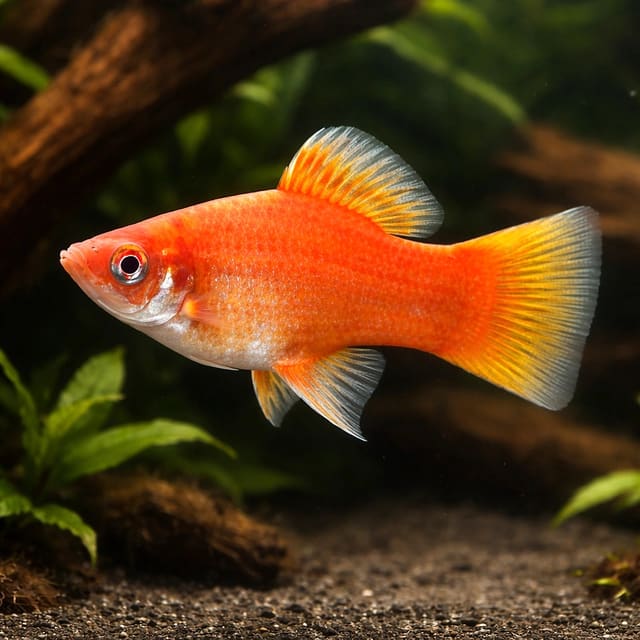
Platy is a trade name used for Xiphophorus maculatus, X. variatus and domestic forms. Start with at least three in a mature aquarium of at least 45 litres, verify the exact fish and measured water, and plan extra capacity before mixing sexes.
Maintain these water conditions for optimal health and vibrant colors
This listing is for one live Pineapple Tuxedo Swordtail, a bred colour form of Xiphophorus hellerii, the green swordtail of eastern Mexico and Central America. Each unit you order is a single fish. The listing does not state a sex, so we cannot promise you a sword-bearing male or a female. If you order several, be ready for any mix of the two; the section on group balance further down explains how to manage whatever arrives.
Seriously Fish calls the green swordtail one of the most recognisable aquarium fishes anywhere, and FishBase lists it as highly commercial in the aquarium trade. It has earned that reputation honestly. It is active from morning to lights-out, it eats almost any sensible food, and it forgives a beginner's early mistakes better than many fish. Two things have to be right from the first day, though: hard, alkaline water, and a tank long enough for a fish that ends up much bigger than most people expect when they see a youngster in a shop.
That size point deserves the most attention of anything on this page. FishBase records a maximum of 14 cm total length for males and 16 cm for females. Those are record figures, not targets, and OATA, the UK ornamental aquatic trade body, gives 8 to 12 cm as the usual adult size for swordtails. Even at the lower end, this is a long-bodied, quick fish that needs room to turn and sprint. Buy the tank for the adult, not for the small fish in the bag.
| Quick facts | Detail |
|---|---|
| Scientific name | Xiphophorus hellerii Heckel, 1848 |
| Family | Poeciliidae, the livebearers |
| Wild range | Río Nantla, Veracruz, Mexico, to north-western Honduras |
| Largest recorded size | 14 cm TL males, 16 cm TL females (FishBase) |
| Usual adult size | 8 to 12 cm (OATA) |
| Temperature | 22 to 28 °C |
| pH | 7.0 to 8.0 |
| Hardness | 9 to 19 dGH |
| Suggested tank | 120 × 30 cm base, about 108 litres |
| Diet | Omnivore with a real need for plant matter |
| What you receive | One fish per unit, sex not specified |
If you already keep platies or other swordtails, most of what follows will be familiar. If this is your first livebearer, read the water, group-balance and breeding sections before you order, because those three decide whether a swordtail tank stays calm or turns into a crowded, chasing mess within a few months.
Our stock records carry this fish under its Latin name with two colour words added, "tuxedo" and "pineapple". On this page we use the English trade form of that name, Pineapple Tuxedo Swordtail, with the spelling put right. You will very often see the species written as Xiphophorus helleri, with a single i. Wikipedia and Seriously Fish both explain that this is a misspelling: the fish honours Karl Bartholomaeus Heller, who collected the type specimen, and FishBase gives the accepted name as Xiphophorus hellerii Heckel, 1848. Same fish, correct spelling. The genus name, Wikipedia notes, is Greek for "sword bearer", a reference to the male's lengthened lower tail lobe.
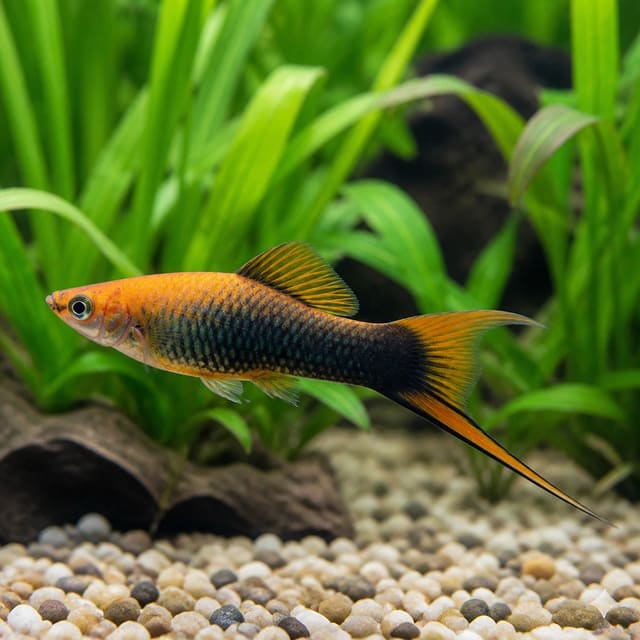
"Tuxedo" and "pineapple" belong to the ornamental side of the hobby rather than to science. Seriously Fish lists tuxedo among the long-established bred varieties of Xiphophorus, next to forms such as wagtail and Mickey Mouse. In shop use, tuxedo describes a fish carrying a large dark area over the rear half of the body, a bit like a black jacket over a coloured shirt, and pineapple describes a warm yellow-to-orange ground colour. Put together, the name tells you the colour family to expect. It is not a promise of an exact pattern. Bred swordtails vary from one fish to the next, and in any group the balance of dark and light will differ between individuals.
Colours like these are not what you would find in a wild swordtail. Seriously Fish notes that selective breeding has produced a huge range of ornamental forms whose colours, and often fin shapes, are absent from wild fish, and that some of them come from deliberate crosses with two platy species, X. maculatus and X. variatus. Wikipedia goes a step further and says most swordtails in aquariums are hybrids to some degree. That makes no difference to how you look after the fish, but it explains why swordtails and platies kept together so readily produce young together.
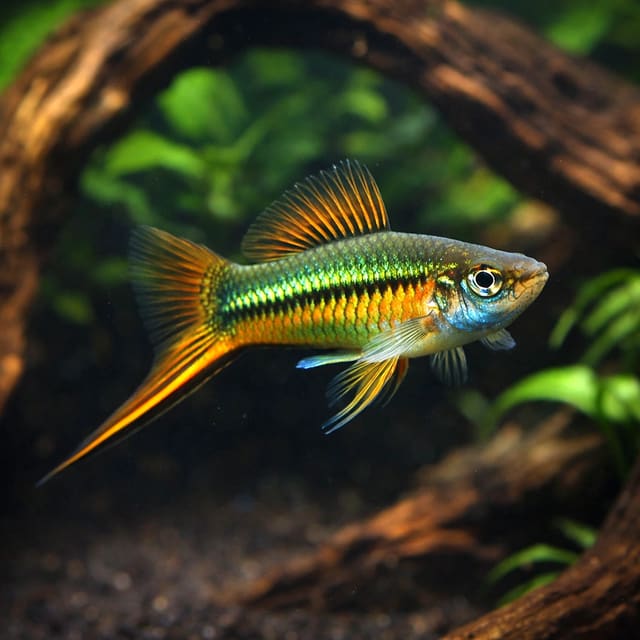
For comparison, Wikipedia describes the wild green swordtail as olive green, with a red or brown stripe along the flank and speckling on the dorsal fin, and the male's sword as yellow with a black lower edge. If you ever want a fish closer to that original look, our Green Swordtail carries the name of the wild species' colouring.
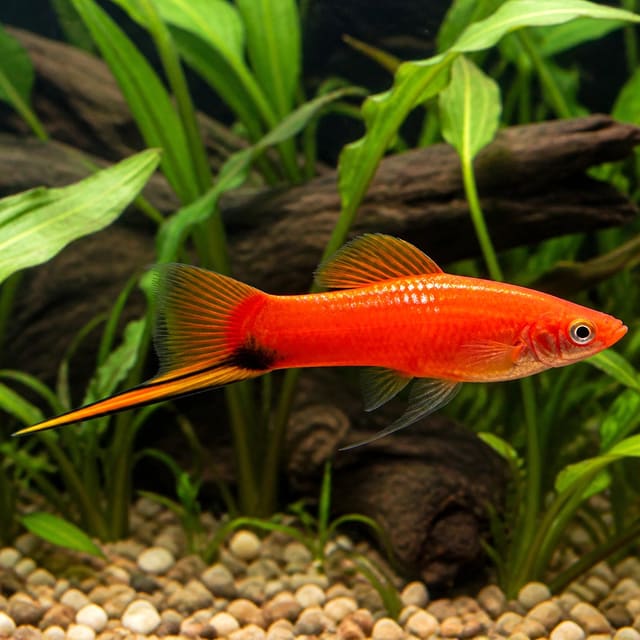
Males are the smaller sex and show two clear signs. The first is the gonopodium, the anal fin reshaped into a narrow rod that the male uses for internal fertilisation. The second is the sword itself: the lengthened lower lobe of the tail fin that gives the fish its common name. Females grow larger, have no sword, and keep a triangular anal fin, which OATA uses as the simple way to tell them apart.
Seriously Fish adds a caution for bred strains. In some ornamental forms the upper tail lobe or other fins are extended as well, and that can happen in females too, so long fins on their own do not make a fish male. Look underneath at the anal fin. A rod means male; a fan or triangle means female.
Young fish can be difficult to sex. Wikipedia gives roughly three months for swordtail fry to reach sexual maturity, and the male features build up over that time. FishBase also records a tendency in this species for females to change into males under certain environmental conditions. So if a fish you have known as a female for months starts to grow a gonopodium and a short sword, you are seeing a documented swordtail quirk, not a mix-up.
FishBase gives the natural range as North and Central America, from the Río Nantla in Veracruz, Mexico, to north-western Honduras. Seriously Fish describes it as south-eastern Mexico, Guatemala, Belize and Honduras. It is a tropical species, found roughly between 26° and 12° north of the equator.
Within that range it lives in a surprising variety of water. FishBase describes rapidly flowing streams and rivers, with a preference for heavily vegetated places. Seriously Fish widens the picture: from sea level up to around 1,500 metres, in fast, rocky streams, springs, ditches, ponds and rivers, in water that can be clear or turbid. Wikipedia also mentions warm springs and canals. FishBase records the species from both fresh and brackish water and classes it as benthopelagic, a fish that uses the zone near the bottom as well as the water above it rather than living at the surface.
In the wild it is a generalist feeder. FishBase lists worms, crustaceans, insects and plant matter in its diet; Seriously Fish adds organic detritus and algae and describes it as a generalised omnivore. That blend of small animals and greenery is exactly what we copy when feeding it in a tank.
Three practical lessons come out of that background.
That last point is worth taking seriously. Wikipedia describes the green swordtail as a nuisance where it has been introduced, with feral populations established in several countries, including parts of southern Africa, and ecological damage put down to how quickly it breeds in large numbers. FishBase also lists established populations in Africa. Never release aquarium fish, their young, plants or tank water into ponds, rivers, streams or drains. If you end up with more swordtails than you can house, rehome them through a local shop or aquarium club.
In its home range the species is not under threat. FishBase shows it as Least Concern on the IUCN Red List, assessed in 2018, and notes its long use in genetics research as well as in the aquarium trade. Seriously Fish mentions its importance in behavioural, genetic and biomedical studies too, which is part of why so much is known about how swordtails choose mates and settle disputes.
Seriously Fish recommends a minimum base of 120 × 30 cm, about 108 litres, for this species. OATA's care sheet sets a lower floor of 80 litres for swordtails. We would steer you towards the larger figure. Length is what a swordtail uses most: it patrols the front of the tank, turns quickly, and a male that wants to keep out of a rival's way needs distance and cover to do it. A 120 cm tank also gives you room for the several females you will want if a male is part of the group.
If your tank is shorter than that, think again about swordtails, or plan an upgrade before the fish fill out. A cramped swordtail tank tends to show its problems as chasing, torn fins and stressed females long before the fish look obviously too big.
Seriously Fish says the species tends to look its best in a heavily planted set-up with a dark substrate, and that it appreciates floating plants and driftwood. For a wild-style tank they suggest an arrangement like a flowing stream, with water-worn rocks and small boulders. For a bred colour form like this one, the planted route usually works better. Dark gravel and green leaves give a warm yellow or orange fish something to stand out against, and the shade under floating plants is welcome.
Plant thickly along the back and sides and leave a clear swimming lane along the front glass. Fine-leaved stems, bushy clumps and a raft of floaters do two jobs: they give females somewhere to rest from a persistent male, and they give any newborn fry a fighting chance. Wikipedia points out that newborn swordtail fry will be eaten by other tank inhabitants if they cannot find shelter, so cover is not just decoration in a livebearer tank.
According to Seriously Fish, filtration does not need to be especially powerful, but the fish appreciates some water movement. A filter rated for the size of the tank, with its outlet set to push a gentle current along the length, does the job. If you hope to raise any young in the main tank, cover the filter intake with a sponge so fry are not drawn in.
The temperature range for this species is 22 to 28 °C, so unless your room stays warm day and night all year round, you need a heater with a thermostat. Set it in the middle of the range and fit a thermometer you can read at a glance. A cover glass helps hold the heat in and cuts evaporation.
Swordtails come from hard, alkaline water and they do best when the tank matches it. Our three main care sources agree on pH and broadly agree on temperature, but they quote different hardness figures. Here is how they compare.
| Parameter | FishBase | Seriously Fish | OATA care sheet |
|---|---|---|---|
| Temperature | 22 to 28 °C | 16 to 28 °C | 22 to 27 °C |
| pH | 7.0 to 8.0 | 7.0 to 8.0 | 7.0 to 8.0 |
| Hardness | 9 to 19 dH | 10 to 25 dGH | GH 4 to 12, KH 3 to 10 |
For temperature, the range FishBase and OATA share, 22 to 27 °C, is the sensible working band, and setting the heater around the middle of it gives you a margin either side. Seriously Fish's lower figure of 16 °C shows what the species can tolerate, not what a heated home aquarium should run at.
For hardness, the care specs on this listing follow FishBase at 9 to 19 dGH. OATA's lower general hardness range tells you swordtails cope in moderately hard water too, while Seriously Fish's upper figure of 25 dGH shows they are comfortable in very hard water. The message from all three is the same: moderately hard to hard, alkaline water suits this fish, and very soft, acidic water does not.
Test your tap water, or look up the hardness your water company publishes for your postcode, before you buy. If it already sits in the hard, alkaline range, you are set. If it is soft, talk to us or your local aquatic shop about raising hardness safely before the fish arrive, and make sure you can repeat the same result at every water change. Swings in pH and hardness do more harm than a steady value at the edge of the range.
OATA's targets for swordtails are zero ammonia, zero nitrite, and nitrate no more than 20 mg per litre above your tap water level. Their care sheet recommends testing at least once a week and a 25 per cent partial water change at least once a week. That is a good routine for this fish:
A word on salt. FishBase lists this species from brackish as well as fresh water, but that is a note about its wild tolerance, not an instruction. None of our care sources ask for salt in the aquarium, and the freshwater figures above are what to aim for.
Swordtails are easy to feed, which is one reason they suit first tanks. In the aquarium Seriously Fish describes them as unfussy, taking dried foods, live Daphnia and Artemia, and frozen bloodworm. OATA's advice for platies and swordtails is a flake or granule food with a high algae content as the staple, with live or frozen foods such as daphnia and bloodworm added, fed once a day in amounts the fish can eat within a few minutes.
The plant side of the diet matters. In the wild, FishBase and Seriously Fish both list algae and plant matter alongside insects, worms and crustaceans, and a swordtail fed only on meaty foods misses part of what it is built to eat. A spirulina or vegetable flake as the daily base covers that easily.
Watch the feeding rather than tipping food in and walking away. Uneaten food breaks down into ammonia, and overfeeding is the commonest reason a swordtail tank's water goes downhill. If flakes are drifting to the gravel untouched, you are giving too much.
A swordtail's appetite is also one of the best health checks you have. A fish that rushes to the front at feeding time is usually a fish that is doing well. One that hangs back, spits food out, or stops eating for more than a day or two needs a closer look, and the health section below covers what to check first.
If fry appear, crush a pinch of the adults' flake to a fine powder between finger and thumb and offer it in small amounts several times a day, alongside whatever they find among the plants. Take care not to foul the water while you do it: a smaller water change more often helps when you are feeding fry heavily.
In the first few days after arrival, keep meals small. A newly moved fish may ignore food for a day while it settles. Offer a little once a day, remove anything left after a few minutes, and let appetite return at its own pace.
In a tank of the right size, swordtails make good community fish. Wikipedia notes that it has been bred into so many aquarium forms because of its hardiness and suitability for community tanks, and Seriously Fish rates it as suitable for community aquariums. The friction, when there is any, usually comes from within the species.
Seriously Fish notes that in confined spaces, groups of males tend to form dominance hierarchies and may spend a large share of their time holding their positions. Males also pursue females to mate, often persistently. Wikipedia recommends one male to three or four females so that no single female is harassed; OATA suggests keeping at least three swordtails together, with two females to each male, and adding more in that same proportion.
Because this listing does not state a sex, give some thought to numbers before you order. A single swordtail on its own is not ideal, as OATA's minimum is three. If you buy several and end up with more males than you want, the fixes are straightforward: a longer tank, more planting to break up sight lines, more females, or rehoming the surplus males. Do not let an outnumbered female stay in a tank where she is chased constantly; it wears fish down.
Swordtail courtship is more interesting than it first looks. Seriously Fish summarises research showing that females choose between males on sword length, colour pattern, body size, vertical barring, chemical cues and particular courtship displays. Wikipedia reports that the presence of a male with a well-developed sword speeds up the maturing of females, while holding back the maturing of young males nearby. In a home tank, that can mean young males look like females for longer while a well-finned male is present.
Pick companions that want the same hard, alkaline water and are lively enough not to be bothered by a busy swordtail. Platies are the obvious partners: OATA covers platies and swordtails in a single care sheet with the same pH range, and both belong to the same genus. Our Red Tuxedo Platy is one of those smaller relatives. Remember that swordtails and platies cross readily, as Wikipedia notes, so if you want to keep the Pineapple Tuxedo line unmixed, keep them in separate tanks.
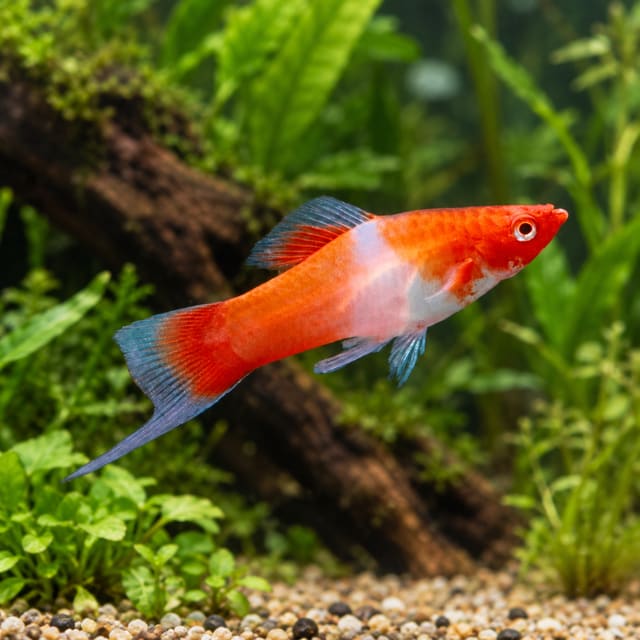
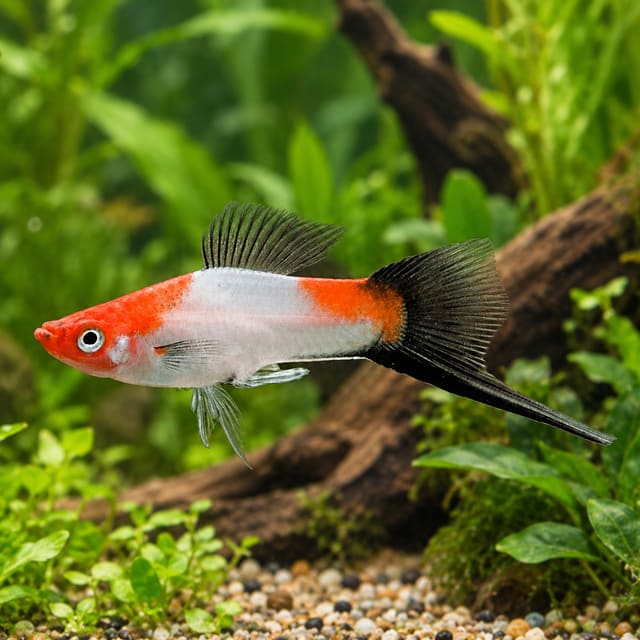
Other swordtail colour forms are the same species and will happily share a tank. Our Pineapple Swordtail and Swordtail Tuxedo are two of them. Mixing colour forms is fine for a display tank, but expect mixed-looking young if they breed.
Swordtails are livebearers. The male fertilises the female internally with his gonopodium, and she gives birth to free young rather than laying eggs. FishBase gives a gestation of 24 to 30 days and broods of 20 to 200 young; OATA's care sheet quotes 20 to 80 fry, which is closer to what most home aquariums see. Wikipedia describes swordtails as some of the easiest fish for an amateur to breed: with males and females in the same suitable tank, it happens without any help.
Two facts catch new keepers out. Seriously Fish notes that females can store viable sperm for months, so a female can give birth to more than one brood without a male in the tank. And Wikipedia points out that all-female groups taken from a mixed tank are often pregnant when they arrive. If you buy a female, there is a fair chance she will produce young at some point even if you never keep a male.
According to Wikipedia, later stages of pregnancy are easy to see, because a dark gravid spot develops near the anal fin. The female also becomes visibly heavier through the belly as her brood grows. On a bred fish with dark rear colouring the spot may be harder to pick out, so watch body shape as well.
Wikipedia is blunt about what happens to unprotected fry: they will be eaten by other tank inhabitants if they cannot find shelter. Adult swordtails are part of that problem. You have three sensible options:
Wikipedia gives around three months for fry to reach sexual maturity, so a pair of broods can turn a small group into a crowded tank within a single season. Before you let swordtails breed freely, decide where the young will go. Local aquatic shops and aquarium clubs are the usual routes. Never release them into the wild; the species' track record as an invasive fish abroad is a direct result of exactly that.
If you keep swordtails and platies together, they can produce hybrid young. Keep colour forms in separate tanks if you want young that resemble a particular parent strain.
Most swordtail health problems start with the water or the group, not with a disease out of nowhere. Keep the water clean and steady, keep the male-to-female balance sensible, and you head off most trouble before it begins.
OATA lists the marks of a healthy platy or swordtail as clear, bright eyes, undamaged fins, intact scales, and no ulcers or bumps. Add to that a fish that swims freely through the tank, holds its fins open and comes up eagerly at feeding time.
OATA flags changes in swimming, changes in colour, clamped fins and flicking or rubbing against the gravel as signs that something is wrong. When you see any of those:
A swollen belly and a dark spot near the anal fin in a female usually mean pregnancy, not illness. A female that slowly grows a gonopodium and a short sword is showing the sex reversal FishBase records for this species. Neither needs treatment.
Xiphophorus fish have been studied for nearly a century as a model for skin cancer. A 2024 review in the journal Disease Models & Mechanisms explains that certain platy and swordtail hybrids develop malignant melanoma, and that it is rarely seen in pure-bred fish. We know of no figures for any particular aquarium colour form. The practical point is simple: get to know your fish's markings in its first few weeks. A dark area that stays flat and changes only slowly with age is just colour; one that becomes raised, lumpy or spreads quickly is a reason to ask a vet.
OATA notes that these fish can live several years in a well-matured set-up with good water quality, so the routine you set up in the first month is the one your swordtail will live with for a long time.
Before you order, read our delivery and live-arrival information. Your aquarium must be ready before the parcel comes: filter running, water tested and the temperature matched to what the fish needs. Someone has to be at the delivery address to take in live animals, so pick a day when you will be home.
Fish travel in oxygen-filled bags inside insulated packaging, with heat packs when conditions call for them, and go by a tracked courier licensed to carry live animals. We email you the confirmed delivery date and the tracking details.
Our live-arrival policy depends on a continuous unboxing video, so set your phone up before you touch the box.
Photos on their own do not meet the policy. Where a claim is accepted, we replace the affected fish with your next order or refund it, subject to the guarantee terms.
Keep the lights low for the rest of the first day and leave the fish to explore. Over the following week, watch three things: breathing, appetite and behaviour. Steady gill movement, interest in food within a day or two, and a fish swimming through the open water rather than pressed into a corner are all good signs. Feed lightly, test the water a couple of times that week, and hold off adding any more fish until everyone has settled. If anything worries you, contact us.
These are the sources behind the facts on this page. They are worth reading if you want to go deeper into swordtail care and biology.
No reviews for this item yet. Bought one? Honest reviews only, good or bad.
What customers say about ordering from us
Easy website plenty of info on fish your buying great to pick a time slot
TRACEY DURRANT · 7 Oct 2026
Got some lovely fish thank you
Kevin Mackie · 7 Oct 2026
Reviews of our shop, collected by Judge.me, an independent third-party review collector. Newest first.