Easy
Platy Red (Xiphophorus maculatus red)
20–25°C · pH 7–8 · 54L
£4.99
Photo coming soon
The size, price and care details on this page are for this listing.
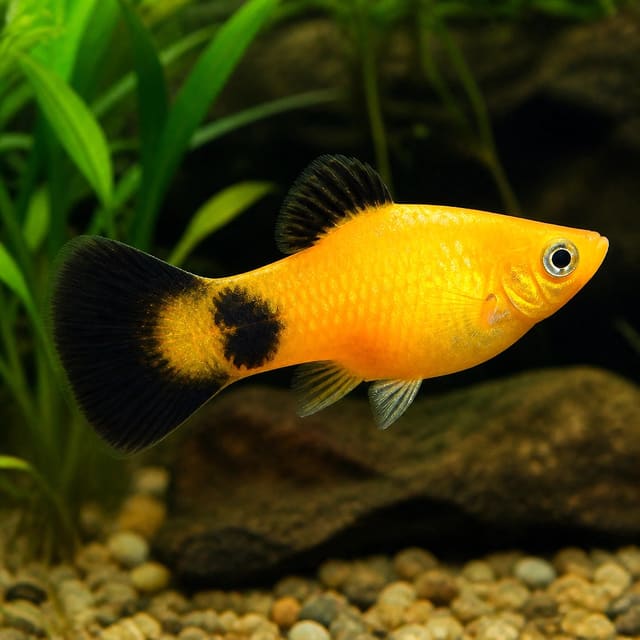
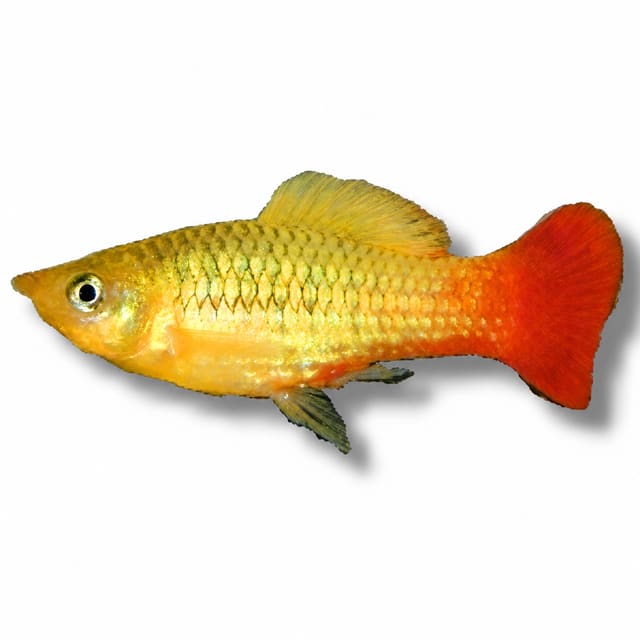
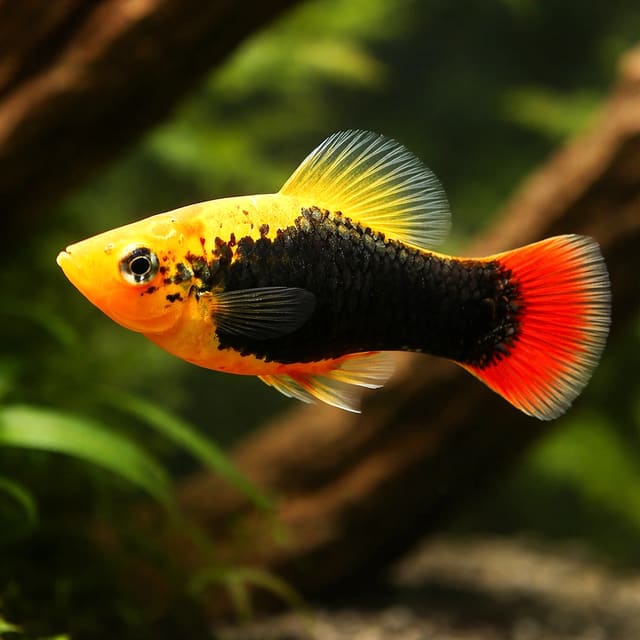
Platy Yellow tuxedo (Xiphophorus maculatus) is a peaceful, yellow tuxedo-patterned platy for hard, alkaline community aquariums, sold as one fish per purchase at 3–4 cm or 3 cm. It breeds readily, so plan for more females than males and for young appearing in a mixed group.
Adult size is the maximum length this species reaches at full maturity (scientific sources). The livestock you receive will be younger and smaller — pick a size above for the actual shipping size. Product-photo provenance and any image-specific limitations are stated on the listing.
Xiphophorus maculatus
Shoaling fish: kept in a group they feel safer, stay calmer and show their best colour.
Minimum of 2 per order.
Platy Yellow tuxedo (Xiphophorus maculatus) is a peaceful, yellow tuxedo-patterned platy for hard, alkaline community aquariums, sold as one fish per purchase at 3–4 cm or 3 cm. It breeds readily, so plan for more females than males and for young appearing in a mixed group.
Adult size is the maximum length this species reaches at full maturity (scientific sources). The livestock you receive will be younger and smaller — pick a size above for the actual shipping size. Product-photo provenance and any image-specific limitations are stated on the listing.
Platy is a trade name used for Xiphophorus maculatus, X. variatus and domestic forms. Start with at least three in a mature aquarium of at least 45 litres, verify the exact fish and measured water, and plan extra capacity before mixing sexes.
Maintain these water conditions for optimal health and vibrant colors
The Platy Yellow tuxedo is a yellow, tuxedo-patterned colour form of the platy, Xiphophorus maculatus. Platies are small, peaceful livebearers: the females give birth to live young, and a mixed group will breed in an ordinary community aquarium with no special effort. Tuxedo is one of the dozens of selectively bred platy varieties, alongside forms such as mickey mouse, wagtail, moon, comet and hi-fin.
Platies earn their reputation as a good first livebearer, with one firm condition: the water must be moderately hard or harder, with a pH above neutral. In soft, acidic water this species does not thrive. If your tap water is hard, a platy is one of the easiest colourful fish you can add to a community. If it is soft, check your readings before you order.
The other thing to plan for is young. Seriously Fish describes breeding this species as a question of "when" rather than "how", and batches of fry are continual when males and females share a tank. That can be a pleasure or a problem, depending on your space, so decide before you buy what you will do with the young.
It is a weaker fit for soft-water setups, and for anyone who wants a tank that never produces fry but cannot choose the sex of the fish.
| Suits | Community keepers with moderately hard, alkaline water, including careful beginners |
|---|---|
| Species | Xiphophorus maculatus, family Poeciliidae |
| Adult length | About 5 cm standard length (Seriously Fish) |
| Water | 20–26 °C, pH 7.0–8.2, 10–30 dGH |
| Temperament | Very peaceful; males tolerate one another |
| Group | At least three, with more females than males |
| Breeding | Very easy; expect fry in a mixed group |
| Sold unit | One live fish per purchase |
|---|---|
| Sizes listed | 3–4 cm and 3 cm |
| Sex | Not selectable |
| Adult length | About 5 cm standard length |
Each purchase supplies one live fish of the size you choose. Two sizes are listed for this platy: 3–4 cm and 3 cm. The size you select is the size supplied, not the adult size. For comparison, Seriously Fish gives an adult length of 5 cm standard length, and OATA's broader guidance says platies generally stay at 6–8 cm, so plan space for adults rather than for the size that arrives. Which sizes can be ordered changes over time, so use the size choice on this page to see what you can buy.
Because each purchase is a single fish, you build the group yourself. OATA suggests at least three platies kept together, so most keepers order several fish, and a newly matured aquarium is best stocked a few fish at a time.
Sex is guaranteed only when the selected option explicitly states male or female. This Platy Yellow tuxedo listing has no sex-guaranteed option. Male platies carry a gonopodium, a modified anal fin, while females have a triangular anal fin, and males are generally the smaller sex. A group bought together can therefore turn out to be any mix of males and females, which matters for both harmony and breeding.
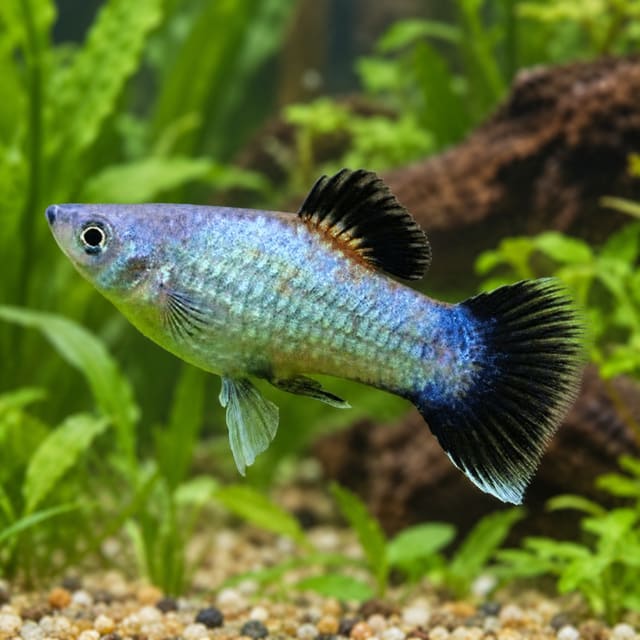
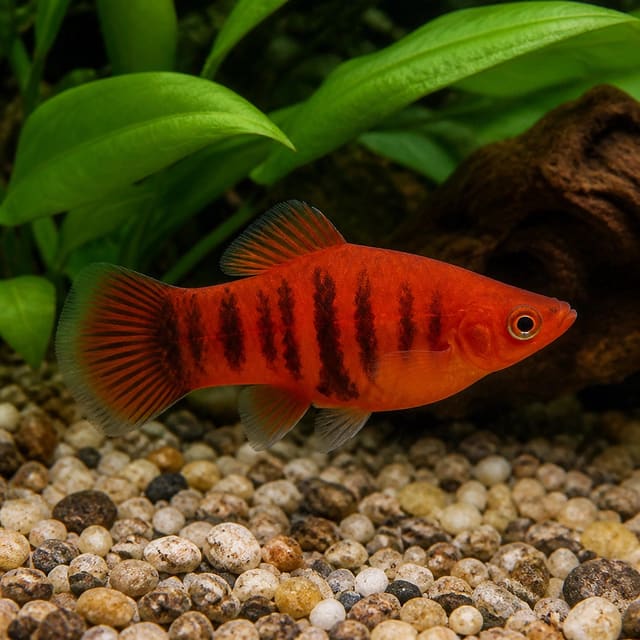
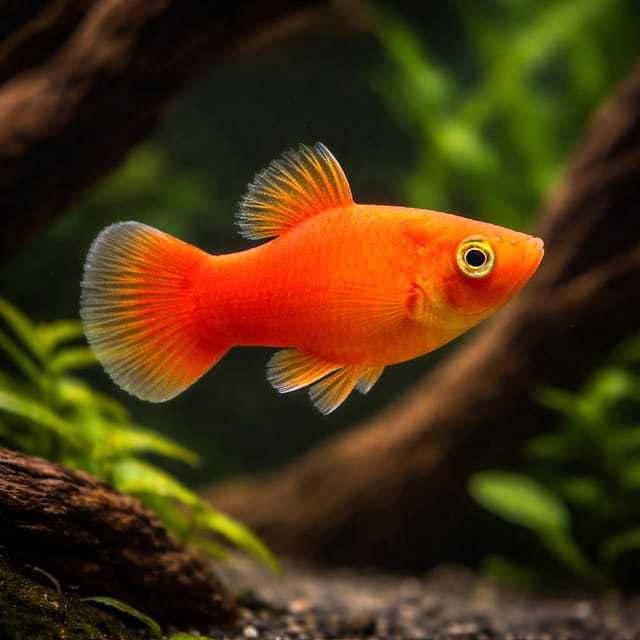
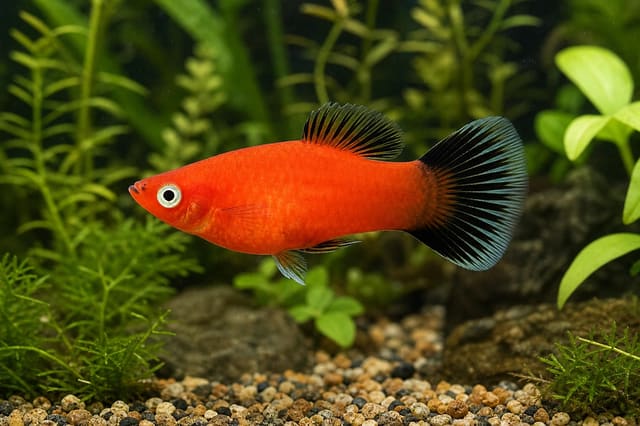
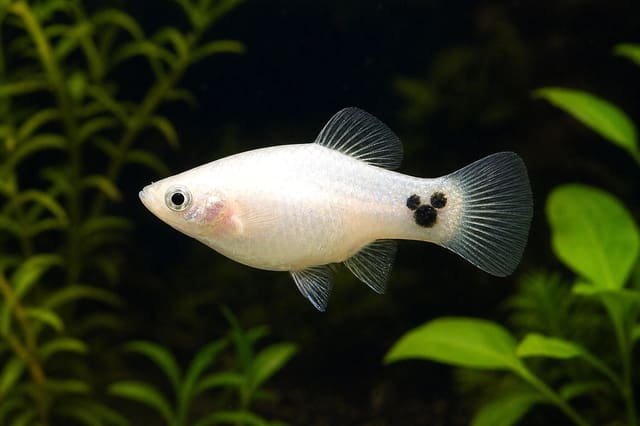
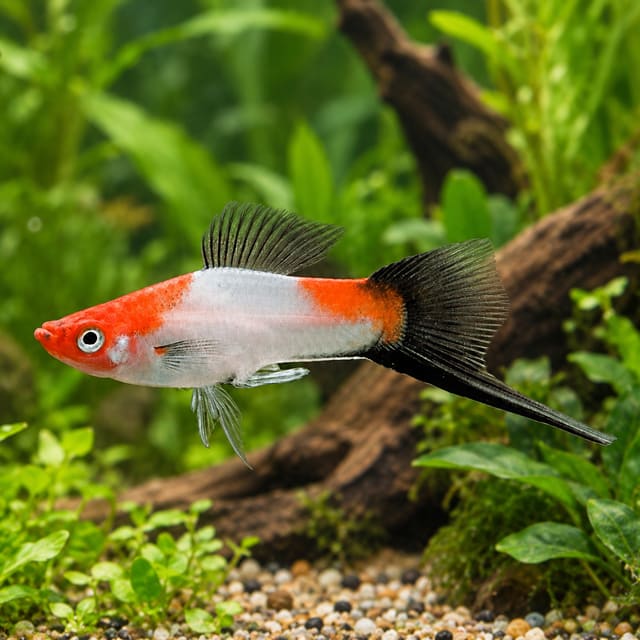
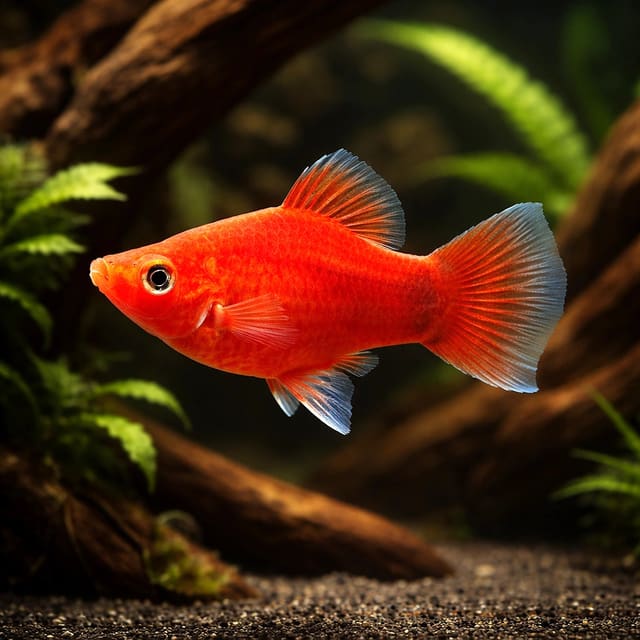
Gallery images have been digitally enhanced to improve image quality. Natural colour, pattern, size and maturity can vary between live animals. Expect the tuxedo marking on your fish to differ in detail from the photographs.
Platies come in many colour forms, and you can see the others we keep in our platy fish collection. Colour forms of Xiphophorus maculatus can share a tank, but they will interbreed if you mix them.
Xiphophorus maculatus comes from North and Central America. FishBase gives its range as Ciudad Veracruz in Mexico to northern Belize. Wild adults live in warm springs, canals and ditches with typically slow-moving water, silt bottoms and weedy banks, and they also inhabit creeks and swamps. There they feed on worms, crustaceans, insects and plant matter.
The platy is a laboratory fish as well as an aquarium favourite: FishBase notes that it is used in genetic research and that several colour varieties are popular aquarium fishes. Seriously Fish calls it a massively popular aquarium fish with dozens of selectively bred varieties, and notes that wild fish are almost never seen in the hobby. OATA adds that most platies in the aquarium trade are now captive bred.
FishBase lists the species as Data Deficient on the IUCN Red List.
Platies move quickly from new arrivals to a breeding group, so it helps to know what the first months usually bring.
Keeping a simple note of test results and births makes it easy to spot a trend, such as rising nitrate as the group grows, before it turns into a problem.
A platy is a small fish, but a group that breeds needs more room than its adult size suggests. Seriously Fish recommends an aquarium base of at least 60 × 30 cm, which is about 54 litres at 30 cm deep, and FishBase gives a minimum aquarium size of 60 cm. OATA recommends at least 45 litres for a small group of platies and reminds keepers that the more fish you keep, the larger the volume you need. A larger tank also keeps temperature and water quality more stable.
A filter is essential in any aquarium. Fish release ammonia, which is toxic; a working biological filter lets beneficial bacteria turn it into nitrite, also toxic, and then into nitrate, which is safer. The RSPCA explains the nitrogen cycle and why no fish should be kept without a well set up and maintained filter. For a tank of about 54 litres, Seriously Fish suggests a filter rated at 215–270 litres per hour, giving four to five turnovers an hour, and a heater of roughly 50 W in a room around 20 °C.
In the wild, platies live in slow-moving water, so a filter that turns the water over well without creating a strong current suits them.
New to fishkeeping? Our step-by-step guide to setting up a tropical fish tank covers choosing equipment and maturing the filter before the first fish go in.
Hardness is the one part of platy care you cannot skip. Seriously Fish states that Xiphophorus maculatus must be kept in moderately hard or harder water and will not thrive in soft, acidic water. It also rates the platy one of the best species available to the beginner, as long as the pH stays above neutral.
| Temperature | 20–26 °C |
|---|---|
| pH | 7.0–8.2 |
| General hardness | 10–30 dGH |
| Ammonia and nitrite | Zero |
| Nitrate | No more than 20 mg per litre above your tap water level |
Temperature, pH and hardness are the Seriously Fish values for the species; the ammonia, nitrite and nitrate limits come from OATA's care sheet.
General hardness is a measure of dissolved minerals such as calcium and magnesium; carbonate hardness is a measure of the buffering that steadies pH. OATA's group sheet gives 3–10 °dKH carbonate hardness for platies and swordtails. For a fish that needs its pH above neutral, keeping some carbonate hardness in the water helps stop the pH sliding downwards between water changes.
Test your tap water for general hardness, carbonate hardness and pH. If the numbers are unfamiliar, our aquarium water parameters guide explains each one. The water parameter matcher then compares your readings with the values above, so you can see at a glance whether your water suits a platy as it is.
If your tap water reads below 10 dGH or below pH 7.0, a platy will struggle unless you adjust the water, and any adjustment then has to be repeated in exactly the same way at every water change. In hard-water areas this is rarely an issue, which is why platies are such a natural choice there.
Hold the temperature steady within 20–26 °C rather than letting it swing, and make every top-up and water change match the tank's hardness and pH, so the fish never meet a sudden shift.
Platies are easy to feed. FishBase records that wild Xiphophorus maculatus feed on worms, crustaceans, insects and plant matter, and Seriously Fish describes aquarium fish as unfussy, accepting most frozen, live and dried foods. OATA calls platies omnivorous fish that take most food types.
OATA advises feeding platies only what they can eat within a few minutes once a day. Overfeeding leaves food to rot, which releases toxic waste into the water. In a breeding group it is tempting to feed more for the fry; keep portions small and let uneaten food be the signal to cut back.
Because platies take most foods, they fit easily into a mixed community's routine. Include some plant content in the diet: FishBase lists plant matter in the wild diet, and OATA recommends a granule with a high algae content. Spread food so that every fish gets a share, and offer powdered flake if young platies are growing up in the main tank.
Watch the group at feeding time. Every fish should come to the food, and one that hangs back or stops eating is worth a closer look and a water test.
Platies have a reputation for toughness, but it is worth being realistic. Seriously Fish warns that many commercially bred platies are not very hardy because of inbreeding and over-production, and are prone to disease and premature death. Good water, a mature tank and a calm community give any platy its best chance.
OATA's platy and swordtail care sheet lists the changes that often come before illness:
If you see any of these, test your water quality first, then seek advice.
Not every problem in a platy tank is a water problem. Where males outnumber females, the females may show the temperament change on OATA's list, hiding more than normal. Seriously Fish describes the males' attention as potentially relentless, so if the females spend their time hiding, rebalance the sex ratio before looking for illness.
Our team hand-bags your platy in pure oxygen and packs it in an insulated poly box, with a heat pack when the weather calls for it. You receive an email with the tracking number and confirmed delivery date, and a courier legally licensed to carry live fish brings the parcel. The delivery and Live Arrival Guarantee page sets out the full policy.
Add new fish only to an aquarium in which ammonia and nitrite read zero, and increase numbers gradually. The filter's bacteria need time to catch up whenever more fish are added and feeding increases; adding too many at once can trigger new tank syndrome, when ammonia and nitrite climb to harmful levels.
A healthy new platy has clear, bright eyes, undamaged fins, intact scales and no ulcers or bumps. Check each new fish against that list over its first days, and watch that it feeds.
Platies breed so readily that the useful question is what you will do with the young. FishBase notes that aquarium platies reach sexual maturity after three to four months and reproduce easily, and Seriously Fish rates breeding as very easy, happening in the community tank without any help.
A separate tank for a pregnant female and her young should have a mature filter and the same hard, alkaline water as the main aquarium, so she can return without a change in conditions. Feed the fry small amounts of brine shrimp nauplii or powdered flake and keep up regular water changes. Because young platies reach maturity within three to four months, decide early whether you will separate young males from females or rehome them.
Seriously Fish's advice for keepers who are not interested in breeding is to buy only male fish. Because this listing is not sexed, you cannot choose males only, so plan for young: a larger tank, dense planting to ease pressure from the males, and a plan to rehome surplus fish. Never release platies or their young into ponds, rivers or drains; FishBase records that at least one country reports adverse ecological effects after introduction.
Some platy varieties were produced by crossing with Xiphophorus helleri or Xiphophorus variatus. If you keep a Yellow tuxedo with other platies, they will interbreed, and the young may not show a matching tuxedo pattern.
Temperament is where platies shine. Seriously Fish describes Xiphophorus maculatus as very peaceful and suitable for most community species, noting that it shows none of the aggression of some swordtails and mollies and that even males tolerate one another. OATA likewise describes platies as generally peaceful and compatible with other species.
| Good choices | Peaceful community fish that share moderately hard, alkaline water |
|---|---|
| Use caution | Large swordtails, which can be boisterous and may chase more timid tankmates |
| Avoid | Species that need soft, acidic water |
Because platies need hard, alkaline water, the first filter for any companion is chemistry, not temperament. A peaceful soft-water species and a platy will not both be at their best in the same tank, whichever way you set the water.
The main source of trouble in a platy tank is not fighting but courtship. Seriously Fish warns that the males' attention to females can be relentless when the sexes share a tank. Dense planting gives females somewhere to rest, and the right sex ratio, covered below, spreads the attention more thinly.
Platies are often kept with other livebearers, and a few points help that mix work.
With non-livebearers, the same two rules apply: choose peaceful species, and choose species that want moderately hard, alkaline water. Start with the water, then look at size and temperament.
Platies need company. OATA suggests keeping at least three together, with two females to each male, to reduce stress on females and other tank inhabitants, and adding further fish in the same ratio. Seriously Fish goes further, recommending several females to every male to dissipate vigorous harassment.
In an aquarium near the Seriously Fish minimum of a 60 × 30 cm base, a trio or a small group leaves room for the young that a mixed group produces. In a larger tank you can keep more, but OATA's rule still applies: add fish in the two-females-to-one-male ratio, add them gradually so the filter keeps pace, and remember that the more fish you keep, the larger the volume they need.
Because sex cannot be chosen here, the mix you receive is down to chance. Males become easy to tell apart as they mature by the gonopodium and their smaller size. If you end up with more males than females, add females or rehome a male rather than leaving the females under constant pressure.
Seriously Fish gives 5 cm standard length for the species and FishBase records a maximum of 4 cm total length, while OATA's broader guidance says platies generally stay at 6–8 cm. Males are generally smaller than females.
Seriously Fish suggests an aquarium base of at least 60 × 30 cm, about 54 litres, and FishBase gives a minimum aquarium size of 60 cm. OATA recommends at least 45 litres for a small group of platies, and a larger tank gives steadier conditions and room for the young that a mixed group produces.
Keep at least three, with two females to each male as OATA suggests. Seriously Fish recommends several females to every male because the males' attention can be relentless. Sex cannot be chosen when you order, so be ready to rebalance the group once males can be recognised.
Yes, provided your water is hard and alkaline. Seriously Fish calls this species one of the best available to the beginner as long as the pH stays above neutral, but it also warns that many commercially bred platies are not very hardy and are prone to disease, so start with a mature tank and steady water quality.
Platies are unfussy omnivores. Use a good-quality flake, or a granule with a high algae content, as the everyday food, and add small live or frozen foods such as daphnia, small bloodworm or tubifex. Feed only what they eat within a few minutes once a day.
Seriously Fish gives 20–26 °C, pH 7.0–8.2 and 10–30 dGH, and states that the species must be kept in moderately hard or harder water because it will not thrive in soft, acidic water.
No. Seriously Fish describes the species as very peaceful, without the aggression of some swordtails and mollies, and notes that even males tolerate one another. The behaviour to manage is males pursuing females, which a group with more females than males eases.
Seriously Fish says the species can be kept with most community species, and OATA describes platies as generally compatible with other species. Choose fish that share hard, alkaline water, and take care with large swordtails, which can be boisterous and may chase more timid tankmates.
Our team hand-bags each fish in pure oxygen inside an insulated poly box, adding a heat pack when the weather calls for it, and a tracked, licensed live-animal courier delivers it. Be at the address to receive the parcel, and open it the same day while recording a continuous unboxing video that starts with the parcel sealed and ends on the fish in its sealed bag, because the Live Arrival Guarantee needs that video for any claim. Float the bag for 20–30 minutes before releasing the fish, and never pour the bag water into your tank.
No reviews for this item yet. Bought one? Honest reviews only, good or bad.
What customers say about ordering from us
Easy website plenty of info on fish your buying great to pick a time slot
TRACEY DURRANT · 7 Oct 2026
Got some lovely fish thank you
Kevin Mackie · 7 Oct 2026
Reviews of our shop, collected by Judge.me, an independent third-party review collector. Newest first.