−14%
Moderate
Gold Gourami (Trichopodus trichopterus)
24–28°C · pH 6–8 · 81L
£2.99£4.99

The Three-Spot Gourami Mix (Trichopodus trichopterus) is a freshwater gourami from the Mekong basin that reaches 15 cm SL. It suits keepers planning an 81-litre planted aquarium and stable values within the FishBase and Seriously Fish overlap of 24–28°C, pH 6.0–8.0 and 5–19 dGH. Sold individually in sizes from 2–3 cm to 8–9 cm.
Adult size is the maximum length this species reaches at full maturity (scientific sources). The livestock you receive will be younger and smaller — pick a size above for the actual shipping size. Product-photo provenance and any image-specific limitations are stated on the listing.
Trichopodus trichopterus
Save when buying multiple fish. Each quantity is one fish; sex and pair formation are not guaranteed unless the selected variant explicitly states them.
Minimum of 2 per order.
The Three-Spot Gourami Mix (Trichopodus trichopterus) is a freshwater gourami from the Mekong basin that reaches 15 cm SL. It suits keepers planning an 81-litre planted aquarium and stable values within the FishBase and Seriously Fish overlap of 24–28°C, pH 6.0–8.0 and 5–19 dGH. Sold individually in sizes from 2–3 cm to 8–9 cm.
Adult size is the maximum length this species reaches at full maturity (scientific sources). The livestock you receive will be younger and smaller — pick a size above for the actual shipping size. Product-photo provenance and any image-specific limitations are stated on the listing.
Maintain these water conditions for optimal health and vibrant colors
The Three-Spot Gourami Mix is Trichopodus trichopterus, a freshwater labyrinth fish in the gourami family Osphronemidae. It comes from the Mekong basin in Laos, Yunnan, Thailand, Cambodia and Viet Nam and reaches a maximum recorded length of 15 cm SL. It suits keepers who can provide an 81-litre planted aquarium, clear surface access, stable tropical water and careful compatibility screening because individual temperament varies.
One purchase supplies one animal in the size you select. The live size selector lists 2–3 cm, 3–4 cm, 4–5 cm, 5–6 cm, 6–7 cm, 7–8 cm and 8–9 cm. The size you select is the size supplied, not the adult size. Every size must be planned as the same adult species, so choosing a smaller fish does not reduce its eventual aquarium requirement.
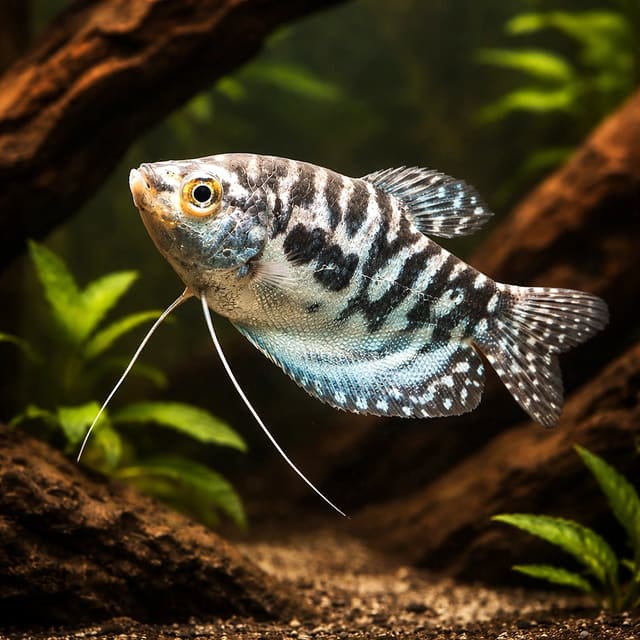
The word “mix” distinguishes this offer from a named colour-form selection. Seriously Fish describes gold, opaline, Cosby, marbled and silver aquarium forms alongside the natural blue-grey form. Treat colour and pattern as individual features rather than the basis for different care.
Sex is guaranteed only when the selected option explicitly states male or female. This Three-Spot Gourami Mix listing has no sex-guaranteed option. Plan any future social arrangement without relying on a fixed male-to-female ratio.
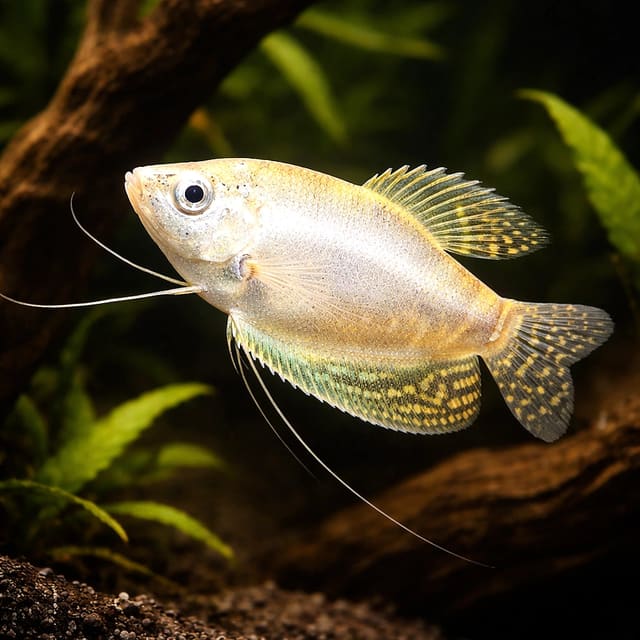
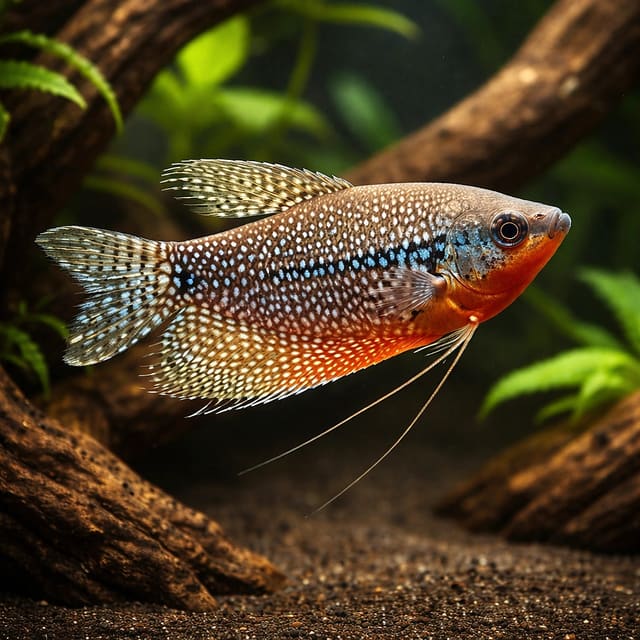
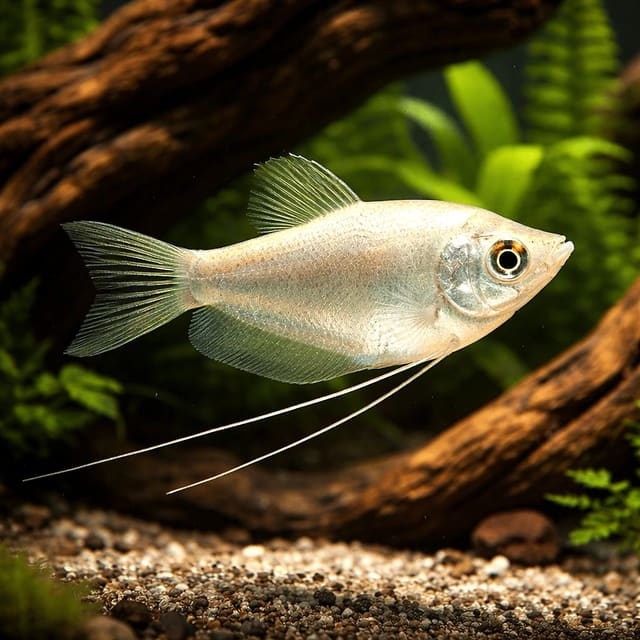
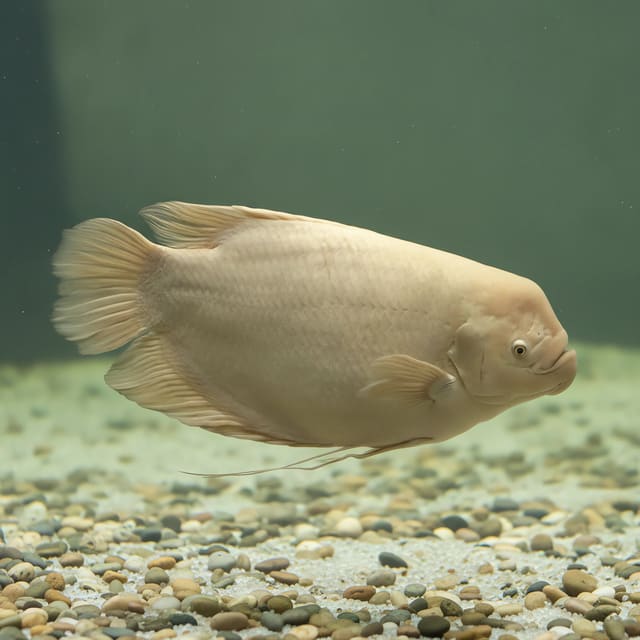
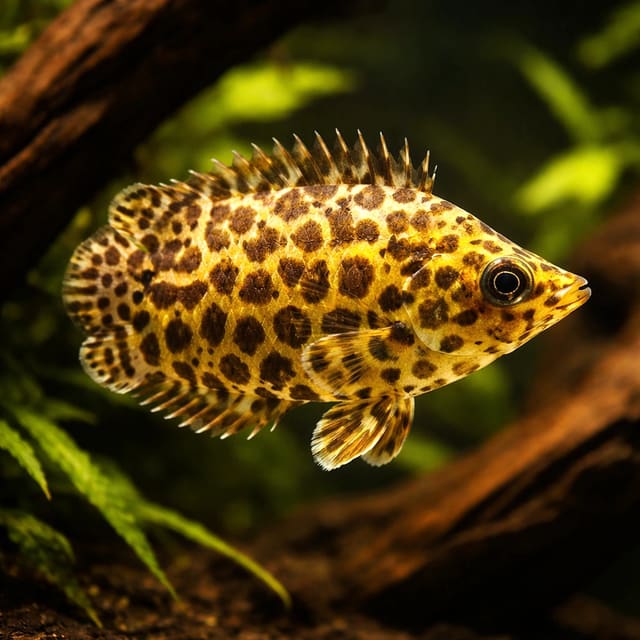
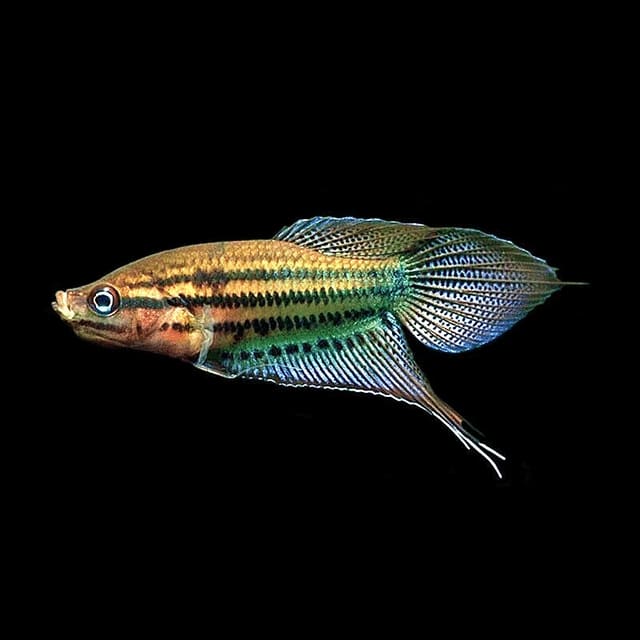
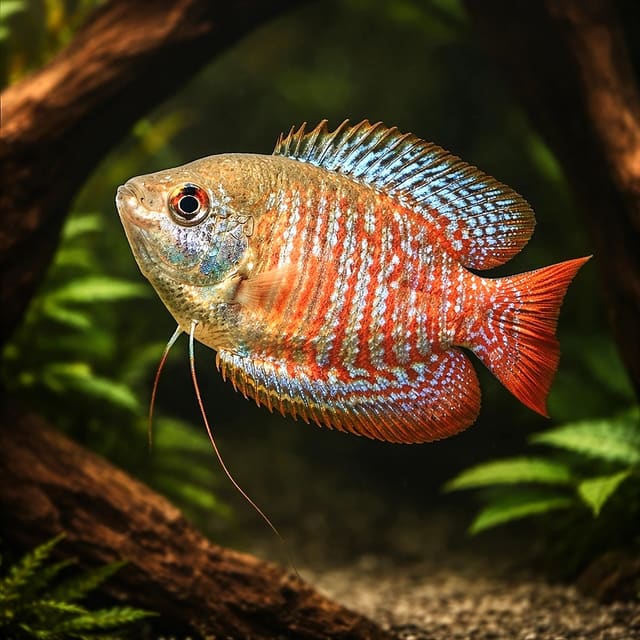
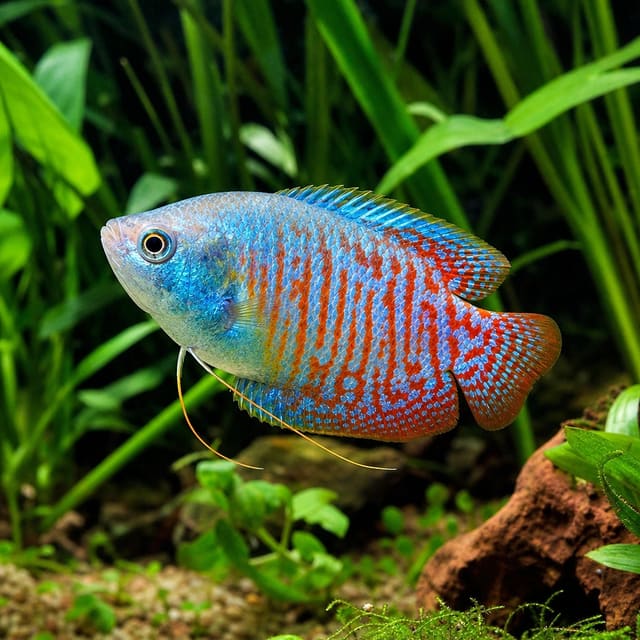
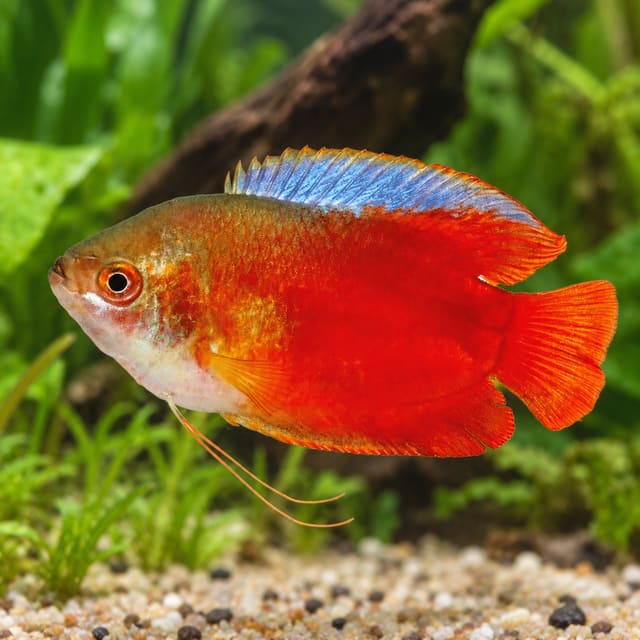
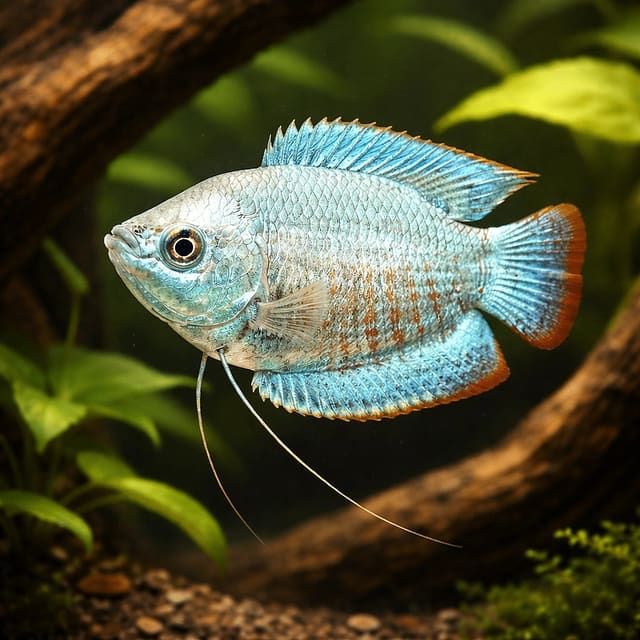
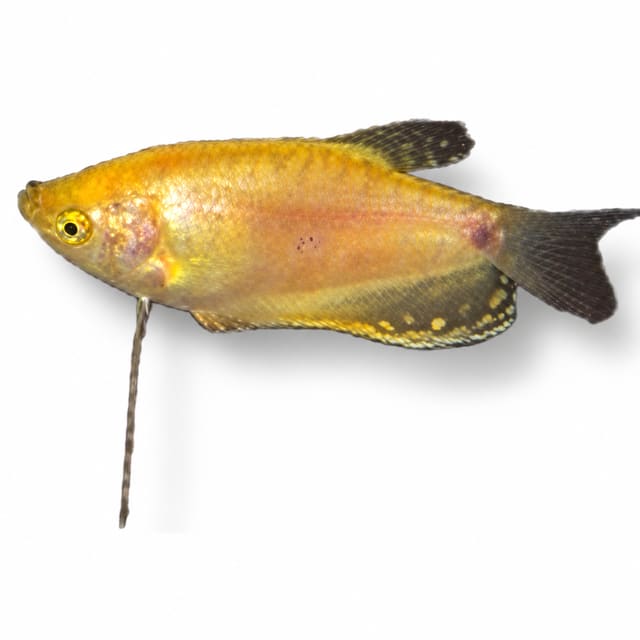
The gallery images are representative, based on reference photographs of this species, so colours can look slightly different from the live animal. They illustrate golden forms with the deep body, spotted fins and long pelvic filaments associated with the species; they do not turn this mixed offer into a named gold-form selection.
| Suits | Not suited to |
|---|---|
| Keepers with a planted aquarium based around 90 × 30 cm and clear surface access | Small aquariums that cannot accommodate the 15 cm SL adult size |
| Homes prepared to assess variable temperament as the fish matures | Communities built around timid fish or small fish that could be eaten |
| Carefully screened robust companions sharing the same water values | Fish that may nip fins or residents needing incompatible water conditions |
Choose this fish when you can plan for its adult footprint, maintain stable tropical conditions and respond if territorial behaviour develops. We rate its care as intermediate because routine feeding is straightforward, but adult space and compatibility need active judgement. You can also browse the gouramis and labyrinth fish collection when comparing different species and offers.
FishBase records a maximum length of 15 cm standard length for Trichopodus trichopterus. It also places the species in freshwater across the Mekong basin in Laos, Yunnan, Thailand, Cambodia and Viet Nam, with introductions elsewhere. Use 15 cm SL as the decisive size when judging swimming room, filtration load and whether companions will remain suitable.
The species aquarium profile recommends a base of 90 × 30 cm, equivalent to an aquarium of about 81 litres when the dimensions are 90 × 30 × 30 cm. It also recommends a planted layout with floating cover and open swimming areas. Those dimensions provide a practical starting point for one fish; adding further gouramis or a substantial community increases the demand for territory and filtration rather than changing the adult size.
| Decision | Planning value |
|---|---|
| Recorded maximum length | 15 cm SL |
| Species aquarium base | 90 × 30 cm |
| Approximate volume at 90 × 30 × 30 cm | 81 litres |
| Routine temperature overlap | 24–28°C |
| Routine pH overlap | 6.0–8.0 |
| Routine hardness overlap | 5–19 dGH |
A worked example makes the size distinction clear: a fish selected at 2–3 cm still needs a home planned around a possible 15 cm SL adult. An 8–9 cm selection is closer to that planning size on dispatch, but it receives the same long-term water, layout and compatibility assessment. Do not use the size selector as a permanent stocking calculator.
Keep routine conditions within the FishBase and Seriously Fish overlap of 24–28°C, pH 6.0–8.0 and 5–19 dGH. Choose stable values within that overlap rather than moving conditions from one end to the other. Measure the water you can maintain consistently, compare it with the intended companions and resolve any conflict before the fish is introduced.
Arrange the aquarium around floating cover, planted shelter and open swimming room. Seriously Fish recommends all three for this species. Floating plants can provide overhead cover, while open areas let the fish move and feed without pushing through a completely enclosed surface. Preserve several clear patches where it can take atmospheric air.
A 90 × 30 cm base gives a useful way to divide the layout. Plant part of the back and sides, retain an open route through the aquarium and distribute cover so one exposed area does not become the only usable space. When other fish are present, separate feeding and resting areas reduce competition even though they cannot guarantee compatible behaviour.
| For about 81 litres | Species-profile guidance |
|---|---|
| Filter turnover | Four to five times the volume each hour |
| Example filter rating | About 325–405 litres per hour |
| Heater estimate | About 100–150 W |
| Heater assumption | A room around 20°C |
These equipment examples belong to an aquarium of roughly 81 litres. Recalculate when the real volume differs, and account for the manufacturer’s rated flow rather than assuming that one model suits every aquarium. Position the outlet so filtration remains effective without removing every calmer area around floating cover.
Prepare and mature the biological system before livestock enters it. If this is your first setup, follow our guide to preparing and maturing a tropical aquarium before choosing a dispatch date. A filter needs time to develop the beneficial bacterial population that processes fish waste.
Make each furnishing serve a care decision: plants provide cover, open water preserves swimming space, and clear surface patches support atmospheric breathing. Avoid filling the aquarium so densely that the fish cannot be observed. Daily visibility matters because changes in posture, colour, feeding and aggression are early prompts to test the water or reassess companions.
Keep routine conditions at 24–28°C, pH 6.0–8.0 and 5–19 dGH. These values are the overlap between FishBase’s recorded environmental range and the Seriously Fish aquarium range. Pick a stable point within the overlap that also suits every other resident; wide ranges do not make sudden changes harmless.
OATA’s gourami and paradise-fish sheet gives broad group guidance of zero mg per litre ammonia, zero mg per litre nitrite and nitrate no more than 20 mg per litre above the normal tap-water level. It also recommends checking water at least weekly. Use those nitrogen values as firm maintenance checkpoints.
| Test result | Care decision |
|---|---|
| Ammonia above 0 mg/l | Pause further stocking, check filtration and correct water quality promptly |
| Nitrite above 0 mg/l | Treat the result as unsafe and investigate the biological filter |
| Nitrate rising over successive tests | Review feeding, stocking and the water-change routine |
| Temperature moving unexpectedly | Check the heater, room conditions and thermometer |
| pH or hardness changing sharply | Compare the aquarium with replacement water before adjusting anything |
Record results rather than relying on the water’s appearance. Clear water can still contain dissolved ammonia or nitrite, while a written weekly pattern makes a gradual change easier to spot. Our aquarium water chemistry guide explains what the main measurements mean.
Use measured values when judging suitability. The water matcher can compare your aquarium readings with the stated range, but the final decision must also include adult size, temperament and the requirements of every companion. A chemical match alone does not create a workable community.
RSPCA aquarium guidance explains why a working biological filter is essential: fish release toxic ammonia, beneficial bacteria convert it to nitrite, and further bacterial activity converts nitrite to the safer nitrate. Atmospheric breathing does not perform any of those functions for a gourami.
Check the filter for blockages and investigate any fall in flow. If the media needs cleaning, do not run it under the tap. Instead, rinse it lightly in aquarium water removed during maintenance. Condition replacement tap water to remove chlorine or chloramine before it enters the aquarium.
Do not turn routine maintenance into a complete reset. Preserving the bacterial population is the reason for cleaning filter media gently and retaining established biological material. Increase observation after a filter blockage, an unexpected test result or the addition of fish because each change can alter the balance between waste production and bacterial processing.
At least once a week, a 25% water change provides the baseline in the OATA routine. Persistent nitrate rise or measurable ammonia or nitrite calls for immediate investigation rather than waiting for the next scheduled change. Reduce feeding pressure, check the filter and stop adding livestock until the system is stable again.
Three-Spot Gouramis are generalised omnivores. Their recorded natural diet includes terrestrial and aquatic plants, algae, small invertebrates, zooplankton and detritus. Build the aquarium diet around variety rather than treating the fish as exclusively carnivorous or exclusively plant-eating.
For feeding, use OATA’s gourami-group routine: offer a good-quality flake, granule or pellet, supported by small live or frozen foods such as daphnia, small bloodworm or tubifex. Feed only what the fish can eat within a few minutes once a day. Seriously Fish also recommends including an algae-based food in response to the species’ broad natural diet.
| Food decision | How to apply it |
|---|---|
| Prepared staple | Choose quality flake, granules or pellets appropriate to the fish’s mouth size |
| Algae-based component | Include it as part of the varied omnivorous diet |
| Frozen or live variety | Use small daphnia, bloodworm or tubifex as supplementary foods |
| Portion size | Stop when the meal has lasted a few minutes |
| Schedule | Feed once each day |
Watch the fish rather than tipping in a fixed volume by habit. A selected 2–3 cm animal needs smaller pieces than an 8–9 cm animal, but both follow the same principle: the meal should be eaten promptly. Distribute food so the gourami and its companions can all feed without one fish controlling the only feeding point.
Remove uneaten food before it breaks down. OATA warns that overfeeding allows waste to accumulate and release toxic material into the water. If interest in food falls, do not compensate by adding richer or larger meals. Check behaviour, breathing, social pressure and water quality first, then return to modest portions once the cause has been addressed.
Prepare the aquarium before the fish arrives. Confirm that the filter is mature, the intended temperature is stable, and ammonia and nitrite both measure zero mg per litre. Check the 90 × 30 cm planning base, plant cover, open swimming room and surface access before adding the new bioload.
Increase the aquarium population slowly. OATA explains that the beneficial bacterial population must grow whenever more fish and more feeding increase waste production. Adding livestock too quickly can cause new tank syndrome because the filter bacteria cannot yet process the additional ammonia and nitrite.
| Checkpoint | What to do |
|---|---|
| Before introduction | Test ammonia and nitrite, confirm temperature and inspect filter flow |
| After the fish enters | Check that it can reach the surface, swim level and move between cover and open water |
| At feeding | Offer a controlled portion and confirm that every resident can eat |
| During the first week | Watch for hiding, colour change, rapid breathing or repeated aggression |
| Before adding anything else | Confirm stable tests and normal behaviour over time |
Do not judge social success from the first few minutes. Seriously Fish reports that individual temperament varies and may change as fish mature. Observe the newcomer and established residents through feeding and normal activity, paying particular attention to whether one fish controls the surface or prevents another from leaving cover.
Read the current delivery and Live Arrival Guarantee policy before arranging the order. Keep the purchase decision separate from aquarium preparation: the live selector chooses the dispatch size, while water testing, mature filtration and adult-size planning determine whether the aquarium is ready.
Learn the fish’s usual swimming, colour, breathing, temperament and feeding pattern. OATA advises watching for hanging at the surface, sitting on the bottom, erratic swimming, darker or paler colour, greater aggression, unusual hiding, changed gill movement, white spots, fluffy growths, lost fins or scales, altered body condition and reduced feeding.
The labyrinth organ makes occasional atmospheric breathing normal. Repeatedly hanging at the surface alongside rapid gill movement, loss of balance or reduced feeding is a different pattern and should trigger immediate checks. Start with ammonia, nitrite and temperature, then inspect filter flow and observe whether another fish is blocking access to space or food.
| Change you see | First response |
|---|---|
| Rapid or unusually slow gill movement | Test water and inspect filtration promptly |
| Persistent hiding | Check aggression, cover, feeding access and water results |
| Darker or paler colour | Compare behaviour and water values with the fish’s normal pattern |
| Damaged fins or missing scales | Observe all interactions and separate sustained aggressors if necessary |
| White spots or fluffy growths | Check water quality and obtain a clear diagnosis before choosing treatment |
| Reduced food intake | Remove leftovers and review health, water and social pressure |
Do not continue feeding extra food to a fish that is refusing meals. Uneaten food increases the load on the biological filter and can make water quality worse. Keep portions controlled while investigating the change.
If the change persists after the immediate water and equipment checks, contact us with the aquarium volume, temperature, ammonia, nitrite and nitrate readings, the other residents and a clear description of when the behaviour began. Those details allow the health concern to be assessed without guessing from one symptom.
Do not assume that every Three-Spot Gourami will behave as a peaceful community fish. Seriously Fish reports that some individuals become spiteful as they mature while others remain peaceful. Males are territorial and will squabble amongst themselves, becoming very aggressive when breeding.
Assess behaviour over time rather than approving the combination on introduction day. A fish may feed and swim calmly at first, then begin controlling the upper aquarium as it settles or matures. Plant cover and open space help create choices, but layout cannot cancel an individual fish’s territorial response.
| What you observe | Decision |
|---|---|
| A brief display with both fish returning to normal activity | Continue close observation |
| Repeated chasing whenever one fish leaves cover | Reassess space and prepare separation |
| One fish cannot reach food | Intervene before body condition declines |
| Torn fins, lost scales or persistent hiding | Separate the fish involved |
| Territory becomes more forceful around breeding behaviour | Protect other residents from continued aggression |
The intermediate care rating reflects this uncertainty. Feeding and routine maintenance follow clear instructions, but compatibility requires enough space to observe the fish, enough cover to provide retreat routes and a practical response if behaviour changes. Never rely on the common word “community” as the whole assessment.
Judge the aquarium from the perspective of the least confident resident. If another fish must hide continuously, misses meals or cannot cross the tank without pursuit, the arrangement is failing even when the gourami appears healthy. Separation is a welfare decision, not an admission that every member of the species behaves identically.
Seriously Fish recommends robust companions and gives barbs, larger characins, loricariids, loaches and other medium or large gouramis as examples. Treat those names as candidates for assessment, not automatic approvals. Each candidate must share the chosen temperature, pH and hardness, have enough adult space and remain able to feed normally.
OATA advises avoiding timid species, small fish that could be eaten and fish that may nip fins. That rule refines the broader examples: a robust, non-nipping barb may pass the screen, while a fin-nipping fish should be avoided. Size must be judged at adulthood rather than from the dimensions seen at introduction.
| Screening question | Pass condition |
|---|---|
| Will both fish share the water values? | The chosen stable temperature, pH and hardness suit both |
| Could the companion be eaten? | It remains too large to be treated as prey |
| Is it timid? | It can use the aquarium and feed beside a confident gourami |
| Does it nip fins? | Its normal behaviour does not threaten the gourami’s fins |
| Is it robust? | It can tolerate normal activity without living under sustained pressure |
| Will adult space remain adequate? | The aquarium accommodates every resident at full planning size |
Other gouramis need especially careful assessment because temperament differs between species and individuals. The species profile includes medium and large gouramis among robust possibilities, yet it also documents territorial behaviour within T. trichopterus. Provide distinct usable areas and be prepared to change the arrangement if surface competition develops.
Honest uncertainty remains after a paper screen because individuals behave differently. Monitor feeding access, hiding, fin condition, colour and breathing after introduction and again as the fish matures. A companion that passes the water and size checks can still fail if either fish applies sustained social pressure.
A single Three-Spot Gourami avoids direct conflict between two members of the same species. If you plan more than one, increase space and structural cover, distribute feeding points and keep a practical way to separate fish. The species profile documents male territoriality and aggressive breeding behaviour, so a shared aquarium must be judged by observed conduct rather than the number purchased.
Plan without assuming a known sex ratio. Seriously Fish describes mature males as larger with a pointed dorsal fin and females as smaller and rounder through the belly, but those differences do not alter the terms of this mixed offer. Behaviour remains the decisive welfare test even when the fish can later be distinguished.
The same approach applies to other medium or large gouramis. Shared family traits and matching water values do not guarantee social acceptance. Compare adult size, territorial use and feeding behaviour, then continue observing after the introduction.
If you want a stocking and compatibility assessment, ask us with the aquarium dimensions, measured water values, current residents and their adult sizes. A useful assessment depends on the whole aquarium rather than the Three-Spot Gourami’s name alone.
FishBase records a maximum adult length of 15 cm SL for the Three-Spot Gourami Mix. Plan every supplied size around that adult figure.
Plan an aquarium around a 90 × 30 cm base and about 81 litres for one fish, with plants, floating cover, open swimming areas and clear surface access.
A single Three-Spot Gourami avoids direct same-species conflict. Multiple fish need more space, cover, distributed feeding points and a separation option because males are territorial and individual behaviour varies.
Seriously Fish recommends this species to beginners with reservations about its temperament. We rate it intermediate because feeding and maintenance are straightforward, while adult space and compatibility require active judgement.
Feed quality flake, granules or pellets with an algae-based component and small live or frozen daphnia, bloodworm or tubifex for variety. Offer only what it can finish within a few minutes once each day.
Keep it within the FishBase and Seriously Fish overlap of 24–28°C, pH 6.0–8.0 and 5–19 dGH. Keep ammonia and nitrite at zero mg per litre.
Individual temperament varies: some remain peaceful, while others become spiteful, and males can be territorial. OATA advises avoiding companions that may nip the gourami’s fins.
Screen robust larger characins, loricariids, loaches, non-fin-nipping barbs and medium or large gouramis for matching water, space and behaviour. Avoid timid species, small fish that could be eaten and fish that may nip fins.
Start filming the sealed parcel before opening it or floating the bag, and continue through opening until the fish is shown still inside the sealed bag. Someone must be present to receive the parcel. Float the bag for 20–30 minutes before releasing the fish, and never pour the bag water into the aquarium.
No reviews for this item yet. Bought one? Honest reviews only, good or bad.
What customers say about ordering from us
I have a small group of long finned mountain minnows. So was delighted to be able to order ten of this variety to increase the genetics in my tank . The ones I recieved are healthy but it’s to early to give a verdict on wether they are of a long finned type since they are small currently.
Gordon Walker · 23 Sept 2026
100% success travel and "installation". Pleased with quality of purchase. The Siamese fighter a bit "shy" so have not yet seen him at his best yet but looking good. Happy customer. GG
George E Garratt · 21 Sept 2026
Reviews of our shop, collected by Judge.me, an independent third-party review collector. Newest first.