Easy
Black and White Platy (Xiphophorus maculatus)
£4.59
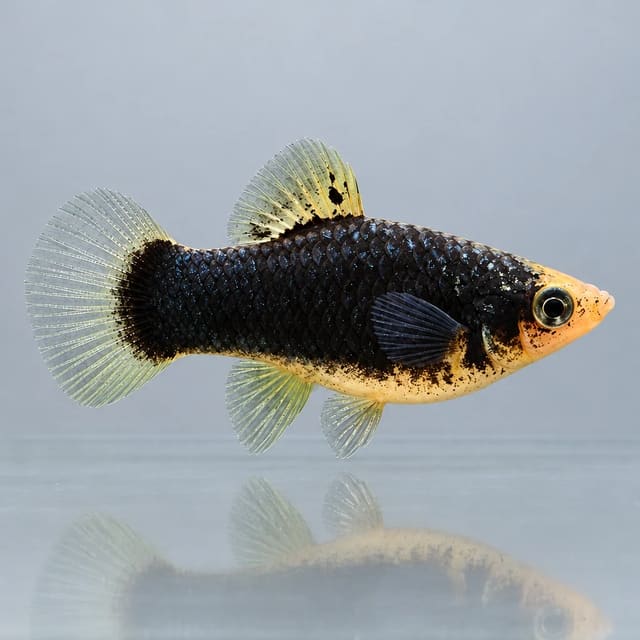
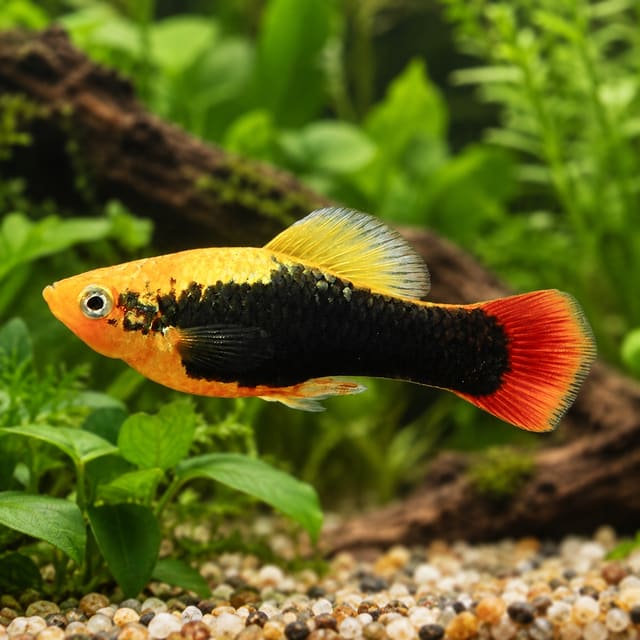
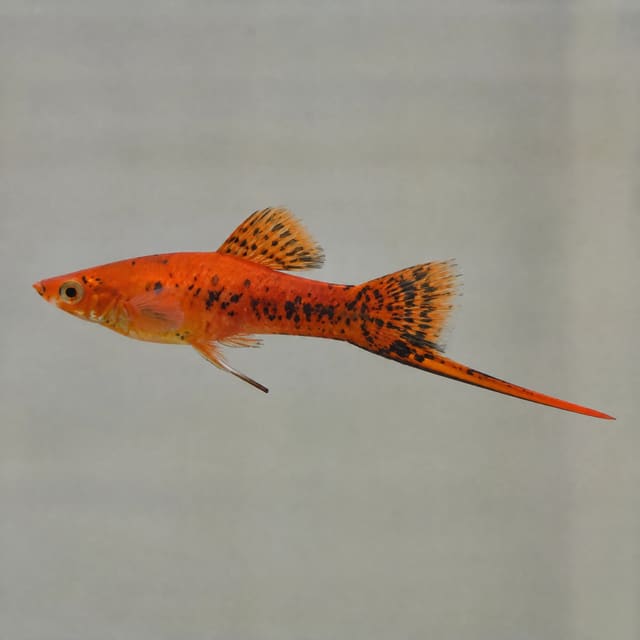
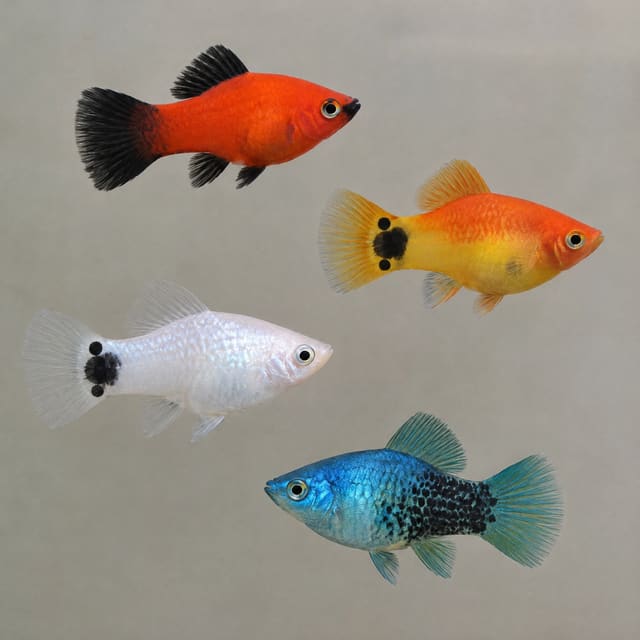
The Sunburst Tuxedo Platy is an aquarium-bred colour form of the common platy, Xiphophorus maculatus, with a golden head, a black speckled tuxedo jacket across the flank and an orange-red tail. It is a peaceful, hardy livebearer for a hard-water community aquarium of 45–54 litres or more, kept with two females to each male. Sold individually as one live fish.
Adult size is the maximum length this species reaches at full maturity (scientific sources). The livestock you receive will be younger and smaller. Product-photo provenance and any image-specific limitations are stated on the listing.
Xiphophorus maculatus
Quantity discounts are pricing offers, not a group-size recommendation. Check the full care guidance and your existing animals before choosing a quantity.
Minimum of 2 per order.
The Sunburst Tuxedo Platy is an aquarium-bred colour form of the common platy, Xiphophorus maculatus, with a golden head, a black speckled tuxedo jacket across the flank and an orange-red tail. It is a peaceful, hardy livebearer for a hard-water community aquarium of 45–54 litres or more, kept with two females to each male. Sold individually as one live fish.
Adult size is the maximum length this species reaches at full maturity (scientific sources). The livestock you receive will be younger and smaller. Product-photo provenance and any image-specific limitations are stated on the listing.
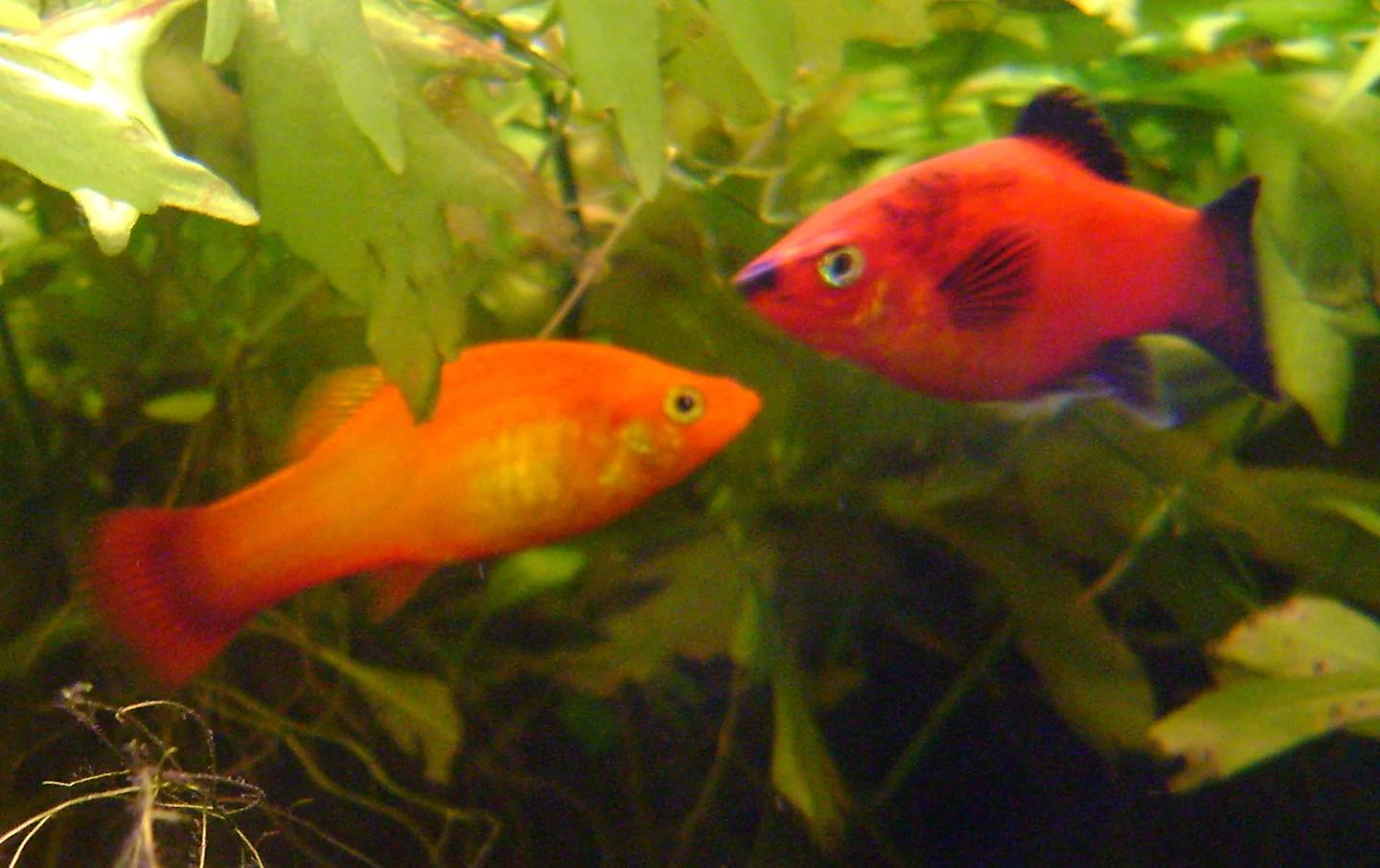
Platy is a trade name used for Xiphophorus maculatus, X. variatus and domestic forms. Start with at least three in a mature aquarium of at least 45 litres, verify the exact fish and measured water, and plan extra capacity before mixing sexes.
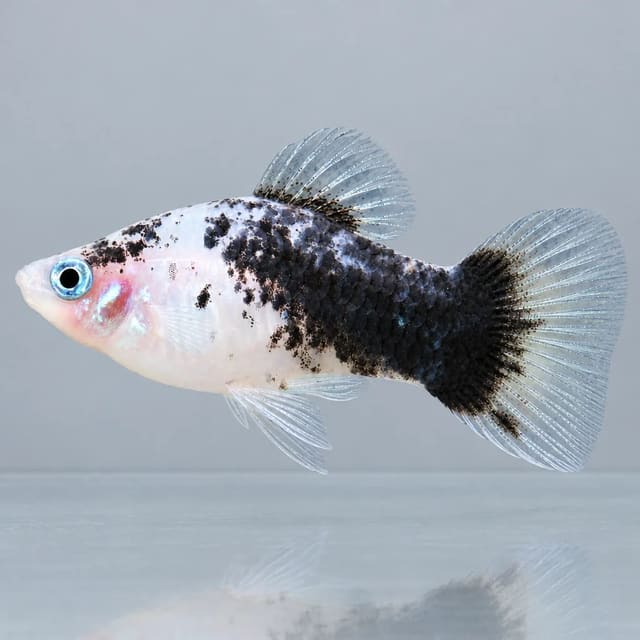
The Sunburst Tuxedo Platy is a colour form of the common platy, Xiphophorus maculatus, bred for the aquarium and one of the most cheerful small livebearers you can add to a community tank. Our photographs show a golden head and back, a broad black "tuxedo" jacket across the middle of the body speckled with blue-green glints, and a rear body that warms to bright orange-red through the tail base and into the tail. The dorsal fin is yellow with orange edging, and the lower fins are clear with a pale blue tint.
Underneath the colour it is a true platy: small, peaceful, easy to feed and well suited to the moderately hard to hard tap water that comes out of taps across much of the UK. Seriously Fish rates the species suitable for beginners, as long as the water is moderately hard or harder, and that is the one condition this fish will not compromise on.
| Name | Meaning |
|---|---|
| Sunburst Tuxedo Platy | Trade name: a gold-to-red body with the black tuxedo flank |
| Xiphophorus maculatus | Scientific name of the common platy; maculatus means spotted |
| Platypoecilus maculatus | Older scientific name still printed in some books |
| Southern platyfish, platy | Everyday names for the species |
| Tuxedo | A platy pattern of dark pigment over the flank; Seriously Fish lists it with Mickey Mouse, wagtail, moon, comet and hi-fin among the trade varieties |
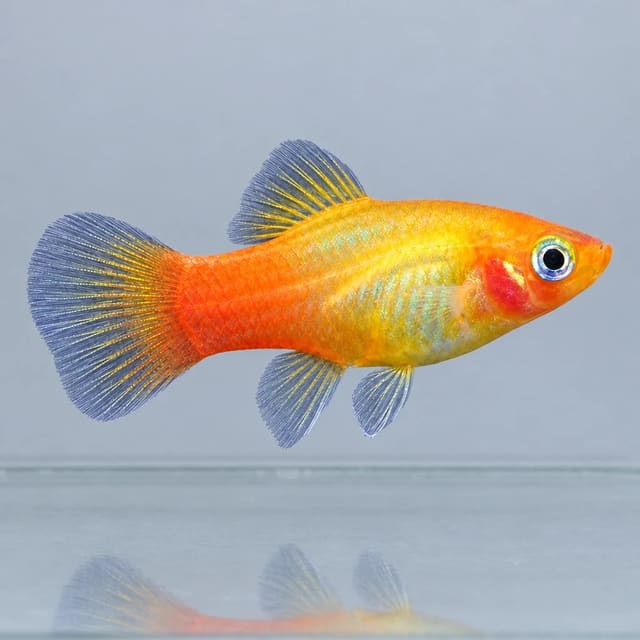
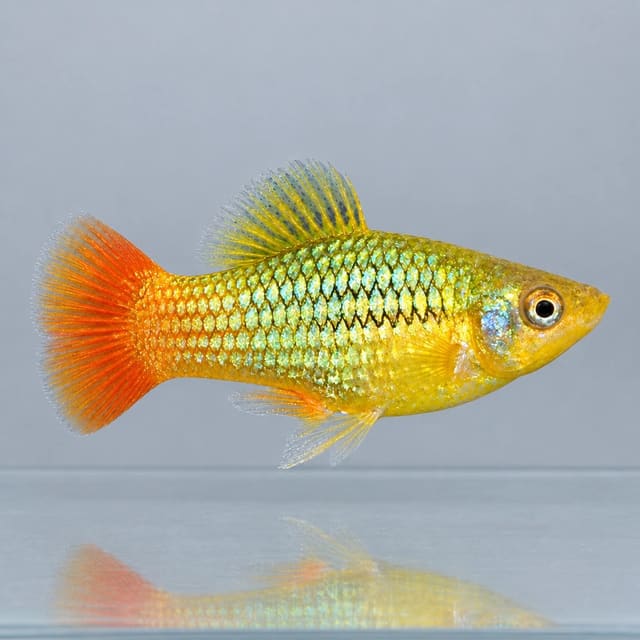
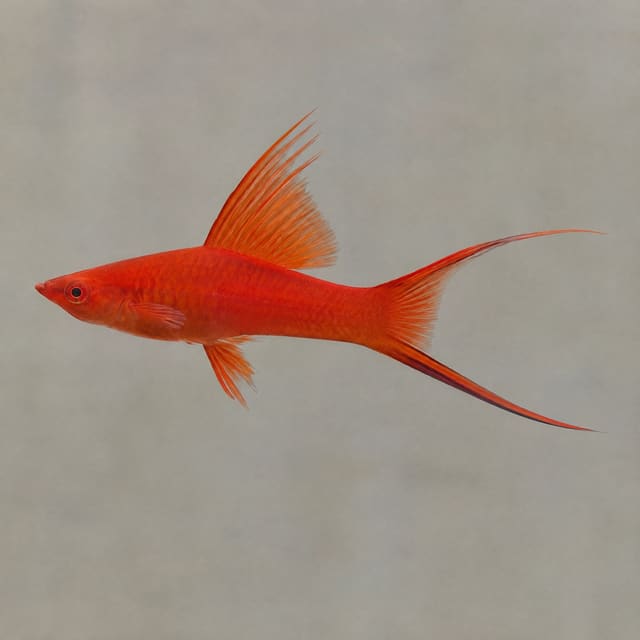
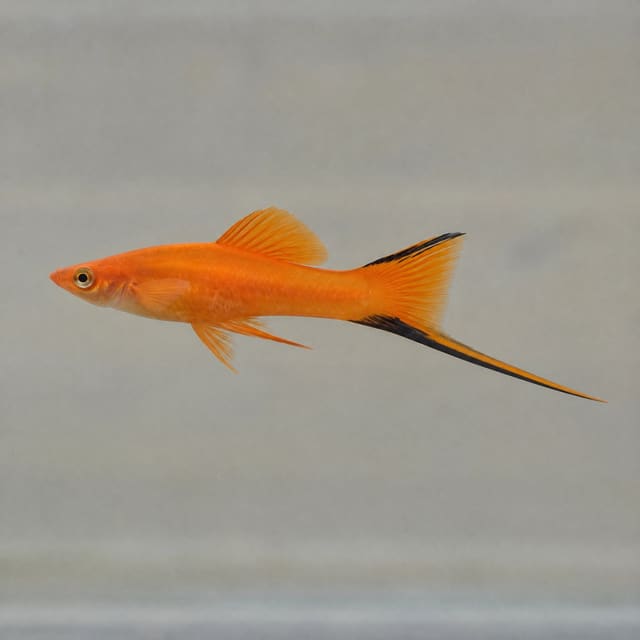
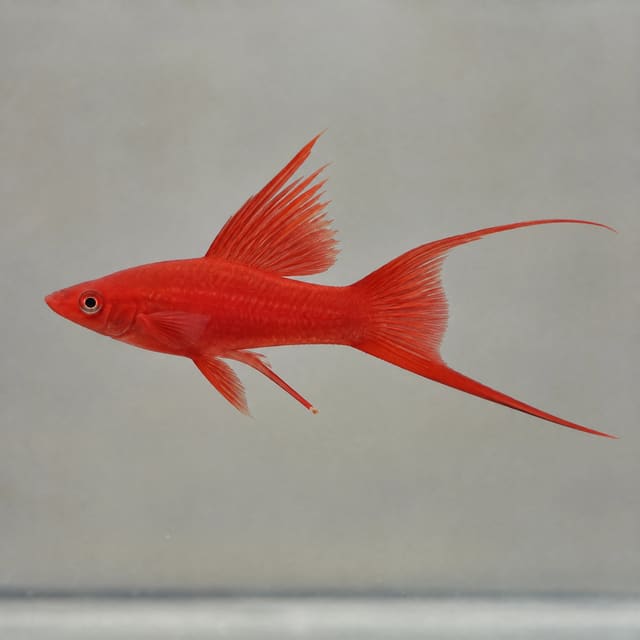
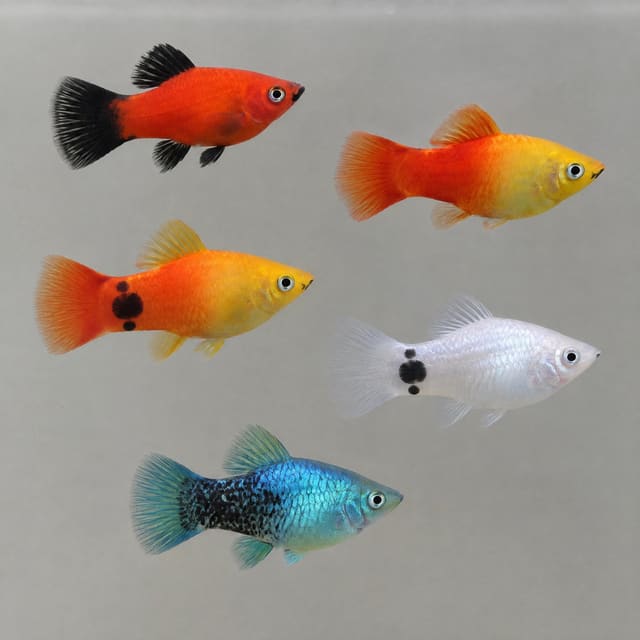
Breeders combine body colour and pattern freely in platies, so the same tuxedo jacket appears on several base colours. Our Red Tuxedo Platy is red all over beneath the black, while the Yellow Tuxedo Platy stays lemon-yellow. The Gold Red Tuxedo Hi-Fin Platy shares the gold-and-red idea but carries a tall, flag-like dorsal fin. If you like the warm gradient without the black, the Sunset Platy shows the plain sunset colour. All are one species with one set of care needs, and all will interbreed.
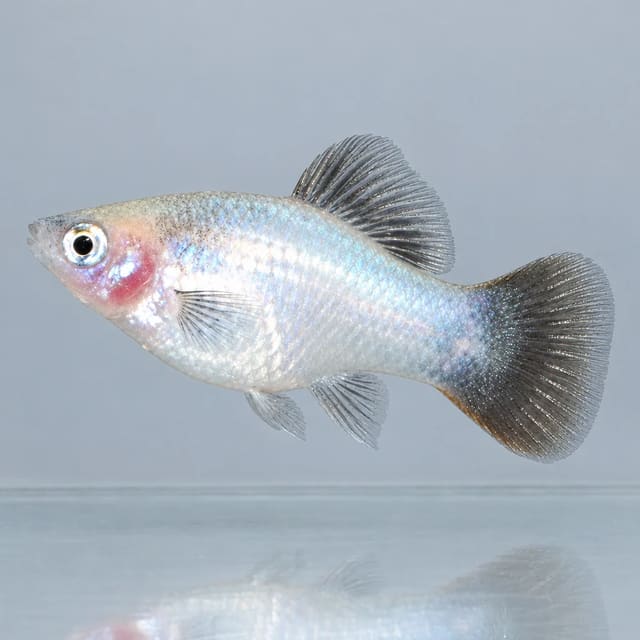
Each purchase is one live Sunburst Tuxedo Platy of medium size: a young fish that still has some growing to do. We do not choose or guarantee sex. Males are the smaller fish and have a narrow, pointed anal fin modified into a mating organ called the gonopodium; females are larger, deeper-bodied and have an ordinary fan-shaped anal fin. The photographs show the colour form, not the individual fish, and the extent of the black jacket and the depth of the red differ from fish to fish. Expect the colours to look washed out for a day or two after the journey; they return once the fish settles.
Before you order, read our delivery and Live Arrival Guarantee details and make sure the aquarium has been running with a mature filter for several weeks.
Sources measure platies in different ways. OATA gives adults as 6–8 cm. FishBase records a maximum of 4.0 cm total length for males and 6.0 cm for females, and Seriously Fish gives 50 mm standard length, a measurement that stops at the base of the tail. However you measure it, you are buying a small fish whose females end up noticeably bigger than the males.
For space, OATA asks for at least 45 litres for a small group, Seriously Fish recommends a footprint of 60 × 30 cm (around 54 litres), and FishBase gives a minimum tank length of 60 cm. A 60 cm tank is therefore the sensible starting point. Remember that platies breed, and a tank that holds six adults comfortably can be holding twenty fish a few months later.
FishBase describes wild platies in warm springs, canals and ditches with slow-moving water, silty bottoms and weedy banks, as well as creeks and swamps, and Seriously Fish notes that the species appreciates a planted aquarium. Gentle flow, plenty of soft-leaved plants and a clear swimming lane at the front copy that well.
| Zone | Why it helps |
|---|---|
| Tall, bushy plants along the back | Somewhere for females to rest away from persistent males |
| Open front water | Room to swim and the best view of the gold, black and red |
| Floating plants in one corner | Shade and cover for newborn fry at the surface |
| Darker gravel or sand | Makes the warm colours glow and is easy to vacuum |
Platies pick at soft green algae on leaves and stones throughout the day, so do not scrub every surface clean. A cover glass or lid is worth having: OATA describes it as optional but advisable, and it keeps a startled fish in the tank.
Seriously Fish puts it plainly: platies need moderately hard or harder water, do best with the pH above neutral and will not thrive in soft, acidic conditions. The three sources agree on pH and broadly on temperature but give quite different hardness ranges, so we show them together and recommend the overlap.
| Value | OATA | FishBase | Seriously Fish | We suggest |
|---|---|---|---|---|
| Temperature | 17–27°C | 18–25°C | 20–26°C | 20–25°C, inside all three |
| pH | 7.0–8.0 | 7.0–8.0 | 7.0–8.2 | 7.0–8.0 |
| General hardness | 4–12°dH | 9–19 dH | 10–30 dGH | 10–12 suits all three; up to about 19 fits both species profiles |
| Carbonate hardness | 3–10°dKH | — | — | 3–10°dKH |
| Ammonia and nitrite | zero | — | — | zero |
| Nitrate | no more than 20 mg/l above tap water | — | — | as OATA |
In much of England the tap water is already hard and alkaline enough for platies once it has been treated with a dechlorinator. Soft-water areas, including many parts of Scotland, Wales and the north-west, may need help to raise hardness; ask us before you buy if your water is soft. Enter your readings in our water matcher, and our guide to water chemistry explains GH, KH and pH in plain terms.
Seriously Fish suggests a filter that turns the tank volume over four to five times an hour, roughly 215–270 litres per hour on a 54-litre aquarium, and a heater of about 50 W where the room sits around 20°C. Platies eat steadily and breed steadily, so waste builds up faster than the number of adults suggests.
In the wild, FishBase lists worms, crustaceans, insects and plant matter in the platy's diet. Seriously Fish says it accepts frozen, live and dried foods without fuss. OATA's advice is a good-quality flake or granule with plenty of algae in it as the daily staple, fed once a day in an amount the fish clear in a few minutes, with occasional live or frozen treats.
Before the box arrives, check that the filter is mature, ammonia and nitrite read zero and the water sits between 20 and 25°C at pH 7.0–8.0. OATA's floating-bag method works well for platies: turn the lights off, float the closed bag for about 10 minutes, add small amounts of aquarium water to the bag over up to 20 minutes, then net the fish out and throw the bag water away rather than tipping it in. Our step-by-step acclimatisation guide shows each stage with pictures.
| When | What to do |
|---|---|
| Arrival day | Keep the lights off for a few hours and do not feed |
| Day 2 | Offer a pinch of food and make sure every fish eats |
| Days 3–7 | Look for clamped fins, shimmying or one female being chased constantly |
| Day 7 | Test the water and make the first 25% change |
Seriously Fish describes the common platy as very peaceful and suitable for most community tanks. Males tolerate one another, but they court females constantly, which is why OATA recommends at least three fish with two females to each male. The best companions are other hard-water fish of a similar size that will not bully platies at feeding time.
| Suits | Avoid |
|---|---|
| Other platies, including red and yellow tuxedos | Soft, acidic-water fish such as many South American tetras and dwarf cichlids |
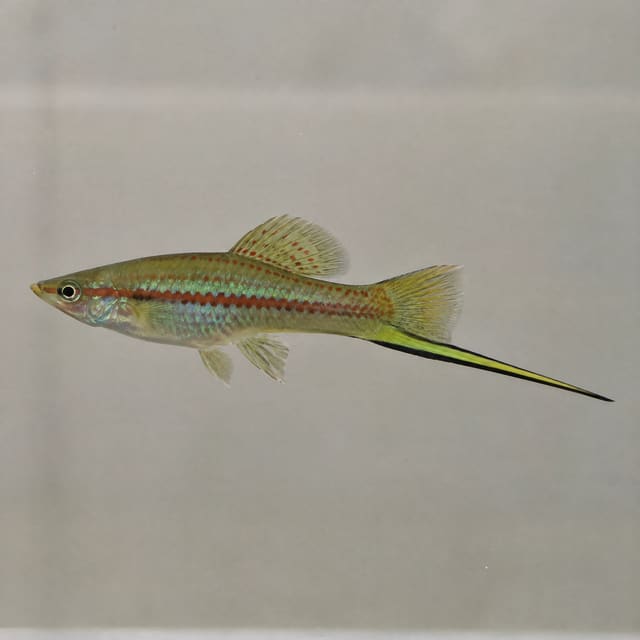
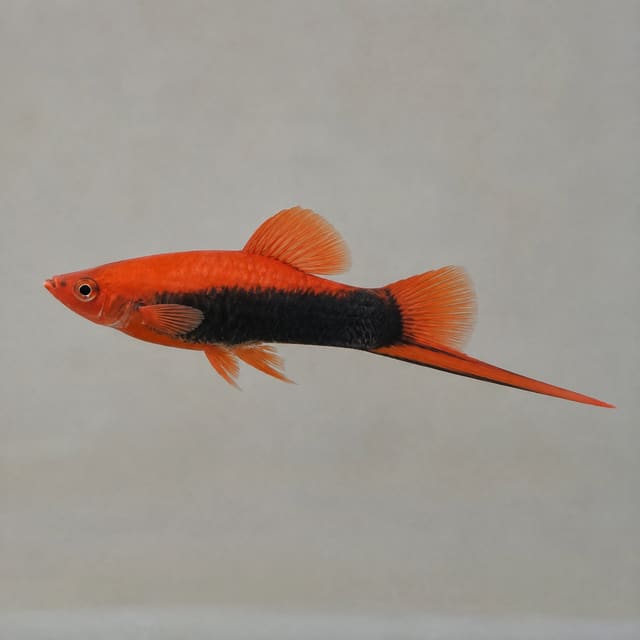
| A Green Swordtail or two in a larger tank | Predatory fish big enough to swallow platies or their young |
| Mollies in a roomy hard-water aquarium | Fast, greedy fish that leave nothing for the platies |
| A Bristlenose Pleco to graze the glass and wood | A group with more males than females |
Run any planned mix through our tank mates checker. You can browse every platy fish and all livebearers we stock, or go straight to the platy category and our range of Xiphophorus maculatus platies. The platy care guide goes deeper into the group, and platies sit high on our beginner tropical fish list.
Platies are livebearers: fertilisation happens inside the female and she gives birth to fully formed, free-swimming young. FishBase gives a gestation of 24–30 days and 20–80 young per brood, with aquarium fish maturing at 3–4 months. Seriously Fish gives about four to six weeks and says broods of up to 80 fry are not unusual. A pregnant female becomes very round as the brood develops.
Breed Sunburst Tuxedos only with one another if you want young that look like their parents. Crossing with other colours gives a mixed brood, and the tuxedo jacket is not always passed on in the same shape.
Seriously Fish warns that many commercially produced platies are less hardy than they should be because of inbreeding and over-production, which makes stable water and a calm settling-in period important. OATA's warning signs include clamped fins, flicking or shaking, hanging at the surface or lying on the bottom, unusually dark or pale colour, white spots or fluffy growths, lost fins or scales, faster or slower breathing and a poor appetite.
| If you notice | Do this first |
|---|---|
| Shimmying or clamped fins | Test pH and hardness; soft or swinging water often causes this in platies |
| A female hiding and constantly chased | Add more females or plants, or rehome a male |
| White spots or cotton-like tufts | Test the water and get fish-health advice before choosing a treatment |
| A raised, lumpy black growth | Ask for advice; a flat black pattern is normal, a swelling is not |
| Gasping at the surface | Test ammonia and nitrite straight away and increase aeration |
The black pigment of the tuxedo pattern has a scientific history. A review by Meierjohann and Schartl (2006) explains how certain crosses between platies and swordtails develop melanoma, a pigment-cell tumour, which has made these fish a research model for many decades, and FishBase notes that the species is used in genetic research. For the keeper this simply means watching black areas for any change from flat colour to a raised lump. FishBase also records that at least one country reports harm after platies were introduced, so unwanted fish should go back to a shop or another keeper, never into a pond or river.
It is an aquarium-bred colour form of the common or southern platy, Xiphophorus maculatus, a small livebearer from the Atlantic side of Mexico and Central America. "Sunburst" describes the warm colour that runs from a golden head to an orange-red tail; "tuxedo" is the platy name for the dark jacket of black pigment across the flank. Seriously Fish lists tuxedo among the established platy varieties.
All three carry the black tuxedo flank, but the base colour differs. A Red Tuxedo is red from head to tail and a Yellow Tuxedo stays yellow; the Sunburst Tuxedo on our photographs is golden at the front and turns orange-red behind the tuxedo patch, through the tail base and tail. Care is the same for all of them.
OATA gives adult platies as 6–8 cm. FishBase records 4.0 cm total length for males and 6.0 cm for females, and Seriously Fish gives 50 mm standard length, which leaves out the tail. Females are the larger sex.
OATA asks for at least 45 litres for a small group of platies. Seriously Fish recommends a 60 × 30 cm base, about 54 litres, and FishBase also gives 60 cm as the minimum tank length.
Hard, alkaline water. pH 7.0–8.0 suits all three sources, and 20–25°C is where OATA (17–27°C), FishBase (18–25°C) and Seriously Fish (20–26°C) overlap. Hardness figures differ: OATA 4–12°dH, FishBase 9–19 and Seriously Fish 10–30, so about 10–12 dGH satisfies all three. Seriously Fish says platies will not thrive in soft, acidic water.
At least three, with two females for every male, as OATA advises. Seriously Fish notes that males get on with each other but can pester females relentlessly, so extra females and plenty of plants keep the group calm.
The size and shape of the black area differ from fish to fish and can spread or break up a little as a young platy grows, so the fish you receive will not match the photograph exactly. A flat, smooth black pattern is normal. A raised, lumpy black growth is not, and needs fish-health advice.
Very likely, if a male and females are kept together. FishBase gives a gestation of 24–30 days and 20–80 young per brood, and aquarium platies mature at 3–4 months, so numbers rise quickly unless you plan for the fry.
One live fish of medium size. Sex is not chosen or guaranteed, and colour and pattern vary slightly from fish to fish.
No reviews for this item yet. Bought one? Honest reviews only, good or bad.
What customers say about ordering from us
Easy website plenty of info on fish your buying great to pick a time slot
TRACEY DURRANT · 7 Oct 2026
Got some lovely fish thank you
Kevin Mackie · 7 Oct 2026
Reviews of our shop, collected by Judge.me, an independent third-party review collector. Newest first.
Moved by UK carriers licensed to handle live animals
Hand-packed with oxygen bags, poly box, heat pack
Email photos the same day; an optional unboxing video helps us review problems faster — claim terms apply
Klarna & PayPal Pay in 3 at checkout