Easy
Red Tuxedo Platy (Xiphophorus maculatus)
20–26°C · pH 7–8.2 · 54L
£2.99

One unsexed Gold Red Tuxedo Hi-Fin Platy (Xiphophorus maculatus) per quantity, approximately 3 cm. A peaceful social livebearer for a mature, mineral-rich planted community.
Xiphophorus maculatus
Shoaling fish: kept in a group they feel safer, stay calmer and show their best colour.
Confirm your email, then we’ll send an availability message for this exact item if it returns within 180 days.
This request is only for this product—no newsletter or other promotions. A mail-provider retry may very rarely duplicate the same availability message. Unconfirmed addresses are removed after 48 hours. See our privacy policy.
One unsexed Gold Red Tuxedo Hi-Fin Platy (Xiphophorus maculatus) per quantity, approximately 3 cm. A peaceful social livebearer for a mature, mineral-rich planted community.
Platy is a trade name used for Xiphophorus maculatus, X. variatus and domestic forms. Start with at least three in a mature aquarium of at least 45 litres, verify the exact fish and measured water, and plan extra capacity before mixing sexes.
Maintain these water conditions for optimal health and vibrant colors
One unsexed Gold Red Tuxedo Hi-Fin Platy is supplied per selected quantity. This is a domestic form of Xiphophorus maculatus, the Southern Platyfish, combining warm gold-red colour, a dark tuxedo saddle and an enlarged dorsal fin. The supplied fish is approximately 3 cm, with natural variation in colour, sex expression and fin development. It is not a pack of ten, even though that wording survives inside the protected legacy URL.
This peaceful, social livebearer suits a mature planted community with moderately hard to hard, neutral-to-alkaline water. Plan around an adult female of up to about 6 cm, keep a small group where space permits, and be prepared for courtship and fry if both sexes are present. The live selector remains the source of truth for stock, price and availability.
| Quick fact | Practical guidance |
|---|---|
| Scientific name | Xiphophorus maculatus |
| Trade form | Gold Red Tuxedo Hi-Fin Platy |
| Sale unit | One unsexed live fish per selected quantity |
| Approximate dispatch size | About 3 cm, with natural variation |
| Adult planning size | Females to about 6 cm; males commonly smaller |
| Care level | Easy in a mature aquarium with suitable mineral content |
| Temperament | Peaceful and social; persistent courtship can occur |
| Practical group | Aim for six or more where space and filtration permit |
| Practical aquarium | At least 60 litres and 60 cm long for a small group |
| Temperature | 18-25°C |
| pH | 7.0-8.0 |
| Hardness | 9-19 dGH |
| Diet | Omnivore |
| Tank region | All levels, often middle and upper water |
Each basket quantity represents one unsexed live fish. Selecting six means six fish; selecting ten means ten fish. The storefront may display shoal-pricing tiers for larger quantities, but a discount tier does not change the sale unit and does not guarantee a particular combination of males and females.
The supplier grade is approximately 3 cm. Live fish cannot be measured to an exact millimetre before dispatch, so modest variation is normal. This is a juvenile or young-fish dispatch grade, not the adult maximum. Body depth, dorsal height and colour contrast can strengthen as the fish settles and matures.
Male and female platies can become easier to distinguish with maturity, but this listing does not offer sex selection. Lighting, age, stress and fin position can make remote sexing unreliable. An order of two may produce two males, two females or a mixed-sex combination; it is not a guaranteed pair.
This product may be temporarily unavailable even while the care page remains visible. Use the current selector and basket state to confirm whether ordering is possible. Fixed stock or price statements in care prose would become stale, so Shopify remains the transactional source of truth.
| Selection | What it means | What it does not promise |
|---|---|---|
| Quantity 1 | One unsexed fish | A chosen male or female |
| Quantity 6 | Six unsexed fish | An exact sex ratio |
| Shoal price tier | A quantity-based price when shown | A pre-formed or bonded group |
| Approx. 3 cm | A dispatch-size band | An exact measurement or adult size |
Xiphophorus maculatus is commonly called the Southern Platyfish or platy. It belongs to Poeciliidae, the livebearing family that also includes guppies, mollies and swordtails. The species is native from Veracruz in Mexico towards northern Belize, although ornamental stock is generally captive produced rather than collected from a known wild locality.
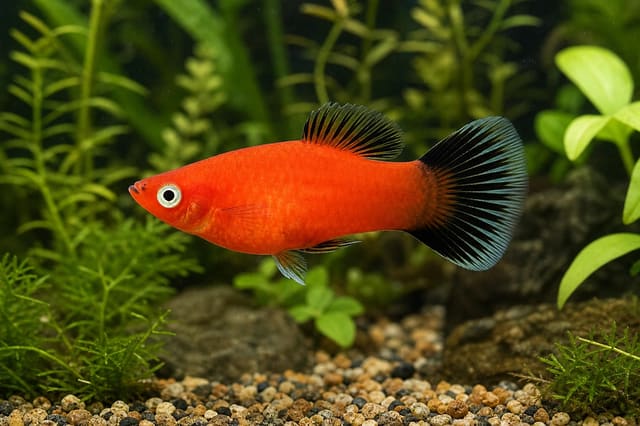
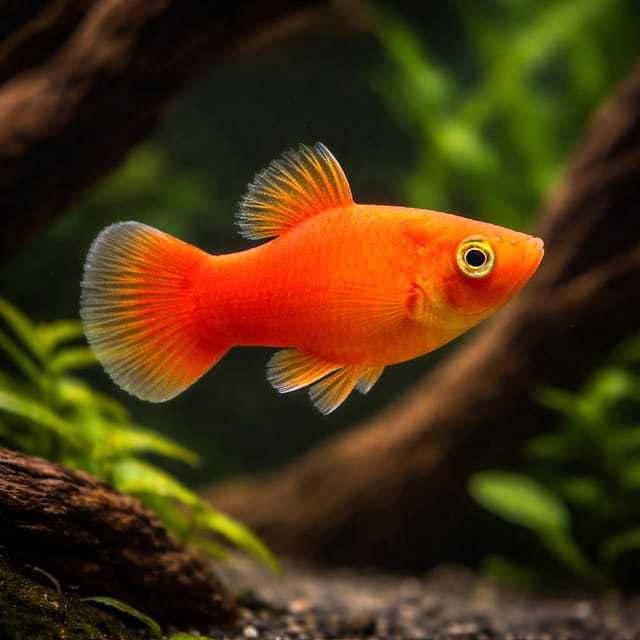
Gold and red describe the warm base colour selected in domestic strains. Individual fish may lean more orange, yellow-gold or red depending on genetics, age, sex, diet, condition and lighting. A representative image can show the intended form, but it cannot promise that every scale will match the same shade.
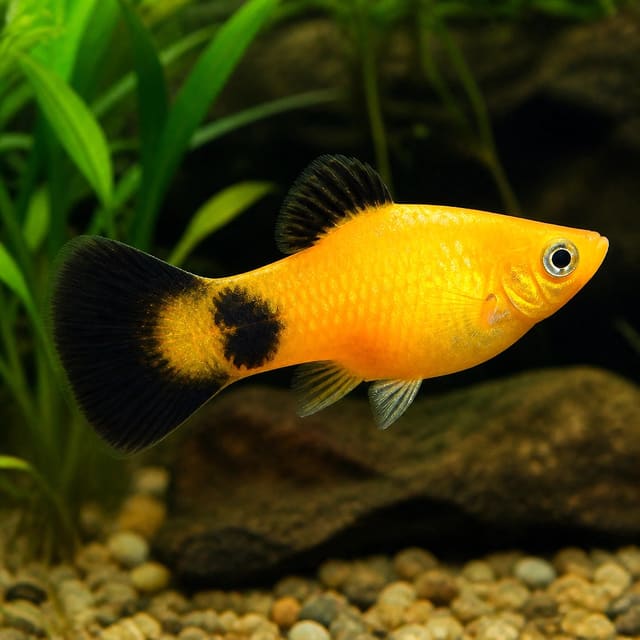
Tuxedo platies carry a broad dark area over much of the rear body, contrasting with the brighter head and front flanks. The edge can be soft or irregular rather than a sharp painted line. Pattern coverage varies naturally, and a fish remains the same trade form if the dark saddle is slightly longer, shorter or lighter than the illustration.
Hi-fin or high-fin refers to an enlarged dorsal fin. Fin extension is often more obvious when the fish is mature, relaxed and actively displaying. A young fish may hold the fin close to the body during transport or acclimation. Dorsal height alone is not a dependable way to sex an individual.
Platies have a compact, laterally compressed body with a short head and fan-shaped tail. Females often become fuller-bodied, while mature males are commonly smaller and more streamlined. A deep abdomen can reflect sex, maturity, food or pregnancy; it should not be used as a single remote diagnosis.
A newly arrived fish may look paler than the listing image. Transport darkness, temperature change and stress can temporarily reduce colour or cause fins to clamp. Stable water, subdued lighting, shelter and appropriate food usually allow the normal pattern to become clearer without using colour-enhancing chemicals.
The gallery is representative and does not show the exact individual packed for an order. The current image is an illustration of the trade form, not a supplier batch photograph. Natural differences in colour coverage, fin height, sex expression and body shape should be expected.
The supplier has not provided a strain pedigree, parentage record or genetic certificate for this batch. The trade name describes the expected appearance, not a laboratory-confirmed genotype. The page therefore avoids claims that every offspring will reproduce the same colour and fin combination.
Platies are adaptable, feed readily and tolerate a practical community temperature range. Easy does not mean suitable for an uncycled aquarium. Success still depends on zero ammonia and nitrite, suitable hardness, restrained feeding and enough space for social behaviour and possible fry.
The species is a poor choice for persistently soft, acidic water or a very small decorative container. It also needs more planning than its size suggests when mixed sexes produce young. A mature filter must support the adult group and any temporary increase in population.
Check appetite, swimming, fin position, breathing and social access at feeding time. A single fish repeatedly hiding, being chased or missing meals needs attention even when the rest of the group appears active. Early changes are easier to correct than advanced injury or water-quality decline.
| Care area | Good practice | Warning sign |
|---|---|---|
| Water | Stable, mineral-rich and fully cycled | Detectable ammonia or nitrite |
| Group | Several fish with plants and open room | One individual is constantly excluded |
| Food | Small varied portions | Persistent swelling or uneaten food |
| Population | Plan for fry before they appear | Tank becomes crowded after repeated broods |
Use at least a 60-litre aquarium with a length of about 60 cm for a small group. Length matters because it creates swimming room and allows fish to move away from persistent courtship. A tall narrow tank with the same volume provides less useful horizontal space.
Increase volume and footprint for a mixed-sex group, a busy community, repeated fry or tank mates that occupy similar water levels. More room does not replace water changes, but it gives social interactions more space and makes sudden waste changes less severe.
Do not calculate stocking from the approximate 3 cm dispatch size. Plan for females reaching about 6 cm and males around 4 cm, then include the adult sizes of every other resident. The filter, maintenance schedule and swimming area must support the mature community.
Platies are not specialist jumpers, but startled fish can leave an open aquarium. Cover cable gaps and filter cut-outs without blocking ventilation. A lid also moderates evaporation, which helps reduce rapid shifts in mineral concentration between water changes.
Keep the aquarium within 18-25°C and avoid rapid changes. Choose a stable point that also suits the community. Warmer water increases metabolism and oxygen demand, while cooler water slows digestion and may not suit warm-water companions. Measure the tank, not only the heater setting.
Neutral to alkaline water suits the species. Stability is generally more valuable than forcing an exact decimal with chemical adjusters. If tap water is outside the range, understand its hardness and buffering before changing it; repeated swings are more dangerous than a stable value near an appropriate boundary.
Moderately hard to hard water supplies minerals relevant to livebearer health and buffering. Platies often struggle in very soft water even when pH initially looks acceptable. Test general hardness rather than assuming that an alkaline pH automatically means the mineral content is sufficient.
Both ammonia and nitrite should remain at 0 mg/l. Nitrate should be controlled through sensible stocking, plant growth where available, substrate cleaning and regular partial water changes. A fish surviving a poor test result does not make that result safe.
| Parameter | Target | Action if unsuitable |
|---|---|---|
| Temperature | 18-25°C | Correct gradually and check oxygen |
| pH | 7.0-8.0 | Check source water and buffering before adjusting |
| Hardness | 9-19 dGH | Use a measured mineral plan, not guesswork |
| Ammonia | 0 mg/l | Stop feeding, change water and investigate filtration |
| Nitrite | 0 mg/l | Change water promptly and protect biofiltration |
| Nitrate | Low and stable | Review stocking, feeding and maintenance |
The filter must process waste from the full adult group, not only the fish currently visible. Do not replace all filter media at once or rinse biological media under chlorinated tap water. Preserve the established bacteria whenever equipment is cleaned or upgraded.
Provide circulation that carries waste towards the filter without pinning fish against the glass. A broad outlet or spray bar can distribute flow. Keep calmer planted margins as resting areas, especially for young fish or females avoiding persistent attention.
Surface movement supports gas exchange. Oxygen demand rises with heat, feeding, crowding and bacterial activity. Gasping near the surface is not normal merely because platies often swim in the upper half of the aquarium; test water and check circulation immediately.
If fry are possible, cover strong intakes with suitable sponge or use fry-safe filtration. Check the guard regularly because debris can reduce flow. A protected intake is also kinder to weak or newly delivered fish while they regain normal swimming strength.
Use rooted or attached plants around the sides and rear to create visual breaks. Dense cover helps shy individuals leave a chase and gives fry a chance to avoid adults. Choose plants that tolerate the same mineral-rich water rather than forcing the fish into softer conditions for a plant preference.
Do not fill every centimetre with hardscape. Platies are active and benefit from an open front or central lane. A balanced layout offers both escape cover and clear water for group movement, feeding and observation.
A limited area of floating plants can soften bright light and provide refuge, but the surface should not become sealed by growth. Thin excess plants during maintenance so food, oxygen exchange and visual checks remain straightforward.
Use stable wood, stone or aquarium-safe ornaments without sharp edges that could damage an enlarged dorsal fin. Confirm that stacked pieces cannot shift during cleaning. Leave enough clearance that an adult female can turn without scraping her body.
Southern Platyfish use social information and normally interact with other platies. A group allows normal following, foraging and hierarchy behaviour. The goal is not to crowd fish together, but to provide several companions within a footprint large enough for individuals to disengage.
A practical target of six or more can spread attention and produce a more natural group when the aquarium can support them. Peer-reviewed work has examined social learning in groups of two, four and six and found more stable traditions in larger shoals. Six is guidance, not an absolute threshold for every setup.
A fish may need temporary isolation for treatment, quarantine or safety, but one alone is not the preferred long-term display plan. Before buying a group, calculate adult bioload and the possibility of fry so social care does not turn into overcrowding.
A group of six is not successful if one fish is constantly cornered or prevented from feeding. Add cover, review the sex balance and move an aggressor or exhausted fish when necessary. Behaviour is the final check on whether a numerical plan works.
Mature males develop a gonopodium, a narrow modified anal fin, while females retain a broader fan-shaped anal fin. Females are often larger and fuller-bodied. These features may be unclear in small, stressed or moving fish, which is why customer sex selection is not offered here.
Where both sexes are present, a common practical aim is roughly one male for every two or three females. This can spread courtship attention, but it cannot guarantee peace. Provide plants, observe feeding and have a plan to separate a persistent chaser or exhausted female.
A verified same-sex group can reduce unwanted fry, but males may still display and establish hierarchy. This product is sold unsexed, so a same-sex order cannot be promised. Customers who cannot accommodate fry should not rely on random ordering to produce the desired sex mix.
A female that has previously been with males may continue producing broods after separation. Scientific experiments recorded several broods after male isolation. A female arriving without a male is therefore not proof that fry are impossible, and pregnancy is never guaranteed from appearance alone.
| Situation | Practical response |
|---|---|
| One male repeatedly chases one female | Add refuge, review ratio and separate if stress persists |
| Two males display | Check that both can feed and retreat; intervene before injury |
| No male present but fry appear | Stored sperm is possible; begin the prepared population plan |
| Sex is unclear at 3 cm | Allow maturity; do not force a remote identification |
Consider peaceful fish that share neutral-to-alkaline, mineral-rich water and are too large to be treated as fry. Calm small barbs, rainbowfish suited to the same setup, peaceful bottom dwellers and other well-managed livebearers may work in an adequately sized aquarium.
Platies establish social relationships, investigate food and may chase during courtship. This is usually different from sustained predatory aggression, but repeated pursuit can still cause stress. Compatibility must be judged by access to food, shelter and rest, not by a label alone.
The enlarged dorsal fin can attract attention from nippy tank mates. Do not assume that a species described as a community fish is safe in every group size or tank shape. If fins become torn, address the social cause as well as water quality.
A small platy should not be combined with fish able to swallow or repeatedly ambush it. Compare adult mouth size and behaviour, not only the present size at purchase. A predator growing slowly is still an unsuitable long-term plan.
| Companion type | Assessment | Main condition |
|---|---|---|
| Peaceful hard-water community fish | Often suitable | Match adult size, temperature and activity |
| Other platies | Generally suitable | Manage sex ratio, space and fry |
| Slow long-finned fish | Use caution | Watch food competition and fin attention |
| Persistent fin nippers | Avoid | High-fin dorsal tissue is vulnerable |
| Large predatory fish | Avoid | Platies may be swallowed or injured |
| Soft-acidic specialists | Poor match | Long-term chemistry requirements conflict |
Adult shrimp may coexist in a planted aquarium, but shrimplets and freshly moulted individuals can be eaten. A platy is an omnivorous forager and will investigate small moving food. Do not use this fish in a valuable shrimp-breeding setup where every juvenile must survive.
Established snails are often ignored, although fish may peck at exposed soft tissue or very small young. Ensure that the snail species also suits the harder, alkaline water. Remove uneaten food rather than relying on snails to correct overfeeding.
Platies may eat their own newborn young and the eggs or fry of other species. Dense plants improve refuge but do not guarantee survival. Keep adults away from a breeding project when maximum yield is the objective.
Choose a high-quality small flake, granule or micro-pellet formulated for omnivorous tropical fish. The food should be small enough to swallow without repeated spitting. A complete staple supplies a more dependable nutrient balance than using dried treats as the main diet.
The wild diet includes animal material and plant matter. Offer a staple with suitable vegetable ingredients and occasional finely prepared foods such as blanched courgette or spinach where the group accepts them. Remove uneaten vegetables before they deteriorate.
Small frozen or live foods such as daphnia, brine shrimp and mosquito larvae can add variety. Use reputable aquarium sources rather than collecting from contaminated water. Rich foods are supplements, not a reason to overfeed.
Feed a portion the group can finish promptly, usually once or twice daily depending on age, temperature and the wider maintenance plan. Watch that timid fish receive food. Remove leftovers and reduce the next portion rather than allowing waste to enter the filter.
| Food type | Role | Caution |
|---|---|---|
| Complete flake or small pellet | Daily nutritional base | Match particle size to the fish |
| Vegetable-rich food | Supports an omnivorous diet | Remove uneaten fresh material |
| Daphnia or brine shrimp | Occasional protein variety | Do not make rich treats the whole diet |
| Wild-collected live food | Not recommended | Contamination and parasite risk |
| Large hard pellets | Poor choice | May be difficult to swallow |
Use a consistent schedule based on test results, stocking and feeding. Many aquaria benefit from a weekly partial change, but the correct amount depends on the system. Match replacement temperature, condition tap water appropriately and avoid exposing fish to abrupt chemistry changes.
Vacuum accessible substrate while preserving planted root zones. Waste trapped behind decor can release nutrients and reduce water quality. Clean a different area when a heavily planted aquarium would be destabilised by disturbing the entire base at once.
Rinse reusable media in removed aquarium water when flow declines. Do not sterilise all biological media during routine cleaning. Check impellers, hoses and intakes so reduced circulation is noticed before oxygen or waste processing becomes a problem.
Record temperature, pH, hardness, ammonia, nitrite, nitrate trend, maintenance and livestock changes. A short history makes it easier to distinguish a sudden fault from a gradual shift and gives better evidence if specialist advice is needed.
Settled platies normally explore, forage and move through the middle and upper aquarium. They often approach when a keeper arrives because they associate movement with feeding. Constant frantic pacing is different from normal activity and can indicate reflection, crowding or unsuitable conditions.
Males may angle their bodies, spread fins and follow females. Brief interactions can be normal; relentless pursuit that prevents feeding or resting is not. Dense cover and a suitable ratio help, but persistent pressure may still require separation.
Clamped fins, rapid breathing, loss of balance, white spots, ulcers, repeated flashing, prolonged refusal to eat or isolation deserve prompt investigation. Start with water tests, temperature, equipment and social conflict before assuming one disease from appearance alone.
Pale colour immediately after transport can be a stress response. Provide dim light and quiet rather than chasing the fish for inspection. Pallor that persists alongside poor appetite, abnormal breathing or skin changes requires a fuller health assessment.
A separate mature quarantine aquarium allows observation before a new fish joins the community. Use dedicated nets and siphons where possible. Quarantine does not mean keeping a fish in an unfiltered jar; it still requires stable heat, oxygen and biological filtration.
Ich is one possibility, but debris, excess mucus and other conditions can look similar in photographs. Consider distribution, behaviour, recent additions and water temperature. Use a current treatment label only after checking the likely cause and compatibility with every resident.
Torn fins can follow nipping, sharp decor, transport or infection. Correct the physical or social cause and maintain excellent water. Medication alone cannot stop a tank mate from continuing to bite an enlarged dorsal fin.
A full abdomen may reflect food, sex, pregnancy, constipation, organ disease or fluid imbalance. Raised scales, asymmetry, poor balance or rapid decline increase concern. Avoid repeated speculative treatments and seek experienced aquatic or veterinary advice for severe cases.
| Observation | First checks | Do not assume |
|---|---|---|
| Rapid breathing | Temperature, oxygen, ammonia, nitrite | That upper-water swimming makes it normal |
| Torn dorsal fin | Tank mates, decor, water quality | That medicine removes the cause |
| White marks | Pattern, spread, recent livestock, behaviour | That every white mark is ich |
| Swollen abdomen | Sex, feeding, symmetry, scales, faeces | That pregnancy is certain |
| Hiding | Arrival time, bullying, light, water tests | That one quiet period proves disease |
Confirm that the aquarium is cycled, within the intended range and securely covered. Dim the lighting and have a clean net or transfer container ready. Do not rearrange the whole community at the same moment unless the layout needs a safety change.
Use the livestock instructions included with the order and the acclimation timer to organise the process. Do not leave a sealed transport bag under bright light or floating for an excessive period. Transport-water chemistry changes after opening.
Where the instructions call for it, move the fish with an appropriate net or container rather than emptying transport water into the aquarium. Keep handling brief and gentle. Cover the receiving tank immediately after transfer.
Leave lights subdued and observe breathing, balance and social responses. Temporary hiding or pallor can be normal. If residents chase the newcomer continuously, use the prepared separation option rather than waiting for visible injury.
Offer only a small meal after the fish has settled. Confirm that it can reach food and is not pinned into a corner. Test water promptly if breathing, posture or swimming seems abnormal, even if the aquarium tested correctly before delivery.
Watch appetite, colour, fins, faeces and group access at different times of day. Recheck ammonia and nitrite because new livestock and extra feeding can reveal limited filter capacity. Keep routine stable rather than making several simultaneous changes.
A female may have been previously inseminated. A fuller body does not confirm pregnancy, but the aquarium should already have a plan for unexpected young. Decide whether fry will remain with adults, be reared separately or be responsibly rehomed before numbers increase.
Platies give birth to free-swimming young rather than laying an external clutch. Mature males use the gonopodium for internal fertilisation. Breeding behaviour should never be forced by crowding, excessive feeding or unsuitable temperature changes.
FishBase reports a typical gestation around 24-30 days, but timing depends on temperature, age, condition and individual biology. This page does not guarantee pregnancy, a delivery date, brood size or fertility.
Dense mosses, floating roots and fine-leaved plants can increase survival, while a bare community leaves young exposed. If maximum survival is required, use a planned separate rearing aquarium. Small trapping devices should not confine a female for prolonged periods.
Repeated broods can exceed the capacity of a modest aquarium. Do not assume every shop, friend or local keeper can take surplus fish. Separate sexes where they can be identified, allow natural adult predation if ethically acceptable in the established community, or choose a verified same-sex group from a seller able to provide one.
| Breeding point | Biology | Retail boundary |
|---|---|---|
| Sex | Mature anal-fin shape differs | Stock is sold unsexed |
| Gestation | Often around 24-30 days | No delivery date is promised |
| Stored sperm | Several later broods may occur | Removing males may not stop fry immediately |
| Brood | Number varies widely | No pregnancy or brood size is guaranteed |
| Fry | Free-swimming and vulnerable | Adults may eat them; survival needs planning |
A mature separate aquarium with sponge filtration gives more control than repeatedly moving a heavily pregnant female. Match temperature and chemistry carefully. Cover intakes and avoid strong currents that exhaust small fry.
Offer finely powdered complete fry food and appropriately sized live or frozen alternatives in very small portions. Frequent feeding increases waste quickly, so siphon leftovers carefully and test water. Growth should never be pursued at the expense of water quality.
As juveniles grow, reduce crowding and separate individuals if fin nipping or uneven access appears. Do not distribute fish until they are healthy, feeding reliably and large enough for safe transport. Explain the adult care needs to every new keeper.
FishBase reports males to about 4 cm total length and females to about 6 cm. Individual outcomes vary with sex, lineage and condition. Use the larger female value for stocking and hardscape clearance rather than assuming every fish remains at the dispatch grade.
The species can mature within a few months under suitable conditions. A small purchase can therefore become a breeding population sooner than a new keeper expects. Aquarium capacity and sex-management plans should be ready before visible courtship begins.
Good care is measured over years, not only during the first week. Maintain stable water, varied food, appropriate group structure and a realistic population ceiling. Revisit stocking whenever fry survive or tank mates reach adult size.
A standard Red Tuxedo Platy shares the warm front and dark rear pattern, but may not show the same enlarged dorsal fin. Compare the Red Tuxedo Platy listing when fin shape matters less than the tuxedo colour contrast.
Wagtail forms concentrate dark pigment in the fins rather than across a broad rear-body tuxedo saddle. The Red Wagtail Platy is a useful comparison for customers choosing between pattern types.
The Yellow Tuxedo Platy retains the dark tuxedo idea against a yellower base. Colour names are trade descriptions with individual variation, so compare the full care and current availability rather than selecting from one photograph alone.
Customers open to mixed colours can view the Assorted Platy, Golden Mickey Mouse Platy and Bumble Bee Platy. These are separate trade forms, not guaranteed genetic matches for breeding.
| Form | Main visible distinction | Shared care theme |
|---|---|---|
| Gold Red Tuxedo Hi-Fin | Warm front, dark rear saddle, enlarged dorsal | Harder neutral-to-alkaline water |
| Red Tuxedo | Red front with dark rear body | Social livebearer care |
| Red Wagtail | Dark fins on a red body | Manage group and possible fry |
| Yellow Tuxedo | Yellow base with dark saddle | Omnivorous community feeding |
| Assorted Platy | Mixed colours and patterns | Same species-level planning |
You have a mature, covered aquarium of at least about 60 litres and 60 cm length, mineral-rich neutral-to-alkaline water, and room for a small social group. You also accept natural colour variation and can manage fry or changing sex ratios.
Your aquarium is uncycled, very soft and acidic, too small for a group, or already at its adult stocking limit. It is also a poor fit where every shrimp or fish fry must survive, or where no backup accommodation exists for persistent courtship.
Use the water matcher to compare the aquarium with the published range, then verify with a reliable liquid or calibrated digital test where appropriate. Do not buy a fish first and plan to correct unsuitable chemistry afterwards.
Browse the platy fish collection, the livebearers and platies category and the Xiphophorus maculatus category. Similar care does not make every colour form identical or every product simultaneously available.
Availability can change with supplier and holding stock. A visible care page does not confirm that checkout is open. Use the live product controls and basket to verify the order at the time of purchase.
Eligible UK livestock orders are covered by the Live Arrival Guarantee when the published conditions are followed. Read the current delivery information, arrange to receive the parcel and inspect livestock promptly. Weather, postcode and dispatch-day restrictions may affect the service offered.
Eligible first-time customers can use WELCOME10 for 10% off under the current promotion terms. A discount should not determine whether an aquarium is ready or how many fish it can support. Confirm water, adult stocking and population plans before selecting quantity.
The current image is a representative illustration of the trade form. It is not a photograph of the exact fish dispatched and was not created from a batch photo. It is retained because no reference image exists for this stock and it communicates the intended colour-and-fin combination.
The delivered fish may be lighter, darker, more orange or more red. The tuxedo boundary and dorsal height can vary, especially in a young or stressed individual. Sex, pregnancy, maturity and exact markings cannot be inferred or guaranteed from the illustration.
One unsexed live fish is supplied per selected quantity. The old "10 X" wording survives only inside the legacy URL and does not mean that one quantity contains ten fish.
The supplier grade is approximately 3 cm. Natural variation is expected, and this is a dispatch band rather than an exact measurement or the adult maximum.
No. The title uses the trade name and scientific identity only. Operational SKU data remains in the protected product record where it belongs.
No. Stock is unsexed. Mature anal-fin shape can distinguish sexes, but that may not be dependable at the supplied size or from remote photographs.
Aim for a social group of six or more where a suitable aquarium, filtration and adult stocking plan permit. Six is practical guidance, not a universal biological threshold or a mandatory pack size.
Where a mixed-sex group develops, roughly one male to two or three females can spread courtship attention. This order cannot guarantee that ratio, and persistent chasing may still require separation.
Plan for females up to about 6 cm total length and males commonly up to about 4 cm. Stock the aquarium for adults, not the approximate 3 cm dispatch grade.
Use at least about 60 litres and 60 cm length for a small group, with more room for mixed sexes, a community or surviving fry.
Use stable water around 18-25°C, pH 7.0-8.0 and 9-19 dGH, with ammonia and nitrite at 0 mg/l. Very soft acidic water is a poor long-term match.
She may. A previously inseminated female can store sperm and produce several later broods. Pregnancy, timing and brood size are not guaranteed.
Adult shrimp may coexist, but shrimplets and vulnerable moulting shrimp can be eaten. Do not treat this fish as safe for a valuable shrimp-breeding project.
Yes, in a mature aquarium with suitable mineral-rich water, enough group space and controlled feeding. Easy does not mean suitable for an uncycled tank or a small bowl.
No. It is a representative illustration of the trade form. The dispatched fish will vary naturally in colour, pattern, sex expression and dorsal development.
It is a quantity-based pricing feature when shown. Every basket quantity remains one fish, and the tier does not guarantee a chosen sex ratio or pre-formed group.
Usually, provided the aquarium supports the adult group and all fish share appropriate water. Monitor ratio, courtship, feeding access and total fry production.
WELCOME10 gives eligible first-time customers 10% off under the current terms. Check the basket and promotion conditions; the code does not change stock, delivery rules or livestock suitability.
Editorial evidence note: Scientific identity, distribution, published adult size, water range, diet and reproductive context were checked against FishBase, GBIF and peer-reviewed research. The 60-litre practical aquarium, six-fish social target and ratio guidance are conservative Tropical Fish Co husbandry judgements. The supplier has not provided a precise locality, sex, pregnancy status, strain pedigree or breeding-origin certificate for this batch.
No reviews for this item yet. Bought one? Honest reviews only, good or bad.
What customers say about ordering from us
I have a small group of long finned mountain minnows. So was delighted to be able to order ten of this variety to increase the genetics in my tank . The ones I recieved are healthy but it’s to early to give a verdict on wether they are of a long finned type since they are small currently.
Gordon Walker · 23 Sept 2026
100% success travel and "installation". Pleased with quality of purchase. The Siamese fighter a bit "shy" so have not yet seen him at his best yet but looking good. Happy customer. GG
George E Garratt · 21 Sept 2026
Reviews of our shop, collected by Judge.me, an independent third-party review collector. Newest first.