Sold Out
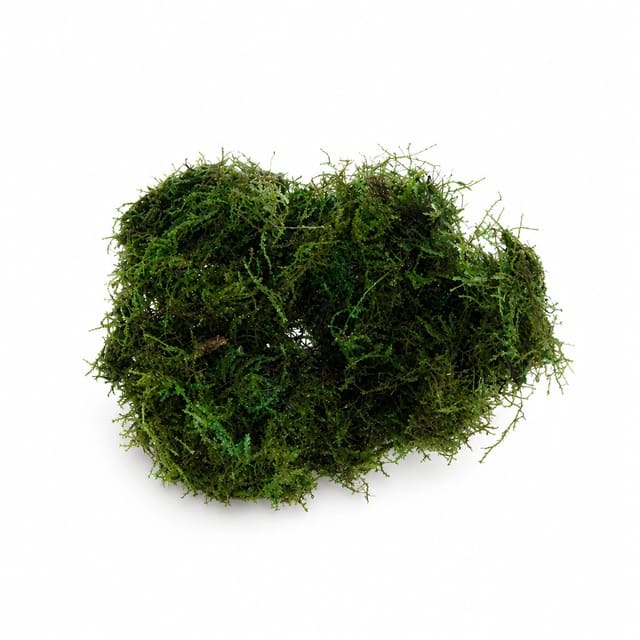
Java Moss (Vesicularia dubyana)
22–28°C · pH 5–8
£6.39
The Marimo Moss Ball (Aegagropila linnaei) is a slow-growing filamentous green alga, not a moss, that forms a soft, velvety ball. It needs no planting or CO2, prefers low to medium light and cool to moderate water, and keeps its shape with a gentle roll at water changes. Sold individually, small 1–2 cm or medium 3–4 cm.
Aegagropila linnaei
The Marimo Moss Ball (Aegagropila linnaei) is a slow-growing filamentous green alga, not a moss, that forms a soft, velvety ball. It needs no planting or CO2, prefers low to medium light and cool to moderate water, and keeps its shape with a gentle roll at water changes. Sold individually, small 1–2 cm or medium 3–4 cm.
The Marimo Moss Ball (Aegagropila linnaei) is not a moss at all but a filamentous green alga that grows into a soft, velvety, bright green ball. It needs no planting, no CO2 and very little light, which makes it one of the easiest living additions to a shrimp tank, a nano aquarium or a coldwater set-up.
Marimo belongs to the green algae order Cladophorales, in the family Pithophoraceae. You will also see it sold as a moss ball, Cladophora ball, lake ball or Japanese moss ball. Wikipedia notes that some recent sources give the name as Aegagropila brownii; the aquarium trade and the recent research cited here still use Aegagropila linnaei. The Japanese name was coined in 1898: “mari” is a bouncing play ball and “mo” a general word for water plants.
In the wild, marimo grows in three forms: on rocks, as loose filaments on lake beds, and, in a few lakes, as free-rolling balls kept round by gentle wave action. The famous balls of Lake Akan in Japan reach 20–30 cm and have been protected since the 1920s; Lake Mývatn in Iceland held colonies of balls about 12 cm across at 2–2.5 m deep. Collecting from Lake Akan is prohibited, so aquarium balls are cultivated rather than taken from those lakes.
| Suits | Not suited to |
|---|---|
| Low to medium light, away from direct sun | A sunny windowsill or a tank under very strong light |
| Cool to moderate water; best at 15–24°C | Tanks kept hot or placed next to a heater |
| Shrimp tanks, nano tanks and coldwater set-ups | Large fish that dig, pick at or tear up decor |
| Keepers happy with very slow growth | Anyone expecting a ball to double in size quickly |
New to live plants? Our live plants for beginners guide covers the basics. The photograph shows the type of ball you will receive, not the exact ball.
One purchase supplies one marimo moss ball in the size you choose: small, about 1–2 cm across, or medium, about 3–4 cm. Each ball is a single living mass of green filaments radiating from the centre, green all the way round.
Buy the size you want to see, because marimo grows very slowly. Wikipedia and Aquarium Co-Op give about 5 mm a year. A 2023 study of giant marimo in Lake Akan by Nakayama and colleagues estimated up to about 11.5 mm a year in the lake, and cited cultivation experiments of about 4.0 mm a year at 10°C and 6.0 mm a year at 14°C. In a home aquarium, expect a small ball to stay small for years.
| Size | Best use |
|---|---|
| Small, 1–2 cm | Nano tanks, shrimp tanks, filling gaps between stones, or a group of several balls |
| Medium, 3–4 cm | A clear feature at the front of a larger tank, or a single ball in a cool or coldwater tank |
Several small balls grouped together give a softer, more natural look than one larger ball. Marimo is sent with our livestock; see our delivery information for dispatch days.
Marimo is adapted to low light. Wikipedia describes wild colonies depending on that adaptation, with balls green on every side so any side can photosynthesise, and inner chloroplasts that stay dormant but switch on within hours if a ball breaks open. Aquarium Co-Op advises low to medium light and keeping balls out of direct sunlight. Flowgrow lists a wide light range, low to high, but strong light is the most common reason keepers give for a ball changing colour.
| Spot | Why it works |
|---|---|
| Front of the substrate, in the open | Easy to see and roll; fine under ordinary aquarium lighting |
| In the shade of taller plants or wood | Best in tanks with strong lighting |
| Between stones in a shrimp tank | Gives shrimp a grazing surface and stays in place |
| Away from heaters and sunny windows | Avoids local warm spots and direct sun |
Turn the ball now and then so every side gets some light. In the wild, wave action rolls the balls and keeps them round; in an aquarium a gentle turn every week or two does the same job.
Marimo comes from cool northern lakes, and temperature matters more to it than light or nutrients. Flowgrow gives a tolerance of 4–28°C with best growth at 15–24°C, pH 6–8.5 and carbonate hardness 2–18 dKH. The Lake Akan study cites a laboratory experiment in which loose marimo filaments grew best at 22°C, the warmest temperature tested in a 5–22°C range, and another in which balls held at 35°C for 24 hours fell apart after 80 days.
| Value | Figure | Source |
|---|---|---|
| Temperature tolerated | 4–28°C | Flowgrow |
| Temperature for best growth | 15–24°C | Flowgrow |
| Kept successfully in betta tanks | Up to 80°F (about 27°C) | Aquarium Co-Op |
| Breakdown after heat stress | 35°C for 24 hours | Nakayama et al., citing an earlier experiment |
| pH | 6–8.5 | Flowgrow |
| Carbonate hardness | 2–18 dKH | Flowgrow |
That makes marimo ideal for coldwater and unheated tanks, and fine in most tropical tanks kept at the cooler end. Growth slows as the water warms, so place it away from the heater. Check your tap water with our water matcher if you are matching it to particular fish or shrimp.
Marimo needs very little care, and most of it fits into your normal water change. Aquarium Co-Op suggests rinsing a new ball in aquarium water before it goes in, letting shrimp and snails pick off leftover food, and gently rolling the ball in your hands at each water change to help it keep its shape.
A new ball may float at first, Aquarium Co-Op notes, and sinks once it is waterlogged. A ball that floats after weeks in the tank usually has gas trapped in the filaments, often after strong light; a gentle squeeze releases it.
Because marimo grows so slowly, most keepers make more balls by dividing one rather than waiting. Flowgrow lists splitting as the way it propagates. Aquarium Co-Op describes the method: squeeze the water out, cut the ball in half, roll each half into a sphere and tie it with cotton sewing thread so it holds its shape while it regrows. Some keepers unroll balls into flat mats instead, to cover stones or the floor of a small tank.
Like any live plant, a moss ball can carry small animals into your tank. The best-known example came from the United States: in February 2021 an employee of a Seattle pet shop found zebra mussels attached to and inside marimo balls sold as aquarium plants, and by late April 2021 contaminated moss balls had been found in 46 states, according to the US National Invasive Species Information Center. Owners there were urged to destroy suspect balls rather than dump them.
That episode is the reason for a quick check with any living plant from any source. Look the ball over in a bowl of tank water, feel for anything hard, and remove snails or shells before it goes into your aquarium.
A healthy marimo is an even, deep green. Changes in colour or shape are slow to appear and slow to recover, so act on them early.
| Problem | Likely cause | What to do |
|---|---|---|
| Brown or pale patches | Too much light, warm water or a ball that is never turned | Move it to shade, away from the heater, and turn it regularly |
| Floating | Air trapped in the filaments | Squeeze it gently under water |
| Losing its round shape | Not rolled, or pulled apart by fish | Roll it at each water change; move it away from pickers |
| Covered in debris | Settled waste and food | Swish it in removed tank water |
| Strands of other algae growing on it | Excess light or nutrients in the tank | Pick them off and review lighting and feeding |
| Falling apart or smelling bad | Heat stress or a dead core | Cool the water; cut away dead parts and re-roll the healthy green filaments |
The same habits that keep marimo green keep the rest of the tank in balance. Our algae control guide explains how light and nutrients affect unwanted algae.
Marimo suits peaceful tanks best. Shrimp and snails graze the surface and help keep it clean, and small, calm fish leave it alone. It is a natural partner for a cherry shrimp tank, and our shrimp-keeping guide explains how to set one up.
| Good companions | Use caution |
|---|---|
| Mixed Neocaridina Shrimp and Amano Shrimp, which graze the surface | Large fish that dig or pick at decor and can roll a ball apart |
| Nerite Snails and other aquarium snails | Very warm tanks kept near the top of the tropical range |
| Cool-water fish such as White Cloud Mountain Minnows | Tanks lit very brightly with no shade |
| Small, peaceful nano tank fish | Anything that eats soft green growth heavily |
If a fish starts tearing at the ball, move the ball to another tank rather than replacing it; a damaged ball can be re-rolled and will recover slowly in calmer company.
No. It is a filamentous green alga (Aegagropila linnaei, family Pithophoraceae) that grows into a ball shape. The name “moss ball” comes from its soft, velvety look.
Small 1–2 cm suits nano and shrimp tanks; medium 3–4 cm makes a clearer feature at the front of a larger tank. Marimo grows only a few millimetres a year, so buy the size you want to see.
Very slowly: about 5 mm a year according to general sources. A 2023 study cites 4–6 mm a year in culture at 10–14°C, and up to about 11.5 mm a year for giant balls in Lake Akan.
Usually too much light, water that is too warm or a ball that is never turned. Move it out of direct light and away from heaters, and roll it gently so every side gets some light.
Yes, at the cooler end. Flowgrow gives a best range of 15–24°C and tolerance up to 28°C, and keepers have grown them in betta tanks at up to 80°F (about 27°C). Growth slows in warm water.
Air trapped in the filaments, often when it is new or after strong light. It usually sinks once it is waterlogged; a gentle squeeze under water releases the air.
No. Normal aquarium water is enough. Some keepers add fertiliser or CO2 to speed growth, but it is not needed.
Rinse it in tank water and look it over for snails, small shells or anything hard before it goes in. In 2021 zebra mussels were found in moss balls sold in the United States, so a careful check is worth the minute it takes.
No reviews for this item yet. Bought one? Honest reviews only, good or bad.
What customers say about ordering from us
Easy website plenty of info on fish your buying great to pick a time slot
TRACEY DURRANT · 7 Oct 2026
Got some lovely fish thank you
Kevin Mackie · 7 Oct 2026
Reviews of our shop, collected by Judge.me, an independent third-party review collector. Newest first.