Easy
Aquarium Plants on Bogwood (Various Species)
22–28°C
£36.69
Dwarf hairgrass (Eleocharis parvula) is a low, grass-like sedge whose runners knit into a dense green lawn across the aquarium foreground. Tropica rates it easy, 3–10+ cm tall, with low light and CO2 demand; stronger light and CO2 make it carpet faster. Sold as one pre-grown pad, one pot or one bunch.
Eleocharis parvula
Confirm your email, then we’ll send an availability message for this exact item if it returns within 180 days.
This request is only for this product—no newsletter or other promotions. A mail-provider retry may very rarely duplicate the same availability message. Unconfirmed addresses are removed after 48 hours. See our privacy policy.
Dwarf hairgrass (Eleocharis parvula) is a low, grass-like sedge whose runners knit into a dense green lawn across the aquarium foreground. Tropica rates it easy, 3–10+ cm tall, with low light and CO2 demand; stronger light and CO2 make it carpet faster. Sold as one pre-grown pad, one pot or one bunch.
Read the full care guidance when planning conditions for your aquarium.
Dwarf hairgrass (Eleocharis parvula) is a low sedge with thin, bright green, grass-like stems that spreads by runners and gradually knits into a lawn across the front of an aquarium. Botanists call the species dwarf spikerush or small spikerush; “hairgrass” is the name used in the aquarium hobby. It belongs to the sedge family, Cyperaceae, rather than to the true grasses.
Tropica’s plant profile rates dwarf hairgrass easy, gives a height of 3–10+ cm after two months in the aquarium and rates both its light and its CO2 demand as low. Tropica describes a low-growing Eleocharis that forms runners close to the parent plant, looks best planted in small bunches quite close to each other so that they gradually form a solid mass, and suits large and small aquariums alike as a foreground plant.
Several small spikerushes are sold as hairgrass, and the labels in the trade are not consistent. The Flowgrow aquatic plant database, citing the plant specialist Christel Kasselmann, says the plant usually sold as Eleocharis parvula is really Eleocharis pusilla from Australia and New Zealand, that true E. parvula may hardly be in the trade at all, and that more than one species probably travels under the name.
| Name you may see | What the sources say |
|---|---|
| Eleocharis parvula (dwarf spikerush) | The name on this listing and on Tropica’s profile: 3–10+ cm. The wild species grows in brackish marshes and mudflats. |
| Eleocharis pusilla | Flowgrow: often sold as E. parvula; usually clearly under 10 cm submerged, light green, with stalks that curve sideways. |
| Eleocharis acicularis (needle spikerush) | Flowgrow: easily confused with dwarf hairgrass; the E. pusilla type is shorter, lighter green and more curved underwater. |
| Eleocharis acicularis ‘Mini’ | Tropica calls it an even smaller variety of dwarf hairgrass, wanting moderate to strong light and CO2 for best results. |
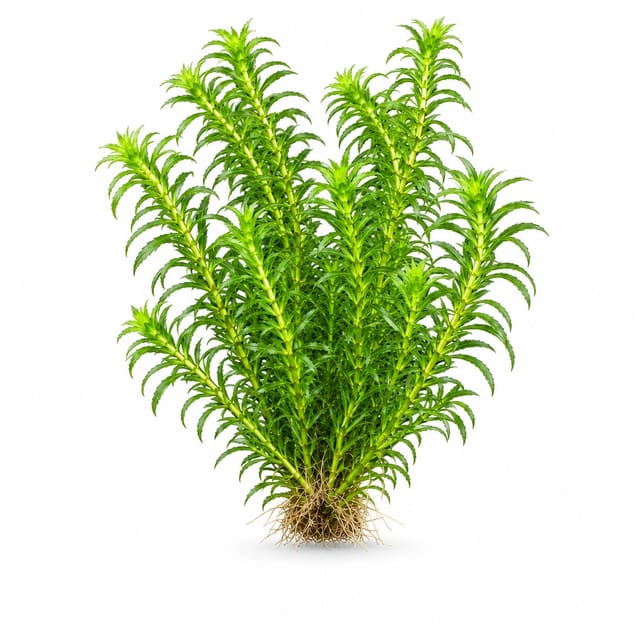
For you as a buyer, the practical point is simple: every plant in this group is planted, trimmed and propagated the same way, and the care below applies whichever name is on the label. Our photograph shows the form supplied.
One purchase supplies one unit of the format you select: one pre-grown pad, one pot or one bunch of dwarf hairgrass. The amount of plant in each unit changes with the growing season, so the photograph shows the format rather than an exact count of stems. Add several units to your basket when you want to plant a whole foreground in one go.
| Format | What arrives | Best for | First step |
|---|---|---|---|
| On pad | A mat of hairgrass already grown on a pad, held in a mesh | Instant cover on one defined patch | Lay it flat and bury the edges lightly in the substrate |
| Potted | One pot of hairgrass in its growing medium | Splitting into many small tufts | Remove the pot and wash off the growing medium |
| Bunch | One bunch of hairgrass | Low-cost infilling between other plants | Split it into small tufts of a few stems |
A pad gives the quickest visual result because the mat has already formed. Pots and bunches cost less per unit and spread further once split, but they take longer to join up into a lawn. If you keep shrimp, look closely at the pad’s mesh after unpacking: if it is wire rather than plastic, cut the hairgrass mat free and plant it without the mesh.
Our delivery and live arrival information explains dispatch days and arrival times. Plant the hairgrass on the day it arrives; until then keep it damp, cool and out of direct sun.
Dwarf hairgrass grows in modest set-ups, but how quickly it carpets depends on light, CO2 and nutrients. Tropica rates its light and CO2 demand low, so added CO2 is not essential. Other sources aim higher: Flowgrow lists medium to high light and 6–40 mg/l CO2 for the plant it describes, and Tropica’s advice for the smaller ‘Mini’ form is moderate to strong lighting with CO2 injection for best results. The sources disagree, so treat Tropica’s rating as what the plant tolerates and the higher figures as what drives a fast, dense lawn.
| Set-up | What to expect |
|---|---|
| Modest light, no added CO2 | Within Tropica’s low-demand rating. Expect slow spreading, so plant the tufts closer together. |
| Good light with injected CO2 in Tropica’s medium band (6–14 mg/l) | Faster runners and a lawn that closes sooner. |
| Strong light, CO2 in Tropica’s high band (15–25 mg/l) and a nutrient-rich soil | The quickest, densest carpet, with more trimming and a closer watch on algae. |
Whenever you inject CO2, raise it gradually and watch your fish: rapid breathing at the surface is a sign to turn it down. Fish and shrimp come first, whatever the plant would prefer.
Tropica says ‘Mini’ grows best in an aquarium soil and also grows in fine gravel or sand when a liquid fertiliser supplies the nutrients. Runners travel through the top layer of the substrate, so a fine, loose surface is easier for them to cross than coarse gravel. Keep the foreground in the light, too: tall stem plants or floating plants that shade the front of the tank slow a lawn down.
Tropica publishes no temperature, pH or hardness limits for dwarf hairgrass. Flowgrow gives a full set of values for the plant usually sold under this name, collected in the table below. They are broad enough to suit most tropical community tanks and many cooler, unheated set-ups.
| Value | Flowgrow range |
|---|---|
| Temperature tolerance | 12–27°C |
| Optimum temperature | 20–25°C |
| pH | 5–7 |
| Carbonate hardness | 0–14 °dKH |
| CO2 | 6–40 mg/l |
| Nitrate (as a plant nutrient) | 10–50 mg/l |
| Phosphate | 0.1–3 mg/l |
| Potassium | 5–30 mg/l |
| Iron | 0.01–0.5 mg/l |
Nitrate means something different in a plant table: here it is a nutrient the plant takes up. Your fish and shrimp set their own upper limits, which are often lower, so keep the tank within the values your animals need.
UK tap water varies from very soft to very hard from one region to the next, and your water company publishes the hardness for your postcode. Test pH and KH before you plant, then compare your readings with the table using our water matcher; the water chemistry guide explains what each reading means. Flowgrow’s pH range stops at 7, while Tropica sets no limit at all, so treat pH 7 as the edge of the comfortable zone rather than a wall.
Although wild Eleocharis parvula grows in brackish marshes, aquarium hairgrass is grown in fresh water. Do not add salt to help it: nothing in the plant sources supports that, and most freshwater companions would suffer.
Hairgrass spreads from the edges of each tuft, so many small tufts close up faster than a few large clumps. Tropica’s own instruction is to divide the pot into as many portions as necessary and plant them with tweezers.
A pad needs no splitting. Lay it flat where you want the lawn, press it down and cover the edges with a little substrate so it stays put. You can also cut a pad into smaller squares and space them out to cover a wider area, letting the runners close the gaps.
Flowgrow notes that the plant can grow above water as well as below it, which is why some keepers start a brand-new tank “dry”: the hairgrass is planted in damp soil and kept humid under a cover until it has rooted and spread, and the tank is flooded afterwards. This only suits a new, empty tank, never one that already holds animals.
Once the tufts join up, upkeep is mostly trimming, cleaning and now and then renewing the lawn. Flowgrow lists runners, splitting and cutting off daughter plants as ways to propagate it, so every tidy-up can also give you new tufts for bare patches.
| Task | When | How |
|---|---|---|
| Trim | When the lawn is taller than you want | Cut across the top with long, sharp aquarium scissors and net out every clipping |
| Vacuum | At every partial water change | Run a siphon just above the lawn to lift trapped debris |
| Fill gaps | Whenever a bare patch appears | Cut a runner with its daughter plant and replant it in the gap |
| Renew | When an old carpet thins in the middle | Lift the whole carpet as one mat and replant the healthiest plants |
Tropica warns that excess organic waste must be removed from a hairgrass carpet by regular vacuuming to prevent algae and poor growth, and says a carpet can go many weeks between trims provided there is sufficient light and water circulation. Gentle flow across the foreground keeps debris moving towards the filter instead of settling in the lawn.
Clippings float and drift into filter intakes, so collect them as you cut. Put every trimming in household waste or compost it well away from water; never tip clippings into a drain, pond or stream.
A hairgrass lawn suits small, peaceful animals that browse over it rather than dig through it. Newly planted tufts have shallow roots for the first weeks, so fish that dig, sift the substrate hard or eat soft plants can lift them before the runners take hold. Browse our fish for planted aquariums and nano tank fish for species that suit a planted foreground.
| Companion | Why it suits a hairgrass lawn |
|---|---|
| Chocolate Cherry Shrimp | Grazes biofilm between the stems and does not uproot plants; young shrimp shelter in the lawn. |
| Amano Shrimp | Picks at algae and debris on the blades. |
| Celestial Pearl Danio | A small, peaceful fish that uses planted cover low in the tank. |
| Pygmy Corydoras | Small enough to forage over a lawn without tearing it up. |
| a group of ten Chili Rasboras | Tiny shoaling fish for nano tanks that leave plants alone. |
Avoid large digging cichlids, goldfish and other big bottom-diggers, which uproot new tufts. Avoid plant-eaters too: Seriously Fish calls the silver dollar Metynnis argenteus an avid plant-eater.
Water values decide the final mix. Check each species’ temperature and pH against the hairgrass table and against each other with our tank mates tool. For shrimp-only tanks, read our shrimp-keeping guide, browse the cherry shrimp collection or the Neocaridina shrimp category.
Most hairgrass problems either show in the first month, while the plant adapts, or come from debris building up in an older lawn. Change one thing at a time and give the plant time to respond before you change another.
| If you see | Do this |
|---|---|
| Some older blades yellowing or browning after planting | Trim them off and keep conditions stable. Plants grown above water have to make new leaves for life underwater, and new green blades follow. |
| Tufts floating up | Replant them deeper with tweezers and check whether a fish is digging. |
| No new runners after several weeks | Check that light reaches the foreground, consider added CO2 or a root fertiliser, and plant tufts closer together. |
| Algae on the blades | Vacuum debris, feed less, review how long the light is on and add algae-grazing shrimp. |
| A brown, thinning centre in an old carpet | Lift the carpet, divide it and replant the healthiest tufts. |
| Debris settling on the lawn | Improve gentle flow over the foreground and siphon at every water change. |
Tropica’s notes on emersed production explain the first symptom: amphibious plants grown above water build up reserves so they can develop new leaves for their new environment. For algae in general, our aquarium algae control guide walks through light, nutrients and clean-up, and our live plants for beginners guide covers planted-tank basics.
The true Eleocharis parvula is a rare wild plant in the British Isles. The Flora of Northern Ireland describes it growing immersed in the estuarine mud around the mouth of the River Bann, a population it calls very significant in both UK and Irish contexts, and notes that the plant has been seen by very few people. Wikipedia records its scattered distribution across Europe, North America and Asia in brackish marshes and mudflats. Aquarium plants of uncertain origin must never be mixed into habitats like that.
OATA advises never releasing aquarium animals or plants into the wild and does not recommend using aquarium plants in outdoor ponds. GOV.UK warns that dumping aquatic plants in the wild may be an offence. Put clippings and old tufts in household waste, or drain them and use them as mulch well away from ponds, streams and drains, as OATA suggests, and pour old aquarium water onto the lawn rather than into a drain or watercourse.
Dwarf hairgrass is the aquarium name for Eleocharis parvula, a low sedge from the family Cyperaceae, also called dwarf spikerush. It spreads by runners into a fine, bright green lawn across the foreground. Tropica rates it easy and gives a height of 3–10+ cm after two months.
Tropica gives 3–10+ cm after two months in the aquarium, and Flowgrow says the plant usually sold under this name stays clearly under 10 cm when submerged. Trim the lawn with long aquarium scissors whenever it is taller than you want.
Added CO2 is not essential: Tropica rates both its CO2 and its light demand as low. Stronger light and added CO2 make it spread faster and denser; Flowgrow lists 6–40 mg/l CO2 for the plant it describes.
Split pots and bunches into small tufts of a few stems and plant them with tweezers in small bunches quite close together across the foreground. The runners fill the gaps and the tufts join up into a lawn. A pre-grown pad gives instant cover on the patch where you lay it.
Choose a pad for instant cover on one patch, a pot for the most tufts after splitting, and a bunch for low-cost infilling. One purchase supplies one pad, one pot or one bunch, and the amount of plant in each varies with the growing season.
Flowgrow gives a temperature tolerance of 12–27°C with an optimum of 20–25°C, pH 5–7 and 0–14 °dKH carbonate hardness. Tropica publishes no water limits and rates the plant easy, so treat Flowgrow’s values as the comfortable zone.
Yes. Shrimp graze between the blades without uprooting them, and the dense lawn gives young shrimp cover. If you buy the pad, look at its mesh before planting: if it is wire rather than plastic, free the mat from the mesh and plant it without it.
Some older blades often yellow while the plant adapts to life underwater; trim them off and new growth follows when conditions are stable. If yellowing continues, check light on the foreground, CO2, fertiliser and debris trapped in the lawn.
No. Flowgrow lists its outdoor use and winter hardiness as unknown, and OATA does not recommend using aquarium plants in outdoor ponds. Keep it in the aquarium and put trimmings in household waste.
No reviews for this item yet. Bought one? Honest reviews only, good or bad.
What customers say about ordering from us
Easy website plenty of info on fish your buying great to pick a time slot
TRACEY DURRANT · 7 Oct 2026
Got some lovely fish thank you
Kevin Mackie · 7 Oct 2026
Reviews of our shop, collected by Judge.me, an independent third-party review collector. Newest first.