Easy
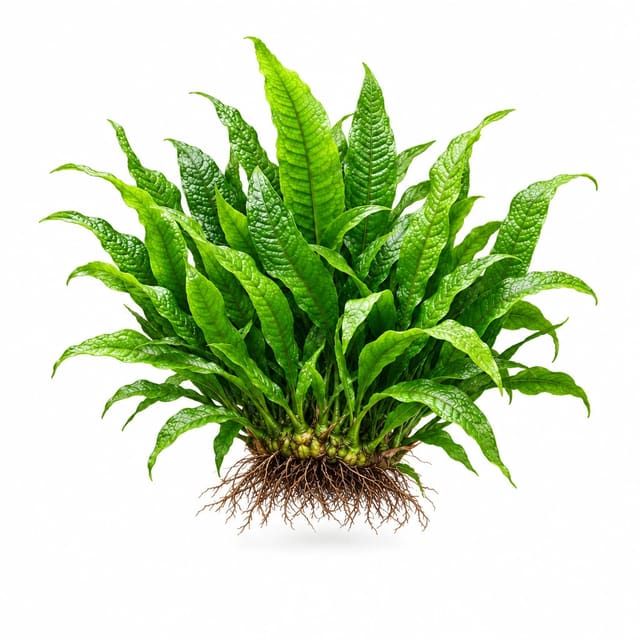
Java Fern (Microsorum pteropus)
20–28°C · pH 5–8
£7.29
Red cabomba (Cabomba furcata, also sold as Cabomba piauhyensis) is a fast-growing stem plant from tropical Central and South America with feathery leaves that turn brown-red to wine-red under strong light. It is demanding: soft water at 24–30°C, strong lighting, added CO2 and complete fertiliser. Sold as one bunch or one pot.
Cabomba furcata
Confirm your email, then we’ll send an availability message for this exact item if it returns within 180 days.
This request is only for this product—no newsletter or other promotions. A mail-provider retry may very rarely duplicate the same availability message. Unconfirmed addresses are removed after 48 hours. See our privacy policy.
Red cabomba (Cabomba furcata, also sold as Cabomba piauhyensis) is a fast-growing stem plant from tropical Central and South America with feathery leaves that turn brown-red to wine-red under strong light. It is demanding: soft water at 24–30°C, strong lighting, added CO2 and complete fertiliser. Sold as one bunch or one pot.
Read the full care guidance when planning conditions for your aquarium.
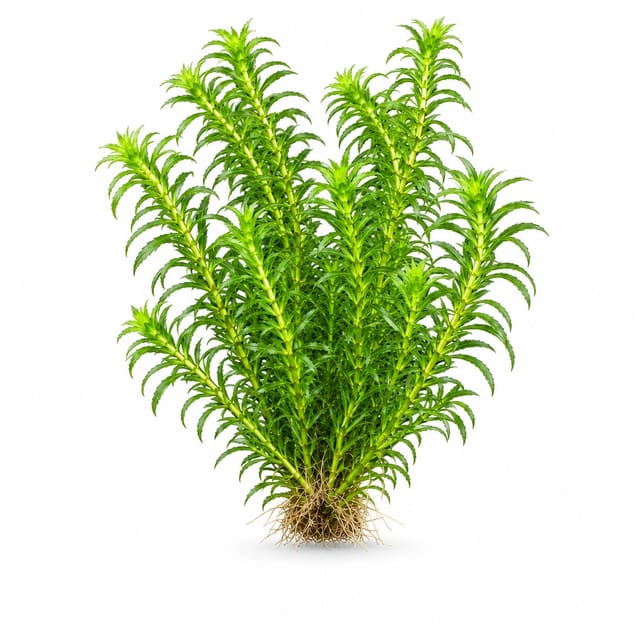
Red cabomba (Cabomba furcata) is a fast-growing stem plant from tropical Central and South America, also called forked fanwort and still widely sold under its older name Cabomba piauhyensis. Each stem carries whorls of finely divided, feathery leaves that shift from olive green to brown-red and wine-red under strong light, which makes red cabomba one of the few fine-leaved red plants for the back of a planted aquarium.
It belongs to the fanwort family, Cabombaceae. The Flowgrow aquatic plant database lists it from Costa Rica and Panama south through Colombia, Ecuador, Peru, Bolivia, Brazil, Venezuela, Guyana and Trinidad, and in Cuba, in slow-flowing waters with a slightly acidic pH. Wikipedia adds lagoons, ponds, streams, lakes and floodplains, and describes mostly whorled, dark purple submerged leaves and purple flowers. Aquasabi and Flowgrow both rate it difficult; Aquasabi calls it the most demanding of the fanworts.
| Suits | Not suited to |
|---|---|
| A planted tank with strong lighting | Low-light or lightly lit tanks |
| Added CO2 and a complete fertiliser routine | Tanks without CO2 or regular feeding of plants |
| Soft, slightly acidic water at 24–30°C | Hard, alkaline tap water used untreated |
| Background or midground groups with room to grow tall | Shallow tanks where the stems reach the surface at once |
| Tank mates that leave fine leaves alone | Plant-eating fish such as silver dollars |
Synonyms you may see on labels include Cabomba piauhyensis (also spelt piauhiensis), Cabomba warmingii and Cabomba pubescens. Red cabomba is a different species from the green Carolina fanwort, Cabomba caroliniana, which may not be sold in England and Wales.
One purchase supplies one bunch or one pot of red cabomba, as you select. A bunch is a group of cut stems held together at the base; a pot holds rooted plants that you separate before planting. The number and length of stems vary with the season, and leaf colour depends on the light the plants were grown under, so stems can arrive greener than in the photograph and colour up as they adapt to strong light.
Cabomba is a true water plant. Tropica’s notes on plant production list Cabomba, with Egeria and Vallisneria, among the “pure water plants” that are grown underwater rather than above it, and Flowgrow says this species cannot be grown emersed. The stems are soft and the fine leaves crush easily, so handle them gently and plant them on the day they arrive.
Our delivery information explains dispatch days and arrival times, so you can plan to be at home to plant the stems the same day.
Red cabomba stays red and compact only with plenty of light, added CO2 and a steady supply of nutrients. Aquasabi says strong lighting and CO2 addition are important, that it needs a complete supply of macro and micro nutrients, and that a nutrient-rich substrate helps. Wikipedia agrees that carbon dioxide addition is usually necessary, together with high light and regular fertilisation.
Flowgrow puts numbers on it: medium to high light of 0.8 watts per litre or more for stable growth, and 20–40 mg/l CO2, adding that CO2 fertilisation gives a healthy appearance and speeds growth considerably. Watts per litre is a rule of thumb from the era of tube lighting and does not translate directly to modern LEDs, so choose a light sold for demanding, high-light planted tanks. Note that Aquasabi’s quick facts list light as medium while its text calls strong lighting important; we follow the text.
| Nutrient | Flowgrow range | Note |
|---|---|---|
| CO2 | 20–40 mg/l | Raise it gradually and watch fish for rapid breathing at the surface |
| Nitrate (as a plant nutrient) | 10–50 mg/l | Careful nitrate limitation can shift the colour towards gold or pink |
| Phosphate | 0.1–3 mg/l | Part of a complete macro-nutrient fertiliser |
| Potassium | 5–30 mg/l | Part of a complete macro-nutrient fertiliser |
| Iron | 0.01–0.5 mg/l | Micronutrients are best given as a liquid fertiliser in the water |
Flowgrow lists darker leaves, reduced growth and long gaps between leaf whorls as the signs of deficiency, and says a nutrient-rich substrate can significantly improve growth. If you see those signs, review the fertiliser before you blame the light. Your fish and shrimp set their own upper limits for nitrate, which are often lower than the plant’s range, so keep the tank within what your animals need.
Red cabomba is a warm-water plant. Aquasabi gives 24–30°C and says its optimum temperatures are quite high; Flowgrow gives the same 24–30°C optimum, with a tolerance of 20–35°C. It also wants soft water: Aquasabi lists its maximum hardness simply as soft, and Flowgrow gives pH 5–6.8 and 0–7 °dKH.
| Value | Aquasabi | Flowgrow |
|---|---|---|
| Temperature | 24–30°C | 20–35°C tolerance; 24–30°C optimum |
| pH | Not stated | 5–6.8 |
| Carbonate hardness | Soft | 0–7 °dKH |
| Light | Medium in the quick facts; strong lighting important in the text | Medium to high |
| CO2 | Needed | 20–40 mg/l |
| Growth | Fast | Fast; needs frequent cutting back |
UK tap water ranges from very soft to very hard between regions, and your water company publishes the hardness for your postcode. Test KH and pH, then compare your readings with the table using our water matcher. If your water is harder than about 7 °dKH, the usual answer is to blend tap water with reverse-osmosis (RO) water to bring hardness down, changing it gradually over several water changes so fish are not shocked.
Our water chemistry guide explains KH, GH and pH, and our guide to pH for tropical fish covers how pH and hardness interact. Outside its soft-water range red cabomba is unlikely to thrive however good the light, so settle the water question before you buy.
Plant red cabomba as a group towards the back or middle of the tank. Aquasabi says it contrasts well with light green plants and Flowgrow notes that it contrasts well with driftwood. Aquasabi gives a stem length of 40–100 cm and recommends keeping it at 20–60 cm, so a taller tank gives you more growth between trims.
Fine leaves catch floating debris. Gentle water movement through the group keeps the leaves clean without flattening the stems, and a quick siphon around the base at each water change stops debris from collecting where the stems enter the substrate.
Flowgrow notes that red cabomba grows fast and needs to be cut back frequently. Trimming is also how you multiply it: Flowgrow says terminal cuttings are the easiest way to propagate it, and that when the lower part stays in the substrate a new shoot usually forms at the uppermost node. Aquasabi adds that new shoots appear at the base of older stems.
| When you see | Do this |
|---|---|
| Tops approaching the surface | Cut the top section off and replant it; the stump left behind usually sends up a new shoot. |
| Bare lower stems | Pull the stem, cut off its healthy top and replant the top in its place. |
| Stems crowding the group | Remove the weakest stems and give the rest room. |
| Floating leaves or flowers at the surface | Keep or trim them, as you prefer. |
Aquasabi notes that narrow, shield-shaped floating leaves and violet flowers may appear when shoots reach the surface, most visibly in open-topped tanks; Flowgrow says floating leaves and flowers are rare in aquaria. The sources differ on how often it happens, so treat flowering as a bonus rather than a target.
The best fish for red cabomba come from the same kind of water: warm, soft and slightly acidic. Many South American tetras fit, and the overlap with the plant can be checked value by value. Browse our tetras, the Paracheirodon tetra category and our fish for planted aquariums.
| Species | Temperature | pH | Hardness | Source |
|---|---|---|---|---|
| Red cabomba | 24–30°C | 5–6.8 | 0–7 °dKH | Aquasabi, Flowgrow |
| Cardinal Tetra | 23–29°C | 3.5–7.5 | 1–12 dGH | Seriously Fish |
| Rummy Nose Tetra | 24–27°C | 5.5–7.0 | 2–15 dGH | Seriously Fish |
Taken together, a tank kept at 24–27°C and pH 5.5–6.8 sits inside every range in the table. KH and dGH measure different things, so test both. Seriously Fish notes that cardinals seem to do best under fairly dim lighting, which pulls against red cabomba’s need for strong light: give the school shaded areas lower down, under wood or broad leaves, and let the cabomba take the light near the surface. Our cardinal tetra care guide covers the rest of their needs.
Other soft-water companions that leave fine leaves alone include the Ember Tetra, the Zebra Oto and the Amano Shrimp, which picks at algae on the leaves. Avoid plant-eaters: Seriously Fish calls the silver dollar Metynnis argenteus an avid plant-eater, and fine cabomba leaves would not last. Large digging fish uproot stems. Check any proposed mix with our tank mates tool.
When red cabomba struggles, it shows in the colour first and then in the lower leaves. Work through the causes one at a time and give each change time to show an effect before you make the next.
| If you see | Do this |
|---|---|
| Stems turning green | Increase light intensity or remove shade; the wine-red tone appears only under intense lighting. |
| Soft stems and falling leaves after planting | Trim off damaged sections and check KH, temperature and CO2 against the tables above. |
| Darker leaves, slow growth, long gaps between whorls | Review fertiliser and root feeding: these are Flowgrow’s deficiency signs. |
| A gold or pink tint | Check nitrate; Flowgrow notes that nitrate limitation shifts the colour. |
| Bare lower stems | Thin the group, replant the healthy tops and keep taller neighbours from shading it. |
| Algae or debris on the fine leaves | Balance light with CO2 and nutrients, siphon debris and add algae-grazing shrimp. |
Algae on a fine-leaved plant usually means light, CO2 and nutrients are out of balance rather than one thing being wrong. Our aquarium algae control guide walks through the fixes. Keep notes of each change and the result, so the next decision rests on what you have seen.
Red cabomba must never go into ponds, rivers or drains. Its relative Carolina fanwort (Cabomba caroliniana) has been listed as a species of special concern in England and Wales since 3 August 2016, and under the GOV.UK rules it must not be imported, kept, bred, transported, sold or grown. Cabomba furcata is not on that list, and Aquasabi notes it may still be traded in the EU, but Wikipedia records it as invasive in Kerala in India, Kalutara in Sri Lanka, Chini Lake in Malaysia and Taiwan.
Aquasabi’s instruction is that aquarium plants must not enter waters or sewage systems and should go only in household waste. OATA advises never releasing aquarium plants into the wild and does not recommend aquarium plants in outdoor ponds, and GOV.UK warns that dumping aquatic plants in the wild may be an offence. Bag spare stems and put them in the bin. Flowgrow lists red cabomba as not winter hardy, so it is not a pond plant in any case.
No. Aquasabi and Flowgrow both rate it difficult. It needs strong light, added CO2 (Flowgrow gives 20–40 mg/l), a complete supply of macro and micro nutrients and soft, warm water at 24–30°C.
Yes. Cabomba piauhyensis (also spelt piauhiensis) is an older name for the same plant, as is Cabomba warmingii. The accepted name is Cabomba furcata, and its common names are red cabomba and forked fanwort.
Usually the light is too weak. Aquasabi says the intense wine-red tone appears under intense lighting, and the plant stays olive green without it. Stems can also arrive greener than the photograph and colour up as they adapt.
Warm, soft and slightly acidic water: Aquasabi gives 24–30°C and soft water, and Flowgrow gives pH 5–6.8 and 0–7 °dKH. In hard, alkaline tap water it is unlikely to thrive without softening the water first.
Aquasabi gives a stem length of 40–100 cm and recommends keeping it at 20–60 cm by trimming. Plant it towards the back or middle of the tank.
Take terminal cuttings: cut off the top of a stem and replant it. Flowgrow notes that when the lower part stays in the substrate, a new shoot usually forms at its uppermost node, and Aquasabi adds that new shoots appear at the base of older stems.
Soft-water fish that leave fine leaves alone, such as cardinal and rummy-nose tetras, ember tetras, otocinclus and Amano shrimp. Avoid plant-eaters such as silver dollars, which Seriously Fish calls avid plant-eaters.
No. Cabomba furcata is not on the GOV.UK list of invasive plants. Its relative Carolina fanwort (Cabomba caroliniana) is: it has been a species of special concern in England and Wales since 3 August 2016. Never release any cabomba into the wild.
No. It is a tropical plant that Flowgrow lists as not winter hardy, and OATA does not recommend aquarium plants in outdoor ponds.
No reviews for this item yet. Bought one? Honest reviews only, good or bad.
What customers say about ordering from us
Easy website plenty of info on fish your buying great to pick a time slot
TRACEY DURRANT · 7 Oct 2026
Got some lovely fish thank you
Kevin Mackie · 7 Oct 2026
Reviews of our shop, collected by Judge.me, an independent third-party review collector. Newest first.