−11%
Moderate
Calico Peacock Cichlid (Aulonocara sp. calico)
24–28°C · pH 7.5–8.5 · 200L
£17.79£19.99

The Super Colour Peacock Cichlid Mix (Aulonocara sp.) is a haplochromine cichlid from Lake Malawi in East Africa. It suits keepers prepared to plan an aggressive Malawi community; OATA’s group guidance gives 23–27°C and pH 8.0–8.6 and says small groups will often fight, so Malawi cichlids can be kept in groups of at least 15 to limit aggression. Sold individually as one live fish per purchase.
Aulonocara sp.
Save when buying multiple fish. Each quantity is one fish; sex and pair formation are not guaranteed unless the selected variant explicitly states them.
The Super Colour Peacock Cichlid Mix (Aulonocara sp.) is a haplochromine cichlid from Lake Malawi in East Africa. It suits keepers prepared to plan an aggressive Malawi community; OATA’s group guidance gives 23–27°C and pH 8.0–8.6 and says small groups will often fight, so Malawi cichlids can be kept in groups of at least 15 to limit aggression. Sold individually as one live fish per purchase.
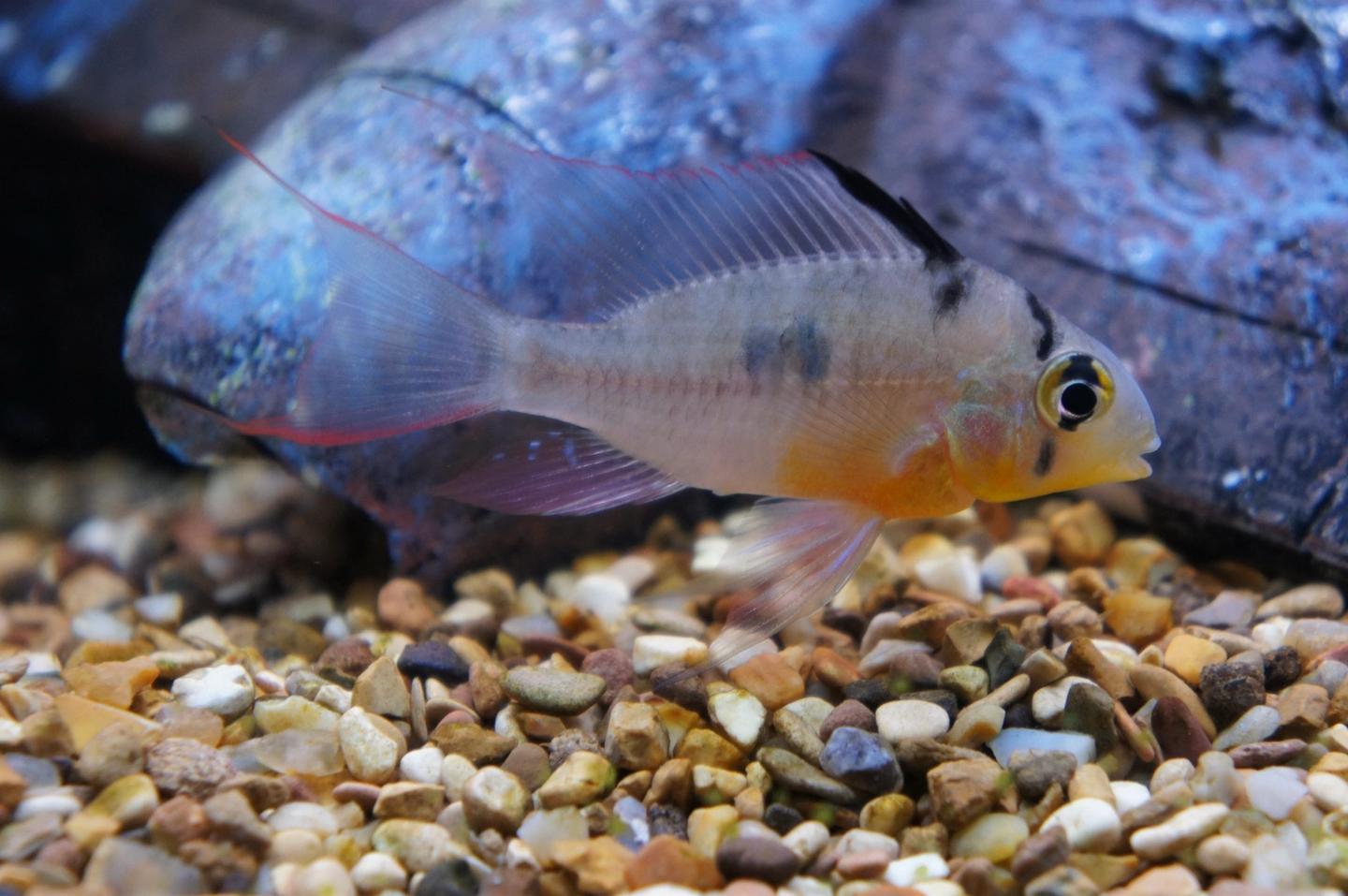
Cichlids are a family of roughly 1,800 accepted species, not one care type. Before buying, identify the exact species and source, then compare adult measurement, usable tank dimensions, social system, territory, tested water, diet and an exit plan. No family-wide minimum tank, water range or tank-mate list is safe.
Maintain these water conditions for optimal health and vibrant colors
The Super Colour Peacock Cichlid Mix (Aulonocara sp.) is a haplochromine cichlid from Lake Malawi in East Africa. It suits a keeper who can maintain hard, alkaline water and plan around the aggression found among Malawi cichlids. This is not a conventional mixed-community fish: its aquarium must be built around Malawi water conditions, substantial filtration, carefully screened companions and enough room for a deliberately planned cichlid community.
WoRMS recognises Aulonocara as an accepted genus in the family Cichlidae and order Cichliformes. The name Aulonocara sp. identifies the genus without assigning one particular species. Plan the aquarium for a full Malawi cichlid community rather than for the size of the fish on arrival.
Wikipedia describes Aulonocara as endemic to Lake Malawi and notes the hobby names peacock cichlids, aulonocaras and peacocks. It also describes the genus as strongly sexually dichromic and records maternal mouthbrooding across the genus. Strong sexual dichromatism means colour differs between the sexes, but neither colour nor the gallery image should be used to assign the sex of the animal.
| Suits | Not suited to |
|---|---|
| Hard, alkaline Malawi aquariums | Soft-water mixed communities |
| Keepers able to manage aggressive fish | Unscreened companion choices |
| At least 200 litres for a reasonable Malawi community | Small groups prone to fighting |
| Strong filtration and aeration | Unfiltered or newly stocked aquariums |
Use the figures on this page as a coherent Malawi-community plan: 23–27°C, pH 8.0–8.6, 12–18°dH, zero ammonia and zero nitrite. A community can be kept as a group of at least 15, while every member still needs individual compatibility screening. The practical challenge is not a complicated daily routine; it is maintaining those conditions while managing waste and aggression together.
One purchase supplies one live Super Colour Peacock Cichlid Mix. The exact species has not been identified, so the care advice here follows the genus Aulonocara and its care group. Treat the scientific label as a precise limit on identity: it means an Aulonocara fish, but it does not justify borrowing the adult length, temperament details or specialised diet of a separately named species.
Sex is guaranteed only when the selected option explicitly states male or female. This Super Colour Peacock Cichlid Mix listing has no sex-guaranteed option. Do not use strong colour, egg-like spots, body shape or the appearance of the pictured fish as a substitute for an explicit sex guarantee. Colour can differ among animals, and many Malawi cichlids only show differences between the sexes once they become adults.
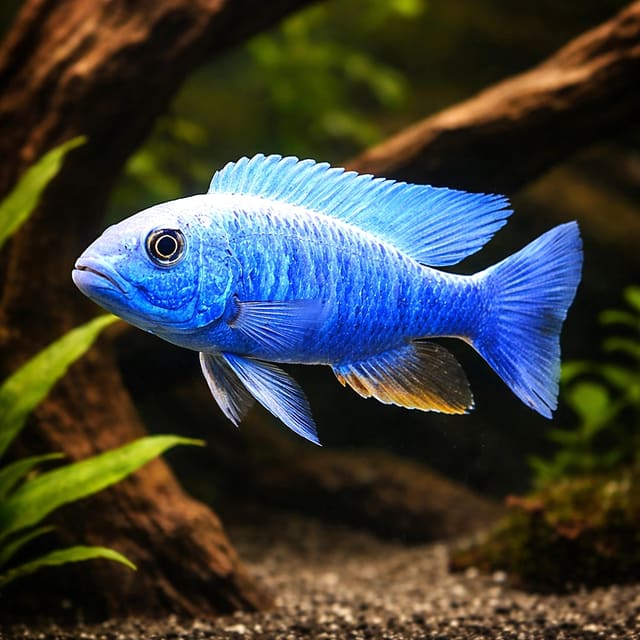
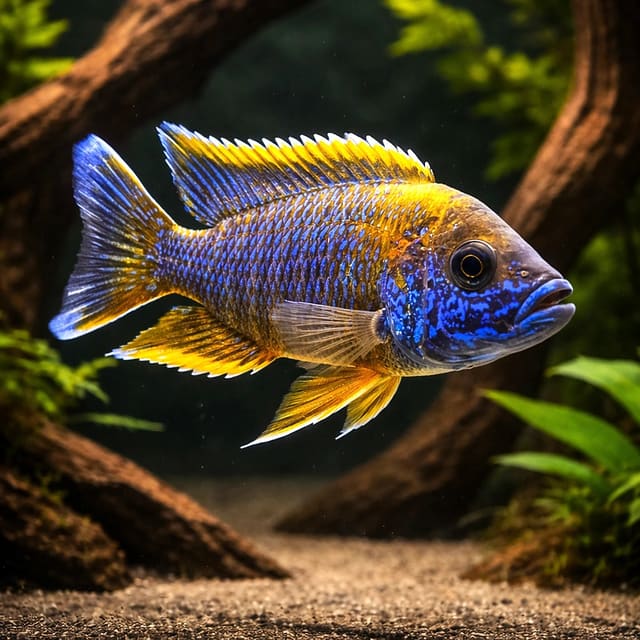
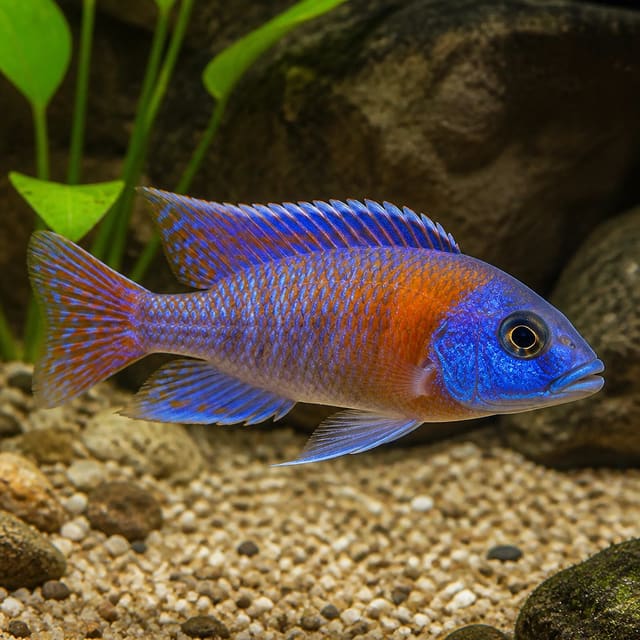
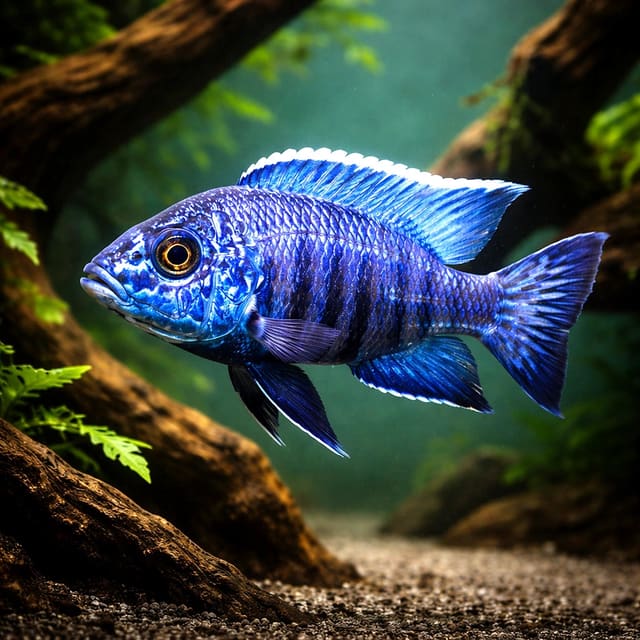
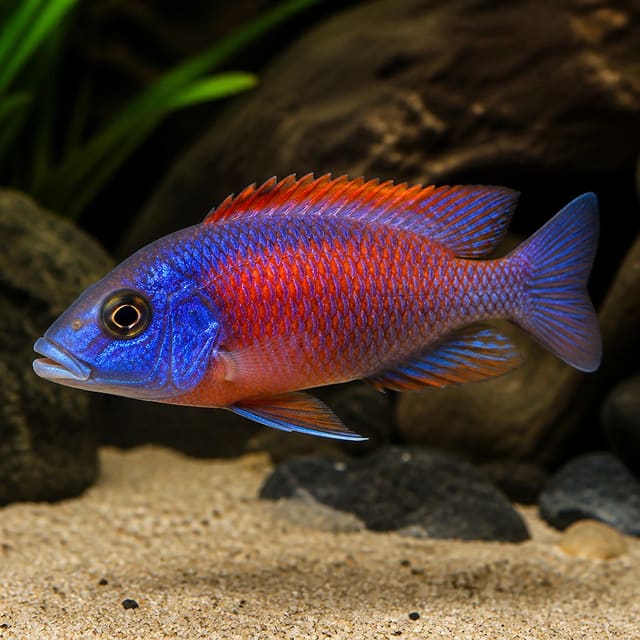
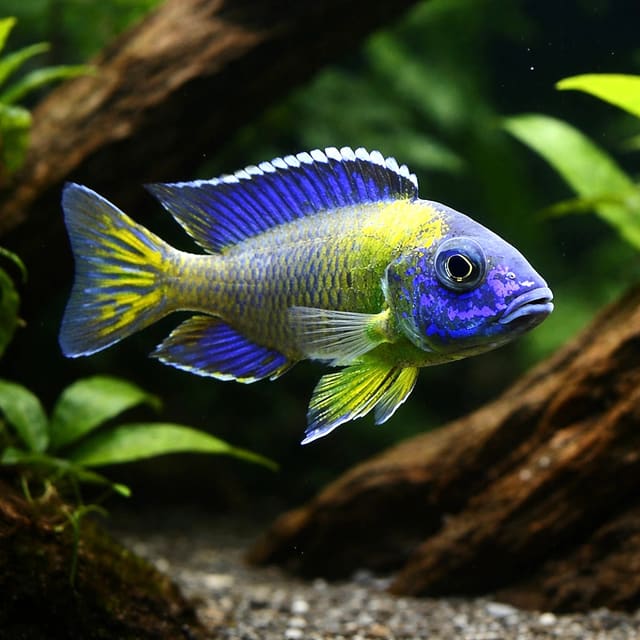
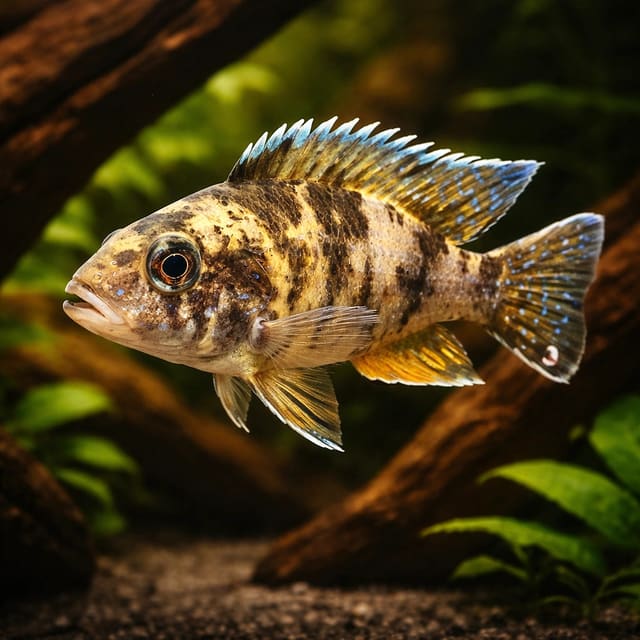
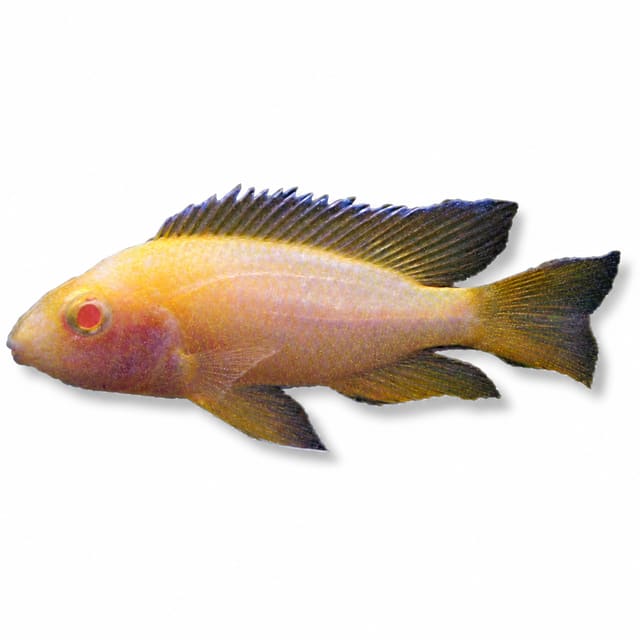
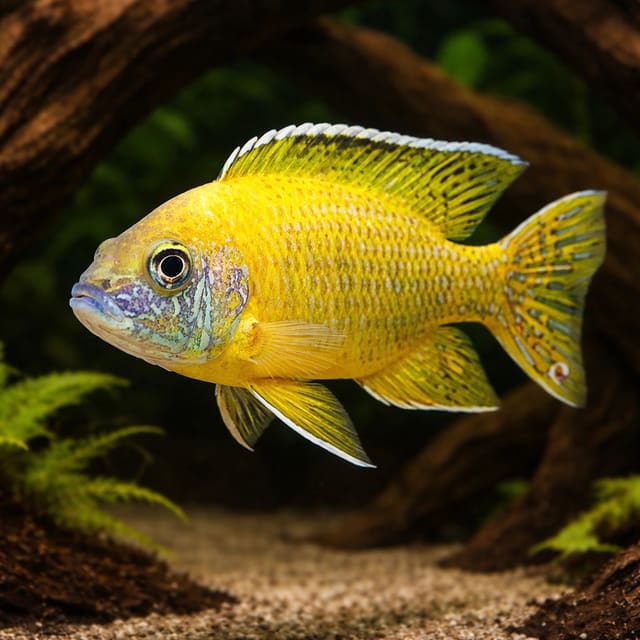
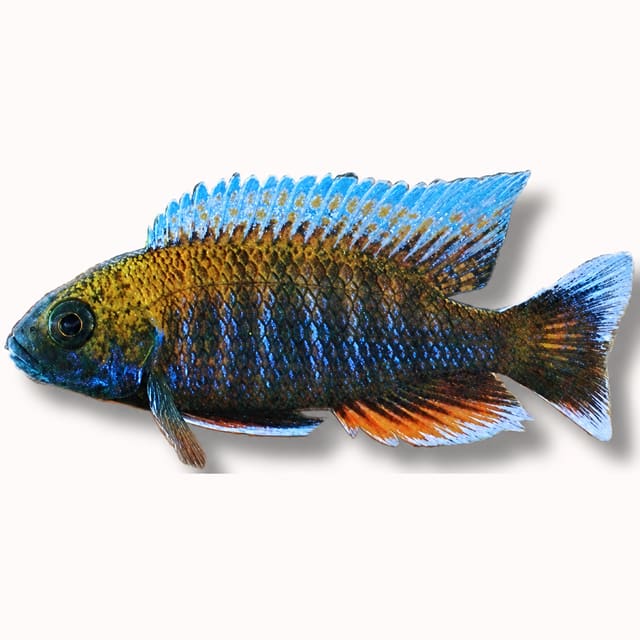
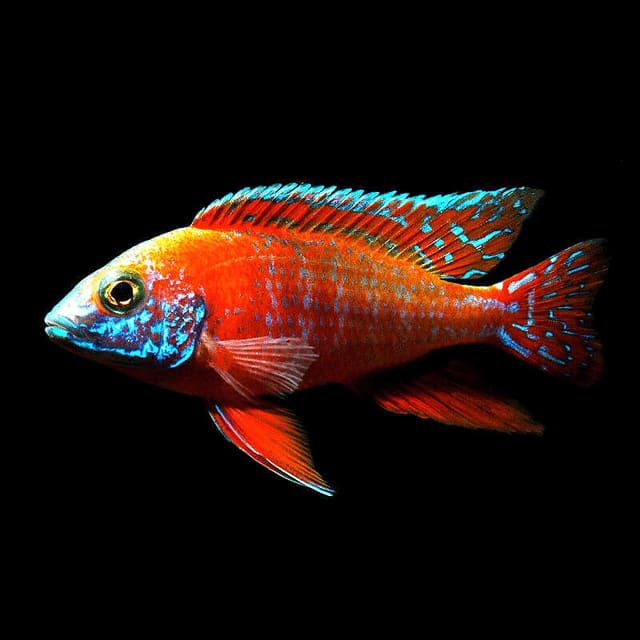
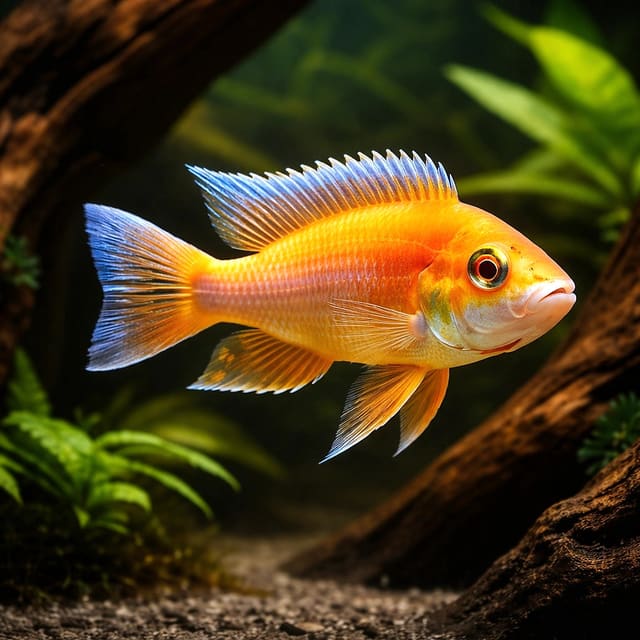
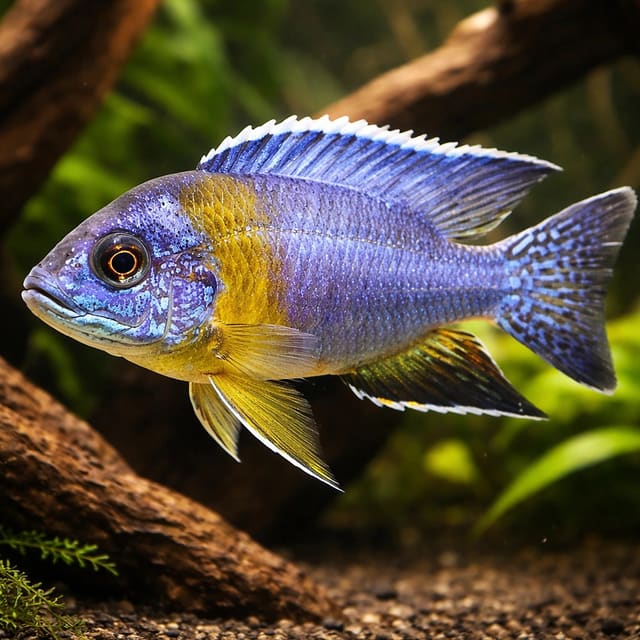
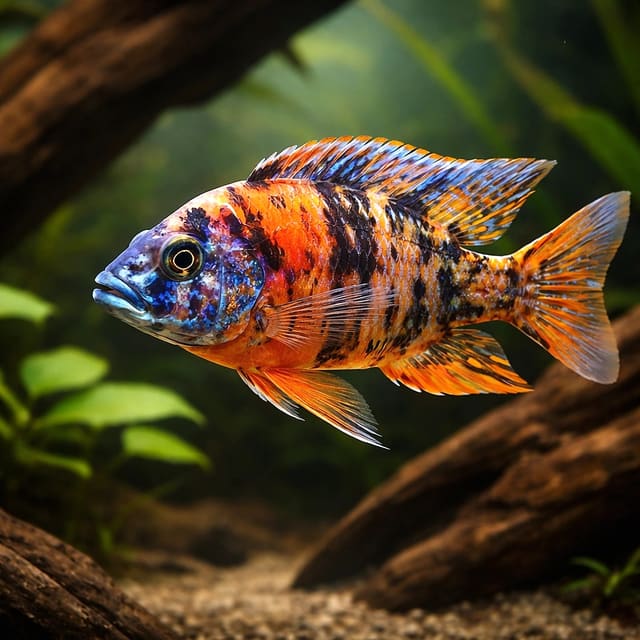
The gallery images are representative of this type of animal rather than photographs of the exact animal supplied, so colours can look slightly different from the live animal. The visible blue and golden-yellow fish demonstrates the kind of peacock-cichlid appearance associated with this mix, while the animal received may show a different balance of colour and markings.
These numbers work as one system. A larger social group increases the demand on filtration and aeration, while aggressive behaviour makes layout and stocking order important. Before adding this fish, check that the aquarium meets every part of the plan rather than relying on temperature alone.
Keep the aquarium at 23–27°C, pH 8.0–8.6 and 12–18°dH general hardness. OATA’s African Malawi cichlid guidance gives these figures for the group, together with carbonate hardness of 10–15°dKH. Use them as routine targets for this unidentified Aulonocara and prioritise stability within the range rather than allowing repeated swings between its limits.
Measure the aquarium before the fish is introduced and continue testing after stocking. Our aquarium water-chemistry guide explains what the principal measurements mean, while the water matcher lets you compare measured values with the targets above. Test the actual aquarium rather than assuming that its pH and hardness still match the tap, because substrate, replacement water and maintenance can affect the result.
| Measurement | Action |
|---|---|
| Temperature | Keep at 23–27°C |
| pH | Keep at 8.0–8.6 |
| General hardness | Keep at 12–18°dH |
| Carbonate hardness | Keep at 10–15°dKH |
| Ammonia and nitrite | Keep each at zero mg per litre |
| Nitrate | Do not exceed 20 mg per litre above normal tap-water levels |
If ammonia or nitrite rises above zero, stop treating the aquarium as ready for another fish. Test again, check the filter for a blockage and carry out the maintenance needed to restore safe water. Do not solve an unstable biological filter by adding more livestock; every increase in fish numbers and feeding requires the beneficial bacterial population to process more waste.
OATA advises that the tank should have coral sand or a similar substrate to buffer the water. Check pH and hardness after water changes so any change in replacement-water chemistry is noticed early. Treat new tap water with conditioner before it enters the aquarium to remove chlorine or chloramine. Match replacement water carefully enough to avoid an abrupt change in the conditions the fish is already experiencing.
Use an aquarium of at least 200 litres for a reasonable-sized Malawi cichlid community. OATA gives this as its recommendation for a reasonable-sized community of Malawi cichlids. Choose a larger aquarium where possible because a greater water volume makes temperature and water quality more stable and gives you more scope to organise territories and swimming areas.
Plan the final community before choosing the aquarium. Malawi cichlids can be kept in groups of at least 15 and slightly overcrowded to limit aggression, while small groups often fight. OATA states that a slight overstocking is required to spread aggression evenly, so plan the oversized filter, strong aeration and weekly maintenance for that larger group from the start. The social plan, aquarium volume, filtration and maintenance routine must all support the same number of fish.
A worked example starts with a mature 200-litre aquarium, but it does not end there. First check that all intended fish share 23–27°C, pH 8.0–8.6 and hard water. Next compare their adult dimensions, expected aggression and territorial use. Then confirm that the filter and aeration can support the planned bioload. If any part fails, change the stocking plan or use a larger aquarium rather than trying to correct the mismatch after introduction.
Do not treat an animal’s dispatch condition as its finished space requirement. Build around the dimensions confirmed for the individual fish and all of its intended companions, leaving the aquarium ready for their long-term needs from the outset.
Use a well-established biological filter in every aquarium housing this fish. The RSPCA explains that aquarium filters are vital because fish release toxic ammonia; beneficial bacteria convert it first to nitrite, which is also toxic, and then to the safer nitrate. A filter therefore needs living bacterial media as well as enough flow to collect waste.
Choose an oversized filter for a Malawi community and provide strong aeration. OATA recommends both because the crowded conditions needed for successful Malawi communities create a substantial oxygen and waste-processing demand. The aim is zero ammonia, zero nitrite and enough dissolved oxygen for all fish, including when feeding and activity are at their highest.
Set up and mature the aquarium before the fish arrives. Our first tropical aquarium guide covers the preparation sequence. Confirm zero ammonia and zero nitrite through testing; elapsed time alone cannot show whether the filter is processing the aquarium’s waste safely.
Check the filter routinely for blocked intakes, reduced output or trapped waste. If the media needs cleaning, rinse it lightly in aquarium water removed during a partial water change. Do not run it under the tap, because chlorine or chloramine may kill the established beneficial bacteria.
Aeration and filtration solve related but different problems. The filter processes waste, while surface movement and aeration support dissolved oxygen. Watch the whole aquarium after feeding: fish hanging at the surface, altered breathing or unusual inactivity warrants an immediate water test and equipment check. Correct the cause before adding more fish or making other changes.
Feed twice a day and offer only what the fish can eat within a few minutes. Remove food that remains uneaten so it cannot break down and release toxic waste. Portion control matters especially in a Malawi community because a large social group already places a high demand on filtration.
Use a specialised Malawi cichlid food as the staple. OATA separates its Malawi examples by feeding type: smaller mbuna are more herbivorous and will appreciate high-algae specialist feeds with fresh vegetables, while some larger utaka may be more predatory and will require pellets with a higher animal content and frozen brine shrimp, prawns or cockles.
| What you see | What to do |
|---|---|
| Food gone within a few minutes | Keep the portion consistent |
| Food left after the fish stop feeding | Remove it and reduce the next portion |
| One fish taking most of the food | Spread the portion while watching every fish |
| Reduced interest in food | Test water and check for other health changes |
Do not use intense feeding as a shortcut to colour. The safe objective is steady body condition, active feeding and clean water. Colour alone cannot identify sex, health or the correct dietary formula. Judge the routine by whether all fish can feed, uneaten food is absent and ammonia and nitrite remain at zero.
Review feeding whenever the population changes. An additional fish means more food and more waste, so observe how quickly the whole group eats and test the aquarium as the filter adjusts. If waste accumulates or nitrate rises faster between weekly changes, reduce excess food first and confirm that the filtration remains unobstructed.
Carry out a 25% partial water change at least once every week. Test ammonia and nitrite at least weekly as well, and continue checking temperature, pH, hardness and nitrate often enough to catch a change before the fish show distress. A siphon helps remove solid waste from the substrate during the water change.
Treat replacement tap water with conditioner before adding it to remove chlorine or chloramine. Keep the replacement conditions close to the aquarium’s established range, then recheck the tank after maintenance if its pH or hardness is difficult to hold. The target remains 23–27°C, pH 8.0–8.6, 12–18°dH, zero ammonia and zero nitrite.
Additional action may be needed if testing shows ammonia, nitrite or excessive nitrate, but routine water changes do not replace finding the cause of a failed filter or an overambitious stocking plan.
After introduction, record temperature, pH, hardness, ammonia, nitrite and nitrate so you know what normal looks like in this aquarium. Observe feeding, breathing, swimming and aggression at the same times each day. During the following weeks, compare results before and after maintenance. A repeatable pattern makes a developing blockage, increasing waste load or changing tap-water chemistry easier to recognise.
If the aquarium needs increasingly large corrections every week, reconsider the underlying cause. Check feeding quantity, filter flow, fish numbers and replacement-water chemistry. Stable care comes from a routine that keeps values within range between maintenance sessions, not from allowing them to deteriorate and then making abrupt corrections.
Prepare the mature aquarium before the parcel reaches you, with the filter running and water held at 23–27°C, pH 8.0–8.6 and 12–18°dH. Test ammonia and nitrite separately and confirm both are zero. These aquarium checks come from OATA’s Malawi guidance and should be completed before the delivery procedure begins.
Keep the continuous video and order number if you need to make a Live Arrival Guarantee claim, and report the issue on the day the fish arrives. The current steps and claim conditions are set out in our delivery and Live Arrival Guarantee policy.
OATA advises increasing fish numbers slowly because the beneficial bacteria established while maturing the filter must grow when both livestock and feeding increase. Adding too many fish too quickly can produce new tank syndrome, with ammonia and nitrite rising because the biological filter cannot yet process the extra waste.
Check the new fish for clear, bright eyes, intact scales, undamaged fins and appropriate swimming. Continue observing the whole community after release because an introduction changes both the social balance and the biological load. Test water if any fish hangs at the surface, sits on the bottom, swims erratically or breathes at an altered rate.
Do not add another group simply because the first fish appear settled. Confirm that ammonia and nitrite remain at zero through feeding and the next maintenance cycle. A gradual stocking plan gives the filter time to respond and gives you time to identify aggression before another introduction makes the social picture harder to read.
Watch for changes in swimming, colour, temperament, breathing, appearance, body condition and feeding. OATA highlights fish hanging at the surface, sitting on the bottom, swimming erratically, becoming darker or paler, hiding more than normal, changing aggression, breathing unusually, developing white spots or fluffy growths, losing fins or scales, changing weight or refusing food.
When a change appears, test water first. Check ammonia, nitrite, nitrate, temperature, pH and hardness, then inspect filter flow and aeration. Ammonia and nitrite should both be zero, and nitrate should remain no more than 20 mg per litre above the normal tap-water level. Correcting poor water quality promptly removes a major source of stress while you assess the fish.
| Warning | First action |
|---|---|
| Surface hanging or altered breathing | Test water and check aeration |
| Erratic swimming or bottom sitting | Test water and observe the whole group |
| New hiding or aggression | Review social pressure and injuries |
| White spots, growths or scale loss | Record the signs and seek health guidance |
| Reduced feeding | Test water and compare body condition |
Do not diagnose a disease from colour change alone. The genus is strongly sexually dichromic, and appearance can also vary between individuals, while a sudden departure from that animal’s normal colour is still worth investigating alongside behaviour and water results.
If you are concerned about any livestock after testing the aquarium, contact us for further guidance. Have the water readings, recent maintenance details, feeding changes and a clear description of the signs ready. Those observations help separate an aquarium-wide water problem from aggression or a health change affecting one fish.
Treat this fish as an aggressive Malawi cichlid. OATA describes Malawi cichlids as aggressive and warns that small groups often fight. Short interactions must therefore be judged by their outcome: repeated pursuit, damaged fins, a fish excluded from feeding or persistent hiding calls for action, even if the aggressor shows no obvious injury.
Colour is not a sex guarantee. Aulonocara is strongly sexually dichromic, but the offer does not assign male or female and the image represents the type of animal rather than the exact individual. OATA also notes that many Malawi cichlids show sex differences only as adults, not as juveniles. Do not build a sex-ratio plan from colour or markings alone.
Where possible, OATA recommends keeping more females than males of each species to prevent males from harassing one individual female. Apply that only when each fish has been reliably identified and sexed. It is not a basis for labelling an unsexed animal after purchase.
Use behaviour as an early-warning system. Compare the fish with its own established pattern and with the rest of the community. A sudden change in aggression, hiding, breathing or feeding should lead to water testing and a review of social pressure rather than an assumption that it is simply normal cichlid behaviour.
Keep this fish only with other Malawi cichlids or with carefully assessed Synodontis species that naturally inhabit Lake Malawi. OATA gives that boundary for Malawi cichlids and also states that they are all aggressive and should be mixed with caution. Avoid animals outside that screened Malawi community rather than treating matching temperature alone as sufficient compatibility.
Other Malawi cichlids are candidates, not universal companions. Compare water needs, adult dimensions, aggression and the number already planned for the aquarium. Some Synodontis are candidates only where the particular species naturally inhabits Lake Malawi and its care requirements fit the same aquarium. The word “some” matters: it does not make every Synodontis suitable.
| Question | Decision |
|---|---|
| Is it a Malawi cichlid or an appropriate Lake Malawi Synodontis? | If no, avoid the combination |
| Can it live at 23–27°C, pH 8.0–8.6 and 12–18°dH? | If no, avoid the combination |
| Are its adult dimensions known and accommodated? | If no, pause the plan |
| Can the filter support the total bioload? | If no, reduce stocking or enlarge the system |
| Can aggression be observed and managed? | If no, choose another plan |
Do not transfer companion claims from a different cichlid community. A fish being African, hard-water tolerant or described as a cichlid does not place it within the Malawi-only rule. Browse the African cichlid collection to identify candidates, then screen each named animal rather than assuming the whole collection can share one aquarium.
Before adding fish, OATA advises seeking retailer advice that the aquarium suits the number of Malawi cichlids planned; have the aquarium volume, dimensions, water readings, filter, current livestock and intended additions ready. Exact names matter because this Aulonocara is itself identified only to genus. A cautious assessment should leave uncertain combinations out rather than turning a broad companion category into a promise.
Add Malawi cichlids in groups so one newly introduced fish is less likely to receive all the aggression while the community settles. OATA recommends adding more peaceful species first and more aggressive species later. Re-arranging aquarium décor can also reduce aggression by making fish establish territories again.
A community can be kept in a group of at least 15 and slightly overcrowded to spread aggression, while small groups often fight. Use that method only alongside at least 200 litres for a reasonable community, an oversized filter, strong aeration and weekly maintenance. Social density without biological capacity replaces one welfare problem with another.
Do not label aggression acceptable merely because Malawi cichlids are naturally aggressive. Persistent pursuit, damaged fins, surface hanging, bottom sitting, exclusion from food or a marked increase in hiding needs intervention. Reassess the aggressor, the targeted fish, group composition, available space and the placement of décor.
A larger aquarium improves environmental stability, but volume alone does not settle compatibility. Two fish may share water chemistry while differing in behaviour or adult dimensions. Likewise, a social plan that spreads aggression may still fail if the filter cannot hold ammonia and nitrite at zero. Every successful combination must pass the water, space, behaviour and waste checks together.
When possible and reliably established, OATA recommends more females than males of each species to prevent one female receiving repeated male attention. Do not apply that ratio by guessing the sex of this animal. The offer is unsexed, and neither colour nor the representative image changes that.
This mix is sold by genus without a named species, so plan space for a Malawi cichlid community of at least 200 litres rather than for the size of the fish on arrival.
Use at least 200 litres for a reasonable Malawi community. OATA gives this as a community recommendation, and a larger aquarium provides more stable temperature and water quality.
OATA says Malawi cichlids can be kept in groups of at least 15 and slightly overcrowded to limit aggression; small groups often fight, so filtration, aeration and space must support the whole plan.
It suits a keeper prepared to maintain hard, alkaline water, manage aggressive Malawi fish and test water consistently; it is not a conventional mixed-community choice.
Feed only what it consumes within a few minutes twice daily. OATA separates Malawi diets by feeding type, so match the staple to the confirmed category: high-algae feed and vegetables for smaller mbuna, or higher-animal-content pellets and suitable frozen foods for some larger utaka.
Keep this fish at 23–27°C and pH 8.0–8.6; OATA’s Malawi guidance also gives hard water at 12–18°dH.
Treat it as aggressive because OATA describes Malawi cichlids that way. Watch for persistent chasing, damaged fins, exclusion from food or increased hiding and change the social plan when harm appears.
Keep it only with screened Malawi cichlids or some carefully assessed Synodontis species that naturally inhabit Lake Malawi; avoid animals outside that planned community.
It is hand-bagged in pure oxygen and placed in an insulated box, with a heat pack when the weather calls for it. Someone must receive the parcel, film continuously from the sealed parcel onward, inspect it that day, float the bag for 20–30 minutes and release the fish without pouring bag water into the aquarium.
No reviews for this item yet. Bought one? Honest reviews only, good or bad.
What customers say about ordering from us
I have a small group of long finned mountain minnows. So was delighted to be able to order ten of this variety to increase the genetics in my tank . The ones I recieved are healthy but it’s to early to give a verdict on wether they are of a long finned type since they are small currently.
Gordon Walker · 23 Sept 2026
100% success travel and "installation". Pleased with quality of purchase. The Siamese fighter a bit "shy" so have not yet seen him at his best yet but looking good. Happy customer. GG
George E Garratt · 21 Sept 2026
Reviews of our shop, collected by Judge.me, an independent third-party review collector. Newest first.