Moderate
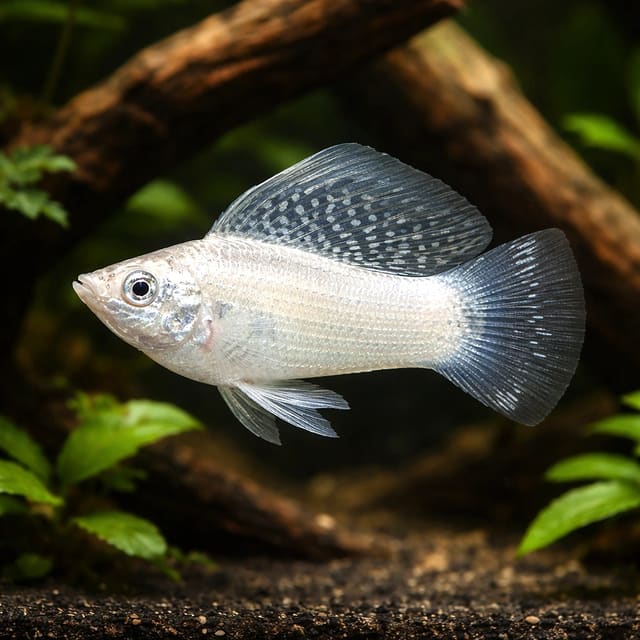
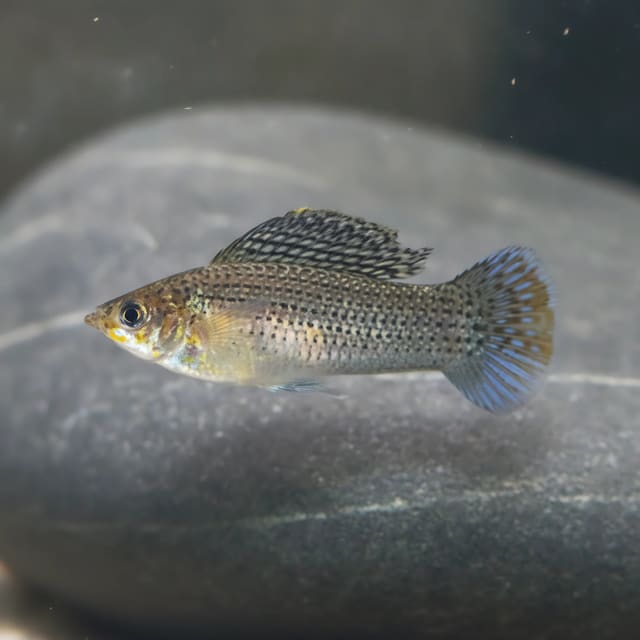
Sailfin silver molly (Poecilia latipinna)
21–26°C · pH 7–8.5 · 87L
£6.99
Photo coming soon
The size, price and care details on this page are for this listing.
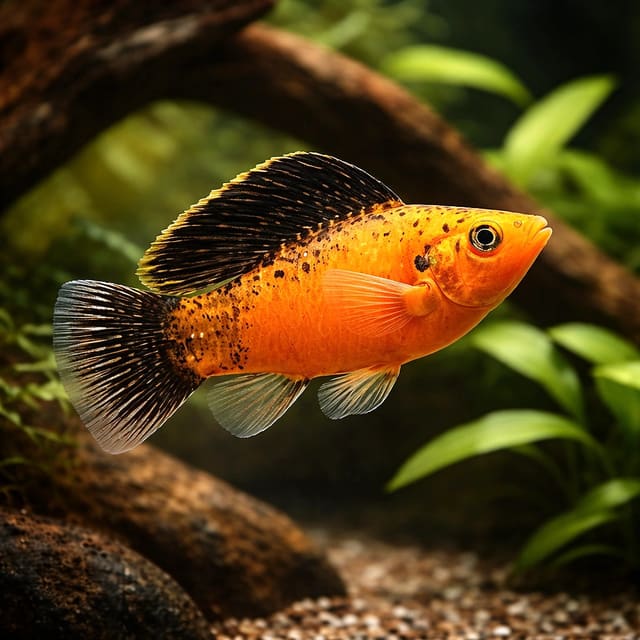
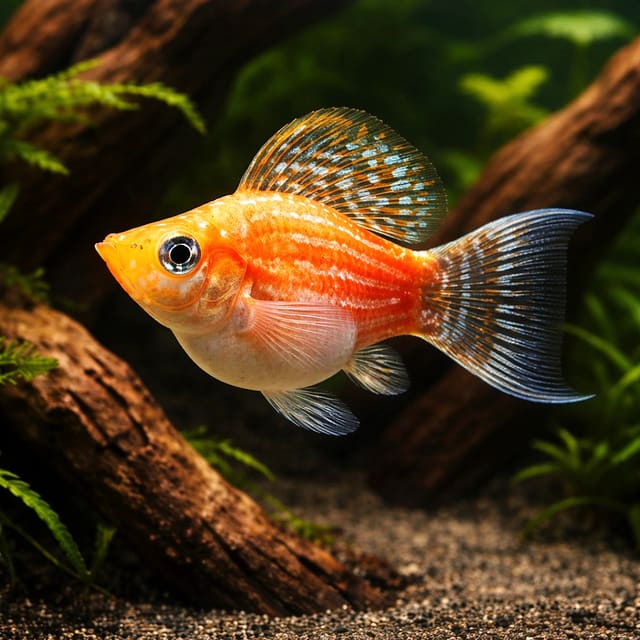
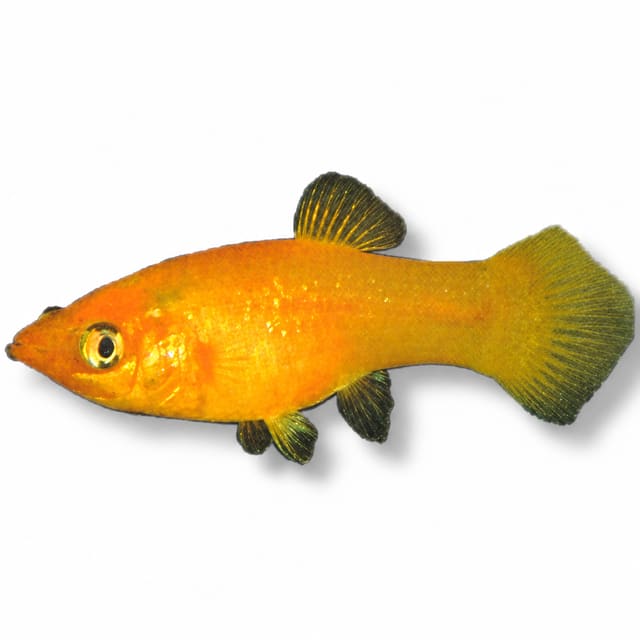
A yellow, short-bodied form of the sailfin molly (Poecilia latipinna), sold as one live fish per quantity with sex not selected. The balloon shape comes from a shortened, malformed spine, so this fish needs clean, hard water at 20-28 °C, an aquarium of 80 litres or more, gentle flow and small, plant-rich meals.
Adult size is the maximum length this species reaches at full maturity (scientific sources). The livestock you receive will be younger and smaller. Product-photo provenance and any image-specific limitations are stated on the listing.
Poecilia latipinna
Shoaling fish: kept in a group they feel safer, stay calmer and show their best colour.
A yellow, short-bodied form of the sailfin molly (Poecilia latipinna), sold as one live fish per quantity with sex not selected. The balloon shape comes from a shortened, malformed spine, so this fish needs clean, hard water at 20-28 °C, an aquarium of 80 litres or more, gentle flow and small, plant-rich meals.
Adult size is the maximum length this species reaches at full maturity (scientific sources). The livestock you receive will be younger and smaller. Product-photo provenance and any image-specific limitations are stated on the listing.
Maintain these water conditions for optimal health and vibrant colors
The yellow balloon molly is an aquarium-bred form of the sailfin molly, Poecilia latipinna, kept for two things: a yellow colour and a short, rounded body. Our old listing used the Latin name with the shop spelling "baloon molly yellow", and you will also see "ballon molly" on labels and in searches. They all mean the same fish. The English name is balloon molly.
Wild sailfin mollies are slender livebearers from the warm coastal lowlands of the south-eastern United States and Mexico. The balloon form has been selected for something quite different: a short body, an arched back and a rounded belly. That outline is built into the skeleton. It is not a sign of good feeding, and no amount of care will change it in either direction. We explain the biology in the next section, because anyone buying one should know what they are taking on.
| Fact | Detail |
|---|---|
| Scientific name | Poecilia latipinna (Lesueur, 1821), family Poeciliidae |
| Body form | Balloon: short body, arched back, short and malformed spine |
| Species maximum | 15 cm total length (FishBase); balloon fish stay smaller |
| Temperature | 20-28 °C |
| Water | Hard and alkaline, pH 7.0-8.5 |
| Aquarium | 80 litres or more |
| Group | At least three, two females to each male |
| Diet | Mostly algae and plant food, with some small live or frozen food |
| Breeding | Livebearer; young born free-swimming |
| Sold as | One live fish per quantity, sex not selected |
Each quantity on this listing is one live yellow balloon molly. There is a single option, so you cannot choose a size or a sex. Any fish may be male or female, and an order of several may contain either or both. Mollies are best kept in a group with more females than males, so if you already have a molly group with a known balance, bear in mind that this listing cannot promise you a particular sex.
No dispatch size is stated, so plan the aquarium around the adult fish rather than whatever size arrives. FishBase records the species at up to 15 cm total length, with a common length nearer 3.4 cm for males. Balloon mollies are described as a small variety, so expect yours to stay shorter than a wild sailfin, but give it the room the species needs.
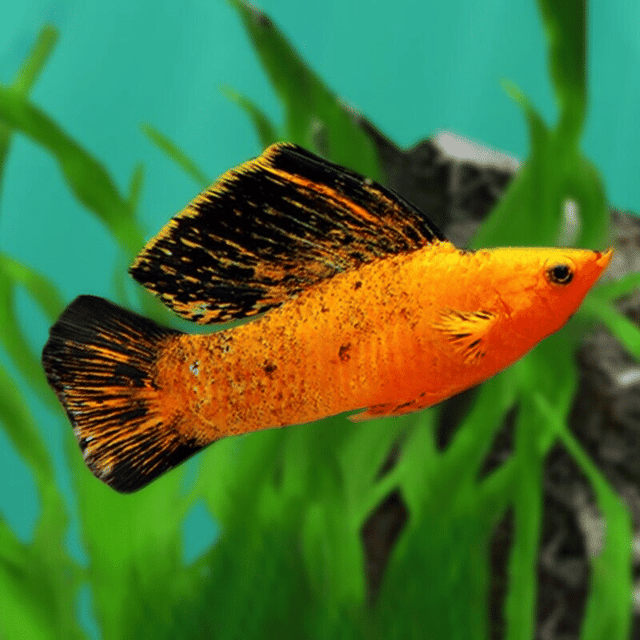
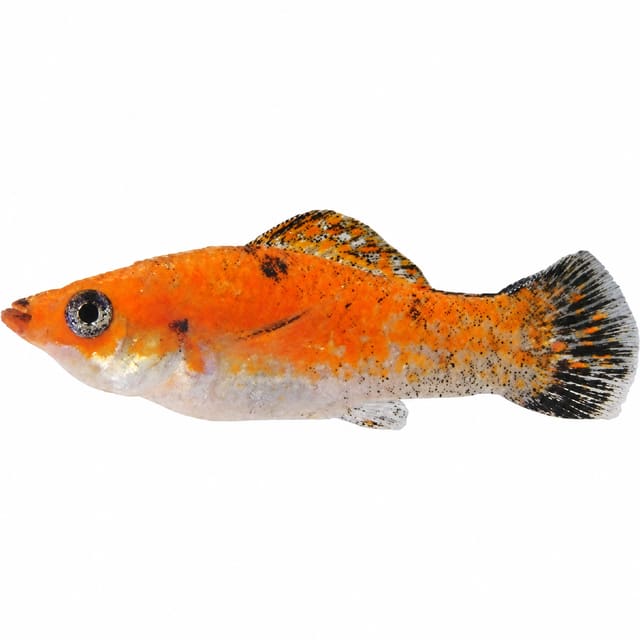
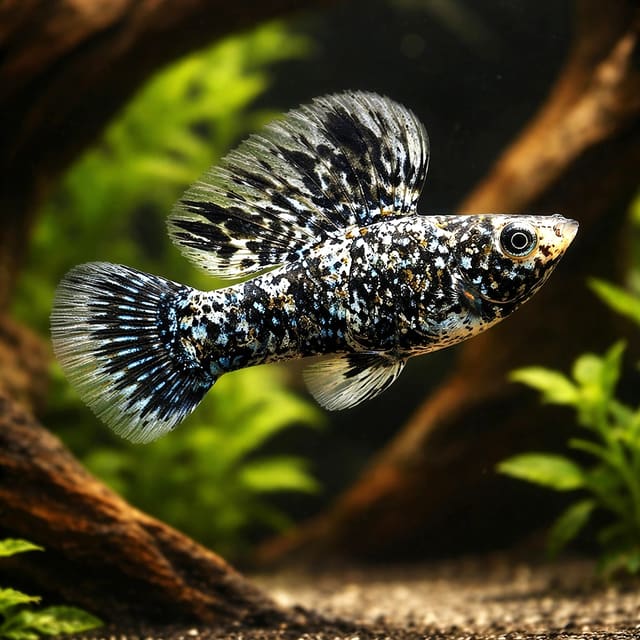
"Yellow" names the body colour the line is kept for. There are no photographs of the actual fish on this listing, so we will not promise more than the name supports. Yellow-gold bodies turn up in more than one fancy molly line. Wikipedia's account of fancy molly varieties says gold mollies are yellow-gold like albino mollies, but with dark eyes. Once your fish arrives, eye colour is the quickest way to see which kind of yellow fish you have. The word "yellow" alone does not settle it.
Look at the fin just behind the belly. In a male, the anal fin is modified into a gonopodium, the organ he uses for internal fertilisation. In a female it stays an ordinary fan shape. FishBase calls the male's large, sail-like dorsal fin the species' most distinctive feature, and Seriously Fish lists the gonopodium and that long dorsal as the ways to sex adults. On a balloon fish the gonopodium is the reliable clue.
We will be plain about this. A balloon molly is not a fat sailfin molly. The round outline is a skeletal trait, kept going by selective breeding for the aquarium trade. Wikipedia notes that pet-shop molly varieties are produced by artificial selection. Seriously Fish describes the balloon variety as one in which "the body is malformed and rounded".
The clearest look at the skeleton comes from a 2019 study by Shao and colleagues, published in the journal Genes. The researchers X-rayed and stained the skeletons of normal and dwarf white sailfin mollies. They note that this dwarf form is also called the balloon belly molly. Both groups had the same number of vertebrae, 27 to 29. The difference was in the bones. The normal fish were slender and flat, while the dwarfs had short bodies and convexly arched backs. The authors call the dwarf spine "short and dysplastic", meaning the vertebrae themselves have developed abnormally. The fish do not simply have fewer of them.
The same study found two regions of the genome and three candidate genes linked to the trait. In plain terms, the body shape is inherited rather than created by how the fish is kept. Even a balloon molly raised in perfect conditions still has a balloon body.
Wikipedia's fancy molly article, drawing on Tropical Fish Hobbyist magazine, describes balloon mollies as a small variety with an extremely deformed abdominal cavity. Seriously Fish calls the balloon variety grotesque, which it gives as its own opinion, and warns that the condition can cause swim bladder and digestive problems and may bring about premature death.
That does not mean every yellow balloon molly will be unwell. It does mean the fish starts with less margin for error than a normal-bodied sailfin, and it is why the rest of this guide keeps coming back to clean water, modest meals, gentle flow and calm companions. If you buy one, those four things are the kindest choices you can make.
We list this fish under Poecilia latipinna, and the Genes study above treats the balloon belly molly as a dwarf sailfin molly. It is still fair to tell you that aquarium mollies are rarely a tidy, single-species story. Seriously Fish notes that the sailfin molly has been bred into many colour forms and has also been crossed with other molly species, particularly Poecilia sphenops. Wikipedia's fancy molly article goes further. It calls the origin of fancy mollies unclear and names P. sphenops, P. gillii, P. latipinna and P. velifera as the parent species usually given. Wikipedia's sailfin article adds that hybrids between sailfin and short-finned mollies can be bred among themselves, and that first-generation hybrids often show novel fin shapes.
None of that changes the care in this guide, which follows the sailfin molly sources. It is one reason fins and proportions can differ between balloon mollies, and why we describe what the sources support rather than promising a particular look.
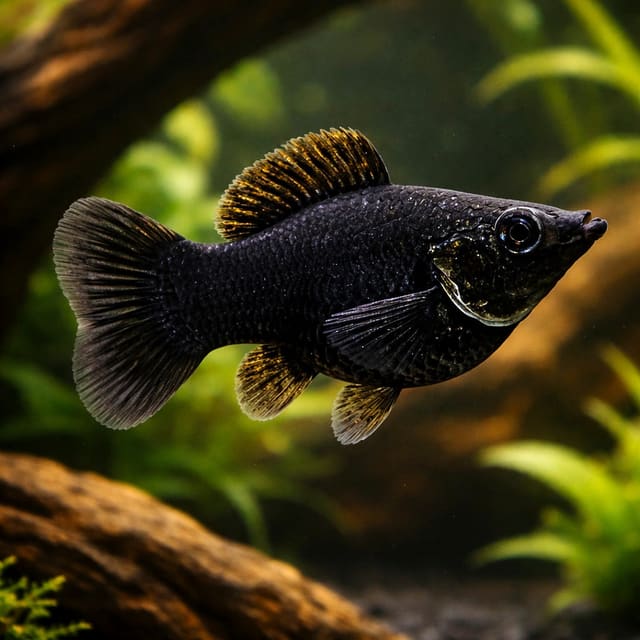
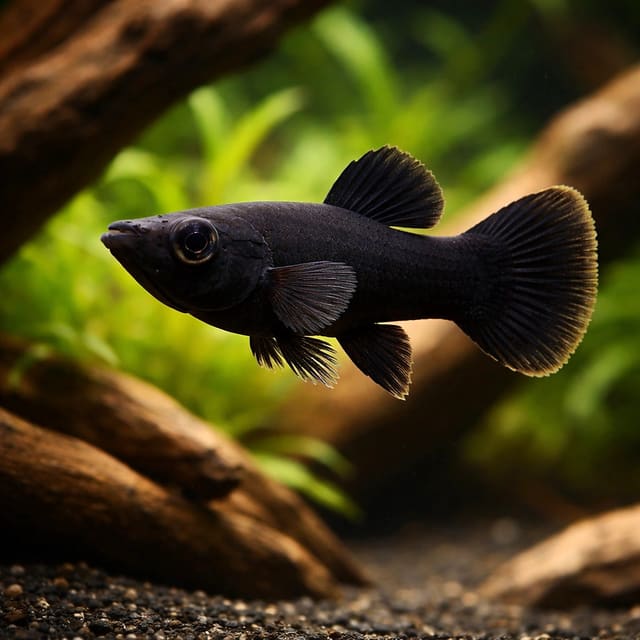
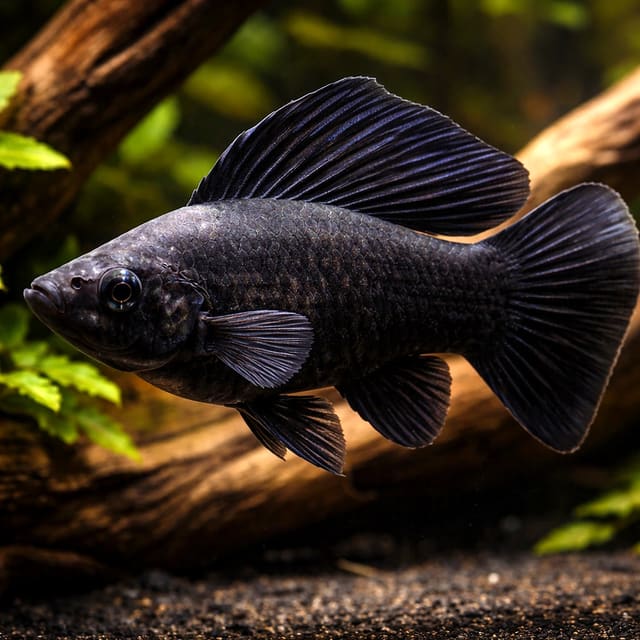
Many keepers like the colour and character of mollies but would rather have a fish with an ordinary spine. Our silver sailfin molly is the same species, listed as a sailfin rather than a balloon form. If you have settled on a balloon molly, everything here also applies to the black balloon molly, which is the same body shape in a different colour.
Every balloon molly goes back to a wild fish from the coast of North America. FishBase gives the native range as the Cape Fear drainage in North Carolina, then south and west around the Gulf of Mexico to Veracruz in Mexico. Wikipedia adds the Yucatán Peninsula and places the species in coastal estuaries, lagoons, river deltas, swamps and mangroves.
FishBase describes adults in still or gently flowing warm water. That means small creeks and drains, ponds, lakes and sloughs, and quiet, often weedy backwaters and pools of streams. The species is also abundant in tidal ditches and brackish canals, and it turns up in coastal waters. Seriously Fish sums up the typical home as heavily vegetated coastal streams, ponds, swamps, canals and ditches. Wikipedia records a tolerance of salinities up to 87 parts per thousand. That is a wild extreme the species can survive, not a target for an aquarium.
Two things in that habitat list shape how you should keep a balloon molly: slow water and plenty of plants. Neither depends on the salt.
FishBase says sailfin mollies feed mainly on algae and also take animal food: rotifers, small crustaceans such as copepods and ostracods, and aquatic insects. Seriously Fish goes further and calls wild populations almost exclusively herbivorous. Wikipedia mentions mosquito larvae among the invertebrates they eat. A molly picking over a green film on a stone is feeding much as its wild relatives do.
On the IUCN Red List the sailfin molly is assessed as Least Concern (FishBase, assessment dated February 2019). The opposite problem is the real concern. FishBase records the species as introduced to many countries, with several reporting harmful ecological effects. Seriously Fish notes that introduced mollies often outcompete native fish. Wikipedia lists established populations in New Zealand, Hawaii, California and Iraq among other places. No aquarium fish should ever go into a pond, stream or drain. If you can no longer keep yours, a local aquatic shop or fishkeeping club can usually help rehome it.
Plan for the species, not for the small fish in the bag. OATA, the UK's ornamental fish trade association, recommends an aquarium of at least 80 litres for sailfin mollies. Seriously Fish suggests a base of 76 by 38 cm, roughly 87 litres. A balloon molly will not reach the length of a wild sailfin, but it is still a social sailfin molly. OATA advises keeping at least three mollies together, and a group needs that floor space. A larger volume also holds its temperature and chemistry more steadily, which matters for a fish that has little reserve when conditions slip.
OATA is clear that a filter is always essential. For this fish, choose one that keeps the water clean without turning the tank into a river. Seriously Fish links the balloon shape to swim bladder trouble, so do not make a rounded fish fight a strong current all day. Spread the return flow with a spray bar, point it at the glass, or turn it down so that there are calm areas near the surface and among the plants. Make sure the filter is fully matured before the fish arrive, because the water targets in the next section leave no room for ammonia or nitrite.
Seriously Fish recommends a densely planted aquarium with open swimming space. It warns that soft-leaved plants may be eaten, because this is a highly vegetarian fish, so pick tougher-leaved plants or accept some nibbling. Plant the back and sides and leave the front and middle clear. That gives a short-bodied fish an easy route to the surface and to food without squeezing through tight gaps.
Seriously Fish also recommends common green algae as a supplementary food. There is no need to scrub every surface spotless. Clean the front glass so you can see your fish, and leave a rock or the back pane to green over as a grazing patch.
To hold the temperatures given below, most homes need an aquarium heater with a thermostat, and a thermometer you can read at a glance. Check it every day as part of feeding, so that a heater fault is noticed within hours rather than days. Put the aquarium where it will not sit in direct sun or a draught. Wikipedia lists low water temperature among the causes of swim bladder disorder, so a cold snap matters more for this fish than for most.
Get the water right and most of the other jobs become easier. Sailfin mollies need hard, mineral-rich water, and the published ranges show it. Where sources differ, all of them are in the table so you can see where the overlap lies.
| Parameter | Range | Source |
|---|---|---|
| Temperature | 20-28 °C | FishBase; OATA |
| Temperature (aquarium guide) | 21-26 °C | Seriously Fish |
| pH | 7.0-8.5 | Seriously Fish |
| pH (UK trade care sheet) | 7.0-8.0 | OATA |
| General hardness | 15-35 °dGH | Seriously Fish |
| General hardness (care sheet) | 8-18 °dH | OATA |
| Carbonate hardness | 5-15 °dKH | OATA |
| Ammonia and nitrite | zero | OATA |
| Nitrate | no more than 20 mg/l above your tap water | OATA |
A temperature between 21 and 26 °C sits inside every range above. A pH between 7.0 and 8.0 satisfies both pH sources. For hardness, Seriously Fish's species-specific figure is higher than OATA's general molly range, and the two meet at around 15 to 18 °dH. If your tap water already sits there, you are in a good position. If it tests soft, talk to an aquatic shop about raising and holding the hardness before you buy, because mollies are fish for hard water.
This is one of the commonest questions about mollies, because wild sailfins live in brackish ditches and canals. Seriously Fish answers it directly: salt is not necessary. What matters, in its words, are the "hard" minerals, calcium and magnesium, which it calls crucial to the species' long-term health. A freshwater community tank with properly hard, alkaline water is the right home. If you do keep a brackish setup, that is a separate project, and it narrows your choice of tank mates considerably.
OATA recommends testing at least once a week for ammonia, nitrite, nitrate, pH and hardness, and a partial water change of 25% every week. Match the new water's temperature and treat it with a dechlorinator before it goes in. Write the results down. A slow drift in pH or a creeping nitrate figure is far easier to spot on paper than by looking at the fish. For a balloon molly, steady conditions do more good than any medicine.
Two facts shape how you feed this fish. Sailfin mollies are mainly plant and algae eaters, and the balloon body is linked to digestive problems. So feed the right food, and not too much of it.
OATA recommends a good-quality flake or granule with a high algae content as the staple. It adds that mollies also benefit from live or frozen foods such as daphnia and small bloodworm. Seriously Fish says tank-bred sailfins accept a varied diet but must have vegetable matter, and suggests blanched spinach or a vegetable flake. It gives a striking reason: "If insufficient greenstuff is provided male dorsal fin development may be impaired." Even in a short-bodied fish, the greens are doing real work.
OATA's guidance is to feed only what the fish can eat within a few minutes, once a day. Follow that closely with a balloon molly. The belly is round because of the body shape, so you cannot judge feeding by how full the fish looks. Judge by the tank instead. If food is still drifting or lying on the bottom after a few minutes, you gave too much. Remove the leftovers and give less next time. Uneaten food rots, pushes up nitrate and undoes the water care in the previous section.
Wikipedia's article on swim bladder disease lists overeating among its causes, along with constipation and physical abnormalities. It also describes constipation linked to the high nitrate that comes with overfeeding, so portion size and water quality are really the same job. A fish with a compressed body cavity has every reason to be fed lightly. Small, regular meals rich in plant matter are what we recommend for this form.
Watch the first few feeds closely. Make sure your yellow balloon molly reaches the food and is not crowded out by faster, greedier fish. If it hangs back, scatter the food across the surface so that every fish gets a share, or offer a sinking vegetable tablet at the front where you can see who is eating.
Seriously Fish lists the sailfin molly as suitable for hard-water community aquariums, with two cautions. Mature fish may pick on much smaller tank mates. And males can be aggressive towards one another, particularly when spawning. Wikipedia adds that males display with their enlarged dorsal and tail fins, that females choose mates by those fins, and that males are the more aggressive sex.
A male's display is the most interesting thing a molly does. Wikipedia describes males raising their enlarged dorsal and tail fins to show off, and notes that females choose their mates partly on those fins. It also records that males suffer higher losses than females to predators and disease. It is also a useful everyday check. OATA lists changes in temperament among the signs of ill health, so a male that suddenly stops displaying and hangs back is worth a closer look.
Both OATA and Seriously Fish give the same ratio: two females to each male. OATA suggests a minimum of three mollies together, adding more in that ratio, and gives the reason: it reduces stress on the females and on the other fish in the tank.
Because this listing cannot choose sex, buy with that in mind. If you are starting from scratch, a group of several gives you the best chance of a workable mix. Watch the fish for the first few weeks. If one female is being hounded, add more females, rehome a male or give her a well-planted refuge. If you add yellow balloon mollies to an existing group, count your current males and females first.
Seriously Fish suggests other livebearers and some catfish as companions. The fish you add must also want the same hard, alkaline water. A soft-water species kept in molly conditions is a compromise for one of them. Within that, a balloon molly has its own needs:
Be cautious with very small fish, which adult mollies may pick at. Avoid fin-nippers and boisterous species that would harass a rounded fish or beat it to every meal. Keep in mind that a balloon fish may already have swim bladder trouble, so it does not need a tank mate that keeps it on the move.
Crowding makes male squabbles worse and pushes water quality the wrong way. Stock gradually, test the water as you go, and keep the open swimming area at the front clear so that no fish is cornered.
Seriously Fish's warning about swim bladder and digestive problems is the reason this section matters more for a balloon molly than for a normal-bodied one. Knowing what normal looks like for your own fish is the best early-warning system you have.
Wikipedia describes a fish with a swim bladder disorder as one that may float nose-down and tail-up, float to the top, or sink to the bottom, with a change in its swimming pattern. It lists the possible causes as physical abnormalities, overeating, constipation, low water temperature, bacterial infection, parasites and inbreeding, among others. Several of those are within your control: temperature, portion size and water quality.
Learn how your own fish swims when it is well, because what you are watching for is change. A fish that used to hold its level and now struggles, tilts or rests on the bottom needs attention.
OATA suggests watching six things: swimming behaviour, colour, temperament, breathing, appearance and feeding. Feeding time is the easy moment to check them all:
When something looks wrong, test the water before you reach for a treatment. Ammonia, nitrite, a nitrate spike or a temperature drop explains a great many problems, and most of those are put right by a water change or a heater fix rather than by medicine. For a balloon molly that is struggling to swim, Wikipedia mentions some common steps: keep the tank clean, raise the temperature slightly to help digestion, feed highly nutritious food, and offer green peas, which suit a plant-eating molly anyway. If a fish keeps getting worse, ask an aquatic specialist or a vet with fish experience for advice before trying medicines.
OATA says guppies and mollies can live for several years in a well-matured aquarium with good water quality. Seriously Fish's warning that the balloon condition may bring about premature death means you should not assume a balloon molly will reach the same age as a normal sailfin. Good conditions give it the best chance.
If you already keep fish, consider a separate quarantine tank for new arrivals. Watch them there for a few weeks before they join the main aquarium. This protects your existing fish and lets you check a balloon molly's feeding and swimming without competition.
Sailfin mollies are livebearers. The male fertilises the female internally with his gonopodium, and she gives birth to free-swimming young rather than laying eggs. Wikipedia notes that females can store sperm and give birth several times a year. So a female that has already mated may give birth again later, even with no male in the tank.
The published figures vary, and here they are side by side:
Three of the four sources put gestation at around four weeks, so that is the sensible working figure. Seriously Fish's two months is the outlier and is worth knowing about. Since brood size depends on the female's size, a small balloon female should not be expected to match the top figures recorded for wild sailfins.
FishBase gives the length at first maturity for wild sailfin mollies as about 6.7 cm, within a range of 5 to 9.5 cm. That is a wild figure for full-bodied fish, measured as length, so it does not translate directly to a short-bodied balloon molly. The practical point is simpler: once your fish look adult, treat any female as a possible mother.
Seriously Fish describes the fry as relatively large. It says they can take brine shrimp nauplii, microworm or powdered flake from birth, and it recommends a heavily planted breeding tank. Dense planting, or a separate nursery tank set up the same way, is the simplest route to raising a brood.
Because the balloon shape is inherited and linked to health problems, think carefully before setting out to raise more of them. If fry do appear, plan where the young fish will go before they grow. A local aquatic shop or club may take healthy youngsters, but none is obliged to.
Please read our delivery and live-arrival information before ordering. The short version is below.
Have the aquarium fully ready: filter running, water tested against the targets above, and temperature steady. Someone must be at the delivery address to receive the parcel, because these are live animals. We email you the confirmed delivery date and tracking details. Your fish will travel in an oxygen-filled bag inside insulated packaging, with heat packs when conditions call for them, carried by a tracked courier licensed to transport live animals.
Start a continuous video before you open anything, with the parcel still sealed. Keep filming in one take as you open it, and show the fish in its still-sealed bag. If a fish arrives dead, dying or clearly compromised, email hello@tropicalfishco.co.uk on the day of delivery with your order number and that video. Photos alone do not meet the policy. The resolution is a replacement with your next order or a refund for the affected fish, subject to the guarantee terms.
Watch breathing, appetite and behaviour closely. Keep meals light all week while the filter adjusts to the extra fish. For a balloon molly, also watch its swimming. A fish that holds its level and comes up to eat is settling. One that struggles to stay upright, or stops feeding, needs the water tested and a closer look.
Every fact in this guide comes from these sources. They are worth reading in full if you want to know the species better.
No reviews for this item yet. Bought one? Honest reviews only, good or bad.
What customers say about ordering from us
Easy website plenty of info on fish your buying great to pick a time slot
TRACEY DURRANT · 7 Oct 2026
Got some lovely fish thank you
Kevin Mackie · 7 Oct 2026
Reviews of our shop, collected by Judge.me, an independent third-party review collector. Newest first.