Easy
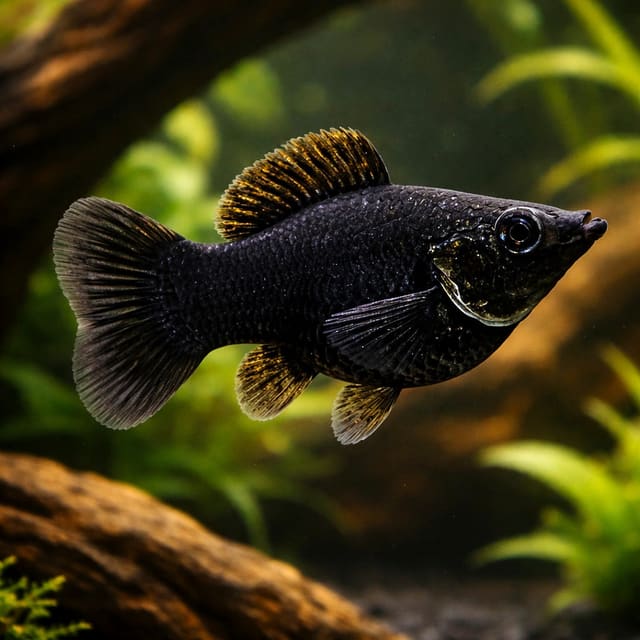
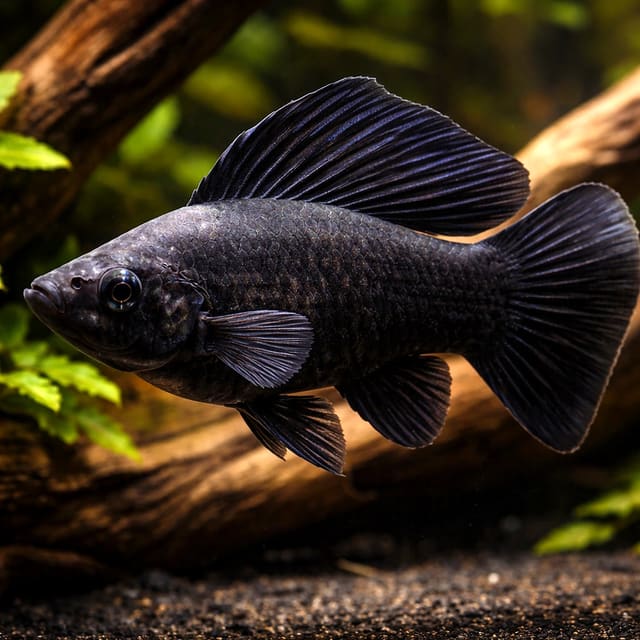
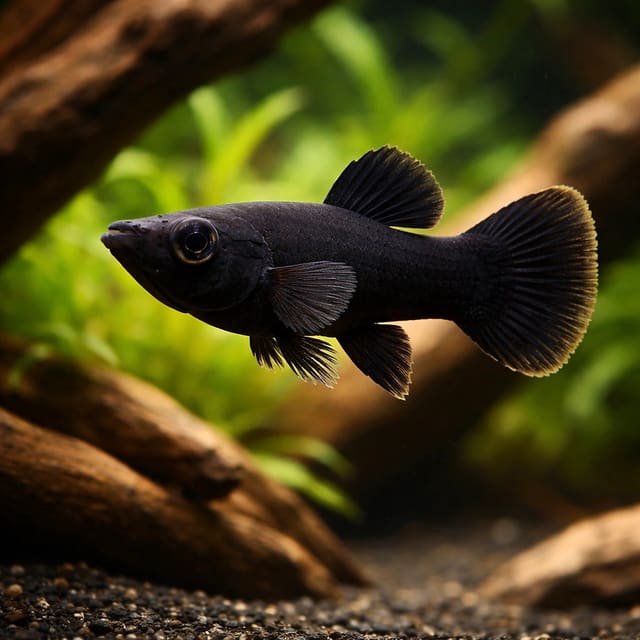
Black Molly (Poecilia sphenops black molly)
21–28°C · pH 7–8.5 · 81L
£3.99
The Sail-Fin Molly assorted lyra (Poecilia velifera) is a livebearing poeciliid from Mexico’s Yucatán–Quintana Roo and lower Usumacinta–Laguna de Términos systems that reaches 15 cm. It suits intermediate keepers who can provide around 104 litres; OATA suggests at least three mollies, while 25–28°C, pH 8.0 and 15–18 dGH are the overlap of FishBase, Seriously Fish and OATA. Sold individually in sizes from 4 - 5 cm to 6 - 7 cm.
Adult size is the maximum length this species reaches at full maturity (scientific sources). The livestock you receive will be younger and smaller — pick a size above for the actual shipping size. Product-photo provenance and any image-specific limitations are stated on the listing.
Poecilia velifera
Shoaling fish: kept in a group they feel safer, stay calmer and show their best colour.
The Sail-Fin Molly assorted lyra (Poecilia velifera) is a livebearing poeciliid from Mexico’s Yucatán–Quintana Roo and lower Usumacinta–Laguna de Términos systems that reaches 15 cm. It suits intermediate keepers who can provide around 104 litres; OATA suggests at least three mollies, while 25–28°C, pH 8.0 and 15–18 dGH are the overlap of FishBase, Seriously Fish and OATA. Sold individually in sizes from 4 - 5 cm to 6 - 7 cm.
Adult size is the maximum length this species reaches at full maturity (scientific sources). The livestock you receive will be younger and smaller — pick a size above for the actual shipping size. Product-photo provenance and any image-specific limitations are stated on the listing.
Maintain these water conditions for optimal health and vibrant colors
The Sail-Fin Molly assorted lyra (Poecilia velifera) is a colourful livebearing fish in the family Poeciliidae. FishBase places the species in Mexico’s Yucatán–Quintana Roo and lower Usumacinta–Laguna de Términos systems and records an adult maximum of 15 cm. This is a substantial molly rather than a small community fish, so it suits a keeper prepared to plan the aquarium, filtration and companions around its full adult size.
We rate its care level as intermediate. The fish is peaceful in a suitable community, but its long-term care depends on hard, basic water and rigorous water quality. It is a better match for a measured hard-water aquarium than for a general tropical mixture assembled around soft or acidic conditions.
The routine water values are the overlap of FishBase’s recorded environment, the aquarium range in the Seriously Fish profile and OATA’s molly guidance. OATA’s figures are broad group guidance, not a species-specific optimum. Holding the aquarium within the overlap gives a clear target that respects the hard, alkaline conditions identified for this fish.
Seriously Fish describes a heavily planted aquarium with floating cover and open swimming areas. That combination matters: plants provide shelter and visual structure, while open water leaves room for normal movement and display. Use smooth, fish-safe décor around the long fins, and avoid crowding the open swimming area with ornaments.
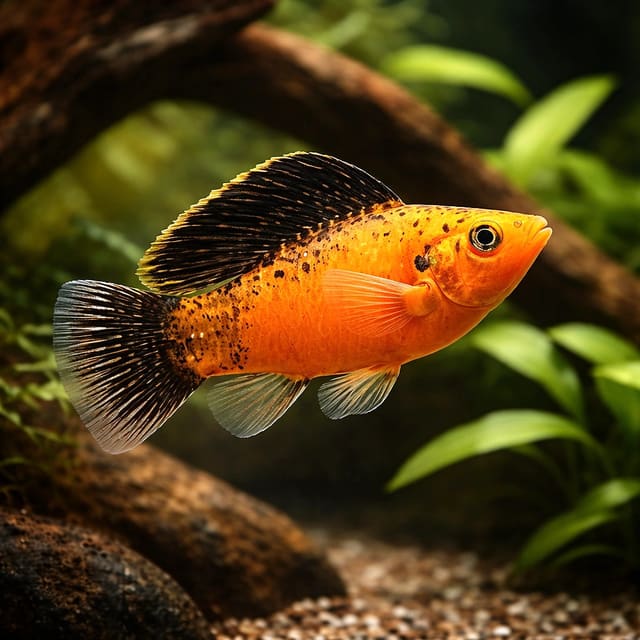
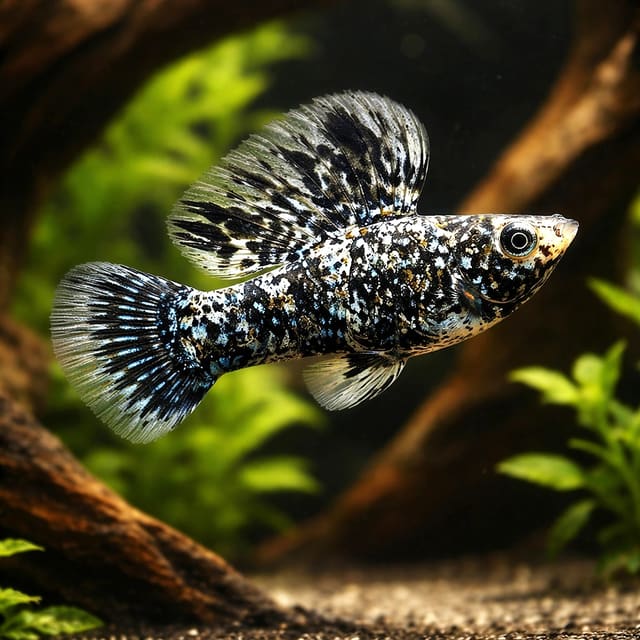
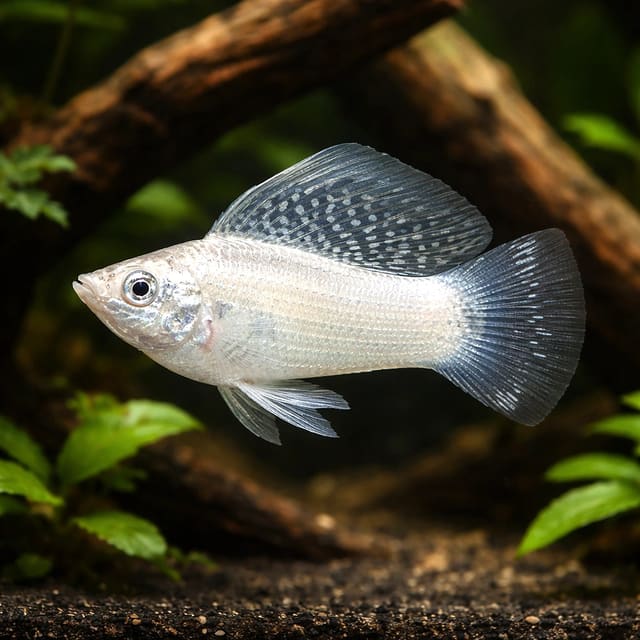
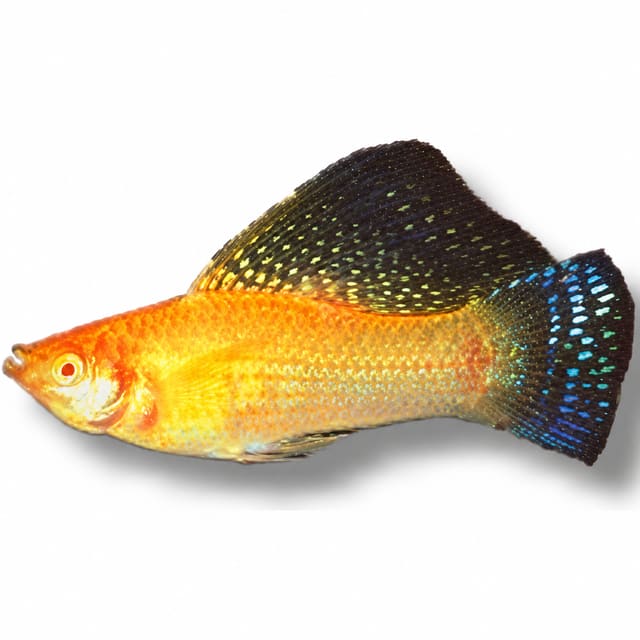
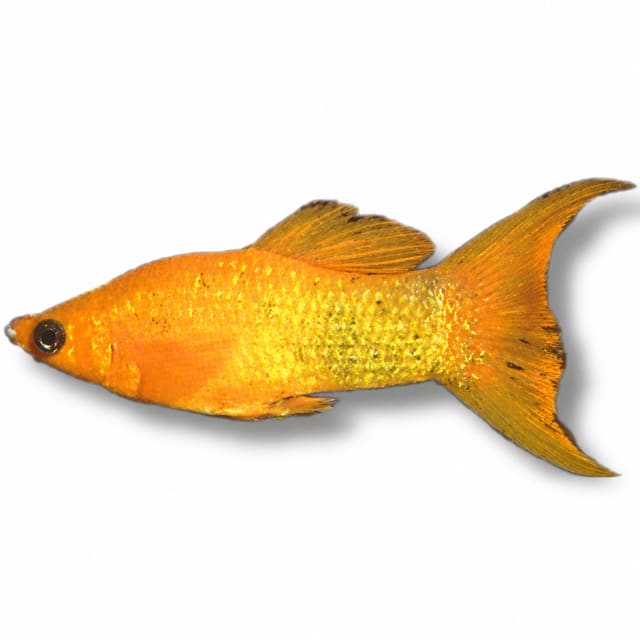
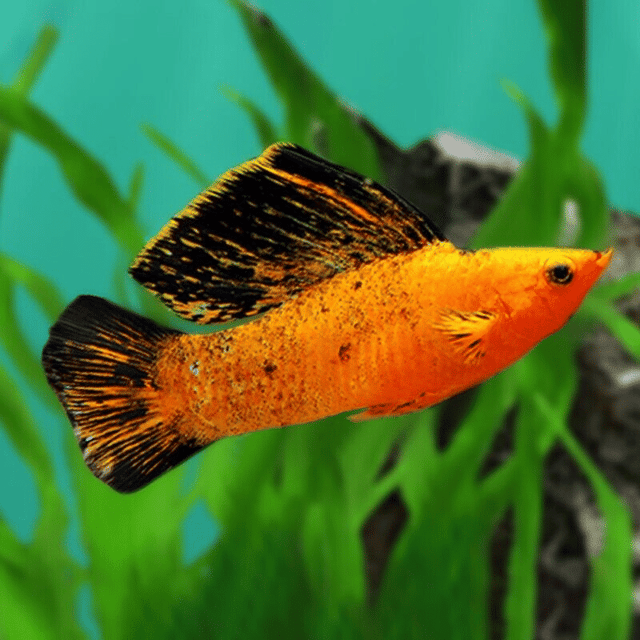
This variety combines the sail-like dorsal profile associated with the species and elongated lyre-shaped tail tips. Assorted colouring means individual markings can differ, so choose it for its form, care requirements and community role rather than expecting one fixed colour pattern.
One purchase supplies one live fish. The live size selector shows 4 - 5 cm and 6 - 7 cm; use it to choose the dispatch size that fits your established stocking plan. The size you select is the size supplied, not the adult size. Both grades must be housed for the same 15 cm adult plan from the start, including the 91 × 38 cm footprint and approximately 104-litre volume.
Sex is guaranteed only when the selected option explicitly states male or female. This Sail-Fin Molly assorted lyra listing has no sex-guaranteed option. Do not build a precise male-to-female group ratio around colour, body size or the gallery; establish the sex of each fish before relying on OATA’s suggested two-female-to-one-male arrangement.
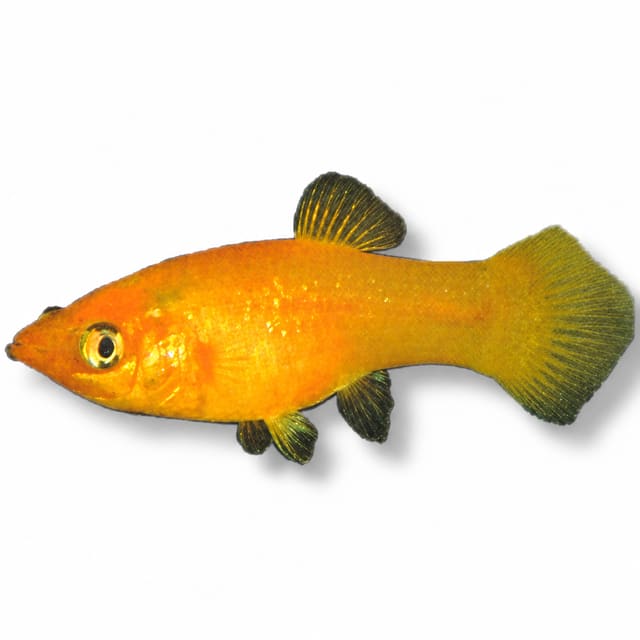
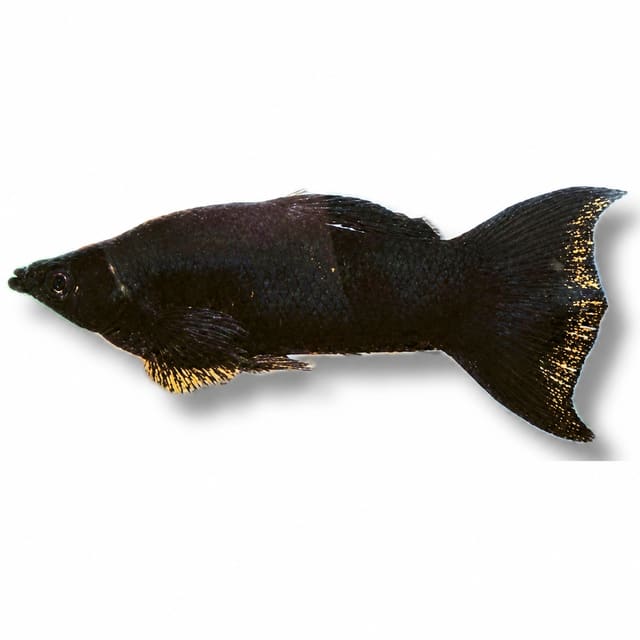
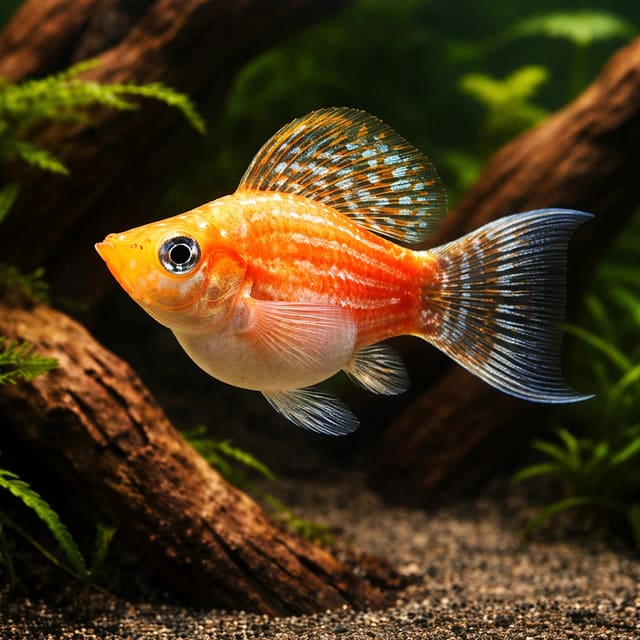
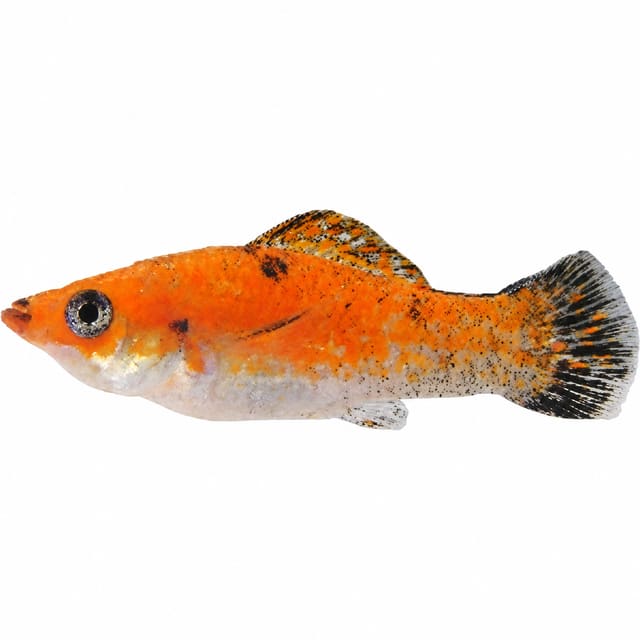
The gallery images are representative of this type of animal rather than photographs of the exact animal supplied, so colours can look slightly different from the live animal. The gallery shows two fish to illustrate assorted colour and form, while the purchase unit remains one animal. Browse the molly fish collection separately when comparing other molly types.
| Suits | Not suited to |
|---|---|
| A hard, basic freshwater aquarium | Soft or acidic aquarium water |
| A 91 × 38 cm base planned around approximately 104 litres | A small aquarium that restricts swimming or dorsal-fin development |
| A planted layout with floating cover and open water | An overcrowded layout with little open swimming room |
| Companions that tolerate the same hard water | Timid fish species |
| A keeper able to test water and maintain it rigorously | A lightly monitored aquarium with unstable water quality |
The intermediate rating reflects the combination of adult size, hard-water requirement and sensitivity to declining conditions. Seriously Fish notes that this species is more difficult to maintain than some other mollies and that water quality must be maintained rigorously, particularly for full dorsal-fin development. The work is straightforward when it is scheduled, but it must be consistent.
Before choosing a dispatch size, check the aquarium’s measured temperature, pH, hardness, usable footprint and existing stock. A smaller fish does not reduce its eventual space requirement, and adding several fish together increases the biological load immediately. Select the grade only after the adult stocking calculation works.
Plan for an adult length of 15 cm. FishBase records 15 cm total length, while Seriously Fish uses 15 cm standard length in its aquarium plan. The same 15 cm figure is therefore the practical adult reference throughout this guide.
Use an aquarium base of 91 × 38 cm and plan around approximately 104 litres. Seriously Fish pairs that footprint and volume with the species’ 15 cm length. FishBase records a minimum aquarium length of 60 cm, while OATA recommends at least 80 litres for sailfin mollies; the larger species plan gives more useful swimming room and environmental stability.
Treat approximately 104 litres as the starting planning volume, not a complete stocking allowance. Other fish, décor and the number of mollies all affect usable space and waste production. Seriously Fish recommends making the aquarium as large as possible, and OATA notes that larger aquariums offer more stable temperature and water quality.
| Area | Purpose |
|---|---|
| Open water | Leaves uninterrupted room for swimming and display |
| Planted zones | Provide cover and visual breaks |
| Floating cover | Adds shelter without filling the swimming footprint |
| Smooth substrate and décor | Reduces the chance of long fins catching on sharp surfaces |
Seriously Fish warns that small or overcrowded aquariums may impair development of the male’s large dorsal fin. Stock sensibly and preserve open water rather than filling every part of the footprint. OATA recommends gravel or sand with live plants; plastic plants and suitable ornaments can provide shelter when live plants are not used, but long fins make smooth edges important.
Assess the finished interior, not only the aquarium’s external dimensions. Dense wood, large rocks or oversized ornaments reduce the water and swimming space the fish can use. Place taller cover towards the back or ends where practical, then leave a broad route through the middle.
Review the layout whenever plants grow densely or the stock changes. Trim or reposition cover if open water disappears, and do not compensate for a crowded footprint by relying on filtration alone. A strong filter deals with waste, but it does not create swimming room.
Keep the aquarium at 25–28°C, pH 8.0 and 15–18 dGH. These routine values are the overlap of FishBase’s recorded environment, Seriously Fish aquarium guidance and OATA’s molly range. Use the water chemistry guide to understand each measurement, then compare your readings with the target through the water matcher.
Seriously Fish states that this species must be maintained in moderately hard or harder water with a basic pH. In soft or acidic water, it may weaken rapidly; reported warning signs include shimmying, fungus and clamped fins. Treat those signs as reasons to test the aquarium immediately rather than changing several conditions without measurements.
Salt is not necessary. Seriously Fish identifies calcium and magnesium—the minerals represented by hardness—as crucial to long-term health. Do not use salt as a substitute for appropriate general hardness or as a routine response to a low reading.
Test at least weekly and record the result so gradual movement is visible. A single acceptable result does not show whether pH or hardness is drifting between maintenance days. Compare readings taken at similar points in the routine, such as before the weekly water change, to make the pattern easier to interpret.
When a reading falls outside the target, first check the test method, replacement water and recent changes to the aquarium. Correct the cause steadily while keeping ammonia and nitrite at zero. Avoid abrupt, unmeasured changes, because the objective is a stable hard-water environment rather than a brief perfect reading.
Screen every future companion against the same water values. A fish described broadly as tropical is not automatically appropriate at pH 8.0 and 15–18 dGH. The companion must remain healthy across the whole shared range, not merely tolerate one end for a short period.
Use a mature, well-maintained biological filter before introducing this fish. The RSPCA explains that fish release toxic ammonia, which beneficial filter bacteria convert first to toxic nitrite and then to safer nitrate. OATA therefore requires ammonia and nitrite readings of zero before fish are added.
If this is a new setup, follow the first tropical aquarium guide and confirm the filter is processing waste before committing to livestock. Clear water alone is not proof that biological filtration is ready; use water tests.
For the approximately 104-litre plan, Seriously Fish recommends turnover of four to five times the aquarium volume each hour. That corresponds to a filter rating of about 415–520 litres per hour. Check the manufacturer’s stated flow, then account for the fact that filter media and normal use can affect actual circulation.
Arrange the outlet so water circulates through the aquarium without removing every calm area. The purpose is to carry waste towards the filter and keep oxygenated water moving through the biological media while preserving usable swimming and cover.
OATA warns that beneficial bacteria need to increase whenever more fish are added and feeding rises. Adding too many fish too quickly can cause new tank syndrome, in which the filter cannot process the increased waste and ammonia or nitrite rises to harmful levels.
A filter cannot compensate for overcrowding. It supports water quality, while the 91 × 38 cm footprint and approximately 104-litre plan provide the physical room this 15 cm fish needs. Both parts of the plan must work together.
Seriously Fish suggests roughly 100–150 W of heating for an aquarium of this size when the room is around 20°C. Select equipment by the aquarium volume, room conditions and manufacturer’s operating guidance, then verify the result with an aquarium thermometer rather than relying on the heater dial alone.
Feed once daily, offering only what the fish can eat within a few minutes. Remove the cause of recurring leftovers by reducing the next portion; uneaten food breaks down and adds toxic waste to the aquarium.
FishBase records wild adults eating worms, crustaceans, insects and plant matter. Seriously Fish also describes the species as omnivorous, feeding on zoobenthos and detritus, and recommends including vegetable matter. The aquarium diet should therefore combine a quality dried food with plant-based material and suitable live or frozen foods.
| Food type | How it fits |
|---|---|
| Quality flake or granule | Provides a practical regular dried food |
| Algae-based or vegetable flake | Supplies the vegetable component |
| Blanched spinach or cucumber | Adds vegetable variety named by Seriously Fish |
| Daphnia, small bloodworm or tubifex | Adds live or frozen animal foods named by OATA |
Use foods that are appropriately sized for the fish’s mouth and monitor whether every fish reaches the food. A group can contain quicker and slower feeders, so observe distribution during the few-minute feeding period rather than judging the portion only by how fast the first fish eats.
OATA’s molly feeding schedule is one controlled meal per day. Variety does not mean adding several full portions at one sitting. Rotate suitable foods across meals while keeping the total daily amount within what the fish finish promptly.
A healthy feeding response is useful daily information. Reduced intake or a lack of interest in food is one of OATA’s warning signs, especially when it appears alongside altered swimming, breathing, colour or body condition. Check the water if feeding behaviour changes.
Do not try to restore appetite simply by adding more food. Extra leftovers increase the load on the filter and can make a water-quality problem worse. Test ammonia, nitrite, nitrate, temperature and pH, check the fish’s other signs, and correct husbandry problems before returning to the normal portion.
Keep the feeding plan compatible with the community. Seriously Fish accepts most live, frozen and dried foods for this species, but every companion must also be able to feed without conflict and remain suited to the same hard-water conditions.
Carry out a 25% partial water change at least once every week. OATA recommends using a siphon to remove solid waste from the substrate, treating replacement water with conditioner before adding it, and testing the aquarium at least weekly.
Keep the 25% volume consistent and complete the change at least once every week. Additional maintenance may be needed when testing or visible waste shows a problem, but do not turn routine water changes into an excuse to overstock or overfeed.
Do not run filter media under the tap. OATA warns that chlorine or chloramine may kill the beneficial bacterial population established in the media. When cleaning is needed, rinse the media lightly in aquarium water removed during the partial water change.
Clean only as much as needed to restore flow and remove blockages. The objective is to preserve the bacterial population while maintaining circulation. A filter that looks visually spotless is not more valuable than one that continues to process ammonia and nitrite effectively.
| Observation | Action |
|---|---|
| Ammonia or nitrite above zero | Pause further stocking, test again and correct the waste-processing problem |
| Nitrate rising beyond the OATA limit | Review water changes, waste removal, feeding and stock load |
| Flow has weakened | Check for blockage and rinse media in removed aquarium water if needed |
| pH or hardness is drifting | Compare replacement and aquarium water before making measured corrections |
Consistency is especially important for this molly because Seriously Fish links soft or acidic conditions with rapid weakening and identifies rigorous water quality as essential. The weekly routine should prevent deterioration rather than wait for the fish to display obvious distress.
Prepare the established aquarium before the parcel arrives: confirm 25–28°C, pH 8.0, 15–18 dGH, zero ammonia and zero nitrite. Be present to receive the fish, because a live-animal parcel cannot be left unattended.
Keep the video with the order details. The continuous unboxing video is required for a Live Arrival Guarantee claim, and the parcel must be opened and inspected on the same day it arrives. Read the current delivery and Live Arrival Guarantee policy before the delivery date.
The fish is packed in an oxygenated bag inside an insulated box, with a heat pack when the weather calls for it. Those measures protect the journey, but the aquarium still needs to be fully prepared before release.
OATA advises checking that ammonia and nitrite are zero before adding fish and increasing the aquarium population slowly. Complete those checks before the parcel arrives rather than trying to make the filter ready while the fish is waiting in its bag.
After release, observe swimming, breathing, posture and the response of existing fish. The new arrival changes the biological load, so continue testing ammonia and nitrite as the filter bacteria adjust to the increase in waste and feeding.
Do not add several unrelated livestock groups at the same time. Gradual stocking makes it easier for the biological filter to adjust and helps you identify which change preceded a water-quality or behavioural problem.
Keep the first observations factual. Note whether the fish swims normally, holds its fins naturally and breathes at its usual rate. If something changes, test the aquarium before altering several conditions at once.
Check the fish every day for changes in swimming, colour, temperament, breathing, appearance, body condition and feeding. OATA identifies these categories as practical early warnings, and a change from the fish’s normal pattern matters more than a brief isolated movement.
| Change you see | First response |
|---|---|
| Hanging at the surface, sitting on the bottom or erratic swimming | Test temperature, ammonia, nitrite and the full water range |
| Faster or slower gill-cover movement | Check water quality and filter circulation |
| Darker or paler colour | Look for other behavioural, water or compatibility changes |
| Clamped or damaged fins | Test pH and hardness and inspect décor and tank-mate behaviour |
| White spots, fluffy growths, ulcers or bumps | Record the appearance and check all water readings |
| Reduced feeding or changing body condition | Check water quality, portion size and access to food |
Seriously Fish specifically associates shimmying, fungus and clamped fins with weakening in soft or acidic conditions. If any of these appear, measure pH and general hardness immediately alongside ammonia, nitrite and temperature.
Do not assume every problem is a disease or begin an unplanned treatment before checking the environment. Several husbandry failures can produce overlapping signs, while an unnecessary change can make the pattern harder to interpret.
If the fish’s health concerns you, test the water and contact us with the readings, observations and timeline. Clear details make it easier to distinguish a water-quality problem, compatibility pressure or a change requiring further attention.
Continue normal observation after conditions improve. Stable readings and a return to ordinary swimming, breathing and feeding provide a more useful picture than appearance alone.
Keep this molly only with species that tolerate hard water. Seriously Fish describes it as peaceful in a community aquarium, but OATA says sailfin mollies should not be kept with timid fish species. Avoid other mollies because they may crossbreed.
A named companion is not an automatic approval. Confirm that the particular species can live long term at 25–28°C, pH 8.0 and 15–18 dGH, then assess adult size, behaviour, feeding and available space. The water match is the first gate because this molly should not be moved into softer or more acidic conditions to suit another fish.
| Compatibility decision | How to apply it |
|---|---|
| Suitable after screening | Swordtails or platies, some gouramis, and hardy corydoras or loricariids that tolerate the same hard water |
| Requires individual screening | Some barbs and tetras, because only suitable hard-water species should be considered |
| Brackish possibility | Chromides or gobies in a properly matched brackish setup |
| Avoid | Other mollies and timid fish species |
Do not move an avoid into a trial category. Other mollies remain an avoid because of crossbreeding, and timid fish remain an avoid because OATA’s instruction applies directly to sailfin mollies.
Peaceful does not mean suitable for every community. The hard-water requirement, adult size and OATA restriction on timid fish narrow the sensible choices. Some barbs and tetras may fit, but the individual species must pass the water and behaviour screen.
For a stocking assessment, ask us with the aquarium dimensions, volume, measured water values, filtration and complete species list. Those details allow the plan to be judged as one community rather than as isolated pairings.
OATA suggests keeping at least three guppies or mollies because they require some companionship. Its recommended arrangement is two females to each male to reduce stress on females and other aquarium inhabitants, with larger groups added in the same ratio.
Use that as the social planning rule only where the sexes are known. Never infer sex from dispatch size, colour or a gallery image. A planned group must also fit the 91 × 38 cm footprint and approximately 104-litre starting volume without crowding.
Do not use a smaller dispatch grade as permission to postpone the adult stocking calculation. Several young fish can still increase waste quickly, and each one develops towards the same adult plan.
Seriously Fish describes males as vigorous in their pursuit of mates and also recommends two females to one male. Cover and visual breaks can help structure the aquarium, but they do not replace the correct space and social assessment.
This fish is a livebearer. Reproduction can increase the aquarium population, so continue checking stocking density and biological load rather than treating the starting number as fixed. The fish’s adult space and water-quality requirements still apply if the population changes.
Other mollies remain unsuitable companions because they may crossbreed. Swordtails and platies are named as good choices by Seriously Fish when they tolerate the same hard water, but their adult space, behaviour and feeding needs must still be included in the complete plan.
Observe whether any fish hides more than normal, changes aggression level, develops damaged fins or loses access to food. OATA lists changes in temperament, swimming and feeding among the signs that should prompt closer checking.
If group behaviour changes, test the water and review space, cover, sex ratio and recent additions together. Avoid solving a stocking problem by adding more fish unless the complete social and capacity calculation supports it.
It reaches 15 cm as an adult. Plan for that full size from the start; FishBase records 15 cm total length, and Seriously Fish also uses 15 cm standard length for aquarium planning.
Plan around a 91 × 38 cm base and approximately 104 litres for this 15 cm fish. Seriously Fish gives those aquarium dimensions, while FishBase records a minimum aquarium length of 60 cm; use the larger plan.
OATA’s group-level molly guidance suggests at least three, arranged as two females to each male where sexes are known. Increase the group only when the aquarium, filtration and adult stocking plan support it.
We rate it intermediate because it reaches 15 cm, requires hard, basic water and needs rigorous water quality. Although OATA describes most mollies as easy, Seriously Fish identifies this species as more difficult than others in the genus.
Feed a quality dried food with algae-based or vegetable foods and suitable live or frozen items such as daphnia, small bloodworm or tubifex. OATA’s molly guidance says to feed once daily and only what is eaten within a few minutes.
Keep it at 25–28°C, pH 8.0 and 15–18 dGH. These values are the overlap of FishBase’s recorded environment, Seriously Fish aquarium guidance and OATA’s molly range.
Seriously Fish describes it as peaceful in a community aquarium. OATA says sailfin mollies should not be kept with timid fish, so choose robust, peaceful companions that tolerate the same hard water and observe behaviour after stocking changes.
Seriously Fish names swordtails, platies, some gouramis, hardy corydoras or loricariids, and some barbs or tetras, provided the species tolerates hard water. Avoid other mollies because they may crossbreed, and avoid timid fish species.
Start filming the sealed parcel before opening it, with the outer box visible. Continue in one take until the fish is shown inside the sealed bag, then float the bag for 20–30 minutes before release. It is packed in an oxygenated bag inside an insulated box, with a heat pack when the weather calls for it.
No reviews for this item yet. Bought one? Honest reviews only, good or bad.
What customers say about ordering from us
Easy website plenty of info on fish your buying great to pick a time slot
TRACEY DURRANT · 7 Oct 2026
Got some lovely fish thank you
Kevin Mackie · 7 Oct 2026
Reviews of our shop, collected by Judge.me, an independent third-party review collector. Newest first.